Spin models from nonlinear cellular automata
Pith reviewed 2026-05-22 22:52 UTC · model grok-4.3
The pith
Nonlinear cellular automata rules produce frustrated spin models whose quantum versions exhibit order-by-disorder and first-order phase transitions to paramagnets.
A machine-rendered reading of the paper's core claim, the machinery that carries it, and where it could break.
Core claim
the nonlinearity of the CA rule leads to a quantum order-by-disorder mechanism, which selects a particular (rule-dependent) spatial structure for small transverse fields, with spontaneous breaking of the translation symmetry in some cases
Load-bearing premise
The mapping from nonlinear CA trajectories to the ground states of the classical spin models is exact and that the observed order-by-disorder and first-order transition arise specifically from the nonlinearity rather than from other modeling choices (abstract, paragraph on classical models and quantum fluctuations).
Figures




read the original abstract
We study classical and quantum spin models derived from one-dimensional cellular automata (CA) with nonlinear update rules, focusing on rules 30, 54 and 201. We argue that the classical models, defined such that their ground states correspond to allowed trajectories of the CA, are frustrated and can be described in terms of local defect variables. Including quantum fluctuations through the addition of a transverse field, we study their ground state phase diagram and quantum phase transitions. We show that the nonlinearity of the CA rule leads to a quantum order-by-disorder mechanism, which selects a particular (rule-dependent) spatial structure for small transverse fields, with spontaneous breaking of the translation symmetry in some cases. Using numerical results for larger fields, we also observe a first-order quantum phase transition into a quantum paramagnet, as in previous studies of spin models based on linear CA rules.
Editorial analysis
A structured set of objections, weighed in public.
Referee Report
Summary. The manuscript constructs classical spin models from nonlinear 1D cellular automata (rules 30, 54, 201) whose ground states are defined to correspond exactly to allowed CA trajectories; these models are frustrated and analyzed via local defect variables. Adding a transverse field, the authors report that nonlinearity induces a quantum order-by-disorder mechanism that selects rule-dependent spatial structures (with spontaneous translation-symmetry breaking in some cases) at small fields, followed by a first-order transition to a quantum paramagnet at larger fields, consistent with prior linear-CA studies.
Significance. If the exact ground-state correspondence holds, the work supplies a new family of frustrated spin models whose quantum phase diagrams can be tuned by CA nonlinearity, offering concrete examples of order-by-disorder selection and first-order quantum transitions that extend existing linear-CA constructions. Reproducible numerical data on the phase diagram would strengthen its utility for the community.
major comments (2)
- [Classical models section] § on classical models (definition of Hamiltonians via defect variables): the central claim that ground states correspond exactly to allowed CA trajectories (and therefore that order-by-disorder can be attributed specifically to nonlinearity) requires an explicit proof or exhaustive check that no lower-energy configurations exist outside the allowed trajectories; the abstract states the models are 'defined such that' this holds, but any gap in the correspondence would undermine the attribution.
- [Quantum phase diagram and numerical results] Numerical results on order-by-disorder and first-order transition: the reported selection of rule-dependent structures and the first-order character of the transition to the paramagnet must be supported by finite-size scaling, error bars, and explicit exclusion of other candidate phases; without these, the load-bearing claim that nonlinearity (rather than the defect encoding) drives the observed selection cannot be verified.
minor comments (2)
- [Classical models] Notation for defect variables and the precise form of the classical Hamiltonian should be introduced with an equation number and a short table of allowed local configurations for each rule.
- [Figures] Figure captions for the phase diagrams should state the system sizes, boundary conditions, and observable used to detect translation-symmetry breaking.
Axiom & Free-Parameter Ledger
Lean theorems connected to this paper
-
IndisputableMonolith/Foundation/RealityFromDistinction.leanreality_from_one_distinction unclear?
unclearRelation between the paper passage and the cited Recognition theorem.
We study classical and quantum spin models derived from one-dimensional cellular automata (CA) with nonlinear update rules... the nonlinearity of the CA rule leads to a quantum order-by-disorder mechanism
-
IndisputableMonolith/Cost/FunctionalEquation.leanwashburn_uniqueness_aczel unclear?
unclearRelation between the paper passage and the cited Recognition theorem.
E30 = −∑ d30(p,q,r,s) ... expressed as a sum of interactions corresponding to linear CA rules
What do these tags mean?
- matches
- The paper's claim is directly supported by a theorem in the formal canon.
- supports
- The theorem supports part of the paper's argument, but the paper may add assumptions or extra steps.
- extends
- The paper goes beyond the formal theorem; the theorem is a base layer rather than the whole result.
- uses
- The paper appears to rely on the theorem as machinery.
- contradicts
- The paper's claim conflicts with a theorem or certificate in the canon.
- unclear
- Pith found a possible connection, but the passage is too broad, indirect, or ambiguous to say the theorem truly supports the claim.
Reference graph
Works this paper leans on
-
[1]
The indexµ refers to the ground state degeneracy
Degenerate perturbation theory Consider a Hamiltonian, H = H0 + hH1, where H0 has de- generate ground states labeled by µ, i.e., H0 |gµ ⟩ = E0 |gµ ⟩, and H1 is the perturbing potential with h much smaller than the energy gap of the system. The indexµ refers to the ground state degeneracy. The projector P projects onto the ground state manifold, so that H0...
-
[2]
We start with Rule 201 and the system size L × M = 4 × 4
Rule 201 Let us now study the specific cases of Rules 30, 54 and 201 in turn. We start with Rule 201 and the system size L × M = 4 × 4. There are 13 classical ground states of the model for this system size, of which the 4 representatives (up to translations) are shown in Fig. 2. As noted above, an in- finitesimal transverse field splits the classical gro...
-
[3]
Rule 54 We now considerH54, starting with a 4×2 system size [71]. A small transverse field again gives nontrivial corrections to the classical ground states to second order in perturbation the- ory. There are 5 ground states in this case, whose 2 represen- tatives are shown in Fig. 3. Their energy corrections are E(2) 54,(a) = D g(a) H(2) eff,54 g(a) E = ...
-
[4]
Rule 30 Finally, we discuss H30. For this CA rule, we conjecture (but do not have a proof [72]) that there is a single configu- ration compatible with PBC for any odd L and three for any even L. For the 4 × 8 system size shown in Fig. 5, we find E(2) 30,(a) = D g(a) H(2) eff,30 g(a) E = −17N 96J E(2) 30,(b) = D g(b) H(2) eff,30 g(b) E = − 3N 16J E(2) 30,(...
-
[5]
Comparison of nonlinear rules Finally, we summarize the common features of perturbation theory for these three models and the differences. All models show a splitting of their energy eigenvalues to second order in degenerate perturbation theory. All the off-diagonal entries of this matrix are zero to this order. The classical ground states are not connect...
-
[6]
Expectation values Figure 7 shows our results for the quantum Rule 30. Pan- els (a) and (c) show the transverse magnetization per site, Mx = 1 N ∑r Xr, as a function of h/J for square systems L × L and PBC from ED, from numerical MPS, and square and rect- angular system sizes for ctQMC simulations and for rectan- gular strip geometries, respectively. Pane...
-
[7]
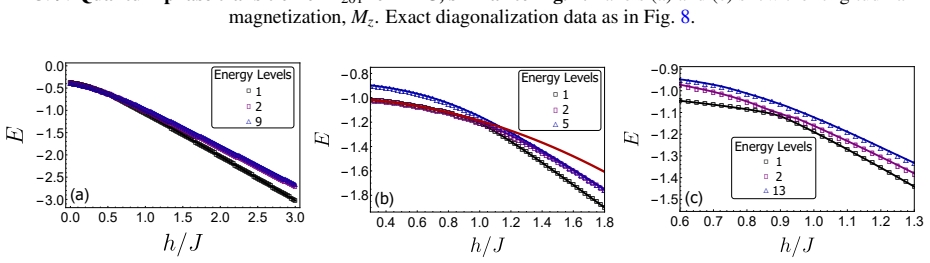
Low-lying spectra Figures 10–12 show the low-lying spectra of these models for small system sizes calculated via ED. Our goal in these figures is to show signatures of the formation of an avoided crossing, a characteristic of first-order quantum phase transi- tions [84]. At the same time, we want to show the classical ground state degeneracy (if any) for ...
work page 2018
-
[8]
R. Liebmann, Statistical Mechanics of Periodic Frustrated Ising Systems, Lecture Notes in Physics (Springer, 1986)
work page 1986
-
[9]
H. T. Diep, Frustrated Spin Systems, 3rd ed. (WORLD SCIEN- TIFIC, 2020)
work page 2020
-
[10]
C. Lacroix, P. Mendels, and F. Mila, eds., Introduction to Frus- trated Magnetism: Materials, Experiments, Theory , Springer Series in Solid-State Sciences, V ol. 164 (Springer, 2011)
work page 2011
-
[11]
U. Schollwöck, J. Richter, D. J. J. Farnell, and a. F. Bishop, eds., Quantum Magnetism, Lecture Notes in Physics (Springer, 2004)
work page 2004
-
[12]
R. Moessner and A. P. Ramirez, Geometrical frustration, Phys. Today 59, 24 (2006)
work page 2006
-
[13]
G. H. Wannier, Antiferromagnetism. The Triangular Ising Net, Phys. Rev. 79, 357 (1950)
work page 1950
-
[14]
Yoshimori, A new type of antiferromagnetic structure in the rutile type crystal, J
A. Yoshimori, A new type of antiferromagnetic structure in the rutile type crystal, J. Phys. Soc. J. 14, 807 (1959)
work page 1959
-
[15]
R. J. Elliott, Phenomenological discussion of magnetic ordering in the heavy rare-earth metals, Phys. Rev. 124, 346 (1961)
work page 1961
-
[16]
T. A. Kaplan, Some effects of anisotropy on spiral spin- configurations with application to rare-earth metals, Phys. Rev. 124, 329 (1961)
work page 1961
-
[17]
J. Villain, R. Bidaux, J.-P. Carton, and R. Conte, Order as an effect of disorder, J. Physique 41, 1263 (1980)
work page 1980
-
[18]
C. L. Henley, Ordering by disorder: Ground-state selection in fcc vector antiferromagnets, J. Appl. Phys. 61, 3962 (1987)
work page 1987
-
[20]
Chubukov, Order from disorder in a kagomé antiferromag- net, Phys
A. Chubukov, Order from disorder in a kagomé antiferromag- net, Phys. Rev. Lett. 69, 832 (1992)
work page 1992
-
[21]
J. T. Chalker, P. C. W. Holdsworth, and E. F. Shender, Hid- den order in a frustrated system: Properties of the Heisenberg Kagomé antiferromagnet, Phys. Rev. Lett. 68, 855 (1992)
work page 1992
-
[22]
R. Moessner and S. L. Sondhi, Ising models of quantum frus- tration, Phys. Rev. B 63, 224401 (2001)
work page 2001
-
[23]
Moessner, Magnets with strong geometric frustration, Can
R. Moessner, Magnets with strong geometric frustration, Can. J. Phys. 79, 1283 (2001)
work page 2001
-
[24]
M. Powalski, K. Coester, R. Moessner, and K. P. Schmidt, Dis- order by disorder and flat bands in the kagome transverse field Ising model, Phys. Rev. B 87, 054404 (2013)
work page 2013
-
[25]
P. Narasimhan, S. Humeniuk, A. Roy, and V . Drouin-Touchette, Simulating the transverse-field Ising model on the kagome lat- tice using a programmable quantum annealer, Phys. Rev. B110, 054432 (2024)
work page 2024
-
[26]
R. Moessner and J. T. Chalker, Low-temperature properties of 13 classical geometrically frustrated antiferromagnets, Phys. Rev. B 58, 12049 (1998)
work page 1998
-
[27]
R. Moessner and J. T. Chalker, Properties of a Classical Spin Liquid: The Heisenberg Pyrochlore Antiferromagnet, Phys. Rev. Lett. 80, 2929 (1998)
work page 1998
-
[28]
L. Savary and L. Balents, Quantum spin liquids: a review, Rep. Prog. Phys. 80, 016502 (2016)
work page 2016
-
[29]
Y . Zhou, K. Kanoda, and T.-K. Ng, Quantum spin liquid states, Rev. Mod. Phys. 89, 025003 (2017)
work page 2017
-
[30]
J. Knolle and R. Moessner, A Field Guide to Spin Liquids, Ann. Rev. Condens. Matter Phys. 10, 451 (2019)
work page 2019
-
[31]
R. Moessner, S. L. Sondhi, and P. Chandra, Two-Dimensional Periodic Frustrated Ising Models in a Transverse Field, Phys. Rev. Lett. 84, 4457 (2000)
work page 2000
-
[32]
O. A. Starykh, Unusual ordered phases of highly frustrated magnets: a review, Rep. Prog. Phys. 78, 052502 (2015)
work page 2015
-
[33]
Y . I. Dublenych, Ground states of the Ising model on an anisotropic triangular lattice: stripes and zigzags, J. Phys.: Con- dens. Matter 25, 406003 (2013)
work page 2013
-
[34]
J. A. Koziol, M. Mühlhauser, and K. P. Schmidt, Order-by- disorder and long-range interactions in the antiferromagnetic transverse-field Ising model on the triangular lattice—A pertur- bative point of view, Res. Phys. 61, 107794 (2024)
work page 2024
-
[35]
Y . Han, Y . Shokef, A. M. Alsayed, P. Yunker, T. C. Luben- sky, and A. G. Yodh, Geometric frustration in buckled colloidal monolayers, Nature 456, 898 (2008)
work page 2008
-
[36]
Y . Shokef and T. C. Lubensky, Stripes, Zigzags, and Slow Dy- namics in Buckled Hard Spheres, Phys. Rev. Lett. 102, 048303 (2009)
work page 2009
- [37]
-
[38]
A. Duft, J. A. Koziol, P. Adelhardt, M. Mühlhauser, and K. P. Schmidt, Order-by-disorder in the antiferromagnetic J1−J2−J3 transverse-field Ising model on the ruby lattice, Phys. Rev. Res. 6, 033339 (2024)
work page 2024
-
[39]
S. N. Hearth, S. C. Morampudi, and C. R. Laumann, Quantum orders in the frustrated Ising model on the bathroom tile lattice, Phys. Rev. B 105, 195101 (2022)
work page 2022
-
[40]
H.-K. Wu, T. Suzuki, N. Kawashima, and W.-L. Tu, Pro- grammable order by disorder effect and underlying phases through dipolar quantum simulators, Phys. Rev. Res.6, 023297 (2024)
work page 2024
-
[41]
J. S. Gardner, M. J. P. Gingras, and J. E. Greedan, Magnetic pyrochlore oxides, Rev. Mod. Phys. 82, 53 (2010)
work page 2010
- [42]
-
[43]
D. Bergman, J. Alicea, E. Gull, S. Trebst, and L. Balents, Order- by-disorder and spiral spin-liquid in frustrated diamond-lattice antiferromagnets, Nat. Phys. 3, 487 (2007)
work page 2007
-
[44]
J.-S. Bernier, M. J. Lawler, and Y . B. Kim, Quantum Order by Disorder in Frustrated Diamond Lattice Antiferromagnets, Phys. Rev. Lett. 101, 047201 (2008)
work page 2008
-
[45]
C. L. Henley, Ordering due to disorder in a frustrated vector antiferromagnet, Phys. Rev. Lett. 62, 2056 (1989)
work page 2056
- [46]
-
[47]
S. V . Isakov and R. Moessner, Interplay of quantum and thermal fluctuations in a frustrated magnet, Phys. Rev. B 68, 104409 (2003)
work page 2003
-
[48]
B. Danu, G. Nambiar, and R. Ganesh, Extended degeneracy and order by disorder in the square lattice J1 − J2 − J3 model, Phys. Rev. B 94, 094438 (2016)
work page 2016
-
[49]
J. G. Rau, P. A. McClarty, and R. Moessner, Pseudo-Goldstone Gaps and Order-by-Quantum Disorder in Frustrated Magnets, Phys. Rev. Lett. 121, 237201 (2018)
work page 2018
- [50]
-
[51]
D. T. Stephen, O. Hart, and R. M. Nandkishore, Ergodicity Breaking Provably Robust to Arbitrary Perturbations, Phys. Rev. Lett. 132, 040401 (2024)
work page 2024
-
[52]
P. A. McClarty, M. Haque, A. Sen, and J. Richter, Disorder- free localization and many-body quantum scars from magnetic frustration, Phys. Rev. B 102, 224303 (2020)
work page 2020
-
[53]
C. J. Turner, A. A. Michailidis, D. A. Abanin, M. Serbyn, and Z. Papi´c, Weak ergodicity breaking from quantum many-body scars, Nat. Phys. 14, 745 (2018)
work page 2018
-
[54]
C. J. Turner, A. A. Michailidis, D. A. Abanin, M. Serbyn, and Z. Papi´c, Quantum scarred eigenstates in a Rydberg atom chain: Entanglement, breakdown of thermalization, and stability to perturbations, Phys. Rev. B 98, 155134 (2018)
work page 2018
-
[55]
D. Bluvstein, A. Omran, H. Levine, A. Keesling, G. Semeghini, S. Ebadi, T. T. Wang, A. A. Michailidis, N. Maskara, W. W. Ho, S. Choi, M. Serbyn, M. Greiner, V . Vuleti´c, and M. D. Lukin, Controlling quantum many-body dynamics in driven Rydberg atom arrays, Science 371, 1355 (2021)
work page 2021
-
[56]
S. Ebadi, T. T. Wang, H. Levine, A. Keesling, G. Semeghini, A. Omran, D. Bluvstein, R. Samajdar, H. Pichler, W. W. Ho, S. Choi, S. Sachdev, M. Greiner, V . Vuleti´c, and M. D. Lukin, Quantum phases of matter on a 256-atom programmable quan- tum simulator, Nature 595, 227 (2021)
work page 2021
-
[57]
G. Semeghini, H. Levine, A. Keesling, S. Ebadi, T. T. Wang, D. Bluvstein, R. Verresen, H. Pichler, M. Kalinowski, R. Sama- jdar, A. Omran, S. Sachdev, A. Vishwanath, M. Greiner, V . Vuleti´c, and M. D. Lukin, Probing topological spin liquids on a programmable quantum simulator, Science 374, 1242 (2021)
work page 2021
-
[58]
S. Ebadi, A. Keesling, M. Cain, T. T. Wang, H. Levine, D. Blu- vstein, G. Semeghini, A. Omran, J.-G. Liu, R. Samajdar, X.- Z. Luo, B. Nash, X. Gao, B. Barak, E. Farhi, S. Sachdev, N. Gemelke, L. Zhou, S. Choi, H. Pichler, S.-T. Wang, M. Greiner, V . Vuleti´c, and M. D. Lukin, Quantum optimiza- tion of maximum independent set using Rydberg atom arrays, Sci...
work page 2022
-
[59]
D. Bluvstein, H. Levine, G. Semeghini, T. T. Wang, S. Ebadi, M. Kalinowski, A. Keesling, N. Maskara, H. Pichler, M. Greiner, V . Vuleti´c, and M. D. Lukin, A quantum processor based on coherent transport of entangled atom arrays, Nature 604, 451 (2022)
work page 2022
-
[60]
K. Sfairopoulos, J. F. Mair, L. Causer, and J. P. Garrahan, Cellu- lar automata in d dimensions and ground states of spin models in (d + 1) dimensions, arXiv:2309.08059 (2023)
-
[61]
Wolfram, Statistical mechanics of cellular automata, Rev
S. Wolfram, Statistical mechanics of cellular automata, Rev. Mod. Phys. (1983)
work page 1983
- [62]
-
[63]
P.-Y . Louis and F. R. Nardi, eds., Probabilistic Cellular Au- tomata: Theory, Applications and Future Perspectives , Emer- gence, Complexity and Computation (Springer, 2018)
work page 2018
-
[64]
J. von Neumann and A. Taub, Collected Works. V ol. 5: De- sign of Computers, Theory of Automata and Numerical Analy- sis (Oxford, 1963)
work page 1963
-
[65]
Wolfram, A New Kind of Science (Wolfram Media, 2002)
S. Wolfram, A New Kind of Science (Wolfram Media, 2002)
work page 2002
-
[66]
K. Sfairopoulos, L. Causer, J. F. Mair, and J. P. Garrahan, Boundary conditions dependence of the phase transition in the 14 quantum Newman-Moore model, Phys. Rev. B 108, 174107 (2023)
work page 2023
-
[68]
M. Mézard and A. Montanari, Information, Physics, and Com- putation (Oxford University Press, 2009)
work page 2009
-
[69]
Auerbach, Interacting Electrons and Quantum Magnetism , edited by J
A. Auerbach, Interacting Electrons and Quantum Magnetism , edited by J. L. Birman, J. W. Lynn, M. P. Silverman, H. E. Stan- ley, and M. V oloshin, Graduate Texts in Contemporary Physics (Springer, New York, NY , 1994)
work page 1994
-
[70]
J. P. Garrahan and M. E. J. Newman, Glassiness and constrained dynamics of a short-range nondisordered spin model, Phys. Rev. E 62, 7670 (2000)
work page 2000
-
[71]
J. P. Garrahan, Glassiness through the emergence of effective dynamical constraints in interacting systems, J. Phys. Condens. Matter 14, 1571 (2002)
work page 2002
-
[72]
M. E. J. Newman and C. Moore, Glassy dynamics and aging in an exactly solvable spin model, Phys. Rev. E 60, 5068 (1999)
work page 1999
-
[73]
J. R. Schrieffer and P. A. Wolff, Relation between the Anderson and Kondo Hamiltonians, Phys. Rev. 149, 491 (1966)
work page 1966
- [74]
-
[75]
K. Slagle and Y . B. Kim, Fracton topological order from nearest-neighbor two-spin interactions and dualities, Phys. Rev. B 96, 165106 (2017)
work page 2017
-
[76]
J. J. Sakurai and J. Napolitano, Modern Quantum Mechanics , 3rd ed. (Cambridge University Press, 2020)
work page 2020
-
[77]
Note that for OBC the situation is drastically different and all models will acquire corrections to first order due to the freedom of selecting a number of spins of the last row, while also due to the update rule of the given CA itself. More precisely, a classi- cal ground state spin term on the east boundary will get updated according to the given CA rul...
-
[78]
Note that we start our study of Rule 54 from the system with size 4 × 2, while for Rule 201 we started from the 4× 4. This is because the system size 4×2 for Rule 201 leads to off-diagonal terms in the second order term of the degenerate perturbation theory. These cross-terms between the different ground states are observed only for small system sizes. In...
-
[79]
For extensive analyses of Rule 30, see [58]
-
[80]
A. W. Sandvik, Computational Studies of Quantum Spin Sys- tems, AIP Conf. Proc. 1297, 135 (2010)
work page 2010
-
[81]
Schollwöck, The density-matrix renormalization group in the age of matrix product states, Ann
U. Schollwöck, The density-matrix renormalization group in the age of matrix product states, Ann. Phys. 326 (2011)
work page 2011
-
[82]
E. Stoudenmire and S. R. White, Studying Two-Dimensional Systems with the Density Matrix Renormalization Group, Annu. Rev. Condens. Matt. Phys. 3, 111 (2012)
work page 2012
discussion (0)
Sign in with ORCID, Apple, or X to comment. Anyone can read and Pith papers without signing in.