Diversity Methods for Improving Convergence and Accuracy of Quantum Error Correction Decoders Through Hardware Emulation
Pith reviewed 2026-05-22 21:26 UTC · model grok-4.3
The pith
A diversity decoder combining BP instances at different quantization levels achieves BP+OSD accuracy with 30-80% speed gains.
A machine-rendered reading of the paper's core claim, the machinery that carries it, and where it could break.
Core claim
By running several belief propagation decoders in parallel, each using a distinct quantization level for its messages, the resulting diversity decoder corrects errors in quantum low-density parity-check codes more effectively than a single floating-point implementation of BP. On tested codes this yields logical error rates equivalent to those of BP+OSD but with substantially lower average and worst-case decoding times and far less frequent calls to ordered statistics post-processing.
What carries the argument
Diversity-based decoder that aggregates outputs from multiple finite-precision belief propagation decoders operating at chosen quantization levels.
If this is right
- Decoder performance can be guaranteed at logical error rates of 10^{-12} using the emulator.
- Post-processing algorithm activation drops from 47% to as low as 3.07%.
- Hardware finite-precision effects can guide improvements in software decoders for bivariate bicycle codes.
- The approach maintains accuracy while delivering 30% to 80% average speed improvements.
Where Pith is reading between the lines
- The stored uncorrectable error patterns could enable systematic design of better decoders beyond the current proposal.
- Extending the diversity method to other iterative decoding algorithms might yield similar gains in classical error correction.
- Actual hardware implementation of the diversity decoder could further reduce the latency between quantum measurements and corrections.
Load-bearing premise
The assumption that the outputs of BP decoders at different quantization levels can be combined in a way that improves overall performance without introducing systematic biases that would require extensive per-code adjustments.
What would settle it
Running the diversity decoder on additional QLDPC codes or under different noise models and finding that its logical error rate exceeds that of BP+OSD.
Figures


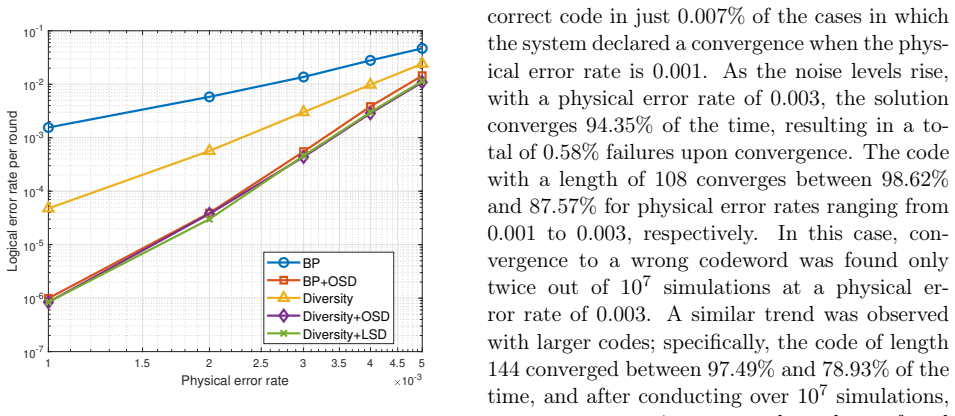

read the original abstract
As quantum computing moves toward fault-tolerant architectures, quantum error correction (QEC) decoder performance is increasingly critical for scalability. Understanding the impact of transitioning from floating-point software to finite-precision hardware is essential, as hardware decoder performance affects code distance, qubit requirements, and connectivity between quantum and classical control units. This paper introduces a hardware emulator to evaluate QEC decoders using real hardware instead of software models. The emulator can explore $10^{13}$ different error patterns in 20 days with a single FPGA device running at 150 MHz, guaranteeing the decoder's performance at logical rates of $10^{-12}$, the requirement for most quantum algorithms. In contrast, an optimized C++ software on an Intel Core i9 with 128 GB RAM would take over a year to achieve similar results. The emulator also enables the storage of uncorrectable error patterns that generate logical errors, allowing for offline analysis and the design of new decoders. Using results from the emulator, we propose a method that combines several belief propagation (BP) decoders with different quantization levels, which we define as a diversity-based decoder. Individually, these decoders may show subpar error correction, but together they outperform the floating-point version of BP for quantum low-density parity-check (QLDPC) codes like hypergraph or lifted product. Preliminary results with circuit-level noise and bivariate bicycle codes suggest that hardware insights can also improve software. Our diversity-based proposal achieves a similar logical error rate as the well-known approach, BP with ordered statistics (BP+OSD) decoding, with average speed improvements ranging from 30% to 80%, and 10% to 120% in worst-case scenarios, while reducing post-processing algorithm activation from 47% to 96.93%, maintaining the same accuracy.
Editorial analysis
A structured set of objections, weighed in public.
Referee Report
Summary. The paper introduces an FPGA-based hardware emulator for quantum error correction decoders that can explore 10^13 error patterns in 20 days at 150 MHz, far faster than software simulation. It proposes a diversity-based decoder that combines multiple belief propagation (BP) variants using different quantization levels; the claim is that this combination outperforms single floating-point BP on hypergraph and lifted-product QLDPC codes, matches the logical error rate of BP+OSD, delivers 30-80% average speed-ups (10-120% worst-case), and reduces post-processing activation from 47% to 96.93% while preserving accuracy. Preliminary circuit-level results on bivariate bicycle codes are also mentioned.
Significance. If the central performance claims hold without hidden per-code tuning, the work would be significant for practical fault-tolerant quantum computing: it demonstrates that finite-precision hardware emulation can both verify ultra-low logical error rates and inspire decoder improvements that reduce reliance on expensive post-processing while retaining accuracy. The emulator's scale (10^13 patterns) is a concrete technical strength for reproducible low-LER verification.
major comments (3)
- [Diversity decoder proposal section] The description of the diversity decoder provides no pseudocode, explicit fusion rule (e.g., syndrome logical-OR, majority vote on corrections, or iterative re-decoding), or definition of how outputs from the quantized BP instances are aggregated. This is load-bearing for the claim that the method matches BP+OSD accuracy while cutting OSD activation by up to 96.93%.
- [Results on hypergraph and lifted-product codes] No ablation is reported on the choice or search procedure for the quantization levels used in the BP variants. The outperformance over floating-point BP on hypergraph and lifted-product codes therefore cannot be distinguished from possible code-specific manual tuning, which would undermine the reported 30-80% speed gains.
- [Abstract and experimental results] Performance numbers in the abstract (speed-ups, OSD activation reduction, logical error rate parity with BP+OSD) are stated without error bars, number of trials, exact noise models, or statistical significance tests. This directly affects the soundness of the central comparison claim.
minor comments (2)
- [Emulator description] The abstract states that the emulator 'guarantees' performance at 10^{-12} logical rates, but the precise mapping from FPGA clock cycles to exhaustive coverage of all weight-w error patterns is not clarified.
- [Diversity decoder proposal section] Notation for the quantization levels (e.g., bit widths or scaling factors) is introduced without a table or explicit list of the values actually used in the reported experiments.
Simulated Author's Rebuttal
We thank the referee for their constructive feedback and for recognizing the scale of the FPGA emulator as a technical strength. We address each major comment below with clarifications and indicate the revisions that will be incorporated.
read point-by-point responses
-
Referee: [Diversity decoder proposal section] The description of the diversity decoder provides no pseudocode, explicit fusion rule (e.g., syndrome logical-OR, majority vote on corrections, or iterative re-decoding), or definition of how outputs from the quantized BP instances are aggregated. This is load-bearing for the claim that the method matches BP+OSD accuracy while cutting OSD activation by up to 96.93%.
Authors: We agree that the diversity decoder section would benefit from additional detail. In the revised manuscript we will insert pseudocode for the full diversity procedure and explicitly state the aggregation rule: the final correction is the first candidate (in a fixed order of the quantized instances) that satisfies the input syndrome; if none does, the output of the highest-precision instance is used and post-processing is triggered. This rule was used for all reported experiments and will be documented to support reproducibility of the accuracy and OSD-activation claims. revision: yes
-
Referee: [Results on hypergraph and lifted-product codes] No ablation is reported on the choice or search procedure for the quantization levels used in the BP variants. The outperformance over floating-point BP on hypergraph and lifted-product codes therefore cannot be distinguished from possible code-specific manual tuning, which would undermine the reported 30-80% speed gains.
Authors: The quantization levels (corresponding to 4-, 6-, and 8-bit fixed-point representations with hardware-aligned scaling) were selected once on the basis of typical FPGA bit-width constraints and then applied uniformly to every code family examined. No per-code search or manual adjustment was performed. In the revision we will add an explicit paragraph in the methods section stating the fixed set of levels, the hardware motivation, and confirmation that the identical set was used for hypergraph, lifted-product, and bivariate-bicycle codes. This addresses the concern without requiring new experiments. revision: partial
-
Referee: [Abstract and experimental results] Performance numbers in the abstract (speed-ups, OSD activation reduction, logical error rate parity with BP+OSD) are stated without error bars, number of trials, exact noise models, or statistical significance tests. This directly affects the soundness of the central comparison claim.
Authors: All logical-error-rate figures derive from exhaustive enumeration of 10^{13} distinct error patterns on the FPGA emulator rather than Monte-Carlo sampling; consequently there is no statistical sampling variance and conventional error bars do not apply. The noise model for the code-level results is the standard independent depolarizing channel (detailed in Section III), the number of trials is exactly 10^{13}, and the speed-up and OSD-activation percentages are deterministic wall-clock measurements on the same hardware platform. We will revise the abstract and results section to state these facts explicitly and to note that the exhaustive nature of the search renders conventional significance testing unnecessary. revision: yes
Circularity Check
No circularity: performance claims rest on independent hardware emulation results
full rationale
The manuscript introduces a hardware emulator and defines a diversity decoder as the combination of multiple quantized BP instances. All reported gains (logical error rates matching BP+OSD, speed-ups, reduced OSD activation) are presented as direct outputs of FPGA emulation runs on specific QLDPC codes, with no equations, fitted parameters, or self-citations that reduce the central claims to inputs by construction. The work is therefore self-contained as an empirical study.
Axiom & Free-Parameter Ledger
free parameters (1)
- quantization levels for BP variants
Forward citations
Cited by 1 Pith paper
-
A Scalable FPGA Architecture for Real-Time Decoding of Quantum LDPC Codes Using GARI
A resource-reusing FPGA architecture for GARI-structured message-passing decoding of quantum LDPC codes with correlated errors achieves 596 ns average latency and 6x lower resource use than prior GARI hardware on a VC...
Reference graph
Works this paper leans on
-
[1]
Fifteen years of quantum LDPC coding and improved decoding strate- gies,
Z. Babar, P. Botsinis, D. Alanis, S. X. Ng, and L. Hanzo, “Fifteen years of quantum LDPC coding and improved decoding strate- gies,”IEEE Access, vol. 3, pp. 2492–2519, Nov. 2015
work page 2015
-
[2]
Decoding across the quantum low-density parity- check code landscape
J. Roffe, D. R. White, S. Burton, and E. Campbell, “Decoding across the quantum low-density parity-check code landscape,” Phys. Rev. Res., vol. 2, p. 043423, Dec 2020. [Online]. Available: https://link.aps.org/ doi/10.1103/PhysRevResearch.2.043423
-
[3]
Degener- ate quantum LDPC codes with good finite length performance,
P. Panteleev and G. Kalachev, “Degener- ate quantum LDPC codes with good finite length performance,” Quantum, vol. 5, p. 585, July 2021
work page 2021
-
[4]
Degeneracy and Its Impact on the Decoding of Sparse Quantum Codes,
P. Fuentes, J. Etxezarreta Martinez, P. M. Crespo, and J. Garcia-Frías, “Degeneracy and Its Impact on the Decoding of Sparse Quantum Codes,”IEEE Access, vol. 9, pp. 89093–89119, 2021
work page 2021
-
[5]
Designing fault-tolerant circuits using detector error models,
P.-J. H. S. Derks, A. Townsend-Teague, A. G. Burchards, and J. Eisert, “Designing fault-tolerant circuits using detector error models,” 2024. [Online]. Available: https: //arxiv.org/abs/2407.13826
-
[6]
Stim: a fast stabilizer circuit simulator,
C. Gidney, “Stim: a fast stabilizer circuit simulator,”Quantum, vol. 5, p. 497, Jul
-
[7]
Stim: a fast stabilizer circuit simulator.Quantum, 5:497, July 2021
[Online]. Available: https://doi.org/ 10.22331/q-2021-07-06-497
-
[8]
Belief propaga- tion decoding of quantum LDPC codes with guided decimation,
H. Yao, W. A. Laban, C. Häger, A. G. i. Amat, and H. D. Pfister, “Belief propaga- tion decoding of quantum LDPC codes with guided decimation,” inIEEE International Symposium on Information Theory , Athens, Greece, July 2024, pp. 2478–2483
work page 2024
-
[9]
arXiv preprint arXiv:2403.18901 (2024)
A. Gong, S. Cammerer, and J. M. Renes, “Toward Low-latency Iterative Decoding of QLDPC Codes Under Circuit-Level Noise,” 2024. [Online]. Available: https: //arxiv.org/abs/2403.18901
-
[10]
Sta- bilizer inactivation for message-passing de- coding of quantum LDPC codes,
J. Du Crest, M. Mhalla, and V. Savin, “Sta- bilizer inactivation for message-passing de- coding of quantum LDPC codes,” inIEEE Information Theory Workshop, Mumbai, In- dia, July 2022, pp. 488–493
work page 2022
-
[11]
Check-agnosia based post-processor for message-passing decoding of quantum LDPC codes,
J. du Crest, F. Garcia-Herrero, M. Mhalla, V. Savin, and J. Valls, “Check-agnosia based post-processor for message-passing decoding of quantum LDPC codes,”Quantum, vol. 8, p. 1334, May 2024
work page 2024
-
[12]
Quintavalle, Jens Eisert, Robert Wille, and Joschka Roffe
T. Hillmann, L. Berent, A. O. Quintavalle, J. Eisert, R. Wille, and J. Roffe, “Localized statistics decoding: A parallel decoding algorithm for quantum low-density parity- check codes,” 2024. [Online]. Available: https://arxiv.org/abs/2406.18655
-
[13]
An almost-linear time decoding algorithm for quantum LDPC codes under circuit-level noise,
A. deMarti iOlius, I. E. Martinez, J. Roffe, and J. E. Martinez, “An almost-linear time decoding algorithm for quantum LDPC codes under circuit-level noise,” 2024. [Online]. Available: https://arxiv.org/abs/ 2409.01440
-
[14]
Layered decoding of quantum LDPC codes,
J. Du Crest, F. Garcia-Herrero, M. Mhalla, V. Savin, and J. Valls, “Layered decoding of quantum LDPC codes,” inIEEE Inter- national Symposium on Topics in Coding , Brest, France, Sep. 2023, pp. 1–5
work page 2023
-
[15]
On the iter- ative decoding of sparse quantum codes,
D. Poulin and Y. Chung, “On the iter- ative decoding of sparse quantum codes,” Quantum Info. Comput. , vol. 8, no. 10, p. 987–1000, Nov. 2008
work page 2008
-
[16]
Plankton: Reconciling binary code and debug information
J. Kim, D. Min, J. Cho, H. Jeong, I. Byun, J. Choi, J. Hong, and J. Kim, “A Fault- Tolerant Million Qubit-Scale Distributed Quantum Computer,” in Proceedings of the 29th ACM International Conference on Architectural Support for Programming Languages and Operating Systems, Volume 2, ser. ASPLOS ’24. New York, NY, USA: Association for Computing Machinery, 2...
-
[17]
Dubey, Christian Ufrecht, Maniraman Periyasamy, Axel Plinge, Christopher Mutschler & Daniel D
J. Kadomoto, T. Kasamura, and H. Irie, “ Preliminary Design Space Exploration for ASIC Implementation of Control Sys- tems in Fault-Tolerant Quantum Com- puters ,” in 2024 IEEE Interna- tional Conference on Quantum Comput- ing and Engineering (QCE) . Los Alami- tos, CA, USA: IEEE Computer Society, Sep. 2024, pp. 626–627. [Online]. Avail- able: https://doi...
-
[18]
Graph Neural Networks for Enhanced De- coding of Quantum LDPC Codes,
A. Gong, S. Cammerer, and J. M. Renes, “Graph Neural Networks for Enhanced De- coding of Quantum LDPC Codes,” in2024 IEEE International Symposium on Informa- tion Theory (ISIT) , 2024, pp. 2700–2705
work page 2024
-
[19]
Efficient near-optimal decoding of the surface code through ensembling,
N. Shutty, M. Newman, and B. Villalonga, “Efficient near-optimal decoding of the surface code through ensembling,” 2024. [Online]. Available: https://arxiv.org/abs/ 2401.12434
-
[20]
Soft syndrome de- coding of quantum LDPC codes for joint correction of data and syndrome errors,
N. Raveendran, N. Rengaswamy, A. K. Pradhan, and B. Vasić, “Soft syndrome de- coding of quantum LDPC codes for joint correction of data and syndrome errors,” in IEEE International Conference on Quan- tum Computing and Engineering , Colorado, USA, Sep. 2022, pp. 275–281
work page 2022
-
[21]
High- threshold and low-overhead fault-tolerant quantum memory,
S. Bravyi, A. W. Cross, J. M. Gambetta, D. Maslov, P. Rall, and T. J. Yoder, “High- threshold and low-overhead fault-tolerant quantum memory,” Nature, vol. 627, no. 8005, pp. 778–782, 2024
work page 2024
-
[22]
Hard- ware Architecture of a Gaussian Noise Gen- erator Based on the Inversion Method,
R. Gutierrez, V. Torres, and J. Valls, “Hard- ware Architecture of a Gaussian Noise Gen- erator Based on the Inversion Method,” IEEE Transactions on Circuits and Systems II: Express Briefs , vol. 59, no. 8, pp. 501– 505, 2012
work page 2012
-
[23]
Syndrome-based min-sum vs OSD-0 decoders: FPGA implementation and analysis for quantum LDPC codes,
J. Valls, F. Garcia-Herrero, N. Raveendran, and B. Vasić, “Syndrome-based min-sum vs OSD-0 decoders: FPGA implementation and analysis for quantum LDPC codes,” IEEE Access, vol. 9, pp. 138734–138743, Sep. 2021
work page 2021
-
[24]
ADM Virtex UltraScale+ FPGA VCU118 Evaluation Board,
AMD, “ADM Virtex UltraScale+ FPGA VCU118 Evaluation Board,” 2023, accessed: 2025-03-03. [On- line]. Available: https://www.amd. com/es/products/adaptive-socs-and-fpgas/ evaluation-boards/vcu118.html
work page 2023
-
[25]
LDPC: Python tools for low density parity check codes,
J. Roffe, “LDPC: Python tools for low density parity check codes,” 2022. [Online]. Available: https://pypi.org/project/ldpc/
work page 2022
-
[26]
Intel® Core™ i9 Processor 14900KF (36M Cache, up to 6.00 GHz) Specifications,
I. Corporation, “Intel® Core™ i9 Processor 14900KF (36M Cache, up to 6.00 GHz) Specifications,” 2023, accessed: 2025-03-03. [Online]. Available: https://www.intel.com/ content/www/us/en/products/sku/236787/ intel-core-i9-processor-14900kf-36m-cache-\ up-to-6-00-ghz/specifications.html
work page 2023
-
[27]
ASurveyofFPGA- Based LDPC Decoders,
P. Hailes, L. Xu, R. G. Maunder, B. M. Al- Hashimi, andL.Hanzo, “ASurveyofFPGA- Based LDPC Decoders,”IEEE Communica- tions Surveys and Tutorials , vol. 18, no. 2, pp. 1098–1122, 2016
work page 2016
-
[28]
A blindness property of the Min-Sum decoding for the toric code,
J. du Crest, M. Mhalla, and V. Savin, “A blindness property of the Min-Sum decoding for the toric code,” 2024. [Online]. Available: https://arxiv.org/abs/2406.14968 14
discussion (0)
Sign in with ORCID, Apple, or X to comment. Anyone can read and Pith papers without signing in.