On the Intersection and Composition properties of conditional independence
Pith reviewed 2026-05-22 20:36 UTC · model grok-4.3
The pith
Sufficient conditions using information-theoretic quantities are derived for the Intersection and Composition properties of conditional independence in discrete random variables.
A machine-rendered reading of the paper's core claim, the machinery that carries it, and where it could break.
Core claim
Compositional graphoids are fundamental discrete structures in probabilistic reasoning that require the Intersection and Composition properties in addition to the semigraphoid axioms, yet general distributions do not satisfy them. The paper surveys what is known, constructs examples and counterexamples, and states necessary and sufficient conditions. Novel sufficient conditions for both properties are obtained for discrete random variables by means of information-theoretic tools.
What carries the argument
Information-theoretic functionals such as entropy and mutual information that characterize the Intersection and Composition properties.
Load-bearing premise
The derivations of the novel sufficient conditions assume that entropy and mutual information functionals can be applied to characterize the properties without further restrictions on the support or positivity of the discrete distributions.
What would settle it
A discrete joint distribution that satisfies one of the new information-theoretic sufficient conditions yet violates the Intersection property on some triple of variables would show the claimed sufficiency does not hold.
Figures



read the original abstract
Compositional graphoids are fundamental discrete structures which appear in probabilistic reasoning, particularly in the area of graphical models. They are semigraphoids which satisfy the Intersection and Composition properties. These important properties, however, are not enjoyed by general probability distributions. This paper surveys what is known about them, providing systematic constructions of examples and counterexamples as well as necessary and sufficient conditions. Novel sufficient conditions for both properties are derived in the context of discrete random variables via information-theoretic tools.
Editorial analysis
A structured set of objections, weighed in public.
Referee Report
Summary. The manuscript surveys compositional graphoids (semigraphoids satisfying both Intersection and Composition), supplies systematic constructions of examples and counterexamples, states necessary and sufficient conditions, and derives novel sufficient conditions for these properties on discrete random variables by means of information-theoretic functionals such as conditional mutual information and entropy equalities.
Significance. If the novel sufficient conditions hold as stated, the work consolidates known results on when general distributions obey these graphoid axioms and supplies a fresh information-theoretic route to sufficient conditions. The explicit constructions of examples and counterexamples constitute a concrete strength that makes the survey useful for researchers in graphical models and probabilistic reasoning.
major comments (1)
- [Sections presenting the novel sufficient conditions via information-theoretic tools] The derivations of the novel sufficient conditions (the central new contribution) equate vanishing conditional mutual information or entropy identities to the Intersection and Composition axioms. These algebraic steps presuppose that all relevant probabilities are strictly positive so that logarithms and divisions remain defined; the manuscript does not state this restriction or supply a separate argument for the boundary of the probability simplex. Because known counterexamples to Intersection and Composition occur precisely when some joint probabilities are zero, the claimed sufficiency is load-bearing only if the domain is clarified.
minor comments (2)
- [Preliminaries] Notation for conditional independence statements and the precise definition of the information-theoretic quantities used in the new conditions should be collected in a single preliminary section for easier reference.
- [Abstract] The abstract states that 'systematic constructions' are provided; cross-references from the abstract to the specific sections or theorems containing those constructions would improve readability.
Simulated Author's Rebuttal
We thank the referee for their careful reading and constructive feedback on the manuscript. We address the single major comment below and will incorporate the suggested clarification in the revised version.
read point-by-point responses
-
Referee: [Sections presenting the novel sufficient conditions via information-theoretic tools] The derivations of the novel sufficient conditions (the central new contribution) equate vanishing conditional mutual information or entropy identities to the Intersection and Composition axioms. These algebraic steps presuppose that all relevant probabilities are strictly positive so that logarithms and divisions remain defined; the manuscript does not state this restriction or supply a separate argument for the boundary of the probability simplex. Because known counterexamples to Intersection and Composition occur precisely when some joint probabilities are zero, the claimed sufficiency is load-bearing only if the domain is clarified.
Authors: We agree that the information-theoretic derivations in the sections on novel sufficient conditions rely on the assumption of strictly positive joint probabilities, which ensures that the logarithms appearing in the definitions of conditional mutual information and entropy are well-defined. The current manuscript does not explicitly flag this restriction. We will revise those sections to state clearly that the sufficient conditions are derived under the standing assumption of strictly positive probability mass functions. We will also add a brief remark noting that this domain excludes the zero-probability cases in which Intersection and Composition are known to fail, thereby delineating the scope of the new results. revision: yes
Circularity Check
No circularity: derivations of novel sufficient conditions are independent
full rationale
The paper surveys known results on semigraphoids and derives new sufficient conditions for Intersection and Composition using information-theoretic characterizations (entropy and mutual information equalities) for discrete random variables. These steps rely on standard definitions and algebraic manipulations of information quantities rather than fitting parameters to data, self-defining the target properties, or depending on load-bearing self-citations. The central claims remain self-contained with independent content from the input axioms and external literature.
Axiom & Free-Parameter Ledger
axioms (1)
- domain assumption Standard semigraphoid axioms for conditional independence
Reference graph
Works this paper leans on
-
[1]
On the Intersection and Composition properties of conditional independence
INTRODUCTION One of the most fundamental aspects one could aim to understand about a complex system is its dependence structure: Which observables depend on others? How many degrees of freedom does the vector of observations have as the system evolves? Insights about the dependence structure are not strictly required to tackle more advanced questions abou...
work page internal anchor Pith review Pith/arXiv arXiv 2025
-
[2]
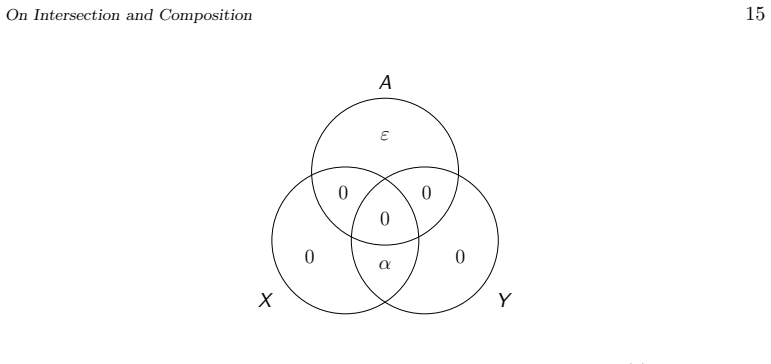
PRELIMINARY REDUCTIONS It is well-known that any CI statement[I ⊥ ⊥J | K] with pairwise disjoint sets I, J, K ⊆ N is equivalent modulo the semigraphoid axioms to a conjunction of elementary CI state- ments: [I ⊥ ⊥J | K] ⇐ ⇒ ^ i∈I ^ j∈J ^ K⊆L⊆IJK \ij [i ⊥ ⊥j | L]. (2) 4 T. BOEGE H(A| X,Y) H(X | A,Y) H(Y | A,X) I(A: X: Y) I(X: Y | A) I(A: X | Y) I(A: Y | X)...
-
[3]
THE INTERSECTION PROPERTY The problem of finding sufficient conditions for the Intersection property has received considerable attention from a variety of research communities. The most widely known and the simplest general condition on a distribution which ensures the full Intersection property is that the probability density be strictly positive. This i...
-
[4]
as well as ∗- and C ∗-separation [1,5]. Example 3.1. A gassoid is a semigraphoid satisfying Intersection, Composition and a further property called Weak transitivity; cf. [31]. Chen [9, Section 2.2] records that gaussoids appear as the CI structures of regular Gaussian random vectors, as the vanishing almost-principal quasi-minors of a polarity in a Desar...
-
[5]
provide an overview of the history of this idea on the statistics side. In algebraic statistics, a similar result is known as the Cartwright–Engstr¨ om conjecture which was recorded in [15] and resolved by Fink in [17]. It asserts that the binomial ideal corresponding to the premises of Intersection has one associated prime for each possible shape of G(X,...
-
[6]
THE COMPOSITION PROPERTY The previous section showed that the Intersection property is well-studied. By comparison, not much is known about the failure modes of Composition. We again begin by examining examples and show how some approaches that were successful for Intersection cannot succeed for Composition. 4.1. Examples and non-examples To start, Gaussi...
-
[7]
REMARKS Duality. Intersection and Composition are not only converses modulo the semigraphoid axioms but also dual. For an elementary CI statement [i ⊥ ⊥j | L] over ground set N, the dual statement is [i ⊥ ⊥j | L]∗ := [i ⊥ ⊥j | N \ ijL]. Applying duality statement-wise transforms Intersection [i ⊥ ⊥j | kL] ∧ [i ⊥ ⊥k | jL] = ⇒ [i ⊥ ⊥j | L] ∧ [i ⊥ ⊥k | L] in...
work page 2020
-
[8]
Carlos Am´ endola, Claudia Kl¨ uppelberg, Steffen Lauritzen, and Ngoc M. Tran. Conditional independence in max-linear Bayesian networks. Ann. Appl. Probab., 32(1):1–45, 2022
work page 2022
-
[9]
Amini, Bryon Aragam, and Qing Zhou
Arash A. Amini, Bryon Aragam, and Qing Zhou. A non-graphical representation of conditional independence via the neighbourhood lattice, 2022
work page 2022
-
[10]
Geometric algebra, volume 3 of Intersci
Emil Artin. Geometric algebra, volume 3 of Intersci. Tracts Pure Appl. Math. Interscience Publishers, 1957
work page 1957
-
[11]
Tobias Boege, Janneke H. Bolt, and Milan Studen´ y. Self-adhesivity in lattices of abstract conditional independence models. Discrete Applied Mathematics, 361:196–225, 2025
work page 2025
-
[12]
Polyhedral aspects of maxoids, 2025
Tobias Boege, Kamillo Ferry, Benjamin Hollering, and Francesco Nowell. Polyhedral aspects of maxoids, 2025
work page 2025
-
[13]
Construction Methods for Gaussoids
Tobias Boege and Thomas Kahle. Construction Methods for Gaussoids. Kybernetika, 56(6):1045–1062, 2020
work page 2020
-
[14]
Tobias Boege, Sonja Petrovi´ c, and Bernd Sturmfels. Marginal independence models. In Proceedings of the 2022 International Symposium on Symbolic and Algebraic Computation , ISSAC ’22, pages 263–271. Association for Computing Machinery (ACM), 2022
work page 2022
-
[15]
J¨ urgen Bokowski and Bernd Sturmfels.Computational synthetic geometry , volume 1355 of Lecture Notes in Mathematics . Springer, 1989
work page 1989
-
[16]
Xiangying Chen. Conditional Erlangen Program. PhD thesis, OvGU Magdeburg, 2024
work page 2024
-
[17]
Cox, John Little, and Donal O’Shea
David A. Cox, John Little, and Donal O’Shea. Ideals, varieties, and algorithms . Under- graduate Texts in Mathematics. Springer, 4th edition, 2015
work page 2015
-
[18]
A short proof of the G´ acs–K¨ orner theorem, 2023
Laszlo Csirmaz. A short proof of the G´ acs–K¨ orner theorem, 2023
work page 2023
-
[19]
Coding theorems for discrete memoryless systems
Imre Csisz´ ar and J´ anos K¨ orner.Information theory. Coding theorems for discrete memoryless systems. Cambridge University Press, 2nd ed. edition, 2011
work page 2011
-
[20]
A. Philip Dawid. Conditional independence for statistical operations. Ann. Stat., 8:598–617, 1980
work page 1980
-
[21]
Alexander P. Dawid. Conditional independence in statistical theory. J. Roy. Statist. Soc. Ser. B, 41(1):1–31, 1979
work page 1979
-
[22]
Lectures on algebraic statistics , volume 39 of Oberwolfach Semin
Mathias Drton, Bernd Sturmfels, and Seth Sullivant. Lectures on algebraic statistics , volume 39 of Oberwolfach Semin. Birkh¨ auser, 2009. 18 T. BOEGE
work page 2009
-
[23]
Total positivity in Markov structures
Shaun Fallat, Steffen Lauritzen, Kayvan Sadeghi, Caroline Uhler, Nanny Wermuth, and Piotr Zwiernik. Total positivity in Markov structures. Ann. Stat., 45(3):1152–1184, 2017
work page 2017
-
[24]
The binomial ideal of the intersection axiom for conditional probabilities
Alex Fink. The binomial ideal of the intersection axiom for conditional probabilities. J. Algebr. Comb., 33(3):455–463, 2011
work page 2011
-
[25]
Common information is far less than mutual information
Peter G´ acs and J´ anos K¨ orner. Common information is far less than mutual information. Probl. Control Inf. Theory , 2:149–162, 1973
work page 1973
-
[26]
Daniel R. Grayson and Michael E. Stillman. Macaulay2, a software system for research in algebraic geometry. Available at http://www2.macaulay2.com. Version 1.22
-
[27]
Uncovering meanings of embeddings via partial orthogonality
Yibo Jiang, Bryon Aragam, and Victor Veitch. Uncovering meanings of embeddings via partial orthogonality. In Proceedings of the 37th International Conference on Neural Information Processing Systems, NeurIPS ’23. Curran Associates Inc., 2023
work page 2023
-
[28]
Conditional information inequalities for entropic and almost entropic points
Tarik Kaced and Andrei Romashchenko. Conditional information inequalities for entropic and almost entropic points. IEEE Trans. Inf. Theory , 59(11):7149–7167, 2013
work page 2013
-
[29]
A conditional information inequality and its combinatorial applications
Tarik Kaced, Andrei Romashchenko, and Nikolai Vereshchagin. A conditional information inequality and its combinatorial applications. IEEE Trans. Inf. Theory, 64(5):3610–3615, 2018
work page 2018
-
[30]
Algebraic aspects of conditional independence and graphical models
Thomas Kahle, Johannes Rauh, and Seth Sullivant. Algebraic aspects of conditional independence and graphical models. In Marloes Maathuis, Mathias Drton, Steffen Lauritzen, and Martin Wainwright, editors, Handbook of graphical models, Chapman & Hall/CRC Handbooks of Modern Statistical Methods, pages 61–80. CRC Press, 2019
work page 2019
-
[31]
George A. Kirkup. Random variables with completely independent subcollections. J. Algebra, 309(2):427–454, 2007
work page 2007
-
[32]
Uniqueness of nonnegative matrix factorizations by rigidity theory
Robert Krone and Kaie Kubjas. Uniqueness of nonnegative matrix factorizations by rigidity theory. SIAM J. Matrix Anal. Appl. , 42(1):134–164, 2021
work page 2021
-
[33]
On entropic and almost multilinear representability of matroids
Lukas K¨ uhne and Geva Yashfe. On entropic and almost multilinear representability of matroids. 2025
work page 2025
-
[34]
Gowtham R. Kumar, Cheuk T. Li, and Abbas El Gamal. Exact common information. In 2014 IEEE International Symposium on Information Theory , pages 161–165, 2014
work page 2014
-
[35]
Graphical models, volume 17 of Oxford Statistical Science Series
Steffen Lauritzen. Graphical models, volume 17 of Oxford Statistical Science Series . Oxford University Press, 1996
work page 1996
-
[36]
Unifying Markov properties for graphical models
Steffen Lauritzen and Kayvan Sadeghi. Unifying Markov properties for graphical models. Ann. Statist., 46(5):2251–2278, 2018
work page 2018
-
[37]
Cheuk Ting Li. Undecidability of network coding, conditional information inequalities, and conditional independence implication. IEEE Trans. Inf. Theory , 69(6):3493–3510, 2023
work page 2023
-
[38]
On Gaussian conditional independence structures
Radim Lnˇ eniˇ cka and Frantiˇ sek Mat´ uˇ s. On Gaussian conditional independence structures. Kybernetika, 43(3):327–342, 2007
work page 2007
-
[39]
The theory of relational databases
David Maier. The theory of relational databases . Computer Software Engineering Series. Pitman Publishing Ltd., 1983
work page 1983
-
[40]
Ascending and descending conditional independence relations
Frantiˇ sek Mat´ uˇ s. Ascending and descending conditional independence relations. InTransac- tions of the 11th Prague Conference on Information Theory, Statistical Decision Functions and Random Processes, volume B, pages 189–200, 1992
work page 1992
-
[41]
Piecewise linear conditional information inequality.IEEE Trans
Frantiˇ sek Mat´ uˇ s. Piecewise linear conditional information inequality.IEEE Trans. Inf. Theory, 52(1):236–238, 2006. On Intersection and Composition 19
work page 2006
-
[42]
Entropy region and convolution.IEEE Trans
Frantiˇ sek Mat´ uˇ s and L´ aszlo Csirmaz. Entropy region and convolution.IEEE Trans. Inf. Theory, 62(11):6007–6018, 2016
work page 2016
-
[43]
Matroid theory, volume 21 of Oxford Graduate Texts in Mathematics
James Oxley. Matroid theory, volume 21 of Oxford Graduate Texts in Mathematics . Oxford University Press, 2nd edition, 2011
work page 2011
-
[44]
An introduction to stability theory
Daniel Palac´ ın. An introduction to stability theory. In Lectures in model theory, pages 1–27. European Mathematical Society (EMS), 2018
work page 2018
-
[45]
Judea Pearl and Azaria Paz. GRAPHOIDS: A graph-based logic for reasoning about relevance relations, or When would x tell you more about y if you already know z. Technical Report CSD-850038, UCLA Computer Science Department, 1985
work page 1985
-
[46]
Pe˜ na, Roland Nilsson, Johan Bj¨ orkegren, and Jesper Tegn´ er
Jose M. Pe˜ na, Roland Nilsson, Johan Bj¨ orkegren, and Jesper Tegn´ er. Towards scalable and data efficient learning of Markov boundaries. Int. J. Approx. Reasoning , 45(2):211–232, 2007
work page 2007
-
[47]
On the intersection property of conditional independence and its application to causal discovery
Jonas Peters. On the intersection property of conditional independence and its application to causal discovery. J. Causal Inference, 3(1):97–108, 2015
work page 2015
-
[48]
Hans Reichenbach. The direction of time . University of California Press, 1971. Edited by Maria Reichenbach
work page 1971
-
[49]
Ignorable common informa- tion, null sets and Basu’s first theorem
Ernesto San Mart´ ın, Michel Mouchart, and Jean-Marie Rolin. Ignorable common informa- tion, null sets and Basu’s first theorem. Sankhy¯ a, 67(4):674–698, 2005
work page 2005
-
[50]
Information Science and Statistics
Milan Studen´ y.Probabilistic Conditional Independence Structures. Information Science and Statistics. Springer, 2005
work page 2005
-
[51]
Milan Studen´ y. Conditional independence structures over four discrete random variables revisited: conditional Ingleton inequalities. IEEE Trans. Inf. Theory, 67(11):7030–7049, 2021
work page 2021
-
[52]
Information-theoretic cryptography
Himanshu Tyagi and Shun Watanabe. Information-theoretic cryptography. Cambridge University Press, 2023
work page 2023
-
[53]
On the recognition problem for limits of entropy functions, 2025
Geva Yashfe. On the recognition problem for limits of entropy functions, 2025
work page 2025
-
[54]
Raymond W. Yeung. A first course in information theory . Information Technology: Transmission, Processing and Storage. Springer, 2005. Tobias Boege, Department of Mathematics and Statistics, UiT – The Arctic University of Norway, N-9037 Tromsø e-mail: post@taboege.de
work page 2005
discussion (0)
Sign in with ORCID, Apple, or X to comment. Anyone can read and Pith papers without signing in.