Logarithmic Spectral Distribution of a non-Hermitian β-Ensemble
Pith reviewed 2026-05-22 20:13 UTC · model grok-4.3
The pith
In the large-beta and large-n limit the spectral density of the non-Hermitian beta-ensemble is rotationally invariant on a compact disc and given by the logarithm of the radius plus a constant.
A machine-rendered reading of the paper's core claim, the machinery that carries it, and where it could break.
Core claim
The paper establishes that for the introduced non-Hermitian beta-ensemble the low-temperature limit beta much greater than one reduces the model exactly to a centred tridiagonal Jacobi matrix with vanishing diagonal. A general theorem from free probability, based on the variance of the coefficients of the characteristic polynomial, then determines the spectral density in the additional large-n limit. This density is rotationally invariant on a compact disc and is given by the logarithm of the radius plus a constant. The same density is recovered when the construction begins from a tridiagonal complex symmetric ensemble.
What carries the argument
The characteristic polynomial of a centred tridiagonal Jacobi matrix with vanishing diagonal, whose coefficients are expressed explicitly in terms of the matrix elements, together with the free-probability theorem that relates the variance of those coefficients to the limiting spectral density.
If this is right
- The limiting density is identical for the tridiagonal complex symmetric ensemble.
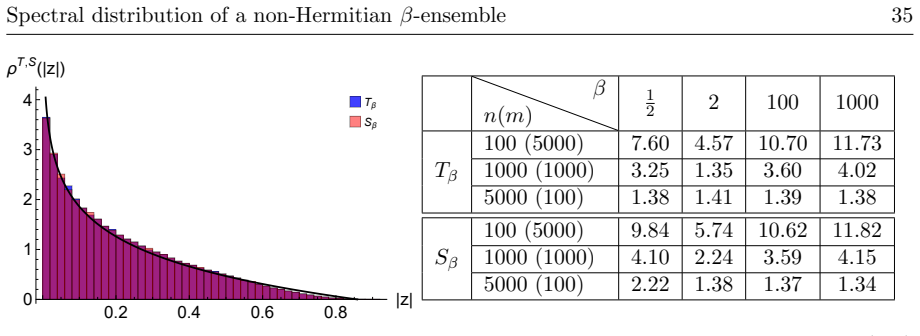
- Extensive numerical simulations confirm the analytical density and situate the ensemble relative to the pseudospectrum.
- The Vandermonde-beta factor and eigenvector coupling become irrelevant once the large-beta reduction is performed.
- The result supplies an exact benchmark for the eigenvalue distribution of non-normal tridiagonal matrices in the low-temperature regime.
Where Pith is reading between the lines
- The logarithmic radial form may indicate an underlying connection to logarithmic potentials that appear in other non-Hermitian models with circular symmetry.
- It would be natural to check whether the same density appears when the tridiagonal structure is replaced by a different sparse non-normal pattern at large beta.
- The explicit reduction to a vanishing diagonal suggests that temperature-driven phase transitions in non-Hermitian ensembles could be studied by tracking the diagonal entries as beta varies.
Load-bearing premise
The low-temperature limit of the ensemble reduces exactly to a centred tridiagonal Jacobi matrix with vanishing diagonal.
What would settle it
A numerical histogram of eigenvalues computed at sufficiently large beta and n that fails to match the predicted radial dependence log of radius plus constant inside the disc would falsify the limiting law.
Figures




read the original abstract
We introduce a non-Hermitian $\beta$-ensemble and determine its spectral density in the limit of large $\beta$ and large matrix size $n$. The ensemble is given by a general tridiagonal complex random matrix of normal and chi-distributed random variables, extending previous work of two of the authors. The joint distribution of eigenvalues contains a Vandermonde determinant to the power $\beta$ and a residual coupling to the eigenvectors. A tool in the computation of the limiting spectral density is a single characteristic polynomial for centred tridiagonal Jacobi matrices, for which we explicitly determine the coefficients in terms of its matrix elements. In the low temperature limit $\beta\gg1$ our ensemble reduces to such a centred matrix with vanishing diagonal. A general theorem from free probability based on the variance of the coefficients of the characteristic polynomial allows us to obtain the spectral density when additionally taking the large-$n$ limit. It is rotationally invariant on a compact disc, given by the logarithm of the radius plus a constant. The same density is obtained when starting form a tridiagonal complex symmetric ensemble, which thus plays a special role. Extensive numerical simulations confirm our analytical results and put this and the previously studied ensemble in the context of the pseudospectrum.
Editorial analysis
A structured set of objections, weighed in public.
Referee Report
Summary. The paper introduces a non-Hermitian β-ensemble via a general tridiagonal complex random matrix with normal and chi-distributed entries, extending prior work, and equipped with a Vandermonde^β weight plus residual eigenvector coupling. It claims that in the joint large-β and large-n limit the spectral density is rotationally invariant on a compact disk and equals the logarithm of the radius plus a constant. The derivation proceeds by reducing the ensemble at large β to a centered tridiagonal Jacobi matrix with vanishing diagonal, explicitly determining the coefficients of its characteristic polynomial in terms of the matrix elements, and invoking a general free-probability theorem that relates the limiting density to the variances of those coefficients. The same density is recovered for the tridiagonal complex symmetric case, and the analytic result is supported by numerical simulations that also place the ensemble in the context of the pseudospectrum.
Significance. If the reduction step and the direct applicability of the free-probability theorem are placed on a rigorous footing, the result supplies an explicit, closed-form limiting spectral density for a new family of non-Hermitian β-ensembles. The explicit construction of the characteristic-polynomial coefficients and the confirmation that the complex-symmetric tridiagonal ensemble yields the identical density are concrete strengths; the numerical simulations further anchor the claim. The work therefore extends the literature on non-Hermitian random matrices and free-probability techniques in a potentially useful direction.
major comments (2)
- [Abstract / reduction step] Abstract and the paragraph describing the low-temperature reduction: the claim that the original ensemble concentrates exactly onto a centered Jacobi matrix with vanishing diagonal (thereby allowing direct application of the cited free-probability theorem on coefficient variances) is load-bearing for the central density formula. The abstract notes a “residual coupling to the eigenvectors”; an explicit limiting joint law on the matrix entries must be supplied to verify that this coupling vanishes in a manner that leaves the coefficient variances unchanged and that the β→∞ and n→∞ limits commute.
- [Derivation of limiting density] The invocation of the general free-probability theorem (based on variances of characteristic-polynomial coefficients) requires a check that the limiting ensemble satisfies the theorem’s hypotheses. Without an explicit computation or bound showing that the variances converge to the required values after the reduction, the theorem cannot be applied directly.
minor comments (2)
- [Abstract] The abstract states that numerical simulations confirm the density but provides neither error bars nor quantitative measures of agreement; these should be added to the figures or text.
- [Model definition] Notation for the tridiagonal entries (normal versus chi-distributed) and the precise form of the eigenvector coupling should be stated once in a dedicated paragraph or table for clarity.
Simulated Author's Rebuttal
We thank the referee for the careful reading and for highlighting the need for greater rigor in the reduction step and the verification of the free-probability theorem. We address each major comment below and will revise the manuscript to supply the requested details.
read point-by-point responses
-
Referee: [Abstract / reduction step] Abstract and the paragraph describing the low-temperature reduction: the claim that the original ensemble concentrates exactly onto a centered Jacobi matrix with vanishing diagonal (thereby allowing direct application of the cited free-probability theorem on coefficient variances) is load-bearing for the central density formula. The abstract notes a “residual coupling to the eigenvectors”; an explicit limiting joint law on the matrix entries must be supplied to verify that this coupling vanishes in a manner that leaves the coefficient variances unchanged and that the β→∞ and n→∞ limits commute.
Authors: We agree that a precise statement of the limiting joint law is required. In the revision we will derive the explicit limiting distribution of the tridiagonal entries as β→∞, showing that the residual eigenvector coupling vanishes in the sense that it leaves the variances of the characteristic-polynomial coefficients unaffected. We will also clarify that the β→∞ limit may be taken first, after which the n→∞ limit yields the stated density, with the two limits commuting under this ordering. revision: yes
-
Referee: [Derivation of limiting density] The invocation of the general free-probability theorem (based on variances of characteristic-polynomial coefficients) requires a check that the limiting ensemble satisfies the theorem’s hypotheses. Without an explicit computation or bound showing that the variances converge to the required values after the reduction, the theorem cannot be applied directly.
Authors: We will add an explicit computation of the coefficient variances for the reduced centered Jacobi ensemble. The revision will include a direct verification (or bound) that these variances converge to the precise values required by the cited free-probability theorem, thereby confirming that the hypotheses are satisfied in the large-n limit. revision: yes
Circularity Check
Derivation chain is self-contained via explicit limit reduction and independent free-probability theorem
full rationale
The paper starts from its defined non-Hermitian β-ensemble (tridiagonal complex matrix with normal/chi entries and Vandermonde^β weight), derives the large-β reduction to a centred zero-diagonal Jacobi matrix directly from the model definition, explicitly computes the characteristic-polynomial coefficients in terms of the matrix elements, and invokes a general free-probability theorem on coefficient variances whose statement and hypotheses are external to the present work. Prior author citations are used only for ensemble construction, not for the limiting density formula itself. The final logarithmic density on the disc is obtained by applying the theorem to the limiting variances after the n→∞ limit; this does not reduce to a fit or to a self-referential definition. No load-bearing step equates the output to the input by construction.
Axiom & Free-Parameter Ledger
axioms (2)
- domain assumption The low-temperature limit beta >> 1 reduces the ensemble exactly to a centred tridiagonal Jacobi matrix with vanishing diagonal.
- standard math A general theorem from free probability gives the spectral density from the variance of the coefficients of the characteristic polynomial.
Lean theorems connected to this paper
-
IndisputableMonolith/Cost/FunctionalEquation.leanwashburn_uniqueness_aczel unclear?
unclearRelation between the paper passage and the cited Recognition theorem.
In the low temperature limit β ≫ 1 our ensemble reduces to such a centred matrix with vanishing diagonal. A general theorem from free probability based on the variance of the coefficients of the characteristic polynomial allows us to obtain the spectral density... given by the logarithm of the radius plus a constant.
-
IndisputableMonolith/Foundation/AlexanderDuality.leanalexander_duality_circle_linking unclear?
unclearRelation between the paper passage and the cited Recognition theorem.
The polynomials defined in (1.16) are either even or odd... obey the three-term-recurrence-relation Pn+1(z) = z Pn(z) − eb_n Pn−1(z)
What do these tags mean?
- matches
- The paper's claim is directly supported by a theorem in the formal canon.
- supports
- The theorem supports part of the paper's argument, but the paper may add assumptions or extra steps.
- extends
- The paper goes beyond the formal theorem; the theorem is a base layer rather than the whole result.
- uses
- The paper appears to rely on the theorem as machinery.
- contradicts
- The paper's claim conflicts with a theorem or certificate in the canon.
- unclear
- Pith found a possible connection, but the passage is too broad, indirect, or ambiguous to say the theorem truly supports the claim.
Reference graph
Works this paper leans on
-
[1]
M. Abramowitz, and I. A. Stegun, Handbook of mathematical functions, graphs and mathematical tools , Dover Publications, New York (1968)
work page 1968
-
[2]
G. Akemann, A. Mielke, and P. P¨ aßler. Spacing distribution in the 2D Coulomb gas: Surmise and sym- metry classes of non-Hermitian random matrices at non-integer β. Phys. Rev. E 106, 014146 (2022), [arXiv:2112.12624]
-
[3]
A. Alastuey and. B Jancovici. On the classical two-dimensional one-component coulomb plasma. J. Physique 42(1), 1–12 (1981)
work page 1981
-
[4]
A. Aptekarev, V. Kaliaguine, and J. Van Iseghem. The genetics sum’s representation for the moments of a system of Stieltjes functions and its application. Constr. Approx. 16, 487-524 (2000)
work page 2000
-
[5]
G. Barbarino, and V. Noferini, The limit empirical spectral distribution of complex matrix polynomials , Random Matrices: Th. Appl. 11(3), 2250023 (2022), [arXiv:2102.02058]. Spectral distribution of a non-Hermitian β-ensemble 47
-
[6]
T. Can, P. J. Forrester, G. T´ ellez, and P. Wiegmann.Singular behavior at the edge of Laughlin states . Phys. Rev. B 89, 235137 (2014), [arXiv:1307.3334]
work page internal anchor Pith review Pith/arXiv arXiv 2014
-
[7]
G. Cardoso, J.-M. St´ ephan, and A. G. Abanov.The boundary density profile of a Coulomb droplet. Freezing at the edge . J. Phys. A 54, 015002 (2021), [arXiv:2009.02359]
-
[8]
T. S. Chihara, An introduction to orhtogonal polynomials. Gordon and Breach, New York (1978)
work page 1978
-
[9]
Cooperative phenomena below melting of the one-component two-dimensional plasma
Ph Choquard and J Clerouin. Cooperative phenomena below melting of the one-component two-dimensional plasma. Phys. Rev. Lett. 50(26), 2086 (1983)
work page 2086
-
[10]
J. K. Cullum, and R. A. Willoghby, A QL procedure for computing the eigenvalues of complex symmetric tridiagonal matrices, SIAM Journal on Matrix Analysis and Applications 17(1), 83-109 (1996)
work page 1996
-
[11]
J. W. Demmel, Applied Numerical Linear Algebra, SIAM, Philadelphia (1997)
work page 1997
-
[12]
Eigenvalues of Hermite and Laguerre ensembles: Large Beta Asymptotics
I. Dumitriu and A. Edelman, Eigenvalues of Hermite and Laguerre ensembles: large beta asymptotics , Annales de l’Institut Henri Poincar´ e (B) Prob. Stat.48, 1083-1099 (2005), [arXiv:math-ph/0403029]
work page internal anchor Pith review Pith/arXiv arXiv 2005
-
[13]
Matrix Models for Beta Ensembles
I. Dumitriu and A. Edelman, Matrix models for beta ensembles , J. Math. Phys. 43, 5830-5847 (2002), [arXiv:math-ph/0206043]
work page internal anchor Pith review Pith/arXiv arXiv 2002
-
[14]
F. J. Dyson, The threefold way. algebraic structure of symmetry groups and ensembles in quantum mechanics, J. Math. Phys. 3, 1199-1215 (1962)
work page 1962
-
[15]
Edelman, Eigenvalues and condition numbers of random matrices, SIAM J
A. Edelman, Eigenvalues and condition numbers of random matrices, SIAM J. Matrix Anal. Appl. 9, 543-560 (1988)
work page 1988
- [16]
-
[17]
Statistical ensembles of complex, quaternion, and real matrices
J. Ginibre, “Statistical ensembles of complex, quaternion, and real matrices.” J. Math. Phys. 6, 440-449 (1965)
work page 1965
-
[18]
Thouless formula for random non-Hermitian Jacobi matrices
Ilya Y. Goldsheid, Bori A. Khoruzhenko. The Thouless formula for random non-Hermitian Jacobi matrices , Israel J. Math. 148, 331-346 (2005), [arXiv:math-ph/0312022]
work page internal anchor Pith review Pith/arXiv arXiv 2005
-
[19]
I. S. Gradshteyn, Table of Integrals, Series, and Products , Academic Press, 6th ed. (2000), San Diego
work page 2000
- [20]
-
[21]
P. Henrici, Bounds for iterates, inverses, spectral variation and fields of values of non-normal matrices , Numer. Math. 4, 24-40 (1962)
work page 1962
-
[22]
R. Koekoek, P. A. Lesky, and R. F. Swarttouw, Hypergeometric Orthogonal Polynomials and Their q- Analogues, Springer-Verlag, Berlin (2010)
work page 2010
-
[23]
Lambert, Poisson statistics for Gibbs measures at high temperature
G. Lambert, Poisson statistics for Gibbs measures at high temperature. Annales de l’Institut Henri Poincar´ e, Prob. Stat. 57(1), 326-350 (2021), [arXiv:1912.10261]
-
[24]
O. Lechtenfeld, R. Ray, and A. Ray. Phase diagram and orthogonal polynomials in multiple well matrix models. Int. J. Mod. Phys. A 6, 4491-4516 (1991)
work page 1991
-
[25]
Statistical properties of eigenvectors in non-Hermitian Gaussian random matrix ensembles
B. Mehlig, and J. T. Chalker, Statistical properties of eigenvectors in non-Hermitian Gaussian random matrix ensembles, J. Math Phys. 41, 3233-3256 (2000), [arXiv:cond-mat/9906279]
work page internal anchor Pith review Pith/arXiv arXiv 2000
-
[26]
F. Mezzadri, and H. Taylor, A matrix model of a non-Hermitian β-ensemble, Random Matrices: Th. Appl. 14(1) 2450027 (2025) [arXiv:2305.13184v2]
-
[27]
F.W.J. Olver, et al. (eds.), NIST Handbook of Mathematical Functions, Cambridge University Press, Cam- bridge (2010)
work page 2010
-
[28]
P. R. Parthasarathy and R. Sudhesh. A formula for the coefficients of orthogonal polynomials from the three-term recurrence relations. Appl. Math. Lett. 19(10), 1083-1089 (2006)
work page 2006
-
[29]
L.N. Trefethen, and M. Lloyd, Spectra and Pseudospectra - The Behaviour of Nonnormal Matrices and Operators, Princeton University Press (2005)
work page 2005
discussion (0)
Sign in with ORCID, Apple, or X to comment. Anyone can read and Pith papers without signing in.