Chronology of Multi-Agent Interactions for Provenance of Evolving Information
Pith reviewed 2026-05-22 19:26 UTC · model grok-4.3
The pith
A chronological system attributes generative history in multi-agent AI from content alone using symbolic chronicles.
A machine-rendered reading of the paper's core claim, the machinery that carries it, and where it could break.
Core claim
We propose a chronological system for post hoc attribution of generative history from content alone, without reliance on internal memory states or external meta-information. At its core lies the notion of symbolic chronicles, representing signed and time-stamped records, in a form analogous to the chain of custody in forensic science. The system operates through a feedback loop, whereby each generative timestep updates the chronicle of prior interactions and synchronises it with the synthetic content in the very act of generation.
What carries the argument
Symbolic chronicles as signed and time-stamped records of interactions, updated and synchronized via a feedback loop during content generation.
If this is right
- Provenance can be traced in multi-agent generative chains even when contributions are revised or overwritten.
- Accountability is enabled for collaborative artificial intelligence without external meta-information.
- The approach mirrors forensic chain of custody for digital content.
- Supports development of accountable forms of AI within evolving cyber ecosystems.
Where Pith is reading between the lines
- This method could be tested in scenarios involving sequential document editing by multiple AI models to verify history reconstruction accuracy.
- Connections to digital watermarking techniques may enhance robustness against tampering in collaborative outputs.
- Potential application in regulatory compliance for AI-generated media where origin tracing is required.
Load-bearing premise
The feedback loop can reliably update the chronicle of prior interactions and synchronize it with the synthetic content during each generation step.
What would settle it
Generate content using the proposed system in a controlled multi-agent setup and then attempt to extract and verify the full interaction history solely from the final content output.
Figures




read the original abstract
Provenance is the chronological history of things, resonating with the fundamental pursuit to uncover origins, trace connections, and situate entities within the flow of space and time. As artificial intelligence advances towards autonomous agents capable of interactive collaboration on complex tasks, the provenance of generated content becomes entangled in the interplay of collective creation, where contributions are continuously revised, extended or overwritten. In a multi-agent generative chain, content undergoes successive transformations, often leaving little, if any, trace of prior contributions. In this study, we investigate the problem of tracking multi-agent provenance across the temporal dimension of generation. We propose a chronological system for post hoc attribution of generative history from content alone, without reliance on internal memory states or external meta-information. At its core lies the notion of symbolic chronicles, representing signed and time-stamped records, in a form analogous to the chain of custody in forensic science. The system operates through a feedback loop, whereby each generative timestep updates the chronicle of prior interactions and synchronises it with the synthetic content in the very act of generation. This research seeks to develop an accountable form of collaborative artificial intelligence within evolving cyber ecosystems.
Editorial analysis
A structured set of objections, weighed in public.
Referee Report
Summary. The manuscript proposes a chronological system for post-hoc attribution of generative history in multi-agent AI interactions. It centers on 'symbolic chronicles' as signed, time-stamped records analogous to forensic chain of custody. The system uses a feedback loop in which each generative timestep updates the chronicle and synchronizes it with the synthetic content, enabling provenance recovery from the final content alone without internal memory states or external meta-information. The work aims to support accountable collaborative AI in evolving cyber ecosystems.
Significance. If a concrete realization of the feedback loop can be shown to achieve synchronization without implicit shared state or detectable metadata, the approach could offer a useful conceptual framework for provenance in multi-agent generative systems. The forensic analogy is apt for the problem domain. At present the contribution is entirely high-level and conceptual, with no algorithms, formal definitions, proofs, or experiments, so its significance remains prospective rather than demonstrated.
major comments (2)
- [Abstract] Abstract: The description of the feedback loop states that it 'updates the chronicle of prior interactions and synchronises it with the synthetic content in the very act of generation.' No mechanism is supplied for how this synchronization occurs while preserving the asserted independence from internal memory states and external meta-information. In a multi-agent setting any practical update appears to require either persistent context passed between agents or structural changes to the output that function as metadata, directly undermining the central claim that attribution is possible from content alone.
- [Abstract] Abstract: The proposal introduces 'symbolic chronicles' as the core construct yet provides neither a formal definition, data structure, nor update rule. Without these, it is impossible to evaluate whether the claimed properties (signed, time-stamped, content-only recoverable) can hold, making the load-bearing technical contribution unassessable.
minor comments (1)
- The abstract would be strengthened by an early, explicit definition of 'symbolic chronicles' rather than deferring the concept to the feedback-loop description.
Simulated Author's Rebuttal
We thank the referee for the constructive and detailed comments on our manuscript. We address each major comment below, clarifying the conceptual scope of the work while committing to improvements where appropriate.
read point-by-point responses
-
Referee: [Abstract] Abstract: The description of the feedback loop states that it 'updates the chronicle of prior interactions and synchronises it with the synthetic content in the very act of generation.' No mechanism is supplied for how this synchronization occurs while preserving the asserted independence from internal memory states and external meta-information. In a multi-agent setting any practical update appears to require either persistent context passed between agents or structural changes to the output that function as metadata, directly undermining the central claim that attribution is possible from content alone.
Authors: The manuscript presents a high-level conceptual framework for provenance tracking rather than a concrete implementation or algorithm. The feedback loop is proposed as an intrinsic aspect of generation in which the symbolic chronicle is updated and synchronized during content creation itself, enabling post-hoc recovery from the final output alone. We acknowledge that the current text does not specify a concrete synchronization mechanism, which leaves open the question of how independence from shared state or metadata is maintained in practice. This is a valid observation. In the revised manuscript we will expand the description of the feedback loop with illustrative principles and examples showing how synchronization could occur through content-embedded, recoverable structures without requiring persistent inter-agent context or detectable external metadata. revision: partial
-
Referee: [Abstract] Abstract: The proposal introduces 'symbolic chronicles' as the core construct yet provides neither a formal definition, data structure, nor update rule. Without these, it is impossible to evaluate whether the claimed properties (signed, time-stamped, content-only recoverable) can hold, making the load-bearing technical contribution unassessable.
Authors: We agree that the absence of formal definitions limits the assessability of the core construct. The manuscript introduces symbolic chronicles at a conceptual level as signed, time-stamped records analogous to forensic chain of custody, with the intent of outlining desired properties for multi-agent provenance. No formal data structure or update rule is supplied because the paper focuses on problem formulation and the high-level system architecture. We will address this directly in revision by adding precise definitions, a basic data structure specification, and update rules that preserve the claimed properties of content-only recoverability. revision: yes
Circularity Check
No circularity: conceptual proposal without derivations or reductions
full rationale
The paper is a high-level proposal for a provenance system based on symbolic chronicles and a feedback loop for synchronization during generation. No equations, parameters, or formal derivations appear in the abstract or described structure. The core claim defines a new mechanism (chronicle updated and synchronized in the generative act) without reducing it by construction to fitted inputs, self-citations, or renamed prior results. The feedback loop is presented as an enabling assumption rather than a derived output, leaving the proposal self-contained as an idea. No load-bearing steps reduce to the inputs via the enumerated circularity patterns.
Axiom & Free-Parameter Ledger
invented entities (1)
-
symbolic chronicles
no independent evidence
Lean theorems connected to this paper
-
IndisputableMonolith/Foundation/RealityFromDistinction.leanreality_from_one_distinction unclear?
unclearRelation between the paper passage and the cited Recognition theorem.
The system operates through a feedback loop, whereby each generative timestep updates the chronicle of prior interactions and synchronises it with the synthetic content in the very act of generation.
-
IndisputableMonolith/Cost/FunctionalEquation.leanwashburn_uniqueness_aczel unclear?
unclearRelation between the paper passage and the cited Recognition theorem.
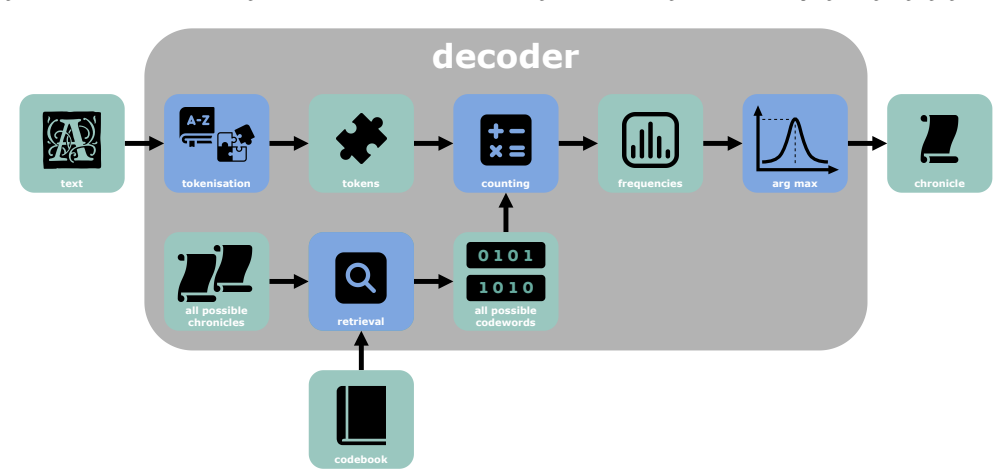
Each unique chronicle x is associated with a corresponding binary codeword c(x) ∈ {0,1}^|V| … tokens … are biased towards during generation.
What do these tags mean?
- matches
- The paper's claim is directly supported by a theorem in the formal canon.
- supports
- The theorem supports part of the paper's argument, but the paper may add assumptions or extra steps.
- extends
- The paper goes beyond the formal theorem; the theorem is a base layer rather than the whole result.
- uses
- The paper appears to rely on the theorem as machinery.
- contradicts
- The paper's claim conflicts with a theorem or certificate in the canon.
- unclear
- Pith found a possible connection, but the passage is too broad, indirect, or ambiguous to say the theorem truly supports the claim.
Reference graph
Works this paper leans on
-
[1]
Computing machinery and intelligence,
A. M. Turing, “Computing machinery and intelligence,” Mind, vol. 59, no. 236, pp. 433–460, 1950
work page 1950
-
[2]
Neural networks and physical systems with emergent collective computational abilities
J. J. Hopfield, “Neural networks and physical systems with emergent collective computational abilities.” Proc. Natl. Acad. Sci. USA , vol. 79, no. 8, pp. 2554–2558, 1982
work page 1982
-
[3]
L. G. Valiant, “A theory of the learnable,” Commun. ACM , vol. 27, no. 11, pp. 1134–1142, 1984
work page 1984
-
[4]
A learning algorithm for Boltzmann machines,
D. H. Ackley, G. E. Hinton, and T. J. Sejnowski, “A learning algorithm for Boltzmann machines,” Cogn. Sci., vol. 9, no. 1, pp. 147–169, 1985
work page 1985
-
[5]
Learning repre- sentations by back-propagating errors,
D. E. Rumelhart, G. E. Hinton, and R. J. Williams, “Learning repre- sentations by back-propagating errors,” Nature, vol. 323, no. 6088, pp. 533–536, 1986
work page 1986
-
[6]
Learning to predict by the methods of temporal differ- ences,
R. S. Sutton, “Learning to predict by the methods of temporal differ- ences,” Mach. Learn., vol. 3, no. 1, pp. 9–44, 1988
work page 1988
-
[7]
A fast learning algorithm for deep belief nets,
G. E. Hinton, S. Osindero, and Y .-W. Teh, “A fast learning algorithm for deep belief nets,” Neural Comput. , vol. 18, no. 7, pp. 1527–1554, 2006
work page 2006
-
[8]
Human-level control through deep reinforcement learn- ing,
V . Mnih et al., “Human-level control through deep reinforcement learn- ing,” Nature, vol. 518, no. 7540, pp. 529–533, 2015
work page 2015
-
[9]
Y . LeCun, Y . Bengio, and G. E. Hinton, “Deep learning,” Nature, vol. 521, no. 7553, pp. 436–444, 2015
work page 2015
-
[10]
Mastering diverse control tasks through world models,
D. Hafner, J. Pasukonis, J. Ba, and T. Lillicrap, “Mastering diverse control tasks through world models,” Nature, pp. 1–19, 2025
work page 2025
-
[11]
J. A. Fodor, The Modularity of Mind . Cambridge, MA, USA: MIT Press, 1983
work page 1983
-
[12]
Markov games as a framework for multi-agent rein- forcement learning,
M. L. Littman, “Markov games as a framework for multi-agent rein- forcement learning,” in Proc. Int. Conf. Mach. Learn. (ICML) , New Brunswick, NJ, USA, 1994, pp. 157–163
work page 1994
-
[13]
Collaborative plans for complex group action,
B. J. Grosz and S. Kraus, “Collaborative plans for complex group action,” Artif. Intell., vol. 86, no. 2, pp. 269–357, 1996
work page 1996
-
[14]
The dynamics of reinforcement learning in cooperative multiagent systems,
C. Claus and C. Boutilier, “The dynamics of reinforcement learning in cooperative multiagent systems,” in Proc. AAAI Conf. Artif. Intell. (AAAI), Madison, WI, USA, 1998, pp. 746–752
work page 1998
-
[15]
Nash Q-learning for general-sum stochastic games,
J. Hu and M. P. Wellman, “Nash Q-learning for general-sum stochastic games,” J. Mach. Learn. Res. , vol. 4, pp. 1039–1069, 2003
work page 2003
-
[16]
Cooperative multi-agent learning: The state of the art,
L. Panait and S. Luke, “Cooperative multi-agent learning: The state of the art,” Auton. Agents Multi-Agent Syst. , vol. 11, no. 3, pp. 387–434, 2005
work page 2005
-
[17]
Multi- agent actor-critic for mixed cooperative-competitive environments,
R. Lowe, Y . Wu, A. Tamar, J. Harb, P. Abbeel, and I. Mordatch, “Multi- agent actor-critic for mixed cooperative-competitive environments,” in Proc. Int. Conf. Neural Inf. Process. Syst. (NeurIPS) , Long Beach, CA, USA, 2017, pp. 6382–6393
work page 2017
-
[18]
Chain of agents: Large language models collaborating on long-context tasks,
Y . Zhang, R. Sun, Y . Chen, T. Pfister, R. Zhang, and S. Arik, “Chain of agents: Large language models collaborating on long-context tasks,” in Proc. Int. Conf. Neural Inf. Process. Syst. (NeurIPS), vol. 37, Vancouver, BC, Canada, 2024, pp. 132 208–132 237
work page 2024
-
[19]
The trustworthy digital camera: Restoring credibility to the photographic image,
G. Friedman, “The trustworthy digital camera: Restoring credibility to the photographic image,” IEEE Trans. Consum. Electron., vol. 39, no. 4, pp. 905–910, 1993
work page 1993
-
[20]
Provenance-aware storage systems,
K.-K. Muniswamy-Reddy, D. A. Holland, U. Braun, and M. Seltzer, “Provenance-aware storage systems,” in Proc. USENIX Ann. Tech. Conf. (ATC), Boston, MA, USA, 2006, pp. 43–56
work page 2006
-
[21]
Preventing history forgery with secure provenance,
R. Hasan, R. Sion, and M. Winslett, “Preventing history forgery with secure provenance,” ACM Trans. Storage, vol. 5, no. 4, pp. 1–43, 2009
work page 2009
-
[22]
A method for obtaining digital signatures and public-key cryptosystems,
R. L. Rivest, A. Shamir, and L. Adleman, “A method for obtaining digital signatures and public-key cryptosystems,”Commun. ACM, vol. 21, no. 2, pp. 120–126, 1978
work page 1978
-
[23]
How to time-stamp a digital document,
S. Haber and W. S. Stornetta, “How to time-stamp a digital document,” J. Cryptol., vol. 3, no. 2, pp. 99–111, 1991
work page 1991
-
[24]
Secure audit logs to support computer forensics,
B. Schneier and J. Kelsey, “Secure audit logs to support computer forensics,” ACM Trans. Inf. Syst. Secur. , vol. 2, no. 2, pp. 159–176, 1999
work page 1999
-
[25]
Collusion-secure fingerprinting for digital data,
D. Boneh and J. Shaw, “Collusion-secure fingerprinting for digital data,” IEEE Trans. Inf. Theory , vol. 44, no. 5, pp. 1897–1905, 1998
work page 1905
-
[26]
B. Chor, A. Fiat, M. Naor, and B. Pinkas, “Tracing traitors,” IEEE Trans. Inf. Theory, vol. 46, no. 3, pp. 893–910, 2000
work page 2000
-
[27]
Anti-collusion fingerprint- ing for multimedia,
W. Trappe, M. Wu, Z. Wang, and K. R. Liu, “Anti-collusion fingerprint- ing for multimedia,” IEEE Trans. Signal Process. , vol. 51, no. 4, pp. 1069–1087, 2003
work page 2003
-
[28]
A design principle for hash functions,
I. B. Damgård, “A design principle for hash functions,” in Proc. Adv. Cryptol. (CRYPTO), Santa Barbara, CA, USA, 1989, pp. 416–427
work page 1989
-
[29]
One way hash functions and DES,
R. C. Merkle, “One way hash functions and DES,” in Proc. Adv. Cryptol. (CRYPTO), Santa Barbara, CA, USA, 1989, pp. 428–446
work page 1989
-
[30]
Keying hash functions for message authentication,
M. Bellare, R. Canetti, and H. Krawczyk, “Keying hash functions for message authentication,” in Proc. Adv. Cryptol. (CRYPTO) , Santa Barbara, CA, USA, 1996, pp. 1–15
work page 1996
-
[31]
R. Venkatesan, S.-M. Koon, M. Jakubowski, and P. Moulin, “Robust image hashing,” in Proc. Int. Conf. Image Process. (ICIP) , vol. 3, Vancouver, BC, Canada, 2000, pp. 664–666
work page 2000
-
[32]
Perceptual image hashing via feature points: Performance evaluation and tradeoffs,
V . Monga and B. Evans, “Perceptual image hashing via feature points: Performance evaluation and tradeoffs,” IEEE Trans. Image Process. , vol. 15, no. 11, pp. 3452–3465, 2006
work page 2006
-
[33]
Robust and secure image hashing,
A. Swaminathan, Y . Mao, and M. Wu, “Robust and secure image hashing,” IEEE Trans. Inf. Forensics Secur., vol. 1, no. 2, pp. 215–230, 2006
work page 2006
-
[34]
R. van Schyndel, A. Tirkel, and C. Osborne, “A digital watermark,” in Proc. Int. Conf. Image Process. (ICIP) , vol. 2, Austin, TX, USA, 1994, pp. 86–90
work page 1994
-
[35]
Secure spread spectrum watermarking for multimedia,
I. J. Cox, J. Kilian, F. T. Leighton, and T. Shamoon, “Secure spread spectrum watermarking for multimedia,” IEEE Trans. Image Process. , vol. 6, no. 12, pp. 1673–1687, 1997
work page 1997
-
[36]
Multimedia data- embedding and watermarking technologies,
M. D. Swanson, M. Kobayashi, and A. H. Tewfik, “Multimedia data- embedding and watermarking technologies,” Proc. IEEE, vol. 86, no. 6, pp. 1064–1087, 1998
work page 1998
-
[37]
Multimedia watermarking techniques,
F. Hartung and M. Kutter, “Multimedia watermarking techniques,” Proc. IEEE, vol. 87, no. 7, pp. 1079–1107, 1999
work page 1999
-
[38]
The use of watermarks in the protection of digital multimedia products,
G. V oyatzis and I. Pitas, “The use of watermarks in the protection of digital multimedia products,” Proc. IEEE, vol. 87, no. 7, pp. 1197–1207, 1999
work page 1999
-
[39]
Watermarking as communications with side information,
I. J. Cox, M. L. Miller, and A. L. McKellips, “Watermarking as communications with side information,” Proc. IEEE, vol. 87, no. 7, pp. 1127–1141, 1999
work page 1999
-
[40]
A unique watermark for every image,
A. Tirkel and T. Hall, “A unique watermark for every image,” IEEE Multimed., vol. 8, no. 4, pp. 30–37, 2001
work page 2001
-
[41]
Scalable watermarking for identifying large language model outputs,
S. Dathathri et al., “Scalable watermarking for identifying large language model outputs,” Nature, vol. 634, no. 8035, pp. 818–823, 2024
work page 2024
-
[42]
A watermark for large language models,
J. Kirchenbauer, J. Geiping, Y . Wen, J. Katz, I. Miers, and T. Goldstein, “A watermark for large language models,” in Proc. Int. Conf. Mach. Learn. (ICML), vol. 202, Honolulu, HI, USA, 2023, pp. 17 061–17 084
work page 2023
-
[43]
On the coexistence and ensembling of watermarks,
A. Petrov, S. Agarwal, P. Torr, A. Bibi, and J. Collomosse, “On the coexistence and ensembling of watermarks,” in Proc. Int. Conf. Learn. Represent. (ICLR) Workshop, Singapore, 2025, pp. 1–29
work page 2025
discussion (0)
Sign in with ORCID, Apple, or X to comment. Anyone can read and Pith papers without signing in.