REVIEW 4 major objections 5 minor 1 cited by
Latent Bayesian Optimization via Autoregressive Normalizing Flows
T0 review · 4 major / 5 minor · reviewed 2026-08-16 · deepseek-v4-flash
Pith's one-line read Latent Bayesian optimization can be made lossless by an invertible flow that maps discrete inputs one-to-one into latent space, eliminating the reconstruction gap that corrupts VAE-based latent search.
desk verdict Solid NF-based latent BO with a real but unenforced reconstruction guarantee; strong experiments, minor tuning concerns. read the letter →
The pith
A machine-rendered reading of the paper's core claim, the machinery that carries it, and where it could break.
The reading
What carries the argument
The carrier of the argument is SeqFlow, an autoregressive normalizing flow for discrete sequences, together with its left-inverse decoding rule. Each token index $x_i$ is first represented by an L2-normalized embedding $e_{x_i}$ from a learned embedding set $E$; an invertible stack of $K$ autoregressive coupling blocks maps the embedding sequence $v$ into a latent code $z$, and decoding is the inverse flow followed by an argmax over cosine similarities to $E$. Propositions 1 and 2 establish that when the embeddings are pairwise distinct, $h$ is injective with $h^{-1}(v) = [\arg\max_j \mathrm{sim}(v_i, e_j)]$ as its left inverse, so $f = g \circ h$ is left-invertible and reconstruction is exact. The second component, token-level adaptive candidate sampling, uses the pointwise mutual information between each latent coordinate and the decoded sequence to define a sampling probability over which tokens to perturb around an anchor point, biasing search toward positions with high influence on the objective.
What would settle it
Train SeqFlow on any sequence dataset, then compute the reconstruction failure rate: the fraction of training inputs $x$ for which $h^{-1}(g^{-1}(g(h(x))))$ differs from $x$, or for which two distinct tokens have cosine similarity equal to 1. Any non-zero failure rate, or any observed embedding collapse, would falsify the exact-reconstruction claim central to the method.
Extended reading notes
Core claim
The central discovery is that perfect reconstruction in latent Bayesian optimization follows from combining an invertible flow with an injective token lookup rather than from any approximation. Writing $h$ for the map that sends a discrete sequence $x$ to the sequence of learned token embeddings, and $g$ for a normalizing flow, the composition $f = g \circ h$ is left-invertible because $h$ is injective (distinct L2-normalized embeddings) and $g$ is invertible by construction; decoding via $h^{-1} \circ g^{-1}$ returns exactly $x$. SeqFlow instantiates this with an autoregressive flow over the sequence of embeddings, so the surrogate model in latent space always refers to a well-defined input and a well-defined objective value. Empirically, the paper reports that this exactness transfers to performance: NF-BO outperforms six latent Bayesian optimization baselines on Guacamol and takes first rank on five out of six PMO scoring metrics, improving the SELFIES VAE baseline's average rank from 19th to 1st.
Load-bearing premise
The guarantee of perfect reconstruction rests on the learned token embeddings remaining pairwise distinct and L2-normalized; if any two embeddings collapse together, the argmax decoding fails and the exact-reconstruction claim collapses.
Editorial extensions
If this is right
- Latent Bayesian optimization no longer needs re-encoding or iterative inversion: because every latent code decodes to a unique input, an acquisition function can trust that the surrogate value it sees at $z$ is the objective value of the decoded molecule.
- The one-to-one mapping turns the latent space into a faithful coordinate system for discrete structures, so trust-region local search and Thompson sampling behave as they do in continuous domains.
- The exact-reconstruction property removes the need for repeated re-encoding of newly found data during optimization, which the paper notes previously caused additional value discrepancy.
- The method is not tied to molecule-specific inductive biases, and the same SeqFlow/TACS pipeline is applicable to other discrete sequence optimization problems where exact reconstruction matters.
Reading between the lines
- If embedding distinctness degrades under training, the argmax decoder is still locally stable, so monitoring the minimum pairwise embedding distance during optimization could serve as a cheap early warning for reconstruction failures; this diagnostic is not reported in the paper.
- Because the latent code is an invertible transformation of the input rather than a stochastic summary, interpolations and small perturbations in $z$ may be more semantically faithful, which could make NF-BO useful for property-guided molecular interpolation; this is an extension the paper does not explore.
- The PMI-based token importance, computed with a trained flow, gives a per-position attribution of which parts of a molecule drive the objective, so TACS doubles as an interpretability tool for medicinal chemists beyond its role in candidate sampling.
- The same construction transfers to other discrete structures with learned embeddings, such as DNA/RNA sequences or program tokens, where the left-inverse guarantee could replace approximate decoders; this is a conjecture, not a claim of the paper.
Signed reviews
Editorial analysis
A structured set of objections, weighed in public.
Referee Report
Summary. The paper proposes NF-BO, a latent Bayesian optimization method that uses an autoregressive normalizing flow (SeqFlow) to map discrete sequences to a continuous latent space. The key claimed advantage is a one-to-one encoding function from the input space to the latent space with a left-inverse decoding function, which is said to eliminate the value discrepancy problem that arises from imperfect reconstruction in VAE-based LBO. The method also introduces Token-level Adaptive Candidate Sampling (TACS) to focus trust-region search on important tokens. The authors evaluate NF-BO on Guacamol and PMO molecular-design benchmarks, reporting strong performance against existing LBO and generative-model baselines.
Significance. If the central claims hold, the paper would make a useful contribution to latent Bayesian optimization by providing a principled alternative to VAE-based encoders and by proposing a concrete way to address the value discrepancy problem. The empirical evaluation is extensive, covering Guacamol and PMO benchmarks with multiple oracle-budget settings, and the manuscript provides code, pseudocode, and proofs in the appendix. However, the theoretical guarantee of perfect reconstruction rests on an unenforced distinctness assumption on the learned embeddings, and the construction does not fully address the consistency between arbitrary latent-space candidates and re-encoded evaluated points. The TACS temperature is also tuned on a benchmark task whose results are then reported. These issues are load-bearing for the paper's main claims, so the manuscript needs substantial revision before the claims can be considered fully established.
major comments (4)
- [Section 4.2, Proposition 2 and Eqs. (13)-(14)] The injectivity of the mapping h is proven under the assumption that the embedding set E consists of distinct, L2-normalized vectors. This assumption is not enforced during training: the contrastive loss in Eq. (13) encourages separation but does not guarantee it, and Algorithm 1 has no projection or pairwise-distinctness step after gradient updates. If two embeddings collapse to the same vector, the argmax in Eq. (8) is not unique, h^{-1} is not a well-defined function, and the claimed guarantee h^{-1}(h(x)) = x fails. Table 5 reports a zero y != y_hat ratio on the top-1000 initial data, but because Algorithm 1 updates E jointly with the flow, this measurement does not cover the embeddings used later in optimization. The proof of Proposition 2 also quantifies over x in N^L while E is finite; the intended statement should be over the finite token vocabulary.
- [Section 4.2 and Section 4.4 / Algorithm 1] The construction gives a left-inverse for the encoding h, but it does not give a two-sided inverse between the discrete input space and the latent space. For an arbitrary latent candidate z sampled by TACS (e.g., within a trust region), the decoded input x = h^{-1}(g^{-1}(z)) may encode to a different latent vector z' = g(h(x)) that is not equal to z. The surrogate is trained on the latent encodings z^{(i)} = g(e_{x^{(i)}}) of the evaluated points, while acquisition is performed at the candidate z. Thus the latent coordinate at which the surrogate is queried can differ from the latent coordinate at which the resulting evaluation is stored, potentially reintroducing a form of value inconsistency that the paper claims to remove. Propositions 1-2 only establish h^{-1}(h(x)) = x, not that decoding an arbitrary z and re-encoding the result returns the same z; the paper should either restrict the candidate set to the image of the discrete embeddings under g, or analyze/control this discrepancy.
- [Section 5.3 and Appendix K] The TACS temperature tau is tuned on a single Guacamol task (searching {400, 200, 100}) and then fixed at tau=400 for all benchmarks, including the same seven Guacamol tasks whose results are reported in the paper. This constitutes hyperparameter selection on the evaluation tasks, which can bias the comparison with baselines. The sensitivity analysis in Table 7 shows that tau=200 achieves a higher summed score (5.565) than the selected tau=400 (5.544), so the chosen value is not clearly the best even within the same benchmark. The authors should either tune hyperparameters on a separate validation set or report results for all settings without selecting on the test tasks.
- [Section 5.1 and Figure 8] For the valt task, the authors state that 'we also added two nonzero data points in the initial dataset of 100 for all methods.' This is a modification to the standard Guacamol benchmark setup. Although applied uniformly to all methods, it should be reported as a limitation and its impact on the ranking should be discussed, especially because the y-axis is on a log scale and without these points the task may be degenerate for all methods.
minor comments (5)
- [Section 4.2, Eq. (9)] In Eq. (9), the notation \hat{x}_i is used both for the argmax index and for the reconstructed token; this is confusing and should be clarified (e.g., by writing the argmax index explicitly as j^*).
- [Section 4.2, Eq. (11)] The description of the constrained sampling distribution q_1(v_i|x_i) is terse; the relationship between the normalization constant Z and the acceptance probability should be spelled out so that the rejection step is unambiguous.
- [Algorithm 1, line 2] The notation D[r - N_q:] is not defined; presumably r refers to the current iteration index, but this should be stated explicitly.
- [Appendix K, Table 7] The sentence 'TACS temperatures above 200 consistently show better optimization results compared to not using TACS' is accurate according to the table, but the conclusion would be clearer if the authors also noted that temperatures 100, 50, and 20 perform worse than the no-TACS baseline, indicating that the method has a limited favorable range.
- [Appendix A, Table 2] Several PMO tasks have very large standard deviations (e.g., celecoxibrediscovery 0.799+-0.164, scaffoldhop 0.769+-0.172), which may weaken the statistical significance of some reported improvements; the authors should discuss this variation.
Circularity Check
No significant circularity: the reconstruction guarantee is a construction-level property, not a fitted prediction; self-citations are contextual and not load-bearing.
full rationale
The central claim that SeqFlow guarantees exact reconstruction follows directly from the definitions in Section 4.2: h maps each token to a distinct L2-normalized embedding and h^{-1} is the argmax-cosine left inverse (Eqs. 8-9, Propositions 1-2). This is a mathematical consequence of the stated injectivity assumption, not a quantity fitted to benchmark data. The empirical y != y_hat ratio of 0.000 in Table 5 is a consistency check of that construction, not a fitted prediction, and it is measured only on the initial top-1000 data. The proof is conditional on the distinctness and L2-normalization of the learned embedding set E, which the training loss in Eqs. (13)-(14) does not formally enforce after gradient updates; that is an unproven premise and a correctness risk, not circularity. Citations to the authors' prior CoBO (Lee et al., 2023) and Inversion-based LBO (Chu et al., 2024) appear as related work and baselines and are not load-bearing for the reconstruction guarantee or the benchmark comparisons. The proposed method is applied to external molecular-design benchmarks and compared with external baselines; no uniqueness theorem or self-citation chain forces the result. No equation in the paper reduces to its own inputs or renames a fitted parameter as a prediction.
Assumptions & free parameters
free parameters (6)
- TACS temperature tau =
400
- TACS scaling factor kappa =
0.1 * L
- Variational distribution std sigma =
0.1
- Similarity loss coefficient lambda =
1
- Anchor softmax temperature tau1 =
0.1
- Top-k data points for training =
1000
assumptions (4)
- standard math The normalizing flow g and its inverse g^{-1} are exactly implementable with autoregressive coupling layers.
- domain assumption The learned embedding vectors remain distinct and L2-normalized after training.
- domain assumption The surrogate Gaussian process with deep kernel adequately models the composite function f composed with p_theta in latent space.
- domain assumption The constrained variational sampling q1 in Eq. (11) yields a valid approximation of the discrete likelihood.
Cite this review
Pith. "Pith review of Latent Bayesian Optimization via Autoregressive Normalizing Flows." pith.science (2026). https://pith.science/paper/PQM7PVE2
@misc{pith2026250414889,
  author       = {Pith},
  title        = {Pith review of: Latent Bayesian Optimization via Autoregressive Normalizing Flows},
  year         = {2026},
  howpublished = {\url{https://pith.science/paper/PQM7PVE2}},
  note         = {Machine review of arXiv:2504.14889}
}
read the original abstract
Bayesian Optimization (BO) has been recognized for its effectiveness in optimizing expensive and complex objective functions. Recent advancements in Latent Bayesian Optimization (LBO) have shown promise by integrating generative models such as variational autoencoders (VAEs) to manage the complexity of high-dimensional and structured data spaces. However, existing LBO approaches often suffer from the value discrepancy problem, which arises from the reconstruction gap between input and latent spaces. This value discrepancy problem propagates errors throughout the optimization process, leading to suboptimal outcomes. To address this issue, we propose a Normalizing Flow-based Bayesian Optimization (NF-BO), which utilizes normalizing flow as a generative model to establish one-to-one encoding function from the input space to the latent space, along with its left-inverse decoding function, eliminating the reconstruction gap. Specifically, we introduce SeqFlow, an autoregressive normalizing flow for sequence data. In addition, we develop a new candidate sampling strategy that dynamically adjusts the exploration probability for each token based on its importance. Through extensive experiments, our NF-BO method demonstrates superior performance in molecule generation tasks, significantly outperforming both traditional and recent LBO approaches.
Figures


Figures from the paper (10 more)



Forward citations
Cited by 1 Pith paper
-
A Language-Guided Bayesian Optimization for Efficient LoRA Hyperparameter Search
LLM embeddings plus Bayesian optimization find better LoRA hyperparameters in ~30 proxy trials than standard published settings.
Reference graph
Works this paper leans on
-
[1]
Light sky blue areas indicate regions with lower density compared to the darker regions
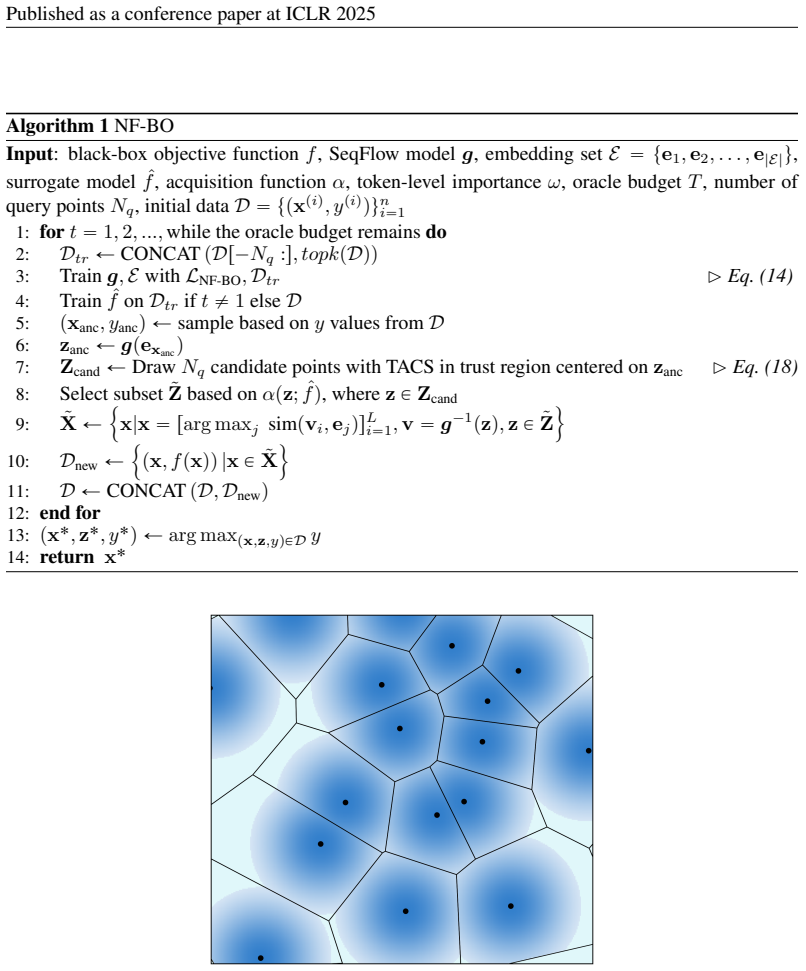
Darker regions indicate higher Gaussian values, and hence higher likelihoods of sample acceptance. Light sky blue areas indicate regions with lower density compared to the darker regions. This visualization demonstrates the selective nature of our sampling method, focusing only on feasible solutions during optimization. H A RCHITECTURE DETAILS Each autore...
work page 2025
-
[3]
Table 3: Fixed parameters for all tasks and settings. Parameter Value Scaling factorκ in TACS 0.1¨ Sequence lengthL Standard deviationσ of variational distributionq 0.1 # of topk data for training 1000 Coefficient of similarity loss Lsim 1 Typically, the anchor point within a trust region is selected based on the current best observed value from the accum...
work page 2019
-
[4]
13 Published as a conference paper at ICLR 2025 Table 2: Detailed results on PMO benchmarks. The table presents scores and standard deviations across 6 evaluation metrics, with each score representing the mean of 5 independent runs. Addition- ally, the sum for each column is computed to summarize the overall performance. Top-1 Top-10 Top-100 AUC Top-1 AUC...
work page 2025
-
[7]
For other settings, these parameters were adjusted to (10, 100). 19 Published as a conference paper at ICLR 2025 We explored the temperatureτ for the Token-level Adaptive Candidate Sampling (TACS) across the values {400, 200, 100} to find the optimal setting. The sequence lengthL was determined based on the longest sequence in the initial dataset. For det...
work page 2025
-
[9]
Please note that we do not apply TACS solely to compare generative models. From the table, our SeqFlow model achieves better perfor- mance with fewer parameters compared to the baseline model. SeqFlow and TextFlow use the same NF model, but TextFlow includes more components and therefore has more parameters. Although TextFlow has more parameters, our SeqF...
work page 2025
-
[10]
Both the oracle budget and the number of initial data were set to 10,000
This analysis is performed across seven Guacamol tasks, with results averaged over five runs per task and summed. Both the oracle budget and the number of initial data were set to 10,000. From the table, TACS temperatures above 200 consistently show better optimization results compared to not using TACS, highlighting the robustness of our approach to the ...
work page 2025
-
[11]
Each task’s performance is averaged over five trials
NF-BO w/ TACS (init 10K) adip 0.765˘ 0.038 0.818˘ 0.051 0.809˘ 0.059 med2 0.306˘ 0.014 0.307˘ 0.027 0.380˘ 0.014 osmb 0.848˘ 0.037 0.855˘ 0.007 0.897˘ 0.016 pdop 0.564˘ 0.045 0.623˘ 0.043 0.759˘ 0.023 rano 0.846˘ 0.019 0.848˘ 0.021 0.941˘ 0.006 valt 0.198˘ 0.443 0.786˘ 0.439 0.995˘ 0.004 zale 0.586˘ 0.013 0.589˘ 0.033 0.760˘ 0.012 Table 7: Sensitivity ana...
work page 2000
-
[500]
and (10,000, 10,000) oracle settings, which were not covered in the main section, along with the results for the (10,000, 70,000) oracle settings. Figures 8, 9, and 10 display the results for the (100, 500), (10,000, 10,000), and (10,000, 70,000) oracle settings, respectively. In the case of PG-LBO (Chen et al., 2024), we were unable to include results fo...
work page 2024
Show all 12 references
-
[2018]
A survey and benchmark of high-dimensional Bayesian optimization of discrete sequences
11 Published as a conference paper at ICLR 2025 Miguel Gonz´alez-Duque, Richard Michael, Simon Bartels, Yevgen Zainchkovskyy, Søren Hauberg, and Wouter Boomsma. A survey and benchmark of high-dimensional Bayesian optimization of discrete sequences. arXiv:2406.04739,
2025 arXiv
-
[2019]
Variational inference with normalizing flows
12 Published as a conference paper at ICLR 2025 Danilo Rezende and Shakir Mohamed. Variational inference with normalizing flows. In ICML,
2025
-
[2020]
High-dimensional Bayesian optimisation with variational autoencoders and deep metric learning.arXiv:2106.03609,
Antoine Grosnit, Rasul Tutunov, Alexandre Max Maraval, Ryan-Rhys Griffiths, Alexander I Cowen- Rivers, Lin Yang, Lin Zhu, Wenlong Lyu, Zhitang Chen, Jun Wang, et al. High-dimensional Bayesian optimisation with variational autoencoders and deep metric learning.arXiv:2106.03609,
-
[2022]
ver et al.,
and LaMBO-2 (Gru- 22 Published as a conference paper at ICLR 2025 Figure 14: Visualizations of the value discrepancy problem across 5 Guacamol tasks. ver et al.,
2025
Reviewed August 16, 2026 · model on record in the stance chip above.
Discussion (0). Continue with ORCID to comment.