REVIEW 2 major objections 6 minor 40 references
A PDE Model for Janus Particle Swarming
T0 review · 2 major / 6 minor · reviewed 2026-08-16 · deepseek-v4-flash
Pith's one-line read This paper argues that vision-guided Janus particles, which move forward only when enough neighbours appear in a cone in front of them, form cohesive swarms whose stable shape is an annulus, and that a nonlocal advection-diffusion PDE…
desk verdict A competent and useful continuum model for a vision-based Janus swarm, with a genuinely new annular-density prediction that deserves a real referee; the main weakness is an untested excluded-volume assumption sitting exactly where the ring lives. read the letter →
The pith
A machine-rendered reading of the paper's core claim, the machinery that carries it, and where it could break.
The reading
What carries the argument
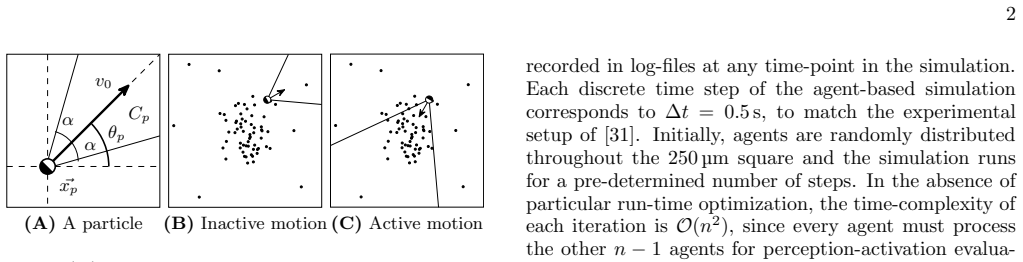
The load-bearing object is the nonlocal advection-diffusion PDE (Eq. 9, with density $\rho(\theta,t,\vec x)$ over orientation, time, and space): $\rho_t = D_{\vec x}\Delta \rho - \nabla\cdot(S v_0 \hat\theta \rho) + D_\theta \rho_{\theta\theta}$. Perception is a convolution $V = K_\theta * \bar\rho$ between the vision cone $K_\theta$ (half-angle $\alpha$, weight $1/d(\vec x,\vec y)$) and the orientation-averaged density $\bar\rho$; the activation flag $S$ is a step function that is 1 where $V$ exceeds the threshold $P^*$ and 0 elsewhere. The PDE does the argument's work by turning that asymmetric, binary sensing rule into a drift term: active particles advect along their orientation $\hat\theta$ while spatial and angular diffusion constantly scramble positions and headings. The ring emerges from the balance of these terms, and the paper uses the PDE's cheap numerical solutions to sweep the two main parameters, vision angle $\alpha$ and threshold ratio $P^*/P^c_\alpha$.
What would settle it
Run both models with a short-range repulsion term at the physical particle diameter and compare the radial cross-section of the annulus: if the rim peak flattens, splits, or shifts beyond the discretization error, the annular state is a finite-size artifact rather than the true continuum attractor. A complementary experiment would time-average high-resolution images of the original system and check whether boundary particles are predominantly inactive; if the rim is not predominantly inactive, the mechanism proposed here is wrong.
Extended reading notes
Core claim
On its own terms, the paper's central discovery is that the attractor of the vision-controlled Janus-particle system is an annulus rather than a uniform disk. Solving the advection-diffusion PDE to a pseudo-steady state yields a nearly rotationally symmetric density profile with a pronounced peak at the rim; the agent-based model, when its histograms are averaged over time, shows the same rim. Breaking the density down by orientation shows each orientation class forms an arc at the periphery where particles face outward, and combining the arcs produces the ring. The active/inactive split is sharp: inactive particles are almost entirely confined to the annulus, while interior particles are active and traverse the group, which explains how the cluster holds together without attractive forces. As the number of agents grows, the agent-based radial cross-sections converge toward the PDE cross-section, supporting the claim that the PDE is the continuum limit of the stochastic process.
Load-bearing premise
The argument assumes that ignoring the finite size of the particles—treating each as an overlap-allowed point, although the real ones are 4.28 µm across—does not change the qualitative pattern, even though the ring's peak is exactly where crowding and stacking would be most severe in the laboratory.
Editorial extensions
If this is right
- If the paper is right, the clustering seen in the original physical experiments can be obtained from a continuum model with no attraction or alignment terms; diffusion plus vision-thresholded forward motion is sufficient.
- The ring is robust to model choice: it appears in the time-averaged histograms of the stochastic agent-based model and in the deterministic PDE, so it is not an artifact of the continuum approximation.
- The active/inactive split is a concrete signature: boundary particles are mostly outward-facing and inactive, interior particles are active, so any experiment that can label activation state should see the rim dominated by inactive particles.
- The phase diagrams for formation and cohesion differ: some parameters never form a ring from random initial data but will sustain an already-formed ring, at least on intermediate time scales.
- The PDE's low cost makes parameter sweeps and bifurcation estimates practical, giving a route to predict group radius and rim height without running expensive agent-based ensembles.
Reading between the lines
- A natural next test is to add a short-range repulsion of roughly the particle diameter to both models; if the peripheral peak persists with a width comparable to the repulsion length, the annulus is a true continuum prediction, and if it collapses, the rim height is a point-particle artifact.
- If the annulus is the attractor, then in larger domains the ring radius should be set by the vision cone and activation threshold rather than by the boundary, which could be checked by repeating the simulations and experiments in fields several times larger than 250 µm.
- The same convolution-threshold-advection structure may describe other sensory particles, such as chemotactic bacteria or phototactic colloids, where the perceived signal is a scalar field instead of a neighbour count; the annular profile would then be a generic signature of thresholded directional motility.
Signed reviews
Editorial analysis
A structured set of objections, weighed in public.
Referee Report
Summary. The manuscript proposes a nonlocal advection-diffusion PDE, Eq. (9), for the density ρ(θ, x, t) of orientable Janus particles whose motility is controlled by vision-cone perception and a threshold activation rule, and it compares this PDE with an agent-based simulation of the same rules. The paper reports that both models produce disk-shaped cohesive groups for moderate parameters and that, in addition, the time-integrated agent histograms and the PDE end-states exhibit a peripheral density peak, giving an annular structure not highlighted in the prior experimental study [31]. A 24×24 parameter sweep over vision angle α and threshold ratio P*/Pc_α yields phase portraits for group formation and for cohesion, and the authors conclude that the PDE recreates the behavior seen in experiments and simulations.
Significance. If the central claims hold, the paper offers a computationally cheap continuum description of an experimental active-particle system whose interactions are known, with all physical parameters inherited from [31] rather than fitted, openly available code, and a falsifiable prediction (the annular density profile) that can be checked with time-integrated imaging or larger particle numbers. The time-averaged histogram approach for comparing discrete and continuum models is a useful methodological contribution. However, the annular structure is the paper's main novel finding, and its physical robustness is not yet established; in particular, the effect of omitted excluded volume on the peripheral density peak is a load-bearing open question. The significance of the paper therefore depends critically on the response to Major Comment 1.
major comments (2)
- [Discussion (final paragraph); Eqs. (1), (6), (9)] The model omits excluded volume even though the experimental particles have diameter 4.28 µm, and the perception kernel in Eq. (1) is singular, w ~ 1/d. In the agent-based model, overlapping particles at unphysically small separations contribute very large weights to the perception sum and can flip the activation state S in Eq. (7); in the PDE, the same 1/d convolution feeds the threshold in Eq. (6), and active particles advect outward in Eq. (9), which is exactly a mechanism that can pile density into a peripheral ring. Since the ring is the high-density region where particle overlap would be most common, the omitted excluded-volume interaction is not a cosmetic correction: it may be the origin of the claimed annular structure. The sentence "we do not anticipate that this would substantially affect the nature of the results reported here" is not a substitute for a test. The authors should add a short-range repulsion or hard-core-like regularization to both the agent-based model and the PDE and show that the annulus persists, in both height and existence, over the parameter ranges shown in Figs. 2 and 7; alternatively, they should provide a quantitative argument for why overlap is negligible in the relevant density regime.
- [§II B and §III B 1] Eq. (9) is introduced as the PDE "that approximates the limit n→∞" and §III B 1 concludes that "the PDE model does indeed represent a continuum limit of the agent-based model," but no mean-field or kinetic derivation of Eq. (9) from Algorithm 1 is given. The evidence in Fig. 6(A) is a single parameter set, compared visually and with time-averaged histograms normalized to the PDE mass. To support the "continuum limit" wording, either provide a formal derivation (e.g., from an interacting-particle or kinetic formulation) or reframe Eq. (9) as a phenomenological continuum model whose validity is demonstrated numerically. In either case, the convergence in Fig. 6(A) should be quantified with a metric such as the relative L1 or L2 difference between the PDE cross-section and the agent histograms for n = 500, 1000, 2000, and 5000.
minor comments (6)
- [§II B, Eq. (5)] The definition K_θ(s) := w(0, -s) is hard to follow because w is originally defined with two position arguments; please write the kernel explicitly in terms of |s|, the half-angle α, and the orientation θ, and clarify the sign convention leading to the convolution in Eq. (6).
- [§II C and §III B 1] The total mass N used in the PDE and its relationship to the agent number n are not stated explicitly. Since V in Eq. (6) scales with the total density, the choice of N and the precise setting of P* (absolute value versus ratio P*/Pc_α) are needed for reproducibility and for interpreting the normalization used in Fig. 6(A).
- [§III C, Fig. 7] The phase diagrams in Fig. 7 are produced from single PDE runs at Nx = 64, and the cohesion panel explicitly acknowledges discretization artifacts (square/rectangular collapse aligned with the grid). Please include a reproducibility check for at least the phase boundaries, such as a second run with different initial conditions or a coarser/finer grid, to show that the reported boundaries are not numerical artifacts.
- [§III A 4, Fig. 5] The claim of "near perfect rotational symmetry" for Nθ ≥ 30 is based on visual inspection of cross-sections; a quantitative measure, such as the amplitude of low-order angular Fourier modes of ρ̄ around the center of mass, would make this claim precise and verifiable.
- [§I and §III C] The phrase "bifurcation structure is then extensively explored" overstates what is done in the paper; the results are phase portraits of end-states, not computed bifurcation curves. Please rephrase to match the actual content.
- [Abstract and §IV] The abstract's statement that the PDE "highlights an annular structure" should make clear that this structure is apparent in time-integrated agent histograms and continuum densities, not in raw experimental snapshots with n = 75; otherwise readers may expect the annulus to be directly visible in the original experiments of [31].
Circularity Check
No significant circularity: the PDE is a formal continuum limit of the same agent rules, parameters are inherited from external experiments, and the annular structure is an emergent output rather than a fitted input.
full rationale
The derivation chain is self-contained and does not reduce to its own inputs. The PDE (Eq. 9) is a large-particle-number limit of the agent-based model described in Section II A: the vision kernel in Eq. (5) is constructed directly from the agent perception weight in Eq. (1), the activation function in Eq. (7) is the same threshold as in Algorithm 1, and the advective term in Eq. (8) encodes the same forward motion with speed v0. Thus the PDE-agent agreement shown in Figures 4 and 6A is a consistency check between a finite-N stochastic process and its mean-field limit, not a fitted prediction. All physical constants (D_x, D_theta, v0, particle count, reference threshold P_c_alpha) come from the external experimental paper [31], and no parameter is tuned to produce the reported ring. The annular density profile, active/inactive separation, and phase diagrams emerge from simulation rather than being built into the model definition. The self-citations in the reference list (e.g., [27], [28]) are not load-bearing: they are cited as methodological background for PDE modeling and do not supply the central result or restrict the model choice. The principal weak point, the omission of excluded volume, is acknowledged by the authors as a possible limitation and is a correctness/robustness risk rather than a circularity: it concerns whether the model captures the physical system, not whether its outputs are equivalent to its inputs. No equation is defined in terms of the claimed result, no fitted quantity is renamed as a prediction, and no uniqueness claim is imported from the authors' own prior work.
Assumptions & free parameters
free parameters (6)
- Spatial diffusion coefficient D_x =
0.02 µm²/s
- Rotational diffusion coefficient D_theta =
1/110 rad²/s
- Active speed v0 =
0.2 µm/s
- Reference activation threshold P_c^alpha =
alpha*N/(pi^2*R0)
- PDE total density/mass N =
not stated
- PDE spatial domain side length =
250 µm
assumptions (5)
- domain assumption The PDE (Eq. 9) is the correct large-n limit of the agent-based model with binary activation.
- domain assumption The binary activation rule S (Eq. 7) with convolution-based perception (Eq. 6) faithfully represents individual vision-cone perception in the continuum.
- domain assumption End-states reached within the simulation horizon (up to 100,000 s) are representative pseudo-steady states or attractors.
- domain assumption Neglecting excluded volume does not materially change the results.
- domain assumption Experimental parameters from [31] (D_x, D_theta, v0, P_c^alpha) transfer to the square 250-µm PDE domain.
Cite this review
Pith. "Pith review of A PDE Model for Janus Particle Swarming." pith.science (2026). https://pith.science/paper/23LR3Z3R
@misc{pith2026250416243,
  author       = {Pith},
  title        = {Pith review of: A PDE Model for Janus Particle Swarming},
  year         = {2026},
  howpublished = {\url{https://pith.science/paper/23LR3Z3R}},
  note         = {Machine review of arXiv:2504.16243}
}
read the original abstract
It has been experimentally shown that Brownian motion and active forward drift controlled by quorum sensing is sufficient to produce clustering behavior in orientable Janus particles. This paper explores the group formation and cohesion of Janus particles using both an agent-based computer model and a nonlocal advection-diffusion partial differential equation (PDE) model. Our PDE model can recreate the behavior from both physical experimentation and computer simulations. Additionally, the PDE model highlights an annular structure which was not apparent in prior work.
Figures


Figures from the paper (4 more)


Reference graph
Works this paper leans on
-
[31]
A. Mogilner and L. Edelstein-Keshet, A non-local model for a swarm, Journal of Mathematical Biology 38, 534 (1999)
work page 1999
-
[1]
This is apparent in the 0 ⇡ 10 2⇡ 10 3⇡ 10 4⇡ 10 ⇡ 2 FIG
Annular structure In addition to the simple disk-shaped appearance of the particle group in the agent-based models, the agent- based histogram and particularly the PDE model’s den- sity function exhibit a pronounced accumulation of parti- cles on the periphery of the disk, resulting in the overall more annular density pattern. This is apparent in the 0 ⇡ ...
-
[2]
Orientation In figure 3, a final state of a PDE simulation was bro- ken up over specific particle orientations. We note that each group of particles with the same orientation has medium density over most of the disk and an arc of higher density at the periphery of the disk where particles are “looking” away from the cluster. As a result, the den- 5 sity o...
-
[3]
Activation Figure 4 makes the relative distribution between active and inactive particles more obvious: For the PDE model, the orientation-specific density was partitioned into ac- tive versus inactive using the activation boundary seen in figure 3, then aggregated over all orientations. This results in the two density maps for active versus inac- tive pa...
-
[4]
Symmetry Next, we examine the symmetry of the annular struc- ture. In figure 5, we observe how the model behaves at different angular PDE discretizations and compare den- sity profiles as cross-sections of different angles through the disk’s center of mass. An annular pattern appears for all chosen angular resolutionsNθ (the number of different orientatio...
-
[5]
Model consistency First, we compare the agent-based model densities (us- ing time-aggregated histograms) against a PDE end-state simulated using the same model parameters. In fig- ure 6 (A), the thickened blue curve represents the PDE cross-section of the final state and is compared against the cross-sections from the histograms of various agent- based si...
-
[6]
Again, taking cross-sections through the annulus’ center of mass shows the structure quite clearly
Temporal convergence Next, we look at temporal convergence of the PDE model towards a supposed steady state. Again, taking cross-sections through the annulus’ center of mass shows the structure quite clearly. In figure 6 (B), we plot av- eraged cross-sections of the PDE at 18 different points in time. The progression through time clearly indicates a conve...
-
[7]
PDE discretization In figure 6 (C), we examine results from PDE sim- ulations at different spatial resolutions N⃗ x× N⃗ x. We note that simulations are consistent over large stretches of resolution choices: increased spatial resolution allows for sharper peaks and overall cleaner distributions, while the lowest resolution simulations exhibit substantial d...
Show all 40 references
-
[8]
In figure 7 (A), we first examine the pattern for- mation for a fixed threshold and varying vision angle, α
Group formation The formation of an annular pattern for moderate pa- rameter choices α = π 2 and P∗ = Pc α was established, above. In figure 7 (A), we first examine the pattern for- mation for a fixed threshold and varying vision angle, α. For narrow vision cones, we notice th...
2000
-
[9]
Group cohesion In contrast to pattern formation from random initial- ization, we now consider group cohesion. To study the cohesion, PDE simulations were run on the same param- eter space, but this time all simulations were started from theα = π 2 andP∗ =Pc α end-state annular...
-
[10]
Vicsek, A
T. Vicsek, A. Czir´ ok, E. Ben-Jacob, I. Cohen, and O. Shochet, Novel type of phase transition in a system of self-driven particles, Physical review letters 75, 1226 (1995)
1995
-
[11]
Cucker and S
F. Cucker and S. Smale, Emergent behavior in flocks, IEEE Transactions on automatic control 52, 852 (2007)
2007
-
[12]
van Drongelen, A
R. van Drongelen, A. Pal, C. P. Goodrich, and T. Idema, Collective dynamics of soft active particles, Physical Re- view E 91, 032706 (2015)
2015
-
[13]
Huth and C
A. Huth and C. Wissel, The simulation of the movement of fish schools, Journal of theoretical biology 156, 365 (1992)
1992
-
[14]
Shinchi, T
T. Shinchi, T. Kitazoe, H. Nishimura, M. Tabuse, N. Azuma, and I. Aoki, Fractal evaluations of fish school movements in simulations and real observations, Artifi- cial Life and Robotics 6, 36 (2002)
2002
-
[15]
C. M. Topaz, A. J. Bernoff, S. Logan, and W. Toolson, A model for rolling swarms of locusts, The European Phys- ical Journal Special Topics 157, 93 (2008)
2008
-
[16]
A. J. Bernoff and C. M. Topaz, A Primer of Swarm Equi- libria, SIAM Journal on Applied Dynamical Systems 10, 212 (2011)
2011
-
[17]
C. M. Topaz, M. R. D’Orsogna, L. Edelstein-Keshet, and A. J. Bernoff, Locust Dynamics: Behavioral Phase Change and Swarming, PLoS Computational Biology 8, e1002642 (2012)
2012
-
[18]
C. R. Reid, M. J. Lutz, S. Powell, A. B. Kao, I. D. Couzin, and S. Garnier, Army ants dynamically adjust living bridges in response to a cost–benefit trade-off, Pro- ceedings of the National Academy of Sciences 112, 15113 (2015)
2015
-
[19]
Volkening and B
A. Volkening and B. Sandstede, Modelling stripe forma- tion in zebrafish: an agent-based approach, Journal of the Royal Society Interface 12, 20150812 (2015)
2015
-
[20]
Volkening and B
A. Volkening and B. Sandstede, Iridophores as a source of robustness in zebrafish stripes and variability in danio patterns, Nature communications 9, 1 (2018)
2018
-
[21]
Volkening, M
A. Volkening, M. R. Abbott, N. Chandra, B. Dubois, F. Lim, D. Sexton, and B. Sandstede, Modeling stripe formation on growing zebrafish tailfins, Bulletin of math- ematical biology 82, 1 (2020)
2020
-
[22]
Chen and T
Y. Chen and T. Kolokolnikov, A minimal model of predator–swarm interactions, Journal of The Royal Soci- ety Interface 11, 20131208 (2014)
2014
-
[23]
Helbing, P
D. Helbing, P. Moln´ ar, I. J. Farkas, and K. Bolay, Self- organizing pedestrian movement, Environment and plan- ning B: planning and design 28, 361 (2001)
2001
-
[24]
A. L. Bertozzi, J. Rosado, M. B. Short, and L. Wang, Contagion shocks in one dimension, Journal of Statistical Physics 158, 647 (2015)
2015
-
[25]
L. Wang, M. B. Short, and A. L. Bertozzi, Efficient numerical methods for multiscale crowd dynamics with emotional contagion, Mathematical Models and Methods in Applied Sciences 27, 205 (2017)
2017
-
[26]
Motsch and E
S. Motsch and E. Tadmor, A new model for self-organized dynamics and its flocking behavior, Journal of Statistical Physics 144, 923 (2011)
2011
-
[27]
J. H. Evers, R. C. Fetecau, and L. Ryzhik, Anisotropic interactions in a first-order aggregation model, Nonlin- earity 28, 2847 (2015)
2015
-
[28]
J. H. von Brecht and D. T. Uminsky, Anisotropic assem- bly and pattern formation, Nonlinearity 30, 225 (2016)
2016
-
[29]
K. P. O’Keeffe, H. Hong, and S. H. Strogatz, Oscilla- tors that sync and swarm, Nature communications 8, 1 (2017)
2017
-
[30]
K. P. O’Keeffe, J. H. Evers, and T. Kolokolnikov, Ring states in swarmalator systems, Physical Review E 98, 022203 (2018)
2018
-
[32]
Kolokolnikov, H
T. Kolokolnikov, H. Sun, D. Uminsky, and A. L. Bertozzi, Stability of ring patterns arising from two-dimensional particle interactions, Phys. Rev. E Rapid. Comm. 84, 015203 (2011)
2011
-
[33]
Eftimie, Hyperbolic and kinetic models for self- organized biological aggregations and movement: a brief review, Journal of mathematical biology 65, 35 (2012)
R. Eftimie, Hyperbolic and kinetic models for self- organized biological aggregations and movement: a brief review, Journal of mathematical biology 65, 35 (2012)
2012
-
[34]
J. H. von Brecht, D. Uminsky, T. Kolokolnikov, and A. L. Bertozzi, Predicting pattern formation in particle inter- actions, Mathematical Models and Methods in Applied Sciences 22 (2012)
2012
-
[35]
J. H. von Brecht and D. Uminsky, On soccer balls and linearized inverse statistical mechanics, Journal of Non- linear Science 22, 935 (2012)
2012
-
[36]
Chaturapruek, J
S. Chaturapruek, J. Breslau, D. Yazdi, T. Kolokolnikov, and S. McCalla, Crime Modeling with L´ evy Flights, SIAM Journal on Applied Mathematics 73, 1703 (2013), http://epubs.siam.org/doi/pdf/10.1137/120895408
2013 doi
-
[37]
S. G. McCalla and J. H. von Brecht, Consistent dynamics of stripes formed by cell-type interfaces, SIAM Journal on Applied Dynamical Systems 17, 2615 (2018)
2018
-
[38]
Degond and S
P. Degond and S. Motsch, Continuum limit of self- driven particles with orientation interaction, Mathemat- ical Models and Methods in Applied Sciences 18, 1193 (2008)
2008
-
[39]
A. L. Bertozzi, T. Kolokolnikov, H. Sun, D. Uminsky, and J. Von Brecht, Ring patterns and their bifurcations in a nonlocal model of biological swarms, Communications in Mathematical Sciences 13, 955 (2015). 10
2015
-
[40]
F. A. Lavergne, H. Wendehenne, T. B¨ auerle, and C. Bechinger, Group formation and cohesion of active particles with visual perception–dependent motility, Sci- ence 364, 70 (2019)
2019
Reviewed August 16, 2026 · model on record in the stance chip above.
Discussion (0). Continue with ORCID to comment.