REVIEW 4 major objections 5 minor 1 cited by
Gaussian Splatting is an Effective Data Generator for 3D Object Detection
T0 review · 4 major / 5 minor · reviewed 2026-08-16 · deepseek-v4-flash
Pith's one-line read Training on 3D-Gaussian-augmented driving scenes beats doubling real data for 3D detection.
desk verdict The headline claim—that inserting 3D agents into Gaussian-splat scenes is what improves detector performance—is not actually isolated by the experiments, because there is no re-render-without-insertion baseline. read the letter →
The pith
A machine-rendered reading of the paper's core claim, the machinery that carries it, and where it could break.
The reading
What carries the argument
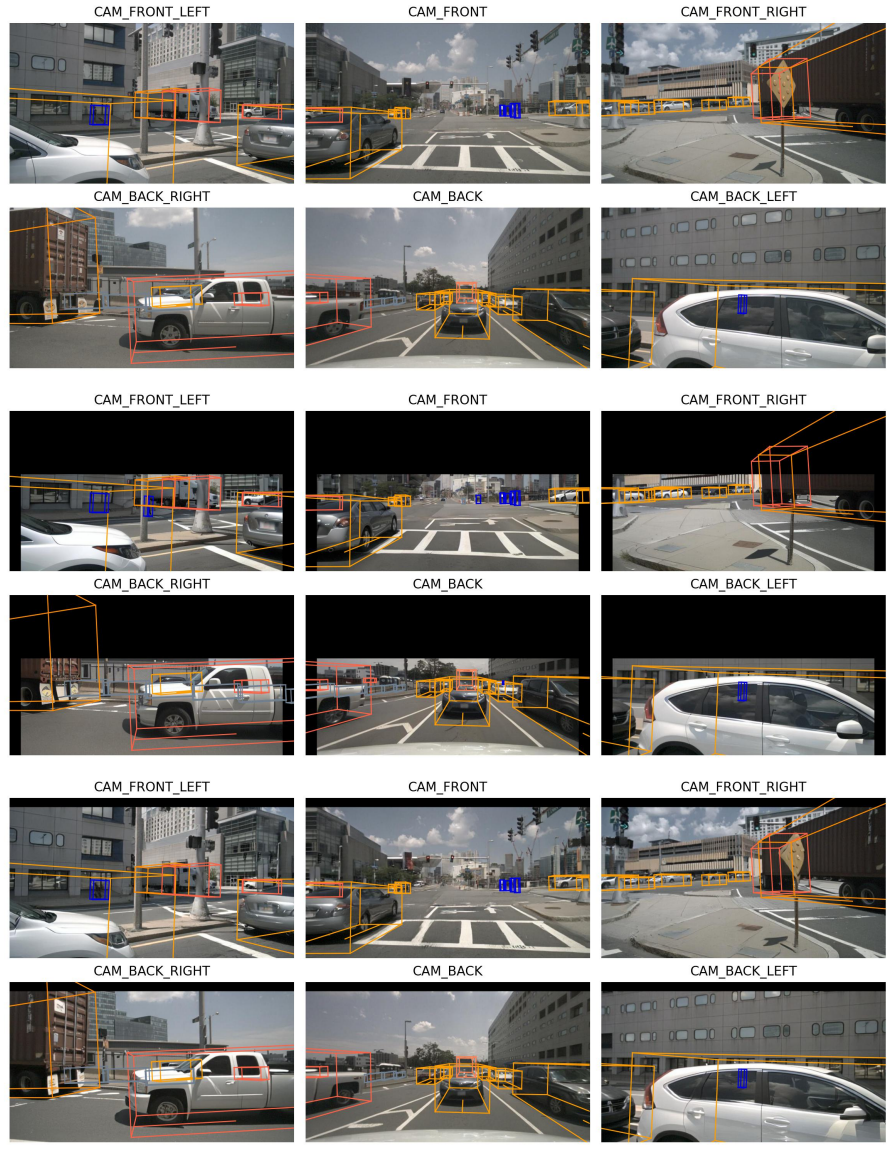
The central object is a scene graph of 3D Gaussian primitives: static nodes model the background, rigid nodes model foreground vehicles, and deformable nodes model pedestrians. Augmentation inserts a new rigid node—a Gaussian asset in canonical coordinates—and applies a rigid transformation $T_a \in SE(3)$ sampled from drivable space, with rejection sampling for collisions and for agents that would be mostly occluded from a camera. Because rendering is differentiable $\alpha$-blending of depth-sorted Gaussians projected into each camera, the same 3D edit appears consistently in all six cameras, and the object's 3D box is known exactly from $T_a$. The geometric transformation, not the asset's appearance, does the work of the augmentation.
What would settle it
Render an inserted asset, then measure the pixel distance between its Gaussians' projected depth and the depth range implied by its declared 3D box; if a nontrivial fraction of augmentations show a box-to-render misalignment of more than a few pixels, the label-accuracy mechanism is not established. Alternatively, add controlled Gaussian noise to the box annotations of augmented frames and check whether the observed mAP gain is unchanged.
Extended reading notes
Core claim
On the nuScenes validation set, training a monocular 3D detector on real frames plus Gaussian-splatting-augmented frames improves mAP from 32.57 (real data doubled) to 33.20, and a multi-camera detector improves from 35.77 to 37.17. Augmented frames alone, without any real frames, reach 31.48 and 34.97 mAP, respectively, already close to the single-copy real-data baselines. The paper attributes this to explicit 3D control: each inserted agent is a set of Gaussian primitives in canonical coordinates, and its placement is a rigid transformation sampled from drivable space with collision and visibility checks, so rendered geometry and 3D bounding-box annotations coincide by construction. Diffusion-based baselines that condition on bird's-eye-view layouts provide no such geometry guarantee and underperform in both settings. The paper also shows that one unique asset per category suffices to outperform those baselines, and that random pose and location sampling beats placement designed to maximize detector loss or occlusion.
Load-bearing premise
The inserted 3D objects are assumed to align so perfectly with a shared canonical coordinate system that the declared 3D bounding boxes exactly match the rendered geometry; the paper does not quantify this alignment error.
Editorial extensions
If this is right
- Real-plus-augmented training beats training on twice the real data for both a monocular and a multi-camera 3D detector, by 0.63 and 1.40 mAP respectively.
- A single reconstructed 3D object per category is sufficient to outperform diffusion-based augmentation; a larger asset library adds only marginal gains.
- Random pose sampling does not change mAP relative to pose-aligned placement but markedly improves orientation error (mAOE).
- Placing agents to maximize detector loss or to maximize occlusion does not improve efficiency over random placement for these camera-based detectors.
- Because editing happens in a shared 3D field, multi-camera consistency is automatic, unlike image-space diffusion baselines.
Reading between the lines
- If the reported label-accuracy advantage holds, the method points toward near-zero-cost annotation for rare or underrepresented categories: a small library of reconstructed assets could generate arbitrarily many labeled placements across a fixed set of reconstructed scenes.
- The geometric-diversity result suggests that combining Gaussian-splatting placement with photometric variation from diffusion or style transfer, which the paper does not test, could be additive.
- The hard-example negative result may be sensitive to the search budget (16 random seeds per placement); a broader or gradient-based search over placements could overturn it.
- The technique's viability depends on the reconstructed scene itself being accurate; as reconstruction quality improves, this augmentation route could extend to closed-loop simulation for driving policy training.
Signed reviews
Editorial analysis
A structured set of objections, weighed in public.
Referee Report
Summary. The paper proposes using 3D Gaussian Splatting scene reconstruction, specifically OmniRe, to augment camera-based 3D object detection training data for autonomous driving. The method reconstructs nuScenes training scenes as a 3D Gaussian scene graph, inserts external 3D object assets at physically plausible locations via explicit SE(3) transformations, and re-renders the augmented scenes. The authors train FCOS3D (monocular) and SparseBEV (multi-camera) on real data, augmented data, and mixtures of both, and compare against diffusion-based baselines (MagicDrive, MagicDriveDiT) and a depth-conditioned inpainting baseline. The central empirical claim is that adding a limited number of external 3D objects into real scenes improves 3D detection performance beyond doubling the real data, and that geometric diversity of object placement is more important than appearance diversity. The paper also reports that hard-example mining and high-occlusion placement do not improve augmentation efficiency.
Significance. If the reported gains are robust and correctly attributed, this is a practically valuable alternative to diffusion-based augmentation for camera-based 3D detection: it operates at native resolution, renders quickly, and provides explicit, geometrically consistent 3D labels. The evaluation is clean in several respects: it uses two detectors, two augmentation schemes, multiple baselines, and a held-out real validation set, and the augmented labels are derived from explicit SE(3) transformations independent of detector predictions. However, the significance is conditional on resolving two load-bearing issues: the missing control for the re-rendering pipeline itself, and the absence of variance estimates for modest reported gains. The geometric-vs-photometric diversity claim is also currently an interpretation rather than a directly tested hypothesis.
major comments (4)
- [§3.2, Eq. (3), Tables 1 and 2] The experimental design confounds scene re-rendering through OmniRe with insertion of external objects. Every augmented frame in the "Real + augm." condition is both a re-render of the 3D-GS reconstruction and a scene containing an extra inserted agent, while the "Real data (2x)" condition repeats original real images. Eq. (3) shows that setting G_a = ∅ would render the same OmniRe scene without insertion, but no such row appears in Tables 1 and 2. The reported gains over Real data (2x) are +0.63 mAP (FCOS3D) and +1.40 mAP (SparseBEV); if the OmniRe re-rendering alone acts as a domain-randomization regularizer, the central claim that "integrating external 3D objects" is the active ingredient is not supported. Please add a "Real + OmniRe re-render (G_a = ∅)" condition, and ideally also the corresponding "Augm. only" condition, so that the effect of insertion is isolated.
- [Tables 1-5] No error bars, multiple seeds, or statistical significance tests are reported for any of the main comparisons. The key improvements over Real data (2x) are modest (0.63 and 1.40 mAP), and with a single training run per condition it is not possible to distinguish a genuine effect from run-to-run training stochasticity. This is especially important because the abstract and conclusion make strong comparative claims against diffusion baselines. Please report mean and standard deviation over at least three independent training seeds for the main conditions, and consider a paired test across validation scenes or a significance statement.
- [§4.3, Table 3] The experiment reported as evidence that "geometric diversity plays a more crucial role than photometric diversity" does not actually isolate these two factors. Moving from the "1/1" row to the "3/10" row changes both the number of inserted agents per camera and the number of unique asset instances per class simultaneously. Moreover, the comparison to diffusion-based baselines changes resolution, layout fidelity, conditioning mechanism, and view consistency, so differences cannot be attributed to geometric diversity. To support the claim, please report experiments that vary placement locations and orientations while holding the asset set fixed, and vary the asset set while holding the placement distribution fixed.
- [Appendix A.1] The claim of "highly accurate 3D pose and position annotations" relies on aligning all reconstructed assets to a universal canonical coordinate system using an ICP-based template matching procedure, but the alignment error is never quantified. If the alignment is imperfect, the ground-truth boxes obtained from the applied transformation T_a will systematically disagree with the rendered object geometry, and the augmentation mechanism could then be one of label noise rather than accurate pose supervision. Please report alignment residuals (e.g., mean chamfer distance, rotation error, or analogous quantitative metrics) and provide some visual or quantitative validation that the rendered assets match the assigned 3D boxes.
minor comments (5)
- [§3.2, visibility ratio] The formula for the visibility ratio is written as r = Σ_i(V_i)/|(V_i)|, which is ambiguous and dimensionally unclear; it should be r = (1/N) Σ_i V_i, where N is the number of agent points.
- [§4.5] There is a typo: "the the usefulness" should be "the usefulness".
- [Table 4 and §4.5] The occlusion-based hard-example strategy is described in terms of 2D IoU, but the table caption says "low/high occlusion"; please clarify the exact metric and the penalty used for fully occluded objects.
- [Appendix A.1] The supplementary text refers to "SAM(v2)" but the reference [18] is Segment Anything; please make the version and citation consistent.
- [General] The paper does not state whether code or trained models will be released; given the number of implementation details (asset alignment, scene reconstruction, rendering), a reproducibility statement would be valuable.
Circularity Check
No circularity: the augmented labels are derived from explicit SE(3) transformations and detector gains are measured on held-out real validation frames.
full rationale
The paper's central claim is empirical rather than derivational: 3D-GS-based augmentation improves FCOS3D and SparseBEV on the nuScenes validation set compared with real-data and diffusion-based baselines. The augmented labels y' are obtained from the explicitly applied transformation Ta in Eq. (3), and the inserted agent Gaussians Ga are external 3D assets reconstructed independently of the detector being trained. There is no fitted parameter that is later renamed as a prediction; the reported mAP numbers are measured on real validation images after training. The only selection mechanism, the hard-example search in Eq. (4), uses the detector's loss to pick among candidate placements, but the resulting comparison to random placement is itself an experiment and does not define the reported validation performance. The paper's reliance on OmniRe is a citation to external prior work, not a self-citation chain, and no uniqueness theorem or ansatz is imported from the authors' own prior work to forbid alternatives. The skeptic's concern about the missing G_a = ∅ re-render-only control is a legitimate experimental confound (the augmented frames differ from real frames by both re-rendering and insertion), but it is not circularity: the claimed effect is not equivalent to its inputs by construction, and a missing control does not satisfy the standard of exhibiting Eq. X = Eq. Y or a fitted input renamed as a prediction. Therefore the circularity burden is minimal and the correct score is 0.
Assumptions & free parameters
free parameters (4)
- visibility ratio threshold r
- number of inserted agents per camera =
3 (main), 1 (ablation)
- number of unique assets per class =
~10 (1 in ablation)
- random seeds for hard-example search =
16
assumptions (3)
- domain assumption OmniRe reconstructs nuScenes scenes with sufficient fidelity that inserted objects render realistically and do not corrupt the detector's input distribution.
- domain assumption Reconstructed agent assets are aligned to a universal canonical coordinate system with negligible error, so the applied transformation Ta yields accurate ground-truth 3D boxes.
- domain assumption nuScenes BEV roadmaps and 3D bounding box annotations are accurate enough to define drivable space and reject collisions.
Cite this review
Pith. "Pith review of Gaussian Splatting is an Effective Data Generator for 3D Object Detection." pith.science (2026). https://pith.science/paper/IDFYURJZ
@misc{pith2026250416740,
  author       = {Pith},
  title        = {Pith review of: Gaussian Splatting is an Effective Data Generator for 3D Object Detection},
  year         = {2026},
  howpublished = {\url{https://pith.science/paper/IDFYURJZ}},
  note         = {Machine review of arXiv:2504.16740}
}
read the original abstract
We investigate data augmentation for 3D object detection in autonomous driving. We utilize recent advancements in 3D reconstruction based on Gaussian Splatting for 3D object placement in driving scenes. Unlike existing diffusion-based methods that synthesize images conditioned on BEV layouts, our approach places 3D objects directly in the reconstructed 3D space with explicitly imposed geometric transformations. This ensures both the physical plausibility of object placement and highly accurate 3D pose and position annotations. Our experiments demonstrate that even by integrating a limited number of external 3D objects into real scenes, the augmented data significantly enhances 3D object detection performance and outperforms existing diffusion-based 3D augmentation for object detection. Extensive testing on the nuScenes dataset reveals that imposing high geometric diversity in object placement has a greater impact compared to the appearance diversity of objects. Additionally, we show that generating hard examples, either by maximizing detection loss or imposing high visual occlusion in camera images, does not lead to more efficient 3D data augmentation for camera-based 3D object detection in autonomous driving.
Figures


Figures from the paper (9 more)



Forward citations
Cited by 1 Pith paper
-
Diffuse the object, keep its label: curating detector training data from a few unlabeled photographs via VLM-built 3D vegetation scenes
A detector trained on VLM-built 3D scenes re-textured by diffusion, with a graded mask-lock on the object, matched or exceeded a detector trained on a larger real labeled dataset on cross-site landmine detection.
Reference graph
Works this paper leans on
-
[1]
Synthesizing robust adversarial examples
Anish Athalye, Logan Engstrom, Andrew Ilyas, and Kevin Kwok. Synthesizing robust adversarial examples. In ICML, pages 284–293. PMLR, 2018. 6
work page 2018
-
[2]
LooseC- ontrol: Lifting controlnet for generalized depth conditioning
Shariq Farooq Bhat, Niloy Mitra, and Peter Wonka. LooseC- ontrol: Lifting controlnet for generalized depth conditioning. In ACM SIGGRAPH 2024 Conference Papers , pages 1–11,
2024
-
[3]
Stable video diffusion: Scaling latent video diffusion models to large datasets
Andreas Blattmann, Tim Dockhorn, Sumith Kulal, Daniel Mendelevitch, Maciej Kilian, Dominik Lorenz, Yam Levi, Zion English, Vikram V oleti, Adam Letts, et al. Stable video diffusion: Scaling latent video diffusion models to large datasets. arXiv preprint arXiv:2311.15127, 2023. 1
arXiv 2023
-
[4]
nuscenes: A multi- modal dataset for autonomous driving
Holger Caesar, Varun Bankiti, Alex H Lang, Sourabh V ora, Venice Erin Liong, Qiang Xu, Anush Krishnan, Yu Pan, Gi- ancarlo Baldan, and Oscar Beijbom. nuscenes: A multi- modal dataset for autonomous driving. In CVPR, 2020. 1, 4, 11
work page 2020
-
[5]
Deepdriving: Learning affordance for direct percep- tion in autonomous driving
Chenyi Chen, Ari Seff, Alain Kornhauser, and Jianxiong Xiao. Deepdriving: Learning affordance for direct percep- tion in autonomous driving. In ICCV, pages 2722–2730,
-
[6]
Geodiffusion: Text- prompted geometric control for object detection data gen- eration
Kai Chen, Enze Xie, Zhe Chen, Yibo Wang, Lanqing Hong, Zhenguo Li, and Dit-Yan Yeung. Geodiffusion: Text- prompted geometric control for object detection data gen- eration. ICLR, 2024. 2
work page 2024
-
[7]
Omnire: Omni ur- ban scene reconstruction
Ziyu Chen, Jiawei Yang, Jiahui Huang, Riccardo de Lutio, Janick Martinez Esturo, Boris Ivanovic, Or Litany, Zan Go- jcic, Sanja Fidler, Marco Pavone, et al. Omnire: Omni ur- ban scene reconstruction. arXiv preprint arXiv:2408.16760,
-
[8]
MMDetection3D: Open- MMLab next-generation platform for general 3D object detection
MMDetection3D Contributors. MMDetection3D: Open- MMLab next-generation platform for general 3D object detection. https://github.com/open- mmlab/ mmdetection3d, 2020. 4
work page 2020
Show all 53 references
-
[9]
CARLA: An open urban driving simulator
Alexey Dosovitskiy, German Ros, Felipe Codevilla, Antonio Lopez, and Vladlen Koltun. CARLA: An open urban driving simulator. In Proceedings of the 1st Annual Conference on Robot Learning, 2017. 1
2017
-
[10]
3drealcar: An in-the-wild rgb- d car dataset with 360-degree views
Xiaobiao Du, Haiyang Sun, Shuyun Wang, Zhuojie Wu, Hongwei Sheng, Jiaying Ying, Ming Lu, Tianqing Zhu, Kun Zhan, and Xin Yu. 3drealcar: An in-the-wild rgb- d car dataset with 360-degree views. arXiv preprint arXiv:2406.04875, 2024. 4
2024 arXiv
-
[11]
Hugging face: Natural language processing made easy, 2025
Hugging Face. Hugging face: Natural language processing made easy, 2025. 11
2025
-
[12]
Multi-level neural scene graphs for dynamic urban environments
Tobias Fischer, Lorenzo Porzi, Samuel Rota Bulo, Marc Pollefeys, and Peter Kontschieder. Multi-level neural scene graphs for dynamic urban environments. In CVPR, pages 21125–21135, 2024. 2
2024
-
[13]
Magicdrive3d: Controllable 3d genera- tion for any-view rendering in street scenes
Ruiyuan Gao, Kai Chen, Zhihao Li, Lanqing Hong, Zhenguo Li, and Qiang Xu. Magicdrive3d: Controllable 3d genera- tion for any-view rendering in street scenes. arXiv preprint arXiv:2405.14475, 2024. 2
2024 arXiv
-
[14]
Magicdrivedit: High-resolution long video generation for autonomous driving with adaptive con- trol
Ruiyuan Gao, Kai Chen, Bo Xiao, Lanqing Hong, Zhen- guo Li, and Qiang Xu. Magicdrivedit: High-resolution long video generation for autonomous driving with adaptive con- trol. arXiv preprint arXiv:2411.13807, 2024. 2, 5, 6
2024 arXiv
-
[15]
Magicdrive: Street view generation with diverse 3d geometry control
Ruiyuan Gao, Kai Chen, Enze Xie, Lanqing Hong, Zhenguo Li, Dit-Yan Yeung, and Qiang Xu. Magicdrive: Street view generation with diverse 3d geometry control. ICLR, 2024. 1, 2, 4, 5, 6, 12
2024
-
[16]
Feedback-guided data synthesis for imbalanced classifica- tion
Reyhane Askari Hemmat, Mohammad Pezeshki, Florian Bordes, Michal Drozdzal, and Adriana Romero-Soriano. Feedback-guided data synthesis for imbalanced classifica- tion. arXiv preprint arXiv:2310.00158, 2023. 6
2023 arXiv
-
[17]
3d gaussian splatting for real-time radiance field rendering
Bernhard Kerbl, Georgios Kopanas, Thomas Leimk ¨uhler, and George Drettakis. 3d gaussian splatting for real-time radiance field rendering. ACM Trans. Graph., 42(4):139–1,
-
[18]
Segment any- thing
Alexander Kirillov, Eric Mintun, Nikhila Ravi, Hanzi Mao, Chloe Rolland, Laura Gustafson, Tete Xiao, Spencer White- head, Alexander C Berg, Wan-Yen Lo, et al. Segment any- thing. In ICCV, pages 4015–4026, 2023. 11
2023
-
[19]
Dataset enhancement with instance-level augmentations
Orest Kupyn and Christian Rupprecht. Dataset enhancement with instance-level augmentations. ECCV, 2024. 11
2024
-
[20]
3d- vfield: Adversarial augmentation of point clouds for do- main generalization in 3d object detection
Alexander Lehner, Stefano Gasperini, Alvaro Marcos- Ramiro, Michael Schmidt, Mohammad-Ali Nikouei Mahani, Nassir Navab, Benjamin Busam, and Federico Tombari. 3d- vfield: Adversarial augmentation of point clouds for do- main generalization in 3d object detection. In CVPR, pages...
2022
-
[21]
GLIGEN: open-set grounded text-to-image generation
Yuheng Li, Haotian Liu, Qingyang Wu, Fangzhou Mu, Jianwei Yang, Jianfeng Gao, Chunyuan Li, and Yong Jae Lee. GLIGEN: open-set grounded text-to-image generation. In IEEE/CVF Conference on Computer Vision and Pattern Recognition, CVPR 2023, Vancouver, BC, Canada, June 17- 24, 20...
2023
-
[22]
Bevformer: learning bird’s-eye-view representation from lidar-camera via spatiotemporal transformers
Zhiqi Li, Wenhai Wang, Hongyang Li, Enze Xie, Chong- hao Sima, Tong Lu, Qiao Yu, and Jifeng Dai. Bevformer: learning bird’s-eye-view representation from lidar-camera via spatiotemporal transformers. IEEE TPAMI, 2024. 2
2024
-
[23]
Sparsebev: High-performance sparse 3d object de- tection from multi-camera videos
Haisong Liu, Yao Teng, Tao Lu, Haiguang Wang, and Limin Wang. Sparsebev: High-performance sparse 3d object de- tection from multi-camera videos. In ICCV, pages 18580– 18590, 2023. 2, 4, 6, 7
2023
-
[24]
Nerf: Representing scenes as neural radiance fields for view syn- thesis
Ben Mildenhall, Pratul P Srinivasan, Matthew Tancik, Jonathan T Barron, Ravi Ramamoorthi, and Ren Ng. Nerf: Representing scenes as neural radiance fields for view syn- thesis. Communications of the ACM , 65(1):99–106, 2021. 2
2021
-
[25]
Neural scene graphs for dynamic scenes
Julian Ost, Fahim Mannan, Nils Thuerey, Julian Knodt, and Felix Heide. Neural scene graphs for dynamic scenes. In CVPR, pages 2856–2865, 2021. 2
2021
-
[26]
Scalable diffusion models with transformers
William Peebles and Saining Xie. Scalable diffusion models with transformers. In ICCV, 2023. 2 9
2023
-
[27]
Com- mon objects in 3d: Large-scale learning and evaluation of real-life 3d category reconstruction
Jeremy Reizenstein, Roman Shapovalov, Philipp Henzler, Luca Sbordone, Patrick Labatut, and David Novotny. Com- mon objects in 3d: Large-scale learning and evaluation of real-life 3d category reconstruction. In ICCV, 2021. 4
2021
-
[28]
High-resolution image syn- thesis with latent diffusion models
Robin Rombach, Andreas Blattmann, Dominik Lorenz, Patrick Esser, and Bj¨orn Ommer. High-resolution image syn- thesis with latent diffusion models. In CVPR, 2022. 1, 5
2022
-
[29]
Denoising diffusion implicit models
Jiaming Song, Chenlin Meng, and Stefano Ermon. Denoising diffusion implicit models. arXiv preprint arXiv:2010.02502, 2020. 11
2010 arXiv
-
[30]
Scalability in perception for autonomous driving: Waymo open dataset
Pei Sun, Henrik Kretzschmar, Xerxes Dotiwalla, Aurelien Chouard, Vijaysai Patnaik, Paul Tsui, James Guo, Yin Zhou, Yuning Chai, Benjamin Caine, Vijay Vasudevan, Wei Han, Jiquan Ngiam, Hang Zhao, Aleksei Timofeev, Scott Et- tinger, Maxim Krivokon, Amy Gao, Aditya Joshi, Yu Zhan...
1912 arXiv
-
[31]
Gen2det: Generate to detect
Saksham Suri, Fanyi Xiao, Animesh Sinha, Sean Chang Cu- latana, Raghuraman Krishnamoorthi, Chenchen Zhu, and Abhinav Shrivastava. Gen2det: Generate to detect. arXiv preprint arXiv:2312.04566, 2023. 11
2023 arXiv
-
[32]
Street- view image generation from a bird’s-eye view layout
Alexander Swerdlow, Runsheng Xu, and Bolei Zhou. Street- view image generation from a bird’s-eye view layout. RAL,
-
[33]
Neurad: Neural rendering for autonomous driving
Adam Tonderski, Carl Lindstr ¨om, Georg Hess, William Ljungbergh, Lennart Svensson, and Christoffer Petersson. Neurad: Neural rendering for autonomous driving. InCVPR, pages 14895–14904, 2024. 2
2024
-
[34]
Suds: Scalable urban dynamic scenes
Haithem Turki, Jason Y Zhang, Francesco Ferroni, and Deva Ramanan. Suds: Scalable urban dynamic scenes. In CVPR, pages 12375–12385, 2023. 2
2023
-
[35]
Fcos3d: Fully convolutional one-stage monocular 3d object detection
Tai Wang, Xinge Zhu, Jiangmiao Pang, and Dahua Lin. Fcos3d: Fully convolutional one-stage monocular 3d object detection. In ICCV, pages 913–922, 2021. 2, 4, 6, 7
2021
-
[36]
Detdiffusion: Synergizing gen- erative and perceptive models for enhanced data generation and perception
Yibo Wang, Ruiyuan Gao, Kai Chen, Kaiqiang Zhou, Yingjie Cai, Lanqing Hong, Zhenguo Li, Lihui Jiang, Dit- Yan Yeung, Qiang Xu, et al. Detdiffusion: Synergizing gen- erative and perceptive models for enhanced data generation and perception. arXiv preprint arXiv:2403.13304, 2024. 6
2024 arXiv
-
[37]
Mars: An instance-aware, mod- ular and realistic simulator for autonomous driving
Zirui Wu, Tianyu Liu, Liyi Luo, Zhide Zhong, Jianteng Chen, Hongmin Xiao, Chao Hou, Haozhe Lou, Yuantao Chen, Runyi Yang, et al. Mars: An instance-aware, mod- ular and realistic simulator for autonomous driving. In CAAI International Conference on Artificial Intelligence, pages 3–
-
[38]
Neural assets: 3d-aware multi-object scene synthesis with image diffusion models
Ziyi Wu, Yulia Rubanova, Rishabh Kabra, Drew A Hud- son, Igor Gilitschenski, Yusuf Aytar, Sjoerd van Steenkiste, Kelsey R Allen, and Thomas Kipf. Neural assets: 3d-aware multi-object scene synthesis with image diffusion models. arXiv preprint arXiv:2406.09292, 2024. 1
2024 arXiv
-
[39]
Torcs, the open racing car simulator
Bernhard Wymann, Eric Espi ´e, Christophe Guionneau, Christos Dimitrakakis, R ´emi Coulom, and Andrew Sumner. Torcs, the open racing car simulator. 2000. 1
2000
-
[40]
On the adversarial robust- ness of camera-based 3d object detection
S Xie, Z Li, Z Wang, and C Xie. On the adversarial robust- ness of camera-based 3d object detection. arxiv 2023. arXiv preprint arXiv:2301.10766, 2023. 2
2023 arXiv
-
[41]
Street gaussians: Modeling dynamic urban scenes with gaussian splatting
Yunzhi Yan, Haotong Lin, Chenxu Zhou, Weijie Wang, Haiyang Sun, Kun Zhan, Xianpeng Lang, Xiaowei Zhou, and Sida Peng. Street gaussians: Modeling dynamic urban scenes with gaussian splatting. In ECCV, 2024. 2, 3
2024
-
[42]
Bevformer v2: Adapting modern image backbones to bird’s-eye-view recognition via perspective su- pervision
Chenyu Yang, Yuntao Chen, Hao Tian, Chenxin Tao, Xizhou Zhu, Zhaoxiang Zhang, Gao Huang, Hongyang Li, Yu Qiao, Lewei Lu, et al. Bevformer v2: Adapting modern image backbones to bird’s-eye-view recognition via perspective su- pervision. In CVPR, pages 17830–17839, 2023. 2
2023
-
[43]
Emernerf: Emergent spatial-temporal scene decomposition via self-supervision
Jiawei Yang, Boris Ivanovic, Or Litany, Xinshuo Weng, Se- ung Wook Kim, Boyi Li, Tong Che, Danfei Xu, Sanja Fidler, Marco Pavone, et al. Emernerf: Emergent spatial-temporal scene decomposition via self-supervision. arXiv preprint arXiv:2311.02077, 2023. 2
2023 arXiv
-
[44]
Bevcontrol: Accurately controlling street- view elements with multi-perspective consistency via bev sketch layout
Kairui Yang, Enhui Ma, Jibin Peng, Qing Guo, Di Lin, and Kaicheng Yu. Bevcontrol: Accurately controlling street- view elements with multi-perspective consistency via bev sketch layout. arXiv preprint arXiv:2308.01661, 2023. 2
2023 arXiv
-
[45]
Depth anything: Unleashing the power of large-scale unlabeled data
Lihe Yang, Bingyi Kang, Zilong Huang, Xiaogang Xu, Jiashi Feng, and Hengshuang Zhao. Depth anything: Unleashing the power of large-scale unlabeled data. In IEEE/CVF Con- ference on Computer Vision and Pattern Recognition, CVPR 2024, Seattle, WA, USA, June 16-22, 2024 , pages 1...
2024
-
[46]
Unisim: A neural closed-loop sensor simulator
Ze Yang, Yun Chen, Jingkang Wang, Sivabalan Mani- vasagam, Wei-Chiu Ma, Anqi Joyce Yang, and Raquel Ur- tasun. Unisim: A neural closed-loop sensor simulator. In CVPR, pages 1389–1399, 2023. 2
2023
-
[47]
Bdd100k: A diverse driving dataset for heterogeneous multitask learning
Fisher Yu, Haofeng Chen, Xin Wang, Wenqi Xian, Yingying Chen, Fangchen Liu, Vashisht Madhavan, and Trevor Dar- rell. Bdd100k: A diverse driving dataset for heterogeneous multitask learning. In CVPR, 2020. 1
2020
-
[48]
Adding conditional control to text-to-image diffusion models, 2023
Lvmin Zhang, Anyi Rao, and Maneesh Agrawala. Adding conditional control to text-to-image diffusion models, 2023. 5, 11
2023
-
[49]
Open-sora: Democratizing efficient video production for all, 2024
Zangwei Zheng, Xiangyu Peng, Tianji Yang, Chenhui Shen, Shenggui Li, Hongxin Liu, Yukun Zhou, Tianyi Li, and Yang You. Open-sora: Democratizing efficient video production for all, 2024. 1
2024
-
[50]
Hugs: Holistic urban 3d scene understanding via gaus- sian splatting
Hongyu Zhou, Jiahao Shao, Lu Xu, Dongfeng Bai, Weichao Qiu, Bingbing Liu, Yue Wang, Andreas Geiger, and Yiyi Liao. Hugs: Holistic urban 3d scene understanding via gaus- sian splatting. In CVPR, pages 21336–21345, 2024. 2, 3
2024
-
[51]
F&f attack: Adversarial attack against multiple object trackers by inducing false negatives and false positives
Tao Zhou, Qi Ye, Wenhan Luo, Kaihao Zhang, Zhiguo Shi, and Jiming Chen. F&f attack: Adversarial attack against multiple object trackers by inducing false negatives and false positives. In ICCV, pages 4573–4583, 2023. 6
2023
-
[52]
Drivinggaussian: Composite gaussian splatting for surrounding dynamic au- tonomous driving scenes
Xiaoyu Zhou, Zhiwei Lin, Xiaojun Shan, Yongtao Wang, Deqing Sun, and Ming-Hsuan Yang. Drivinggaussian: Composite gaussian splatting for surrounding dynamic au- tonomous driving scenes. In CVPR, pages 21634–21643,
-
[2024]
object replacement
2, 3 10 Gaussian Splatting is an Effective Data Generator for 3D Object Detection Supplementary Material A.1. 3D asset generation pipeline To generate 3D models of objects from multi-view image datasets, we first used SAM(v2) by prompting on a coarse 2D mask of the object in t...
Reviewed August 16, 2026 · model on record in the stance chip above.
Discussion (0). Continue with ORCID to comment.