REVIEW 3 major objections 3 minor 1 cited by
Transforming Evidence Synthesis: A Systematic Review of the Evolution of Automated Meta-Analysis in the Age of AI
T0 review · 3 major / 3 minor · reviewed 2026-08-16 · deepseek-v4-flash
Pith's one-line read Automated meta-analysis remains concentrated in data extraction and statistical modeling, with full-process automation nearly absent.
desk verdict Useful survey of automated meta-analysis with a curated corpus, but the headline '2% full automation' is contradicted by the paper's own appendix and rests on subjective coding. read the letter →
The pith
A machine-rendered reading of the paper's core claim, the machinery that carries it, and where it could break.
The reading
What carries the argument
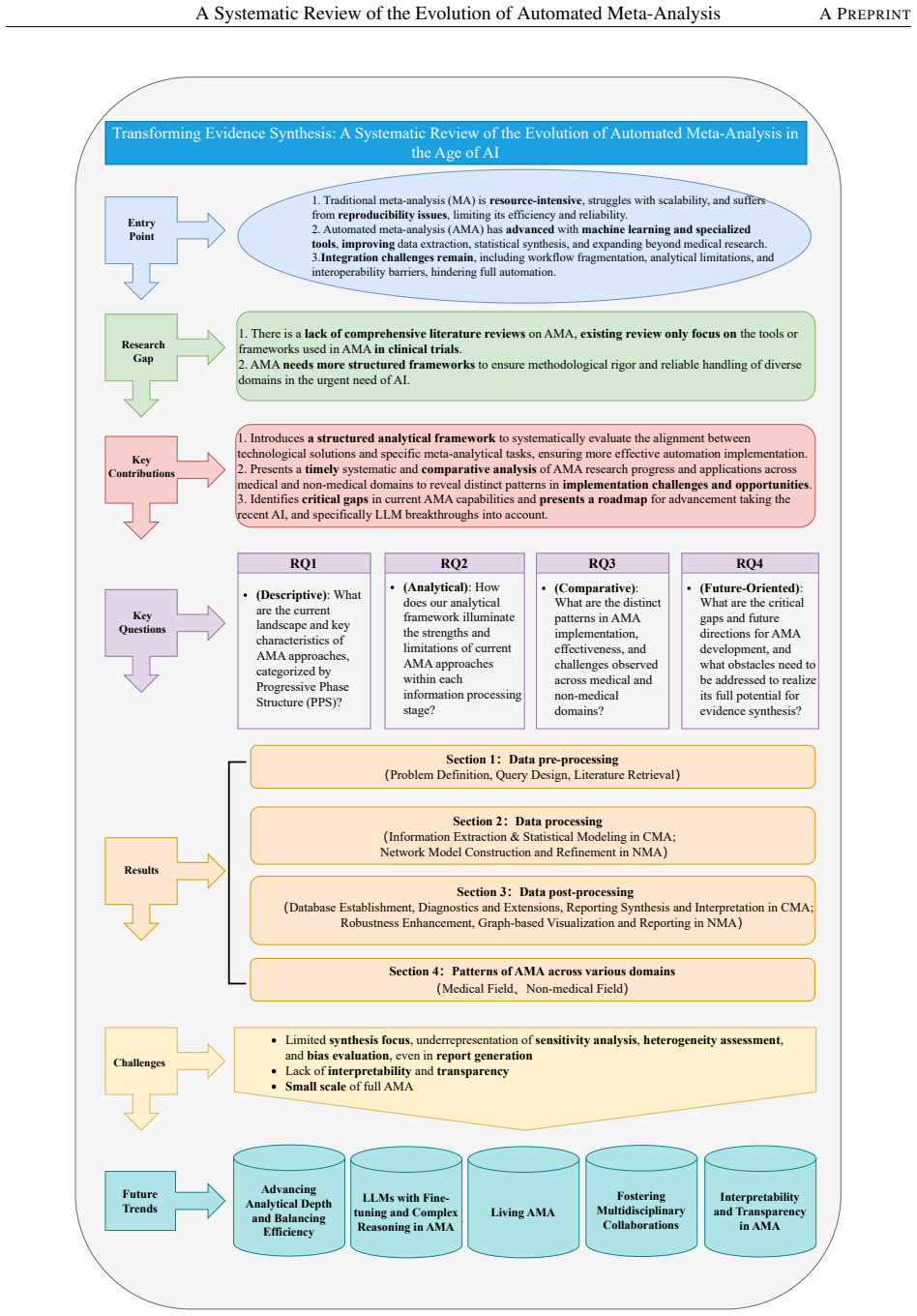
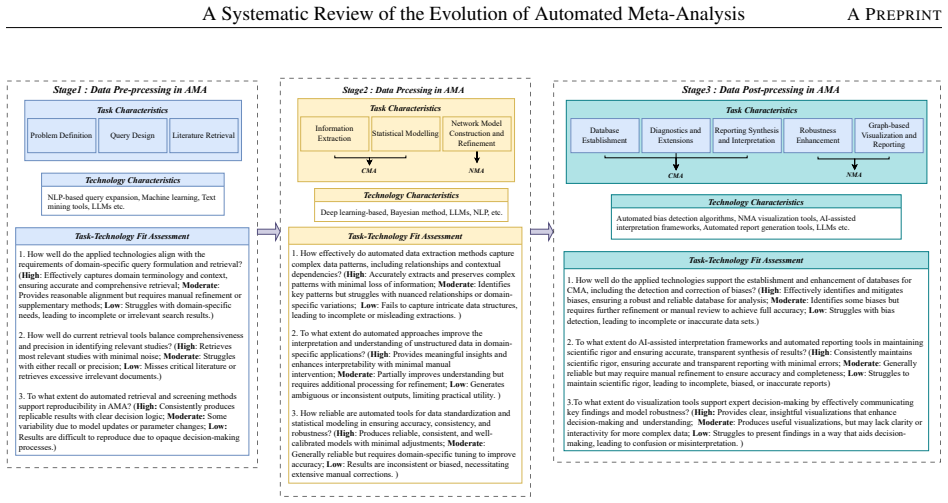
The machinery is the Progressive Phase Structure (PPS) with Task-Technology Fit (TTF). PPS divides meta-analysis into three phases—data pre-processing (problem definition, query design, literature retrieval), data processing (information extraction and statistical modeling, or network construction in NMA), and data post-processing (database building, diagnostics, reporting, visualization)—and TTF grades how well a technology's characteristics match each phase's tasks. This framework does the paper's quantitative work: it is the instrument by which the 54 studies are tagged by stage, the 57%/17%/2% distribution is produced, and the medical versus non-medical comparison is explained.
What would settle it
Re-code the 54 included studies using the paper's own PPS definitions. If two or more studies beyond [39] are found to automate pre-processing, processing, and post-processing—as Appendix 1's rows for [16] and [82] suggest—the 2% full-automation claim is refuted; if independent coding reproduces a single full-process study, the claim survives.
Extended reading notes
Core claim
The central claim is that automated meta-analysis has matured as a set of point solutions rather than as an end-to-end pipeline. Using a three-stage Progressive Phase Structure (pre-processing, processing, post-processing) paired with Task-Technology Fit, the authors classify 54 studies and find that 89% automate a single meta-analysis step, only 11% address multiple stages, and just one study ([39]) spans all three. They further report that 57% of the work concentrates on data processing, compared with 17% on advanced synthesis, and that LLMs have entered extraction and screening but remain underused in statistical modeling and higher-order synthesis such as heterogeneity and bias assessment. Medical applications (67% of the dataset) show stronger task-technology fit because clinical trial data is standardized, while non-medical fields (33%) struggle with heterogeneous data and reporting styles. The paper concludes that achieving seamless, end-to-end automation remains an open challenge, and that LLMs with reasoning capability are the natural next step for closing it.
Load-bearing premise
The headline percentages rest on the authors' stage-by-stage coding of which studies automate which phases, and specifically on counting only study [39] as full-process automation; the appendix's own markers for [16] and [82] appear to contradict that count.
Editorial extensions
If this is right
- If the distribution is accurate, the highest-value next target for AMA is not more extraction tools but automated heterogeneity assessment, bias evaluation, and sensitivity analysis.
- Full-process AMA remains an open problem, so near-term systems should be semi-automated, with expert oversight at synthesis and interpretation steps.
- In standardized medical data, automation fit is strong and near-term deployment can proceed, while non-medical domains need more adaptable, less format-dependent tools.
- LLM-based extraction is viable but not yet trustworthy for quantitative outcomes, so hallucination control and validation benchmarks are prerequisites for clinical use.
- A living AMA that continuously updates evidence will require new infrastructure for monitoring, version control, and reconciling conflicting new studies.
Reading between the lines
- The paper's own Appendix 1 marks [16] and [82] as covering pre-processing, processing, and post-processing; if those markers are read literally, the claim that only [39] achieved full-process automation would need to be revised upward, undercutting the 2% headline.
- A natural next step, not pursued in the paper, is to turn the TTF fit ratings into a quantitative rubric and have independent coders re-score the 54 studies, which would test whether the stage distribution is stable.
- The same framework could be applied prospectively: new LLM-based tools could be benchmarked by which PPS stages they cover and how well they handle heterogeneity and bias, giving the field a shared scorecard.
Signed reviews
Editorial analysis
A structured set of objections, weighed in public.
Referee Report
Summary. This manuscript reports a PRISMA-guided systematic review of automated meta-analysis (AMA), screening 978 records and analyzing 54 studies published between 2006 and 2024. The authors introduce a Progressive Phase Structure (PPS) that splits AMA into pre-processing, processing, and post-processing, and combine it with Task-Technology Fit (TTF) judgments. They report that research is concentrated in the data-processing stage (57%), that only 17% address advanced synthesis (heterogeneity, bias, sensitivity), and that just one study (2%) attempts full-process automation. They also compare CMA versus NMA, medical versus non-medical domains, and propose future research directions, including fine-tuned LLMs, living AMA, and interpretability standards.
Significance. If the quantitative claims were reliable, the review would fill a real gap: it is broader than an earlier clinical-trials-focused AMA review [23] and it provides a 54-study appendix organized by field, methodology, and automation stage. The PRISMA process is described, the snowballing extension is a useful design choice, and the domain-level comparison (medical vs. non-medical, CMA vs. NMA) is a genuinely useful contribution. The paper is also candid about its limitations (§6.5). However, the headline quantitative findings rest on a coding scheme that is not defined in the manuscript and is contradicted by the paper's own appendix; as a result, the central claims are not reproducible from the supplied materials.
major comments (3)
- [Abstract & §6.2 vs. Appendix 1 (rows 12, 13, 24)] The abstract states that "just one study (2%)" explored preliminary full-process automation, and §6.2 repeats "Only one study [39] has explored full automation across all AMA stages." Appendix 1, however, marks three studies with all three PPS stage markers: [16] (row 12), [82] (row 13), and [39] (row 24) each have pre-processing, processing, and post-processing markers. If those markers mean the study addresses all three PPS phases, the count is three out of 54 (5.6%), not one (2%). If the markers mean something weaker, then the appendix does not support the "one study" claim and the counting rule is not defined. Either way, the central quantitative headline is internally inconsistent and must be reconciled.
- [§3.2, §6.5, and Figure 4B] No coding rubric is provided for the Appendix 1 stage markers or for the High/Moderate/Low TTF ratings used throughout Tables 2–6, and §6.5 concedes that "the criteria for assessing the level of automation remain subjective and qualitative." This is load-bearing because the abstract's percentages (57% processing, 17% advanced synthesis, 2% full automation) are computed from exactly this coding. Without an explicit protocol, a worked example of stage assignment, or at least a cross-tabulation linking Figure 4B's percentages to Appendix 1's rows, the quantitative results cannot be independently verified. The "advanced synthesis" category (17%) is especially problematic because PPS defines only three broad phases and the appendix does not separately code heterogeneity, bias, or sensitivity analysis.
- [§4, first paragraph] The results state that 89% of studies focused on a single AMA step and 11% addressed multiple stages, but the manuscript does not list which studies are counted as multi-stage or provide the mapping from that binary classification to Appendix 1's three-column markers. This compounds the counting problem in the previous comment: the 11% multi-stage figure and the 2% full-automation figure are not derivable from the appendix as presented. The authors should provide a transparent study-by-study coding table, or revise the quantitative claims to be consistent with the markers they actually report.
minor comments (3)
- [§3.1 and Table 1] The text says inclusion criteria require publication from 2014 to 2024, then says snowballing "expanded our temporal scope to 2006-2024," while Table 1 lists all dates from 2006 to 2024 as accepted; please reconcile these three statements.
- [Throughout] Several small writing and consistency issues should be fixed: "medical filed" (§4.4.1), "Enanced accessibility" (§4.4.2), "frontier fro future" (§6), and inconsistent spelling of "metaGWASmanager"/"MetaGW ASmanager" in §4.4.1 and Appendix 1.
- [Figure 6] The caption and text say line thickness reflects application frequency, but the figure itself has no legend defining line thickness; please add one for reproducibility.
Circularity Check
No circular derivation: findings are descriptive tabulations from the authors' own PPS/TTF classification, not predictions forced by fitted inputs or self-citations.
full rationale
This paper is a PRISMA systematic review; its central claims are descriptive counts (57% data processing, 17% advanced synthesis, 2% full-process automation) produced by applying the authors' introduced PPS framework and TTF lens to 54 studies. The framework is not fitted to a target conclusion, and the percentages are tabulations of the authors' coding decisions rather than a quantity derived from a parameter that was itself fit to those same counts. No load-bearing self-citation appears: the PPS/TTF framework is attributed to Goodhue and Thompson [36], and the only prior AMA review cited ([23]) is external and is used to motivate the gap rather than to establish the paper's findings. There is no uniqueness theorem, no imported ansatz, and no renamed known result that is then presented as a prediction. The paper's own Section 6.5 candidly states that 'the criteria for assessing the level of automation remain subjective and qualitative,' which is an acknowledgment of measurement-construct limitations, not circularity. One notable internal inconsistency exists: Section 6.2 says 'Only one study [39] has explored full automation across all AMA stages,' while Appendix 1 rows 12 and 13 mark studies [16] and [82] as covering pre-processing, processing, and post-processing. This appears to be a coding or reporting error that undermines the reproducibility of the 2% headline statistic, but it does not make the derivation circular: the claim is not equivalent to its inputs by construction, and no fitted parameter is renamed as a prediction. On the defined scale, the appropriate finding is no significant circularity.
Assumptions & free parameters
assumptions (4)
- ad hoc to paper The three-stage Progressive Phase Structure (pre-processing, processing, post-processing) is a valid decomposition of meta-analysis workflows for assessing automation.
- domain assumption The database search and inclusion criteria (Table 1) capture the population of automated meta-analysis studies.
- domain assumption Task-Technology Fit (Goodhue and Thompson 1995) is an appropriate lens for rating tool-task alignment in AMA.
- domain assumption Self-reported capabilities in the reviewed studies reflect actual automation performance.
Cite this review
Pith. "Pith review of Transforming Evidence Synthesis: A Systematic Review of the Evolution of Automated Meta-Analysis in the Age of AI." pith.science (2026). https://pith.science/paper/NF5Z44PY
@misc{pith2026250420113,
  author       = {Pith},
  title        = {Pith review of: Transforming Evidence Synthesis: A Systematic Review of the Evolution of Automated Meta-Analysis in the Age of AI},
  year         = {2026},
  howpublished = {\url{https://pith.science/paper/NF5Z44PY}},
  note         = {Machine review of arXiv:2504.20113}
}
read the original abstract
Exponential growth in scientific literature has heightened the demand for efficient evidence-based synthesis, driving the rise of the field of Automated Meta-analysis (AMA) powered by natural language processing and machine learning. This PRISMA systematic review introduces a structured framework for assessing the current state of AMA, based on screening 978 papers from 2006 to 2024, and analyzing 54 studies across diverse domains. Findings reveal a predominant focus on automating data processing (57%), such as extraction and statistical modeling, while only 17% address advanced synthesis stages. Just one study (2%) explored preliminary full-process automation, highlighting a critical gap that limits AMA's capacity for comprehensive synthesis. Despite recent breakthroughs in large language models (LLMs) and advanced AI, their integration into statistical modeling and higher-order synthesis, such as heterogeneity assessment and bias evaluation, remains underdeveloped. This has constrained AMA's potential for fully autonomous meta-analysis. From our dataset spanning medical (67%) and non-medical (33%) applications, we found that AMA has exhibited distinct implementation patterns and varying degrees of effectiveness in actually improving efficiency, scalability, and reproducibility. While automation has enhanced specific meta-analytic tasks, achieving seamless, end-to-end automation remains an open challenge. As AI systems advance in reasoning and contextual understanding, addressing these gaps is now imperative. Future efforts must focus on bridging automation across all meta-analysis stages, refining interpretability, and ensuring methodological robustness to fully realize AMA's potential for scalable, domain-agnostic synthesis.
Figures

Figures from the paper (3 more)


Forward citations
Cited by 1 Pith paper
-
What Level of Automation is "Good Enough"? A Benchmark of Large Language Models for Meta-Analysis Data Extraction
LLMs used for meta-analysis data extraction show high precision but low recall, with domain-specific prompts providing the largest recall gains and supporting a three-tier human-oversight framework.
Reference graph
Works this paper leans on
-
[39]
Exploration of meta analysis automation
Xu Yang, Haijing Tang, Xiaonan Dongye, and Guo Chen. Exploration of meta analysis automation. In 2018 International Conference on Network Infrastructure and Digital Content (IC-NIDC) , pages 218–222, 2018. doi:10.1109/ICNIDC.2018.8525710
arXiv 2018
-
[16]
Automating meta-analyses of randomized clinical trials: a first look
Matthew Michelson. Automating meta-analyses of randomized clinical trials: a first look. In 2014 AAAI Fall Symposium Series, 2014
2014
-
[82]
Network Meta- Analysis Using R: A Review of Currently Available Automated Packages
Binod Neupane, Danielle Richer, Ashley Joel Bonner, Taddele Kibret, and Joseph Beyene. Network Meta- Analysis Using R: A Review of Currently Available Automated Packages. PLOS ONE, 9(12):e115065, December
-
[23]
S. C. Christopoulou. Towards Automated Meta-Analysis of Clinical Trials: An Overview. BioMedInformatics, 3 (1):115–140, 2023. ISSN 26737426 (ISSN). doi:10.3390/biomedinformatics3010009
-
[1]
The Fourth Industrial Revolution
Klaus Schwab. The Fourth Industrial Revolution. Crown Publishing Group, USA, 2017. ISBN 1524758868
2017
-
[2]
What can machine learning do? workforce implications
Erik Brynjolfsson and Tom Mitchell. What can machine learning do? workforce implications. Science, 358 (6370):1530–1534, 2017. doi:10.1126/science.aap8062. URL https://www.science.org/doi/abs/10. 1126/science.aap8062
-
[3]
Toward systematic review automation: a practical guide to using machine learning tools in research synthesis
Iain J Marshall and Byron C Wallace. Toward systematic review automation: a practical guide to using machine learning tools in research synthesis. Systematic reviews, 8:1–10, 2019. URL https://doi.org/10.1186/ s13643-019-1074-9
2019
-
[4]
A. E. Kwabena, O. B. Wiafe, B. D. John, A. Bernard, and F. A. F. Boateng. An automated method for developing search strategies for systematic review using Natural Language Processing (NLP). MethodsX, 10, 2023. ISSN 22150161 (ISSN). doi:10.1016/j.mex.2022.101935
arXiv 2023
Show all 100 references
-
[5]
Systematic review automation technologies
Guy Tsafnat, Paul Glasziou, Miew Keen Choong, Adam Dunn, Filippo Galgani, and Enrico Coiera. Systematic review automation technologies. Systematic Reviews, 3(1):74, July 2014. ISSN 2046-4053. doi:10.1186/2046- 4053-3-74. URL https://doi.org/10.1186/2046-4053-3-74
2014 doi
-
[6]
Schoots, Michel Eisenblätter, and Matthias Benndorf
Andrea Nedelcu, Benedict Oerther, Hannes Engel, August Sigle, Christine Schmucker, Ivo G. Schoots, Michel Eisenblätter, and Matthias Benndorf. A machine learning framework reduces the manual workload for systematic reviews of the diagnostic performance of prostate magnetic res...
2023 doi
-
[7]
Qusai Khraisha, Sophie Put, Johanna Kappenberg, Azza Warraitch, and Kristin Hadfield. Can large language models replace humans in systematic reviews? evaluating gpt-4’s efficacy in screening and extracting data from peer-reviewed and grey literature in multiple languages. Rese...
2024 doi
-
[8]
Automation of systematic literature reviews: A systematic literature review
Raymon Van Dinter, Bedir Tekinerdogan, and Cagatay Catal. Automation of systematic literature reviews: A systematic literature review. Information and Software Technology , 136:106589, August 2021. ISSN 09505849. doi:10.1016/j.infsof.2021.106589. URL https://linkinghub.elsevie...
2021
-
[9]
Research Synthesis and Meta-Analysis: A Step-by-Step Approach
Harris Cooper. Research Synthesis and Meta-Analysis: A Step-by-Step Approach . SAGE Publications, Inc, Thousand Oaks, California, 5 edition, 2017. doi:10.4135/9781071878644. URL https://methods.sagepub. com/book/mono/research-synthesis-and-meta-analysis-5e/toc . 25 A Systemati...
2017 doi
-
[10]
Analysing data and undertaking meta-analyses, chapter 10, pages 241–284
Jonathan J Deeks, Julian PT Higgins, Douglas G Altman, and on behalf of the Cochrane Statistical Methods Group. Analysing data and undertaking meta-analyses, chapter 10, pages 241–284. John Wiley & Sons, Ltd, 2019. ISBN 9781119536604. doi:https://doi.org/10.1002/9781119536604....
2019 doi
-
[11]
Analysis of the time and workers needed to conduct systematic reviews of medical interventions using data from the prospero registry.BMJ Open, 7 (2), 2017
Rohit Borah, Andrew W Brown, Patrice L Capers, and Kathryn A Kaiser. Analysis of the time and workers needed to conduct systematic reviews of medical interventions using data from the prospero registry.BMJ Open, 7 (2), 2017. ISSN 2044-6055. doi:10.1136/bmjopen-2016-012545. URL...
2017 doi
-
[12]
Higgins, James Thomas, Jacqueline Chandler, Miranda Cumpston, Tianjing Li, Matthew J
Julian P.T. Higgins, James Thomas, Jacqueline Chandler, Miranda Cumpston, Tianjing Li, Matthew J. Page, and Vivian A. Welch. Cochrane handbook for systematic reviews of interventions. wiley, January 2019. ISBN 9781119536628. doi:10.1002/9781119536604. Publisher Copyright: © 20...
2019 doi
-
[13]
Gladding, Bruce H
Zhaohan Xiong, Tong Liu, Gary Tse, Mengqi Gong, Patrick A. Gladding, Bruce H. Smaill, Martin K. Stiles, Anne M. Gillis, and Jichao Zhao. A Machine Learning Aided Systematic Review and Meta-Analysis of the Relative Risk of Atrial Fibrillation in Patients With Diabetes Mellitus....
-
[14]
K. E. K. Chai, R. L. J. Lines, D. F. Gucciardi, and L. Ng. Research Screener: a machine learning tool to semi-automate abstract screening for systematic reviews. Systematic Reviews, 10(1), 2021. ISSN 20464053 (ISSN). doi:10.1186/s13643-021-01635-3
2021 doi
-
[15]
Automated medical literature screening using artificial intelligence: a systematic review and meta-analysis
Yunying Feng, Siyu Liang, Yuelun Zhang, Shi Chen, Qing Wang, Tianze Huang, Feng Sun, Xiaoqing Liu, Huijuan Zhu, and Hui Pan. Automated medical literature screening using artificial intelligence: a systematic review and meta-analysis. Journal of the American Medical Informatics...
2022 doi
-
[17]
F. W. Mutinda, S. Yada, S. Wakamiya, and E. Aramaki. AUTOMETA: Automatic Meta-Analysis System Employing Natural Language Processing. Studies in health technology and informatics, 290:612–616, June 2022. ISSN 0926-9630. doi:10.3233/shti220150
2022 doi
-
[18]
R. B. Büchter, T. Rombey, T. Mathes, H. Khalil, C. Lunny, D. Pollock, L. Puljak, A. C. Tricco, and D. Pieper. Sys- tematic reviewers used various approaches to data extraction and expressed several research needs: a survey. Jour- nal of Clinical Epidemiology, 159:214–224, 2023...
2023 doi
-
[19]
Exploring the use of a large language model for data extraction in systematic reviews: a rapid feasibility study, 2024
Lena Schmidt, Kaitlyn Hair, Sergio Graziosi, Fiona Campbell, Claudia Kapp, Alireza Khanteymoori, Dawn Craig, Mark Engelbert, and James Thomas. Exploring the use of a large language model for data extraction in systematic reviews: a rapid feasibility study, 2024. URL https://ar...
2024 arXiv
-
[20]
Katz-Rogozhnikov, Kush R
Lu Cheng, Dmitriy A. Katz-Rogozhnikov, Kush R. Varshney, and Ioana Baldini. Automated meta-analysis in medical research: A causal learning perspective. In In ACM Conference on Health, Inference, and Learning, April 2021
2021
-
[21]
metagwasmanager: a toolbox for an automated workflow from phenotypes to meta-analysis in gwas consortia
Zulema Rodriguez-Hernandez, Mathias Gorski, Maria Tellez-Plaza, Pascal Schlosser, and Matthias Wuttke. metagwasmanager: a toolbox for an automated workflow from phenotypes to meta-analysis in gwas consortia. Bioinformatics, 40(5):btae294, 04 2024. ISSN 1367-4811. doi:10.1093/b...
2024 doi
-
[22]
Towards the automation of systematic reviews using natural language processing, machine learning, and deep learning: a comprehensive review
Regina Ofori-Boateng, Magaly Aceves-Martins, Nirmalie Wiratunga, and Carlos Francisco Moreno-Garcia. Towards the automation of systematic reviews using natural language processing, machine learning, and deep learning: a comprehensive review. Artificial intelligence review, 57(...
2024 doi
-
[24]
Ajiji, J
P. Ajiji, J. Cottin, C. Picot, A. Uzunali, E. Ripoche, M. Cucherat, and P. Maison. Feasibility study and evaluation of expert opinion on the semi-automated meta-analysis and the conventional meta-analysis. Eur J Clin Pharmacol, 78(7):1177–1184, July 2022. ISSN 0031-6970. doi:1...
2022 doi
-
[25]
Glass and Mary Lee Smith
Gene V . Glass and Mary Lee Smith. Meta-analysis of research on class size and achievement. Educational Evaluation and Policy Analysis , 1(1):2–16, 1979. ISSN 01623737, 19351062. doi:10.2307/1164099. URL http://www.jstor.org/stable/1164099. 26 A Systematic Review of the Evolut...
1979
-
[26]
Systematic reviews in health care: meta-analysis in context
Matthias Egger, George Davey Smith, and Douglas Altman. Systematic reviews in health care: meta-analysis in context. John Wiley & Sons, 2008
2008
-
[27]
Efficacy and safety of more intensive lowering of LDL cholesterol: a meta-analysis of data from 170 000 participants in 26 randomised trials
Cholesterol Treatment Trialists’ (CTT) Collaboration. Efficacy and safety of more intensive lowering of LDL cholesterol: a meta-analysis of data from 170 000 participants in 26 randomised trials. The Lancet, 376(9753): 1670–1681, November 2010. ISSN 0140-6736, 1474-547X. doi:1...
2010 doi
-
[28]
Statistical methods for meta-analysis
Larry V Hedges and Ingram Olkin. Statistical methods for meta-analysis. Academic press, 2014
2014
-
[29]
PRISMA statement
Bahi Takkouche and Guy Norman. PRISMA statement. Epidemiology, 22(1):128, 2011. doi:10.1097/EDE.0b013e3181fe7999. URL https://journals.lww.com/epidem/fulltext/2011/01000/ prisma_statement.23.aspx
2011 doi
-
[30]
Page, David Moher, Patrick M
Matthew J. Page, David Moher, Patrick M. Bossuyt, Isabelle Boutron, Tammy C. Hoffmann, Cynthia D. Mulrow, Larissa Shamseer, Jennifer M. Tetzlaff, Elie A. Akl, and Sue E. Brennan. PRISMA 2020 explanation and elaboration: updated guidance and exemplars for reporting systematic r...
2020
-
[31]
Page, Joanne E
Matthew J. Page, Joanne E. McKenzie, Patrick M. Bossuyt, Isabelle Boutron, Tammy C. Hoffmann, Cynthia D. Mulrow, Larissa Shamseer, Jennifer M. Tetzlaff, and David Moher. Updating guidance for reporting systematic reviews: development of the PRISMA 2020 statement. Journal of cl...
2020
-
[32]
Page, Joanne E
Matthew J. Page, Joanne E. McKenzie, Patrick M. Bossuyt, Isabelle Boutron, Tammy C. Hoffmann, Cynthia D. Mulrow, Larissa Shamseer, Jennifer M. Tetzlaff, Elie A. Akl, and Sue E. Brennan. The PRISMA 2020 statement: an updated guideline for reporting systematic reviews. bmj, 372,...
2020
-
[33]
David L. Sackett. Evidence-based medicine. Seminars in Perinatology, 21(1):3–5, 1997. ISSN 0146-0005. doi:10.1016/S0146-0005(97)80013-4. URL https://www.sciencedirect.com/science/article/pii/ S0146000597800134. Fatal and Neonatal Hematology for the 21st Century
1997 doi
-
[34]
Brand communities: A literature review and future research agendas using TCCM approach
Debashree Roy Bhattacharjee, Debasis Pradhan, and Kunal Swani. Brand communities: A literature review and future research agendas using TCCM approach. International Journal of Consumer Studies, 46(1):3–28, January
-
[35]
User Acceptance of Information Technology: Toward a Unified View
Venkatesh, Morris, Davis, and Davis. User Acceptance of Information Technology: Toward a Unified View. MIS Quarterly, 27(3):425, 2003. ISSN 02767783. doi:10.2307/30036540. URL https://www.jstor.org/stable/ 10.2307/30036540
2003 doi
-
[36]
Goodhue and Ronald L
Dale L. Goodhue and Ronald L. Thompson. Task-technology fit and individual performance. MIS quarterly, pages 213–236, 1995. doi:10.2307/249689. URL https://www.jstor.org/stable/249689
1995 doi
-
[37]
Leo A. Goodman. Snowball sampling. The annals of mathematical statistics , pages 148–170, 1961. doi:10.1214/aoms/1177705148. URL https://www.jstor.org/stable/2237615
1961
-
[38]
Snowball sampling
Charlie Parker, Sam Scott, and Alistair Geddes. Snowball sampling. SAGE research methods foundations, 2019. URL https://eprints.glos.ac.uk/6781
2019
-
[40]
Anisienia, R
A. Anisienia, R. M. Mueller, A. Kupfer, and T. Staake. Research method classification with deep transfer learning for semi-automatic meta-analysis of information systems papers. volume 2020-January, pages 6099–6108. IEEE Computer Society, 2021
2020
-
[41]
Chat2brain: A method for mapping open- ended semantic queries to brain activation maps
Yaonai Wei, Tuo Zhang, Han Zhang, Tianyang Zhong, Lin Zhao, Zhengliang Liu, Chong Ma, Songyao Zhang, Muheng Shang, Lei Du, Xiao Li, Tianming Liu, and Junwei Han. Chat2brain: A method for mapping open- ended semantic queries to brain activation maps. In 2023 IEEE International ...
2023
-
[42]
Issaiy, H
M. Issaiy, H. Ghanaati, S. Kolahi, M. Shakiba, A. H. Jalali, D. Zarei, S. Kazemian, M. A. Avanaki, and K. Firouznia. Methodological insights into ChatGPT’s screening performance in systematic reviews. BMC Medical Research Methodology, 24(1), 2024. ISSN 14712288 (ISSN). doi:10....
2024 doi
-
[43]
Jamal Deen
Ronald Luo, Ziya Sastimoglu, Abu Ilius Faisal, and M. Jamal Deen. Evaluating the Efficacy of Large Language Models for Systematic Review and Meta-Analysis Screening, June 2024. URL http://medrxiv.org/lookup/ doi/10.1101/2024.06.03.24308405. 27 A Systematic Review of the Evolut...
2024 doi
-
[44]
Bosco, Krista L
Frank A. Bosco, Krista L. Uggerslev, and Piers Steel. MetaBUS as a vehicle for facilitating meta-analysis. Human Resource Management Review, 27(1):237–254, March 2017. ISSN 10534822. doi:10.1016/j.hrmr.2016.09.013. URL https://linkinghub.elsevier.com/retrieve/pii/S1053482216300675
2017 doi
-
[45]
A. A. Boyko, A. M. Kaidina, Y . C. Kim, A. Yu. Lupatov, A. I. Panov, R. E. Suvorov, and A. V . Shvets. A framework for automated meta-analysis: Dendritic cell therapy case study. In 2016 IEEE 8th International Conference on Intelligent Systems (IS), pages 160–166, 2016. doi:10...
2016
-
[46]
MetaSeer.STEM: Towards Automating Meta-Analyses
Kishore Neppalli, Cornelia Caragea, Robin Mayes, Kim Nimon, and Fred Oswald. MetaSeer.STEM: Towards Automating Meta-Analyses. In Proceedings of the AAAI Conference on Artificial Intelligence, volume 30, pages 4035–4040, February 2016. doi:10.1609/aaai.v30i2.19081. URL https://...
2016 doi
-
[47]
M. W. Lorenz, N. A. Abdi, F. Scheckenbach, A. Pflug, A. Bülbül, A. L. Catapano, S. Agewall, M. Ezhov, M. L. Bots, S. Kiechl, A. Orth, G. D. Norata, J. P. Empana, H. J. Lin, S. McLachlan, L. Bokemark, K. Ronkainen, M. Amato, U. Schminke, S. R. Srinivasan, L. Lind, A. Kato, C. D...
2017
-
[48]
Devyatkin, A.I
D.A. Devyatkin, A.I. Molodchenkov, A.V . Lukin, Y .S. Kim, A.A. Boyko, P.A. Karalkin, J.-H. Chiang, G.D. V olkova, and A.Yu. Lupatov. Towards automated meta-analysis of biomedical texts in the field of cell-based im- munotherapy. Biomedical Chemistry: Research and Methods, 2(3...
2019 doi
-
[49]
Hoaglin, Matthew Cornell, Weisong Liu, Victoria Wang, and Hong Yu
Richeek Pradhan, David C. Hoaglin, Matthew Cornell, Weisong Liu, Victoria Wang, and Hong Yu. Automatic extraction of quantitative data from ClinicalTrials.gov to conduct meta-analyses.Journal of Clinical Epidemiology, 105:92–100, January 2019. ISSN 08954356. doi:10.1016/j.jcli...
2019 doi
-
[50]
Method for biomedical information extraction of immunosuppressive cell properties
Gisina Alisa, Devyatkin Dmitry, Lukin Anton, Lupatov Alexey, Molodchenkov Alexey, and Kholodenko Irina. Method for biomedical information extraction of immunosuppressive cell properties. In 2021 IEEE Ural-Siberian Conference on Computational Technologies in Cognitive Science, ...
2021
-
[51]
Donoghue and B
T. Donoghue and B. V oytek. Automated meta-analysis of the event-related potential (ERP) literature.Sci Rep, 12 (1):1867, February 2022. ISSN 2045-2322. doi:10.1038/s41598-022-05939-9
2022 doi
-
[52]
F. W. Mutinda, K. Liew, S. Yada, S. Wakamiya, and E. Aramaki. Automatic data extraction to support meta- analysis statistical analysis: a case study on breast cancer. BMC Med Inform Decis Mak, 22(1):158, June 2022. ISSN 1472-6947. doi:10.1186/s12911-022-01897-4
2022 doi
-
[53]
Zhang, C
X. Zhang, C. Wang, Y . Yao, W. Sun, Y . Guo, L. Ma, X. Lu, and H. Deng. Construction of a Meta-Evidence Prototype Database of Traditional Chinese Medicine Splenogastric Diseases and Its Application in an Automatic Meta-Analysis System. Evidence-Based Complementary and Alternat...
2022 doi
-
[54]
Zero-shot infor- mation extraction for clinical meta-analysis using large language models
David Kartchner, Selvi Ramalingam, Irfan Al-Hussaini, Olivia Kronick, and Cassie Mitchell. Zero-shot infor- mation extraction for clinical meta-analysis using large language models. In Dina Demner-fushman, Sophia Ananiadou, and Kevin Cohen, editors, The 22nd Workshop on Biomed...
2023 doi
-
[55]
Large Language Model-Based Architecture for Automatic Outcome Data Extraction to Support Meta-Analysis
Fatemeh Shah-Mohammadi and Joseph Finkelstein. Large Language Model-Based Architecture for Automatic Outcome Data Extraction to Support Meta-Analysis. In 2024 IEEE 14th Annual Computing and Communication Workshop and Conference (CCWC), pages 0079–0085. IEEE, 2024. doi:10.1109/...
2024
-
[56]
Automatically extracting numerical results from randomized controlled trials with large language models
Hye Sun Yun, David Pogrebitskiy, Iain James Marshall, and Byron C Wallace. Automatically extracting numerical results from randomized controlled trials with large language models. In Kaivalya Deshpande, Madalina Fiterau, Shalmali Joshi, Zachary Lipton, Rajesh Ranganath, and Iñ...
2024
-
[57]
MetaMate: Large Language Model to the Rescue of Automated Data Extraction for Educational Systematic Reviews and Meta-analyses, 2024
Xue Wang and Gaoxiang Luo. MetaMate: Large Language Model to the Rescue of Automated Data Extraction for Educational Systematic Reviews and Meta-analyses, 2024
2024
-
[58]
A Latent Variable Approach for Meta-Analysis of Gene Expression Data from Multiple Microarray Experiments
Hyungwon Choi, Ronglai Shen, Arul M Chinnaiyan, and Debashis Ghosh. A Latent Variable Approach for Meta-Analysis of Gene Expression Data from Multiple Microarray Experiments. BMC Bioinformatics, 8(1): 364, December 2007. ISSN 1471-2105. doi:10.1186/1471-2105-8-364. URL https:/...
2007 doi
-
[59]
Moderated effect size and P -value combinations for microarray meta-analyses
Guillemette Marot, Jean-Louis Foulley, Claus-Dieter Mayer, and Florence Jaffrézic. Moderated effect size and P -value combinations for microarray meta-analyses. Bioinformatics, 25(20):2692–2699, October 2009. ISSN 1367- 4811, 1367-4803. doi:10.1093/bioinformatics/btp444. URL h...
2009 doi
-
[60]
Conducting Meta-Analyses inR with the metafor Package
Wolfgang Viechtbauer. Conducting Meta-Analyses inR with the metafor Package. Journal of Statistical Software, 36(3), 2010. ISSN 1548-7660. doi:10.18637/jss.v036.i03. URL http://www.jstatsoft.org/v36/i03/
2010 doi
-
[61]
Willer, Yun Li, and Gonçalo R
Cristen J. Willer, Yun Li, and Gonçalo R. Abecasis. METAL: fast and efficient meta-analysis of genomewide association scans. Bioinformatics, 26(17):2190–2191, September 2010. ISSN 1367-4811, 1367-4803. doi:10.1093/bioinformatics/btq340. URL https://academic.oup.com/bioinformat...
2010 doi
-
[62]
Kang, Kui Shen, Chi Song, Shuya Lu, Lun-Ching Chang, Serena G
Xingbin Wang, Dongwan D. Kang, Kui Shen, Chi Song, Shuya Lu, Lun-Ching Chang, Serena G. Liao, Zhiguang Huo, Shaowu Tang, Ying Ding, Naftali Kaminski, Etienne Sibille, Yan Lin, Jia Li, and George C. Tseng. An R package suite for microarray meta-analysis in quality control, diff...
2012 doi
-
[63]
Introduction, comparison, and validation of Meta-Essentials : A free and simple tool for meta-analysis
Robert Suurmond, Henk Van Rhee, and Tony Hak. Introduction, comparison, and validation of Meta-Essentials : A free and simple tool for meta-analysis. Research Synthesis Methods, 8(4):537–553, December 2017. ISSN 1759-2879, 1759-2887. doi:10.1002/jrsm.1260
2017 doi
-
[64]
Riley, Kym Snell, Johannes B
Thomas Pa Debray, Johanna Aag Damen, Richard D. Riley, Kym Snell, Johannes B. Reitsma, Lotty Hooft, Gary S. Collins, and Karel Gm Moons. A framework for meta-analysis of prediction model studies with binary and time-to-event outcomes. Statistical Methods in Medical Research, 2...
2019 doi
-
[65]
NeuroQuery, comprehensive meta-analysis of human brain mapping
Jérôme Dockès, Russell A Poldrack, Romain Primet, Hande Gözükan, Tal Yarkoni, Fabian Suchanek, Bertrand Thirion, and Gaël Varoquaux. NeuroQuery, comprehensive meta-analysis of human brain mapping. eLife, 9: e53385, March 2020. ISSN 2050-084X. doi:10.7554/eLife.53385. URL https...
2020 doi
-
[66]
Towards a Logic of Meta-Analysis
Rafael Peñaloza. Towards a Logic of Meta-Analysis. In Proceedings of the Seventeenth International Con- ference on Principles of Knowledge Representation and Reasoning , pages 672–676, Rhodes, Greece, July
-
[67]
Amanida: an R package for meta-analysis of metabolomics non-integral data
Maria Llambrich, Eudald Correig, Josep Gumà, Jesús Brezmes, and Raquel Cumeras. Amanida: an R package for meta-analysis of metabolomics non-integral data. Bioinformatics, 38(2):583–585, January 2022. ISSN 1367-4803, 1367-4811. doi:10.1093/bioinformatics/btab591
2022 doi
-
[68]
Marshall, Joël Kuiper, and Byron C
Iain J. Marshall, Joël Kuiper, and Byron C. Wallace. RobotReviewer: evaluation of a system for automatically assessing bias in clinical trials. Journal of the American Medical Informatics Association, 23(1):193–201, 2016. doi:10.1093/jamia/ocv044
2016 doi
-
[69]
Gert Van Valkenhoef, Guobing Lu, Bert De Brock, Hans Hillege, A. E. Ades, and Nicky J. Welton. Automating network meta-analysis. Research Synthesis Methods, 3(4):285–299, December 2012. ISSN 1759-2879, 1759-2887. doi:10.1002/jrsm.1054. URL https://onlinelibrary.wiley.com/doi/1...
2012 doi
-
[70]
Van Valkenhoef, S
G. Van Valkenhoef, S. Dias, A. E. Ades, and N. J. Welton. Automated generation of node-splitting models for assessment of inconsistency in network meta-analysis. Research Synthesis Methods, 7(1):80–93, 2016. ISSN 17592879 (ISSN). doi:10.1002/jrsm.1167
2016 doi
-
[71]
H. Thom, I. R. White, N. J. Welton, and G. Lu. Automated methods to test connectedness and quantify indirectness of evidence in network meta-analysis. Research Synthesis Methods, 10(1):113–124, 2019. ISSN 17592887 (ISSN). doi:10.1002/jrsm.1329. 29 A Systematic Review of the Ev...
2019 doi
-
[72]
Large-scale automated synthesis of human functional neuroimaging data
Tal Yarkoni, Russell A Poldrack, Thomas E Nichols, David C Van Essen, and Tor D Wager. Large-scale automated synthesis of human functional neuroimaging data. Nature Methods, 8(8):665–670, August 2011. ISSN 1548-7091, 1548-7105. doi:10.1038/nmeth.1635. URL https://www.nature.co...
2011 doi
-
[73]
McFarlane, and Lee D
Julia Feichtinger, Ramsay J. McFarlane, and Lee D. Larcombe. CancerMA: a web-based tool for auto- matic meta-analysis of public cancer microarray data. Database, 2012, January 2012. ISSN 1758-0463. doi:10.1093/database/bas055
2012 doi
-
[74]
McFarlane, and Lee D
Julia Feichtinger, Ramsay J. McFarlane, and Lee D. Larcombe. Cancerest: a web-based tool for automatic meta- analysis of public est data. Database, 2014:bau024, 04 2014. ISSN 1758-0463. doi:10.1093/database/bau024. URL https://doi.org/10.1093/database/bau024
2014 doi
-
[75]
H. L. Shashirekha and Agaz Hussain Wani. Shinymde: Shiny tool for microarray meta-analysis for differentially expressed gene detection. In 2016 International Conference on Bioinformatics and Systems Biology (BSB), pages 1–5, 2016. doi:10.1109/BSB.2016.7552152
2016
-
[76]
Craig, S
A. Craig, S. H. Bae, and C. Taswell. Bridging the semantic and lexical webs: Concept-validating and hypothesis- exploring ontologies for the Nexus-PORTAL-DOORS system. volume 2, pages 269–274. International Institute of Informatics and Systemics, IIIS, 2017. ISBN 978-194176364...
2017
-
[77]
Hughey, Sandra Andorf, Hao-Chih Lee, Pier Federico Gherar- dini, Matthew H
Zicheng Hu, Chethan Jujjavarapu, Jacob J. Hughey, Sandra Andorf, Hao-Chih Lee, Pier Federico Gherar- dini, Matthew H. Spitzer, Cristel G. Thomas, John Campbell, Patrick Dunn, Jeff Wiser, Brian A. Kidd, Joel T. Dudley, Garry P. Nolan, Sanchita Bhattacharya, and Atul J. Butte. M...
2018 doi
-
[78]
Ngo, Minh Nguyen, Nancy F
Gia H. Ngo, Minh Nguyen, Nancy F. Chen, and Mert R. Sabuncu. Text2Brain: Synthesis of Brain Activation Maps from Free-Form Text Query. Medical Image Computing and Computer Assisted Intervention – MICCAI 2021, 12907:605–614, 2021. doi:10.1007/978-3-030-87234-2_57. URL https://l...
2021 doi
-
[79]
Sabates, S
J. Sabates, S. Belleville, M. Castellani, T. Dwolatzky, B. M. Hampstead, A. Lampit, S. Simon, K. Anstey, B. Goodenough, S. Mancuso, D. Marques, R. Sinnott, and A. Bahar-Fuchs. CogTale: an online platform for the evaluation, synthesis, and dissemination of evidence from cogniti...
2021 doi
-
[80]
Finnigan, M
W. Finnigan, M. Lubberink, L. J. Hepworth, J. Citoler, A. P. Mattey, G. J. Ford, J. Sangster, S. C. Cosgrove, B. Z. da Costa, R. S. Heath, T. W. Thorpe, Y . Yu, S. L. Flitsch, and N. J. Turner. RetroBioCat Database: A Platform for Collaborative Curation and Automated Meta-Anal...
2023 doi
-
[81]
ADDIS: A de- cision support system for evidence-based medicine
Gert Van Valkenhoef, Tommi Tervonen, Tijs Zwinkels, Bert De Brock, and Hans Hillege. ADDIS: A de- cision support system for evidence-based medicine. Decision Support Systems , 55(2):459–475, May 2013. ISSN 01679236. doi:10.1016/j.dss.2012.10.005. URL https://linkinghub.elsevie...
2013 doi
-
[83]
Owen, Naomi Bradbury, Yiqiao Xin, Nicola Cooper, and Alex Sutton
Rhiannon K. Owen, Naomi Bradbury, Yiqiao Xin, Nicola Cooper, and Alex Sutton. MetaInsight: An interactive web-based tool for analyzing, interrogating, and visualizing network meta-analyses using R-shiny and netmeta.Re- search Synthesis Methods, 10(4):569–581, December 2019. IS...
2019 doi
-
[84]
CINeMA: an approach for assessing confidence in the results of a network meta-analysis
Adriani Nikolakopoulou, Julian PT Higgins, Theodoros Papakonstantinou, Anna Chaimani, Cinzia Del Giovane, Matthias Egger, and Georgia Salanti. CINeMA: an approach for assessing confidence in the results of a network meta-analysis. PLoS medicine, 17(4):e1003082, 2020. doi:10.13...
2020 doi
-
[85]
Semi-automated assessment of the risk of bias due to missing evidence in network meta-analysis: a guidance paper for the ROB-MEN web-application
Virginia Chiocchia, Alexander Holloway, and Georgia Salanti. Semi-automated assessment of the risk of bias due to missing evidence in network meta-analysis: a guidance paper for the ROB-MEN web-application. BMC Medical Research Methodology, 23(1):223, October 2023. ISSN 1471-2...
2023 doi
-
[86]
A gentle introduction to Bayesian network meta-analysis using an automated R package
Y Liu, A Béliveau, Y Wei, and MY Chen. A gentle introduction to Bayesian network meta-analysis using an automated R package. Multivariate Behavioral Research, 2023. doi:10.1080/00273171.2022.2115965. 30 A Systematic Review of the Evolution of Automated Meta-Analysis A PREPRINT
2023
-
[87]
Reason, E
T. Reason, E. Benbow, J. Langham, A. Gimblett, S. L. Klijn, and B. Malcolm. Artificial Intelligence to Automate Network Meta-Analyses: Four Case Studies to Evaluate the Potential Application of Large Language Models. PharmacoEconomics - Open, 8(2):205–220, 2024. ISSN 25094262 ...
2024 doi
-
[88]
GENEVESTI- GATOR
Philip Zimmermann, Matthias Hirsch-Hoffmann, Lars Hennig, and Wilhelm Gruissem. GENEVESTI- GATOR. Arabidopsis microarray database and analysis toolbox. Plant physiology , 136(1):2621–2632,
-
[89]
Parkinson
H. Parkinson. ArrayExpress–a public repository for microarray gene expression data at the EBI. Nucleic Acids Research, 33(Database issue):D553–D555, December 2004. ISSN 1362-4962. doi:10.1093/nar/gki056. URL https://academic.oup.com/nar/article-lookup/doi/10.1093/nar/gki056
2004 doi
-
[90]
McEntee, Ben S
Fangxin Hong, Rainer Breitling, Connor W. McEntee, Ben S. Wittner, Jennifer L. Nemhauser, and Joanne Chory. RankProd: a bioconductor package for detecting differentially expressed genes in meta-analysis. Bioinformatics, 22(22):2825–2827, November 2006. ISSN 1367-4811, 1367-480...
2006 doi
-
[91]
Liu, Kevin Lin, John Hewitt, Ashwin Paranjape, Michele Bevilacqua, Fabio Petroni, and Percy Liang
Nelson F. Liu, Kevin Lin, John Hewitt, Ashwin Paranjape, Michele Bevilacqua, Fabio Petroni, and Percy Liang. Lost in the Middle: How Language Models Use Long Contexts. Transactions of the Association for Computational Linguistics , 12:157–173, February 2024. ISSN 2307-387X. do...
2024 doi
-
[92]
Living Literature Reviews
Michel Wijkstra, Timo Lek, Tobias Kuhn, Kasper Welbers, and Mickey Steijaert. Living Literature Reviews. In Proceedings of the 11th Knowledge Capture Conference, pages 241–248, Virtual Event USA, December 2021. ACM. ISBN 978-1-4503-8457-5. doi:10.1145/3460210.3493567. URL http...
2021
-
[93]
Interventions for the prevention and treatment of COVID-19: a living mapping of research and living network meta-analysis
Isabelle Boutron, Anna Chaimani, Declan Devane, Joerg J Meerpohl, Gabriel Rada, Asbjørn Hróbjartsson, David Tovey, Giacomo Grasselli, and Philippe Ravaud. Interventions for the prevention and treatment of COVID-19: a living mapping of research and living network meta-analysis....
2020 doi
-
[94]
Evrenoglou, I
T. Evrenoglou, I. Boutron, G. Seitidis, L. Ghosn, and A. Chaimani. metaCOVID: A web-application for living meta-analyses of COVID-19 trials. Research Synthesis Methods, 14(3):479–488, 2023. ISSN 17592887 (ISSN). doi:10.1002/jrsm.1627
2023 doi
-
[95]
K. Hair, E. Wilson, C. Wong, A. Tsang, M. Macleod, and A. Bannach-Brown. Systematic online living evidence summaries: emerging tools to accelerate evidence synthesis. Clinical Science, 137(10):773–784, 2023. ISSN 01435221 (ISSN). doi:10.1042/CS20220494. 31 A Systematic Review ...
2023 doi
-
[2004]
URL https://academic.oup.com/plphys/article-abstract/136/ 1/2621/6112398
doi:10.1104/pp.104.046367. URL https://academic.oup.com/plphys/article-abstract/136/ 1/2621/6112398
-
[2014]
doi:10.1371/journal.pone.0115065
ISSN 1932-6203. doi:10.1371/journal.pone.0115065. URL https://journals.plos.org/plosone/ article?id=10.1371/journal.pone.0115065
1932 doi
-
[2018]
doi:10.3389/fphys.2018.00835
ISSN 1664-042X. doi:10.3389/fphys.2018.00835. URL https://www.frontiersin.org/article/ 10.3389/fphys.2018.00835/full
2018
-
[2020]
ISBN 978-0-9992411-7-2
International Joint Conferences on Artificial Intelligence Organization. ISBN 978-0-9992411-7-2. doi:10.24963/kr.2020/68
2020 doi
-
[2022]
doi:10.1111/ijcs.12758
ISSN 1470-6423, 1470-6431. doi:10.1111/ijcs.12758. URL https://onlinelibrary.wiley.com/ doi/10.1111/ijcs.12758
Reviewed August 16, 2026 · model on record in the stance chip above.
Discussion (0). Continue with ORCID to comment.