REVIEW 5 major objections 7 minor 2 cited by
Addressing Noise and Stochasticity in Fraud Detection for Service Networks
T0 review · 5 major / 7 minor · reviewed 2026-08-16 · deepseek-v4-flash
Pith's one-line read A spectral graph network that splits service networks into homophilic and heterophilic subgraphs reports state-of-the-art fraud detection results on three public benchmarks.
desk verdict Incremental but competent spectral fraud detector whose SOTA claim skips the closest baseline (SplitGNN) and whose 'information bottleneck' is really a consistency regularizer, but the assembly is new and the ablations are thorough. read the letter →
The pith
A machine-rendered reading of the paper's core claim, the machinery that carries it, and where it could break.
The reading
What carries the argument
The argument rides on four components. First, a heterophily-aware edge classifier: an MLP that labels each edge as homophilic or heterophilic using source and target features, splitting the graph into two subgraphs, $G_{homo}$ and $G_{heter}$. Second, Beta-wavelet band-pass filters applied to each subgraph and to the original graph, producing low-frequency, high-frequency, and band-pass signals. Third, a prototype-learning fusion function that computes affinity scores between node embeddings and frequency-domain prototypes and weights the high/low signals accordingly. Fourth, an IB-based loss built from cosine-similarity surrogates that is meant to maximize mutual information between filtered embeddings and pseudo-labels while minimizing it against the original features. The joint objective also includes a cross-entropy classification loss and the edge-classifier loss.
What would settle it
Take the trained SGNN-IB on YelpChi and replace only the IB term in the loss with a strength-matched L2 penalty on the filtered embeddings, keeping the edge split, filters, and prototype fusion fixed; if Recall and AUC do not drop materially, the information-bottleneck mechanism is not what carries the reported gain.
Extended reading notes
Core claim
The central claim is that the combination of an edge-type classifier, Beta-wavelet filters, prototype-based fusion, and an IB-style loss yields better fraud detection than state-of-the-art graph-based baselines on three real-world benchmark datasets. On YelpChi, SGNN-IB reports an absolute improvement of 1.76 percentage points in Recall, 2.13 in F1-Macro, 2.34 in AUC, and 1.96 in GMean over the best baseline; on Amazon the gains are 1.63, 0.20, 1.12, and 1.52 points, and on FDCompCN 0.92, 1.91, 6.02, and 0.43 points. The authors attribute the gains to three mechanisms: splitting the graph so that low-frequency and high-frequency signals are filtered separately; prototype-based adaptive fusion that preserves frequency-specific semantics; and an information bottleneck objective that compresses noisy input features toward task-relevant labels. The ablation study reports that removing any of these components lowers performance, with the high-pass signal and the IB loss among the most consequential.
Load-bearing premise
The load-bearing premise is that the cosine-similarity-based mutual information loss actually implements information-bottleneck denoising rather than acting as a generic regularizer.
Editorial extensions
If this is right
- Reported absolute gains on YelpChi are 1.76% in Recall, 2.13% in F1-Macro, 2.34% in AUC, and 1.96% in GMean over the best baseline, with smaller but consistent gains on Amazon and FDCompCN.
- Separating homophilic and heterophilic edges before spectral filtering appears to be a load-bearing design choice, since removing the edge classifier drops YelpChi AUC from 92.06% to 85.62% in the ablation.
- The IB-style loss contributes most on the larger, denser datasets: without it YelpChi AUC falls to 89.13% and Amazon AUC falls to 90.42%.
- Prototype-based fusion preserves the frequency identity of signals, so the fused embedding is not a blind average of high- and low-pass outputs.
Reading between the lines
- If the IB loss genuinely denoises rather than acting as a generic regularizer, the same edge-split-then-denoise pattern should transfer to other heterophilic detection tasks, such as spam account detection or anomalous transaction identification, where connected nodes often differ systematically; the paper does not test that transfer.
- The ablation suggests high-frequency signals carry much of the detection power; a direct extension would swap the Beta wavelet for other high-pass spectral filters, such as high-order polynomial or ARMA filters, to separate gains due to graph splitting from gains due to the specific filter family.
- Because the edge classifier is trained from edge labels derived from node labels, applying the method to networks without reliable labels would require a way to bootstrap the split, which the paper leaves open.
Signed reviews
Editorial analysis
A structured set of objections, weighed in public.
Referee Report
Summary. The paper proposes SGNN-IB, a spectral graph neural network for fraud detection in service networks. The method consists of: (1) an MLP edge classifier that splits the graph into homophilic and heterophilic subgraphs; (2) Beta-wavelet low- and high-pass filters applied to the subgraphs and to the original graph; (3) a prototype-based fusion mechanism that weights high- and low-frequency signals by their cosine affinity to frequency-specific prototypes; and (4) an information-bottleneck (IB) style loss term intended to denoise the latent representations by maximizing mutual information with 'labels' (taken to be filtered embeddings of the original graph) and minimizing mutual information with input features. The model is trained with a joint loss combining classification, edge classification, and the IB term, and is evaluated on YelpChi, Amazon, and FDCompCN. The paper reports improved Recall, F1-macro, AUC, and GMean over ten baselines, and ablation studies that remove each component.
Significance. If the claims hold, the paper would contribute a practically oriented architecture for fraud detection that combines graph splitting, frequency-specific filtering, and prototype-based fusion. The use of three real-world datasets and the ablation/sensitivity analyses are strengths. However, the central technical novelty—the IB-based denoising—is not rigorously established: the loss as written is inconsistent with the method description, the mutual information estimator is asserted rather than derived, and the pseudo-labels are self-generated. The empirical evaluation omits the closest related baseline (SplitGNN), selects hyperparameters on the test set, and reports no error bars. The significance of the claimed improvements therefore cannot be assessed from the present manuscript. The core idea is plausible, but the evidence and exposition need substantial revision.
major comments (5)
- [Section V-A, Table II] The closest related baseline, SplitGNN [7], is not included in the experiments. SplitGNN introduced the FDCompCN dataset and is built on the same high-level design as SGNN-IB: splitting the graph into homophilic and heterophilic subgraphs and applying frequency-aware spectral filters. Because SGNN-IB is explicitly framed as an extension of this line, omitting SplitGNN from Table II makes the claim that SGNN-IB 'outperforms all these baseline models' and 'outperforms state-of-the-art fraud detection methods' under-supported. Please add SplitGNN (and any other recent spectral fraud detectors, e.g., IDGL [6]) to the comparison and discuss the results.
- [Section IV-E, Eqs. (16)-(19), Figure 2] The IB loss is described inconsistently and its claimed information-bottleneck interpretation is not supported. Specifically: (a) Eq. (18) defines I(H;X) as I(H_high;H) + I(H_low;H), but Figure 2 and the text also state that the model minimizes the mutual information between high-pass and low-pass signals to address stochasticity; this term I(h_high;h_low) is missing from Eq. (19) and from the joint loss in Eq. (22). (b) In Eq. (17), the label variable Y is replaced by H^o, the filtered embeddings of the original graph. These are deterministic functions of the same node features and adjacency matrix used to produce H, so maximizing I(H;H^o) is a self-distillation objective, not an information bottleneck with respect to ground-truth labels. The classification loss L_C provides external grounding, but it does not rescue the claim that the IB module performs information-bottleneck denoising. (c) Section V-E selects cosine similarity as the estimator for mutual information, but no argument or citation establishes cosine similarity as a valid MI estimator. Without that, L_IB is a heuristic similarity regularizer. These points are load-bearing because the IB module is a main contribution and is the basis for the 'denoising' claim in the title and abstract.
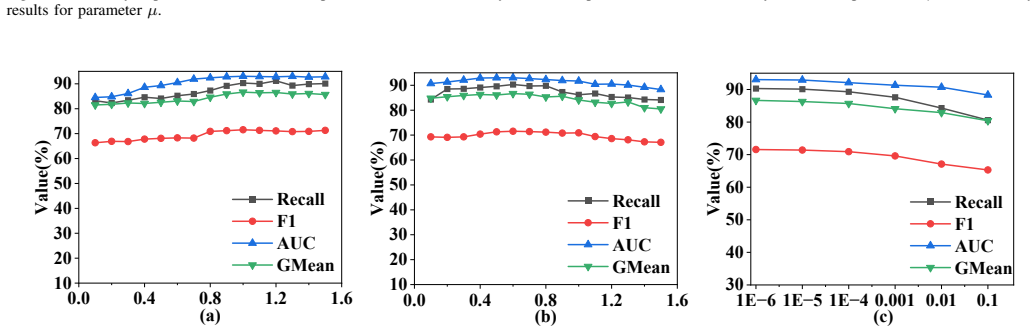
- [Section V-D] Hyperparameters λ, η, and μ are chosen per dataset based on the sensitivity experiments shown in Figures 3–5. The text reports 'optimal settings for each dataset' without describing a held-out validation split; if the sensitivity curves are computed on the test set, the hyperparameters are selected on the test data, which can substantially inflate the reported performance. Please state the exact train/validation/test split used for all methods, select hyperparameters on the validation split, and report the corresponding test performance.
- [Table II and Section V-B] No error bars, standard deviations, or significance tests are reported. Several claimed improvements over the best baseline are small (e.g., +0.20% F1-macro and +1.12% AUC on Amazon; +0.43% GMean on FDCompCN). Without variance estimates, it is impossible to judge whether these differences are meaningful. Please report the mean and standard deviation over multiple runs (at least five) for all models and, where appropriate, paired significance tests between SGNN-IB and the strongest baselines.
- [Section V-A, Eqs. (23) and (25)] The evaluation metric formulas contain errors. Eq. (23) is not the standard trapezoidal AUC formula, and Eq. (25) defines GMean as sqrt(TPR * FPR), whereas the correct definition is sqrt(TPR * TNR) (sensitivity times specificity). Since GMean and AUC values are central to the reported improvements, please correct these formulas and verify that the numbers in Tables II and III were computed with the correct definitions.
minor comments (7)
- [Section IV-D, Eq. (15)] In Eq. (15), the second term of the fusion formula should use H_low, not H_high; as written, the weighted sum is not a fusion of high- and low-frequency signals.
- [Section IV-D, Eq. (14)] Eq. (14) states that cos(·,·) denotes Euclidean distance; it should be cosine similarity.
- [Section IV-B, Eq. (5)] Eq. (5) is missing a closing parenthesis at the end of the loss expression.
- [Section IV-D] The final paragraph of Section IV-D duplicates a paragraph that already appears in Section IV-C; please remove the repetition.
- [Table II] The caption states that the second-best results are underlined, but no underlines are visible in the table; please ensure consistent formatting.
- [References] Reference [8] is a specific application of the information bottleneck; please also cite the foundational IB work (Tishby, Pereira, and Bialek, 2000) and, if possible, a recent review of IB in deep learning.
- [Section V-A] Please provide a public code repository for SGNN-IB and specify the hardware/software environment, training epochs, learning rate, and other implementation details needed for reproducibility.
Circularity Check
IB-based denoising loss is a self-distillation objective: its 'labels' are filtered views of the same input, so the noise-removal claim is definitionally circular; the overall accuracy claim is still externally grounded by the classification loss.
-
self definitional
[Section IV-E, Eqs. (16)-(19); text preceding Eq. (17)]
"However, due to the lack of prior knowledge of different frequency signals, it is impractical to calculate the mutual information directly using ground truth labels. To this end, we regard the latent embeddings from the encoded original graph using different graph filter as the labels Y and the representations encoded from the heterophilic and homophilic using corresponding graph filters as the latent embeddings H."
The IB objective in Eq. (16) is defined against labels Y, but Eq. (17) substitutes filtered original-graph embeddings Ho_high/Ho_low for Y, while Hhigh/Hlow are filtered subgraph embeddings of the same feature matrix H and the same underlying graph. All four quantities are deterministic functions of the same input features and graph Laplacians. Minimizing -I(H;Y)+mu*I(H;X) therefore reduces to aligning two self-generated views of the input, not to compressing information about an external target. The paper's claim that this 'decrease[s] the noise in different signals' is thus imposed by definition: the 'clean' target is another filtered version of the noisy input. This is a genuine definitional circularity in the IB-denoising contribution; the classification loss (Eq.
full rationale
The only load-bearing reduction I can exhibit is in the IB-based enhancer: the paper explicitly replaces ground-truth labels Y with filtered embeddings from the original graph, making the IB loss a self-distillation regularizer rather than an information bottleneck against an independent target. This weakens the stated novelty of 'information bottleneck theory' and the claim of noise removal, but it does not by itself force the reported accuracy numbers, which are anchored by the cross-entropy classification loss on real labels. I found no self-citation chain or author-imported uniqueness argument: the Beta-wavelet filter is attributed to external prior work [16], and the closest related method (SplitGNN) is cited but not compared, which is an experimental-completeness concern rather than a circularity concern. The empirical comparison, if reproduced, is externally falsifiable. Therefore the circularity is partial and localized to one auxiliary loss component, not a collapse of the whole derivation.
Assumptions & free parameters
free parameters (4)
- Beta wavelet parameters alpha, beta =
not reported for final model; searched in ranges alpha 0-3, beta 1-4
- lambda (edge loss weight) =
1.0 on all datasets
- eta (IB loss weight) =
0.6 YelpChi/FDCompCN, 0.5 Amazon
- mu (IB regularization strength) =
0.000001 on all datasets
assumptions (5)
- domain assumption Homophilic subgraphs carry mostly low-frequency signals and heterophilic subgraphs mostly high-frequency signals.
- ad hoc to paper Cosine similarity between embeddings is a valid proxy for mutual information in the IB loss.
- ad hoc to paper Filtered embeddings of the original graph can serve as the labels Y in the IB objective.
- domain assumption The edge classifier trained on labeled training edges generalizes to all edges of the graph.
- standard math Standard spectral graph theory, including Beta wavelet basis and normalized Laplacian eigenvalues in [0,2].
Cite this review
Pith. "Pith review of Addressing Noise and Stochasticity in Fraud Detection for Service Networks." pith.science (2026). https://pith.science/paper/G5KT7ZAP
@misc{pith2026250500946,
  author       = {Pith},
  title        = {Pith review of: Addressing Noise and Stochasticity in Fraud Detection for Service Networks},
  year         = {2026},
  howpublished = {\url{https://pith.science/paper/G5KT7ZAP}},
  note         = {Machine review of arXiv:2505.00946}
}
read the original abstract
Fraud detection is crucial in social service networks to maintain user trust and improve service network security. Existing spectral graph-based methods address this challenge by leveraging different graph filters to capture signals with different frequencies in service networks. However, most graph filter-based methods struggle with deriving clean and discriminative graph signals. On the one hand, they overlook the noise in the information propagation process, resulting in degradation of filtering ability. On the other hand, they fail to discriminate the frequency-specific characteristics of graph signals, leading to distortion of signals fusion. To address these issues, we develop a novel spectral graph network based on information bottleneck theory (SGNN-IB) for fraud detection in service networks. SGNN-IB splits the original graph into homophilic and heterophilic subgraphs to better capture the signals at different frequencies. For the first limitation, SGNN-IB applies information bottleneck theory to extract key characteristics of encoded representations. For the second limitation, SGNN-IB introduces prototype learning to implement signal fusion, preserving the frequency-specific characteristics of signals. Extensive experiments on three real-world datasets demonstrate that SGNN-IB outperforms state-of-the-art fraud detection methods.
Figures


Figures from the paper (4 more)


Forward citations
Cited by 2 Pith papers
-
Multilingual Source Tracing of Speech Deepfakes: A First Benchmark
The first multilingual source-tracing benchmark for speech deepfakes, showing LFCC-ECAPA-TDNN generalizes best across languages.
-
Fake-Mamba: Real-Time Speech Deepfake Detection Using Bidirectional Mamba as Self-Attention's Alternative
Fake-Mamba reports EERs of 0.97%, 1.74%, and 5.85% on three speech deepfake benchmarks, but the provided full text is an unrelated paper, so the claims cannot be verified.
Reference graph
Works this paper leans on
-
[7]
Splitgnn: Spectral graph neural network for fraud detection against heterophily,
B. Wu, X. Yao, B. Zhang, K. Chao, and Y . Li, “Splitgnn: Spectral graph neural network for fraud detection against heterophily,” in Proceedings of the 32nd ACM International Conference on Information and Knowl- edge Management, 2023, pp. 2737–2746
work page 2023
-
[6]
A gnn-based fraud detector with dual resistance to graph disassortativity and imbalance,
J. Wu, R. Hu, D. Li, L. Ren, W. Hu, and Y . Zang, “A gnn-based fraud detector with dual resistance to graph disassortativity and imbalance,” Information Sciences, vol. 669, p. 120580, 2024
work page 2024
-
[1]
Improving hotels’ operational efficiency through esg investment: A risk management perspective,
K. Chung, L. T. M. Nguyen, and D. T. T. Nguyen, “Improving hotels’ operational efficiency through esg investment: A risk management perspective,” Service Science, vol. 16, no. 3, 2024
work page 2024
-
[2]
Recommending products and services belonging to online businesses using intelligent agents,
A. Alexandrescu, C. N. Butincu, and M. Craus, “Recommending products and services belonging to online businesses using intelligent agents,” Service Science, vol. 9, no. 4, pp. 338–348, 2017
work page 2017
-
[3]
Sefraud: Graph-based self- explainable fraud detection via interpretative mask learning,
K. Li, T. Yang, M. Zhou, J. Meng, S. Wang, Y . Wu, B. Tan, H. Song, L. Pan, F. Yu, Z. Sheng, and Y . Tong, “Sefraud: Graph-based self- explainable fraud detection via interpretative mask learning,” inProceed- ings of the 30th ACM SIGKDD Conference on Knowledge Discovery and Data Mining, 2024, pp. 5329–5338
work page 2024
-
[4]
Intention-aware heterogeneous graph attention networks for fraud transactions detection,
C. Liu, L. Sun, X. Ao, J. Feng, Q. He, and H. Yang, “Intention-aware heterogeneous graph attention networks for fraud transactions detection,” in The 27th ACM SIGKDD Conference on Knowledge Discovery and Data Mining, 2021, pp. 3280–3288
work page 2021
-
[5]
H2-fdetector: A gnn-based fraud detector with homophilic and heterophilic connections,
F. Shi, Y . Cao, Y . Shang, Y . Zhou, C. Zhou, and J. Wu, “H2-fdetector: A gnn-based fraud detector with homophilic and heterophilic connections,” in Proceedings of the ACM Web Conference 2022, 2022, pp. 1486–1494
work page 2022
-
[8]
Cross-modal clustering with deep correlated information bottleneck method,
X. Yan, Y . Mao, Y . Ye, and H. Yu, “Cross-modal clustering with deep correlated information bottleneck method,”IEEE Transactions on Neural Networks and Learning Systems , vol. 35, no. 10, pp. 13 508–13 522, 2024
work page 2024
Show all 31 references
-
[9]
Enhancing graph neural network-based fraud detectors against camouflaged fraud- sters,
Y . Dou, Z. Liu, L. Sun, Y . Deng, H. Peng, and P. S. Yu, “Enhancing graph neural network-based fraud detectors against camouflaged fraud- sters,” in Proceedings of the 29th ACM International Conference on Information and Knowledge Management , 2020, pp. 315 – 324
2020
-
[10]
Pick and choose: A gnn-based imbalanced learning approach for fraud detection,
Y . Liu, X. Ao, Z. Qin, J. Chi, J. Feng, H. Yang, and Q. He, “Pick and choose: A gnn-based imbalanced learning approach for fraud detection,” in Proceedings of the Web Conference 2021 , 2021, pp. 3168–3177
2021
-
[11]
Dig- in-gnn: Discriminative feature guided gnn-based fraud detector against inconsistencies in multi-relation fraud graph,
J. Zhang, Z. Xu, D. Lv, Z. Shi, D. Shen, J. Jin, and F. Dong, “Dig- in-gnn: Discriminative feature guided gnn-based fraud detector against inconsistencies in multi-relation fraud graph,” in Proceedings of the 38th AAAI Conference on Artificial Intelligence , 2024, pp. 9323–9331
2024
-
[12]
Asa-gnn: Adaptive sampling and aggregation-based graph neural network for transaction fraud detection,
Y . Tian, G. Liu, J. Wang, and M. Zhou, “Asa-gnn: Adaptive sampling and aggregation-based graph neural network for transaction fraud detection,” IEEE Transactions on Computational Social Systems , vol. 11, no. 3, pp. 3536–3549, 2024
2024
-
[13]
Alleviating the incon- sistency problem of applying graph neural network to fraud detection,
Z. Liu, Y . Dou, P. S. Yu, Y . Deng, and H. Peng, “Alleviating the incon- sistency problem of applying graph neural network to fraud detection,” in Proceedings of the 43rd International ACM SIGIR Conference on Research and Development in Information Retrieval , 2020, pp. 1569– 1572
2020
-
[14]
Label information enhanced fraud detection against low homophily in graphs,
Y . Wang, J. Zhang, Z. Huang, W. Li, S. Feng, Z. Ma, Y . Sun, D. Yu, F. Dong, J. Jin, B. Wang, and J. Luo, “Label information enhanced fraud detection against low homophily in graphs,” in Proceedings of the ACM Web Conference 2023, 2023, pp. 406–416
2023
-
[15]
Can abnormality be detected by graph neural networks?
Z. Chai, S. You, Y . Yang, S. Pu, J. Xu, H. Cai, and W. Jiang, “Can abnormality be detected by graph neural networks?” in Proceedings of the 31st International Joint Conference on Artificial Intelligence , 2022, pp. 1945–1951
2022
-
[16]
Rethinking graph neural networks for anomaly detection,
J. Tang, J. Li, Z. Gao, and J. Li, “Rethinking graph neural networks for anomaly detection,” in Proceedings of the 39th International Conference on Machine Learning , vol. 162, 2022, pp. 21 076–21 089
2022
-
[17]
Semi-supervised classification with graph convolutional networks,
T. N. Kipf and M. Welling, “Semi-supervised classification with graph convolutional networks,” in Proceedings of the 5th International Con- ference on Learning Representations , 2017
2017
-
[18]
Adaptive filters in graph convolutional neural networks,
A. Apicella, F. Isgr `o, A. Pollastro, and R. Prevete, “Adaptive filters in graph convolutional neural networks,” Pattern Recognition, vol. 144, p. 109867, 2023
2023
-
[19]
Graph neural networks with learnable and optimal polynomial bases,
Y . Guo and Z. Wei, “Graph neural networks with learnable and optimal polynomial bases,” in International Conference on Machine Learning , vol. 202, 2023, pp. 12 077–12 097
2023
-
[20]
Polyformer: Scalable node-wise filters via polynomial graph transformer,
J. Ma, M. He, and Z. Wei, “Polyformer: Scalable node-wise filters via polynomial graph transformer,” in Proceedings of the 30th ACM SIGKDD Conference on Knowledge Discovery and Data Mining , 2024, pp. 2118–2129
2024
-
[21]
Node-oriented spectral filtering for graph neural networks,
S. Zheng, Z. Zhu, Z. Liu, Y . Li, and Y . Zhao, “Node-oriented spectral filtering for graph neural networks,” IEEE Transactions on Pattern Analysis and Machine Intelligence , vol. 46, no. 1, pp. 388–402, 2024
2024
-
[22]
Graph attention networks,
P. Veli ˇckovi´c, G. Cucurull, A. Casanova, A. Romero, P. Li `o, and Y . Bengio, “Graph attention networks,” in Proceedings of the 6th International Conference on Learning Representations , 2018
2018
-
[23]
Inductive representation learning on large graphs,
W. L. Hamilton, Z. Ying, and J. Leskovec, “Inductive representation learning on large graphs,” in Advances in Neural Information Processing Systems, 2017, pp. 1024–1034
2017
-
[24]
Edgeless-gnn: Unsupervised representation learning for edgeless nodes,
Y . Shin, C. Tran, W. Shin, and X. Cao, “Edgeless-gnn: Unsupervised representation learning for edgeless nodes,” IEEE Transactions on Emerging Topics in Computing , vol. 12, no. 1, pp. 150–162, 2024
2024
-
[25]
Trajectory-user linking via multi-scale graph attention network,
Y . Li, T. Sun, Z. Shao, Y . Zhen, Y . Xu, and F. Wang, “Trajectory-user linking via multi-scale graph attention network,” Pattern Recognition, vol. 158, p. 110978, 2025
2025
-
[26]
Heterogeneous graph attention networks for depression identification by campus cyber- activity patterns,
M. Yang, Z. Li, Y . Gao, C. He, F. Huang, and W. Chen, “Heterogeneous graph attention networks for depression identification by campus cyber- activity patterns,” IEEE Transactions on Computational Social Systems , vol. 11, no. 3, pp. 3493–3503, 2024
2024
-
[27]
Two-level graph neural network,
X. Ai, C. Sun, Z. Zhang, and E. R. Hancock, “Two-level graph neural network,” IEEE Transactions on Neural Networks and Learning Systems, vol. 35, no. 4, pp. 4593–4606, 2024
2024
-
[28]
Specformer: Spectral graph neural networks meet transformers,
D. Bo, C. Shi, L. Wang, and R. Liao, “Specformer: Spectral graph neural networks meet transformers,” in Proceedings of the 11th International Conference on Learning Representations , 2023
2023
-
[29]
Xgboost: A scalable tree boosting system,
T. Chen and C. Guestrin, “Xgboost: A scalable tree boosting system,” in Proceedings of the 22nd ACM SIGKDD International Conference on Knowledge Discovery and Data Mining , 2016, pp. 785–794
2016
-
[30]
Beyond low-frequency informa- tion in graph convolutional networks,
D. Bo, X. Wang, C. Shi, and H. Shen, “Beyond low-frequency informa- tion in graph convolutional networks,” in Proceedings of the 35th AAAI Conference on Artificial Intelligence , vol. 35, 2021, pp. 3950–3957
2021
-
[31]
Adaptive universal generalized pagerank graph neural network,
E. Chien, J. Peng, P. Li, and O. Milenkovic, “Adaptive universal generalized pagerank graph neural network,” in Proceedings of the 9th International Conference on Learning Representations , 2021
2021
Reviewed August 16, 2026 · model on record in the stance chip above.
Discussion (0). Continue with ORCID to comment.