REVIEW 3 major objections 6 minor 39 references
Accelerating point defect photo-emission calculations with machine learning interatomic potentials
T0 review · 3 major / 6 minor · reviewed 2026-08-16 · deepseek-v4-flash
Pith's one-line read A pre-trained machine-learned potential reproduces defect photoluminescence spectra with near-DFT accuracy at over ten times lower cost.
desk verdict Solid application of universal MLIPs to defect photoluminescence with a large honest benchmark, but the headline speedup is never measured and the accuracy claims cover only magnetic defects. read the letter →
The pith
A machine-rendered reading of the paper's core claim, the machinery that carries it, and where it could break.
The reading
What carries the argument
The machinery is the electron-phonon spectral function $S(\omega)=\sum_k S_k \delta(\hbar\omega-\hbar\omega_k)$ built from partial Huang-Rhys factors $S_k=\omega_k Q_k^2/(2\hbar)$, where $Q_k$ is the projection of the mass-weighted ground-to-excited displacement $\Delta Q$ onto phonon mode $k$; the photoluminescence spectrum follows from this spectral function through a generating function. The computational replacement is the phonon force-constant matrix: instead of computing it with DFT for every displaced atom, a universal machine-learned interatomic potential provides the forces, and a hybrid variant uses DFT forces only for displacements of atoms within a cutoff radius $r_c$ of the defect and MLIP forces for all other displacements. The hybrid dynamical matrix therefore keeps DFT accuracy precisely in the region where the defect's phonon modes have large amplitude.
What would settle it
A controlled benchmark on defects with $S_{\mathrm{DFT}} \ge 4$ would settle it: if MLIP-only Huang-Rhys factors deviate by roughly a factor of two in a substantial fraction of such large-displacement cases, the claim of ab initio accuracy fails outside the small-reorganization regime. The paper's own hybrid results show that this is exactly the regime where DFT forces near the defect are needed to recover agreement.
Extended reading notes
Core claim
The central claim is that the electron-phonon coupling shaping a defect's photoluminescence, quantified by the Huang-Rhys factor $S$ and the spectral function $S(\omega)=\sum_k S_k\delta(\hbar\omega-\hbar\omega_k)$ with $S_k=\omega_k Q_k^2/(2\hbar)$, can be computed to ab initio accuracy using MLIP phonons in place of DFT phonons. The ground-state displacement vector $\Delta Q$ is still obtained from DFT relaxations of ground and excited states; only the normal modes and frequencies of the ground-state supercell come from the machine-learned potential. Against a dataset of 791 spin-defect color centers, the best of seven universal MLIPs yields a mean absolute error of 0.79 in the Huang-Rhys factor, and accuracy is essentially independent of the defect's charge state (errors 0.73-0.83 for $q=-1,0,+1$) and magnetic moment. The authors attribute this to the division of labor: the charge-sensitive displacement stays in DFT while the MLIP only supplies ground-state phonons. Large ground-to-excited displacements degrade accuracy, with worst cases off by about a factor of two, and the paper's hybrid force-constant scheme restores DFT accuracy by computing force constants with DFT for atoms within a cutoff radius around the defect.
Load-bearing premise
The central assumption is that a pre-trained machine-learned potential, which has no charge or spin input and may have seen few defect geometries, produces ground-state phonon modes and frequencies for defect supercells that faithfully reproduce DFT phonons.
Editorial extensions
If this is right
- Photoluminescence spectra and Huang-Rhys factors for point defects can be computed at more than an order of magnitude lower cost, with an overall error of about 12% and under 10% for the small-HR defects most relevant to applications.
- The method is not biased by charge or magnetic state, so screening can safely cover neutral, charged, and magnetic color centers without special handling.
- Defects with large ground-to-excited reorganization are the failure regime; on the 50 worst cases the hybrid DFT/MLIP force-constant scheme cuts the average Huang-Rhys error from 48.7% to 5.1% using a DFT region of only 16-20 atoms.
- The same workflow applies to molecular emitters on surfaces, reproducing the Huang-Rhys factor and lineshape of terrylene on hexagonal boron nitride including low-energy molecule-substrate modes.
- Removing the phonon bottleneck makes high-throughput screening of defect-engineered materials computationally tractable.
Reading between the lines
- Because accuracy is tied to the size of the ground-to-excited displacement, a screening pipeline could decide on the fly whether to trust MLIP-only phonons or switch to the hybrid scheme based on $\Delta Q$.
- The charge-state independence suggests the MLIP's ground-state phonon subspace transfers across charge states; a direct test would compare MLIP and DFT phonons on identical supercells in different charge states.
- The hybrid cutoff behavior implies an error estimator based on phonon mode amplitude near the defect could replace the current empirical $r_c$ choice.
- The 12% mean error in the Huang-Rhys factor is comparable to reported method-to-method variations from supercell size and exchange-correlation functional, so MLIP-accelerated spectra may be accurate enough for relative ranking even where absolute values carry systematic offsets.
Signed reviews
Editorial analysis
A structured set of objections, weighed in public.
Referee Report
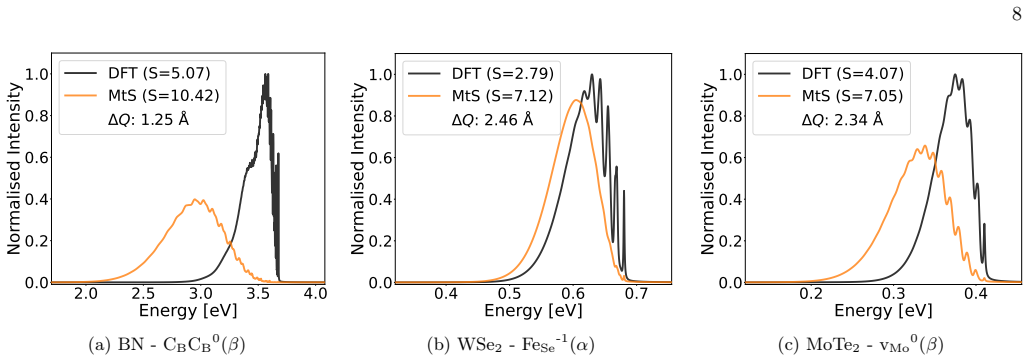
Summary. The paper proposes a workflow that replaces DFT phonon-mode calculations with universal machine-learning interatomic potential (MLIP) phonon calculations when computing Huang-Rhys factors and photoluminescence spectra of point defects. The ground-state and excited-state relaxations, as well as the displacement vector ΔR, are still obtained from DFT, while the phonons are computed with the MLIP. Seven universal MLIPs are benchmarked against a dataset of 791 two-dimensional point defects, with MatterSim-v1-5M identified as the best performer (MAE 0.79 in the Huang-Rhys factor). Full PL lineshapes are compared for 12 selected defects, a molecular emitter (terrylene) in gas phase and on hBN, and a hybrid DFT/MLIP force-constant approach is introduced to correct the worst cases, reducing the average error on S from 48.7% to 5.1% for the 50 worst structures. The abstract and discussion claim speed improvements exceeding an order of magnitude and 'ab initio accuracy' for the MLIP-accelerated spectra.
Significance. If the claimed speedup and accuracy hold, this would be a practically valuable tool for high-throughput screening of defect-based quantum emitters. The paper has notable strengths: a large and openly available benchmark dataset of 791 defect PL spectra, a systematic comparison of seven MLIPs, a clear analysis of error trends with ΔQ, and a hybrid scheme with a large demonstrated error reduction. The availability of data and code is also a positive feature. However, the central performance claim of 'speed improvements exceeding an order of magnitude' is never directly measured, and the accuracy claims are established only for a benchmark that is restricted to magnetic defects, with lineshape validation on a hand-picked subset. These gaps are load-bearing for the stated purpose of the paper.
major comments (3)
- [III. Discussion and Abstract] The abstract and Section III state that the approach achieves 'speed improvements exceeding an order of magnitude' and is 'faster by an order of magnitude', but the manuscript contains no wall-clock timing measurements of either the full DFT workflow or the MLIP-accelerated workflow. Since the MLIP replaces only the phonon step while DFT ground-state and excited-state relaxations are still required, and since the hybrid scheme reintroduces DFT forces for atoms within r_c, the asserted speedup is not established. Please provide measured timings for the phonon stage and for the end-to-end workflow, state the hardware and parallelization settings, and report the effective speedup of the hybrid scheme including the N_c/N DFT cost.
- [II.C, II.D, II.E] Section II.C states that the 791-defect benchmark 'contains only defects with finite magnetic moments' because non-magnetic defects were filtered out; the only non-magnetic system is the molecular emitter TRL in Section II.G. Consequently, the claim in Sections II.D and III that accuracy is independent of charge and magnetic state is demonstrated only for magnetic point defects, not for non-magnetic point defects. In addition, the PL lineshape agreement is shown for 12 hand-picked defects in Fig. 4, and the failure cases in Fig. 5 are also selected by hand; no systematic lineshape metric over the full dataset is provided. Please either add non-magnetic point defects to the benchmark or explicitly qualify the generality claim, and add a systematic lineshape metric (for example, spectral overlap or a sideband-position error) evaluated over the whole dataset.
- [II.E and II.F] The paper reports that the MLIP relaxation must start from the DFT-relaxed geometry, that large ground-to-excited displacements (large ΔQ) lead to errors of up to a factor of two in S (Fig. 5), and that the hybrid correction was tested only on the 50 worst errors with S_DFT<10. These are load-bearing limitations for the stated goal of high-throughput screening: the practical workflow still requires DFT relaxations, and the hybrid scheme reduces the phonon speedup by a factor N_c/N without a quantitative estimate of the residual speedup. Please quantify how often large-ΔQ failures occur in the full 791-defect dataset, measure the actual speedup of the hybrid approach as a function of r_c, and provide a practical criterion for deciding when the hybrid correction is needed.
minor comments (6)
- [References] The reference by Alkauskas et al. appears twice, as [10] and as [31]; the duplicate should be merged.
- [Eq. (6)] In the definition of the hybrid force-constant matrix, the notation F^α_i and u^β_j should be defined explicitly, and the symmetry of the resulting matrix should be discussed.
- [IV.A] The Methods section reports a 'k-point density of 3 Å'; this should read 3 Å^-1 or specify the actual Monkhorst-Pack grid used.
- [Throughout] The model name is written inconsistently as 'MatterSim-v1-5M', 'Mattersim-V1-5M', and 'MtS'; one convention should be used consistently.
- [Fig. 7 caption] The caption states that the ZPL positions are shifted to 0 and the ZPL intensity is set to unity, but the horizontal axis is labelled in absolute energy; the plotting convention should be clarified.
- [Section II.G] The version or checkpoint of MatterSim used should be stated precisely, since the model is maintained externally and the reproducibility of the central results depends on a fixed model version.
Circularity Check
No circularity found: the predicted Huang-Rhys factors are not inputs to the fixed MatterSim model, and the DFT benchmark is an out-of-sample comparison for the MLIP.
full rationale
The central quantity S is computed from the DFT-derived displacement ΔR (Eqs. 1–3) projected onto phonon modes (Eq. 4). In the DFT reference, those phonons come from DFT force constants; in the MLIP workflow, they come from the fixed, pre-trained MatterSim-v1-5M network of Ref. [29]. No parameter of MatterSim is fitted to the 791-defect Huang-Rhys values, and the DFT benchmark is therefore a genuine external comparison of the phonon component while ΔR is held fixed. The hybrid phonon scheme (Eq. 6) intentionally converges to DFT as the cutoff radius grows, but the paper presents it as a corrective strategy, not as evidence for the pure MLIP result. The self-citations to Ref. [25] for model preselection and Ref. [30] for spin purification are not load-bearing: the model choice is independently re-tested in Table I and Fig. 1, and the spin-purification expression is a standard documented procedure. The paper itself states limitations, including the need to start MLIP relaxation from the DFT-relaxed structure and degraded accuracy for large ΔQ (Section II.E, Fig. 2); these are accuracy limitations, not circular steps. The absence of wall-clock timing measurements weakens the 'order of magnitude' speed claim, but that is a missing-evidence and correctness concern, not a circularity concern. The derivation is self-contained in the sense that every predicted quantity is computed from inputs that are not themselves the predicted quantity.
Assumptions & free parameters
free parameters (1)
- Hybrid cutoff radius r_c =
4-5 Å (16-20 atoms)
assumptions (4)
- domain assumption Born-Oppenheimer approximation
- domain assumption Harmonic approximation and identical ground/excited state potential energy surfaces
- domain assumption Single-determinant excited states via DO-MOM
- domain assumption DFT-PBE reference is the accuracy target
Cite this review
Pith. "Pith review of Accelerating point defect photo-emission calculations with machine learning interatomic potentials." pith.science (2026). https://pith.science/paper/7E3FCZ3M
@misc{pith2026250501403,
  author       = {Pith},
  title        = {Pith review of: Accelerating point defect photo-emission calculations with machine learning interatomic potentials},
  year         = {2026},
  howpublished = {\url{https://pith.science/paper/7E3FCZ3M}},
  note         = {Machine review of arXiv:2505.01403}
}
read the original abstract
We introduce a computational framework leveraging universal machine learning interatomic potentials (MLIPs) to dramatically accelerate the calculation of photoluminescence (PL) spectra of atomic or molecular emitters with ab initio accuracy. By replacing the costly density functional theory (DFT) computation of phonon modes with much faster MLIP phonon mode calculations, our approach achieves speed improvements exceeding an order of magnitude with minimal precision loss. We benchmark the approach using a dataset comprising ab initio emission spectra of 791 color centers spanning various types of crystal point defects in different charge and magnetic states. The method is also applied to a molecular emitter adsorbed on a hexagonal boron nitride surface. Across all the systems, we find excellent agreement for both the Huang-Rhys factor and the PL lineshapes. This application of universal MLIPs bridges the gap between computational efficiency and spectroscopic fidelity, opening pathways to high-throughput screening of defect-engineered materials. Our work not only demonstrates accelerated calculation of PL spectra with DFT accuracy, but also makes such calculations tractable for more complex materials.
Figures


Figures from the paper (4 more)



Reference graph
Works this paper leans on
-
[1]
The spectral region beyond 45 meV is enhanced by a factor of 2 for clarity. (c) Vibrational modes corresponding to the peaks highlighted by the blue circle in (b). while maintaining maximum overlap with ground-state orbitals. The DO-MOM algorithm uses a nested opti- mization approach: an inner loop finds stationary points in the subspace of occupied and v...
work page 2022
-
[2]
G. Wolfowicz, F. J. Heremans, C. P. Anderson, S. Kanai, H. Seo, A. Gali, G. Galli, and D. D. Awschalom, Quan- tum guidelines for solid-state spin defects, Nat. Rev. Mater.6, 906–925 (2021)
work page 2021
-
[3]
G. Wang, Y. Yang, D. Han, and Y. Li, Oxygen defective metal oxides for energy conversion and storage, Nano To- day13, 23 (2017)
work page 2017
-
[4]
A. Sarkar, L. Velasco, D. Wang, Q. Wang, G. Ta- lasila, L. de Biasi, C. Kübel, T. Brezesinski, S. S. Bhat- tacharya, H. Hahn, and B. Breitung, High entropy ox- ides for reversible energy storage, Nat. Commun.9, 10.1038/s41467-018-05774-5 (2018)
-
[5]
K. Jhuria, V. Ivanov, D. Polley, Y. Zhiyenbayev, W. Liu, A. Persaud, W. Redjem, W. Qarony, P. Parajuli, Q. Ji, A. J. Gonsalves, J. Bokor, L. Z. Tan, B. Kanté, and T. Schenkel, Programmable quantum emitter formation in silicon, Nature Communications15, 10.1038/s41467- 024-48714-2 (2024)
doi:10.1038/s41467- 2024
-
[6]
F. Jelezko and J. Wrachtrup, Single defect centres in di- amond: A review, Phys. Status Solidi A203, 3207–3225 (2006)
work page 2006
-
[7]
M. W. Doherty, N. B. Manson, P. Delaney, F. Jelezko, J. Wrachtrup, and L. C. L. Hollenberg, The nitrogen-vacancy colour centre in diamond, arXiv 10.48550/ARXIV.1302.3288 (2013)
-
[8]
R. Jones and P. Briddon, Chapter 6 the ab initio cluster method and the dynamics of defects in semiconductors, inIdentification of Defects in Semiconductors, Semicon- ductors and Semimetals, Vol. 51, edited by M. Stavola (Elsevier, 1998) pp. 287–349
work page 1998
Show all 39 references
-
[9]
P. Deák, B. Aradi, T. Frauenheim, and A. Gali, Chal- lenges for ab initio defect modeling, Mater. Sci. Eng., B 154-155, 187 (2008), front-End Junction and Contact Formation in Future Silicon/Germanium Based Devices
2008
-
[10]
Gali, Recent advances in the ab initio theory of solid- state defect qubits, Nanophotonics12, 359–397 (2023)
A. Gali, Recent advances in the ab initio theory of solid- state defect qubits, Nanophotonics12, 359–397 (2023)
2023
-
[12]
Behler, Perspective: Machine learning potentials for atomistic simulations, J
J. Behler, Perspective: Machine learning potentials for atomistic simulations, J. Chem. Phys.145, 170901 (2016)
2016
-
[13]
Schmidt, M
J. Schmidt, M. R. G. Marques, S. Botti, and M. A. L. Marques, Recent advances and applications of machine learning in solid-state materials science, npj Comput. Mater.5, 83 (2019)
2019
-
[14]
Graser, S
J. Graser, S. K. Kauwe, and T. D. Sparks, Machine learning and energy minimization approaches for crystal structure predictions: A review and new horizons, Chem. Mater.30, 3601–3612 (2018)
2018
-
[15]
O. T. Unke, S. Chmiela, H. E. Sauceda, M. Gastegger, I. Poltavsky, K. T. Schütt, A. Tkatchenko, and K.-R. Müller, Machine learning force fields, Chem. Rev.121, 10142–10186 (2021)
2021
-
[16]
C. Chen, W. Ye, Y. Zuo, C. Zheng, and S. P. Ong, Graph networks as a universal machine learning framework for molecules and crystals, Chem. Mater.31, 3564–3572 (2019)
2019
-
[17]
Chen and S
C. Chen and S. P. Ong, A universal graph deep learning interatomic potential for the periodic table, Nat. Com- put. Sci.2, 718–728 (2022)
2022
-
[18]
Batatia, D
I. Batatia, D. P. Kovacs, G. Simm, C. Ortner, and G. Csanyi, MACE: Higher order equivariant message passing neural networks for fast and accurate force fields, inAdvances in Neural Information Processing Systems, Vol. 35, edited by S. Koyejo, S. Mohamed, A. Agarwal, D. Belgrav...
-
[19]
B. Deng, P. Zhong, K. Jun, J. Riebesell, K. Han, C. J. Bartel, and G. Ceder, CHGNet as a pretrained universal neural network potential for charge-informed atomistic modelling, Nat. Mach. Intell.5, 1031–1041 (2023)
2023
-
[20]
Neumann, J
M. Neumann, J. Gin, B. Rhodes, S. Bennett, Z. Li, H. Choubisa, A. Hussey, and J. Godwin, Orb: A fast, scalable neural network potential, arXiv , 2410.22570 (2024)
2024 arXiv
-
[21]
Y. Park, J. Kim, S. Hwang, and S. Han, Scalable parallel algorithm for graph neural network interatomic poten- tialsinmoleculardynamicssimulations,J.Chem.Theory Comput.20, 4857–4868 (2024)
2024
-
[22]
Y.-L. Liao, B. M. Wood, A. Das, and T. Smidt, EquiformerV2: Improved equivariant transformer for scaling to higher-degree representations, inThe Twelfth International Conference on Learning Representations (2024)
2024
-
[23]
Choudhary and B
K. Choudhary and B. DeCost, Atomistic line graph neu- ral network for improved materials property predictions, npj Comput. Mater.7, 185 (2021)
2021
-
[24]
Chmiela, V
S. Chmiela, V. Vassilev-Galindo, O. T. Unke, A. Kabylda, H. E. Sauceda, A. Tkatchenko, and K.-R. Müller, Accurate global machine learning force fields for molecules with hundreds of atoms, Sci. Adv.9, eadf0873 (2023)
2023
-
[25]
Stocker, J
S. Stocker, J. Gasteiger, F. Becker, S. Günnemann, and J. T. Margraf, How robust are modern graph neural net- work potentials in long and hot molecular dynamics sim- ulations?, Machine Learning: Science and Technology3, 045010 (2022)
2022
-
[26]
A. Loew, D. Sun, H.-C. Wang, S. Botti, and M. A. L. Marques, Universal machine learning interatomic poten- tials are ready for phonons, arXiv , 2412.16551 (2024)
2024 arXiv
-
[27]
Riebesell, R
J. Riebesell, R. E. A. Goodall, P. Benner, Y. Chi- ang, B. Deng, A. A. Lee, A. Jain, and K. A. Persson, Matbench discovery – a framework to evaluate machine learning crystal stability predictions, arXiv , 2308.14920 (2023)
2023 arXiv
-
[28]
Batzner, A
S. Batzner, A. Musaelian, L. Sun, M. Geiger, J. P. Mailoa, M. Kornbluth, N. Molinari, T. E. Smidt, and B. Kozinsky, E(3)-equivariant graph neural networks for data-efficient and accurate interatomic potentials, Nat. Commun.13, 2453 (2022)
2022
-
[29]
Barroso-Luque, M
L. Barroso-Luque, M. Shuaibi, X. Fu, B. M. Wood, M. Dzamba, M. Gao, A. Rizvi, C. L. Zitnick, and Z. W. Ulissi, Open materials 2024 (OMat24) inorganic materi- als dataset and models, arXiv , 2410.12771 (2024)
2024 arXiv
-
[30]
H. Yang, C. Hu, Y. Zhou, X. Liu, Y. Shi, J. Li, G. Li, Z. Chen, S. Chen, C. Zeni, M. Horton, R. Pinsler, A. Fowler, D. Zügner, T. Xie, J. Smith, L. Sun, Q. Wang, L. Kong, C. Liu, H. Hao, and Z. Lu, Mattersim: A deep learning atomistic model across elements, temperatures and pr...
2024 arXiv
-
[31]
H. Wang, N. Stenger, P. Lyngby, M. Kuisma, J. Schiøtz, and K. S. Thygesen, Two-dimensional materials as ideal substrates for molecular quantum emitters, Nano Letters 25, 9952 (2025)
2025
-
[32]
Alkauskas, B
A. Alkauskas, B. B. Buckley, D. D. Awschalom, and C. G. Van de Walle, First-principles theory of the luminescence lineshape for the triplet transition in diamond nv centres, New J. Phys.16, 073026 (2014)
2014
-
[33]
J. Lee, H. Wang, K.-Y. Park, S. Huh, D. Kim, M. Yu, C. Kim, K. S. Thygesen, and J. Lee, Room temperature quantum emitters in van der waalsα-moo3, Nano Lett. 25, 1142 (2025)
2025
-
[34]
R. Smit, A. Tebyani, J. Hameury, S. J. van der Molen, and M. Orrit, Sharp zero-phonon lines of single organic molecules on a hexagonal boron-nitride surface, Nature Communications14, 7960 (2023)
2023
-
[35]
J. J. Mortensen, A. H. Larsen, M. Kuisma, A. V. Ivanov, A. Taghizadeh, A. Peterson, A. Haldar, A. O. Dohn, C. Schäfer, E. O. Jónsson, E. D. Hermes, F. A. Nilsson, G. Kastlunger, G. Levi, H. Jónsson, H. Häkkinen, J. Fojt, J. Kangsabanik, J. Sødequist, J. Lehtomäki, J. Heske, J....
2024
-
[36]
J. P. Perdew, K. Burke, and M. Ernzerhof, Generalized gradient approximation made simple, Phys. Rev. Lett. 77, 3865 (1996)
1996
-
[37]
A. V. Ivanov, G. Levi, E. Ö. Jónsson, and H. Jónsson, Method for calculating excited electronic states using density functionals and direct orbital optimization with real space grid or plane-wave basis set, Journal of Chem- ical Theory and Computation17, 5034 (2021), pMID: 342...
2021 doi
-
[38]
Bitzek, P
E. Bitzek, P. Koskinen, F. Gähler, M. Moseler, and P. Gumbsch, Structural relaxation made simple, Phys. Rev. Lett.97, 170201 (2006)
2006
-
[39]
A. Togo, L. Chaput, and I. Tanaka, Distributions of phonon lifetimes in Brillouin zones, Phys. Rev. B91, 094306 (2015)
2015
-
[40]
Togo, First-principles phonon calculations with Phonopy and Phono3py, J
A. Togo, First-principles phonon calculations with Phonopy and Phono3py, J. Phys. Soc. Jpn.92, 012001 (2023)
2023
Reviewed August 16, 2026 · model on record in the stance chip above.
Discussion (0). Continue with ORCID to comment.