REVIEW 4 major objections 3 minor 19 references
SKALD: Scalable K-Anonymisation for Large Datasets
T0 review · 4 major / 3 minor · reviewed 2026-08-15 · deepseek-v4-flash
Pith's one-line read SKALD k-anonymises datasets larger than available RAM by aggregating per-chunk histogram counts into one global histogram, then searching a generalisation lattice on that histogram, reporting at least a nine-fold lower DM* than a…
desk verdict SKALD's chunk-histogram aggregation is a sensible engineering idea, but the memory accounting misses the Phase 1 encoding map and the paper overclaims chunk-size independence. read the letter →
The pith
A machine-rendered reading of the paper's core claim, the machinery that carries it, and where it could break.
The reading
What carries the argument
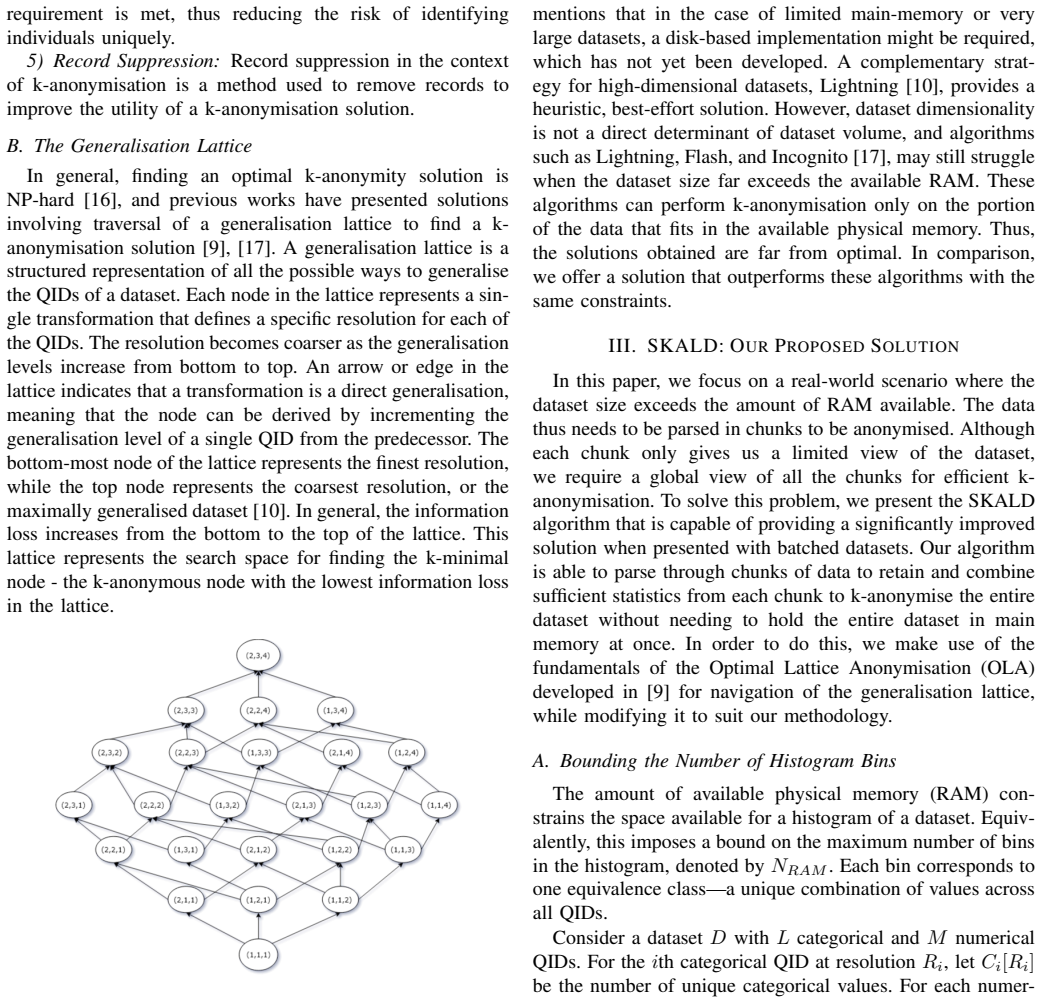
The central object is an aggregate histogram: each bin counts records sharing one equivalence class, i.e. one combination of quasi-identifier values at a chosen generalisation level. SKALD accumulates this histogram by adding per-chunk counts, so the final array is a bounded-memory sufficient statistic for the whole dataset. The lattice navigation uses predictive tagging to mark nodes as compliant or non-compliant with the memory bound and with k-anonymity, and the DM* metric ranks surviving nodes by information loss.
What would settle it
Instrument peak memory during Phase 1 on a dataset whose unique-value map is larger than the RAM budget; if the run stays within budget the central scalability claim survives, and if it does not, the claim fails for that dataset. A second check is to run SKALD and a full-memory global-optimal solver on the same small dataset and compare DM*; a lower DM* from the global solver would show that SKALD's global view is still approximate.
Extended reading notes
Core claim
The paper claims that a single histogram of equivalence-class counts, updated chunk by chunk, is enough to solve k-anonymisation for the entire dataset without ever holding more than one chunk in RAM. SKALD first encodes sparse numerical QIDs and picks the finest categorical resolutions and numerical bin widths that keep the bin count within memory. It then passes all chunks again, accumulating one global histogram whose bins are equivalence classes, and runs a lattice search over this aggregate histogram, using predictive tagging to prune nodes and the DM* metric to choose the least-loss node that meets k-anonymity. The resulting generalisation is applied on a final pass, decoding the encoding and releasing the anonymised table. The experiments report that this global view reduces DM* by at least a factor of nine relative to a per-chunk baseline at 125 chunks, across the tested values of k.
Load-bearing premise
The algorithm assumes that the sorted list of every distinct value appearing in the encoded numerical columns fits in memory at once, because the paper's memory budget counts only histogram bins, not this Phase 1 map.
Editorial extensions
If this is right
- For a fixed RAM budget, smaller chunks do not degrade output: SKALD can halve the chunk size and use the freed memory for histogram storage while keeping the same aggregate counts.
- As a dataset grows past available RAM, SKALD's utility advantage over per-chunk k-anonymisation grows; the paper's experiments show the gap widening as the number of chunks increases from 5 to 125.
- Because the aggregate histogram is built before the lattice search, the search cost depends on the number of bins rather than the number of records, so row count can scale while the memory bound stays fixed.
- The released dataset satisfies k-anonymity globally even though processing is chunked, since the suppression bin and all equivalence-class counts come from the merged histogram.
Reading between the lines
- A direct extension would store per-sensitive-attribute counts in each histogram bin so that l-diversity or t-closeness could be enforced on the aggregate histogram; the paper names this as future work.
- If the Phase 1 encoding map were spilled to disk, the same three-pass design could handle datasets whose unique-value dictionaries exceed RAM; the paper does not discuss this variant.
- The reported DM* ratios come from one synthetic dataset; a reader could test whether the trend survives on real datasets with more categorical QIDs, where the bin-count formula in Eq. (1) grows quickly with the number of QID levels.
Signed reviews
Editorial analysis
A structured set of objections, weighed in public.
Referee Report
Summary. The paper proposes SKALD, a three-phase chunked algorithm for k-anonymisation of tabular datasets too large for RAM. In Phase 1, SKALD encodes numerical QIDs and selects categorical resolutions and numerical bin widths so that the number of histogram bins satisfies a RAM bound (Eqs. (1)-(3)). In Phase 2, it builds an aggregate histogram over all chunks, traverses a generalisation lattice using predictive tagging, and selects the node that minimises the monotonic Discernibility Metric DM* under the k-anonymity and suppression constraints. In Phase 3, it decodes and generalises the dataset. On a synthetic medical-style dataset with 125 chunks of one million rows each, the authors report that SKALD yields finer generalisation than per-chunk ARX Flash and achieves a DM* ratio of at least nine for 125 chunks.
Significance. If the memory accounting is completed, SKALD would be a useful practical contribution: it replaces per-chunk k-anonymisation with an aggregate-histogram approach that preserves a global view of the data, and the experimental comparison against the external ARX Flash baseline using the external DM* metric from [9] is appropriate and not circular. The core algorithmic idea is simple and internally coherent, and the paper makes falsifiable predictions, namely that SKALD's utility advantage over per-chunk anonymisation grows with the number of chunks. However, the manuscript does not yet establish the central bounded-memory claim because the Phase 1 encoding map is not included in the memory budget, and the chunk-size independence claim is contradicted by Eq. (3)'s explicit dependence on chunk size. These issues are fixable but load-bearing.
major comments (4)
- [III.B.1, Phase 1] The Phase 1 encoding procedure creates a key-value map holding one entry per distinct encoded numerical QID value across the entire dataset. The size of this map is not bounded by NRAM from Eqs. (1)-(3), which budget only histogram bins. For high-cardinality numerical QIDs (e.g., precise coordinates or raw identifiers with millions of distinct values), this map can grow linearly with dataset cardinality and exceed available RAM, which is exactly the regime SKALD targets. The synthetic experiment uses only 1,347 unique PIN codes, so it does not exercise this issue. To establish the bounded-memory scalability claim, the authors must either explicitly budget the encoding map in RAM, replace it with a disk-backed or streaming encoding that does not require holding all unique values, or state a cardinality assumption under which the map is small.
- [III.A, Eq. (1)] Equation (1) places the '+1' suppression bin inside the product over numerical QIDs, yielding Ndata = (prod_i C_i[Ri]) * (prod_j ((Qj,max - Qj,min + 1)/Wj) + 1). This counts the suppression bin once per categorical combination, i.e., cat*num + cat, rather than once globally, which would be cat*num + 1. The overcount can force unnecessarily coarse choices of (Ri, Wj) to satisfy Eq. (2), thereby understating the achievable utility of SKALD. The equation should be corrected to Ndata = (prod_i C_i[Ri]) * (prod_j ((Qj,max - Qj,min + 1)/Wj)) + 1, or the authors should justify why a suppression bin per categorical combination is intended.
- [III.A, Eq. (3)] The claim that 'the accuracy of SKALD does not depend on the chunk size' is not supported by the derivation of NRAM. The text considers a reduced chunk of n/2 records occupying S/2 bytes, but then substitutes S = n*d into NRAM = S/16, giving NRAM = n*d/16. If n is the actual reduced chunk size, NRAM depends linearly on n; if n is the original chunk size, the accounting no longer matches the reduced-chunk scenario. The derivation should be recast in terms of a fixed total RAM budget R, with the chunk size and histogram space as explicit partitions of R, so that the dependence on chunk size can be stated correctly rather than asserted.
- [V, Fig. 3] The headline empirical claim of 'at least nine-fold reduction' in DM* for 125 chunks rests on a single synthetic dataset, with no error bars, no repeated trials, and no code or data release. Since the result is quantitative and depends on the specific distribution of the 1,347 unique PIN codes, the authors should provide the benchmark artifacts or add additional datasets with varying cardinalities and QID types to support the general claim that the improvement grows with the number of chunks.
minor comments (3)
- [Fig. 1 caption] The caption reads 'An generalisation lattice'; it should read 'A generalisation lattice'.
- [References [11]] The title of Sweeney's paper contains a typo: 'Knowldege-Based Systems' should be 'Knowledge-Based Systems'.
- [III.A, Eq. (1)] The expression (Qj,max - Qj,min + 1)/Wj is ambiguous for continuous numerical attributes; the authors should specify whether integer division, flooring, or ceiling is intended, and how inclusive bin boundaries are handled.
Circularity Check
No load-bearing circularity; SKALD is benchmarked externally and the self-citation in the introduction is not used to derive the central claim.
full rationale
SKALD's central claim—that combining sufficient statistics across chunks yields better utility than per-chunk ARX Flash—is evaluated against an external tool (ARX Flash, [18]) using the external DM* metric from [9]. The algorithm's two key ingredients, OLA lattice traversal and the precision metric, are cited from external work ([9], [11]), not from the authors' prior results. The only self-citation is [8], mentioned as contextual extension ('we extend our work in [8] on data de-identification pipelines'), and it plays no role in the correctness, memory bound, or utility comparison; thus it is not load-bearing. The paper does not fit a parameter and then rename it a prediction: the generalization node (Ri,final, Wj,final) is chosen by minimizing DM* over lattice nodes using aggregate histograms, and the reported nine-fold reduction is an empirical ratio measured against ARX. The Phase 1 encoding key-value map grows with the distinct numerical values and is omitted from the Section III.A memory budget—but this is a memory-correctness concern about the scalability claim, not a circularity, because the claim is not equivalent to the assumptions by construction. Similarly, the '+1' suppression-bin placement in Eq. (1) is a formula error that can distort bin counting, but it does not reduce the output to the input. Under the review rules, 'this is not standard consensus' and algorithmic memory gaps are correctness risks, not circularity. Hence the only circularity-adjacent element is the minor, non-load-bearing self-citation, warranting a score of 1.
Assumptions & free parameters
free parameters (4)
- Categorical generalisation hierarchies for Blood Group and Profession =
Blood Group: 3 levels; Profession: 4 levels
- Finest numerical bin widths =
Age=1, BMI=0.1, encoded PIN Code=1
- Suppression limit =
not stated
- RAM bin budget split =
NRAM = n*d/16
assumptions (5)
- standard math Full-domain generalisation and record suppression satisfy the standard k-anonymity definition.
- domain assumption A histogram of equivalence class counts at a fixed resolution is sufficient to evaluate k-anonymity and DM* at coarser resolutions via bin merging.
- domain assumption OLA predictive tagging from [9] remains correct when run on an aggregate histogram rather than on a full in-memory dataset.
- ad hoc to paper The Phase 1 key-value encoding map for all unique numerical values across all chunks fits within the available RAM.
- ad hoc to paper Equation (1) correctly counts the number of histogram bins including suppressed records.
Cite this review
Pith. "Pith review of SKALD: Scalable K-Anonymisation for Large Datasets." pith.science (2026). https://pith.science/paper/NAXP2YOK
@misc{pith2026250503529,
  author       = {Pith},
  title        = {Pith review of: SKALD: Scalable K-Anonymisation for Large Datasets},
  year         = {2026},
  howpublished = {\url{https://pith.science/paper/NAXP2YOK}},
  note         = {Machine review of arXiv:2505.03529}
}
read the original abstract
Data privacy and anonymisation are critical concerns in today's data-driven society, particularly when handling personal and sensitive user data. Regulatory frameworks worldwide recommend privacy-preserving protocols such as k-anonymisation to de-identify releases of tabular data. Available hardware resources provide an upper bound on the maximum size of dataset that can be processed at a time. Large datasets with sizes exceeding this upper bound must be broken up into smaller data chunks for processing. In these cases, standard k-anonymisation tools such as ARX can only operate on a per-chunk basis. This paper proposes SKALD, a novel algorithm for performing k-anonymisation on large datasets with limited RAM. Our SKALD algorithm offers multi-fold performance improvement over standard k-anonymisation methods by extracting and combining sufficient statistics from each chunk during processing to ensure successful k-anonymisation while providing better utility.
Figures


Reference graph
Works this paper leans on
-
[9]
A Globally Optimal k-Anonymity Method for the De-Identification of Health Data,
K. El Emam, F. K. Dankar, R. Issa, et al., “A Globally Optimal k-Anonymity Method for the De-Identification of Health Data,” Journal of the American Medical Informatics Association , vol. 16, no. 5, pp. 670–682, 2009, ISSN : 10675027. DOI: 10.1197/jamia.M3144
-
[1]
Ex- posed! A survey of attacks on private data,
C. Dwork, A. Smith, T. Steinke, and J. Ullman, “Ex- posed! A survey of attacks on private data,” Annual Review of Statistics and Its Application , vol. 4, pp. 61– 84, 2017, ISSN : 2326831X. DOI: 10 . 1146 / annurev - statistics-060116-054123
work page 2017
-
[2]
The 2010 Census Confidentiality Protections Failed, Here’s How and Why,
J. Abowd, T. Adams, R. Ashmead, et al. , “The 2010 Census Confidentiality Protections Failed, Here’s How and Why,” SSRN Electronic Journal , 2023. DOI: 10 . 2139/ssrn.4675183
work page 2010
-
[3]
Anonymization: The imperfect science of using data while preserving privacy,
A. Gadotti, L. Rocher, F. Houssiau, A. M. Cret ¸u, and Y . A. de Montjoye, “Anonymization: The imperfect science of using data while preserving privacy,” Science advances, vol. 10, no. 29, 2024, ISSN : 23752548. DOI: 10.1126/sciadv.adn7053
- [4]
-
[5]
k-anonymity: A model for protecting privacy,
L. Sweeney, “k-anonymity: A model for protecting privacy,” International Journal of Uncertainty, Fuzzi- ness and Knowledge-Based Systems , vol. 10, no. 5, pp. 557–570, 2002, ISSN : 02184885. DOI: 10 . 1142 / S0218488502001648
work page 2002
-
[6]
The Future of Data Protection in India - Part 1: A Roadmap for Regulators,
DSCI, “The Future of Data Protection in India - Part 1: A Roadmap for Regulators,” Data Security Council of India, Tech. Rep., 2023. [Online]. Available: https: //www.dsci.in/resource/content/future-data-protection- india
work page 2023
-
[7]
European Parliament and Council of the European Union, Regulation (EU) 2016/679 of the European Parliament and of the Council , OJ L 119, 4.5.2016, p. 1–88, May 4, 2016. [Online]. Available: https://data. europa.eu/eli/reg/2016/679/oj
work page 2016
Show all 19 references
-
[8]
Building a privacy web with spider - secure pipeline for infor- mation de-identification with end-to-end encryption,
N. Chakraborty, A. Tandon, K. Reddy, et al., “Building a privacy web with spider - secure pipeline for infor- mation de-identification with end-to-end encryption,” in 2025 17th International Conference on COMmunication Systems and NETworks (COMSNETS) , 2025, pp. 1–3. DOI: 10.1...
2025
-
[10]
Lightning: Utility-driven anonymiza- tion of high-dimensional data,
F. Prasser, R. Bild, J. Eicher, H. Spengler, F. Kohlmayer, and K. A. Kuhn, “Lightning: Utility-driven anonymiza- tion of high-dimensional data,” Transactions on Data Privacy, vol. 9, no. 2, pp. 161–185, 2016, ISSN : 20131631
2016
-
[11]
Achieving k-anonymity privacy protection using generalization and suppression,
L. Sweeney, “Achieving k-anonymity privacy protection using generalization and suppression,” International Journal of Uncertainty, Fuzziness and Knowldege- Based Systems, vol. 10, no. 5, pp. 571–588, 2002, ISSN : 02184885. DOI: 10.1142/S021848850200165X
2002 doi
-
[12]
A scalable software solution for anonymizing high- dimensional biomedical data,
T. Meurers, R. Bild, K. M. Do, and F. Prasser, “A scalable software solution for anonymizing high- dimensional biomedical data,” GigaScience, vol. 10, no. 10, pp. 1–13, 2021, ISSN : 2047217X. DOI: 10.1093/ gigascience/giab068
2021
-
[13]
De-identifying government datasets:
S. Garfinkel, J. Near, A. Dajani, P. Singer, and B. Guttman, “De-identifying government datasets:” Na- tional Institute of Standards and Technology, Tech. Rep., Sep. 2023. DOI: 10.6028/NIST.SP.800-188
2023 doi
-
[14]
Efficient Algorithms for Mask- ing and Finding Quasi-Identifiers,
R. Motwani and Y . Xu, “Efficient Algorithms for Mask- ing and Finding Quasi-Identifiers,” Vldb ’07, pp. 23–28, 2007
2007
-
[15]
Simple Demographics Often Identify Peo- ple Uniquely,
L. Sweeney, “Simple Demographics Often Identify Peo- ple Uniquely,” Data Privacy Working Paper 3, pp. 1–34, 2000
2000
-
[16]
On the complexity of optimal k-anonymity,
A. Meyerson and R. Williams, “On the complexity of optimal k-anonymity,” Proceedings of the ACM SIGACT-SIGMOD-SIGART Symposium on Principles of Database Systems , vol. 23, pp. 223–228, 2004. DOI: 10.1145/1055558.1055591
2004
-
[17]
Incognito: Efficient Full-Domain K-Anonymity,
K. LeFevre, D. J. DeWitt, and R. Ramakrishnan, “Incognito: Efficient Full-Domain K-Anonymity,” ACM SIGMOD International Conference on Management of Data, 2005
2005
-
[18]
Flash: Efficient, stable and optimal k- anonymity,
F. Kohlmayer, F. Prasser, C. Eckert, A. Kemper, and K. A. Kuhn, “Flash: Efficient, stable and optimal k- anonymity,” Proceedings - 2012 ASE/IEEE Interna- tional Conference on Privacy, Security, Risk and Trust and 2012 ASE/IEEE International Conference on So- cial Computing, So...
2012
-
[2012]
DOI: 10.1109/SocialCom-PASSAT.2012.52
2012 doi
Reviewed August 15, 2026 · model on record in the stance chip above.
Discussion (0). Continue with ORCID to comment.