REVIEW 3 major objections 6 minor 14 references
FedTDP: A Privacy-Preserving and Unified Framework for Trajectory Data Preparation via Federated Learning
T0 review · 3 major / 6 minor · reviewed 2026-08-15 · deepseek-v4-flash
Pith's one-line read This paper claims that one federated learning framework, FedTDP, can prepare trajectory data—imputation, denoising, map matching, mode identification, and more—without raw trajectories leaving client regions, and that on six real datasets…
desk verdict The framework is real and broad, but the privacy claim is unsupported—the server sees embeddings directly and the secret-sharing step doesn't cover them. read the letter →
The pith
A machine-rendered reading of the paper's core claim, the machinery that carries it, and where it could break.
The reading
What carries the argument
The load-bearing object is the Trajectory Privacy AutoEncoder (TPA), a three-layer MLP that maps each spatio-temporal point to a 32-dimensional embedding so raw coordinates never travel, paired with Shamir secret sharing so masked TPA parameter blocks aggregate exactly (Theorem 4.1). The other two modules do the accuracy and efficiency work: TKE converts tasks to prompts, moves LLM adapter layers into the client SLM through offsite-tuning, prunes LoRA layers by change rate, and aligns the two models' output distributions; FPO splits learning between client and server and alternates freezing so communication shrinks. Together they make the claimed result—a single privacy-preserving model for many TDP tasks—mechanically possible.
What would settle it
Take the TPA encoder trained on GeoLife and run embedding-inversion attacks of the kind cited in the paper, for example training a mapping from the 32-dimensional point embeddings back to GPS coordinates; if the reconstructed points land near the true locations on a held-out test set, the privacy claim fails because the server could recover trajectories from what it receives.
Extended reading notes
Core claim
The paper's central claim is that trajectory data preparation in a federated setting—where regional data silos legally cannot share raw movement data—can be solved uniformly by FedTDP, a framework that couples a server-side large language model with client-side small language models. The Trajectory Privacy AutoEncoder (TPA) encodes each spatio-temporal point into a 32-dimensional embedding before transmission, so the server sees compact vectors rather than GPS coordinates; a decentralized secret-sharing scheme masks TPA parameters during aggregation so that gradient and parameter inversion attacks are blocked. A Trajectory Knowledge Enhancer (TKE) supplies task prompts, transfers the LLM's adapter layers to the SLM via offsite-tuning, applies LoRA sparse-tuning to train only the most-changing layers, and aligns SLM and LLM outputs with bidirectional KL divergence. Federated Parallel Optimization (FPO) splits training between client and server, freezes the other side's data during alternating updates, and runs objectives in parallel. On this architecture, the paper claims, FedTDP outperforms 13 state-of-the-art baselines across 10 tasks, with gains from 4.84% to 45.22% and improvement over non-LLM TDP methods of at least 18.38%.
Load-bearing premise
The framework's privacy guarantee rests on the assumption that the server cannot recover raw trajectories from the 32-dimensional embeddings it receives, a claim the paper states but does not prove.
Editorial extensions
If this is right
- If FedTDP's reported gains hold, a single trained deployment can replace seven or more single-task TDP models, cutting training time and memory for organizations that maintain trajectory analytics.
- Because the framework reports strong performance on tasks unseen in training (noise filtering, stay point detection, trajectory segmentation), one federated training round on one dataset could transfer to new cleaning jobs without retraining from scratch.
- Clients with limited hardware can participate: the client-side SLM is small (60M–125M parameter bases are tested), while the heavy LLM stays on the server, so the framework is usable by regional data silos with modest compute.
- Training communication is claimed to drop by roughly 4x via FPO relative to the same framework without it, making multi-round federated training over 100 MB/s links more practical.
- The modular architecture is claimed to extend to additional trajectory analysis tasks beyond the ten evaluated, because the pipeline decouples encoding, prompting, and task decoding.
Reading between the lines
- Inference beyond the paper: TPA's per-point independent encoding may discard higher-order motion features such as speed, turning angle, and road-network alignment; a natural extension is a recurrent or graph encoder compared head-to-head on map matching and trajectory recovery.
- Inference beyond the paper: the privacy claim could be sharpened into a benchmark by measuring reconstructability of TPA embeddings, for example training an inversion model on GeoLife encodings and reporting GPS reconstruction error; the paper currently asserts privacy rather than measuring it.
- Inference beyond the paper: the architecture is not trajectory-specific in principle, so the same encode-prompt-decode pipeline could be tested on other federated sequence-preparation problems such as sensor streams or financial transaction cleaning.
- Inference beyond the paper: since FPO freezes data alternately, an efficiency extension would be asynchronous client updates or compressed embedding transmission, both likely to reduce communication size further without changing the training objective.
Signed reviews
Editorial analysis
A structured set of objections, weighed in public.
Referee Report
Summary. The paper proposes FedTDP, a federated-learning framework for trajectory data preparation (TDP) that aims to be both privacy-preserving and unified across many TDP tasks. The framework consists of three modules: a Trajectory Privacy AutoEncoder (TPA) that encodes raw trajectory points into embeddings before transmission, a Trajectory Knowledge Enhancer (TKE) that adapts a large language model and a small language model to TDP tasks via prompts, offsite-tuning, sparse LoRA tuning, and bidirectional distillation, and a Federated Parallel Optimization (FPO) scheme based on split learning and alternating optimization. The authors report experiments on six datasets and ten TDP tasks, claiming consistent improvements over thirteen baselines, with gains of 4.84% to 45.22%.
Significance. If the performance claims held and the privacy guarantee were real, FedTDP would be a practically useful contribution: it addresses a real gap by applying federated learning to trajectory data preparation and it provides a multi-task, modular design with publicly released code. The efficiency analysis and the use of SLM/LLM distillation are also interesting engineering ideas. However, the central claim that the framework is 'privacy-preserving' is not supported by any formal analysis or empirical attack evaluation, and the only concrete cryptographic mechanism protects parameter aggregation rather than the transmitted embeddings. Since privacy is a headline contribution, the significance of the paper as it stands is substantially diminished.
major comments (3)
- [Section 4.1, Eqs. (2)-(4)] The core privacy claim is unsupported. The paper states that TPA 'encodes trajectory data into spatio-temporal embeddings for transmission, rather than sending the raw data. This ensures data privacy' (Section 4.1), but the server in the federated architecture receives and stores these embeddings from all clients. The only concrete privacy mechanism described is the decentralized secret-sharing aggregation of TPA parameters (Eqs. 2-4, Theorem 4.1), which ensures that masked parameter blocks aggregate correctly; it does not prevent the server, or anyone with access to the transmitted embeddings, from attempting to invert them. The paper itself acknowledges that 'merely using embeddings for transmission cannot safeguard data privacy completely' and cites embedding inversion attacks, yet no threat model, no privacy budget, and no inversion-attack evaluation are provided. The claim that transmitting TPA embeddings 'ensures data privacy' is therefore an untested assumption, and the paper's central privacy contribution is not established.
- [Section 4.2, Theorem 4.2, Eqs. (5)-(7)] Theorem 4.2 does not provide a valid or well-specified basis for the LoRA sparse-tuning scheme. The theorem asserts a closed-form expression for the probability that a layer is selected for training, but the expression in Eq. (7) is a sum of terms that do not correspond to a clearly defined sampling procedure. No algorithm for random layer selection is given, no proof of correctness for the probability calculation is supplied beyond an inductive derivation, and no convergence guarantee is established for training with this layer-drop rule. Since the claimed efficiency and generalization of TKE rely on this sparse-tuning mechanism, the theorem as stated is not load-bearing in its current form.
- [Section 5.1 and Figures 5-7] The experimental comparison is under-specified with respect to privacy. The baselines are extended by applying differential privacy to perturb local trajectory data before transmission, but the paper does not report the privacy budget (epsilon, delta) used for these baselines, nor does it report any privacy parameter for FedTDP. Without matching privacy budgets, the comparison between FedTDP and the DP-perturbed baselines is not meaningful. In addition, all main results are reported as point estimates without error bars or significance tests, so the claim that FedTDP 'consistently outperforms' the baselines is not statistically supported. This is particularly important because the privacy mechanism itself may degrade utility, and the paper's own ablation (Section 5.3) notes that using TPA causes a slight performance decline.
minor comments (6)
- [Section 5.3] The ablation study refers to a configuration 'w/o FPT' when it should be 'w/o FPO'.
- [Section 4.1] There is a typo: 'TPD decodes results' should be 'TPA decodes results'.
- [Appendix C.1] The proof of Theorem 4.1 is introduced as 'the complete theoretical proof of Theorem 4.2', which is incorrect and confusing.
- [References] The reference for OpenStreetMap is listed as 'Openstreemap' instead of 'OpenStreetMap'.
- [Table 4] The dataset name 'Gowall' should be 'Gowalla'.
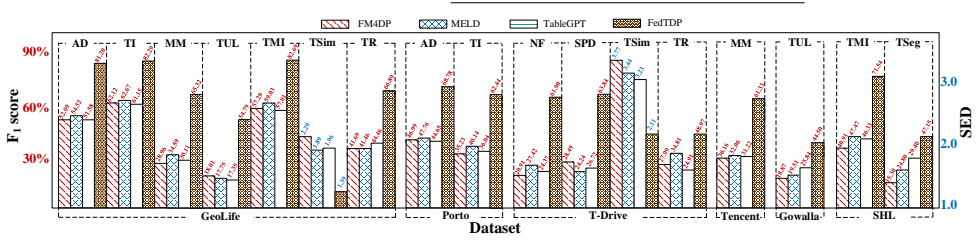
- [Figures 5-7] The figures mix different metric scales on a single axis (e.g., SED values and F1 scores) and are difficult to read; separate panels or clearly labeled secondary axes would improve clarity.
Circularity Check
No load-bearing circularity: the performance claims rest on external baselines, and the privacy gap is under-supported rather than derived from itself.
full rationale
FedTDP's main empirical claim—consistent outperformance of 13 baselines by 4.84%–45.22% across 10 TDP tasks—is measured against external methods on held-out and unseen tasks; the reported numbers are not constructed from the framework's own fitted parameters or losses. No fitted parameter is renamed as a prediction in the evaluation. The nearest candidates for circularity do not rise to that level. (1) Theorem 4.2 restates the inclusion probability of the random layer-selection scheme defined in the same section; it is a definitional identity rather than an independent prediction, and it is not used to produce the headline results. (2) Section 4.1 asserts that transmitting TPA embeddings 'ensures data privacy', but the same paragraph concedes 'merely using embeddings for transmission cannot safeguard data privacy completely', and Theorem 4.1 only proves that masked parameter blocks aggregate to the raw parameter sum (Eqs. 2–4); it does not show that a server receiving embeddings directly cannot invert them. This is a missing formal privacy analysis and a correctness risk, not a circular reduction. (3) Self-citations such as Zeng et al. (2024) are used only to motivate the cross-region data-silo setting and are not load-bearing for any derivation. Therefore no circular step is established by quote-and-reduction; the score reflects the minor definitional theorem and the acknowledged privacy gap, neither of which makes the central result circular.
Assumptions & free parameters
free parameters (2)
- LoRA sparse-tuning layer ratio m =
25% (suggested; see D.6)
- TPA embedding dimension =
32
assumptions (3)
- ad hoc to paper The server cannot invert TPA embeddings to recover raw trajectory data without additional analysis.
- domain assumption Trajectories can be segmented into sub-trajectories across clients without losing the spatio-temporal context needed for TDP tasks.
- ad hoc to paper The sampling probabilities in Theorem 4.2 correctly model the random layer selection, and selecting layers this way preserves convergence.
Cite this review
Pith. "Pith review of FedTDP: A Privacy-Preserving and Unified Framework for Trajectory Data Preparation via Federated Learning." pith.science (2026). https://pith.science/paper/S26W46AB
@misc{pith2026250505155,
  author       = {Pith},
  title        = {Pith review of: FedTDP: A Privacy-Preserving and Unified Framework for Trajectory Data Preparation via Federated Learning},
  year         = {2026},
  howpublished = {\url{https://pith.science/paper/S26W46AB}},
  note         = {Machine review of arXiv:2505.05155}
}
read the original abstract
Trajectory data, which capture the movement patterns of people and vehicles over time and space, are crucial for applications like traffic optimization and urban planning. However, issues such as noise and incompleteness often compromise data quality, leading to inaccurate trajectory analyses and limiting the potential of these applications. While Trajectory Data Preparation (TDP) can enhance data quality, existing methods suffer from two key limitations: (i) they do not address data privacy concerns, particularly in federated settings where trajectory data sharing is prohibited, and (ii) they typically design task-specific models that lack generalizability across diverse TDP scenarios. To overcome these challenges, we propose FedTDP, a privacy-preserving and unified framework that leverages the capabilities of Large Language Models (LLMs) for TDP in federated environments. Specifically, we: (i) design a trajectory privacy autoencoder to secure data transmission and protect privacy, (ii) introduce a trajectory knowledge enhancer to improve model learning of TDP-related knowledge, enabling the development of TDP-oriented LLMs, and (iii) propose federated parallel optimization to enhance training efficiency by reducing data transmission and enabling parallel model training. Experiments on 6 real datasets and 10 mainstream TDP tasks demonstrate that FedTDP consistently outperforms 13 state-of-the-art baselines.
Figures


Figures from the paper (10 more)




Reference graph
Works this paper leans on
-
[2]
Specifically, given the number of trajectory embeddings data|E| from all clients, the complexity of Algorithm 1 isO(|E|∗ TR∗MC), where MC is the model complexity of the LLM. Given the number of trajectories|D| in the client, the complexity of Algorithm 2 isO(|D|∗ TR∗ MC ′ ), where MC ′ is the model complexity of the SLM. D. Experimental Details D.1. Datas...
work page 2010
-
[3]
Open anomalous trajectory recognition via probabilistic metric learning
Gao, Q., Wang, X., Liu, C., Trajcevski, G., Huang, L., and Zhou, F. Open anomalous trajectory recognition via probabilistic metric learning. In IJCAI, pp. 2095–2103,
-
[4]
The Statistics of Dataset Dataset # trajectories # points Quality Issue Task GeoLife 182 24,876,978 Positional inaccuracies, data noise, and lower precision AD, TI, MM, TUL, TMI, TSim, and TR Porto 442 83,409,386 Anomalies and missing data AD and TI T-Drive 10,336 17,662,984 Noisy and incomplete points NF, TR, SPD, and TSim Tencent 40,966 1,610,216 Inaccu...
work page 2010
-
[5]
Llama: Open and efficient foundation language models
Touvron, H., Lavril, T., Izacard, G., Martinet, X., Lachaux, M., Lacroix, T., Rozi `ere, B., Goyal, N., Hambro, E., Azhar, F., Rodriguez, A., Joulin, A., Grave, E., and Lam- ple, G. Llama: Open and efficient foundation language models. CoRR, abs/2302.13971,
-
[6]
Public trans- port planning: When transit network connectivity meets commuting demand
Wang, S., Sun, Y ., Musco, C., and Bao, Z. Public trans- port planning: When transit network connectivity meets commuting demand. In SIGMOD, pp. 1906–1919,
work page 1906
-
[7]
Offsite-tuning: Transfer learn- ing without full model
Xiao, G., Lin, J., and Han, S. Offsite-tuning: Transfer learn- ing without full model. CoRR, abs/2302.04870,
-
[8]
Effective travel time estimation: When historical trajectories over road networks matter
Yuan, H., Li, G., Bao, Z., and Feng, L. Effective travel time estimation: When historical trajectories over road networks matter. In SIGMOD, June 14-19, 2020 , pp. 2135–2149,
work page 2020
-
[11]
Scalability Study D.4. Model Base Study To evaluate the impact of various model bases on the proposed FedTDP framework, we choose widely used model bases for the LLM (Llama-8B (Touvron et al., 2023), GPT3-7B (Brown et al., 2020), and Qwen-7B (Bai et al., 2023)) and SLM (GPT3-Small-125M (Brown et al., 2020), GPT2-Small-117M (Radford et al., 2019), and T5-S...
work page 2023
Show all 14 references
-
[12]
Baseline We compare the proposed FedTDP framework with state-of-the-art baselines, as shown in Table
The Compared Baselines Category Method Task Year S-TDP ATROM Anomaly Detection 2023 Kamel Trajectory Imputation2023 GraphMM Map Matching 2024 AttnTUL Trajectory-User Linking2024 Estimator Travel Mode Identification2024 S3 Trajectory Simplification2023 LightTR Trajectory Recove...
2023
-
[13]
• ATROM (Gao et al., 2023)
for the TSeg task, and LightTR (Liu et al., 2024c) for the TR task, as detailed below. • ATROM (Gao et al., 2023). It solves the anomaly detection task in open-world scenarios and introduces a new probabilistic metric learning model. • Kamel (Musleh & Mokbel, 2023). It propose...
2023
-
[2018]
Qwen technical report
Bai, J., Bai, S., Chu, Y ., Cui, Z., Dang, K., Deng, X., Fan, Y ., Ge, W., Han, Y ., Huang, F., Hui, B., Ji, L., Li, M., Lin, J., Lin, R., Liu, D., Liu, G., Lu, C., Lu, K., Ma, J., Men, R., Ren, X., Ren, X., Tan, C., Tan, S., Tu, J., Wang, P., Wang, S., Wang, W., Wu, S., Xu, B...
-
[2022]
However, these works are specifically tailored for table data preparation and are not directly applicable to trajectory data preparation tasks
explores the performance of LLMs for table data preparation tasks, which evaluates their performance on five data cleaning and integration tasks through prompt-based methods. However, these works are specifically tailored for table data preparation and are not directly applica...
2023
-
[2023]
and Gimpel, K
Hendrycks, D. and Gimpel, K. Gaussian error linear units (gelus). arXiv preprint arXiv:1606.08415,
-
[2024]
Personal information protection law of the people’s republic of china
China. Personal information protection law of the people’s republic of china. https://www.gjbmj.gov. cn/n1/2024/0910/c459362-40317200.html,
2024
Reviewed August 15, 2026 · model on record in the stance chip above.
Discussion (0). Continue with ORCID to comment.