Conversational Process Model Redesign
Pith reviewed 2026-05-22 15:39 UTC · model grok-4.3
The pith
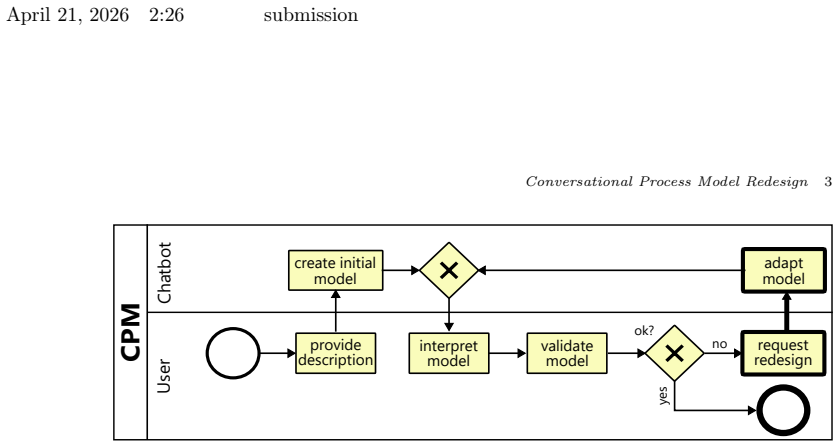
A multi-step LLM process redesigns business models by first matching user requests to literature change patterns before applying them.
A machine-rendered reading of the paper's core claim, the machinery that carries it, and where it could break.
Core claim
The central claim is that decomposing conversational process-model redesign into pattern identification, request rephrasing to expected pattern wording, and subsequent application yields more explainable and reproducible modifications than letting the LLM edit the model in one step.
What carries the argument
The conversational process model redesign (CPMR) pipeline, which routes user requests through literature-derived change patterns as an explicit intermediate representation.
If this is right
- Changes become traceable because each step records which pattern was chosen and how the request was aligned with it.
- Direct application of well-understood patterns can be automated while unclear cases trigger clarification questions.
- Evaluation must separately measure pattern identification accuracy, rephrasing fidelity, and final model correctness.
- User training or interface support for precise change descriptions is required for reliable results.
Where Pith is reading between the lines
- The same pattern-mediated structure could be tested in other model-editing domains such as workflow or data-schema redesign.
- Logging the intermediate pattern and rephrasing steps supplies an audit trail that could support regulatory compliance checks.
- Future interfaces might let users approve or edit the system's proposed rephrasing before the change is applied.
Load-bearing premise
Large language models can consistently recognize which change pattern from the literature a user's request corresponds to and can accurately reword that request to the pattern's canonical phrasing.
What would settle it
A test set of vague or ambiguous user redesign requests where the model either selects the wrong pattern or produces a rephrasing that alters the intended meaning, leading to incorrect model changes.
Figures


read the original abstract
With the recent success of large language models (LLMs), the idea of AI-augmented Business Process Management systems is becoming more feasible. One of their essential characteristics is the ability to be conversationally actionable, allowing humans to interact with the LLM effectively to perform crucial process life cycle tasks such as process model design and redesign. However, most current research focuses on single-prompt execution and evaluation of results, rather than on continuous interaction between the user and the LLM. In this work, we aim to explore the feasibility of using LLMs to empower domain experts in the creation and redesign of process models in an iterative and effective way. The proposed conversational process model redesign (CPMR) approach receives as input a process model and a redesign request by the user in natural language. Instead of just letting the LLM make changes, the LLM is employed to (a) identify process change patterns from literature, (b) re-phrase the change request to be aligned with an expected wording for the identified pattern (i.e., the meaning), and then to (c) apply the meaning of the change to the process model. This multi-step approach allows for explainable and reproducible changes. In order to ensure the feasibility of the CPMR approach, and to find out how well the patterns from literature can be handled by the LLM, we perform an extensive evaluation, also in comparison to a baseline approach without change patterns. The results show that some patterns are hard to understand by LLMs and by users and that clear change descriptions by users are essential. Overall, we recommend a hybrid approach that identifies all used change patterns and then directly applies those patterns that work correctly and for the others derives follow-up questions in order to improve user input.
Editorial analysis
A structured set of objections, weighed in public.
Referee Report
Summary. The paper proposes a conversational process model redesign (CPMR) pipeline in which an LLM first identifies a relevant process change pattern from the literature, then rephrases an arbitrary natural-language user request into the canonical wording expected by that pattern, and finally applies the aligned change to an input process model. The multi-step design is presented as delivering explainable and reproducible redesigns relative to direct single-prompt baselines. An evaluation is described that compares the approach to a baseline without patterns, finds that certain literature patterns remain difficult for both LLMs and users, and concludes that clear user descriptions are essential; a hybrid strategy (apply reliable patterns directly, ask follow-up questions for the rest) is recommended.
Significance. If the reliability of the pattern-identification and re-phrasing steps can be demonstrated on a broad distribution of unconstrained user inputs, the work would offer a concrete route toward more transparent, literature-grounded AI assistance in business-process lifecycle tasks. The explicit recognition that some patterns are hard to handle and the suggestion of a hybrid follow-up mechanism constitute practical contributions that could inform future conversational BPM systems.
major comments (2)
- [Evaluation] Evaluation section: the manuscript provides no quantitative details on dataset size, number of process models or redesign requests tested, success metrics (e.g., accuracy of pattern identification, correctness of applied changes, or inter-rater agreement), error rates, or the sampling strategy used to select patterns and requests. Without these, it is impossible to judge whether the reported difficulties with certain patterns are representative or whether the baseline comparison supports the feasibility conclusions.
- [Approach] Approach description (steps a–c): the central reproducibility and explainability claims rest on the assumption that the LLM can reliably map arbitrary natural-language requests to literature patterns and rephrase them into canonical wording. The evaluation summary notes that “some patterns are hard” and that “clear change descriptions are essential,” yet no failure-rate statistics or tests on deliberately unconstrained inputs are supplied; this leaves open the possibility that the pipeline frequently reduces to repeated prompting plus clarification, undermining the claimed advantages over the baseline.
minor comments (2)
- A diagram or pseudocode listing the exact sequence of LLM calls and the interface to the process-model representation would improve readability of the pipeline.
- The abstract and conclusion both state that the approach was evaluated “in comparison to a baseline approach without change patterns,” but the precise baseline prompt template is not reproduced; including it would allow replication.
Simulated Author's Rebuttal
We thank the referee for the constructive and detailed feedback on our manuscript. The comments highlight important areas for improvement in the presentation of the evaluation and the justification of the approach's advantages. We address each major comment below and will revise the manuscript to incorporate additional details and clarifications.
read point-by-point responses
-
Referee: [Evaluation] Evaluation section: the manuscript provides no quantitative details on dataset size, number of process models or redesign requests tested, success metrics (e.g., accuracy of pattern identification, correctness of applied changes, or inter-rater agreement), error rates, or the sampling strategy used to select patterns and requests. Without these, it is impossible to judge whether the reported difficulties with certain patterns are representative or whether the baseline comparison supports the feasibility conclusions.
Authors: We agree that the evaluation section would benefit from explicit quantitative details to enable readers to assess the scope and representativeness of the results. In the revised manuscript, we will expand this section to report the dataset size, the number of process models and redesign requests tested, success metrics including accuracy of pattern identification and correctness of applied changes, inter-rater agreement where relevant, error rates, and the sampling strategy used. These additions will provide a clearer foundation for interpreting the difficulties observed with certain patterns and the baseline comparison. revision: yes
-
Referee: [Approach] Approach description (steps a–c): the central reproducibility and explainability claims rest on the assumption that the LLM can reliably map arbitrary natural-language requests to literature patterns and rephrase them into canonical wording. The evaluation summary notes that “some patterns are hard” and that “clear change descriptions are essential,” yet no failure-rate statistics or tests on deliberately unconstrained inputs are supplied; this leaves open the possibility that the pipeline frequently reduces to repeated prompting plus clarification, undermining the claimed advantages over the baseline.
Authors: We acknowledge that the reproducibility and explainability claims would be stronger with explicit failure-rate statistics and evidence from tests on unconstrained inputs. While the multi-step design inherently supports explainability through the use of literature patterns, we agree that the current evaluation does not fully rule out frequent reliance on clarification. In the revision, we will add failure-rate statistics for the pattern-identification and re-phrasing steps along with results from additional tests using deliberately unconstrained inputs. This will clarify the conditions under which the pipeline retains its advantages over the single-prompt baseline. revision: yes
Circularity Check
No significant circularity: empirical pipeline draws from external literature patterns
full rationale
The paper presents an empirical conversational redesign method that maps user requests to change patterns drawn from external literature, re-phrases them, and applies the changes via LLM. No mathematical derivations, fitted parameters, self-definitional loops, or load-bearing self-citations are present. The central feasibility claim is supported by comparative evaluation against a baseline rather than by reducing to its own inputs or prior author work.
Axiom & Free-Parameter Ledger
axioms (1)
- domain assumption Existing literature on process change patterns provides a reliable and complete set of patterns that LLMs can map user requests onto.
Lean theorems connected to this paper
-
IndisputableMonolith/Foundation/RealityFromDistinction.leanreality_from_one_distinction unclear?
unclearRelation between the paper passage and the cited Recognition theorem.
The proposed conversational process model redesign (CPMR) approach receives as input a process model and a redesign request by the user in natural language. Instead of just letting the LLM make changes, the LLM is employed to (a) identify process change patterns from literature, (b) re-phrase the change request to be aligned with an expected wording for the identified pattern (i.e., the meaning), and then to (c) apply the meaning of the change to the process model.
What do these tags mean?
- matches
- The paper's claim is directly supported by a theorem in the formal canon.
- supports
- The theorem supports part of the paper's argument, but the paper may add assumptions or extra steps.
- extends
- The paper goes beyond the formal theorem; the theorem is a base layer rather than the whole result.
- uses
- The paper appears to rely on the theorem as machinery.
- contradicts
- The paper's claim conflicts with a theorem or certificate in the canon.
- unclear
- Pith found a possible connection, but the passage is too broad, indirect, or ambiguous to say the theorem truly supports the claim.
Forward citations
Cited by 1 Pith paper
-
On the Hybrid Nature of ABPMS Process Frames and its Implications on Automated Process Discovery
ABPMS process frames are defined as hybrid semi-concurrent procedural and declarative models, with a proposed discovery method that maps declarative constraints into equivalent procedural fragments.
Reference graph
Works this paper leans on
-
[1]
C. M. DaSilva and P. Trkman, Business model: What it is and what it is not,Long Range Planning47(6) (2014) 379–389
work page 2014
-
[2]
A. Mursyada, The role of business process modeling notation in process improvement: A critical review,Advanced Qualitative Research(2024)
work page 2024
-
[3]
D. Ley, Approximating process knowledge and process thinking: Acquiring workflow data by domain experts,2011 IEEE International Conference on Systems, Man, and Cybernetics(2011) 3274–3279
work page 2011
-
[4]
D. Beverungen, Exploring the interplay of the design and emergence of business pro- cesses as organizational routines,Bus. Inf. Syst. Eng.6(4) (2014) 191–202
work page 2014
-
[5]
N. Klievtsova, J. Benzin, T. Kampik, J. Mangler and S. Rinderle-Ma, Conversational process modelling: State of the art, applications, and implications in practice (2023)
work page 2023
-
[6]
N.Klievtsova,J.Mangler,T.iik,J.-V.BenzinandS.Rinderle-Ma,Howcangenerative ai empower domain experts in creating process models? (2024), (accepted)
work page 2024
-
[7]
H. Leopold, J. Mendling and A. Polyvyanyy, Supporting process model validation through natural language generation,IEEE Trans. Software Eng.40(8) (2014) 818– 840
work page 2014
- [8]
-
[9]
N.Klievtsova,T.Kampik,J.ManglerandS.Rinderle-Ma,Conversationallyactionable process model creation, inCooperative Information Systems, (Springer, 2024), pp. 39– 55
work page 2024
-
[10]
B. Weber, S. Rinderle and M. Reichert, Change patterns and change support features in process-aware information systems, inAdvanced Information Systems Engineer- ing, eds. J. Krogstie, A. Opdahl and G. Sindre (Springer Berlin Heidelberg, Berlin, April 21, 2026 2:26 submission 36Klievtsova et al. Heidelberg, 2007), pp. 574–588
work page 2026
-
[11]
S.Rinderle-Ma,M.ReichertandB.Weber,Ontheformalsemanticsofchangepatterns in process-aware information systems, inER, (Springer, 2008), pp. 279–293
work page 2008
-
[12]
M. Weske,Business Process Management - Concepts, Languages, Architectures, Third Edition(Springer, 2019)
work page 2019
-
[13]
T. Debnath, M. N. A. Siddiky, M. E. Rahman, P. Das and A. K. Guha, A compre- hensive survey of prompt engineering techniques in large language models,TechRxiv (2025)
work page 2025
-
[14]
Q. Guo, L. Wang, Y. Wang, W. Ye and S. Zhang, What makes a good order of examples in in-context learning, inFindings of the Association for Computational Linguistics: ACL 2024, eds. L.-W. Ku, A. Martins and V. Srikumar (Association for Computational Linguistics, Bangkok, Thailand, August 2024), pp. 14892–14904
work page 2024
-
[15]
Y. Li, A practical survey on zero-shot prompt design for in-context learning, in Proceedings of the Conference Recent Advances in Natural Language Processing - Large Language Models for Natural Language Processings,RANLP, (INCOMA Ltd., Shoumen, BULGARIA, 2023), p. 641–647
work page 2023
-
[16]
M. Levy, A. Jacoby and Y. Goldberg, Same task, more tokens: the impact of input length on the reasoning performance of large language models (2024)
work page 2024
-
[17]
S. Wu, Y. Li, X. Qu, R. Ravikumar, Y. Li, T. Loakman, S. Quan, X. Wei, R. Batista- Navarro and C. Lin, Longeval: A comprehensive analysis of long-text generation through a plan-based paradigm (2025)
work page 2025
-
[18]
Y. Du, M. Tian, S. Ronanki, S. Rongali, S. Bodapati, A. Galstyan, A. Wells, R. Schwartz, E. A. Huerta and H. Peng, Context length alone hurts llm performance despite perfect retrieval (2025)
work page 2025
-
[19]
X. Liu, T. Rietz and A. Maedche, Conversational versus graphical user interfaces: the influence of rational decision style when individuals perform decision-making tasks repeatedly,Universal Access in the Information Society(06 2024) 1–16
work page 2024
-
[20]
L. A. Flohr, S. Kalinke, A. Krüger and D. P. Wallach, Chat or tap? – comparing chatbotswith‘classic’graphicaluserinterfacesformobileinteractionwithautonomous mobility-on-demand systems, inProceedings of the 23rd International Conference on Mobile Human-Computer Interaction,MobileHCI ’21, (Association for Computing Machinery, New York, NY, USA, 2021)
work page 2021
-
[21]
M. A. Xydis, Comparing change primitives versus change patterns support using think aloud
-
[22]
F. Mu, L. Shi, S. Wang, Z. Yu, B. Zhang, C. Wang, S. Liu and Q. Wang, Clarifygpt: A framework for enhancing llm-based code generation via requirements clarification, Proc. ACM Softw. Eng.1(July 2024)
work page 2024
-
[23]
M. Voelter, R. Hadian, T. Kampik, M. Breitmayer and M. Reichert, Leveraging gen- erative ai for extracting process models from multimodal documents (2024)
work page 2024
-
[24]
J. Mendling, H. Reijers and J. Recker, Activity labeling in process modeling: Empirical insights and recommendations,Information Systems35(4) (2010) 467–482
work page 2010
-
[25]
J. Mendling, H. Reijers and W. Aalst, Seven process modeling guidelines (7pmg), Information and Software Technology52(02 2010) 127–136
work page 2010
- [26]
-
[27]
E. Mickeviciute, R. Butleris, S. Gudas and E. Karciauskas, Transforming bpmn 2.0 business process model into sbvr business vocabulary and rules,Inf. Technol. Control. 46(2017) 360–371
work page 2017
-
[28]
D. Hildebrand, S. Rösl, T. Auer and C. Schieder, Next-generation business process management (bpm): A systematic literature review of cognitive computing and im- April 21, 2026 2:26 submission Conversational Process Model Redesign37 provements in bpm (05 2024)
work page 2026
-
[29]
M. Dumas and et al., AI-augmented business process management systems: A research manifesto,ACM Transactions on Management Inf. Syst.14(2022) 1 – 19
work page 2022
-
[30]
A. Casciani, M. L. Bernardi, M. Cimitile and A. Marrella, Conversational systems for ai-augmented business process management (2024)
work page 2024
-
[31]
T.Kampik,C.Warmuth,A.Rebmann,R.Agam,L.N.P.Egger,A.Gerber,J.Hoffart, J. Kolk, P. Herzig, G. Decker, H. van der Aa, A. Polyvyanyy, S. Rinderle-Ma, I. Weber and M. Weidlich, Large process models: Business process management in the age of generative AI,CoRR(2023)
work page 2023
- [32]
-
[33]
A. Beheshti, J. Yang, Q. Z. Sheng, B. Benatallah, F. Casati, S. Dustdar, H. R. Motahari-Nezhad, X. Zhang and S. Xue, Processgpt: Transforming business process management with GenAI (2023)
work page 2023
- [34]
- [35]
-
[36]
A.KumarandR.Liu,Businessworkflowoptimizationthroughprocessmodelredesign, IEEE Transactions on Engineering Management69(6) (2022) 3068–3084
work page 2022
-
[37]
M. Lohrmann and M. Reichert, Effective application of process improvement patterns to business processes,Software and Systems Modeling15(01 2015)
work page 2015
-
[38]
G. Zellner, Towards a framework for identifying business process redesign patterns, Business Process Management Journal19(07 2013)
work page 2013
-
[39]
A. Yousfi and R. Saidi, Variability patterns for business processes in bpmn,Informa- tion Systems and e-Business Management14(08 2015)
work page 2015
-
[40]
D. Kim, M. Kim and H. Kim, Dynamic business process management based on process change patterns (2007)
work page 2007
-
[41]
A. Kumar and P. Indradat, Optimizing process model redesign, inService-Oriented Computing, (Springer International Publishing, Cham, 2016), pp. 39–54
work page 2016
-
[42]
M. Fellmann, A. Koschmider, R. Laue, A. Schoknecht and A. Vetter, Business pro- cess model patterns: State-of-the-art, research classification and taxonomy,Business Process Management Journal25(08 2018)
work page 2018
-
[43]
H. Kourani, A. Berti, D. Schuster and W. M. P. van der Aalst, Promoai: Process modeling with generative ai,ArXivabs/2403.04327(2024)
-
[44]
J. Köpke and A. Safan, Efficient llm-based conversational process modeling, inBusi- ness Process Management Workshops - BPM 2024 International Workshops, Krakow, Poland, September 1-6, 2024, Revised Selected Papers,eds.K.Gdowska,M.T.Gómez- López and J. RehseLecture Notes in Business Information Processing534, (Springer, 2024), pp. 259–270
work page 2024
discussion (0)
Sign in with ORCID, Apple, or X to comment. Anyone can read and Pith papers without signing in.