REVIEW 3 major objections 5 minor 1 cited by
Efficient Long-Range Machine Learning Force Fields for Liquid and Materials Properties
T0 review · 3 major / 5 minor · reviewed 2026-08-15 · deepseek-v4-flash
Pith's one-line read By predicting atomic partial charges inside the network, the MPNICE force field reaches near-best accuracy at 5–20x lower inference cost.
desk verdict A broad, honest benchmark paper for a charge-aware MLFF; the architecture and new datasets are real contributions, but the headline 5-20x speedup is not actually measured. read the letter →
The pith
A machine-rendered reading of the paper's core claim, the machinery that carries it, and where it could break.
The reading
What carries the argument
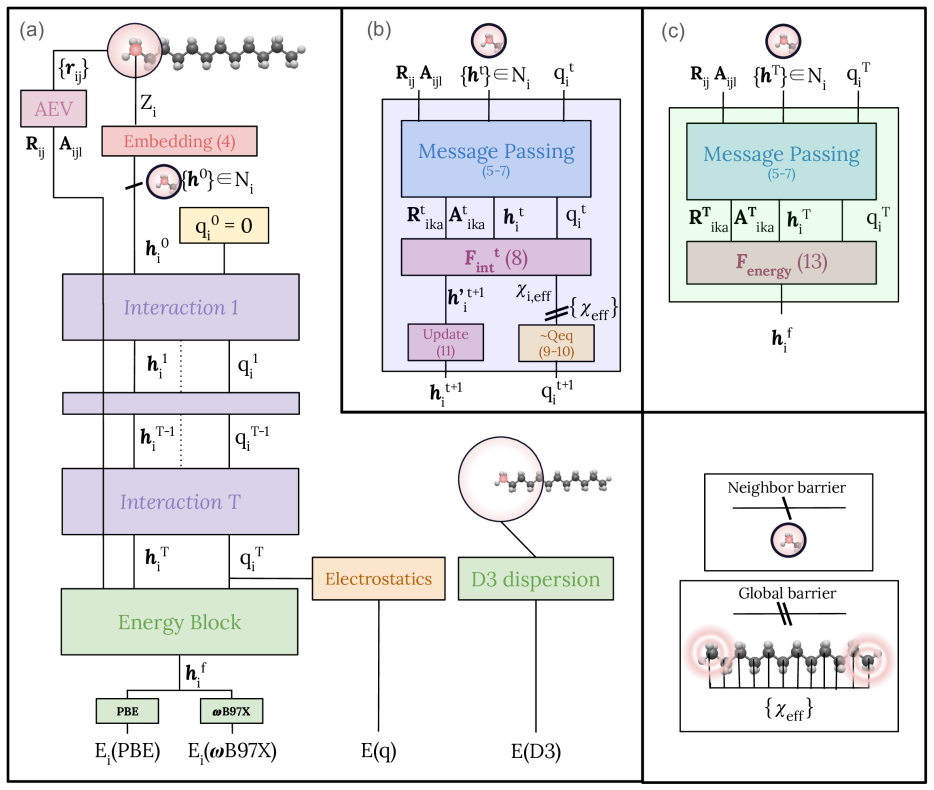
The load-bearing object is the iterative charge-equilibration loop inside the message-passing stack. With the total charge fixed, each atom's charge is $q_i = -(\chi_{\mathrm{eff},i} - \lambda)/J_{ii}$, with $\lambda$ chosen so that $\sum_i q_i = Q_{\mathrm{tot}}$, where $\chi_{\mathrm{eff},i}$ is an MLP-predicted electronegativity and $J_{ii}$ a self-interaction term; this is an approximation to the Qeq method. The loop makes charges internal variables rather than fixed inputs, so long-range electrostatics enter the energy while the messages themselves stay within a finite cutoff, and it gives the model a channel through which an external electric field can be applied as a linear perturbation of the electronegativities. That field perturbation is what turns the same trained model into a predictor of dielectric tensors, Born charges, and non-analytic phonon corrections.
What would settle it
Run the inorganic model on a set of roughly 50 polar crystals for which reference values from density-functional perturbation theory are available for the dielectric tensor, Born effective charges, and LO-TO splitting, then compare magnitudes. The paper's NaCl example already shows reduced magnitudes and small off-diagonal artifacts; if systematic underestimation or large errors in crystals with asymmetric unit cells appears broadly, the claim that the charge representation supports reliable electric response properties is false.
Extended reading notes
Core claim
MPNICE is an invariant message-passing potential in which each atom carries a node-feature vector, a local environment expansion (atomic environment vectors), and a running atomic partial charge. After each interaction block, an MLP predicts an effective electronegativity for each atom, and charges are updated through an analytic charge-equilibration step that enforces global charge conservation and makes the predicted charges feed the next block and the final energy. The final energy is a sum of per-atom terms plus an explicit electrostatic energy from the equilibrated point charges and, optionally, a dispersion correction; multiple output heads let one body of shared features serve different reference levels of theory. The authors demonstrate that this design yields rotamer, tautomer, crystal-ranking, liquid-density, and elastic/phonon accuracies at or near the level of the best existing transferable models, while the charge variables give direct access to ionization energies and to response tensors such as dielectric constants and Born charges.
Load-bearing premise
The inorganic models inherit whatever bias the semi-empirical tight-binding charges carry, because the paper trains them to reproduce those charges rather than true or density-functional-theory charges and then uses the charges to build electrostatic energies and response tensors.
Editorial extensions
If this is right
- Stable, zero-shot liquid simulations: one Organic MPNICE model simulates 62 common solvents with roughly 4% average density error and reproduces water's diffusion coefficient and hydration free energy closely, suggesting transferable models can be dropped into condensed-phase molecular dynamics without task-specific fitting.
- Charge-dependent observables become available from a single trained model: vertical ionization potentials and electron affinities for small molecules, and the LO-TO splitting in polar crystals such as NaCl, can be computed directly from the predicted charge representation.
- Cheaper inorganic screening: Inorganic MPNICE ranks monoelemental crystals and thousands of metal-organic framework structures with energy mean absolute errors comparable to much larger general models, and can be used to estimate bulk and shear moduli near equilibrium.
- Delta learning with a cheap baseline: the delta-learned organic model reaches roughly 0.2 kcal/mol on torsion scans and 0.3 kcal/mol on tautomer energies, indicating that semi-empirical corrections inside this architecture recover much of the cost of high-level reference data.
- Multi-task and shared-force training give a usable single model: a hybrid trained on both organic and inorganic data keeps inorganic total energies accurate and predicts qualitatively correct geometries for unseen Pt/Ir organometallic complexes, though with reduced domain-specific peak accuracy.
Reading between the lines
- The point-charge representation is the main pressure point: the paper's own NaCl example shows dielectric and Born-charge magnitudes running low relative to reference values, with small off-diagonal artifacts in symmetric cells. A natural extension is to give each atom a learned polarizability or higher multipoles, and the architecture's derivative machinery could then be tested against density-fu
- If the 5–20x inference advantage persists for larger models and longer cutoffs, the practical simulation envelope shifts: the reported 17,000-atom water box at roughly 0.07 ns/day would scale to multi-nanosecond simulations of electrolytes, interfaces, and amorphous battery coatings on a single mid-range GPU.
- The shared-force hybrid trick—fixing the energy scale to one dataset and letting forces carry the other—looks like a general recipe for multi-fidelity training that could be tested on other incompatible pairs of reference theories beyond the organic/inorganic split.
- The dependence on semi-empirical charges suggests an explicit experiment: retrain the inorganic model on density-functional-theory-quality partial charges and compare dielectric and Born-charge predictions. If the errors shrink, the architecture's response claims are limited by the charge labels rather than by the model form.
Signed reviews
Editorial analysis
A structured set of objections, weighed in public.
Referee Report
Summary. The paper introduces MPNICE, an invariant message-passing machine-learned force field that iteratively predicts atomic partial charges through an approximate Qeq scheme and includes explicit electrostatics and optional D3 dispersion. The authors train a suite of models for organic molecules (direct, delta-learned, and crystal-aware), for inorganic crystals (MPtrj, OMAT24a, and a sequential inorganic model), and for hybrid organic/inorganic multi-task and shared-force training. The accuracy benchmarks are extensive: torsion scans (Genentech, TorsionNet500, and a new Torsion2000 set), tautomer energies, organic crystal lattice energies and polymorph ranking, liquid densities, water properties, ionization energies and electron affinities, monoelemental crystal ranking, Matbench Discovery, QMOF, elastic moduli, phonon MDR benchmarks, the NaCl non-analytic phonon correction, Li diffusion in amorphous LiAlO2, and Pt/Ir organometallic structure optimization. The paper also claims in the abstract and conclusions that MPNICE achieves 5-20x faster inference than comparable models, a claim that Section 3.4 does not presently substantiate with comparative timing data.
Significance. If the benchmark results and the efficiency claim both hold, MPNICE would be a significant contribution: it combines near-best-class accuracy on several organic and inorganic tasks with a charge-aware architecture that enables charge-dependent properties without an equivariant backbone. The manuscript also provides reusable test data, notably DLPNO-CCSD(T) reference energies for TorsionNet500, a new Torsion2000 set, tautomer and crystal test geometries, and a large set of liquid-density benchmarks; these are valuable community assets. The shared-force hybrid training idea is original and is tested on a demanding organometallic zero-shot task. The authors are also appropriately explicit in Section 4 about limitations such as spin-state insensitivity, extrapolative use on reactive surfaces and defects, and untested organic/inorganic interfaces. The central efficiency claim, however, is currently unsupported by comparative measurements, and the charge-dependent property demonstrations inherit a documented bias from training to GFN1-xTB charges.
major comments (3)
- [Abstract; Section 3.4, Fig. 12] The headline claim of "5-20x faster inference" and the conclusion's "order of magnitude faster than comparable models" are not supported by the evidence in Section 3.4. That section reports absolute MPNICE timings (76, 36, and 20 microseconds per atom for diamond, water, and aluminum) but provides no timing for MatterSim-v1.0.0-1M or SevenNet-0; both competitors are described as running out of memory on the smallest diamond cell, so no speedup ratio is measured anywhere. The comparison is also not apples-to-apples because MPNICE runs in the Desmond MD engine while the competitors run as ASE calculators, which can differ in neighbor-list handling, batching, and memory footprint. The authors should measure all models under a common driver at matched system sizes, report timings for at least one system where every model fits in memory, and state the resulting speedup factors; if this is not possible, the abstract and conclusions should be revised to claim only competitive or engine-specific performance.
- [Section 3.2; Section 3.2.3] The inorganic models are trained to reproduce GFN1-xTB partial charges because MPtrj has no charge labels, and Section 3.2.3 explicitly states that the magnitudes of the dielectric tensor and Born effective charges are reduced relative to PBEsol and that unphysical off-diagonal terms appear for NaCl. Since the abstract and Section 4 present "direct prediction of charge-dependent properties" as a headline capability, the current evidence supports only qualitative response tensors for the studied NaCl case, with the successful LO-TO splitting partly due to error cancellation between Z* and the dielectric tensor. The authors should either validate the charge model against a higher-quality reference for at least one representative system, or explicitly qualify the charge-dependent-property claim in the abstract and conclusions as qualitative.
- [Section 3.2.2, Table 9] Table 9 excludes elastic-moduli outliers (values below -50 or above 600 GPa) from the reported MAE and R2 statistics, and the number of excluded outliers is not negligible in absolute terms: Inorganic MPNICE has 82 excluded shear-modulus outliers, and its reported GVRH R2 is only 0.52 even after exclusion. Because Section 3.2.2 concludes that "all models achieve reasonable performance, comparable to previous reports of MACE MP 0," the authors should report outlier counts as fractions of the test set, give statistics both with and without outlier exclusion, and justify the exclusion threshold with a sensitivity analysis.
minor comments (5)
- [Section 2, Eqs. (1)-(3)] The parameters eta, r_a, theta_a, and zeta in the AEV definitions are not all defined near the equations; please add explicit definitions and state the numerical values used for these parameters.
- [Section 3.4, Fig. 12] The timings are averaged over 500 steps, but no variance or error bars are reported; please report standard errors and state whether the quoted times include only neural-network inference or also engine overhead such as neighbor-list construction and integration.
- [Section 3.1.1 vs. Table 12 and Data Availability] The new torsion benchmark is referred to as "Torsion2000" in the text and Figure 2 but as "TorsionTest2000" in Table 12 and the Data Availability section; please standardize the name.
- [Section 3.1.5] There is a typo in the sentence beginning "Interstingly, Kovacs et al. report..."; "Interstingly" should be "Interestingly".
- [Section 3.2.3, Eqs. (20)-(21)] Please specify the exact definitions used for the fixed-ion dielectric tensor and Born effective charges, including the Ewald summation convention and whether clamped-ion conditions are imposed, so that the automatic-differentiation procedure can be reproduced.
Circularity Check
No circularity found: MPNICE accuracy benchmarks use external references and the charge target is an independent semi-empirical method; the unsupported speedup claim is an evidentiary gap, not circularity.
full rationale
This paper does not exhibit derivation circularity. The MPNICE architecture is benchmarked against external references: torsional energies are compared to literature levels of theory and new DLPNO-CCSD(T)/CBS estimates; tautomer, crystal, liquid, elastic, phonon, and Li-diffusion tests are checked against experiment or independent DFT datasets such as Materials Project, WBM, QMOF, and the PBE MDR benchmark. The inorganic charge model is trained to GFN1-xTB partial charges because MP trj lacks charge labels; this is an external, approximate semi-empirical target, and the authors explicitly acknowledge that training on xTB charges reduces the magnitude of the dielectric and Born-charge tensors relative to PBEsol. The response tensors and non-analytic phonon correction are computed from that independently trained charge model, not fitted to the target response properties, so they are not predictions by construction. Comparisons against the authors' prior QRNN models serve as baselines rather than as validation of MPNICE. Self-citations to the QRNN architecture and prior CSP workflow are present but are not load-bearing for the central accuracy claims. The abstract's '5-20x faster' claim is not substantiated by Section 3.4 because the comparison models ran out of memory and no speedup factor is reported; however, that is an evidentiary gap, not a circular derivation, so it does not raise the circularity score.
Assumptions & free parameters
free parameters (6)
- AEV Gaussian parameters =
Not reported (hand-chosen)
- Radial and angular cutoffs =
5.2 Å and 3.5 Å
- Qeq self-interaction Jii =
Determined by atomic radii (values not tabulated)
- Atomic energy offsets =
Fitted per element/level of theory
- Model hyperparameters (Nint, Nk, N~k, MLP dims) =
e.g., 3 interaction blocks, 64-128 node features, 32 message features
- Huber loss deltas and task weights sigma =
Delta 10 meV; sigma trainable
assumptions (6)
- standard math Neural networks with message passing can represent smooth potential energy surfaces.
- domain assumption DFT references (PBE, omegaB97X-D3BJ) are accurate enough ground truths for training and benchmarking.
- domain assumption GFN1-xTB partial charges are suitable labels for learning atomic charges.
- domain assumption Qeq charge equilibration with predicted electronegativities captures long-range electrostatics.
- domain assumption Born-Oppenheimer approximation and classical nuclei.
- standard math Ewald summation for long-range Coulomb interactions.
Cite this review
Pith. "Pith review of Efficient Long-Range Machine Learning Force Fields for Liquid and Materials Properties." pith.science (2026). https://pith.science/paper/SC23DYPS
@misc{pith2026250506462,
  author       = {Pith},
  title        = {Pith review of: Efficient Long-Range Machine Learning Force Fields for Liquid and Materials Properties},
  year         = {2026},
  howpublished = {\url{https://pith.science/paper/SC23DYPS}},
  note         = {Machine review of arXiv:2505.06462}
}
abstract
Machine learning force fields (MLFFs) have emerged as a sophisticated tool for cost-efficient atomistic simulations approaching DFT accuracy, with recent message passing MLFFs able to cover the entire periodic table. We present an invariant message passing MLFF architecture (MPNICE) which iteratively predicts atomic partial charges, including long-range interactions, enabling the prediction of charge-dependent properties while achieving 5-20x faster inference versus models with comparable accuracy. We train direct and delta-learned MPNICE models for organic systems, and benchmark against experimental properties of liquid and solid systems. We also benchmark the energetics of finite systems, contributing a new set of torsion scans with charged species and a new set of DLPNO-CCSD(T) references for the TorsionNet500 benchmark. We additionally train and benchmark MPNICE models for bulk inorganic crystals, focusing on structural ranking and mechanical properties. Finally, we explore multi-task models for both inorganic and organic systems, which exhibit slightly decreased performance on domain-specific tasks but surprising generalization, stably predicting the gas phase structure of $\simeq500$ Pt/Ir organometallic complexes despite never training to organometallic complexes of any kind.
Figures


Figures from the paper (9 more)


Forward citations
Cited by 1 Pith paper
-
A universal augmentation framework for long-range electrostatics in machine learning interatomic potentials
LES augments short-range MLIPs with long-range electrostatics learned from energies and forces alone, improving accuracy and enabling Born effective charge and dipole prediction.
Reference graph
Works this paper leans on
-
[1]
(1) Mardirossian, N.; Head-Gordon, M. Thirty years of density functional theory in com- putational chemistry: an overview and extensive assessment of 200 density functionals. Molecular physics 2017, 115, 2315–2372. (2) Jorgensen, W. L.; Maxwell, D. S.; Tirado-Rives, J. Development and testing of the OPLS all-atom force field on conformational energetics a...
work page Pith review arXiv 2017
-
[11]
(42) Eastman, P.; Pritchard, B. P.; Chodera, J. D.; Markland, T. E. Nutmeg and SPICE: models and data for biomolecular machine learning. Journal of chemical theory and computation 2024, 20, 8583–8593. (43) Christensen, A. S.; Sirumalla, S. K.; Qiao, Z.; O’Connor, M. B.; Smith, D. G.; Ding, F.; Bygrave, P. J.; Anandkumar, A.; Welborn, M.; Manby, F. R.; oth...
work page 2024
-
[12]
(73) Rosen, A. S.; Iyer, S. M.; Ray, D.; Yao, Z.; Aspuru-Guzik, A.; Gagliardi, L.; Notestein, J. M.; Snurr, R. Q. Machine learning the quantum-chemical properties of metal–organic frameworks for accelerated materials discovery. Matter 2021, 4, 1578–
work page 2021
-
[85]
The radial distribution functions of water and ice from 220 to 673 K and at pressures up to 400 MPa
(68) Soper, A. The radial distribution functions of water and ice from 220 to 673 K and at pressures up to 400 MPa. Chemical Physics 2000, 258, 121–137. (69) Zubatyuk, R.; Smith, J. S.; Nebgen, B. T.; Tretiak, S.; Isayev, O. Teaching a neural network to attach and detach electrons from molecules. Nature Communications 2021, 12,
work page 2000
-
[134]
Generalized Neural-Network Representation of High- Dimensional Potential-Energy Surfaces
(8) Behler, J.; Parrinello, M. Generalized Neural-Network Representation of High- Dimensional Potential-Energy Surfaces. Phys. Rev. Lett. 2007, 98, 146401. (9) Ko, T. W.; Finkler, J. A.; Goedecker, S.; Behler, J. A fourth-generation high- dimensional neural network potential with accurate electrostatics including non-local charge transfer. Nature communic...
work page 2007
-
[154]
(38) Shiota, T.; Ishihara, K.; Do, T. M.; Mori, T.; Mizukami, W. Taming Multi-Domain,- Fidelity Data: Towards Foundation Models for Atomistic Scale Simulations. arXiv preprint arXiv:2412.13088 2024, (39) Release, S. 1: Desmond Molecular Dynamics System, DE Shaw Research, New York, NY,
arXiv 2024
-
[185]
Graph atomic cluster expansion for semilo- cal interactions beyond equivariant message passing
(26) Bochkarev, A.; Lysogorskiy, Y.; Drautz, R. Graph atomic cluster expansion for semilo- cal interactions beyond equivariant message passing. Physical Review X 2024, 14, 021036. (27) Merchant, A.; Batzner, S.; Schoenholz, S. S.; Aykol, M.; Cheon, G.; Cubuk, E. D. Scaling deep learning for materials discovery. Nature 2023, 624, 80–85. (28) Neumann, M.; G...
arXiv 2024
-
[265]
W.; Johansson, A.; Musaelian, A.; Owen, C
(78) Falletta, S.; Cepellotti, A.; Tan, C. W.; Johansson, A.; Musaelian, A.; Owen, C. J.; Kozinsky, B. Unified differentiable learning of the electric enthalpy and dielectric prop- erties with exact physical constraints. arXiv e-prints 2024, arXiv–2403. (79) Assowe, O.; Politano, O.; Vignal, V.; Arnoux, P.; Diawara, B.; Verners, O.; Van Duin, A. Reactive ...
arXiv 2024
Show all 17 references
-
[293]
E.; Jain, A.; Benner, P.; Persson, K
(30) Riebesell, J.; Goodall, R. E.; Jain, A.; Benner, P.; Persson, K. A.; Lee, A. A. Matbench Discovery–An evaluation framework for machine learning crystal stability prediction. arXiv preprint arXiv:2308.14920 2023, (31) Loew, A.; Sun, D.; Wang, H.-C.; Botti, S.; Marques, M. ...
2023 arXiv
-
[398]
D.; Stevenson, J
(10) Jacobson, L. D.; Stevenson, J. M.; Ramezanghorbani, F.; Ghoreishi, D.; Leswing, K.; Harder, E. D.; Abel, R. Transferable neural network potential energy surfaces for closed- shell organic molecules: Extension to ions. Journal of Chemical Theory and Computa- tion 2022, 18,...
2022 arXiv
-
[1093]
System- atic assessment of various universal machine-learning interatomic potentials
(76) Yu, H.; Giantomassi, M.; Materzanini, G.; Wang, J.; Rignanese, G.-M. System- atic assessment of various universal machine-learning interatomic potentials. Materials Genome Engineering Advances 2024, 2, e58. (77) Mao, Z.; Li, W.; Tan, J. Dielectric tensor prediction for in...
2024
-
[1597]
S.; Fung, V.; Huck, P.; O’Donnell, C
59 (74) Rosen, A. S.; Fung, V.; Huck, P.; O’Donnell, C. T.; Horton, M. K.; Truhlar, D. G.; Persson, K. A.; Notestein, J. M.; Snurr, R. Q. High-throughput predictions of metal– organic framework electronic properties: theoretical challenges, graph neural networks, and data expl...
2022
-
[2019]
A consistent and accurate ab initio parametrization of density functional dispersion correction (DFT-D) for the 94 elements H-Pu
(40) Grimme, S.; Antony, J.; Ehrlich, S.; Krieg, H. A consistent and accurate ab initio parametrization of density functional dispersion correction (DFT-D) for the 94 elements H-Pu. The Journal of Chemical Physics 2010, 132, 154104. 55 (41) Eastman, P.; Behara, P. K.; Dotson, ...
2010
-
[2020]
W.; Bernstein, J
(53) Buˇ car, D.-K.; Lancaster, R. W.; Bernstein, J. Disappearing Polymorphs Revisited. Angewandte Chemie International Edition 2015, 54, 6972–6993. (54) Egorova, O.; Hafizi, R.; Woods, D. C.; Day, G. M. Multifidelity Statistical Machine Learning for Molecular Crystal Structur...
2015 arXiv
-
[2991]
E.; Lubbers, N.; Matin, S.; Smith, J.; Messerly, R.; Tretiak, S.; Barros, K
(37) Allen, A. E.; Lubbers, N.; Matin, S.; Smith, J.; Messerly, R.; Tretiak, S.; Barros, K. Learning together: Towards foundation models for machine learning interatomic po- tentials with meta-learning. npj computational materials 2024, 10,
2024
-
[4870]
AIMNet-NSE test datasets
(70) Zubatiuk, R. AIMNet-NSE test datasets. 2021; https://doi.org/10.5281/zenodo. 5007980. (71) Yang, H.; Hu, C.; Zhou, Y.; Liu, X.; Shi, Y.; Li, J.; Li, G.; Chen, Z.; Chen, S.; Zeni, C.; others Mattersim: A deep learning atomistic model across elements, temperatures and press...
2021 arXiv
-
[6424]
(36) Takamoto, S. et al. Towards universal neural network potential for material discovery applicable to arbitrary combination of 45 elements. Nature Commun. 2022, 13,
2022
Reviewed August 15, 2026 · model on record in the stance chip above.
Discussion (0). Continue with ORCID to comment.