Quantum Reservoir Computing for Realized Volatility Forecasting
Pith reviewed 2026-05-22 15:04 UTC · model grok-4.3
The pith
Quantum reservoir computing using a fully connected transverse-field Ising model with input and memory qubits outperforms econometric and standard ML benchmarks in realized volatility forecasting.
A machine-rendered reading of the paper's core claim, the machinery that carries it, and where it could break.
Core claim
Our results indicate that the proposed quantum reservoir approach consistently outperforms benchmark models across various metrics, highlighting its potential for financial forecasting despite existing quantum hardware constraints.
Load-bearing premise
That the fully connected transverse-field Ising Hamiltonian reservoir with distinct input and memory qubits can reliably capture and exploit temporal dependencies in realized volatility data on current or near-term quantum hardware without being dominated by noise or decoherence effects.
Figures





read the original abstract
Recent advances in quantum computing have demonstrated its potential to significantly enhance the analysis and forecasting of complex classical data. Among these, quantum reservoir computing has emerged as a particularly powerful approach, combining quantum computation with machine learning for modeling nonlinear temporal dependencies in high-dimensional time series. As with many data-driven disciplines, quantitative finance and econometrics can hugely benefit from emerging quantum technologies. In this work, we investigate the application of quantum reservoir computing for realized volatility forecasting. Our model employs a fully connected transverse-field Ising Hamiltonian as the reservoir with distinct input and memory qubits to capture temporal dependencies. The quantum reservoir computing approach is benchmarked against several econometric models and standard machine learning algorithms. The models are evaluated using multiple error metrics and the model confidence set procedures. To enhance interpretability and mitigate current quantum hardware limitations, we utilize wrapper-based forward selection for feature selection, identifying optimal subsets, and quantifying feature importance via Shapley values. Our results indicate that the proposed quantum reservoir approach consistently outperforms benchmark models across various metrics, highlighting its potential for financial forecasting despite existing quantum hardware constraints. This work serves as a proof-of-concept for the applicability of quantum computing in econometrics and financial analysis, paving the way for further research into quantum-enhanced predictive modeling as quantum hardware capabilities continue to advance.
Editorial analysis
A structured set of objections, weighed in public.
Referee Report
Summary. The manuscript proposes a quantum reservoir computing (QRC) model that employs a fully connected transverse-field Ising Hamiltonian as the reservoir, with separate input and memory qubits, to forecast realized volatility in financial time series. The approach is benchmarked against standard econometric models and classical machine learning algorithms using multiple error metrics together with model confidence set procedures; wrapper-based forward feature selection and Shapley-value analysis are used to improve interpretability and address hardware limitations. The central claim is that the QRC model consistently outperforms the benchmarks across the reported metrics, serving as a proof-of-concept for quantum-enhanced financial forecasting despite current quantum hardware constraints.
Significance. If the empirical results are shown to be robust under realistic noise and decoherence, the work would constitute a concrete demonstration that quantum reservoir computing can capture temporal structure in realized-volatility data more effectively than classical alternatives. The explicit use of model confidence sets and Shapley values for interpretability strengthens the contribution by providing falsifiable, reproducible comparisons rather than isolated error metrics.
major comments (2)
- [§4 (Numerical Experiments)] §4 (Numerical Experiments) and the abstract: the claim that the QRC approach outperforms benchmarks 'despite existing quantum hardware constraints' is load-bearing for the central contribution, yet the manuscript does not state whether the reservoir dynamics were obtained from ideal unitary simulation, from classical simulation with injected noise models, or from actual device execution. Without this information the hardware-robustness part of the result cannot be evaluated.
- [Table 2] Table 2 (or equivalent results table): the reported superiority is asserted across 'various metrics' and model confidence sets, but no numerical values, standard errors, or dataset sizes are supplied in the abstract and the main text does not indicate whether the same train/test splits and hyper-parameter search budgets were used for all models. This leaves open the possibility that the reported advantage depends on post-hoc choices.
minor comments (2)
- [Eq. 3] The description of the transverse-field Ising Hamiltonian (Eq. 3 or equivalent) would benefit from an explicit statement of the coupling strengths and the separation between input and memory qubits to allow reproduction.
- [Figure 1] Figure 1 (reservoir schematic) lacks a clear legend distinguishing input, memory, and readout qubits; this reduces clarity for readers unfamiliar with QRC architectures.
Simulated Author's Rebuttal
We thank the referee for the thoughtful and constructive report. The comments highlight important points regarding experimental clarity and reproducibility that we will address directly in the revision. Below we respond to each major comment.
read point-by-point responses
-
Referee: [§4 (Numerical Experiments)] §4 (Numerical Experiments) and the abstract: the claim that the QRC approach outperforms benchmarks 'despite existing quantum hardware constraints' is load-bearing for the central contribution, yet the manuscript does not state whether the reservoir dynamics were obtained from ideal unitary simulation, from classical simulation with injected noise models, or from actual device execution. Without this information the hardware-robustness part of the result cannot be evaluated.
Authors: We agree that this information is essential for evaluating the hardware-robustness claim. The numerical experiments reported in Section 4 were performed via classical simulation of the ideal unitary evolution of the transverse-field Ising reservoir; no noise models were injected and no results were obtained from actual quantum hardware. The phrase 'despite existing quantum hardware constraints' in the abstract and conclusion is intended to indicate that the approach is designed to be compatible with near-term devices (via the use of a fully connected but small reservoir and separate input/memory qubits), rather than claiming execution on current hardware. We will revise the abstract, Section 4, and the discussion to explicitly state that all presented results come from ideal unitary simulation on classical hardware, and we will add a dedicated paragraph outlining the steps required to port the model to noisy hardware together with preliminary noise-resilience estimates. revision: yes
-
Referee: [Table 2] Table 2 (or equivalent results table): the reported superiority is asserted across 'various metrics' and model confidence sets, but no numerical values, standard errors, or dataset sizes are supplied in the abstract and the main text does not indicate whether the same train/test splits and hyper-parameter search budgets were used for all models. This leaves open the possibility that the reported advantage depends on post-hoc choices.
Authors: We acknowledge that greater transparency on experimental protocol is needed. The manuscript already reports the full set of error metrics and model confidence set (MCS) p-values in Table 2 and the associated text, but we will add explicit statements confirming that (i) identical chronological train/test splits were used for every model, (ii) hyper-parameter search was performed with the same computational budget and cross-validation procedure across all classical and quantum baselines, and (iii) dataset sizes (number of trading days and assets) are stated in Section 3. Standard errors for the main metrics will be included in the revised Table 2. We will also insert a short summary of the key numerical results into the abstract to satisfy the referee’s request for concrete values. revision: yes
Circularity Check
No circularity: empirical benchmarking with independent performance metrics
full rationale
This is an applied empirical study that trains a quantum reservoir on realized volatility time series, selects features via wrapper methods, computes Shapley values for interpretability, and reports outperformance against econometric and ML baselines using standard error metrics and model confidence set procedures. No derivation chain exists that reduces a claimed prediction to a fitted parameter or self-citation by construction; the reservoir dynamics follow the standard transverse-field Ising evolution (external to this paper), and all reported results are falsifiable against held-out data. Self-citations to prior QRC literature, if present, support the method choice but do not bear the load of the outperformance claim, which rests on direct numerical comparison.
Axiom & Free-Parameter Ledger
Forward citations
Cited by 2 Pith papers
-
Fixed-Reservoir vs Variational Quantum Architectures for Chaotic Dynamics: Benchmarking QRC and QPINN on the Lorenz System
Fixed-reservoir QRC achieves 81% lower test MSE and 52,000x faster training than variational QPINN on Lorenz chaotic prediction with 4-5 qubits.
-
Quantum reservoir computing in Jaynes-Cummings models: Nonlinear memory and time-series prediction
Jaynes-Cummings qubit-boson systems show superior nonlinear memory capacity and comparable Mackey-Glass forecasting performance when used as quantum reservoirs.
Reference graph
Works this paper leans on
-
[1]
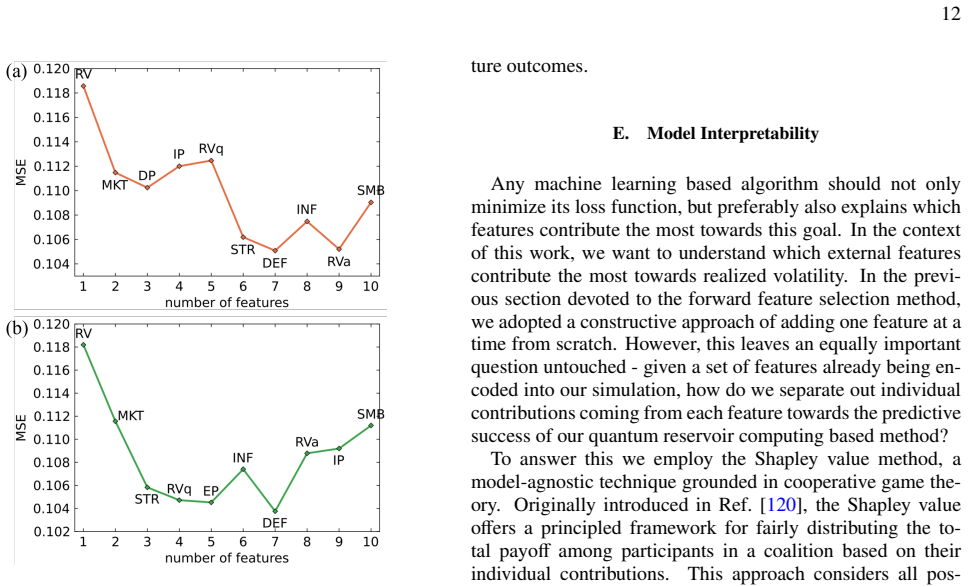
and Engleet al.[113] demonstrate that indicators such as Inflation Rates (INF) and Industrial Production Growth (IP) provide an essential context about the state of the broader economy, improving a model’s reliability in forecasting fi- nancial volatility. Similarly, valuation measures such as the Dividend-Price Ratio (DP) and the Earnings-Price ratio (EP...
work page 1950
-
[2]
This process continues iteratively, rolling through all 245 out-of-sample observations, spanning from August 1997 to December 2017. During this process, all models are re- estimated at each step to ensure optimal performance for the new rolling window. Among the classical linear models that we use,AR1,AR3, ARMAX,HAR,HARXare estimated using ordinary least ...
-
[3]
P. Shor, Algorithms for quantum computation: discrete loga- rithms and factoring, inProceedings 35th Annual Symposium on Foundations of Computer Science(1994) pp. 124–134
work page 1994
-
[4]
Steane, Quantum computing, Rep
A. Steane, Quantum computing, Rep. Prog. Phys.61, 117 (1998)
work page 1998
-
[5]
A. Y . Kitaev, A. H. Shen, and M. N. Vyalyi,Classical and Quantum Computation(American Mathematical Society, USA, 2002)
work page 2002
- [6]
- [7]
-
[8]
Z. Han, C. Lyu, Y . Zhou, J. Yuan, J. Chu, W. Nuerbolati, H. Jia, L. Nie, W. Wei, Z. Yang, L. Zhang, Z. Zhang, C.-K. Hu, L. Hu, J. Li, D. Tan, A. Bayat, S. Liu, F. Yan, and D. Yu, Multilevel variational spectroscopy using a programmable quantum sim- ulator, Phys. Rev. Res.6, 013015 (2024)
work page 2024
-
[9]
W. Ren, W. Li, S. Xu, K. Wang, W. Jiang, F. Jin, X. Zhu, J. Chen, Z. Song, P. Zhang,et al., Experimental quantum ad- versarial learning with programmable superconducting qubits, Nat. Comput. Sci.2, 711 (2022)
work page 2022
-
[10]
D. Kielpinski, C. Monroe, and D. J. Wineland, Architecture for a large-scale ion-trap quantum computer, Nature417, 709 (2002)
work page 2002
- [11]
-
[12]
M. Ringbauer, M. Meth, L. Postler, R. Stricker, R. Blatt, P. Schindler, and T. Monz, A universal qudit quantum proces- sor with trapped ions, Nat. Phys.18, 1053 (2022)
work page 2022
- [13]
-
[14]
H. Bernien, S. Schwartz, A. Keesling, H. Levine, A. Omran, H. Pichler, S. Choi, A. S. Zibrov, M. Endres, M. Greiner,et al., Probing many-body dynamics on a 51-atom quantum simula- tor, Nature551, 579 (2017)
work page 2017
- [15]
-
[16]
H.-S. Zhong, Y .-H. Deng, J. Qin, H. Wang, M.-C. Chen, L.-C. Peng, Y .-H. Luo, D. Wu, S.-Q. Gong, H. Su,et al., Phase-programmable gaussian boson sampling using stimu- lated squeezed light, Phys. Rev. Lett.127, 180502 (2021)
work page 2021
-
[17]
L. Xiao, T. Deng, K. Wang, G. Zhu, Z. Wang, W. Yi, and P. Xue, Non-hermitian bulk–boundary correspondence in quantum dynamics, Nat. Phys.16, 761 (2020)
work page 2020
- [18]
-
[19]
M. A. Quantum, M. Aghaee, A. Alcaraz Ramirez, Z. Alam, R. Ali, M. Andrzejczuk, A. Antipov, M. Astafev, A. Barzegar, B. Bauer,et al., Interferometric single-shot parity measure- ment in inas–al hybrid devices, Nature638, 651 (2025)
work page 2025
-
[20]
Preskill, Quantum Computing in the NISQ era and beyond, Quantum2, 79 (2018)
J. Preskill, Quantum Computing in the NISQ era and beyond, Quantum2, 79 (2018)
work page 2018
- [21]
-
[22]
A Quantum Approximate Optimization Algorithm
E. Farhi, J. Goldstone, and S. Gutmann, A quantum approxi- mate optimization algorithm (2014), arXiv:1411.4028 [quant- ph]
work page internal anchor Pith review Pith/arXiv arXiv 2014
-
[23]
Y . Cao, J. Romero, J. P. Olson, M. Degroote, P. D. John- son, M. Kieferová, I. D. Kivlichan, T. Menke, B. Peropadre, N. P. D. Sawaya, S. Sim, L. Veis, and A. Aspuru-Guzik, Quan- tum Chemistry in the Age of Quantum Computing, Chem. Rev.119, 10856 (2019)
work page 2019
-
[24]
Q. Li, C. Mukhopadhyay, and A. Bayat, Fermionic simula- tors for enhanced scalability of variational quantum simula- tion, Phys. Rev. Res.5, 043175 (2023)
work page 2023
-
[25]
A. Baiardi, M. Christandl, and M. Reiher, Quantum comput- 18 ing for molecular biology, ChemBioChem24, e202300120 (2023)
work page 2023
-
[26]
D. Paulson, L. Dellantonio, J. F. Haase, A. Celi, A. Kan, A. Jena, C. Kokail, R. van Bijnen, K. Jansen, P. Zoller, and C. A. Muschik, Simulating 2d effects in lattice gauge theories on a quantum computer, PRX Quantum2, 030334 (2021)
work page 2021
-
[27]
J. P. Crutchfield and K. Young, Inferring statistical complexity, Phys. Rev. Lett.63, 105 (1989)
work page 1989
-
[28]
C. R. Shalizi and J. P. Crutchfield, Computational mechanics: Pattern and prediction, structure and simplicity, J. Stat. Phys. 104, 817 (2001)
work page 2001
-
[29]
M. Gu, K. Wiesner, E. Rieper, and V . Vedral, Quantum me- chanics can reduce the complexity of classical models, Nat. Commun.3, 762 (2012)
work page 2012
-
[30]
W. da Silva Coelho, L. Henriet, and L.-P. Henry, Quantum pricing-based column-generation framework for hard combi- natorial problems, Phys. Rev. A107, 032426 (2023)
work page 2023
- [31]
- [32]
-
[33]
J. Wi ´sniewska and M. Sawerwain, Variational quantum eigen- solver for classification in credit sales risk, arXiv preprint arXiv:2303.02797 https://doi.org/10.48550/arXiv.2303.02797 (2023)
-
[34]
L. Leclerc, L. Ortiz-Gutiérrez, S. Grijalva, B. Albrecht, J. R. Cline, V . E. Elfving, A. Signoles, L. Henriet, G. Del Bimbo, U. A. Sheikh,et al., Financial risk management on a neutral atom quantum processor, Phys. Rev. Res.5, 043117 (2023)
work page 2023
-
[35]
N. Innan, A. Marchisio, M. Bennai, and M. Shafique, Lep-qnn: Loan eligibility prediction using quan- tum neural networks, arXiv preprint arXiv:2412.03158 https://doi.org/10.48550/arXiv.2412.03158 (2024)
-
[36]
R. Orús, S. Mugel, and E. Lizaso, Quantum computing for fi- nance: Overview and prospects, Phys. Rev.4, 100028 (2019)
work page 2019
-
[37]
A survey of quantum computing for finance,
D. Herman, C. Googin, X. Liu, A. Galda, I. Safro, Y . Sun, M. Pistoia, and Y . Alexeev, A survey of quan- tum computing for finance, arXiv preprint arXiv:2201.02773 https://doi.org/10.48550/arXiv.2201.02773 (2022)
-
[38]
A. S. Naik, E. Yeniaras, G. Hellstern, G. Prasad, and S. K. L. P. Vishwakarma, From portfolio optimization to quantum blockchain and security: A systematic review of quantum computing in finance, Financial Innovation11, 1 (2025)
work page 2025
-
[39]
H. Jaeger and H. Haas, Harnessing nonlinearity: Predicting chaotic systems and saving energy in wireless communication, Science304, 78 (2004)
work page 2004
- [40]
-
[41]
J. Kim, H. Kim, H. Kim, D. Lee, and S. Yoon, A compre- hensive survey of deep learning for time series forecasting: Architectural diversity and open challenges, Artif. Intell. Rev. 58, 216 (2025)
work page 2025
-
[42]
K. Fujii and K. Nakajima, Harnessing disordered-ensemble quantum dynamics for machine learning, Phys. Rev. Appl.8, 024030 (2017)
work page 2017
-
[43]
L. C. G. Govia, G. J. Ribeill, G. E. Rowlands, H. K. Krovi, and T. A. Ohki, Quantum reservoir computing with a single nonlinear oscillator, Phys. Rev. Res.3, 013077 (2021)
work page 2021
-
[44]
S. Das, G. L. Giorgi, and R. Zambrini, Quantum reser- voir computing using jaynes-cummings model (2025), arXiv:2510.00171 [quant-ph]
work page internal anchor Pith review Pith/arXiv arXiv 2025
-
[45]
T. Yasuda, Y . Suzuki, T. Kubota, K. Nakajima, Q. Gao, W. Zhang, S. Shimono, H. I. Nurdin, and N. Yamamoto, Quantum reservoir computing with repeated measurements on superconducting devices, arXiv preprint arXiv:2310.06706 https://doi.org/10.48550/arXiv.2310.06706 (2023)
-
[46]
M. C. Mackey and L. Glass, Oscillation and chaos in physio- logical control systems, Science197, 287 (1977)
work page 1977
-
[47]
P. A. Moran and P. Whittle, Hypothesis Testing in Time Series Analysis., J. R. Stat. Soc114, 579 (1951), 10.2307/2981095
-
[48]
F. Black and M. Scholes, The pricing of options and corporate liabilities, J. Political Econ.81, 637 (1973)
work page 1973
-
[49]
S.-H. Poon and C. W. J. Granger, Forecasting volatility in fi- nancial markets: A review, Econ. Lit.41, 478 (2003)
work page 2003
-
[50]
Bollerslev, Generalized autoregressive conditional het- eroskedasticity, J
T. Bollerslev, Generalized autoregressive conditional het- eroskedasticity, J. Econom.31, 307 (1986)
work page 1986
-
[51]
T. G. Andersen, T. Bollerslev, F. X. Diebold, and H. Ebens, The distribution of realized stock return volatility, J. financ. econ.61, 43 (2001)
work page 2001
-
[52]
O. E. Barndorff-Nielsen and N. Shephard, Econometric anal- ysis of realized volatility and its use in estimating stochastic volatility models, J. R. Stat. Soc64, 253 (2002)
work page 2002
-
[53]
Corsi, A Simple Approximate Long-Memory Model of Re- alized V olatility, J
F. Corsi, A Simple Approximate Long-Memory Model of Re- alized V olatility, J. financ. econ.7, 174 (2009)
work page 2009
-
[54]
T. G. Andersen, T. Bollerslev, and F. X. Diebold, Roughing it up: Including jump components in the measurement, model- ing, and forecasting of return volatility, Rev. Econ. Stat.89, 701 (2007)
work page 2007
-
[55]
A. J. Patton and K. Sheppard, Good volatility, bad volatility: Signed jumps and the persistence of volatility, Rev. Econ. Stat. 97, 683 (2015)
work page 2015
-
[56]
T. Bollerslev, A. J. Patton, and R. Quaedvlieg, Exploiting the errors: A simple approach for improved volatility forecasting, J. Econom.192, 1 (2016)
work page 2016
-
[57]
C.-M. Kuan and H. White, Artificial neural networks: An econometric perspective, Econom. Rev.13, 1 (1994)
work page 1994
-
[58]
Habibnia,Essays in high-dimensional nonlinear time se- ries analysis, Ph.D
A. Habibnia,Essays in high-dimensional nonlinear time se- ries analysis, Ph.D. thesis, London School of Economics and Political Science (2016)
work page 2016
-
[59]
S. Gu, B. Kelly, and D. Xiu, Empirical asset pricing via ma- chine learning, Rev. Financ. Stud.33, 2223 (2020)
work page 2020
-
[60]
Bucci, Realized V olatility Forecasting with Neural Net- works, J
A. Bucci, Realized V olatility Forecasting with Neural Net- works, J. financ. econ.18, 502 (2020)
work page 2020
-
[61]
S. Gu, B. Kelly, and D. Xiu, Autoencoder asset pricing mod- els, J. Econom. Annals Issue: Financial Econometrics in the Age of the Digital Economy,222, 429 (2021)
work page 2021
-
[62]
A. Habibnia and E. Maasoumi, Forecasting in Big Data En- vironments: An Adaptable and Automated Shrinkage Estima- tion of Neural Networks (AAShNet), Quant. Econ. J.19, 363 (2021)
work page 2021
-
[63]
H. Zhu, L. Bai, L. He, and Z. Liu, Forecasting realized volatil- ity with machine learning: Panel data perspective, J. Empir. Finance73, 251 (2023)
work page 2023
- [64]
-
[65]
L. Chen, M. Pelger, and J. Zhu, Deep Learning in Asset Pric- ing, Manag. Sci.70, 714 (2024)
work page 2024
-
[66]
E. Hillebrand and M. C. and Medeiros, The Benefits of Bag- ging for Forecast Models of Realized V olatility, Econom. Rev. 29, 571 (2010)
work page 2010
-
[67]
M. Fernandes, M. C. Medeiros, and M. Scharth, Modeling and predicting the CBOE market volatility index, Journal of Bank- ing & Finance40, 1 (2014)
work page 2014
-
[68]
F. Audrino and S. D. and Knaus, Lassoing the HAR Model: A 19 Model Selection Perspective on Realized V olatility Dynamics, Econom. Rev.35, 1485 (2016)
work page 2016
-
[69]
R. R. Branco, A. Rubesam, and M. Zevallos, Forecasting re- alized volatility: Does anything beat linear models?, J. Empir. Finance78, 101524 (2024)
work page 2024
-
[70]
K. Christensen, M. Siggaard, and B. Veliyev, A machine learn- ing approach to volatility forecasting, J. financ. econ.21, 1680 (2023)
work page 2023
- [71]
-
[72]
E. Ghysels, P. Santa-Clara, and R. Valkanov, Predicting volatility: Getting the most out of return data sampled at dif- ferent frequencies, J. Econom.131, 59 (2006)
work page 2006
-
[73]
E. S. Gunnarsson, H. R. Isern, A. Kaloudis, M. Risstad, B. Vigdel, and S. Westgaard, Prediction of realized volatil- ity and implied volatility indices using AI and machine learn- ing: A review, International Review of Financial Analysis93, 103221 (2024)
work page 2024
-
[74]
S. Hochreiter and J. Schmidhuber, Long Short-Term Memory, Neural Comput.9, 1735 (1997)
work page 1997
-
[75]
I. Goodfellow, Y . Bengio, and A. Courville,Deep Learning (MIT Press, 2016)http://www.deeplearningbook.org
work page 2016
-
[76]
M. Lukoševi ˇcius and H. Jaeger, Reservoir computing ap- proaches to recurrent neural network training, Comput. Sci. Rev.3, 127 (2009)
work page 2009
- [77]
-
[78]
J. García-Beni, G. L. Giorgi, M. C. Soriano, and R. Zambrini, Scalable photonic platform for real-time quantum reservoir computing, Phys. Rev. Appl.20, 014051 (2023)
work page 2023
- [79]
-
[80]
J. Garcia-Beni, G. L. Giorgi, M. C. Soriano, and R. Zambrini, Quantum reservoir computing for time series processing, in Quantum Communications and Quantum Imaging XXII, V ol. PC13148, edited by K. S. Deacon and R. E. Meyers, Inter- national Society for Optics and Photonics (SPIE, 2024) p. PC131480E
work page 2024
discussion (0)
Sign in with ORCID, Apple, or X to comment. Anyone can read and Pith papers without signing in.