Quantum reservoir computing in Jaynes-Cummings models: Nonlinear memory and time-series prediction
Pith reviewed 2026-05-21 20:47 UTC · model grok-4.3
The pith
Jaynes-Cummings models as quantum reservoirs display stronger nonlinear memory than linear memory and match standard methods on chaotic time-series forecasting.
A machine-rendered reading of the paper's core claim, the machinery that carries it, and where it could break.
Core claim
Jaynes-Cummings and dispersive Jaynes-Cummings reservoirs exhibit superior nonlinear over linear memory capacity together with forecasting performance on the Mackey-Glass time series that is comparable to conventional approaches while exceeding the capability of equivalent qubit-pair reservoirs.
What carries the argument
The Jaynes-Cummings Hamiltonian (and its dispersive limit) that supplies the intrinsic nonlinear qubit-boson coupling used to evolve the reservoir state.
If this is right
- Higher-order bosonic observables increase memory capacity and prediction accuracy.
- Time multiplexing enhances expressivity even in minimal qubit-boson configurations.
- Reservoir parameters can be tuned to trade off memory depth against prediction horizon.
- Hybrid spin-boson reservoirs outperform pure qubit reservoirs on the tested tasks.
Where Pith is reading between the lines
- The same nonlinear advantage could appear in other light-matter Hamiltonians with similar structure.
- Real-device implementations would need to verify whether decoherence preserves the reported separation between nonlinear and linear memory.
- These reservoirs could serve as modular units in larger quantum machine-learning circuits for sequential data.
Load-bearing premise
The reported advantages rest on specific numerical choices of reservoir parameters, finite bosonic Hilbert-space truncation, and the particular set of measured observables.
What would settle it
A simulation or experiment that removes the nonlinear memory advantage by changing truncation level, observable choice, or parameter regime without post-hoc retuning.
Figures




read the original abstract
We investigate quantum reservoir computing (QRC) using a hybrid qubit-boson system described by the Jaynes-Cummings (JC) Hamiltonian and its dispersive limit (DJC). These models provide high-dimensional Hilbert spaces and intrinsic nonlinear dynamics, making them powerful substrates for temporal information processing. We systematically benchmark both reservoirs through linear and nonlinear memory tasks, demonstrating that they exhibit an unusual superior nonlinear over linear memory capacity. We further test their predictive performance on the Mackey-Glass time series, a widely used benchmark for chaotic dynamics, and show comparable forecasting ability. We also investigate how memory and prediction accuracy vary with reservoir parameters, and show the role of higher-order bosonic observables and time multiplexing in enhancing expressivity, even in minimal spin-boson configurations. Our results establish JC- and DJC-based reservoirs as versatile platforms for time-series processing and as elementary units that overcome the setting of equivalent qubit pairs and offer pathways toward tunable, high-performance quantum machine learning architectures.
Editorial analysis
A structured set of objections, weighed in public.
Referee Report
Summary. The manuscript investigates quantum reservoir computing using Jaynes-Cummings (JC) and dispersive Jaynes-Cummings (DJC) hybrid qubit-boson systems. It systematically benchmarks linear and nonlinear memory capacities, claiming an unusual superiority of nonlinear over linear memory in these models relative to qubit-pair baselines. The work further demonstrates comparable forecasting performance on the Mackey-Glass chaotic time series and examines the effects of reservoir parameters, higher-order bosonic observables, and time multiplexing on expressivity in minimal configurations.
Significance. If the numerical results prove robust, the paper would be significant for quantum machine learning by showing that the intrinsic nonlinearity of the JC interaction provides a natural advantage for temporal processing tasks. The systematic parameter sweeps and exploration of minimal spin-boson setups offer concrete guidance for experimental realizations in circuit QED platforms.
major comments (2)
- §4.2: The reported superior nonlinear memory capacity for JC/DJC reservoirs (relative to linear capacity and to qubit-pair controls) is obtained with a finite bosonic Fock-space truncation and a specific set of higher-order observables. The manuscript does not demonstrate that the advantage persists under increased truncation or with a minimal observable set, leaving open the possibility that the headline distinction is sensitive to these choices.
- §3.1, Eq. (7): The readout layer uses a combination of qubit and bosonic expectation values whose selection is not accompanied by an ablation study. Without showing that the nonlinear-memory superiority survives when higher-order bosonic terms are removed, it is difficult to attribute the effect unambiguously to the JC dynamics rather than to the measurement choice.
minor comments (3)
- Figure 3: Error bars or standard deviations across random initializations are missing, making it hard to judge the statistical reliability of the reported memory-capacity differences.
- The notation for the memory-capacity metric (Eq. (5)) should explicitly state the target functions used for the nonlinear tasks to improve reproducibility.
- A short discussion of how the chosen truncation level was validated for convergence would strengthen the methods section.
Simulated Author's Rebuttal
We thank the referee for the careful reading and constructive comments on our manuscript. We address each major comment below and outline the revisions we will make to strengthen the presentation.
read point-by-point responses
-
Referee: §4.2: The reported superior nonlinear memory capacity for JC/DJC reservoirs (relative to linear capacity and to qubit-pair controls) is obtained with a finite bosonic Fock-space truncation and a specific set of higher-order observables. The manuscript does not demonstrate that the advantage persists under increased truncation or with a minimal observable set, leaving open the possibility that the headline distinction is sensitive to these choices.
Authors: We chose the bosonic truncation such that the population in the highest Fock states remains below 10^{-4} throughout the simulated dynamics, providing evidence of convergence for the reported parameter regimes. The higher-order observables are included to access the nonlinear features generated by the JC interaction. We agree that explicit checks would increase confidence and will add, in the revised manuscript, results obtained with a doubled Fock-space cutoff for representative cases. We will also include a brief comparison using a reduced observable set to confirm that the nonlinear-over-linear memory advantage is not an artifact of the specific truncation or measurement choice. revision: partial
-
Referee: §3.1, Eq. (7): The readout layer uses a combination of qubit and bosonic expectation values whose selection is not accompanied by an ablation study. Without showing that the nonlinear-memory superiority survives when higher-order bosonic terms are removed, it is difficult to attribute the effect unambiguously to the JC dynamics rather than to the measurement choice.
Authors: The readout is constructed to extract both linear and nonlinear information from the hybrid Hilbert space, and the manuscript already examines the contribution of higher-order bosonic observables to expressivity. The qubit-pair baseline employs an analogous set of expectation values, so the performance difference is attributable to the distinct dynamics. To make this attribution fully explicit, we will add an ablation study in the revised version that removes the higher-order bosonic terms and recomputes the memory capacities, thereby isolating the role of the JC nonlinearity. revision: partial
Circularity Check
No circularity: claims rest on independent numerical benchmarks of standard metrics
full rationale
The paper's central results on superior nonlinear memory capacity and Mackey-Glass forecasting performance are obtained by direct numerical integration of the Jaynes-Cummings and dispersive Jaynes-Cummings dynamics, followed by training linear readouts and computing conventional memory-capacity and prediction-error quantities. No equation or procedure in the presented chain defines a target metric in terms of itself or a fitted parameter; the reported superiority is an empirical outcome of the chosen Hamiltonian evolution and observable set rather than a self-referential construction. The work therefore remains self-contained against external simulation benchmarks.
Axiom & Free-Parameter Ledger
free parameters (1)
- coupling strength and detuning
axioms (1)
- domain assumption The Jaynes-Cummings Hamiltonian and its dispersive limit accurately capture the relevant dynamics in the parameter regime studied.
Lean theorems connected to this paper
-
IndisputableMonolith/Foundation/RealityFromDistinction.lean (spacetime and constant emergence)reality_from_one_distinction unclear?
unclearRelation between the paper passage and the cited Recognition theorem.
The JC Hamiltonian... HJC = ωa/2 σZ + ωb c†c + χ(cσ+ + c†σ−)... Lindblad master equation
What do these tags mean?
- matches
- The paper's claim is directly supported by a theorem in the formal canon.
- supports
- The theorem supports part of the paper's argument, but the paper may add assumptions or extra steps.
- extends
- The paper goes beyond the formal theorem; the theorem is a base layer rather than the whole result.
- uses
- The paper appears to rely on the theorem as machinery.
- contradicts
- The paper's claim conflicts with a theorem or certificate in the canon.
- unclear
- Pith found a possible connection, but the passage is too broad, indirect, or ambiguous to say the theorem truly supports the claim.
Forward citations
Cited by 2 Pith papers
-
Efficient classical training of model-free quantum photonic reservoir
Classical light training of photonic quantum reservoirs enables accurate model-free estimation of single-qubit observables and two-qubit entanglement witnesses on unseen quantum states.
-
Quantum Reservoir Computing for Realized Volatility Forecasting
Quantum reservoir computing using a fully connected transverse-field Ising model with input and memory qubits outperforms econometric and standard ML benchmarks in realized volatility forecasting.
Reference graph
Works this paper leans on
-
[1]
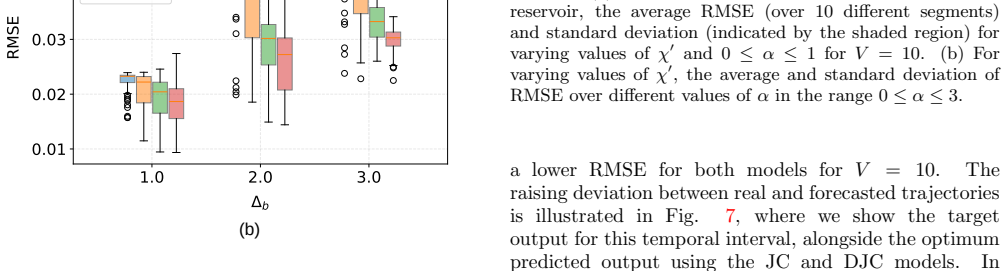
The raising deviation between real and forecasted trajectories is illustrated in Fig. 7, where we show the target output for this temporal interval, alongside the optimum predicted output using the JC and DJC models. In Table I, we show the optimum RMSE for bothV= 1 andV= 10 when autonomously predicting the output of an arbitrary segment of the MG series ...
-
[2]
Comparison of quantum and semiclassical radiation theories with application to the beam maser,
E.T. Jaynes and F.W. Cummings, “Comparison of quantum and semiclassical radiation theories with application to the beam maser,” Proceedings of the IEEE 51, 89–109 (1963)
work page 1963
-
[3]
Bruce W. Shore and Peter L. Knight, “The jaynes- cummings model,” Journal of Modern Optics40, 1195– 1238 (1993)
work page 1993
-
[4]
Jonas Larson and Themistoklis Mavrogordatos,The Jaynes–Cummings Model and its Descendants (Second Edition), 2053-2563 (IOP Publishing, 2024)
work page 2053
-
[5]
D. Meschede, H. Walther, and G. M¨ uller, “One-atom maser,” Phys. Rev. Lett.54, 551–554 (1985)
work page 1985
-
[6]
S.M. Dutra,Cavity Quantum Electrodynamics: The Strange Theory of Light in a Box, Wiley Series in Lasers and Applications (Wiley, 2005)
work page 2005
-
[7]
Quantum collapses and revivals in a quantized trap,
C. A. Blockley, D. F. Walls, and H. Risken, “Quantum collapses and revivals in a quantized trap,” Europhysics Letters17, 509 (1992)
work page 1992
-
[8]
Demonstration of a fundamental quantum logic gate,
C. Monroe, D. M. Meekhof, B. E. King, W. M. Itano, and D. J. Wineland, “Demonstration of a fundamental quantum logic gate,” Phys. Rev. Lett.75, 4714–4717 13 (1995)
work page 1995
-
[9]
Coherent control of macroscopic quantum states in a single-cooper- pair box,
Y. Nakamura, Yu. A. Pashkin, and J. S. Tsai, “Coherent control of macroscopic quantum states in a single-cooper- pair box,” Nature398, 786–788 (1999)
work page 1999
-
[10]
Alexandre Blais, Ren-Shou Huang, Andreas Wallraff, S. M. Girvin, and R. J. Schoelkopf, “Cavity quantum electrodynamics for superconducting electrical circuits: An architecture for quantum computation,” Phys. Rev. A69, 062320 (2004)
work page 2004
-
[11]
Strong coupling of a single photon to a superconducting qubit using circuit quantum electrodynamics,
A. Wallraff, D. I. Schuster, A. Blais, L. Frunzio, R.-. S. Huang, J. Majer, S. Kumar, S. M. Girvin, and R. J. Schoelkopf, “Strong coupling of a single photon to a superconducting qubit using circuit quantum electrodynamics,” Nature431, 162–167 (2004)
work page 2004
-
[12]
Dispersive regime of circuit qed: Photon- dependent qubit dephasing and relaxation rates,
Maxime Boissonneault, J. M. Gambetta, and Alexandre Blais, “Dispersive regime of circuit qed: Photon- dependent qubit dephasing and relaxation rates,” Phys. Rev. A79, 013819 (2009)
work page 2009
-
[13]
Circuit quantum electrodynamics,
Alexandre Blais, Arne L. Grimsmo, S. M. Girvin, and Andreas Wallraff, “Circuit quantum electrodynamics,” Rev. Mod. Phys.93, 025005 (2021)
work page 2021
-
[14]
Quantum neuromorphic computing,
Danijela Markovi´ c and Julie Grollier, “Quantum neuromorphic computing,” Applied Physics Letters117, 150501 (2020)
work page 2020
-
[15]
Opportunities in quantum reservoir computing and extreme learning machines,
Pere Mujal, Rodrigo Mart´ ınez-Pe˜ na, Johannes Nokkala, Jorge Garc´ ıa-Beni, Gian Luca Giorgi, Miguel C. Soriano, and Roberta Zambrini, “Opportunities in quantum reservoir computing and extreme learning machines,” Advanced Quantum Technologies4, 2100027 (2021)
work page 2021
-
[16]
Neural networks with quantum states of light,
Adri` a Labay-Mora, Jorge Garc´ ıa-Beni, Gian Luca Giorgi, Miguel C. Soriano, and Roberta Zambrini, “Neural networks with quantum states of light,” Philosophical Transactions of the Royal Society A: Mathematical, Physical and Engineering Sciences382, 20230346 (2024)
work page 2024
-
[17]
Microwave signal processing using an analog quantum reservoir computer,
Alen Senanian, Sridhar Prabhu, Vladimir Kremenetski, Saswata Roy, Yingkang Cao, Jeremy Kline, Tatsuhiro Onodera, Logan G. Wright, Xiaodi Wu, Valla Fatemi, and Peter L. McMahon, “Microwave signal processing using an analog quantum reservoir computer,” Nature Communications15, 7490 (2024)
work page 2024
-
[18]
Experimental quantum reservoir computing with a circuit quantum electrodynamics system,
Baptiste Carles, Julien Dudas, L´ eo Balembois, Julie Grollier, and Danijela Markovi´ c, “Experimental quantum reservoir computing with a circuit quantum electrodynamics system,” (2025), arXiv:2506.22016 [quant-ph]
-
[19]
Harnessing nonlinearity: Predicting chaotic systems and saving energy in wireless communication,
Herbert Jaeger and Harald Haas, “Harnessing nonlinearity: Predicting chaotic systems and saving energy in wireless communication,” Science304, 78–80 (2004)
work page 2004
-
[20]
Wolfgang Maass, Thomas Natschl¨ ager, and Henry Markram, “Real-time computing without stable states: a new framework for neural computation based on perturbations,” Neural Comput14, 2531–2560 (2002)
work page 2002
-
[21]
An experimental unification of reservoir computing methods,
D Verstraeten, B Schrauwen, M D’Haene, and D Stroobandt, “An experimental unification of reservoir computing methods,” Neural Netw20, 391–403 (2007)
work page 2007
-
[22]
Recent advances in physical reservoir computing: A review,
Gouhei Tanaka, Toshiyuki Yamane, Jean Benoit H´ eroux, Ryosho Nakane, Naoki Kanazawa, Seiji Takeda, Hidetoshi Numata, Daiju Nakano, and Akira Hirose, “Recent advances in physical reservoir computing: A review,” Neural Networks115, 100–123 (2019)
work page 2019
-
[23]
Harnessing disordered-ensemble quantum dynamics for machine learning,
Keisuke Fujii and Kohei Nakajima, “Harnessing disordered-ensemble quantum dynamics for machine learning,” Phys. Rev. Appl.8, 024030 (2017)
work page 2017
-
[24]
Online quantum time series processing with random oscillator networks,
Johannes Nokkala, “Online quantum time series processing with random oscillator networks,” Scientific Reports13, 7694 (2023)
work page 2023
-
[25]
Retrieving past quantum features with deep hybrid classical-quantum reservoir computing,
Johannes Nokkala, Gian Luca Giorgi, and Roberta Zambrini, “Retrieving past quantum features with deep hybrid classical-quantum reservoir computing,” Machine Learning: Science and Technology5, 035022 (2024)
work page 2024
-
[26]
Barren plateaus in quantum neural network training landscapes,
Jarrod R. McClean, Sergio Boixo, Vadim N. Smelyanskiy, Ryan Babbush, and Hartmut Neven, “Barren plateaus in quantum neural network training landscapes,” Nature Communications9, 4812 (2018)
work page 2018
-
[27]
Quantum variational algorithms are swamped with traps,
Eric R. Anschuetz and Bobak T. Kiani, “Quantum variational algorithms are swamped with traps,” Nature Communications13, 7760 (2022)
work page 2022
-
[28]
Boosting computational power through spatial multiplexing in quantum reservoir computing,
Kohei Nakajima, Keisuke Fujii, Makoto Negoro, Kosuke Mitarai, and Masahiro Kitagawa, “Boosting computational power through spatial multiplexing in quantum reservoir computing,” Phys. Rev. Appl.11, 034021 (2019)
work page 2019
-
[29]
Dynamical phase transitions in quantum reservoir computing,
Rodrigo Mart´ ınez-Pe˜ na, Gian Luca Giorgi, Johannes Nokkala, Miguel C. Soriano, and Roberta Zambrini, “Dynamical phase transitions in quantum reservoir computing,” Phys. Rev. Lett.127, 100502 (2021)
work page 2021
-
[30]
Information processing capacity of spin-based quantum reservoir computing systems,
R. Mart´ ınez-Pe˜ na, J. Nokkala, G. L. Giorgi, R. Zambrini, and M. C. Soriano, “Information processing capacity of spin-based quantum reservoir computing systems,” Cognitive Computation15, 1440–1451 (2023)
work page 2023
-
[31]
Learning temporal quantum tomography,
Quoc Hoan Tran and Kohei Nakajima, “Learning temporal quantum tomography,” Phys. Rev. Lett.127, 260401 (2021)
work page 2021
-
[32]
Time-series quantum reservoir computing with weak and projective measurements,
Pere Mujal, Rodrigo Mart´ ınez-Pe˜ na, Gian Luca Giorgi, Miguel C. Soriano, and Roberta Zambrini, “Time-series quantum reservoir computing with weak and projective measurements,” npj Quantum Information9, 16 (2023)
work page 2023
-
[33]
Exploring quantumness in quantum reservoir computing,
Niclas G¨ otting, Frederik Lohof, and Christopher Gies, “Exploring quantumness in quantum reservoir computing,” Phys. Rev. A108, 052427 (2023)
work page 2023
-
[34]
Dissipation as a resource for Quantum Reservoir Computing,
Antonio Sannia, Rodrigo Mart´ ınez-Pe˜ na, Miguel C. Soriano, Gian Luca Giorgi, and Roberta Zambrini, “Dissipation as a resource for Quantum Reservoir Computing,” Quantum8, 1291 (2024)
work page 2024
-
[35]
Quantum Reservoir Computing for Realized Volatility Forecasting
Qingyu Li, Chiranjib Mukhopadhyay, Abolfazl Bayat, and Ali Habibnia, “Quantum reservoir computing for realized volatility forecasting,” (2025), arXiv:2505.13933 [quant-ph]
work page internal anchor Pith review Pith/arXiv arXiv 2025
-
[36]
High-accuracy temporal prediction via experimental quantum reservoir computing in correlated spins,
Yanjun Hou, Juncheng Hua, Ze Wu, Wei Xia, Yuquan Chen, Xiaopeng Li, Zhaokai Li, Xinhua Peng, and Jiangfeng Du, “High-accuracy temporal prediction via experimental quantum reservoir computing in correlated spins,” (2025), arXiv:2508.12383 [quant-ph]
-
[37]
Johannes Nokkala, Rodrigo Mart´ ınez-Pe˜ na, Gian Luca Giorgi, Valentina Parigi, Miguel C. Soriano, and Roberta Zambrini, “Gaussian states of continuous- variable quantum systems provide universal and versatile reservoir computing,” Communications Physics4, 53 (2021)
work page 2021
-
[38]
Quantum reservoir computing with a single nonlinear oscillator,
L. C. G. Govia, G. J. Ribeill, G. E. Rowlands, H. K. Krovi, and T. A. Ohki, “Quantum reservoir computing with a single nonlinear oscillator,” Phys. Rev. Res.3, 013077 (2021)
work page 2021
-
[39]
Physical reservoir computing using finitely-sampled quantum systems,
Saeed Ahmed Khan, Fangjun Hu, Gerasimos Angelatos, and Hakan E. T¨ ureci, “Physical reservoir computing using finitely-sampled quantum systems,” (2021), arXiv:2110.13849 [quant-ph]. 14
-
[40]
Hilbert space as a computational resource in reservoir computing,
W. D. Kalfus, G. J. Ribeill, G. E. Rowlands, H. K. Krovi, T. A. Ohki, and L. C. G. Govia, “Hilbert space as a computational resource in reservoir computing,” Phys. Rev. Res.4, 033007 (2022)
work page 2022
-
[41]
Scalable photonic platform for real-time quantum reservoir computing,
Jorge Garc´ ıa-Beni, Gian Luca Giorgi, Miguel C. Soriano, and Roberta Zambrini, “Scalable photonic platform for real-time quantum reservoir computing,” Phys. Rev. Appl.20, 014051 (2023)
work page 2023
-
[42]
Quantum reservoir computing implementation on coherently coupled quantum oscillators,
Julien Dudas, Baptiste Carles, Erwan Plouet, Frank Alice Mizrahi, Julie Grollier, and Danijela Markovi´ c, “Quantum reservoir computing implementation on coherently coupled quantum oscillators,” npj Quantum Information9, 64 (2023)
work page 2023
-
[43]
Benchmarking the role of particle statistics in quantum reservoir computing,
Guillem Llodr` a, Christos Charalambous, Gian Luca Giorgi, and Roberta Zambrini, “Benchmarking the role of particle statistics in quantum reservoir computing,” Advanced Quantum Technologies6, 2200100 (2023)
work page 2023
-
[44]
Liouvillian skin effect in quantum neural networks,
Antonio Sannia, Gian Luca Giorgi, Stefano Longhi, and Roberta Zambrini, “Liouvillian skin effect in quantum neural networks,” Optica Quantum3, 189–194 (2025)
work page 2025
-
[45]
Temporal information processing on noisy quantum computers,
Jiayin Chen, Hendra I. Nurdin, and Naoki Yamamoto, “Temporal information processing on noisy quantum computers,” Phys. Rev. Appl.14, 024065 (2020)
work page 2020
-
[46]
Feedback-driven quantum reservoir computing for time- series analysis,
Kaito Kobayashi, Keisuke Fujii, and Naoki Yamamoto, “Feedback-driven quantum reservoir computing for time- series analysis,” PRX Quantum5, 040325 (2024)
work page 2024
-
[47]
Overcoming the coherence time barrier in quantum machine learning on temporal data,
Fangjun Hu, Saeed A. Khan, Nicholas T. Bronn, Gerasimos Angelatos, Graham E. Rowlands, Guilhem J. Ribeill, and Hakan E. T¨ ureci, “Overcoming the coherence time barrier in quantum machine learning on temporal data,” Nature Communications15, 7491 (2024)
work page 2024
-
[48]
Experimental neuromorphic computing based on quantum memristor,
Mirela Selimovi´ c, Iris Agresti, Micha l Siemaszko, Joshua Morris, Borivoje Daki´ c, Riccardo Albiero, Andrea Crespi, Francesco Ceccarelli, Roberto Osellame, Magdalena Stobi´ nska, and Philip Walther, “Experimental neuromorphic computing based on quantum memristor,” (2025), arXiv:2504.18694 [quant- ph]
-
[49]
Experimental memory control in continuous variable optical quantum reservoir computing,
Iris Paparelle, Johan Henaff, Jorge Garcia-Beni, Emilie Gillet, Gian Luca Giorgi, Miguel C. Soriano, Roberta Zambrini, and Valentina Parigi, “Experimental memory control in continuous variable optical quantum reservoir computing,” (2025), arXiv:2506.07279 [quant-ph]
-
[50]
Milan Kornjaˇ ca, Hong-Ye Hu, Chen Zhao, Jonathan Wurtz, Phillip Weinberg, Majd Hamdan, Andrii Zhdanov, Sergio H. Cantu, Hengyun Zhou, Rodrigo Araiza Bravo, Kevin Bagnall, James I. Basham, Joseph Campo, Adam Choukri, Robert DeAngelo, Paige Frederick, David Haines, Julian Hammett, Ning Hsu, Ming-Guang Hu, Florian Huber, Paul Niklas Jepsen, Ningyuan Jia, Th...
-
[51]
Reservoir computing using measurement-controlled quantum dynamics,
A. H. Abbas and Ivan S. Maksymov, “Reservoir computing using measurement-controlled quantum dynamics,” Electronics13(2024), 10.3390/electronics13061164
-
[52]
Practical few-atom quantum reservoir computing,
Chuanzhou Zhu, Peter J. Ehlers, Hendra I. Nurdin, and Daniel Soh, “Practical few-atom quantum reservoir computing,” Phys. Rev. Res.7, 023290 (2025)
work page 2025
-
[53]
Guillem Llodr` a et al, manuscript in preparation
-
[54]
Canonical dressing of atoms by intense radiation fields,
P. Carbonaro, G. Compagno, and F. Persico, “Canonical dressing of atoms by intense radiation fields,” Physics Letters A73, 97–99 (1979)
work page 1979
-
[55]
H. Jaeger,The ”echo state” approach to analysing and training recurrent neural networks, GMD Report 148 (GMD - German National Research Institute for Computer Science, 2001)
work page 2001
-
[56]
Re-visiting the echo state property,
Izzet B. Yildiz, Herbert Jaeger, and Stefan J. Kiebel, “Re-visiting the echo state property,” Neural Netw.35, 1–9 (2012)
work page 2012
-
[57]
Fading memory and the problem of approximating nonlinear operators with volterra series,
S. Boyd and L. Chua, “Fading memory and the problem of approximating nonlinear operators with volterra series,” IEEE Transactions on Circuits and Systems32, 1150–1161 (1985)
work page 1985
-
[58]
Markku Hahto and Johannes Nokkala, “Smarter usage of measurement statistics can greatly improve continuous variable quantum reservoir computing,” (2025), arXiv:2507.03557 [quant-ph]
-
[59]
Dynamic stark effect for the jaynes-cummings system,
P. Alsing, D.-S. Guo, and H. J. Carmichael, “Dynamic stark effect for the jaynes-cummings system,” Phys. Rev. A45, 5135–5143 (1992)
work page 1992
-
[60]
Analytical evidence of nonlinearity in qubits and continuous-variable quantum reservoir computing,
Pere Mujal, Johannes Nokkala, Rodrigo Mart´ ınez-Pe˜ na, Gian Luca Giorgi, Miguel C Soriano, and Roberta Zambrini, “Analytical evidence of nonlinearity in qubits and continuous-variable quantum reservoir computing,” Journal of Physics: Complexity2, 045008 (2021)
work page 2021
-
[61]
Nils Bertschinger, Thomas Natschl¨ ager, and Robert Legenstein, “At the edge of chaos: Real-time computations and self-organized criticality in recurrent neural networks,” inAdvances in Neural Information Processing Systems, Vol. 17, edited by L. Saul, Y. Weiss, and L. Bottou (MIT Press, 2004)
work page 2004
-
[62]
Oscillation and chaos in physiological control systems,
Michael C. Mackey and Leon Glass, “Oscillation and chaos in physiological control systems,” Science197, 287–289 (1977)
work page 1977
-
[63]
Quantum reservoir computing in atomic lattices,
Guillem Llodr` a, Pere Mujal, Roberta Zambrini, and Gian Luca Giorgi, “Quantum reservoir computing in atomic lattices,” (2024), arXiv:2411.13401 [quant-ph]
-
[64]
Pradip Laha, P. A. Ameen Yasir, and Peter van Loock, “Genuine non-gaussian entanglement of light and quantum coherence for an atom from noisy multiphoton spin-boson interactions,” Phys. Rev. Res.6, 033302 (2024)
work page 2024
-
[65]
Qutip 2: A python framework for the dynamics of open quantum systems,
J.R. Johansson, P.D. Nation, and Franco Nori, “Qutip 2: A python framework for the dynamics of open quantum systems,” Computer Physics Communications 184, 1234–1240 (2013)
work page 2013
-
[66]
Qutip: An open-source python framework for the dynamics of open quantum systems,
J.R. Johansson, P.D. Nation, and Franco Nori, “Qutip: An open-source python framework for the dynamics of open quantum systems,” Computer Physics Communications183, 1760–1772 (2012)
work page 2012
-
[67]
QuTiP 5: The Quantum Toolbox in Python
Neill Lambert, Eric Gigu` ere, Paul Menczel, Boxi Li, Patrick Hopf, Gerardo Su´ arez, Marc Gali, Jake Lishman, Rushiraj Gadhvi, Rochisha Agarwal, Asier Galicia, Nathan Shammah, Paul Nation, J. R. Johansson, Shahnawaz Ahmed, Simon Cross, Alexander Pitchford, 15 and Franco Nori, “Qutip 5: The quantum toolbox in python,” (2024), arXiv:2412.04705 [quant-ph]
work page internal anchor Pith review Pith/arXiv arXiv 2024
discussion (0)
Sign in with ORCID, Apple, or X to comment. Anyone can read and Pith papers without signing in.