REVIEW 4 major objections 6 minor 5 cited by
Towards General Continuous Memory for Vision-Language Models
T0 review · 4 major / 6 minor · reviewed 2026-08-07 · deepseek-v4-flash
Pith's one-line read A vision-language model can serve as its own continuous memory encoder, compressing retrieved multimodal and multilingual knowledge into eight embeddings that improve reasoning without lengthening the context.
desk verdict A genuinely new memory recipe for VLMs that mostly works; send it to review, but ask for the input-injection ablation and error bars. read the letter →
The pith
A machine-rendered reading of the paper's core claim, the machinery that carries it, and where it could break.
The reading
What carries the argument
The mechanism is a two-part compressor riding on the frozen VLM. First, the VLM encodes a retrieved image-text pair and its late-layer hidden states are collected. Second, a Q-Former—a lightweight transformer with eight learnable query embeddings whose parameters are shared across layers—attends to those hidden states and outputs eight continuous vectors per knowledge item. Training updates only the Q-Former and LoRA matrices (1.2% of parameters) on 15.6K self-synthesized samples, and at inference the resulting vectors are simply prepended to the VLM's input embedding sequence. This gives a compression ratio above 80× relative to the average 643.7 tokens per knowledge item, and it is what makes the memory plug-and-play: the inference model is never modified.
What would settle it
Concretely, measure InfoSeek or OK-VQA accuracy with the eight memory vectors replaced by eight vectors sampled from the same embedding distribution but carrying no information about the retrieved item: if accuracy stays high, the frozen VLM is ignoring the memory content, and if accuracy drops to the no-memory baseline, the vectors are demonstrably content-bearing.
Extended reading notes
Core claim
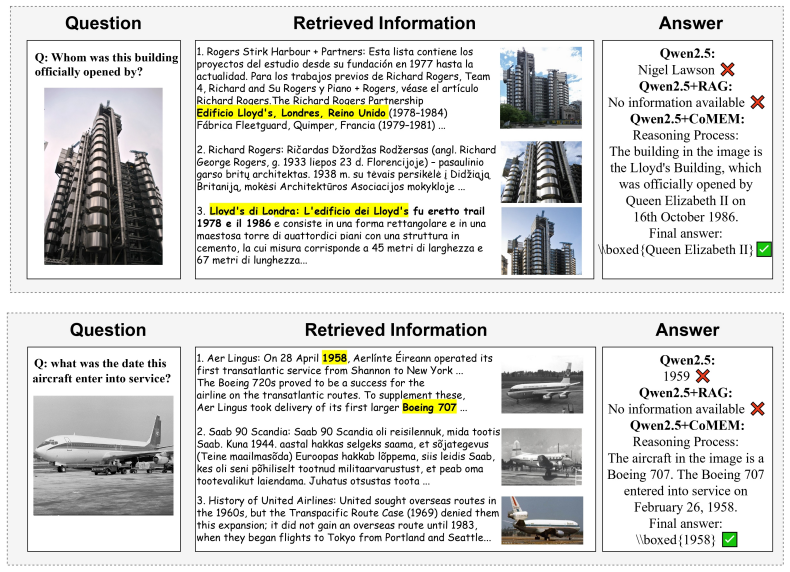
The paper's central claim is that a VLM can serve as its own continuous memory encoder: hidden states taken from the later layers of a frozen VLM, after being pooled by a trainable Q-Former, are semantically aligned enough that the same VLM can consume them as ordinary input embeddings and reason better with them than with the original text-and-image tokens. The authors establish this in two steps: first, a training-free study shows that simply concatenating the VLM's own layer-wise hidden states at selected layers beats both vanilla RAG and token pruning; second, the full CoMEM method adds a shared-parameter Q-Former with eight query embeddings and LoRA fine-tuning, trained only on self-synthesized samples that a vanilla RAG run answered correctly. The resulting eight-vector memories improve accuracy on six English benchmarks and two multilingual benchmarks, and the same VLM-encoded memory can be prepended to a language-only LLM that never sees images.
Load-bearing premise
The method assumes the eight compressed vectors produced by the Q-Former already occupy the same internal space as the frozen VLM's ordinary inputs, so inserting them needs no extra alignment step and the model will read them as meaningful context.
Editorial extensions
If this is right
- On Qwen2-VL-Instruct, CoMEM raises average accuracy on six English benchmarks by 8.0 points and on two multilingual benchmarks by 5.1 points; the corresponding gains on Qwen2.5-VL-Instruct are 7.7 and 4.3 points.
- Because the memory is compact, retrieval scale stops hurting: accuracy remains stable from top-3 to top-50 retrieved pairs, whereas vanilla RAG degrades beyond about 30 pairs.
- The memory transfers across model families: a language-only LLM reading VLM-encoded memory reaches 17.8% average accuracy on InfoSeek and OVEN, versus 7.0% with text RAG and 3.1% with no augmentation.
- The recipe is inexpensive enough to be practical: 15.6K self-synthesized samples, 1.2% trainable parameters, one epoch, and about 20 hours on a single H100; scaling data or parameters by 4× gives only marginal gains.
- CoMEM is detachable by design: since the inference-time VLM is frozen, the same model can run with or without memory, making the module an optional augmentation rather than a retrained system.
Reading between the lines
- If the embedding-space compatibility generalizes, the same memory encoding could serve as a shared knowledge bus: one VLM encodes once, and any model with a sufficiently aligned embedding space consumes the vectors without retraining; the paper demonstrates this only for Qwen2.5-Instruct reading Qwen2.5-VL memory, but the architecture places no obvious barrier to other aligned models.
- A natural stress test the paper leaves implicit is to replace the eight memory vectors with eight random vectors drawn from the same distribution: if accuracy does not drop, the frozen VLM is not actually reading the memory, and if it drops sharply, the vectors are content-bearing and the compression claim is doing real work.
- Because training data is filtered by whether a vanilla RAG run answered correctly, the encoder is taught to compress knowledge that RAG can already surface; extending CoMEM to settings where retrieval is noisy or the answer is absent would test whether the memory adds information or merely repackages retrieved context.
- The paper's training-free experiment suggests that even attention-based selection of hidden states helps, so a lighter compressor without a Q-Former might capture part of the gain; comparing these variants would isolate what LoRA-plus-Q-Former training actually contributes.
Editorial analysis
A structured set of objections, weighed in public.
Referee Report
Summary. The paper proposes CoMEM, a continuous memory mechanism for vision-language models (VLMs). The core idea is to use the VLM itself as a memory encoder: retrieved image-text knowledge items are encoded by the (frozen, plus LoRA-tuned) VLM, then compressed into eight continuous embeddings by a Q-Former, and these embeddings are prepended to the input embedding sequence of a frozen inference VLM. The authors report a training-free empirical study suggesting that VLM hidden states can serve as memory, and then introduce a training recipe that fine-tunes only 1.2% of parameters on 15.6k self-synthesized samples. Experiments on eight benchmarks show average gains over base VLMs and RAG baselines, with additional studies on long-context robustness and transferability to a text-only LLM.
Significance. If the central claim holds, CoMEM would provide a highly data- and parameter-efficient way to augment VLMs with external multimodal and multilingual knowledge, using only a compact set of continuous vectors instead of long token sequences. The paper includes several strengths: a training-free empirical analysis of VLM-as-memory, a long-context stability study, a transferability experiment to a pure LLM, public code and data, and scaling ablations on data size and parameter count. The reported average improvements of +8.0% (English) and +5.1% (multilingual) over base VLMs are notable and would be of practical interest for knowledge-intensive visual question answering.
major comments (4)
- [Section 3.2, Eq. (1)] The final CoMEM mechanism prepends Q-Former output vectors V_t directly to the input embedding sequence E_I of the frozen inference VLM, but the training-free evidence in Section 2 (Table 2) uses a different interface: hidden states concatenated at layers 17–19. The paper never shows that the frozen VLM can consume input-level continuous vectors without a learned projection; the training loss can in principle align them, yet no distributional analysis, no projection-layer ablation, and no training-free input-level test are provided. This leaves the central 'VLM as its own memory encoder' claim without direct support for the deployed interface.
- [Table 3] On MRAG-Bench, CoMEM+Qwen2-VL (35.1) and CoMEM+Qwen2.5-VL (38.1) are below the base models (39.3 and 42.0) and below their RAG counterparts (40.4 and 42.1). The paper claims 'significant gains across multimodal reasoning benchmarks' without acknowledging this regression or providing an explanation. The claim of consistent improvement needs to be qualified or mechanistically explained.
- [Section 2, Table 2] For Qwen2-VL-Instruct, the VLM-as-Memory method scores 38.9 on A-OKVQA versus a base score of 41.8, a clear degradation. This contradicts the statement that VLM-as-Memory 'outperforms both approaches across most tasks' and reduces the strength of the empirical motivation for the proposed method.
- [Section 3.3] The training corpus is synthesized by Qwen2.5-VL-Instruct and filtered by whether that same model produces correct answers, and the main evaluation uses Qwen2-VL and Qwen2.5-VL. The cross-model results with Qwen2-VL are encouraging, but no experiment trains the memory encoder on one architecture and evaluates on another. The claim of a 'general continuous memory' would be substantially strengthened by such a cross-architecture control.
minor comments (6)
- [Section 2.1] In the sentence 'our method outperforms the baseline even at a high compression rate of 5This suggests ...', a period is missing after '5'.
- [Table 3] The mPLUG-Owl3 row contains the value '1.945.031.9', which appears to be missing separators between the MRAG and OKVQA columns and should be reformatted.
- [Section 3.2] The Q-Former formulation writes 'H(0) = q', but q is a set of k query embeddings; it should be specified as a k×d matrix rather than a single vector.
- [Figure 2] The x-axis label '5' appears cut off at the high-compression end; the label should read '5%' or similar.
- [Table 1] Several entries use inconsistent spacing, e.g., 'V oCo-LLaMA' and 'ReflectiV A'; these should be typeset consistently.
- [Appendix D, Table 6] The row for '4x' reads '4x34.828.431.3' with missing separators; the values need proper spacing for readability.
Circularity Check
No significant circularity: the VLM-as-Memory insight is supported by an independent training-free experiment, and the trained CoMEM is validated on external benchmarks.
full rationale
The paper's derivation chain does not reduce to its own inputs by construction or by self-citation. The central claim that a VLM can serve as its own memory encoder is supported by the training-free empirical study in Section 2, where hidden states of the VLM are extracted and reinjected at layers 17-19 (Table 2). This measurement is independent of the later training objective and does not presuppose the result. The trained CoMEM method then adds a Q-Former and LoRA to compress VLM representations, and its evaluation includes held-out benchmarks (OVEN, MRAG-Bench, A-OKVQA, ViQuAE, CVQA) that are not in the 15.6k self-synthesized training corpus. The self-synthesized data filtering (retaining only correct RAG answers) is a standard self-distillation/compression setup, not a circular definition of the measured accuracy. The one notable weakness is a non-circular correctness concern: the Section 2 experiment injects hidden states at middle layers, whereas the final plug-and-play mechanism prepends Q-Former outputs to the input embedding sequence (Section 3.2), so the preliminary evidence does not fully cover the final deployment mechanism. That gap is an unsupported inference, not a circular step. The minor citation to co-authored work [17] for the general intuition that continuous embeddings are expressive is not load-bearing and does not import any ansatz or uniqueness theorem. Therefore, no circular step meets the evidentiary bar, and the correct finding is no significant circularity.
Assumptions & free parameters
free parameters (7)
- number of memory embeddings k =
8
- LoRA rank =
16
- Q-Former layers =
not reported
- top-k retrieved knowledge pairs =
10
- training corpus size =
15.6k
- attention selection threshold for VLM-as-Memory+Attn =
25% (top-25%)
- layers for memory injection in preliminary study =
17-19
assumptions (6)
- domain assumption Transformer self-attention hidden states aggregate answer-relevant semantic information.
- domain assumption CLIP-based top-10 retrieval from WIT returns knowledge items relevant to each query.
- domain assumption Compression to 8 embeddings preserves the answer-relevant content of each knowledge item.
- ad hoc to paper Q-Former output vectors can be prepended to the frozen VLM input embedding sequence without a learned projection.
- ad hoc to paper Self-synthesized and correctness-filtered training samples are representative enough to generalize to unseen benchmarks and languages.
- domain assumption Exact-match and multiple-choice accuracy on static benchmarks measure the value of the memory module.
Cite this review
Pith. "Pith review of Towards General Continuous Memory for Vision-Language Models." pith.science (2026). https://pith.science/paper/YPMNBMVR
@misc{pith2026250517670,
  author       = {Pith},
  title        = {Pith review of: Towards General Continuous Memory for Vision-Language Models},
  year         = {2026},
  howpublished = {\url{https://pith.science/paper/YPMNBMVR}},
  note         = {Machine review of arXiv:2505.17670}
}
read the original abstract
Language models (LMs) and their extension, vision-language models (VLMs), have achieved remarkable performance across various tasks. However, they still struggle with complex reasoning tasks that require multimodal or multilingual real-world knowledge. To support such capabilities, an external memory system that can efficiently provide relevant multimodal information is essential. Existing approaches generally concatenate image and text tokens into a long sequence as memory, which, however, may drastically increase context length and even degrade performance. In contrast, we propose using continuous memory, a compact set of dense embeddings to more effectively and efficiently represent multimodal and multilingual knowledge. Our key insight is that a VLM can serve as its own continuous memory encoder. We empirically show that this design improves performance on complex multimodal reasoning tasks. Building on this, we introduce a data-efficient and parameter-efficient method to fine-tune the VLM into a memory encoder, requiring only 1.2% of the model's parameters and a small corpus of 15.6K self-synthesized samples. Our approach CoMEM utilizes VLM's original capabilities to encode arbitrary multimodal and multilingual knowledge into just 8 continuous embeddings. Since the inference-time VLM remains frozen, our memory module is plug-and-play and can be flexibly integrated as needed. Extensive experiments across eight multimodal reasoning benchmarks demonstrate the effectiveness of our approach.
Figures


Figures from the paper (2 more)

Forward citations
Cited by 5 Pith papers
-
MMAgent-R$^2$: Learning to Rerank and Reject for Agentic mRAG
An agentic mRAG framework uses GRPO-trained visual reranking and active rejection to verify retrieved candidate entities, achieving state-of-the-art on three KB-VQA benchmarks.
-
Dual Latent Memory for Visual Multi-agent System
L2-VMAS replaces text-based inter-agent communication in visual multi-agent systems with decoupled latent perception and thinking memories, improving accuracy by 2.7–5.4% and cutting token use by 21.3–44.8%.
-
Reason Before You Retrieve: Agentic Planning for Multi-modal RAG
MM-R2 claims SOTA multimodal RAG accuracy on InfoSeek and Encyclopedic VQA via intent grounding plus a 10-topic KnowledgeMap, but its teacher trajectories leak the gold Wikipedia page and omit the image.
-
The Latent Space: Foundation, Evolution, Mechanism, Ability, and Outlook
A large survey organizes latent-space work in language-based models by foundation, evolution, four mechanisms, seven abilities, and open challenges.
-
Recurrence Meets Transformers for Universal Multimodal Retrieval
A single multimodal retriever with a gated recurrent Transformer cell, one-token output, and three-layer sampling achieves strong results on M2KR and M-BEIR and improves RAG-VQA accuracy.
Reference graph
Works this paper leans on
-
[1]
Language models are few-shot learners.Advances in neural information processing systems, 33:1877–1901, 2020
Tom Brown, Benjamin Mann, Nick Ryder, Melanie Subbiah, Jared D Kaplan, Prafulla Dhariwal, Arvind Neelakantan, Pranav Shyam, Girish Sastry, Amanda Askell, et al. Language models are few-shot learners.Advances in neural information processing systems, 33:1877–1901, 2020
1901
-
[2]
Llama: Open and efficient foundation language models.arXiv preprint arXiv:2302.13971, 2023
Hugo Touvron, Thibaut Lavril, Gautier Izacard, Xavier Martinet, Marie-Anne Lachaux, Timo- thée Lacroix, Baptiste Rozière, Naman Goyal, Eric Hambro, Faisal Azhar, et al. Llama: Open and efficient foundation language models.arXiv preprint arXiv:2302.13971, 2023
arXiv 2023
-
[3]
Ishita Dasgupta, Andrew K Lampinen, Stephanie CY Chan, Hannah R Sheahan, Antonia Creswell, Dharshan Kumaran, James L McClelland, and Felix Hill. Language models show human-like content effects on reasoning tasks.arXiv preprint arXiv:2207.07051, 2022
arXiv 2022
-
[4]
Janice Ahn, Rishu Verma, Renze Lou, Di Liu, Rui Zhang, and Wenpeng Yin. Large language models for mathematical reasoning: Progresses and challenges.arXiv preprint arXiv:2402.00157, 2024
arXiv 2024
-
[5]
Chain-of-thought prompting elicits reasoning in large language models
Jason Wei, Xuezhi Wang, Dale Schuurmans, Maarten Bosma, Fei Xia, Ed Chi, Quoc V Le, Denny Zhou, et al. Chain-of-thought prompting elicits reasoning in large language models. Advances in neural information processing systems, 35:24824–24837, 2022
2022
-
[6]
A survey on large language models for code generation.arXiv preprint arXiv:2406.00515, 2024
Juyong Jiang, Fan Wang, Jiasi Shen, Sungju Kim, and Sunghun Kim. A survey on large language models for code generation.arXiv preprint arXiv:2406.00515, 2024. 10
arXiv 2024
-
[7]
Zichen Wen, Yifeng Gao, Weijia Li, Conghui He, and Linfeng Zhang. Token pruning in multimodal large language models: Are we solving the right problem?arXiv preprint arXiv:2502.11501, 2025
arXiv 2025
-
[8]
Retrieval-augmented generation for knowledge-intensive nlp tasks
Patrick Lewis, Ethan Perez, Aleksandra Piktus, Fabio Petroni, Vladimir Karpukhin, Naman Goyal, Angela Fan, Vishrav Chaudhary, Matthias Gallé, Veselin Stoyanov, and Wen-tau Yih. Retrieval-augmented generation for knowledge-intensive nlp tasks. InAdvances in Neural Information Processing Systems (NeurIPS), 2020
work page 2020
Show all 59 references
-
[9]
Augmenting language models with long-term memory.arXiv preprint arXiv:2306.07174, 2023
Weizhi Wang, Li Dong, Hao Cheng, Xiaodong Liu, Xifeng Yan, Jianfeng Gao, and Furu Wei. Augmenting language models with long-term memory.arXiv preprint arXiv:2306.07174, 2023
2023 arXiv
-
[10]
Realm: Retrieval-augmented language model pre-training
Kelvin Guu, Kenton Lee, Zora Tung, Panupong Pasupat, and Ming-Wei Chang. Realm: Retrieval-augmented language model pre-training. InInternational Conference on Machine Learning (ICML), 2020
2020
-
[11]
Shuai Bai, Keqin Chen, Xuejing Liu, Jialin Wang, Wenbin Ge, Sibo Song, Kai Dang, Peng Wang, Shijie Wang, Jun Tang, et al. Qwen2. 5-vl technical report.arXiv preprint arXiv:2502.13923, 2025
2025 arXiv
-
[12]
Visrag: Vision-based retrieval-augmented generation on multi-modality documents.arXiv preprint arXiv:2410.10594, 2024
Shi Yu, Chaoyue Tang, Bokai Xu, Junbo Cui, Junhao Ran, Yukun Yan, Zhenghao Liu, Shuo Wang, Xu Han, Zhiyuan Liu, et al. Visrag: Vision-based retrieval-augmented generation on multi-modality documents.arXiv preprint arXiv:2410.10594, 2024
-
[13]
An image is worth 1/2 tokens after layer 2: Plug-and-play inference acceleration for large vision-language models
Liang Chen, Haozhe Zhao, Tianyu Liu, Shuai Bai, Junyang Lin, Chang Zhou, and Baobao Chang. An image is worth 1/2 tokens after layer 2: Plug-and-play inference acceleration for large vision-language models. InEuropean Conference on Computer Vision, pages 19–35. Springer, 2024
2024
-
[14]
Sparsevlm: Visual token sparsification for efficient vision-language model inference.arXiv preprint arXiv:2410.04417, 2024
Yuan Zhang, Chun-Kai Fan, Junpeng Ma, Wenzhao Zheng, Tao Huang, Kuan Cheng, Denis Gudovskiy, Tomoyuki Okuno, Yohei Nakata, Kurt Keutzer, et al. Sparsevlm: Visual token sparsification for efficient vision-language model inference.arXiv preprint arXiv:2410.04417, 2024
-
[15]
A mathematical framework for transformer circuits.Transformer Circuits Thread, 2021.https://transformer-circuits.pub/2021/framework/index.html
Nelson Elhage, Neel Nanda, Catherine Olsson, Tom Henighan, Nicholas Joseph, Ben Mann, Amanda Askell, Yuntao Bai, Anna Chen, Tom Conerly, Nova DasSarma, Dawn Drain, Deep Ganguli, Zac Hatfield-Dodds, Danny Hernandez, Andy Jones, Jackson Kernion, Liane Lovitt, Kamal Ndousse, Dari...
2021
-
[16]
In-context learning and induction heads.arXiv preprint arXiv:2209.11895, 2022
Catherine Olsson, Nelson Elhage, Neel Nanda, Nicholas Joseph, Nova DasSarma, Tom Henighan, Ben Mann, Amanda Askell, Yuntao Bai, Anna Chen, Tom Conerly, Dawn Drain, Deep Ganguli, Zac Hatfield-Dodds, Danny Hernandez, Scott Johnston, Andy Jones, Jackson Kernion, Liane Lovitt, Kam...
2022 arXiv
-
[17]
Training large language models to reason in a continuous latent space.arXiv preprint arXiv:2412.06769, 2024
Shibo Hao, Sainbayar Sukhbaatar, DiJia Su, Xian Li, Zhiting Hu, Jason Weston, and Yuandong Tian. Training large language models to reason in a continuous latent space.arXiv preprint arXiv:2412.06769, 2024
2024 arXiv
-
[18]
Botvinick, Andrew Zisserman, Oriol Vinyals, and João Carreira
Andrew Jaegle, Sebastian Borgeaud, Jean-Baptiste Alayrac, Carl Doersch, Catalin Ionescu, David Ding, Skanda Koppula, Daniel Zoran, Andrew Brock, Evan Shelhamer, Olivier Hénaff, Matthew M. Botvinick, Andrew Zisserman, Oriol Vinyals, and João Carreira. Perceiver io: A general ar...
2021 arXiv
-
[19]
Kanwal, Tegan Maharaj, Asja Fischer, Aaron Courville, Yoshua Bengio, and Simon Lacoste-Julien
Devansh Arpit, Stanisław Jastrz˛ ebski, Nicolas Ballas, David Krueger, Emmanuel Bengio, Maxinder S. Kanwal, Tegan Maharaj, Asja Fischer, Aaron Courville, Yoshua Bengio, and Simon Lacoste-Julien. A closer look at memorization in deep networks. InProceedings of the 34th Internat...
2017
-
[20]
The trade-offs of domain adaptation for neural language models
David Grangier and Dan Iter. The trade-offs of domain adaptation for neural language models. InProceedings of the 60th Annual Meeting of the Association for Computational Linguistics (V olume 1: Long Papers), pages 3802–3813, Dublin, Ireland, May 2022. Association for Computat...
2022
-
[21]
Attention is all you need.arXiv preprint arXiv:1706.03762, 2017
Ashish Vaswani, Noam Shazeer, Niki Parmar, Jakob Uszkoreit, Llion Jones, Aidan N Gomez, Lukasz Kaiser, and Illia Polosukhin. Attention is all you need.arXiv preprint arXiv:1706.03762, 2017
2017 arXiv
-
[22]
Kevin Clark, Urvashi Khandelwal, Omer Levy, and Christopher D. Manning. What does bert look at? an analysis of bert’s attention.arXiv preprint arXiv:1906.04341, 2019
1906 arXiv
-
[23]
Lora: Low-rank adaptation of large language models.arXiv preprint arXiv:2106.09685, 2021
Edward J Hu, Yelong Shen, Phil Wallis, Zeyuan Allen-Zhu, Yuanzhi Li, Lu Wang, and Weizhu Chen. Lora: Low-rank adaptation of large language models.arXiv preprint arXiv:2106.09685, 2021
2021 arXiv
-
[24]
Blip-2: Bootstrapping language- image pre-training with frozen image encoders and large language models.arXiv preprint arXiv:2301.12597, 2023
Junnan Li, Dongxu Li, Silvio Savarese, and Steven Hoi. Blip-2: Bootstrapping language- image pre-training with frozen image encoders and large language models.arXiv preprint arXiv:2301.12597, 2023
2023 arXiv
-
[25]
Echosight: Advancing visual-language models with wiki knowledge
Yibin Yan and Weidi Xie. Echosight: Advancing visual-language models with wiki knowledge. arXiv preprint arXiv:2407.12735, 2024. Accepted at EMNLP 2024 Findings
2024 arXiv
-
[26]
Augmenting multimodal llms with self-reflective tokens for knowledge-based visual question answering.arXiv preprint arXiv:2411.16863, 2024
Federico Cocchi, Nicholas Moratelli, Marcella Cornia, Lorenzo Baraldi, and Rita Cucchiara. Augmenting multimodal llms with self-reflective tokens for knowledge-based visual question answering.arXiv preprint arXiv:2411.16863, 2024. Accepted at CVPR 2025
2024 arXiv
-
[27]
RORA-VLM: Robust retrieval augmentation for vision language models.arXiv preprint arXiv:2410.08876, 2024
Jingyuan Qi, Zhiyang Xu, Rulin Shao, Yang Chen, Jin Di, Yu Cheng, Qifan Wang, and Lifu Huang. RORA-VLM: Robust retrieval augmentation for vision language models.arXiv preprint arXiv:2410.08876, 2024
2024 arXiv
-
[28]
xrag: Extreme context compression for retrieval-augmented generation with one token.arXiv preprint arXiv:2405.13792, 2024
Xin Cheng, Xun Wang, Xingxing Zhang, Tao Ge, Si-Qing Chen, Furu Wei, Huishuai Zhang, and Dongyan Zhao. xrag: Extreme context compression for retrieval-augmented generation with one token.arXiv preprint arXiv:2405.13792, 2024
2024 arXiv
-
[29]
Kv-distill: Nearly lossless learnable context compression for llms.ArXiv, abs/2503.10337, 2025
Vivek Chari, Guanghui Qin, and Benjamin Van Durme. Kv-distill: Nearly lossless learnable context compression for llms.ArXiv, abs/2503.10337, 2025
2025 arXiv
-
[30]
V oco-llama: Towards vision compression with large language models.arXiv preprint arXiv:2406.12275, 2024
Xubing Ye, Yukang Gan, Xiaoke Huang, Yixiao Ge, and Yansong Tang. V oco-llama: Towards vision compression with large language models.arXiv preprint arXiv:2406.12275, 2024
2024 arXiv
-
[31]
MA-LMM: Memory-augmented large multimodal model for long-term video understanding.arXiv preprint arXiv:2404.05726, 2024
Bo He, Hengduo Li, Young Kyun Jang, Menglin Jia, Xuefei Cao, Ashish Shah, Abhinav Shrivastava, and Ser-Nam Lim. MA-LMM: Memory-augmented large multimodal model for long-term video understanding.arXiv preprint arXiv:2404.05726, 2024
2024 arXiv
-
[32]
M+: Extending memoryllm with scalable long-term memory.arXiv preprint arXiv:2502.00592, 2025
Yu Wang, Dmitry Krotov, Yuanzhe Hu, Yifan Gao, Wangchunshu Zhou, Julian McAuley, Dan Gutfreund, Rogerio Feris, and Zexue He. M+: Extending memoryllm with scalable long-term memory.arXiv preprint arXiv:2502.00592, 2025
2025 arXiv
-
[33]
Memgpt: Towards llms as operating systems.arXiv preprint arXiv:2310.08560, 2024
Charles Packer, Sarah Wooders, Kevin Lin, Vivian Fang, Shishir G Patil, Ion Stoica, and Joseph E Gonzalez. Memgpt: Towards llms as operating systems.arXiv preprint arXiv:2310.08560, 2024
2024 arXiv
-
[34]
Can pre-trained vision and language models answer visual information-seeking questions?arXiv preprint arXiv:2302.11713, 2023
Yang Chen, Hexiang Hu, Yi Luan, Haitian Sun, Soravit Changpinyo, Alan Ritter, and Ming- Wei Chang. Can pre-trained vision and language models answer visual information-seeking questions?arXiv preprint arXiv:2302.11713, 2023
2023 arXiv
-
[35]
Ok-vqa: A visual question answering benchmark requiring external knowledge
Kenneth Marino, Mohammad Rastegari, Ali Farhadi, and Roozbeh Mottaghi. Ok-vqa: A visual question answering benchmark requiring external knowledge. InProceedings of the IEEE/cvf conference on computer vision and pattern recognition, pages 3195–3204, 2019
2019
-
[36]
A-okvqa: A benchmark for visual question answering using world knowledge
Dustin Schwenk, Apoorv Khandelwal, Christopher Clark, Kenneth Marino, and Roozbeh Mottaghi. A-okvqa: A benchmark for visual question answering using world knowledge. In European conference on computer vision, pages 146–162. Springer, 2022. 12
2022
-
[37]
Wiki-LLaV A: Hierarchical retrieval-augmented generation for multimodal llms.arXiv preprint arXiv:2404.15406, 2024
Davide Caffagni, Federico Cocchi, Nicholas Moratelli, Sara Sarto, Marcella Cornia, Lorenzo Baraldi, and Rita Cucchiara. Wiki-LLaV A: Hierarchical retrieval-augmented generation for multimodal llms.arXiv preprint arXiv:2404.15406, 2024
2024 arXiv
-
[38]
Learning transferable visual models from natural language supervision
Alec Radford, Jong Wook Kim, Chris Hallacy, Aditya Ramesh, Gabriel Goh, Sandhini Agarwal, Girish Sastry, Amanda Askell, Pamela Mishkin, Jack Clark, et al. Learning transferable visual models from natural language supervision. InInternational conference on machine learning, pag...
2021
-
[39]
Wit: Wikipedia-based image text dataset for multimodal multilingual machine learning
Krishna Srinivasan, Karthik Raman, Jiecao Chen, Michael Bendersky, and Marc Najork. Wit: Wikipedia-based image text dataset for multimodal multilingual machine learning. InPro- ceedings of the 44th international ACM SIGIR conference on research and development in information r...
2021
-
[40]
Encyclopedic vqa: Visual questions about detailed properties of fine-grained categories
Thomas Mensink, Jasper Uijlings, Lluis Castrejon, Arushi Goel, Felipe Cadar, Howard Zhou, Fei Sha, André Araujo, and Vittorio Ferrari. Encyclopedic vqa: Visual questions about detailed properties of fine-grained categories. InProceedings of the IEEE/CVF International Conferenc...
2023
-
[41]
Open-domain visual entity recognition: Towards recognizing millions of wikipedia entities
Hexiang Hu, Yi Luan, Yang Chen, Urvashi Khandelwal, Mandar Joshi, Kenton Lee, Kristina Toutanova, and Ming-Wei Chang. Open-domain visual entity recognition: Towards recognizing millions of wikipedia entities. InProceedings of the IEEE/CVF International Conference on Computer V...
2023
-
[42]
Mrag-bench: Vision-centric evaluation for retrieval-augmented multimodal models.arXiv preprint arXiv:2410.08182, 2024
Wenbo Hu, Jia-Chen Gu, Zi-Yi Dou, Mohsen Fayyaz, Pan Lu, Kai-Wei Chang, and Nanyun Peng. Mrag-bench: Vision-centric evaluation for retrieval-augmented multimodal models.arXiv preprint arXiv:2410.08182, 2024
2024 arXiv
-
[43]
Viquae, a dataset for knowledge-based visual question answering about named entities
Paul Lerner, Olivier Ferret, Camille Guinaudeau, Hervé Le Borgne, Romaric Besançon, José G Moreno, and Jesús Lovón Melgarejo. Viquae, a dataset for knowledge-based visual question answering about named entities. InProceedings of the 45th international ACM SIGIR conference on r...
2022
-
[44]
CVQA: Culturally-diverse multilingual visual question answering benchmark
David Romero, Chenyang Lyu, Haryo Akbarianto Wibowo, Teresa Lynn, Injy Hamed, Aditya Nanda Kishore, Aishik Mandal, Alina Dragonetti, Artem Abzaliev, Atnafu Lambebo Tonja, et al. CVQA: Culturally-diverse multilingual visual question answering benchmark. arXiv preprint arXiv:240...
2024 arXiv
-
[45]
Gpt-4o technical report, 2024
OpenAI. Gpt-4o technical report, 2024. Accessed: 2025-05-10
2024
-
[46]
Visual instruction tuning.arXiv preprint arXiv:2304.08485, 2023
Haotian Liu, Chunyuan Li, Qingyang Wu, and Yong Jae Lee. Visual instruction tuning.arXiv preprint arXiv:2304.08485, 2023
2023 arXiv
-
[47]
Llava-next: Open large multimodal models
LLaV A-VL Team. Llava-next: Open large multimodal models. https://github.com/ LLaVA-VL/LLaVA-NeXT, 2024. Accessed: 2025-05-10
2024
-
[48]
Internlm- xcomposer-2.5: A versatile large vision language model supporting long-contextual input and output.arXiv preprint arXiv:2407.03320, 2024
Pan Zhang, Xiaoyi Dong, Yuhang Zang, Yuhang Cao, Rui Qian, Lin Chen, Qipeng Guo, Haodong Duan, Bin Wang, Linke Ouyang, Songyang Zhang, Wenwei Zhang, Yining Li, Yang Gao, Peng Sun, Xinyue Zhang, Wei Li, Jingwen Li, Wenhai Wang, Hang Yan, Conghui He, Xingcheng Zhang, Kai Chen, J...
2024 arXiv
-
[49]
mplug-owl3: Towards long image-sequence understanding in multi-modal large language models.arXiv preprint arXiv:2408.04840, 2024
Jiabo Ye, Haiyang Xu, Haowei Liu, Anwen Hu, Ming Yan, Qi Qian, Ji Zhang, Fei Huang, and Jingren Zhou. mplug-owl3: Towards long image-sequence understanding in multi-modal large language models.arXiv preprint arXiv:2408.04840, 2024
2024 arXiv
-
[50]
Qwen2-vl: Enhancing vision-language model’s perception of the world at any resolution.arXiv preprint arXiv:2409.12191, 2024
Peng Wang, Shuai Bai, Sinan Tan, Shijie Wang, Zhihao Fan, Jinze Bai, Keqin Chen, Xuejing Liu, Jialin Wang, Wenbin Ge, et al. Qwen2-vl: Enhancing vision-language model’s perception of the world at any resolution.arXiv preprint arXiv:2409.12191, 2024
2024 arXiv
-
[51]
An Yang, Baosong Yang, Beichen Zhang, Binyuan Hui, Bo Zheng, Bowen Yu, Chengyuan Li, Dayiheng Liu, Fei Huang, Haoran Wei, et al. Qwen2. 5 technical report.arXiv preprint arXiv:2412.15115, 2024. 13
2024 arXiv
-
[52]
A simple framework for contrastive learning of visual representations
Ting Chen, Simon Kornblith, Mohammad Norouzi, and Geoffrey Hinton. A simple framework for contrastive learning of visual representations. InInternational conference on machine learning, pages 1597–1607. PmLR, 2020
2020
-
[53]
Mm1: methods, analysis and insights from multimodal llm pre-training
Brandon McKinzie, Zhe Gan, Jean-Philippe Fauconnier, Sam Dodge, Bowen Zhang, Philipp Dufter, Dhruti Shah, Xianzhi Du, Futang Peng, Anton Belyi, et al. Mm1: methods, analysis and insights from multimodal llm pre-training. InEuropean Conference on Computer Vision, pages 304–323....
2024
-
[54]
Ulip-2: Towards scalable multimodal pre-training for 3d understanding
Le Xue, Ning Yu, Shu Zhang, Artemis Panagopoulou, Junnan Li, Roberto Martín-Martín, Jiajun Wu, Caiming Xiong, Ran Xu, Juan Carlos Niebles, et al. Ulip-2: Towards scalable multimodal pre-training for 3d understanding. InProceedings of the IEEE/CVF Conference on Computer Vision ...
2024
-
[55]
Improved baselines with visual instruction tuning
Haotian Liu, Chunyuan Li, Yuheng Li, and Yong Jae Lee. Improved baselines with visual instruction tuning. InProceedings of the IEEE/CVF Conference on Computer Vision and Pattern Recognition, pages 26296–26306, 2024
2024
-
[56]
Learning to compress prompts with gist tokens
Jesse Mu, Xiang Li, and Noah Goodman. Learning to compress prompts with gist tokens. Advances in Neural Information Processing Systems, 36:19327–19352, 2023
2023
-
[57]
In- context former: Lightning-fast compressing context for large language model.arXiv preprint arXiv:2406.13618, 2024
Xiangfeng Wang, Zaiyi Chen, Zheyong Xie, Tong Xu, Yongyi He, and Enhong Chen. In- context former: Lightning-fast compressing context for large language model.arXiv preprint arXiv:2406.13618, 2024
2024 arXiv
-
[58]
Adapting llms for efficient context processing through soft prompt compression
Cangqing Wang, Yutian Yang, Ruisi Li, Dan Sun, Ruicong Cai, Yuzhu Zhang, and Chengqian Fu. Adapting llms for efficient context processing through soft prompt compression. InProceedings of the International Conference on Modeling, Natural Language Processing and Machine Learnin...
2024
-
[59]
The probabilistic relevance framework: Bm25 and beyond.F oundations and Trends in Information Retrieval, 3(4):333–389, 2009
Stephen Robertson and Hugo Zaragoza. The probabilistic relevance framework: Bm25 and beyond.F oundations and Trends in Information Retrieval, 3(4):333–389, 2009. 14 A Benchmark Details InfoSeekInfoSeek is a visual question answering (VQA) dataset tailored for information-seeki...
2009
Reviewed August 7, 2026 · model on record in the stance chip above.
Discussion (0). Continue with ORCID to comment.