REVIEW 5 major objections 4 minor 1 cited by
Deep Reinforcement Learning Agents are not even close to Human Intelligence
T0 review · 5 major / 4 minor · reviewed 2026-08-07 · deepseek-v4-flash
Pith's one-line read Deep RL agents systematically collapse on simpler versions of their training tasks, a new benchmark shows.
desk verdict HackAtari is a useful new benchmark, but the 'systematic shortcut learning' headline is stronger than the paper's own tables support. read the letter →
The pith
A machine-rendered reading of the paper's core claim, the machinery that carries it, and where it could break.
The reading
What carries the argument
The load-bearing object is HackAtari, a benchmark of over 224 controlled variations of Arcade Learning Environment games, implemented by directly overwriting the games' Random Access Memory. RAM alteration is the mechanism because the original games are proprietary; it lets the authors remove or freeze enemies, change colors, stop cars, and alter physics in ways that preserve task semantics while reducing difficulty. The second load-bearing piece is the performance-change metric normalized against random scores, which measures an agent's relative drop from original to modified environment, together with a human study on 15 of the variations that validates the chosen variants as true simplifications.
What would settle it
Run the same trained agents on a set of RAM perturbations that are equally large in RAM space but semantically meaningless for the game, such as randomizing unused memory cells or changing the color of irrelevant background objects. If the agents' normalized scores drop by the same magnitude on these controls as on the HackAtari simplifications, then the drops would be explained by input sensitivity rather than by reliance on task-specific shortcuts, contradicting the paper's interpretation.
Extended reading notes
Core claim
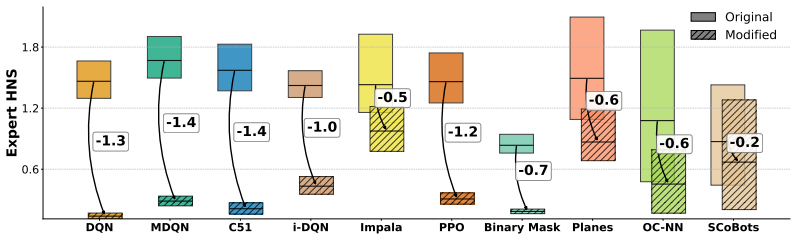
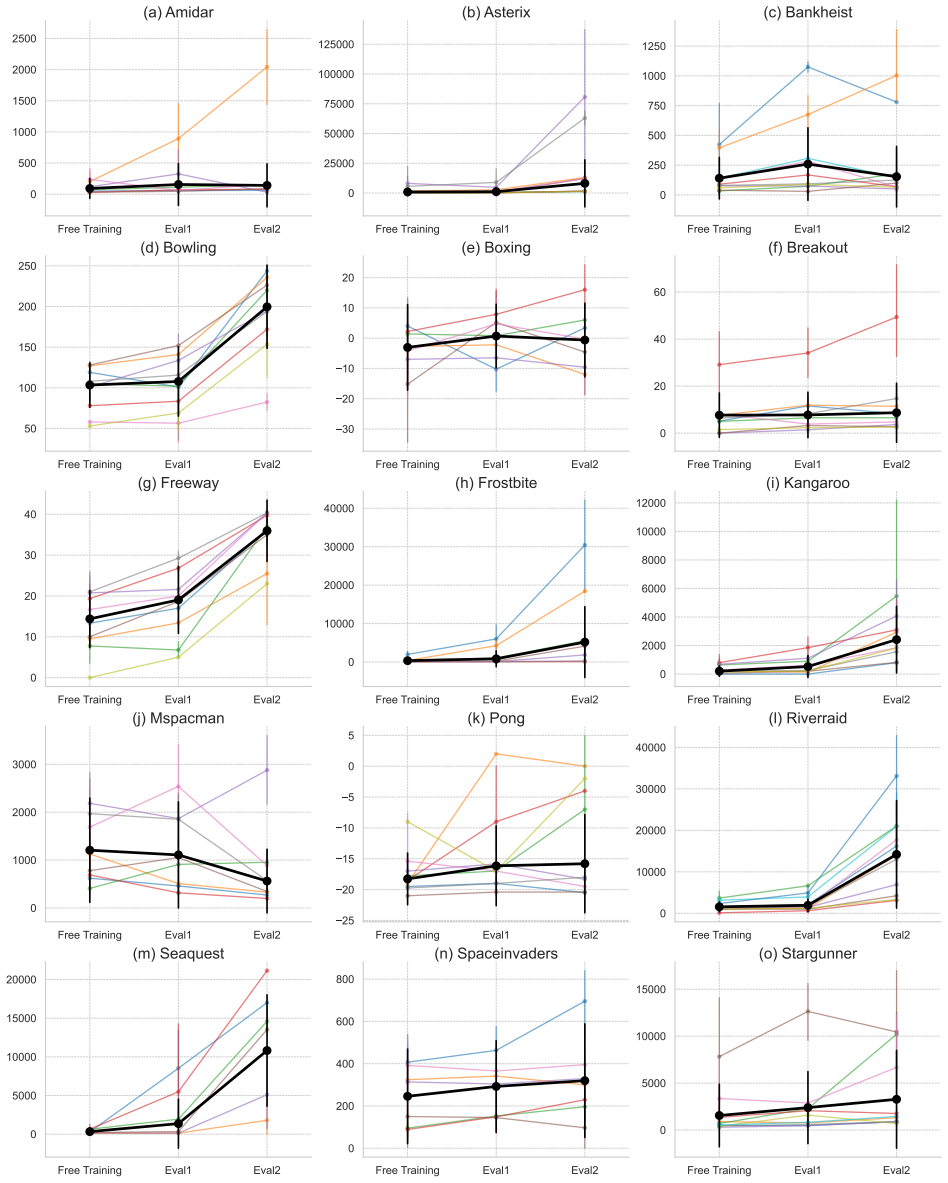
The central discovery is that task simplification, not complexification, exposes misalignment in deep RL. Using RAM alterations to make games objectively easier—removing enemies, stopping cars, aligning ice floes, shifting shields by a pixel—the paper finds that the aggregated normalized score of every evaluated deep agent drops substantially, often toward random, while humans improve or hold their performance on 13 of the 15 tested variations. Because the variations were chosen to be simplifications for humans, the agents' failure is interpreted not as an inability to cope with harder tasks but as reliance on shortcuts: they succeed in the original environment for the wrong reasons. The pattern holds across value-based, policy-gradient, and object-centric agents, with object-centric representations reducing sensitivity to visual changes but not resolving gameplay-logic failures. In-distribution evaluation with human-normalized scores is therefore insufficient to certify human-like intelligence.
Load-bearing premise
The load-bearing premise is that the 15 human-tested variations are true simplifications that preserve the task's meaning, so the agents' performance drops on them indicate shortcut reliance rather than mere sensitivity to altered inputs.
Editorial extensions
If this is right
- A superhuman score on the original environment no longer counts as evidence of task understanding, because held-out simplifications can falsify it.
- Evaluation protocols for general RL should include both complexifications and simplifications, since only simplifications clearly separate poor adaptation from misaligned policies.
- Object-centric inductive biases improve robustness to visual changes but are not sufficient for generalization to gameplay-logic changes.
- Agents that pass a broad set of semantically validated simplifications are more likely to be aligned with the intended task goals.
- Reward maximization during training alone is not enough to produce policies that generalize the way humans do.
Reading between the lines
- The RAM-alteration technique could be reused to build semantic control conditions for other emulated benchmarks, separating shortcut reliance from mere input sensitivity.
- Fine-tuning an agent on a single simplified variant and measuring how quickly it recovers could reveal whether failures come from missing features in the policy or from an inability to reuse learned skills.
- The 224-variation suite could be distilled into a standardized, human-validated subset for reporting generalization, making agent comparisons more meaningful across studies.
Editorial analysis
A structured set of objections, weighed in public.
Referee Report
Summary. This paper introduces HackAtari, a RAM-based modification framework for the Arcade Learning Environment containing over 224 variations across more than 33 games, and uses it to argue that deep RL agents rely on shortcuts. The authors evaluate six deep RL algorithms and several object-centric agents on a subset of 17 games (32 variations), reporting that agents' performance drops on simplified variants while a human study of 128 participants on 15 game-variation pairs shows that humans mostly maintain or improve performance. They conclude that training and testing in the same environment is insufficient to obtain agents with human-like generalization, and they release the benchmark and promise to release code and checkpoints. The paper includes extended results in appendices, including raw scores for all agents and human participants.
Significance. If the central claim were established, this would be a useful benchmark and a cautionary result: simplification testing is underused in RL, and the open release of 224 RAM-based variations would support robustness evaluation. The paper's strengths include the use of IQM with bootstrap confidence intervals, multiple algorithms and seeds, and a reasonably sized human study with performance-contingent bonuses. However, the headline claim of systematic performance drops is not yet supported by the aggregated evidence, and the human validation is selection-confounded. The paper is best viewed as a benchmark resource plus a promising but incomplete diagnostic study; the central conclusion requires additional representative sampling and per-variation analysis before it can be accepted.
major comments (5)
- [Section 4 (Q2) and Appendix F.2] The 15 human-validated variations were explicitly selected "for which most agents exhibit performance drops while we expect humans to improve or maintain their performances." Consequently, the human study confirms the selection criterion rather than validating the broader claim that HackAtari variations are simplifications. Since Figure 3 aggregates only 32 of the 224 variations and no random or held-out subset is analyzed, the paper's "systematic" conclusion is not established for the benchmark as a whole; a random sample of variations, or an explicit limitation of the claim to the selected subset, is required.
- [Appendix F.2 and Section 4 (human protocol)] The human protocol always presents the original game before the modified game (Free Training, Eval1 original, Eval2 modified), with no counterbalancing across participants. Human improvement in Eval2 is therefore confounded with practice or fatigue, and the paper itself invokes fatigue to explain the MsPacman drop. A counterbalanced order, or an analysis of score trajectories within each phase, is needed before human adaptation can be attributed to the simplification itself rather than to continued practice.
- [Table 5 and Figure 3] Table 5 contains numerous agent-variation entries with large improvements, for example C51 on Asterix obelix (7,766 to 81,812), MDQN on Bowling top pins (33 to 181), and IMPALA on StarGunner static flyers (166,881 to 878,106), and Figure 3 reports that IMPALA maintains superhuman average performance. The aggregated IQM in Figure 3 can mask these positive cases, so the abstract's claim that agents "systematically exhibit huge performance drops" requires a per-variation distribution, such as the proportion of drops and the median drop, rather than a single aggregate over games.
- [Figures 4 and 5, Table 7] The inference from performance drops to shortcut learning requires that the tested variations are genuine simplifications that preserve task semantics, but two of the 15 human-validated variations, BankHeist two police cars and MsPacman set level 1, produce human performance decreases or deep-agent scores near the random baseline; the text itself describes BankHeist as a decrease. These variations should be separated from strict simplifications, and the shortcut-learning interpretation should be applied only to variations with verified human non-decrease; otherwise the observed drop could reflect sensitivity to RAM-level distribution shift rather than shortcut reliance.
- [Appendix B and Figure 5] The object-centric comparison in Figure 5 is confounded by training budget: Appendix B states that Binary Mask PPO and Planes PPO were trained for only 40 million frames, whereas the pixel PPO baseline and the deep agents were trained for 200 million frames. Since Figure 5 uses this comparison to conclude that object-centric inductive biases are insufficient, the training budgets must be matched or explicitly accounted for in the analysis.
minor comments (4)
- [Section 4 and Figure 3 caption] The main text says agents were evaluated "on the 30 modifications," while the Figure 3 caption says "32 task variations," and Appendix C mentions 50 game configurations; these counts should be harmonized.
- [Figure 5 caption] The caption says "gameplay modifications (left)" twice; the second "left" should likely be "right," since the figure places visual perturbations on the left and gameplay modifications on the right.
- [Section 4 and Appendix F] The main text says "We randomly selected 134 users," while the preceding paragraph and Appendix F report 128 participants after exclusions; clarify the recruitment sample versus the analysis sample.
- [Appendix A and Table 7] The HNS metric is defined with human and random reference scores from Badia et al. (2020a), but Table 7 also reports in-house random scores that differ substantially (e.g., Bowling random 63.12 versus Badia random 23.1); state explicitly which random baseline is used for normalization in each figure.
Circularity Check
The central human-agent contrast is criterion-selected: the 15 variants used to validate 'simplification' were chosen because agents drop and humans were expected to improve, so the 'systematic' divergence is partly constructed by the selection rather than independently demonstrated.
-
other
[Section 4, Q2 ('Human adaptation to simplification far exceeds RL agents’ ones'), text preceding Figure 4; see also Section 3 definition of simplification]
"We thus selected 15 games, with one variation for each, for which most agents exhibit performance drops while we expect humans to improve or maintain their performances."
Section 3 defines a 'simplification' as a variation 'that will lead humans to increase or maintain their overall performances.' The Q2 validation set is then explicitly chosen as the 15 games 'for which most agents exhibit performance drops while we expect humans to improve or maintain their performances.' Thus the Figure 4 pattern—humans maintain/improve on the modified tasks while every deep agent drops—is a restatement of the inclusion criterion for those 15 variants, not an independent test of the full 224-variation HackAtari suite. The paper does not report a random or held-out sample, so the abstract's 'systematically' is constructed by selection rather than demonstrated across the suite.
full rationale
The paper's core measurement—that trained RL agents score lower on the 30 HackAtari modifications than on the originals (Figure 3)—is an independent, non-circular empirical result: the scores are obtained from frozen agents, no parameter is fitted to the modified environments, and the drop magnitudes are not derived from the training objectives. The neurosymbolic and object-centric comparisons are likewise direct evaluations. The circularity sits one layer up, in the validation of the 'simplification' label. Section 3 defines a simplification as a variation 'that will lead humans to increase or maintain their overall performances.' Section 4 then selects the human-validation set as the 15 games 'for which most agents exhibit performance drops while we expect humans to improve or maintain their performances.' The subsequent Figure 4 result—humans maintain/improve while every deep agent drops—is therefore a confirmation of the selection criterion rather than an independent characterization of HackAtari's 224 variations. The paper does not report a random or held-out sample of the suite, so the word 'systematically' in the abstract generalizes beyond what the experimental design can establish. The fixed order (free training, original evaluation, then modified evaluation) additionally makes the human improvement partly attributable to practice, though the paper notes fatigue/overfitting for MsPacman. Self-citations to Delfosse et al. (2024b) for the Pong paddle-shortcut mechanism are used as background and are not the sole load-bearing evidence; the present paper's own drop measurements carry the argument. The Section 7 limitation about absent difficulty scaling is an honest caveat but does not repair the selection issue. Overall: one central validation step is selection-circular, so the claim of a systematic human-agent divergence is only partially supported; the underlying agent-drop measurements remain legitimate.
Assumptions & free parameters
assumptions (4)
- domain assumption The selected HackAtari variations are true simplifications that preserve task semantics.
- ad hoc to paper A performance drop on a simplification is evidence of shortcut learning.
- domain assumption Expert human scores from Badia et al. (2020a) remain valid references for modified tasks.
- domain assumption RAM modifications affect only the intended game attribute.
Cite this review
Pith. "Pith review of Deep Reinforcement Learning Agents are not even close to Human Intelligence." pith.science (2026). https://pith.science/paper/UHO2HJ47
@misc{pith2026250521731,
  author       = {Pith},
  title        = {Pith review of: Deep Reinforcement Learning Agents are not even close to Human Intelligence},
  year         = {2026},
  howpublished = {\url{https://pith.science/paper/UHO2HJ47}},
  note         = {Machine review of arXiv:2505.21731}
}
read the original abstract
Deep reinforcement learning (RL) agents achieve impressive results in a wide variety of tasks, but they lack zero-shot adaptation capabilities. While most robustness evaluations focus on tasks complexifications, for which human also struggle to maintain performances, no evaluation has been performed on tasks simplifications. To tackle this issue, we introduce HackAtari, a set of task variations of the Arcade Learning Environments. We use it to demonstrate that, contrary to humans, RL agents systematically exhibit huge performance drops on simpler versions of their training tasks, uncovering agents' consistent reliance on shortcuts. Our analysis across multiple algorithms and architectures highlights the persistent gap between RL agents and human behavioral intelligence, underscoring the need for new benchmarks and methodologies that enforce systematic generalization testing beyond static evaluation protocols. Training and testing in the same environment is not enough to obtain agents equipped with human-like intelligence.
Figures


Figures from the paper (12 more)




Forward citations
Cited by 1 Pith paper
-
Bridging Physical Reasoning and Task Generalization via Visual Action Outcome Reasoning Alignment
VAORA aligns VLM chain-of-thought reasoning with visual scene observations and post-action outcomes via structured symbolic rewards, achieving cross-task and cross-environment generalization on physical reasoning benchmarks.
Reference graph
Works this paper leans on
-
[1]
write newline
" write newline "" before.all 'output.state := FUNCTION n.dashify 't := "" t empty not t #1 #1 substring "-" = t #1 #2 substring "--" = not "--" * t #2 global.max substring 't := t #1 #1 substring "-" = "-" * t #2 global.max substring 't := while if t #1 #1 substring * t #2 global.max substring 't := if while FUNCTION format.date year duplicate empty "emp...
-
[2]
S., Courville, A
Agarwal, R., Schwarzer, M., Castro, P. S., Courville, A. C., and Bellemare, M. Deep reinforcement learning at the edge of the statistical precipice. Advances in Neural Information Processing Systems, 2021
2021
-
[3]
Allen, K. R., Smith, K. A., and Tenenbaum, J. B. Rapid trial-and-error learning with simulation supports flexible tool use and physical reasoning. Proceedings of the National Academy of Sciences, 2020
work page 2020
-
[4]
The option-critic architecture
Bacon, P., Harb, J., and Precup, D. The option-critic architecture. In Proceedings of the Thirty-First AAAI Conference on Artificial Intelligence , 2017
work page 2017
-
[5]
P., Piot, B., Kapturowski, S., Sprechmann, P., Vitvitskyi, A., Guo, Z
Badia, A. P., Piot, B., Kapturowski, S., Sprechmann, P., Vitvitskyi, A., Guo, Z. D., and Blundell, C. Agent57: Outperforming the atari human benchmark. In Proceedings of the 37th International Conference on Machine Learning,, 2020 a
work page 2020
-
[6]
P., Sprechmann, P., Vitvitskyi, A., Guo, Z
Badia, A. P., Sprechmann, P., Vitvitskyi, A., Guo, Z. D., Piot, B., Kapturowski, S., Tieleman, O., Arjovsky, M., Pritzel, A., Bolt, A., and Blundell, C. Never give up: Learning directed exploration strategies. In 8th International Conference on Learning Representations, 2020 b
work page 2020
-
[7]
L., Saxe, R., and Tenenbaum, J
Baker, C. L., Saxe, R., and Tenenbaum, J. B. Action understanding as inverse planning. Cognition, 2009
work page 2009
-
[8]
H., Wang, R., and Manchester, I
Barbara, N. H., Wang, R., and Manchester, I. On robust reinforcement learning with lipschitz-bounded policy networks. In ICML Workshop: Foundations of Reinforcement Learning and Control--Connections and Perspectives, 2024
work page 2024
Show all 82 references
-
[9]
Verifiable reinforcement learning via policy extraction
Bastani, O., Pu, Y., and Solar-Lezama, A. Verifiable reinforcement learning via policy extraction. In Advances in Neural Information Processing Systems, 2018
2018
-
[10]
W., Hamrick, J
Battaglia, P. W., Hamrick, J. B., and Tenenbaum, J. B. Simulation as an engine of physical scene understanding. Proceedings of the National Academy of Sciences, 2013
2013
-
[11]
G., Naddaf, Y., Veness, J., and Bowling, M
Bellemare, M. G., Naddaf, Y., Veness, J., and Bowling, M. The arcade learning environment: An evaluation platform for general agents. Journal of Artificial Intelligence Research, 2013
2013
-
[12]
G., Dabney, W., and Munos, R
Bellemare, M. G., Dabney, W., and Munos, R. A distributional perspective on reinforcement learning. In Proceedings of the 34th International Conference on Machine Learning, 2017
2017
-
[13]
Multi-objective causal bayesian optimization
Bhatija, S., Zuercher, P.-D., Thumm, J., and Bohn \'e , T. Multi-objective causal bayesian optimization. arXiv, 2025
2025
-
[14]
Deep reinforcement learning via object-centric attention
Bl \"u ml, J., Derstroff, C., Gregori, B., Dillies, E., Delfosse, Q., and Kersting, K. Deep reinforcement learning via object-centric attention. arXiv, 2025
2025
-
[15]
Cannon, T. P. and S im s ek, \"O . Accelerating task generalisation with multi-level hierarchical options. In The Thirteenth International Conference on Learning Representations, 2025
2025
-
[16]
Galois: boosting deep reinforcement learning via generalizable logic synthesis
Cao, Y., Li, Z., Yang, T., Zhang, H., Zheng, Y., Li, Y., Hao, J., and Liu, Y. Galois: boosting deep reinforcement learning via generalizable logic synthesis. Advances in Neural Information Processing Systems, 2022
2022
-
[17]
Chan, S. C. Y., Fishman, S., Korattikara, A., Canny, J. F., and Guadarrama, S. Measuring the reliability of reinforcement learning algorithms. In 8th International Conference on Learning Representations, 2020
2020
-
[18]
Quantifying generalization in reinforcement learning
Cobbe, K., Klimov, O., Hesse, C., Kim, T., and Schulman, J. Quantifying generalization in reinforcement learning. In Proceedings of the 36th International Conference on Machine Learning, 2019
2019
-
[19]
Leveraging procedural generation to benchmark reinforcement learning
Cobbe, K., Hesse, C., Hilton, J., and Schulman, J. Leveraging procedural generation to benchmark reinforcement learning. In International conference on machine learning, 2020
2020
-
[20]
and Lake, B
Davidson, G. and Lake, B. M. Investigating simple object representations in model-free deep reinforcement learning. In Proceedings of the 42th Annual Meeting of the Cognitive Science Society, 2020
2020
-
[21]
D., Gershman, S
Daw, N. D., Gershman, S. J., Seymour, B., Dayan, P., and Dolan, R. J. Model-based influences on humans' choices and striatal prediction errors. Neuron, 2011
2011
-
[22]
S., and Kersting, K
Delfosse, Q., Shindo, H., Dhami, D. S., and Kersting, K. Interpretable and explainable logical policies via neurally guided symbolic abstraction. Advances in Neural Information Processing (NeurIPS), 2023 a
2023
-
[23]
Boosting object representation learning via motion and object continuity
Delfosse, Q., Stammer, W., Rothenbacher, T., Vittal, D., and Kersting, K. Boosting object representation learning via motion and object continuity. In European Conference on Machine Learning and Principles and Practice of Knowledge Discovery in Databases ( ECML ) , 2023 b
2023
-
[24]
OCAtari : O bject-centric Atari 2600 reinforcement learning environments
Delfosse, Q., Bl \" u ml, J., Gregori, B., Sztwiertnia, S., and Kersting, K. OCAtari : O bject-centric Atari 2600 reinforcement learning environments. Reinforcement Learning Journal, 2024 a
2024
-
[25]
Interpretable concept bottlenecks to align reinforcement learning agents
Delfosse, Q., Sztwiertnia, S., Stammer, W., Rothermel, M., and Kersting, K. Interpretable concept bottlenecks to align reinforcement learning agents. Advances in Neural Information Processing Systems, 2024 b
2024
-
[26]
Dennett, D. C. The intentional stance. 1989
1989
-
[27]
L., Koch, J., Sharkey, L
di Langosco, L. L., Koch, J., Sharkey, L. D., Pfau, J., and Krueger, D. Goal misgeneralization in deep reinforcement learning. In International Conference on Machine Learning, 2022
2022
-
[28]
P., and Kersting, K
Dillies, E., Delfosse, Q., Bl \"u ml, J., Emunds, R., Busch, F. P., and Kersting, K. Better decisions through the right causal world model. arXiv, 2025
2025
-
[29]
and Rothkopf, C
Dimitrakakis, C. and Rothkopf, C. A. Bayesian multitask inverse reinforcement learning. In European workshop on reinforcement learning, 2011
2011
-
[30]
Diuk, C., Cohen, A., and Littman, M. L. An object-oriented representation for efficient reinforcement learning. In Proceedings of the 25th international conference on Machine learning, 2008
2008
-
[31]
IMPALA: scalable distributed deep-rl with importance weighted actor-learner architectures
Espeholt, L., Soyer, H., Munos, R., Simonyan, K., Mnih, V., Ward, T., Doron, Y., Firoiu, V., Harley, T., Dunning, I., Legg, S., and Kavukcuoglu, K. IMPALA: scalable distributed deep-rl with importance weighted actor-learner architectures. In Proceedings of the 35th Internation...
2018
-
[32]
C., and Bowling, M
Farebrother, J., Machado, M. C., and Bowling, M. Generalization and regularization in DQN . 2018
2018
-
[33]
Forbus, K. D. Qualitative physics: Past, present, and future. In Exploring artificial intelligence. 1988
1988
-
[34]
S., Brendel, W., Bethge, M., and Wichmann, F
Geirhos, R., Jacobsen, J., Michaelis, C., Zemel, R. S., Brendel, W., Bethge, M., and Wichmann, F. A. Shortcut learning in deep neural networks. Nat. Mach. Intell., 2020
2020
-
[35]
Atari agents, 2022
Gogianu, F., Berariu, T., Bușoniu, L., and Burceanu, E. Atari agents, 2022
2022
-
[36]
Visualizing and understanding atari agents, 2018
Greydanus, S., Koul, A., Dodge, J., and Fern, A. Visualizing and understanding atari agents, 2018
2018
-
[37]
E., Pechenizkiy, M., and Mocanu, D
Grooten, B., Sokar, G., Dohare, S., Mocanu, E., Taylor, M. E., Pechenizkiy, M., and Mocanu, D. C. Automatic noise filtering with dynamic sparse training in deep reinforcement learning. In International Conference on Autonomous Agents and Multiagent Systems, 2023
2023
-
[38]
H., Codel, C., Hofmann, K., Houghton, B., Kuno, N., Milani, S., Mohanty, S., Liebana, D
Guss, W. H., Codel, C., Hofmann, K., Houghton, B., Kuno, N., Milani, S., Mohanty, S., Liebana, D. P., Salakhutdinov, R., Topin, N., et al. The minerl competition on sample efficient reinforcement learning using human priors. arXiv, 2019
2019
-
[39]
Benchmarking the spectrum of agent capabilities
Hafner, D. Benchmarking the spectrum of agent capabilities. In International Conference on Learning Representations, 2022
2022
-
[40]
P., Ba, J., and Norouzi, M
Hafner, D., Lillicrap, T. P., Ba, J., and Norouzi, M. Dream to control: Learning behaviors by latent imagination. In 8th International Conference on Learning Representations, 2020
2020
-
[41]
T., Wang, Z., Heess, N., and Riedmiller, M
Hausman, K., Springenberg, J. T., Wang, Z., Heess, N., and Riedmiller, M. Learning an embedding space for transferable robot skills. In International Conference on Learning Representations, 2018
2018
-
[42]
S., and Kersting, K
Helff, L., Stammer, W., Shindo, H., Dhami, D. S., and Kersting, K. V-lol: A diagnostic dataset for visual logical learning. Journal of Data-centric Machine Learning Research, 2025
2025
-
[43]
Rainbow: Combining improvements in deep reinforcement learning
Hessel, M., Modayil, J., Van Hasselt, H., Schaul, T., Ostrovski, G., Dabney, W., Horgan, D., Piot, B., Azar, M., and Silver, D. Rainbow: Combining improvements in deep reinforcement learning. In Proceedings of the AAAI conference on artificial intelligence, 2018
2018
-
[44]
Huang, S., Dossa, R. F. J., Ye, C., Braga, J., Chakraborty, D., Mehta, K., and Araújo, J. G. Cleanrl: High-quality single-file implementations of deep reinforcement learning algorithms. Journal of Machine Learning Research, 2022
2022
-
[45]
Adversarial examples are not bugs, they are features
Ilyas, A., Santurkar, S., Tsipras, D., Engstrom, L., Tran, B., and Madry, A. Adversarial examples are not bugs, they are features. Advances in neural information processing systems, 2019
2019
-
[46]
and Luo, S
Jiang, Z. and Luo, S. Neural logic reinforcement learning. In International Conference on Machine Learning, 2019
2019
-
[47]
u ml, J., W \
Kaufmann, T., Bl \"u ml, J., W \"u st, A., Delfosse, Q., Kersting, K., and H \"u llermeier, E. Ocalm: Object-centric assessment with language models. arXiv, 2024
2024
-
[48]
Kessler, F., Frankenstein, J., and Rothkopf, C. A. Human navigation strategies and their errors result from dynamic interactions of spatial uncertainties. Nature Communications, 2024
2024
-
[49]
Objective robustness in deep reinforcement learning
Koch, J., Langosco, L., Pfau, J., Le, J., and Sharkey, L. Objective robustness in deep reinforcement learning. arXiv, 2021
2021
-
[50]
Interpretable and editable programmatic tree policies for reinforcement learning
Kohler, H., Delfosse, Q., Akrour, R., Kersting, K., and Preux, P. Interpretable and editable programmatic tree policies for reinforcement learning. arXiv, 2024
2024
-
[51]
R., Holyoak, K
Kubricht, J. R., Holyoak, K. J., and Lu, H. Intuitive physics: Current research and controversies. Trends in cognitive sciences, 2017
2017
-
[52]
M., Ullman, T
Lake, B. M., Ullman, T. D., Tenenbaum, J. B., and Gershman, S. J. Building machines that learn and think like people. Behavioral and brain sciences, 2017
2017
-
[53]
Sub-policy adaptation for hierarchical reinforcement learning
Li, A., Florensa, C., Clavera, I., and Abbeel, P. Sub-policy adaptation for hierarchical reinforcement learning. In International Conference on Learning Representations, 2020
2020
-
[54]
V., Sun, W., Singh, G., Deng, F., Jiang, J., and Ahn, S
Lin, Z., Wu, Y., Peri, S. V., Sun, W., Singh, G., Deng, F., Jiang, J., and Ahn, S. SPACE: unsupervised object-oriented scene representation via spatial attention and decomposition. In International Conference on Learning Representations, 2020
2020
-
[55]
Hierarchical programmatic reinforcement learning via learning to compose programs
Liu, G.-T., Hu, E.-P., Cheng, P.-J., Lee, H.-Y., and Sun, S.-H. Hierarchical programmatic reinforcement learning via learning to compose programs. In International Conference on Machine Learning, 2023
2023
-
[56]
Insight: End-to-end neuro-symbolic visual reinforcement learning with language explanations
Luo, L., Zhang, G., Xu, H., Yang, Y., Fang, C., and Li, Q. Insight: End-to-end neuro-symbolic visual reinforcement learning with language explanations. arXiv, 2024
2024
-
[57]
C., Bellemare, M
Machado, M. C., Bellemare, M. G., Talvitie, E., Veness, J., Hausknecht, M., and Bowling, M. Revisiting the arcade learning environment: Evaluation protocols and open problems for general agents. Journal of Artificial Intelligence Research, 2018
2018
-
[58]
Sympol: Symbolic tree-based on-policy reinforcement learning
Marton, S., Grams, T., Vogt, F., L \"u dtke, S., Bartelt, C., and Stuckenschmidt, H. Sympol: Symbolic tree-based on-policy reinforcement learning. In International Conference on Learning Representations, 2025
2025
-
[59]
The perception of causality
Michotte, A. The perception of causality. 1963
1963
-
[60]
H., Mohanty, S
Milani, S., Topin, N., Houghton, B., Guss, W. H., Mohanty, S. P., Nakata, K., Vinyals, O., and Kuno, N. S. Retrospective analysis of the 2019 minerl competition on sample efficient reinforcement learning. In NeurIPS 2019 competition and demonstration track, 2020
2019
-
[61]
A., Veness, J., Bellemare, M
Mnih, V., Kavukcuoglu, K., Silver, D., Rusu, A. A., Veness, J., Bellemare, M. G., Graves, A., Riedmiller, M. A., Fidjeland, A., Ostrovski, G., Petersen, S., Beattie, C., Sadik, A., Antonoglou, I., King, H., Kumaran, D., Wierstra, D., Legg, S., and Hassabis, D. Human-level cont...
2015
-
[62]
Robust reinforcement learning: A review of foundations and recent advances
Moos, J., Hansel, K., Abdulsamad, H., Stark, S., Clever, D., and Peters, J. Robust reinforcement learning: A review of foundations and recent advances. Machine Learning and Knowledge Extraction, 2022
2022
-
[63]
Neup \"a rtl, N., Tatai, F., and Rothkopf, C. A. Intuitive physical reasoning about objects’ masses transfers to a visuomotor decision task consistent with newtonian physics. PLoS Computational Biology, 2020
2020
-
[64]
Robust adversarial reinforcement learning
Pinto, L., Davidson, J., Sukthankar, R., and Gupta, A. Robust adversarial reinforcement learning. In International conference on machine learning, 2017
2017
-
[65]
Proximal policy optimization algorithms
Schulman, J., Wolski, F., Dhariwal, P., Radford, A., and Klimov, O. Proximal policy optimization algorithms. 2017
2017
-
[66]
Schultz, W., Dayan, P., and Montague, P. R. A neural substrate of prediction and reward. Science, 1997
1997
-
[67]
Reinforcement learning in strategy-based and atari games: A review of google deepminds innovations
Shaheen, A., Badr, A., Abohendy, A., Alsaadawy, H., and Alsayad, N. Reinforcement learning in strategy-based and atari games: A review of google deepminds innovations. arXiv, 2025
2025
-
[68]
S., and Kersting, K
Shindo, H., Delfosse, Q., Dhami, D. S., and Kersting, K. Blendrl: A framework for merging symbolic and neural policy learning. In International Conference on Learning Representations, 2025
2025
-
[69]
Silver, D., Singh, S., Precup, D., and Sutton, R. S. Reward is enough. Artificial intelligence, 2021
2021
-
[70]
Right for the right concept: Revising neuro-symbolic concepts by interacting with their explanations
Stammer, W., Schramowski, P., and Kersting, K. Right for the right concept: Revising neuro-symbolic concepts by interacting with their explanations. In Proceedings of the IEEE/CVF conference on computer vision and pattern recognition, 2021
2021
-
[71]
Straub, D., Schultheis, M., Koeppl, H., and Rothkopf, C. A. Probabilistic inverse optimal control for non-linear partially observable systems disentangles perceptual uncertainty and behavioral costs. Advances in Neural Information Processing Systems, 2023
2023
-
[72]
Scaling up robust mdps using function approximation
Tamar, A., Mannor, S., and Xu, H. Scaling up robust mdps using function approximation. In Proceedings of the 31st International Conference on Machine Learning, 2014
2014
-
[73]
Tatai, F., Straub, D., and Rothkopf, C. A. Intuitive sensorimotor decisions under risk take newtonian physics into account. 2025
2025
-
[74]
B., Kemp, C., Griffiths, T
Tenenbaum, J. B., Kemp, C., Griffiths, T. L., and Goodman, N. D. How to grow a mind: Statistics, structure, and abstraction. Science, 2011
2011
-
[75]
Domain randomization for transferring deep neural networks from simulation to the real world
Tobin, J., Fong, R., Ray, A., Schneider, J., Zaremba, W., and Abbeel, P. Domain randomization for transferring deep neural networks from simulation to the real world. In international conference on intelligent robots and systems, 2017
2017
-
[76]
Munchausen reinforcement learning
Vieillard, N., Pietquin, O., and Geist, M. Munchausen reinforcement learning. Advances in Neural Information Processing Systems, 2020
2020
-
[77]
Iterated q -network: Beyond one-step bellman updates in deep reinforcement learning
Vincent, T., Palenicek, D., Belousov, B., Peters, J., and D'Eramo, C. Iterated q -network: Beyond one-step bellman updates in deep reinforcement learning. Transactions on Machine Learning Research, 2025
2025
-
[78]
S., Rothkopf, C
W \"u st, A., Tobiasch, T., Helff, L., Ibs, I., Stammer, W., Dhami, D. S., Rothkopf, C. A., and Kersting, K. Bongard in wonderland: Visual puzzles that still make ai go mad? arXiv, 2025
2025
-
[79]
Towards generalizable reinforcement learning via causality-guided self-adaptive representations
Yang, Y., Huang, B., Feng, F., Wang, X., Tu, S., and Xu, L. Towards generalizable reinforcement learning via causality-guided self-adaptive representations. In International Conference on Learning Representations, 2025
2025
-
[80]
F., Raposo, D., Santoro, A., Bapst, V., Li, Y., Babuschkin, I., Tuyls, K., Reichert, D
Zambaldi, V. F., Raposo, D., Santoro, A., Bapst, V., Li, Y., Babuschkin, I., Tuyls, K., Reichert, D. P., Lillicrap, T. P., Lockhart, E., Shanahan, M., Langston, V., Pascanu, R., Botvinick, M. M., Vinyals, O., and Battaglia, P. W. Relational deep reinforcement learning. arXiv, 2018
2018
-
[81]
Natural environment benchmarks for reinforcement learning
Zhang, A., Wu, Y., and Pineau, J. Natural environment benchmarks for reinforcement learning. arXiv, 2018
2018
-
[82]
N., et al
Zhu, Y., Gao, T., Fan, L., Huang, S., Edmonds, M., Liu, H., Gao, F., Zhang, C., Qi, S., Wu, Y. N., et al. Dark, beyond deep: A paradigm shift to cognitive ai with humanlike common sense. Engineering, 2020
2020
Reviewed August 7, 2026 · model on record in the stance chip above.
Discussion (0). Continue with ORCID to comment.