REVIEW 4 major objections 6 minor 13 cited by
Video World Models with Long-term Spatial Memory
T0 review · 4 major / 6 minor · reviewed 2026-08-07 · deepseek-v4-flash
Pith's one-line read A persistent 3D point cloud, not more context frames, lets video world models remember what they generated.
desk verdict A genuinely new memory architecture for video world models, with large reported gains on revisit-consistency but a load-bearing TSDF-filtering premise the authors never measure. read the letter →
The pith
A machine-rendered reading of the paper's core claim, the machinery that carries it, and where it could break.
The reading
What carries the argument
The central object is the global static point cloud, a persistently updated 3D map of the static portion of the generated world, built by truncated signed distance function (TSDF) fusion. The TSDF fusion rule is the mechanism that separates static from dynamic content: voxels with inconsistent depth observations accumulate low-confidence values and are suppressed, leaving clean static geometry to guide later generations. The point cloud is retrieved by rendering it from the target camera trajectory, and the render is injected through a zero-initialized conditioning branch of the diffusion transformer. Historical keyframes, selected when newly revealed regions exceed a threshold, are attended to by the generated frames to restore appearance detail that the sparse cloud lacks.
What would settle it
Run the autoregressive pipeline on a trajectory with a large, abrupt camera rotation and compare view-recall PSNR against a smooth trajectory over the same scene; a drop toward the baseline range would indicate that the spatial-memory filter, not the generator, is the bottleneck. A second check is to place a large moving object in front of static structure and inspect the fused point cloud for ghost geometry from the moving object.
Extended reading notes
Core claim
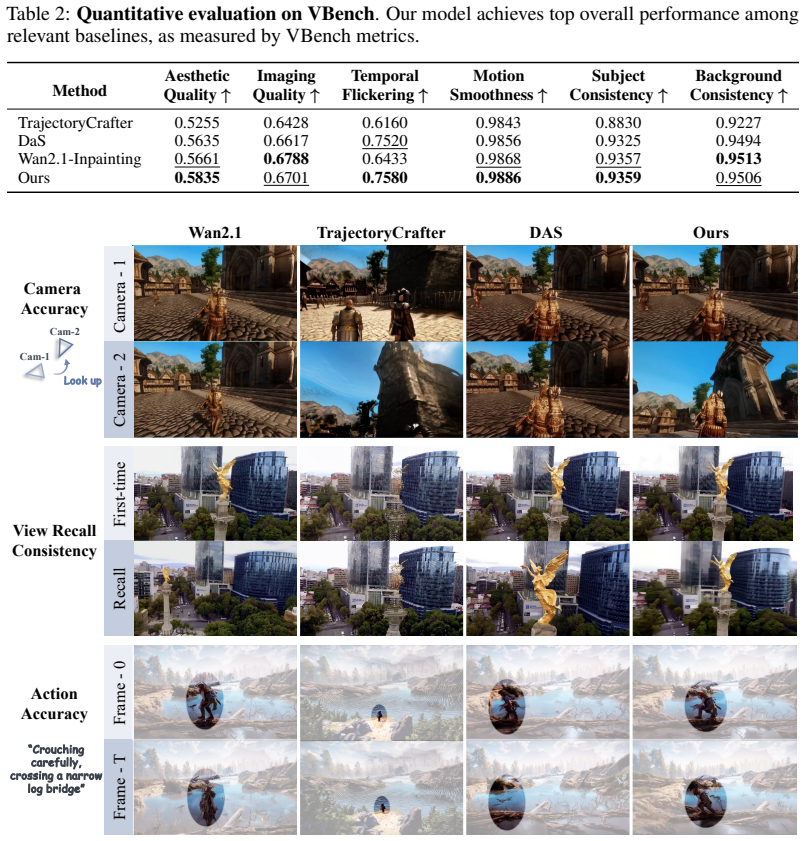
The central claim is that long-term spatial consistency in autoregressive video generation can be externalized into a persistent 3D representation instead of being re-derived from a sliding window of frames. At each autoregressive step the paper reconstructs newly generated frames into a metric point map, suppresses dynamic content with TSDF-Fusion, and fuses the result into a global static point cloud held in one world coordinate frame. The next batch of frames is then generated with this cloud rendered from the target camera poses as an additional conditioning signal, plus a sparse set of historical reference frames attended to through cross-attention. The paper reports a view-recall PSNR of 19.10 against 11.71 to 12.16 for the compared baselines, and top average human rankings on camera accuracy, static consistency, and dynamic plausibility.
Load-bearing premise
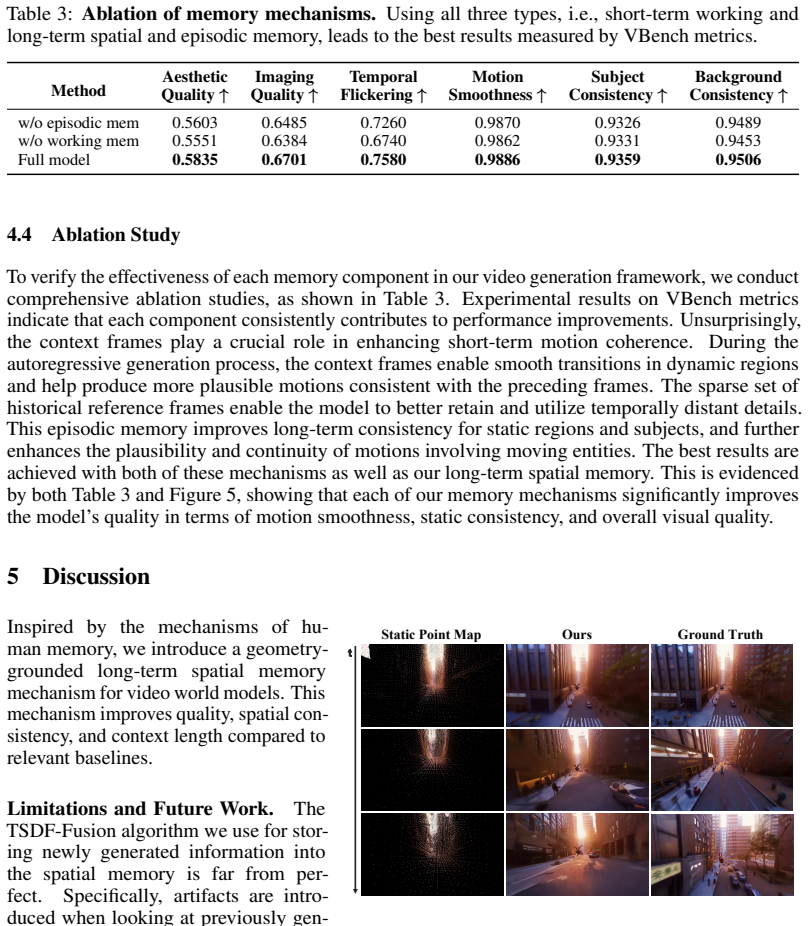
The load-bearing premise is that TSDF-Fusion with a uniform confidence weight reliably separates static from dynamic content, so the persistent point cloud contains mostly clean static geometry; if moving objects contaminate it or large camera motions erase it, the rendered guidance misleads the generator.
Editorial extensions
If this is right
- Revisit consistency should persist over arbitrarily long generations, since static geometry is stored in a camera-independent form rather than in a fixed-size frame window.
- Static and dynamic content are controlled through separate channels: the point-cloud branch pins down structure while recent frames and prompts drive motion, so camera edits need not disturb dynamics.
- Memory cost stays bounded: a compact point cloud plus a few keyframes replaces the long frame histories that current context-window methods require for consistency.
- The 90K-clip dataset with explicit 3D memory makes it possible to train the model to use memory, which is a prerequisite for scaling the approach to longer horizons.
- The improved consistency is specifically spatial; drift from error accumulation over time remains an open problem the paper does not address.
Reading between the lines
- A direct stress test would measure the completeness of the fused point cloud over rolling windows and correlate it with revisit PSNR; the paper does not report such a curve, and it would reveal whether the memory or the generator is the bottleneck.
- The same static-map-plus-keyframes design maps naturally onto embodied-agent memory, suggesting that generative world models could be coupled with online mapping so an agent's past observations condition its simulated future.
- Combining this spatial memory with frame-packing context compression, which the authors name as future work, would target both spatial forgetting and appearance drift at once.
- A testable extension is to vary the episodic-memory selection threshold and measure whether detail retention trades off against context load, which would indicate an optimal recall schedule.
Signed reviews
Editorial analysis
A structured set of objections, weighed in public.
Referee Report
Summary. The paper proposes a video world model that augments autoregressive frame generation with three memory systems: working memory (recent context frames), spatial memory (a persistent static point cloud fused via truncated signed distance function), and episodic memory (sparse historical keyframes). The spatial memory is rendered along the camera trajectory and injected through a ControlNet-style condition branch; the model is trained on a custom 90K-sample dataset derived from MiraData with Mega-SAM reconstruction. The paper reports large improvements over TrajectoryCrafter, DiffusionAsShader (DaS), and Wan2.1-Inpainting on view-recall consistency (PSNR 19.10 vs 12.16), VBench metrics, and a user study.
Significance. If the results hold, the paper presents a practical and well-motivated architecture for improving spatial consistency in long-horizon world generation. The view-recall evaluation protocol is sensible for measuring revisit consistency, and the reported gains are large. The honest discussion of failure cases and the inclusion of a custom dataset are valuable. However, the central novelty - the spatial memory - is not isolated in the ablations, the TSDF-Fusion filtering assumption is not validated, the online coordinate-frame stability is asserted without evidence, and the context-length claim is not directly evaluated. These gaps require additional experiments before the significance claim can be fully accepted.
major comments (4)
- [Sec. 4.4, Table 3] The ablation study in Table 3 never removes the spatial-memory condition; all three rows include the point-cloud render branch, so the claim in Sec. 4.4 that 'each component consistently contributes' is not supported for the geometry-grounded spatial memory, which is the paper's central novel component. Please add a 'w/o spatial memory' condition (e.g., removing the point-cloud render branch or replacing the fused point cloud with a blank render) and report both VBench and view-recall metrics for that condition, so the contribution of the spatial memory can be isolated.
- [Sec. 3.2, Eq. (2) and Fig. 6/Limitations] The statement that TSDF-Fusion with a uniform confidence weight (w_i=1) 'inherently filters out dynamic elements' is not justified by the standard weighted-averaging update in Eq. (2), which can blend inconsistent observations into ghost surfaces; conversely, the failure case in Fig. 6 shows that TSDF-Fusion can erase valid static points under large camera motion. No point-cloud quality metric (e.g., dynamic contamination rate, static recall, or geometric accuracy) is provided for the generated videos, so the reader cannot verify that the stored spatial memory is clean enough to serve as reliable conditioning. Please add such metrics and, if possible, compare equal-weight TSDF-Fusion with an outlier-rejecting fusion scheme (e.g., confidence-weighted or median-based) to substantiate the filtering claim.
- [Appendix A, last paragraph] The online autoregressive fusion relies on CUT3R's saved state to keep a single world coordinate frame across steps, and the text asserts that the difference between Mega-SAM (training) and CUT3R (inference) 'does not lead to a significant performance gap' without reporting any numbers. Coordinate-frame drift would directly corrupt the fused spatial memory and undermine the long-term consistency results. Please quantify the drift (e.g., average point-map alignment error across consecutive fusion steps) and report an online-vs-offline comparison on the same generated sequences, such as view-recall PSNR with Mega-SAM fusion vs CUT3R fusion.
- [Sec. 4.1, Tables 1-2, and abstract] The abstract claims improved 'context length,' but the experiments measure view-recall consistency on a single revisit trajectory and VBench metrics, neither of which directly evaluates how generation quality degrades with increasing distance from the recent context window. No experiment varies the number of autoregressive steps or measures performance as a function of temporal distance, so the context-length claim is unsupported. Please add an evaluation that plots a consistency metric against the number of generated frames (or the distance of the revisited frame from the last context) for the proposed method and the baselines.
minor comments (6)
- [Related Work, Sec. 2] Typo: 'inifinite-length videos' should be 'infinite-length videos'.
- [Sec. 3.4] The phrase 'to to serve as static geometry guidance' contains a duplicated preposition; please correct.
- [Table 1] The baseline name is misspelled as 'TrajctoryCrafter'; it should be 'TrajectoryCrafter'.
- [Appendix B / References] The reference to MonST3R appears as '[86? , 69]' in Appendix B; please resolve the dangling question mark and provide the correct citation.
- [Sec. 4.3] The user study reports average rankings but no confidence intervals or inter-rater agreement; given only 20 subjects, please report these statistics.
- [Sec. 4.1] Please describe how the paired frames for the view-recall metric are aligned (e.g., whether dynamic regions are masked) and whether the same noise seed is used for the forward and reversed generation; this is important for reproducibility of the main quantitative result.
Circularity Check
No significant circularity: the memory system is validated by ablations and external benchmarks; no central claim reduces to a fitted input or self-citation chain.
full rationale
This is a system paper without a formal derivation chain, so the enumerated circularity patterns do not apply in a load-bearing way. The claim that spatial memory improves long-term consistency is evaluated (i) by ablations that remove episodic or working memory from the same model (Table 3), (ii) against external baselines that do not use the memory mechanism (Table 1), and (iii) by VBench metrics and a user study. The view-recall metric compares forward and reversed generations of the same model; it is a self-consistency measure rather than ground-truth accuracy, but it is not circular because the baselines are evaluated under the same protocol and the ablations isolate the memory components. The dataset and inference pipelines use external reconstructions (Mega-SaM, CUT3R) and standard TSDF-Fusion; the claim that TSDF-Fusion suppresses dynamic content is an empirical assumption, explicitly acknowledged as imperfect in Figure 6 and the Limitations paragraph, not an equation that reduces the conclusion to its input. No parameter is fitted to the test set and renamed as a prediction, and no uniqueness or ansatz is imported through a self-citation. The only author-overlapping reference, DaS [25], is used as a pretrained initialization and baseline, and it is code-reproduced external work, so it does not make the argument circular.
Assumptions & free parameters
free parameters (3)
- context frame count k =
5
- TSDF confidence weight w_i =
1
- episodic memory insertion threshold =
not specified
assumptions (4)
- domain assumption Mega-SaM provides accurate camera poses and per-frame depth maps for training data construction.
- domain assumption CUT3R's online recurrent reconstruction maintains a consistent world coordinate system across autoregressive steps via saved state.
- domain assumption TSDF-Fusion with uniform weights suppresses dynamic objects and preserves static structure.
- domain assumption The diffusion model can learn to use black-background point-cloud renderings as geometric guidance via ControlNet-style conditioning.
Cite this review
Pith. "Pith review of Video World Models with Long-term Spatial Memory." pith.science (2026). https://pith.science/paper/BXELDHNB
@misc{pith2026250605284,
  author       = {Pith},
  title        = {Pith review of: Video World Models with Long-term Spatial Memory},
  year         = {2026},
  howpublished = {\url{https://pith.science/paper/BXELDHNB}},
  note         = {Machine review of arXiv:2506.05284}
}
read the original abstract
Emerging world models autoregressively generate video frames in response to actions, such as camera movements and text prompts, among other control signals. Due to limited temporal context window sizes, these models often struggle to maintain scene consistency during revisits, leading to severe forgetting of previously generated environments. Inspired by the mechanisms of human memory, we introduce a novel framework to enhancing long-term consistency of video world models through a geometry-grounded long-term spatial memory. Our framework includes mechanisms to store and retrieve information from the long-term spatial memory and we curate custom datasets to train and evaluate world models with explicitly stored 3D memory mechanisms. Our evaluations show improved quality, consistency, and context length compared to relevant baselines, paving the way towards long-term consistent world generation.
Figures


Figures from the paper (3 more)

Forward citations
Cited by 13 Pith papers
-
Addressable Memory for Video World Models
Video world models can recall revisited scenes far beyond their training horizon by storing compressed memory at fixed in-distribution positions and averaging keys in a rotation-free space.
-
HERA: Historical Evidence Routing Adapter for Physical Prediction in Latent World Models
A memory adapter with separate retrieval and workspace registers routes historical visual evidence into a frozen video predictor and improves physical prediction accuracy on IntPhys2.
-
WorldCycle: Self-Verifiable Reinforcement Learning for Long-Horizon Video World Models
WorldCycle post-trains interactive video world models with reinforcement learning rewards for spatial closure and temporal consistency on reversible action cycles, reducing long-horizon drift and improving composite-a...
-
Pano2World: End-to-End 3D Generation via Unified Multi-View Sequences
Pano2World generates an explorable 3D Gaussian scene directly from a single indoor panorama via coarse proxy rendering, view-aware joint denoising, and a latent feature adapter.
-
From Synchrony to Sequence: Exo-to-Ego Generation via Interpolation
Interpolating only the video frames between synchronized exo and ego clips already turns discontinuous cross-view generation into continuous sequence modeling and measurably improves diffusion-based Exo2Ego synthesis.
-
ShareVerse: Multi-Agent Consistent Video Generation for Shared World Modeling
Distributed video-generation agents can create a spatiotemporally consistent shared world by tiling four views, exchanging cross-agent attention, and querying a spatial memory cache.
-
UCM: Unified Modeling of Camera Control and Memory with Time-aware Positional Encoding Warping for World Models
A video-generation world model that warps positional encodings of memory frames to target viewpoints achieves state-of-the-art long-term consistency and camera control.
-
Flow Equivariant World Models: Memory for Partially Observed Dynamic Environments
Flow equivariant world models use a latent memory that shifts with the agent and with inferred object motion, giving stable long-horizon prediction under partial observability.
-
CustomX: Unified Character, Action, and Scene Customization in Video World Models
AniX generates controllable videos of a user-supplied character performing typed actions inside a user-supplied 3D scene by fine-tuning a pre-trained video generator on small locomotion datasets.
-
A Comprehensive Survey on World Models for Embodied AI
A unified three-axis taxonomy — functionality, temporal modeling, spatial representation — organizes the world-model literature for embodied AI.
-
PE-Field 4D: Video Generation Models as Canvas
Warping reference tokens' positional encodings into the target view, with depth offsets and frame-level compression fixes, improves geometry-aware camera control in video diffusion transformers.
-
Vision-Language Memory for Spatial Reasoning
A video-based vision-language model with 3D-aligned visual features and bounded dual memory achieves state-of-the-art scores on four spatial reasoning benchmarks.
-
HunyuanWorld 1.0: Generating Immersive, Explorable, and Interactive 3D Worlds from Words or Pixels
A staged pipeline generates layered, mesh-based 3D worlds from text or images by combining panoramic diffusion, semantic layer decomposition, and video-based expansion.
Reference graph
Works this paper leans on
-
[1]
Diffusion for world modeling: Visual details matter in atari
Eloi Alonso, Adam Jelley, Vincent Micheli, Anssi Kanervisto, Amos J Storkey, Tim Pearce, and François Fleuret. Diffusion for world modeling: Visual details matter in atari. Advances in Neural Information Processing Systems, 37:58757–58791, 2024
2024
-
[2]
Genesis: A universal and generative physics engine for robotics and beyond
Genesis Authors. Genesis: A universal and generative physics engine for robotics and beyond. URL https://github. com/Genesis-Embodied-AI/Genesis, 2024
2024
-
[3]
Essentials of human memory
Alan Baddeley. Essentials of human memory . Psychology Press, 2013
2013
-
[4]
Lindell, and Sergey Tulyakov
Sherwin Bahmani, Ivan Skorokhodov, Guocheng Qian, Aliaksandr Siarohin, Willi Menapace, Andrea Tagliasacchi, David B. Lindell, and Sergey Tulyakov. Ac3d: Analyzing and improving 3d camera control in video diffusion transformers. Proc. CVPR, 2025
2025
-
[5]
Lindell, and Sergey Tulyakov
Sherwin Bahmani, Ivan Skorokhodov, Aliaksandr Siarohin, Willi Menapace, Guocheng Qian, Michael Vasilkovsky, Hsin-Ying Lee, Chaoyang Wang, Jiaxu Zou, Andrea Tagliasacchi, David B. Lindell, and Sergey Tulyakov. VD3d: Taming large video diffusion transformers for 3d camera control. In The Thirteenth International Conference on Learning Representations , 2025...
2025
-
[6]
Recammaster: Camera-controlled generative rendering from a single video, 2025
Jianhong Bai, Menghan Xia, Xiao Fu, Xintao Wang, Lianrui Mu, Jinwen Cao, Zuozhu Liu, Haoji Hu, Xiang Bai, Pengfei Wan, and Di Zhang. Recammaster: Camera-controlled generative rendering from a single video, 2025. URL https://arxiv.org/abs/2503.11647
arXiv 2025
-
[7]
Syncammaster: Synchronizing multi-camera video generation from diverse viewpoints
Jianhong Bai, Menghan Xia, Xintao Wang, Ziyang Yuan, Zuozhu Liu, Haoji Hu, Pengfei Wan, and Di ZHANG. Syncammaster: Synchronizing multi-camera video generation from diverse viewpoints. In The Thirteenth International Conference on Learning Representations , 2025. URL https://openreview.net/forum?id=m8Rk3HLGFx
2025
-
[9]
Stable video diffusion: Scaling latent video diffusion models to large datasets
Andreas Blattmann, Tim Dockhorn, Sumith Kulal, Daniel Mendelevitch, Maciej Kilian, Do- minik Lorenz, Yam Levi, Zion English, Vikram V oleti, Adam Letts, et al. Stable video diffusion: Scaling latent video diffusion models to large datasets. arXiv preprint arXiv:2311.15127, 2023
arXiv 2023
Show all 91 references
-
[10]
Video generation models as world simulators
Tim Brooks, Bill Peebles, Connor Holmes, Will DePue, Yufei Guo, Li Jing, David Schnurr, Joe Taylor, Troy Luhman, Eric Luhman, Clarence Ng, Ricky Wang, and Aditya Ramesh. Video generation models as world simulators. 2024. URL https://openai.com/research/ video-generation-models...
2024
-
[11]
Video generation models as world simulators
Tim Brooks, Bill Peebles, Connor Holmes, Will DePue, Yufei Guo, Li Jing, David Schnurr, Joe Taylor, Troy Luhman, Eric Luhman, et al. Video generation models as world simulators. OpenAI Blog, 1:8, 2024
2024
-
[12]
Gamegen-x: Interactive open-world game video generation
Haoxuan Che, Xuanhua He, Quande Liu, Cheng Jin, and Hao Chen. Gamegen-x: Interactive open-world game video generation. arXiv preprint arXiv:2411.00769, 2024
2024 arXiv
-
[13]
Diffusion forcing: Next-token prediction meets full-sequence diffusion
Boyuan Chen, Diego Martí Monsó, Yilun Du, Max Simchowitz, Russ Tedrake, and Vincent Sitzmann. Diffusion forcing: Next-token prediction meets full-sequence diffusion. In NeurIPS, 2024
2024
-
[14]
Skyreels-v2: Infinite-length film generative model
Guibin Chen, Dixuan Lin, Jiangping Yang, Chunze Lin, Juncheng Zhu, Mingyuan Fan, Hao Zhang, Sheng Chen, Zheng Chen, Chengchen Ma, Weiming Xiong, Wei Wang, Nuo Pang, Kang Kang, Zhi-Xin Xu, Yuzhe Jin, Yupeng Liang, Yu-Ning Song, Peng Zhao, Bo Xu, Di Qiu, Debang Li, Zhengcong Fei...
2025
-
[15]
Flexworld: Progressively expanding 3d scenes for flexiable-view synthesis
Luxi Chen, Zihan Zhou, Min Zhao, Yikai Wang, Ge Zhang, Wenhao Huang, Hao Sun, Ji-Rong Wen, and Chongxuan Li. Flexworld: Progressively expanding 3d scenes for flexiable-view synthesis. arXiv preprint arXiv:2503.13265, 2025
2025 arXiv
-
[16]
Seine: Short-to-long video diffusion model for generative transition and prediction
Xinyuan Chen, Yaohui Wang, Lingjun Zhang, Shaobin Zhuang, Xin Ma, Jiashuo Yu, Yali Wang, Dahua Lin, Yu Qiao, and Ziwei Liu. Seine: Short-to-long video diffusion model for generative transition and prediction. In ICLR, 2023
2023
-
[17]
Oasis: A universe in a transformer
Etched Decart, Q McIntyre, S Campbell, Xinlei Chen, and R Wachen. Oasis: A universe in a transformer. URL: https://oasis-model. github. io, 2024
2024
-
[18]
Oasis: A universe in a transformer
Julian Decart, Quinn Quevedo, Spruce McIntyre, Xinlei Campbell, Robert Chen, and Wachen. Oasis: A universe in a transformer. 2024. URL https://oasis-model.github.io/
2024
-
[19]
Diffusion models beat gans on image synthesis
Prafulla Dhariwal and Alex Nichol. Diffusion models beat gans on image synthesis. ArXiv, abs/2105.05233, 2021. URL https://api.semanticscholar.org/CorpusID: 234357997
2021 arXiv
-
[20]
Skyreels-a2: Compose anything in video diffusion transformers
Zhengcong Fei, Debang Li, Di Qiu, Jiahua Wang, Yikun Dou, Rui Wang, Jingtao Xu, Mingyuan Fan, Guibin Chen, Yang Li, and Yahui Zhou. Skyreels-a2: Compose anything in video diffusion transformers. 2025. URL https://api.semanticscholar.org/CorpusID:277509893
2025
-
[21]
The matrix: Infinite-horizon world generation with real-time moving control
Ruili Feng, Han Zhang, Zhantao Yang, Jie Xiao, Zhilei Shu, Zhiheng Liu, Andy Zheng, Yukun Huang, Yu Liu, and Hongyang Zhang. The matrix: Infinite-horizon world generation with real-time moving control. arXiv preprint arXiv:2412.03568, 2024
2024 arXiv
-
[22]
Vid-gpt: Introducing gpt-style autoregressive generation in video diffusion models
Kaifeng Gao, Jiaxin Shi, Hanwang Zhang, Chunping Wang, and Jun Xiao. Vid-gpt: Introducing gpt-style autoregressive generation in video diffusion models. arXiv preprint arXiv:2406.10981, 2024
2024 arXiv
-
[23]
Ca2- vdm: Efficient autoregressive video diffusion model with causal generation and cache sharing
Kaifeng Gao, Jiaxin Shi, Hanwang Zhang, Chunping Wang, Jun Xiao, and Long Chen. Ca2- vdm: Efficient autoregressive video diffusion model with causal generation and cache sharing. arXiv preprint arXiv:2411.16375, 2024
2024 arXiv
-
[24]
Long-context autoregressive video mod- eling with next-frame prediction
Yuchao Gu, Weijia Mao, and Mike Zheng Shou. Long-context autoregressive video mod- eling with next-frame prediction. ArXiv, abs/2503.19325, 2025. URL https://api. semanticscholar.org/CorpusID:277313237. 12
2025 arXiv
-
[25]
Diffusion as shader: 3d-aware video diffusion for versatile video generation control
Zekai Gu, Rui Yan, Jiahao Lu, Peng Li, Zhiyang Dou, Chenyang Si, Zhen Dong, Qifeng Liu, Cheng Lin, Ziwei Liu, Wenping Wang, and Yuan Liu. Diffusion as shader: 3d-aware video diffusion for versatile video generation control. arXiv preprint arXiv:2501.03847, 2025
2025 arXiv
-
[26]
Photorealistic video generation with diffusion models
Agrim Gupta, Lijun Yu, Kihyuk Sohn, Xiuye Gu, Meera Hahn, Fei-Fei Li, Irfan Essa, Lu Jiang, and José Lezama. Photorealistic video generation with diffusion models. In ECCV, 2024
2024
-
[27]
Recurrent world models facilitate policy evolution
David Ha and Jürgen Schmidhuber. Recurrent world models facilitate policy evolution. In Advances in Neural Information Processing Systems 31 , pages 2451–2463. Curran Associates, Inc., 2018. URL https://papers.nips.cc/ paper/7512-recurrent-world-models-facilitate-policy-evolut...
2018
-
[28]
Ltx-video: Realtime video latent diffusion
Yoav HaCohen, Nisan Chiprut, Benny Brazowski, Daniel Shalem, Dudu Moshe, Eitan Richard- son, Eran Levin, Guy Shiran, Nir Zabari, Ori Gordon, et al. Ltx-video: Realtime video latent diffusion. arXiv preprint arXiv:2501.00103, 2024
2024 arXiv
-
[29]
Dream to control: Learning behaviors by latent imagination
Danijar Hafner, Timothy Lillicrap, Jimmy Ba, and Mohammad Norouzi. Dream to control: Learning behaviors by latent imagination. arXiv preprint arXiv:1912.01603, 2019
1912 arXiv
-
[30]
Cameractrl: Enabling camera control for video diffusion models
Hao He, Yinghao Xu, Yuwei Guo, Gordon Wetzstein, Bo Dai, Hongsheng Li, and Ceyuan Yang. Cameractrl: Enabling camera control for video diffusion models. In The Thirteenth International Conference on Learning Representations , 2025. URL https://openreview. net/forum?id=Z4evOUYrk7
2025
-
[31]
Cameractrl ii: Dynamic scene exploration via camera- controlled video diffusion models
Hao He, Ceyuan Yang, Shanchuan Lin, Yinghao Xu, Meng Wei, Liangke Gui, Qi Zhao, Gordon Wetzstein, Lu Jiang, and Hongsheng Li. Cameractrl ii: Dynamic scene exploration via camera- controlled video diffusion models. arXiv preprint arXiv:2503.10592, 2025
2025 arXiv
-
[32]
Latent video diffusion models for high-fidelity long video generation
Yingqing He, Tianyu Yang, Yong Zhang, Ying Shan, and Qifeng Chen. Latent video diffusion models for high-fidelity long video generation. arXiv preprint arXiv:2211.13221, 2022
2022 arXiv
-
[33]
Streamingt2v: Consistent, dynamic, and extendable long video generation from text
Roberto Henschel, Levon Khachatryan, Daniil Hayrapetyan, Hayk Poghosyan, Vahram Tade- vosyan, Zhangyang Wang, Shant Navasardyan, and Humphrey Shi. Streamingt2v: Consistent, dynamic, and extendable long video generation from text. arXiv preprint arXiv:2403.14773, 2024
2024 arXiv
-
[34]
Denoising diffusion probabilistic models
Jonathan Ho, Ajay Jain, and Pieter Abbeel. Denoising diffusion probabilistic models. In NeurIPS, 2020
2020
-
[35]
Video diffusion models
Jonathan Ho, Tim Salimans, Alexey Gritsenko, William Chan, Mohammad Norouzi, and David J Fleet. Video diffusion models. In NeurIPS, 2022
2022
-
[36]
Vbench: Comprehensive benchmark suite for video generative models
Ziqi Huang, Yinan He, Jiashuo Yu, Fan Zhang, Chenyang Si, Yuming Jiang, Yuanhan Zhang, Tianxing Wu, Qingyang Jin, Nattapol Chanpaisit, et al. Vbench: Comprehensive benchmark suite for video generative models. In Proceedings of the IEEE/CVF Conference on Computer Vision and Pat...
2024
-
[37]
Pyramidal flow matching for efficient video generative modeling
Yang Jin, Zhicheng Sun, Ningyuan Li, Kun Xu, Hao Jiang, Zhuang Nan, Quzhe Huang, Yang Song, Yadong Mu, and Zhouchen Lin. Pyramidal flow matching for efficient video generative modeling. ArXiv, abs/2410.05954, 2024. URL https://api.semanticscholar. org/CorpusID:273228937
2024
-
[38]
Pyramidal flow matching for efficient video generative modeling
Yang Jin, Zhicheng Sun, Ningyuan Li, Kun Xu, Hao Jiang, Nan Zhuang, Quzhe Huang, Yang Song, Yadong Mu, and Zhouchen Lin. Pyramidal flow matching for efficient video generative modeling. In ICLR, 2025
2025
-
[39]
Miradata: A large-scale video dataset with long durations and structured captions, 2024
Xuan Ju, Yiming Gao, Zhaoyang Zhang, Ziyang Yuan, Xintao Wang, Ailing Zeng, Yu Xiong, Qiang Xu, and Ying Shan. Miradata: A large-scale video dataset with long durations and structured captions, 2024. URL https://arxiv.org/abs/2407.06358
2024 arXiv
-
[40]
Videopoet: A large language model for zero-shot video generation
Dan Kondratyuk, Lijun Yu, Xiuye Gu, Jose Lezama, Jonathan Huang, Grant Schindler, Rachel Hornung, Vighnesh Birodkar, Jimmy Yan, Ming-Chang Chiu, et al. Videopoet: A large language model for zero-shot video generation. In ICML, 2024. 13
2024
-
[41]
Hunyuanvideo: A systematic framework for large video generative models
Weijie Kong, Qi Tian, Zijian Zhang, Rox Min, Zuozhuo Dai, Jin Zhou, Jiangfeng Xiong, Xin Li, Bo Wu, Jianwei Zhang, et al. Hunyuanvideo: A systematic framework for large video generative models. arXiv preprint arXiv:2412.03603, 2024
2024 arXiv
-
[42]
Lee, Richard Zhang, Frederik Ebert, P
Alex X. Lee, Richard Zhang, Frederik Ebert, P. Abbeel, Chelsea Finn, and Sergey Levine. Stochastic adversarial video prediction. ArXiv, abs/1804.01523, 2018. URL https://api. semanticscholar.org/CorpusID:4591836
2018 arXiv
-
[43]
Efficient spatially sparse inference for conditional gans and diffusion models
Muyang Li, Ji Lin, Chenlin Meng, Stefano Ermon, Song Han, and Jun-Yan Zhu. Efficient spatially sparse inference for conditional gans and diffusion models. Advances in neural information processing systems, 35:28858–28873, 2022
2022
-
[44]
Megasam: Accurate, fast and robust structure and motion from casual dynamic videos
Zhengqi Li, Richard Tucker, Forrester Cole, Qianqian Wang, Linyi Jin, Vickie Ye, Angjoo Kanazawa, Aleksander Holynski, and Noah Snavely. Megasam: Accurate, fast and robust structure and motion from casual dynamic videos. In Proceedings of the IEEE/CVF Conference on Computer Vi...
2025
-
[45]
Open-sora plan: Open-source large video generation model
Bin Lin, Yunyang Ge, Xinhua Cheng, Zongjian Li, Bin Zhu, Shaodong Wang, Xianyi He, Yang Ye, Shenghai Yuan, Liuhan Chen, Tanghui Jia, Junwu Zhang, Zhenyu Tang, Yatian Pang, Bin She, Cen Yan, Zhiheng Hu, Xiao wen Dong, Lin Chen, Zhang Pan, Xing Zhou, Shaoling Dong, Yonghong Tian...
2024 arXiv
-
[46]
Yaron Lipman, Ricky T. Q. Chen, Heli Ben-Hamu, Maximilian Nickel, and Matt Le. Flow matching for generative modeling. ArXiv, abs/2210.02747, 2022. URL https://api. semanticscholar.org/CorpusID:252734897
2022 arXiv
-
[47]
Linfusion: 1 gpu, 1 minute, 16k image
Songhua Liu, Weihao Yu, Zhenxiong Tan, and Xinchao Wang. Linfusion: 1 gpu, 1 minute, 16k image. ArXiv, abs/2409.02097, 2024. URL https://api.semanticscholar.org/ CorpusID:272366893
2024 arXiv
-
[48]
Deep multi-scale video prediction beyond mean square error
Michaël Mathieu, Camille Couprie, and Yann LeCun. Deep multi-scale video prediction beyond mean square error. CoRR, abs/1511.05440, 2015. URL https://api.semanticscholar. org/CorpusID:205514
2015 arXiv
-
[49]
Ssm meets video diffusion models: Efficient long-term video generation with structured state spaces
Yuta Oshima, Shohei Taniguchi, Masahiro Suzuki, and Yutaka Matsuo. Ssm meets video diffusion models: Efficient long-term video generation with structured state spaces. arXiv preprint arXiv:2403.07711, 2024
2024 arXiv
-
[50]
Genie 2: A large-scale foundation world model
J Parker-Holder, P Ball, J Bruce, V Dasagi, K Holsheimer, C Kaplanis, A Moufarek, G Scully, J Shar, J Shi, et al. Genie 2: A large-scale foundation world model. URL: https://deepmind. google/discover/blog/genie-2-a-large-scale-foundation-world-model, 2024
2024
-
[51]
Genie 2: A large-scale foundation world model
Jack Parker-Holder, Philip Ball, Jake Bruce, Vibhavari Dasagi, Kristian Holsheimer, Christos Kaplanis, Alexandre Moufarek, Guy Scully, Jeremy Shar, Jimmy Shi, Stephen Spencer, Jessica Yung, Michael Dennis, Sultan Kenjeyev, Shangbang Long, Vlad Mnih, Harris Chan, Maxime Gazeau,...
2024
-
[52]
State of the art on diffusion models for visual computing
Ryan Po, Wang Yifan, Vladislav Golyanik, Kfir Aberman, Jonathan T Barron, Amit Bermano, Eric Chan, Tali Dekel, Aleksander Holynski, Angjoo Kanazawa, et al. State of the art on diffusion models for visual computing. Computer Graphics F orum, 43(2):e15063, 2024
2024
-
[53]
Skyreels-a1: Expressive portrait animation in video diffusion trans- formers
Di Qiu, Zhengcong Fei, Rui Wang, Jialin Bai, Changqian Yu, Mingyuan Fan, Guibin Chen, and Xiang Wen. Skyreels-a1: Expressive portrait animation in video diffusion trans- formers. abs/2502.10841, 2025. URL https://api.semanticscholar.org/CorpusID: 276409428. 14
2025 arXiv
-
[54]
Gen3c: 3d-informed world- consistent video generation with precise camera control
Xuanchi Ren, Tianchang Shen, Jiahui Huang, Huan Ling, Yifan Lu, Merlin Nimier-David, Thomas Müller, Alexander Keller, Sanja Fidler, and Jun Gao. Gen3c: 3d-informed world- consistent video generation with precise camera control. In Proceedings of the IEEE/CVF Conference on Comp...
2025
-
[55]
Structure-from-motion revisited
Johannes Lutz Schönberger and Jan-Michael Frahm. Structure-from-motion revisited. In Conference on Computer Vision and Pattern Recognition (CVPR) , 2016
2016
-
[56]
Make-a-video: Text-to-video generation without text-video data
Uriel Singer, Adam Polyak, Thomas Hayes, Xi Yin, Jie An, Songyang Zhang, Qiyuan Hu, Harry Yang, Oron Ashual, Oran Gafni, et al. Make-a-video: Text-to-video generation without text-video data. In ICLR, 2023
2023
-
[57]
Deep unsuper- vised learning using nonequilibrium thermodynamics
Jascha Sohl-Dickstein, Eric Weiss, Niru Maheswaranathan, and Surya Ganguli. Deep unsuper- vised learning using nonequilibrium thermodynamics. 2015
2015
-
[58]
History-guided video diffusion
Kiwhan Song, Boyuan Chen, Max Simchowitz, Yilun Du, Russ Tedrake, and Vincent Sitzmann. History-guided video diffusion. arXiv preprint arXiv:2502.06764, 2025
2025 arXiv
-
[59]
Score-based generative modeling through stochastic differential equations
Yang Song, Jascha Sohl-Dickstein, Diederik P Kingma, Abhishek Kumar, Stefano Ermon, and Ben Poole. Score-based generative modeling through stochastic differential equations. In ICLR, 2021
2021
-
[60]
Autoregressive model beats diffusion: Llama for scalable image generation
Peize Sun, Yi Jiang, Shoufa Chen, Shilong Zhang, Bingyue Peng, Ping Luo, and Zehuan Yuan. Autoregressive model beats diffusion: Llama for scalable image generation. arXiv preprint arXiv:2406.06525, 2024
2024 arXiv
-
[61]
Vidtok: A versatile and open-source video tokenizer
Anni Tang, Tianyu He, Junliang Guo, Xinle Cheng, Li Song, and Jiang Bian. Vidtok: A versatile and open-source video tokenizer. ArXiv, abs/2412.13061, 2024. URL https://api. semanticscholar.org/CorpusID:274788955
2024 arXiv
-
[62]
Tulyakov, Ming-Yu Liu, Xiaodong Yang, and Jan Kautz
S. Tulyakov, Ming-Yu Liu, Xiaodong Yang, and Jan Kautz. Mocogan: Decomposing motion and content for video generation. 2018 IEEE/CVF Conference on Computer Vision and Pattern Recognition, pages 1526–1535, 2017. URL https://api.semanticscholar.org/ CorpusID:4475365
2018
-
[63]
Diffusion models are real-time game engines
Dani Valevski, Yaniv Leviathan, Moab Arar, and Shlomi Fruchter. Diffusion models are real-time game engines. arXiv preprint arXiv:2408.14837, 2024
2024 arXiv
-
[64]
Phenaki: Variable length video generation from open domain textual descriptions
R Villegas, H Moraldo, S Castro, M Babaeizadeh, H Zhang, J Kunze, PJ Kindermans, MT Saffar, and D Erhan. Phenaki: Variable length video generation from open domain textual descriptions. In ICLR, 2023
2023
-
[65]
Generating the future with adversarial transformers.2017 IEEE Conference on Computer Vision and Pattern Recognition (CVPR) , pages 2992–3000,
Carl V ondrick and Antonio Torralba. Generating the future with adversarial transformers.2017 IEEE Conference on Computer Vision and Pattern Recognition (CVPR) , pages 2992–3000,
2017
-
[66]
Wan: Open and advanced large-scale video generative models
Team Wan, Ang Wang, Baole Ai, Bin Wen, Chaojie Mao, Chen-Wei Xie, Di Chen, Feiwu Yu, Haiming Zhao, Jianxiao Yang, et al. Wan: Open and advanced large-scale video generative models. arXiv preprint arXiv:2503.20314, 2025
2025 arXiv
-
[67]
Lingen: Towards high-resolution minute-length text-to-video generation with linear compu- tational complexity
Hongjie Wang, Chih-Yao Ma, Yen-Cheng Liu, Ji Hou, Tao Xu, Jialiang Wang, Felix Juefei-Xu, Yaqiao Luo, Peizhao Zhang, Tingbo Hou, Peter Vajda, Niraj Kumar Jha, and Xiaoliang Dai. Lingen: Towards high-resolution minute-length text-to-video generation with linear compu- tational ...
2024 arXiv
-
[68]
Vggt: Visual geometry grounded transformer
Jianyuan Wang, Minghao Chen, Nikita Karaev, Andrea Vedaldi, Christian Rupprecht, and David Novotny. Vggt: Visual geometry grounded transformer. In Proceedings of the IEEE/CVF Conference on Computer Vision and Pattern Recognition, 2025
2025
-
[69]
Efros, and Angjoo Kanazawa
Qianqian Wang*, Yifei Zhang*, Aleksander Holynski, Alexei A. Efros, and Angjoo Kanazawa. Continuous 3d perception model with persistent state. In Proceedings of the IEEE/CVF Conference on Computer Vision and Pattern Recognition (CVPR) , 2025. 15
2025
-
[70]
Dust3r: Geometric 3d vision made easy
Shuzhe Wang, Vincent Leroy, Yohann Cabon, Boris Chidlovskii, and Jerome Revaud. Dust3r: Geometric 3d vision made easy. In Proceedings of the IEEE/CVF Conference on Computer Vision and Pattern Recognition (CVPR), pages 20697–20709, June 2024
2024
-
[71]
Loong: Generating minute-level long videos with autoregressive language models
Yuqing Wang, Tianwei Xiong, Daquan Zhou, Zhijie Lin, Yang Zhao, Bingyi Kang, Jiashi Feng, and Xihui Liu. Loong: Generating minute-level long videos with autoregressive language models. arXiv preprint arXiv:2410.02757, 2024
2024 arXiv
-
[72]
Motionctrl: A unified and flexible motion controller for video generation
Zhouxia Wang, Ziyang Yuan, Xintao Wang, Yaowei Li, Tianshui Chen, Menghan Xia, Ping Luo, and Ying Shan. Motionctrl: A unified and flexible motion controller for video generation. In ACM SIGGRAPH 2024 Conference Papers, pages 1–11, 2024
2024
-
[73]
Art-v: Auto-regressive text-to-video generation with diffusion models
Wenming Weng, Ruoyu Feng, Yanhui Wang, Qi Dai, Chunyu Wang, Dacheng Yin, Zhiyuan Zhao, Kai Qiu, Jianmin Bao, Yuhui Yuan, et al. Art-v: Auto-regressive text-to-video generation with diffusion models. In Proceedings of the IEEE/CVF Conference on Computer Vision and Pattern Recog...
2024
-
[74]
Day- dreamer: World models for physical robot learning
Philipp Wu, Alejandro Escontrela, Danijar Hafner, Pieter Abbeel, and Ken Goldberg. Day- dreamer: World models for physical robot learning. In Conference on robot learning, pages 2226–2240. PMLR, 2023
2023
-
[75]
Sana: Efficient high-resolution image synthesis with linear diffusion transformers
Enze Xie, Junsong Chen, Junyu Chen, Han Cai, Haotian Tang, Yujun Lin, Zhekai Zhang, Muyang Li, Ligeng Zhu, Yao Lu, and Song Han. Sana: Efficient high-resolution image synthesis with linear diffusion transformers. ArXiv, abs/2410.10629, 2024. URL https: //api.semanticscholar.or...
-
[76]
Videogpt: Video generation using vq-vae and transformers
Wilson Yan, Yunzhi Zhang, Pieter Abbeel, and Aravind Srinivas. Videogpt: Video generation using vq-vae and transformers. arXiv preprint arXiv:2104.10157, 2021
2021 arXiv
-
[77]
An Yang, Baosong Yang, Beichen Zhang, Binyuan Hui, Bo Zheng, Bowen Yu, Chengyuan Li, Dayiheng Liu, Fei Huang, Haoran Wei, et al. Qwen2. 5 technical report. arXiv preprint arXiv:2412.15115, 2024
2024 arXiv
-
[79]
Cogvideox: Text-to-video diffusion models with an expert transformer
Zhuoyi Yang, Jiayan Teng, Wendi Zheng, Ming Ding, Shiyu Huang, Jiazheng Xu, Yuanming Yang, Wenyi Hong, Xiaohan Zhang, Guanyu Feng, et al. Cogvideox: Text-to-video diffusion models with an expert transformer. arXiv preprint arXiv:2408.06072, 2024
2024 arXiv
-
[80]
From slow bidirectional to fast autoregressive video diffusion models
Tianwei Yin, Qiang Zhang, Richard Zhang, William T Freeman, Fredo Durand, Eli Shechtman, and Xun Huang. From slow bidirectional to fast autoregressive video diffusion models. In CVPR, 2025
2025
-
[81]
Gamefactory: Creating new games with generative interactive videos
Jiwen Yu, Yiran Qin, Xintao Wang, Pengfei Wan, Di Zhang, and Xihui Liu. Gamefactory: Creating new games with generative interactive videos. arXiv preprint arXiv:2501.08325, 2025
2025
-
[82]
Trajectorycrafter: Redirecting camera trajectory for monocular videos via diffusion models
Mark YU, Wenbo Hu, Jinbo Xing, and Ying Shan. Trajectorycrafter: Redirecting camera trajectory for monocular videos via diffusion models. arXiv preprint arXiv:2503.05638, 2025
2025 arXiv
-
[83]
Viewcrafter: Taming video diffusion models for high-fidelity novel view synthesis
Wangbo Yu, Jinbo Xing, Li Yuan, Wenbo Hu, Xiaoyu Li, Zhipeng Huang, Xiangjun Gao, Tien-Tsin Wong, Ying Shan, and Yonghong Tian. Viewcrafter: Taming video diffusion models for high-fidelity novel view synthesis. arXiv preprint arXiv:2409.02048, 2024
2024 arXiv
-
[84]
3dmatch: Learning local geometric descriptors from rgb-d reconstructions
Andy Zeng, Shuran Song, Matthias Nießner, Matthew Fisher, Jianxiong Xiao, and Thomas Funkhouser. 3dmatch: Learning local geometric descriptors from rgb-d reconstructions. In CVPR, 2017
2017
-
[85]
Recapture: Generative video camera controls for user-provided videos using masked video fine-tuning
David Junhao Zhang, Roni Paiss, Shiran Zada, Nikhil Karnad, David E Jacobs, Yael Pritch, Inbar Mosseri, Mike Zheng Shou, Neal Wadhwa, and Nataniel Ruiz. Recapture: Generative video camera controls for user-provided videos using masked video fine-tuning. arXiv preprint arXiv:24...
2024 arXiv
-
[86]
MonST3r: A simple approach for estimating geometry in the presence of motion
Junyi Zhang, Charles Herrmann, Junhwa Hur, Varun Jampani, Trevor Darrell, Forrester Cole, Deqing Sun, and Ming-Hsuan Yang. MonST3r: A simple approach for estimating geometry in the presence of motion. In The Thirteenth International Conference on Learning Representa- tions, 20...
2025
-
[87]
Packing input frame context in next-frame prediction models for video generation
Lvmin Zhang and Maneesh Agrawala. Packing input frame context in next-frame prediction models for video generation. arXiv preprint arXiv:2504.12626, 2025
2025
-
[88]
Adding conditional control to text-to-image diffusion models
Lvmin Zhang, Anyi Rao, and Maneesh Agrawala. Adding conditional control to text-to-image diffusion models. In Proceedings of the IEEE/CVF international conference on computer vision , pages 3836–3847, 2023
2023
-
[89]
Flare: Feed-forward geometry, appearance and camera estimation from uncalibrated sparse views
Shangzhan Zhang, Jianyuan Wang, Yinghao Xu, Nan Xue, Christian Rupprecht, Xiaowei Zhou, Yujun Shen, and Gordon Wetzstein. Flare: Feed-forward geometry, appearance and camera estimation from uncalibrated sparse views. In Proceedings of the IEEE/CVF Conference on Computer Vision...
2025
-
[90]
Extdm: Distribu- tion extrapolation diffusion model for video prediction
Zhicheng Zhang, Junyao Hu, Wentao Cheng, Danda Paudel, and Jufeng Yang. Extdm: Distribu- tion extrapolation diffusion model for video prediction. In CVPR, 2024
2024
-
[91]
Open-sora: Democratizing efficient video production for all
Zangwei Zheng, Xiangyu Peng, Tianji Yang, Chenhui Shen, Shenggui Li, Hongxin Liu, Yukun Zhou, Tianyi Li, and Yang You. Open-sora: Democratizing efficient video production for all. ArXiv, abs/2412.20404, 2024. URL https://api.semanticscholar.org/CorpusID: 275133398
2024 arXiv
-
[92]
Is sora a world simulator? a comprehensive survey on general world models and beyond
Zheng Zhu, Xiaofeng Wang, Wangbo Zhao, Chen Min, Nianchen Deng, Min Dou, Yuqi Wang, Botian Shi, Kai Wang, Chi Zhang, et al. Is sora a world simulator? a comprehensive survey on general world models and beyond. arXiv preprint arXiv:2405.03520, 2024. 17
2024
-
[2017]
URL https://api.semanticscholar.org/CorpusID:8234308
Reviewed August 7, 2026 · model on record in the stance chip above.
Discussion (0). Continue with ORCID to comment.