Bayesian Inference of the Landau Parameter G'₀ from Joint Gamow-Teller Measurements
Pith reviewed 2026-05-19 10:21 UTC · model grok-4.3
The pith
Bayesian analysis of Gamow-Teller resonances in three nuclei extracts the spin-isospin Landau parameter G'_0 as 0.48 with uncertainty 0.034.
A machine-rendered reading of the paper's core claim, the machinery that carries it, and where it could break.
Core claim
Using joint experimental constraints from Gamow-Teller resonances in 208Pb, 132Sn, and 90Zr within a self-consistent standard Skyrme RPA framework, the Bayesian posterior for the Landau parameter G'_0 is centered at 0.48 with a standard deviation of 0.034. This value lies nearer to existing Skyrme models that include spin-isospin data than to older estimates derived from pion-exchange pictures, with the difference possibly traceable to the adopted nucleon effective mass.
What carries the argument
Self-consistent Skyrme random phase approximation (RPA) serving as the forward model inside the Bayesian likelihood that maps the single parameter G'_0 to the observed energies and strengths of Gamow-Teller resonances.
If this is right
- The extracted G'_0 supplies a direct constraint for calculating beta-decay and double-beta-decay matrix elements in medium-mass and heavy nuclei.
- It modifies predicted neutrino absorption rates in hot dense nucleonic matter relevant to core-collapse supernovae.
- It shifts the estimated critical density at which pion condensation may occur inside neutron stars.
- It offers a concrete benchmark for building new Skyrme energy density functionals that treat the spin-isospin channel consistently across finite nuclei and infinite matter.
Where Pith is reading between the lines
- Adopting this lower G'_0 may push the onset of pion condensation to higher densities than older pion-exchange estimates imply for neutron-star cores.
- Repeating the same Bayesian procedure with additional nuclei or with measured beta-decay lifetimes would test whether the present uncertainty can be reduced further.
- The noted sensitivity to effective mass suggests that future functionals should vary both G'_0 and m*/m together when fitting spin-isospin data.
Load-bearing premise
The Skyrme RPA model supplies an accurate enough description of the chosen Gamow-Teller resonances that missing correlations or model deficiencies do not shift the extracted G'_0 by more than the reported uncertainty.
What would settle it
New high-resolution Gamow-Teller strength data on any of the three nuclei that cannot be reproduced by the Skyrme RPA when G'_0 is set near 0.48 would require revision of the inferred central value.
Figures


read the original abstract
The Landau-Migdal parameter $G'_0$ characterizes the main part of the spin-isospin dependent nucleon-nucleon interaction. Consequently, the $G'_0$ is closely related to the Gamow-Teller resonance (GTR), the beta and double-beta decay rates of finite nuclei, the response of hot and dense nucleonic matter that modifies the neutrino-nucleon absorption rates in core-collapse supernovae (CCSNe) and binary neutron star (BNS) mergers, and finally the critical density for pion condensation in neutron stars. In this letter, for the first time, we report the $G'_0$ with quantified uncertainty in the framework of Bayesian inference, using a self-consistent standard Skyrme Random Phase Approximation (RPA) model and joint constraints from experimental GTR measurements on $^{208}\mathrm{Pb}$, $^{132}\mathrm{Sn}$, $^{90}\mathrm{Zr}$. Our extracted $G_0'$ is $0.48\pm0.034$, which is close to the prediction of a few existing Skyrme models that consider spin-isospin observables but smaller than the traditional ones extracted from pion-exchange models. We hint to possible reasons for this deviation, like the value of the nucleon effective mass $\frac{m^*}{m}$. The $G_0'$ values extracted in this work may guide the construction of new energy density functionals that aims to self-consistently describe the dense matter properties in the spin-isospin channel.
Editorial analysis
A structured set of objections, weighed in public.
Referee Report
Summary. The manuscript reports the first Bayesian inference of the Landau-Migdal parameter G'_0 using a self-consistent Skyrme RPA forward model jointly constrained by experimental Gamow-Teller resonance data in 208Pb, 132Sn, and 90Zr. The extracted posterior is G'_0 = 0.48 ± 0.034, stated to be consistent with certain spin-isospin-aware Skyrme parametrizations but smaller than traditional pion-exchange values, with a qualitative suggestion that the effective mass m*/m may be responsible.
Significance. If the central claim holds, the work supplies a data-driven, uncertainty-quantified value of G'_0 with direct relevance to beta-decay rates, neutrino opacities in CCSNe and BNS mergers, and the onset of pion condensation. The joint multi-nucleus constraint and explicit Bayesian treatment are strengths that improve upon single-nucleus or ad-hoc extractions.
major comments (2)
- [Methods / Bayesian inference section] The likelihood in the Bayesian setup (described in the methods) is constructed from RPA predictions of GTR centroids and strengths; however, the manuscript provides no quantitative propagation of the known systematic offsets from omitted 2p-2h mixing, tensor forces, and particle-vibration coupling (shifts of 1–3 MeV and ~20–30 % quenching). Because these effects enter directly into the forward model that maps G'_0 to the data, the reported ±0.034 uncertainty may be underestimated and the posterior mean biased.
- [Discussion] The discussion notes that the extracted G'_0 is smaller than pion-exchange results and hints at the role of m*/m, yet the Skyrme parametrization employed fixes m* at a single value. No sensitivity study or marginalization over this (or other fixed) parameter is presented, leaving open whether the posterior would shift appreciably once m* is allowed to vary consistently with the same data.
minor comments (2)
- [Abstract] The abstract states the result is 'close to the prediction of a few existing Skyrme models' but does not name those models or cite the specific parametrizations used for comparison.
- [Methods] Notation for the RPA response function and the precise form of the likelihood (Gaussian or otherwise) should be written explicitly with equation numbers for reproducibility.
Simulated Author's Rebuttal
We thank the referee for their thorough review and constructive feedback on our manuscript. We address each of the major comments point by point below, providing our responses and indicating the revisions we plan to make.
read point-by-point responses
-
Referee: [Methods / Bayesian inference section] The likelihood in the Bayesian setup (described in the methods) is constructed from RPA predictions of GTR centroids and strengths; however, the manuscript provides no quantitative propagation of the known systematic offsets from omitted 2p-2h mixing, tensor forces, and particle-vibration coupling (shifts of 1–3 MeV and ~20–30 % quenching). Because these effects enter directly into the forward model that maps G'_0 to the data, the reported ±0.034 uncertainty may be underestimated and the posterior mean biased.
Authors: We agree that the systematic effects from 2p-2h mixing, tensor forces, and particle-vibration coupling are important and can influence the GTR properties. Our analysis is performed within the standard Skyrme RPA model, and the reported uncertainty reflects the statistical uncertainty given the model assumptions and the experimental data. We will revise the manuscript to include a dedicated paragraph in the discussion section acknowledging these limitations and explaining that a quantitative propagation would require a more advanced forward model incorporating these effects, which is left for future investigations. This will clarify that the ±0.034 is the uncertainty within the current framework. revision: partial
-
Referee: [Discussion] The discussion notes that the extracted G'_0 is smaller than pion-exchange results and hints at the role of m*/m, yet the Skyrme parametrization employed fixes m* at a single value. No sensitivity study or marginalization over this (or other fixed) parameter is presented, leaving open whether the posterior would shift appreciably once m* is allowed to vary consistently with the same data.
Authors: The referee correctly notes that our Skyrme parametrization fixes the effective mass ratio m*/m. The qualitative hint in the discussion is based on literature comparisons rather than a direct variation in our model. To strengthen the manuscript, we will perform a limited sensitivity analysis by considering a few alternative Skyrme parametrizations with different m*/m values and recomputing the posterior for G'_0. This will be added to the revised version, allowing us to assess the robustness of our result with respect to this parameter. revision: yes
Circularity Check
Bayesian extraction of G'_0 driven by external GTR data; minor prior-tuning risk only
full rationale
The paper performs Bayesian inference of the Landau parameter G'_0 by treating experimental Gamow-Teller resonance centroids and strengths in 208Pb, 132Sn and 90Zr as independent data constraints. The Skyrme RPA forward model maps the single varied parameter G'_0 to those observables; the posterior is therefore shaped by external measurements rather than by any internal loop that re-uses the same fitted quantities as predictions. No equation in the manuscript equates a derived quantity to its own input by construction, and no self-citation is invoked to justify a uniqueness theorem or to smuggle an ansatz. The only residual circularity risk is the possibility that other Skyrme parameters were previously tuned on related observables, but this does not make the central claim tautological. The derivation remains self-contained against the stated experimental inputs.
Axiom & Free-Parameter Ledger
free parameters (1)
- G'_0
axioms (1)
- domain assumption The standard Skyrme RPA provides a sufficiently accurate description of Gamow-Teller resonances in the selected nuclei.
Lean theorems connected to this paper
-
IndisputableMonolith/Cost/FunctionalEquation.leanwashburn_uniqueness_aczel unclear?
unclearRelation between the paper passage and the cited Recognition theorem.
We use Bayesian inference to obtain constraints on G'_0. The posterior distribution of Skyrme parameterizations are found by: Ppost({p}) = ∫ L({p})Pprior({p}) d{p}
-
IndisputableMonolith/Foundation/RealityFromDistinction.leanreality_from_one_distinction unclear?
unclearRelation between the paper passage and the cited Recognition theorem.
The density-dependent Landau-Migdal parameter G'_0(n), is included in the QRPA matrix elements A and B.
What do these tags mean?
- matches
- The paper's claim is directly supported by a theorem in the formal canon.
- supports
- The theorem supports part of the paper's argument, but the paper may add assumptions or extra steps.
- extends
- The paper goes beyond the formal theorem; the theorem is a base layer rather than the whole result.
- uses
- The paper appears to rely on the theorem as machinery.
- contradicts
- The paper's claim conflicts with a theorem or certificate in the canon.
- unclear
- Pith found a possible connection, but the passage is too broad, indirect, or ambiguous to say the theorem truly supports the claim.
Forward citations
Cited by 1 Pith paper
-
Core Collapse Supernova Modeling: The Next Ten Years
Core collapse supernova models have demonstrated the neutrino shock reheating mechanism in three dimensions but require substantially more rigorous treatments of neutrino kinetics, fluid instabilities, magnetic fields...
Reference graph
Works this paper leans on
-
[1]
The posterior distribution of Skyrme parameterizations are found by: Ppost({p}) = ∫ L({p})Pprior({p}) d{p}, (3) where {p} is the set of Skyrme parameters and L({p}) is the likelihood constraining the parameter distribution of our model. Given Ppost({p}), we can find the posterior distri- bution of G′ 0 as a function of Skyrme parameters. Note that if we ig...
-
[2]
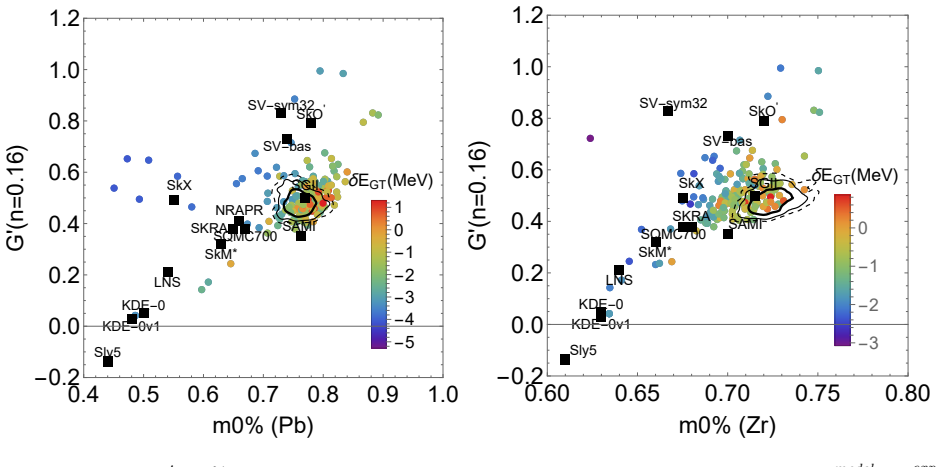
sam- pled from Bayesian posteriors, and compare it with existing Skyrme models. The correlation between G′ 0 and m0% is ob- served both in the existing Skyrme models (black squares) and in the posterior without constraints of EGT and m0% (col- ored scattering dots). The posterior (black contours) of GTAll shows the pinned-down area favored by GTR measurem...
-
[3]
The red dashed, green dashed, orange dashed, and black dashed curves are the posterior of G′ 0 extracted from Bayesian inferences with constraints of only 208Pb (GTPb), only 132Sn (GTSn), only 90Zr (GTZr), and noGT, respectively. The black solid curve represents the posterior of G′ 0 from a Bayesian inference including all the aforementioned GTR measureme...
-
[4]
For the first time, by apply- ing GTR constraints we significantly reduce the uncertainty of MBax due to variation of G′
-
[5]
The remaining uncertainty of MBax mainly comes from the variation of δU = Un − Up at sub-saturation densities and results in a wide spreading of MBax along the vertical axis. The neutron skin measurements [46, 50] applied in our Bayesian inference cannot tightly con- strain the symmetry energy and δU at sub-saturation densities. In the future, stronger co...
-
[6]
The GT spectra are calculated 4 NRAPR SGII SVmin Sly4 Sly5 SV - bas KDE - 0 KDE - 0v1 SAMI SkX SkM * SkO ' SV - sym32 LNS SKRA SQMC700 δ U ( MeV ) 10.0 12.5 15.0 17.5 20.0 22.5 - 0.2 0.0 0.2 0.4 0.6 0.8 1.0 0.6 0.8 1.0 1.2 1.4 1.6 1.8 G' ( n = 0.16 ) MB ax ( ν e , e ) NRAPR SGII SVmin Sly4 Sly5 SV - bas KDE - 0 KDE - 0v1 SAMI SkX SkM * SkO ' SV - sym32 LN...
-
[7]
The color represents the difference of nucleon potentials δU = Un − Up, which is another factor determining the many-body corrections. The νe(n, p)e− , ¯νe(p, n)e+ reactions and the δU examined here are calculated at n= 0.02 fm− 3, T = 10 MeV , incoming neutrino energyEν = 30 MeV and Ye = 0.05. using self-consistent Skyrme QRPA and the GT experiments are ...
-
[10]
A. Byelikov, T. Adachi, H. Fujita, K. Fujita, Y . Fu- jita, K. Hatanaka, A. Heger, Y . Kalmykov, K. Kawase, K. Langanke, et al., Phys. Rev. Lett. 98, 082501 (2007), 5 URL https://link.aps.org/doi/10.1103/ PhysRevLett.98.082501
work page 2007
-
[11]
R. G. T. Zegers (Springer Nature Singapore, Singapore, 2023), pp. 739–773, ISBN 978-981-19-6345-2, URL https:// doi.org/10.1007/978-981-19-6345-2_77
-
[12]
Neutrino Interactions in Hot and Dense Matter
S. Reddy, M. Prakash, and J. M. Lattimer, Phys. Rev. D 58, 013009 (1998), astro-ph/9710115
work page internal anchor Pith review Pith/arXiv arXiv 1998
-
[13]
The Effects of Correlations on Neutrino Opacities in Nuclear Matter
A. Burrows and R. F. Sawyer, Phys. Rev. C 58, 554 (1998), astro-ph/9801082
work page internal anchor Pith review Pith/arXiv arXiv 1998
- [15]
-
[16]
Y .-Z. Qian, W. C. Haxton, K. Langanke, and P . V ogel, Phys. Rev. C 55, 1532 (1997), URL https://link.aps.org/ doi/10.1103/PhysRevC.55.1532
-
[17]
Y . F. Niu, Z. M. Niu, G. Col `o, and E. Vigezzi, Phys. Rev. Lett. 114, 142501 (2015), URL https://link.aps.org/ doi/10.1103/PhysRevLett.114.142501
-
[18]
A. B. Migdal, E. E. Saperstein, M. A. Troitsky, and D. N. V oskresensky, Phys. Rept.192, 179 (1990)
work page 1990
- [19]
-
[20]
L. D. Landau, Zh. Eksp. Teor. Fiz. 30, 1058 (1956)
work page 1956
-
[21]
G. Bertsch, D. Cha, and H. Toki, Phys. Rev. C 24, 533 (1981), URL https://link.aps.org/doi/10.1103/ PhysRevC.24.533
work page 1981
- [22]
-
[23]
K. Nishida and M. Ichimura, Phys. Rev. C 51, 269 (1995), URL https://link.aps.org/doi/10.1103/ PhysRevC.51.269
work page 1995
- [24]
-
[27]
Spin-isospin nuclear response using the existing microscopic Skyrme functionals
S. Fracasso and G. Colo, Phys. Rev. C 76, 044307 (2007), 0704.2892
work page internal anchor Pith review Pith/arXiv arXiv 2007
-
[28]
S. Fracasso and G. Col `o, Phys. Rev. C 72, 064310 (2005), URL https://link.aps.org/doi/10.1103/ PhysRevC.72.064310
work page 2005
-
[29]
M. Al-Mamun, A. W. Steiner, J. N ¨attil¨a, J. Lange, R. O’Shaughnessy, I. Tews, S. Gandolfi, C. Heinke, and S. Han, Phys. Rev. Lett. 126, 061101 (2021), 2008.12817
-
[30]
S. Reddy, M. Prakash, J. M. Lattimer, and J. A. Pons, Phys. Rev. C 59, 2888 (1999), URL https://link.aps.org/ doi/10.1103/PhysRevC.59.2888
-
[31]
Y .-Z. Ma, Z. Lin, B.-N. Lu, S. Elhatisari, D. Lee, N. Li, U.-G. Meißner, A. W. Steiner, and Q. Wang, Phys. Rev. Lett. 132, 232502 (2024), URL https://link.aps.org/ doi/10.1103/PhysRevLett.132.232502
-
[32]
Z. Lin, A. W. Steiner, and J. Margueron, Phys. Rev. C 107, 015804 (2023), URL https://link.aps.org/ doi/10.1103/PhysRevC.107.015804
-
[35]
E. Chabanat, P . Bonche, P . Haensel, J. Meyer, and R. Schaeffer, Nucl. Phys. A 635, 231 (1998), [Erratum: Nucl.Phys.A 643, 441–441 (1998)]
work page 1998
-
[36]
P . Kl ¨upfel, P .-G. Reinhard, T. J. B ¨urvenich, and J. A. Maruhn, Phys. Rev. C 79, 034310 (2009), URL https://link. aps.org/doi/10.1103/PhysRevC.79.034310
-
[37]
B. K. Agrawal, S. Shlomo, and V . K. Au, Phys. Rev. C 72, 014310 (2005), URL https://link.aps.org/doi/ 10.1103/PhysRevC.72.014310
-
[39]
B. Alex Brown, Phys. Rev. C 58, 220 (1998), URL https:// link.aps.org/doi/10.1103/PhysRevC.58.220
- [40]
-
[41]
P .-G. Reinhard, D. J. Dean, W. Nazarewicz, J. Dobaczewski, J. A. Maruhn, and M. R. Strayer, Phys. Rev. C 60, 014316 (1999), URL https://link.aps.org/doi/10.1103/ PhysRevC.60.014316
work page 1999
- [42]
-
[43]
L. G. Cao, U. Lombardo, C. W. Shen, and N. V . Giai, Phys. Rev. C 73, 014313 (2006), URL https://link.aps.org/ doi/10.1103/PhysRevC.73.014313
-
[44]
A. W. Steiner, M. Prakash, J. M. Lattimer, and P . J. Ellis, Phys. Rept. 411, 325 (2005), nucl-th/0410066
work page internal anchor Pith review Pith/arXiv arXiv 2005
-
[45]
Rashdan, Modern Physics Letters A 15, 1287 (2000)
M. Rashdan, Modern Physics Letters A 15, 1287 (2000)
work page 2000
-
[46]
P . A. M. Guichon, H. H. Matevosyan, N. Sandulescu, and A. W. Thomas, Nucl. Phys. A 772, 1 (2006), nucl-th/0603044
work page internal anchor Pith review Pith/arXiv arXiv 2006
-
[47]
M. Kortelainen, T. Lesinski, J. Mor ´e, W. Nazarewicz, J. Sarich, N. Schunck, M. V . Stoitsov, and S. Wild, Phys. Rev. C 82, 024313 (2010), URL https://link.aps.org/doi/ 10.1103/PhysRevC.82.024313
-
[48]
Unified Analysis of Spin Isospin Responses of Nuclei
T. Wakasa, M. Ichimura, and H. Sakai, Phys. Rev. C 72, 067303 (2005), nucl-ex/0411055
work page internal anchor Pith review Pith/arXiv arXiv 2005
- [49]
-
[50]
J. Y asuda, M. Sasano, R. G. T. Zegers, H. Baba, D. Bazin, W. Chao, M. Dozono, N. Fukuda, N. In- abe, T. Isobe, et al., Phys. Rev. Lett. 121, 132501 (2018), URL https://link.aps.org/doi/10.1103/ PhysRevLett.121.132501
work page 2018
-
[51]
M. Wang, G. Audi, A. H. Wapstra, F. G. Kondev, M. Mac- Cormick, X. Xu, and B. Pfeiffer, Chin. Phys. C 36, 1603 (2012)
work page 2012
-
[54]
T. Wakasa, M. Okamoto, M. Dozono, K. Hatanaka, M. Ichimura, S. Kuroita, Y . Maeda, H. Miyasako, T. Noro, T. Saito, et al., Phys. Rev. C 85, 064606 (2012), URL https://link.aps.org/doi/10.1103/PhysRevC. 85.064606
-
[55]
H. Akimune, I. Daito, Y . Fujita, M. Fujiwara, M. B. Greenfield, M. N. Harakeh, T. Inomata, J. J¨anecke, K. Katori, S. Nakayama, et al., Phys. Rev. C 52, 604 (1995), URL https://link. aps.org/doi/10.1103/PhysRevC.52.604
-
[56]
T. Wakasa, H. Sakai, H. Okamura, H. Otsu, S. Fujita, S. Ishida, N. Sakamoto, T. Uesaka, Y . Satou, M. B. Greenfield, et al., Phys. Rev. C 55, 2909 (1997), URL https://link.aps. org/doi/10.1103/PhysRevC.55.2909
-
[58]
K. Y ako, M. Sasano, K. Miki, H. Sakai, M. Dozono, D. Frekers, M. B. Greenfield, K. Hatanaka, E. Ihara, M. Kato, et al., Phys. Rev. Lett. 103, 012503 (2009), URL https://link.aps. org/doi/10.1103/PhysRevLett.103.012503
- [59]
-
[60]
M. C. Miller et al., Astrophys. J. Lett. 887, L24 (2019), 1912.05705
work page internal anchor Pith review Pith/arXiv arXiv 2019
-
[61]
Y . F. Niu, G. Col `o, M. Brenna, P . F. Bortignon, and J. Meng, Phys. Rev. C 85, 034314 (2012), URL https://link. aps.org/doi/10.1103/PhysRevC.85.034314
-
[62]
BA YESIAN INFERENCE OF THE LANDAU PARAMETERG′ 0 FROM JOINT GAMOW-TELLER MEASUREMENTS
M. Dutra, O. Lourenc ¸o, J. S. S ´a Martins, A. Delfino, J. R. Stone, and P . D. Stevenson, Phys. Rev. C 85, 035201 (2012), URL https://link.aps.org/doi/10.1103/ PhysRevC.85.035201. 7 SUPPLEMENTAL MATERIAL FOR “BA YESIAN INFERENCE OF THE LANDAU PARAMETERG′ 0 FROM JOINT GAMOW-TELLER MEASUREMENTS” A. Definition of Landau parameters We assume we have a spin-is...
work page 2012
-
[63]
the spin-orbit splitting values of 48Ca and 90Zr are strongly correlated; 6) the ground state properties (e.g. binding energy, charge radii) of heavy nuclei are strongly correlated; 7) the ground state properties of light nuclei are strongly correlated; 7) the ground state properties of heavy nuclei are correlated with those of light nuclei, but with less...
-
[64]
These correlations are subtle and more obvious in simulations with joint GTR constraints. More studies are needed to confirm these correlations. E. Many-body correction on neutrino-nucleon reactions Here, we introduce the basic formulas for calculating the many-body correction on charged current neutrino-nucleon reactions based on RPA. Based on linear resp...
-
[65]
Gamow-Teller strength and the spin-isospin coupling constants of the Skyrme energy functional
M. Bender, J. Dobaczewski, J. Engel, and W. Nazarewicz, Phys. Rev. C 65, 054322 (2002), nucl-th/0112056
work page internal anchor Pith review Pith/arXiv arXiv 2002
-
[66]
I. S. Towner, Phys. Rept. 155, 263 (1987)
work page 1987
- [67]
-
[68]
Neutrino Capture Reactions on $^{40}$Ar
T. Suzuki and M. Honma, Phys. Rev. C 87, 014607 (2013), 1211.4078
work page internal anchor Pith review Pith/arXiv arXiv 2013
-
[69]
M. Zalewski, J. Dobaczewski, W. Satula, and T. R. Werner, Phys. Rev. C 77, 024316 (2008), 0801.0924
work page internal anchor Pith review Pith/arXiv arXiv 2008
-
[70]
M. Wang, G. Audi, A. H. Wapstra, F. G. Kondev, M. MacCormick, X. Xu, and B. Pfeiffer, Chin. Phys. C 36, 1603 (2012)
work page 2012
-
[71]
I. Angeli and K. P . Marinova, Atom. Data Nucl. Data Tabl. 99, 69 (2013)
work page 2013
-
[72]
Precision Determination of the Neutral Weak Form Factor of Ca48,
D. Adhikari et al. (CREX), Phys. Rev. Lett. 129, 042501 (2022), 2205.11593
-
[73]
D. Adhikari et al. (PREX), Phys. Rev. Lett. 126, 172502 (2021), 2102.10767
-
[74]
E. S. Hernandez, J. Navarro, and A. Polls, Nucl. Phys. A 658, 327 (1999)
work page 1999
-
[75]
Z. Lin, A. W. Steiner, and J. Margueron, Phys. Rev. C 107, 015804 (2023), URL https://link.aps.org/doi/10.1103/ PhysRevC.107.015804
work page 2023
-
[76]
Effects of spin-orbit interaction on nuclear response and neutrino mean free path
J. Margueron, J. Navarro, and N. V an Giai, Phys. Rev. C 74, 015805 (2006), nucl-th/0604019
work page internal anchor Pith review Pith/arXiv arXiv 2006
- [77]
-
[78]
A new Skyrme interaction with improved spin-isospin properties
X. Roca-Maza, G. Colo, and H. Sagawa, Phys. Rev. C 86, 031306 (2012), 1205.3958
work page internal anchor Pith review Pith/arXiv arXiv 2012
- [79]
discussion (0)
Sign in with ORCID, Apple, or X to comment. Anyone can read and Pith papers without signing in.