REVIEW 4 major objections 7 minor 71 references
Three-dimensional Deep Shape Optimization with a Limited Dataset
T0 review · 4 major / 7 minor · reviewed 2026-08-07 · deepseek-v4-flash
Pith's one-line read The paper claims that a latent space learned from as few as two 3D shapes can serve as a design-variable space for multi-objective shape optimization, producing Pareto-optimal designs that outperform the training data.
desk verdict The two-shape result is likely just interpolation along a one-dimensional latent curve; the cross-dataset 30-sample experiment is the real contribution, but the paper needs baselines and ablations before I'd trust it. read the letter →
The pith
A machine-rendered reading of the paper's core claim, the machinery that carries it, and where it could break.
The reading
What carries the argument
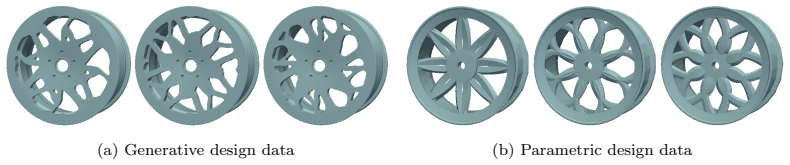
The central object is a signed distance function (SDF) implicit neural representation with an auto-decoder structure: the decoder $f(x,z)$ takes spatial coordinates $x$ and a latent code $z$ and returns the signed distance to the surface. Positional encoding projects coordinates into Fourier features so the network can represent high-frequency geometry such as wheel rims. Lipschitz regularization normalizes each layer's weight matrix by a trainable bound and penalizes the product of bounds, keeping the latent space smooth and stable under sparse data. A truncated L1 loss focuses learning on the near-surface region, and after training the frozen decoder is paired with a multi-objective genetic algorithm, which applies crossover and mutation to latent codes and evaluates decoded shapes by FEM or CFD simulation.
What would settle it
Train the two-shape car or wheel model, then decode a dense line of latent codes between the two training codes and check every decoded mesh for watertightness and every CFD or FEM result for smooth, monotone trends. If intermediate meshes develop holes, self-intersections, or non-smooth jumps in drag, lift, stiffness, or mass, the central claim of a meaningful smooth latent space would be refuted.
Extended reading notes
Core claim
The central claim is that latent codes learned from extremely few examples are smooth enough to support engineering optimization. The paper presents this as an automatic feature selector: instead of hand-parameterizing a CAD model, the decoder's latent vector becomes the design variable, and because the latent space is continuous, genetic search can move through it to create shapes that were never in the training set. In the most extreme experiment, the model is trained on two wheel designs or two car designs, and optimization still establishes a coherent Pareto front, generating engineering-relevant variations that appear as smooth adjustments of stiffness, mass, drag, and lift. Against 30 training examples, the optimized candidates are reported to outperform the training data on the chosen objectives.
Load-bearing premise
The load-bearing premise is that a latent space built from only two to thirty shapes, with Lipschitz smoothing, is genuinely smooth and meaningful, so that nearby latent codes decode into physically plausible intermediate shapes rather than meaningless or infeasible geometry.
Editorial extensions
If this is right
- Shape optimization no longer needs an explicit parametric CAD model; the learned latent space supplies the design variables automatically.
- Distinct datasets generated by different methods can be fused into one optimization because the latent space, not the parameterization, is shared.
- With 30 training shapes, optimized candidates can dominate the training data on stiffness-versus-mass and drag-versus-lift Pareto fronts.
- With only two training shapes, the genetic search still yields a coherent Pareto front and visually plausible intermediate geometry.
- The same framework carries over from structural analysis to aerodynamic analysis, suggesting the mechanism is not tied to one simulation type.
Reading between the lines
- If the smooth-latent claim holds, the framework should transfer to other sparse-data design families such as airfoils, brackets, or metamaterials with no architectural change; the paper tests only wheels and cars.
- The two-sample result is a strong prior, not a proof: the paper does not measure latent-space smoothness directly, so an obvious next step is to sample latent paths and check whether decoded shapes stay watertight and physically simulatable.
- The authors' own conclusion implies that which two shapes are chosen matters; a testable extension is active selection of a third training shape and measuring how much of the achievable Pareto front widens.
- Because only two-objective problems are demonstrated, a natural stress test is adding a third objective or an explicit constraint; crowding-distance search in a low-dimensional latent space may behave differently there.
Signed reviews
Editorial analysis
A structured set of objections, weighed in public.
Referee Report
Summary. The paper proposes a data-driven 3D shape optimization framework intended for small datasets, based on an implicit neural representation (auto-decoder) trained with positional encoding and a Lipschitz regularization loss, followed by NSGA-II search in the latent space. It evaluates the approach on wheel stiffness/mass optimization and car aerodynamic (drag and lift coefficient) optimization with 30 training samples, and on an 'extremely limited' setting with only two training samples using a one-dimensional latent space. The paper also compares auto-decoder and encoder-decoder architectures on reconstruction metrics (CD, MMD, COV).
Significance. If the framework truly enables reliable multi-objective shape optimization from very small datasets, it would be a useful contribution to engineering design, where labeled 3D data are scarce. The manuscript demonstrates a plausible pipeline and provides an architectural comparison, and the authors are to be credited for explicitly acknowledging in Section 5 that CD/MMD/COV values alone do not guarantee a meaningful latent representation in the small-data regime. However, the central claims currently rest on experiments that do not separate a learned latent space from straightforward interpolation, and no code or data are released, so reproducibility cannot be independently assessed. The paper is potentially valuable but needs stronger validation before the claims are supported.
major comments (4)
- [Section 4.3, Table 4] The two-sample experiments use latent dimension 1, so the decoder defines a one-parameter family between the two training shapes. The reported Pareto fronts (Figs. 10a-10d) and smooth interpolation (Fig. 10c) are therefore consistent with a trivial baseline that directly interpolates the two training shapes (e.g., blending SDFs or morphing meshes) and evaluates the same FEM/CFD objectives. Without such a baseline, the claimed effectiveness of the framework with two training examples is not established. The authors' own admission in Section 5 that CD/MMD/COV alone do not guarantee a meaningful latent representation further weakens the interpretation of this experiment.
- [Section 3, Eq. (6)] The Lipschitz regularization term is weighted at wAD = 1e-7, but the paper does not report an ablation with wAD = 0, nor does it measure the actual Lipschitz constant of the trained network. Since the paper attributes the meaningful latent space to this regularization, the causal claim is unsupported. A simple ablation and a measurement of the Lipschitz bound (or at least a sensitivity study of wAD) are needed to establish that this term is the enabler of the reported behavior.
- [Sections 4.1-4.3, Figs. 7a and 9a] All Pareto-front results are shown as single runs without error bars, multiple seeds, or comparison to baseline algorithms (e.g., NSGA-II on a parametric mesh-morphing formulation, or latent-space search without the proposed regularization). Consequently, the statement in Section 5 (item 2) that the generated designs 'outperform the performance of the actual data' cannot be quantitatively assessed. Reporting the distribution of objective values over independent repetitions, or at least the number of runs performed, is necessary to support the empirical claims.
- [Section 5] The authors acknowledge that CD, MMD, and COV 'do not guarantee that a generative model has learned a meaningful latent representation.' This self-acknowledged limitation applies directly to the headline two-sample result and to the AD-versus-ED comparison in Table 3, because these metrics were designed for large datasets. The paper should either adopt metrics appropriate for small data or validate the latent space with task-specific checks, such as physical feasibility of intermediate shapes, sensitivity analysis, or comparison to direct interpolation, as noted above.
minor comments (7)
- [Eq. (4)] The displayed formula for lossLipschitz is malformed; it should be a product over layers, e.g., the product of ln(1 + exp(k_i)) for all layers i. Please fix the notation.
- [Eq. (2)] The positional encoding formula appears to use 2^0 and 2^(L-1) but is typeset as 20πp and 2L-1πp; please correct the exponents and add the missing parentheses.
- [Throughout] The acronym is written inconsistently as 'NSGA-2' and 'NSGA-II'; please unify.
- [Table 6] The title 'Reconstruction results for 2 data' should be rephrased as 'Reconstruction results for two shapes' or '...for a two-sample dataset.'
- [Section 4.1] The stiffness measure is obtained from the 11th natural frequency in a free-free modal analysis; the assumption that this mode is the lateral spoke mode should be justified or visualized in Fig. 6, since this directly affects the objective function.
- [Section 3.1] Training hyperparameters such as optimizer type, learning rate, batch size, and latent-code initialization are not reported; providing these would improve reproducibility.
- [Section 4.2] The CFD setup is described only briefly; please specify the boundary conditions, mesh resolution, turbulence model, and OpenFOAM solver settings, as these determine the reliability of the quantitative claims.
Circularity Check
No significant circularity: the optimization objectives are external FEM/CFD simulations, and the latent-space search is not used to define those objectives; self-citations supply data provenance but not load-bearing uniqueness claims.
full rationale
I traced the derivation chain from training (Section 3) through optimization (Sections 4.1-4.3). The model fits a decoder and latent codes to SDF training data; the multi-objective optimizations then evaluate generated shapes with external simulators (Altair Inspire modal analysis and OpenFOAM CFD). The objectives (stiffness, mass, CD, CL) are not fitted parameters or outputs of the decoder, so the Pareto fronts are not tautological. The two-sample experiment (Section 4.3, Table 4) is explicitly framed as exploring shapes between two training examples with latent dimension 1; this is interpolation by design, and the paper's Section 5 admits that 'limited data imposes inherent interpolation constraints' and that CD/MMD/COV 'do not guarantee that a generative model has learned a meaningful latent representation.' That is an evidentiary limitation and a missing baseline (no direct SDF/mesh morphing comparison), but not a case where the claimed prediction equals its input by the paper's equations. Self-citations [19,59] are data sources and related-work context; no load-bearing uniqueness theorem is imported. Thus I find no concrete circular step warranting a score above 2.
Assumptions & free parameters
free parameters (5)
- truncation threshold delta =
0.1
- KL weight beta =
0.01
- Lipschitz loss weights w_AD and w_ED =
1e-7 (AD), 1e-5 (ED)
- latent dimension =
5 (30 data), 1 (2 data)
- Lipschitz bounds k_i =
trainable per layer
assumptions (4)
- domain assumption The 11th mode natural frequency is a valid stiffness proxy for wheel designs.
- domain assumption The CFD setup (incompressible RANS, SimpleFoam, 10 m/s airflow) is accurate enough for car aerodynamic optimization.
- domain assumption A 5-dimensional latent space captures the essential shape variations of the 30-wheel and 30-car datasets.
- ad hoc to paper The Lipschitz regularization term ensures a smooth, meaningful latent space for optimization.
Cite this review
Pith. "Pith review of Three-dimensional Deep Shape Optimization with a Limited Dataset." pith.science (2026). https://pith.science/paper/SNH2R72W
@misc{pith2026250612326,
  author       = {Pith},
  title        = {Pith review of: Three-dimensional Deep Shape Optimization with a Limited Dataset},
  year         = {2026},
  howpublished = {\url{https://pith.science/paper/SNH2R72W}},
  note         = {Machine review of arXiv:2506.12326}
}
read the original abstract
Generative models have attracted considerable attention for their ability to produce novel shapes. However, their application in mechanical design remains constrained due to the limited size and variability of available datasets. This study proposes a deep learning-based optimization framework specifically tailored for shape optimization with limited datasets, leveraging positional encoding and a Lipschitz regularization term to robustly learn geometric characteristics and maintain a meaningful latent space. Through extensive experiments, the proposed approach demonstrates robustness, generalizability and effectiveness in addressing typical limitations of conventional optimization frameworks. The validity of the methodology is confirmed through multi-objective shape optimization experiments conducted on diverse three-dimensional datasets, including wheels and cars, highlighting the model's versatility in producing practical and high-quality design outcomes even under data-constrained conditions.
Figures


Figures from the paper (8 more)



Reference graph
Works this paper leans on
-
[1]
Regenwetter, A
L. Regenwetter, A. H. Nobari, F. Ahmed, Deep generative models in engineering design: A review, Journal of Mechanical Design 144 (7) (2022) 071704
2022
-
[2]
H. Xu, X. Zou, L. H. Sneed, A two-stage classification-regression method for prediction of flexural strength of fiber reinforced polymer strength- ened reinforced concrete beams, Engineering Applications of Artificial Intelligence 145 (2025) 110164
work page 2025
-
[3]
J. Li, X. Du, J. R. Martins, Machine learning in aerodynamic shape optimization, Progress in Aerospace Sciences 134 (2022) 100849
work page 2022
-
[4]
J. Munoz-Paniagua, J. Garc ´ ıa, Aerodynamic drag optimization of a high-speed train, Journal of Wind Engineering and Industrial Aerody- namics 204 (2020) 104215
work page 2020
-
[5]
K. Belhadj, A. Helali, N. Ben Guedria, C. Bouraoui, Optimization of dif- fuser angle to reduce the drag of a light car, in: Advances in Mechanical Engineering and Mechanics II: Selected Papers from the 5th Tunisian Congress on Mechanics, CoTuMe 2021, March 22–24, 2021, Springer, 2022, pp. 425–432
work page 2021
-
[6]
J. Li, J. Cai, K. Qu, Surrogate-based aerodynamic shape optimization with the active subspace method, Structural and Multidisciplinary Op- timization 59 (2) (2019) 403–419. 26
work page 2019
-
[7]
S. Kim, M. Jwa, S. Lee, S. Park, N. Kang, Deep learning-based inverse design for engineering systems: multidisciplinary design optimization of automotive brakes, Structural and Multidisciplinary Optimization 65 (11) (2022) 323
work page 2022
-
[8]
N. S. Akbar, T. Zamir, J. Akram, T. Noor, T. Muhammad, Simulation of hybrid boiling nano fluid flow with convective boundary conditions through a porous stretching sheet through levenberg marquardt artifi- cial neural networks approach, International Journal of Heat and Mass Transfer 228 (2024) 125615
work page 2024
Show all 71 references
-
[9]
N. S. Akbar, T. Zamir, T. Noor, T. Muhammad, M. R. Ali, Heat trans- fer enhancement using ternary hybrid nanofluid for cross-viscosity model with intelligent levenberg-marquardt neural networks approach incor- porating entropy generation, Case Studies in Thermal Engineering 63...
2024
-
[10]
Alghamdi, N
M. Alghamdi, N. S. Akbar, T. Zamir, T. Muhammad, Double layered combined convective heated flow of eyring-powell fluid across an elevated stretched cylinder using intelligent computing approach, Case Studies in Thermal Engineering 54 (2024) 104009
2024
-
[11]
N. S. Akbar, T. Zamir, S. Bilal, T. Muhammad, Computational study with neural networks to double diffusion in prandtl thermal nanofluid flow adjacent to a stretching surface design with numerical treat- ment, Proceedings of the Institution of Mechanical Engineers, Part N: Jour...
2024
-
[12]
Goodfellow, J
I. Goodfellow, J. Pouget-Abadie, M. Mirza, B. Xu, D. Warde-Farley, S. Ozair, A. Courville, Y. Bengio, Generative adversarial nets, Advances in Neural Information Processing Systems (NeurIPS) 27 (2014)
2014
-
[13]
D. P. Kingma, M. Welling, Auto-encoding variational bayes, arXiv preprint arXiv:1312.6114 (2013)
2013 arXiv
-
[14]
J. Ho, A. Jain, P. Abbeel, Denoising diffusion probabilistic models, Ad- vances in Neural Information Processing Systems (NeurIPS) 33 (2020) 6840–6851. 27
2020
-
[15]
K. Deb, A. Pratap, S. Agarwal, T. Meyarivan, A fast and elitist multi- objective genetic algorithm: Nsga-ii, IEEE transactions on evolutionary computation 6 (2) (2002) 182–197
2002
-
[16]
J. D. Cunningham, D. Shu, T. W. Simpson, C. S. Tucker, A sparsity preserving genetic algorithm for extracting diverse functional 3d designs from deep generative neural networks, Design Science 6 (2020) e11
2020
-
[17]
S. Hong, Y. Kwon, D. Shin, J. Park, N. Kang, Deepjeb: 3d deep learning-based synthetic jet engine bracket dataset, Journal of Mechan- ical Design 147 (4) (2025)
2025
-
[18]
Li, C.-K
K.-Y. Li, C.-K. Huang, Q.-W. Chen, H.-C. Zhang, T.-T. Tang, Genera- tive ai and cad automation for diverse and novel mechanical component designs under data constraints, Discover Applied Sciences 7 (4) (2025) 1–21
2025
-
[19]
S. Oh, Y. Jung, S. Kim, I. Lee, N. Kang, Deep generative design: In- tegration of topology optimization and generative models, Journal of Mechanical Design 141 (11) (2019) 111405
2019
-
[20]
Lee, Y.-C
D. Lee, Y.-C. Chan, W. Chen, L. Wang, A. van Beek, W. Chen, t-metaset: Task-aware acquisition of metamaterial datasets through diversity-based active learning, Journal of Mechanical Design 145 (3) (2023) 031704
2023
-
[21]
Harries, C
S. Harries, C. Abt, M. Brenner, Upfront cad—parametric modeling tech- niques for shape optimization, Advances in Evolutionary and Determin- istic Methods for Design, Optimization and Control in Engineering and Sciences 48 (2018) 191–211
2018
-
[22]
Agarwal, T
D. Agarwal, T. T. Robinson, C. G. Armstrong, C. Kapellos, Enhancing cad-based shape optimisation by automatically updating the cad model’s parameterisation, Structural and Multidisciplinary Optimization 59 (5) (2019) 1639–1654
2019
-
[23]
T. T. Robinson, C. G. Armstrong, H. S. Chua, C. Othmer, T. Grahs, Optimizing parameterized cad geometries using sensitivities based on adjoint functions, Computer-Aided Design and Applications 9 (3) (2012) 253–268. 28
2012
-
[24]
C. Lu, L. Chen, J. Luo, H. Chen, Acoustic shape optimization based on isogeometric boundary element method with subdivision surfaces, Engineering Analysis with Boundary Elements 146 (2023) 951–965
2023
-
[25]
L. Chen, Z. Wang, H. Lian, Y. Ma, Z. Meng, P. Li, C. Ding, S. P. Bordas, Reduced order isogeometric boundary element methods for cad- integrated shape optimization in electromagnetic scattering, Computer Methods in Applied Mechanics and Engineering 419 (2024) 116654
2024
-
[26]
L. F. F. Miguel, L. F. F. Miguel, Shape and size optimization of truss structures considering dynamic constraints through modern metaheuris- tic algorithms, Expert Systems with Applications 39 (10) (2012) 9458– 9467
2012
-
[27]
N. J. Bagazinski, F. Ahmed, Ship-d: Ship hull dataset for design optimization using machine learning, arXiv preprint arXiv:2305.08279 (2023)
2023 arXiv
-
[28]
Umetani, B
N. Umetani, B. Bickel, Learning three-dimensional flow for interac- tive aerodynamic design, ACM Transactions on Graphics (TOG) 37 (4) (2018) 1–10
2018
-
[29]
Salmoiraghi, A
F. Salmoiraghi, A. Scardigli, H. Telib, G. Rozza, Free-form deformation, mesh morphing and reduced-order methods: enablers for efficient aero- dynamic shape optimisation, International Journal of Computational Fluid Dynamics 32 (4-5) (2018) 233–247
2018
-
[30]
Gomez, M
M. Gomez, M. C. Galbraith, Analysis driven shape design using free- form deformation of parametric cad geometry, in: AIAA SCITECH 2024 Forum, 2024, p. 1317
2024
-
[31]
Gagnon, D
H. Gagnon, D. Zingg, Two-level free-form deformation for high-fidelity aerodynamic shape optimization, in: 12th AIAA Aviation Technology, Integration, and Operations (ATIO) Conference and 14th AIAA/ISSMO Multidisciplinary Analysis and Optimization Conference, 2012, p. 5447
2012
-
[32]
Baque, E
P. Baque, E. Remelli, F. Fleuret, P. Fua, Geodesic convolutional shape optimization, in: International Conference on Machine Learning (ICML), PMLR, 2018, pp. 472–481. 29
2018
-
[33]
M. P. Bendsøe, Optimal shape design as a material distribution problem, Structural optimization 1 (1989) 193–202
1989
-
[34]
M. P. Bendsøe, O. Sigmund, Material interpolation schemes in topology optimization, Archive of applied mechanics 69 (1999) 635–654
1999
-
[35]
Sigmund, K
O. Sigmund, K. Maute, Topology optimization approaches: A compara- tive review, Structural and Multidisciplinary Optimization 48 (6) (2013) 1031–1055
2013
-
[36]
K. Liu, A. Tovar, An efficient 3d topology optimization code written in matlab, Structural and Multidisciplinary Optimization 50 (6) (2014) 1175–1196
2014
-
[37]
H. Deng, P. S. Vulimiri, A. C. To, An efficient 146-line 3d sensitivity analysis code of stress-based topology optimization written in matlab, Optimization and Engineering 23 (2021) 1733–1757
2021
-
[38]
McKnight, Generative design: What it is? how is it being used? why it’s a game changer, KnE engineering 2 (2) (2017) 176–181
M. McKnight, Generative design: What it is? how is it being used? why it’s a game changer, KnE engineering 2 (2) (2017) 176–181
2017
-
[39]
H. Na, W. Kim, A study on the practical use of generative design in the product design process, Arch. Des. Res 34 (1) (2021) 85–99
2021
-
[40]
S. Jang, S. Yoo, N. Kang, Generative design by reinforcement learning: enhancing the diversity of topology optimization designs, Computer- Aided Design 146 (2022) 103225
2022
-
[41]
S. Shin, D. Shin, N. Kang, Topology optimization via machine learning and deep learning: A review, Journal of Computational Design and Engineering 10 (4) (2023) 1736–1766
2023
-
[42]
Matejka, M
J. Matejka, M. Glueck, E. Bradner, A. Hashemi, T. Grossman, G. Fitz- maurice, Dream lens: Exploration and visualization of large-scale gen- erative design datasets, in: Proceedings of the 2018 CHI conference on human factors in computing systems, 2018, pp. 1–12
2018
-
[43]
D. Yang, J. Lee, Multi-labeled image data-based generative topology optimization of primary mirror with conditional designable generative adversarial network and reinforcement learning, Engineering Applica- tions of Artificial Intelligence 133 (2024) 108642. 30
2024
-
[44]
J. Kou, L. Botero-Bol ´ ıvar, R. Ballano, O. Marino, L. De Santana, E. Valero, E. Ferrer, Aeroacoustic airfoil shape optimization enhanced by autoencoders, Expert Systems with Applications 217 (2023) 119513
2023
-
[45]
W. Chen, K. Chiu, M. D. Fuge, Airfoil design parameterization and optimization using b´ ezier generative adversarial networks, AIAA journal 58 (11) (2020) 4723–4735
2020
-
[46]
M. S. Selig, Uiuc airfoil data site (1996)
1996
-
[47]
H. I. On, L. Jeong, T. M. Seo, Y. Jo, W. Choi, D. J. Kang, J. H. Park, H.-J. Lee, Novel method of performance-optimized metastructure design for electromagnetic wave absorption in specific band using deep learning, Engineering Applications of Artificial Intelligence 137 (2024) 109274
2024
-
[48]
J. J. Park, P. Florence, J. Straub, R. Newcombe, S. Lovegrove, Deepsdf: Learning continuous signed distance functions for shape representation, in: Proceedings of the IEEE/CVF conference on Computer Vision and Pattern Recognition (CVPR), 2019, pp. 165–174
2019
-
[49]
Remelli, A
E. Remelli, A. Lukoianov, S. Richter, B. Guillard, T. Bagautdinov, P. Baque, P. Fua, Meshsdf: Differentiable iso-surface extraction, Ad- vances in Neural Information Processing Systems (NeurIPS) 33 (2020) 22468–22478
2020
-
[50]
Rosset, G
N. Rosset, G. Cordonnier, R. Duvigneau, A. Bousseau, Interactive de- sign of 2d car profiles with aerodynamic feedback, in: Computer Graph- ics Forum, Vol. 42, Wiley Online Library, 2023, pp. 427–437
2023
-
[51]
Maturana, S
D. Maturana, S. Scherer, Voxnet: A 3d convolutional neural network for real-time object recognition, in: 2015 IEEE/RSJ International Confer- ence on Intelligent Robots and Systems (IROS), IEEE, 2015, pp. 922– 928
2015
-
[52]
C. R. Qi, H. Su, K. Mo, L. J. Guibas, Pointnet: Deep learning on point sets for 3d classification and segmentation, in: Proceedings of the IEEE conference on Computer Vision and Pattern Recognition (CVPR), 2017, pp. 652–660
2017
-
[53]
Huang, X
Q. Huang, X. Huang, B. Sun, Z. Zhang, J. Jiang, C. Bajaj, Arapreg: An as-rigid-as possible regularization loss for learning deformable shape 31 generators, in: Proceedings of the IEEE/CVF International Conference on Computer Vision (ICCV), 2021, pp. 5815–5825
2021
-
[54]
W. E. Lorensen, H. E. Cline, Marching cubes: A high resolution 3d surface construction algorithm, ACM SIGGRAPH Computer Graphics 21 (4) (1987) 163–169
1987
-
[55]
Z. Hao, H. Averbuch-Elor, N. Snavely, S. Belongie, Dualsdf: Semantic shape manipulation using a two-level representation, in: Proceedings of the IEEE/CVF Conference on Computer Vision and Pattern Recogni- tion (CVPR), 2020, pp. 7631–7641
2020
-
[56]
J. Mu, W. Qiu, A. Kortylewski, A. Yuille, N. Vasconcelos, X. Wang, A-sdf: Learning disentangled signed distance functions for articulated shape representation, in: Proceedings of the IEEE/CVF International Conference on Computer Vision (ICCV), 2021, pp. 13001–13011
2021
-
[57]
S. Peng, M. Niemeyer, L. Mescheder, M. Pollefeys, A. Geiger, Convo- lutional occupancy networks, in: Computer Vision–ECCV 2020: 16th European Conference, Glasgow, UK, August 23–28, 2020, Proceedings, Part III 16, Springer, 2020, pp. 523–540
2020
-
[58]
A. X. Chang, T. Funkhouser, L. Guibas, P. Hanrahan, Q. Huang, Z. Li, S. Savarese, M. Savva, S. Song, H. Su, et al., Shapenet: An information- rich 3d model repository, arXiv preprint arXiv:1512.03012 (2015)
2015 arXiv
-
[59]
S. Yoo, S. Lee, S. Kim, K. H. Hwang, J. H. Park, N. Kang, Integrating deep learning into cad/cae system: generative design and evaluation of 3d conceptual wheel, Structural and Multidisciplinary Optimization 64 (4) (2021) 2725–2747
2021
-
[60]
Huang, H
J. Huang, H. Su, L. Guibas, Robust watertight manifold surface gen- eration method for shapenet models, arXiv preprint arXiv:1802.01698 (2018)
2018 arXiv
-
[61]
J. H. Holland, Adaptation in natural and artificial systems: an intro- ductory analysis with applications to biology, control, and artificial in- telligence, MIT press, 1992
1992
-
[62]
URL https://altair.com/inspire/ 32
Altair Engineering, Accelerate Simulation-driven Design (2024). URL https://altair.com/inspire/ 32
2024
-
[63]
Jasak, A
H. Jasak, A. Jemcov, Z. Tukovic, et al., Openfoam: A c++ library for complex physics simulations, in: International workshop on coupled methods in numerical dynamics, Vol. 1000, 2007, pp. 1–20
2007
-
[64]
Mildenhall, P
B. Mildenhall, P. P. Srinivasan, M. Tancik, J. T. Barron, R. Ramamoor- thi, R. Ng, Nerf: Representing scenes as neural radiance fields for view synthesis, Communications of the ACM 65 (1) (2021) 99–106
2021
-
[65]
Sitzmann, J
V. Sitzmann, J. Martel, A. Bergman, D. Lindell, G. Wetzstein, Implicit neural representations with periodic activation functions, Advances in Neural Information Processing Systems (NeurIPS) 33 (2020) 7462–7473
2020
-
[66]
H.-T. D. Liu, F. Williams, A. Jacobson, S. Fidler, O. Litany, Learn- ing smooth neural functions via lipschitz regularization, in: ACM SIG- GRAPH 2022 Conference Proceedings, 2022, pp. 1–13
2022
-
[67]
G. Yang, X. Huang, Z. Hao, M.-Y. Liu, S. Belongie, B. Hariharan, Point- flow: 3d point cloud generation with continuous normalizing flows, in: Proceedings of the IEEE/CVF International Conference on Computer Vision (ICCV), 2019, pp. 4541–4550
2019
-
[68]
Higgins, L
I. Higgins, L. Matthey, A. Pal, C. Burgess, X. Glorot, M. Botvinick, S. Mohamed, A. Lerchner, beta-vae: Learning basic visual concepts with a constrained variational framework, in: International conference on learning representations (ICLR), 2017
2017
-
[69]
W. Chen, F. Ahmed, Padgan: Learning to generate high-quality novel designs, Journal of Mechanical Design 143 (3) (2021) 031703
2021
-
[70]
Regenwetter, F
L. Regenwetter, F. Ahmed, Towards goal, feasibility, and diversity-oriented deep generative models in design, arXiv preprint arXiv:2206.07170 (2022)
2022 arXiv
-
[71]
Y. Jeon, M. K. Hong, Y.-Y. Chen, K. Murakami, J. Q. Li, X. A. Chen, M. Klenk, Weaving ml with human aesthetic assessments to augment design space exploration: An automotive wheel design case study, in: Extended Abstracts of the CHI Conference on Human Factors in Com- puting Sy...
2024
Reviewed August 7, 2026 · model on record in the stance chip above.
Discussion (0). Continue with ORCID to comment.