REVIEW 5 major objections 5 minor 41 references
Knowledge Graph Fusion with Large Language Models for Accurate, Explainable Manufacturing Process Planning
T0 review · 5 major / 5 minor · reviewed 2026-08-07 · deepseek-v4-flash
Pith's one-line read Small 3B LLM plus knowledge graph matches GPT-4o on CNC planning
desk verdict A sensible RAG-over-KG engineering demo undercut by a self-referential benchmark; the headline numbers are uninterpretable until the evaluation is redone with independent ground truth. read the letter →
The pith
A machine-rendered reading of the paper's core claim, the machinery that carries it, and where it could break.
The reading
What carries the argument
The load-bearing object is the augmented triple, written as $\langle s, r, (v, c)\rangle$, in which every relationship carries its original verbatim context string $c$; this preserves the provenance that plain subject-predicate-object triples lose. Retrieval is a two-stage mechanism: cosine-similarity ranking of embedded triples gives a top-$K$ candidate pool, and a beam search with depth $d_{\max}$ and beam width $b$ expands outward from those candidates to adjacent triples sharing a node, so quantitative questions can pull in supporting facts that a flat top-$K$ search would miss. The final prompt concatenates system instructions, the retrieved triple-and-context set, and the query, conditioning whatever LLM is plugged into the pipeline. The mechanism is model-agnostic: the paper's experiments vary the LLM from 3B to 8B open-weight models up to large cloud models and hold the graph and retriever fixed.
What would settle it
Give the ARKNESS pipeline a held-out set of CNC parameter questions whose answers are verified by independent machinists and whose source text is excluded from the knowledge graph corpus; if the augmented 3B model then fails to match GPT-4o accuracy or cites triples that do not support its numeric answer, the central claim is refuted.
Extended reading notes
Core claim
The paper's central claim is that a retrieval-augmented generation pipeline built on an automatically constructed, multi-relational machining knowledge graph can make a small open-weight LLM numerically reliable and explainable enough for CNC process planning. The knowledge graph is built zero-shot: a large model reads each paragraph of heterogeneous machining documents, G-code annotations, and vendor datasheets, and emits augmented triples of the form (entity, relation, object, context), where the context is the verbatim sentence the relation came from. At query time the question is embedded, the top-K triples are selected by cosine similarity, and a beam search expands to neighboring triples so the model receives the minimal evidence-linked subgraph rather than just scattered facts. The paper reports that this grounding lifts open-source models across the board, with the largest gains on quantitative machining questions, and that a lightweight 3B Llama answers multiple-choice and open-ended questions at GPT-4o-level accuracy while reducing numeric hallucination by 22 percentage points.
Load-bearing premise
The load-bearing premise is that the 155-question benchmark's ground-truth answers are correct and representative, because the same model family that built the knowledge graph also wrote the test questions and no independent expert validation or public release of the test set is provided.
Editorial extensions
If this is right
- A private, on-premise 3B-parameter assistant could answer tool-sizing and feed-speed questions with numeric exactness and traceable evidence, removing the data-sovereignty barrier to shop-floor LLM use.
- Numeric hallucination, not reasoning ability, appears to be the main bottleneck for technical LLM answers; supplying verbatim context from a knowledge graph can suppress it more than model scale alone does.
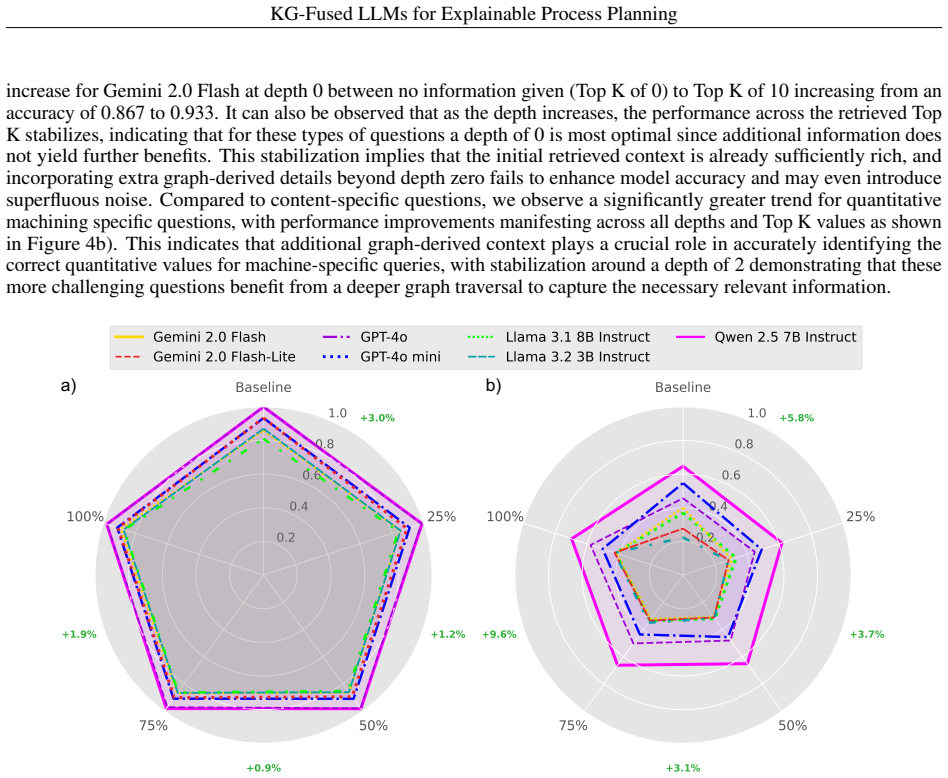
- Deeper graph traversal helps quantitative questions, while shallow retrieval suffices for content questions, so retrieval depth can be tuned to question type.
- Knowledge graph construction for a new manufacturing domain can start from raw documents without manual labeling or ontology engineering.
- Smaller models benefit disproportionately from the graph, suggesting cost-efficient deployment where the graph, not the model, carries the domain expertise.
Reading between the lines
- The same document-to-augmented-triple pipeline should transfer to other regulated technical domains, such as maintenance manuals, medical device procedures, or chemical batch records, where numeric precision and provenance matter more than conversational fluency; the paper does not test this.
- A cleaner test of the retrieval mechanism would drop the graph's source sentences from the LLM's parametric knowledge by using deliberately unfamiliar material; the paper's drill-size examples come from standard charts the models may have seen in training.
- Applying ARKNESS to open-ended questions with exact-match numerical scoring instead of ROUGE-L would test whether the reported 8.1 times ROUGE-L gain reflects true numeric accuracy rather than lexical overlap.
Editorial analysis
A structured set of objections, weighed in public.
Referee Report
Summary. The paper introduces ARKNESS, a retrieval-augmented generation framework for CNC process planning. GPT-4o is prompted to extract entity-relation triples, each with a contextual description, from technical machining documents; the triples are stored in a PostgreSQL database. At query time, a semantic embedding model scores triples by cosine similarity, a top-K pool is selected, beam search expands the neighborhood up to depth d_max, and the retrieved context is concatenated into the prompt of a chosen LLM. The authors evaluate multiple-choice and open-ended questions across seven models, reporting that KG augmentation improves accuracy, F1, and ROUGE scores, and claiming that a 3B-parameter Llama model augmented by ARKNESS matches GPT-4o. The central quantitative claims rest on a benchmark that was generated by GPT-4o from the same documents used to build the KG, which raises circularity concerns, and the headline numbers are not fully consistent with the reported tables.
Significance. If the claimed effects are real, the framework would be a useful contribution: it is model-agnostic, runs on-premise, provides provenance through triple-level context, and the qualitative examples in Tables 3-6 show dramatic corrections of numeric hallucinations. The experiments cover multiple model families and parameter scales, and the retrieval procedure is clearly described. However, the evaluation is not currently convincing: the benchmark is self-generated, the abstract overstates results relative to Table 2, and there is no non-KG retrieval baseline. The contribution is therefore plausible but unproven as reported.
major comments (5)
- [Section 4.3 and Section 4.1] GPT-4o is used both to construct the KG triples from the source documents and to generate all benchmark questions from the same documents, with no independent human expert validation or release of the test set. The abstract's characterization of the benchmark as 'industry-curated' is unsupported by the text. This makes the evaluation self-referential: retrieval can succeed by returning the exact source passage from which a question was written, and the reported gains may reflect distribution alignment with GPT-4o's own semantic preferences rather than genuine process-planning competence. This issue is load-bearing for every headline number in the abstract.
- [Section 4.3 (question counts)] The stated totals are internally inconsistent. Section 4.3 lists 65 content-specific multiple-choice + 45 machining-specific multiple-choice + 104 content-specific open-ended + 45 machining-specific open-ended, which sums to 259 questions, while the abstract and introduction state that the benchmark contains 155 questions. The denominators for the accuracies in Table 2 and the averages in Figure 6 are therefore ambiguous, and the reader cannot verify the reported percentages.
- [Abstract and Section 5, Table 2] The headline claim that 'a lightweight 3B-parameter Llama-3 augmented by ARKNESS matches GPT-4o accuracy while achieving a +25 percentage point gain in multiple-choice accuracy' is not supported by Table 2. The +0.250 accuracy gain on machining-specific questions is achieved by Gemini 2.0 Flash (0.267 to 0.517), not by Llama 3.2 3B, whose gain is +0.216 (0.367 to 0.583). Moreover, Llama 3.2 3B with KG augmentation (0.583) remains below GPT-4o with KG augmentation (0.733) on machining-specific questions; the 'matches GPT-4o' statement holds only for content-specific questions. The +22.4 pp F1 gain does apply to Llama 3.2 3B on machining-specific questions, so the abstract sentence combines results from different models misleadingly.
- [Sections 3.3 and 5 (missing retrieval baseline)] The experiments compare a no-context baseline with KG-augmented prompting, but never compare against ordinary chunk-based passage retrieval over the same documents. Since ARKNESS retrieval effectively returns triples with their original verbatim context, the observed gains could come from passage-level context injection rather than from the graph structure, beam-search expansion, or relational organization. A top-K passage-retrieval baseline is needed to isolate the specific contribution of the knowledge graph.
- [Section 5, Tables 3-6 (ground truth provenance)] The 'Grounded Answer' values shown in Tables 3-6 appear to be verbatim strings drawn from the source documents, and the open-ended reference answers are said in Section 4.3 to have been generated by GPT-4o from those same documents. The paper does not state how the ground-truth numeric values were verified by domain experts, nor whether the reference answers were independently checked. Without such verification, the large ROUGE improvements may partly measure how faithfully the model copies the retrieved context rather than how well it solves realistic process-planning problems.
minor comments (5)
- [Section 5, Table 2] Gemini 2.0 Flash-Lite shows a 0.200 decrease in content-specific F1 after KG augmentation; the text acknowledges this exception but the conclusion that KG augmentation 'consistently enhances performance across most models' is worded too strongly.
- [Section 3.3, Eq. (6)] The formula uses 'C_d\V' but the visited set was introduced as 'E_v'; the notation should be aligned to avoid ambiguity about which set is subtracted.
- [Section 5, Figures 4 and 6] No error bars or statistical significance tests are reported despite the statement that results are averaged over 10 runs, so the reader cannot assess whether the observed differences are stable across runs.
- [Throughout] There are several typos and inconsistent acronym usages, including 'transversal' for 'traversal', 'ROGUE' for 'ROUGE', and 'enviornments' in the conclusion; these should be corrected.
- [Section 4.2 and Table 2] The hyperparameter choice for Table 2 (top-K = 10, depth = 0) is described as 'minimal viable integration,' but the selection procedure for these values is not described; because Figures 4 and 5 show sensitivity to these parameters, the reported results should be accompanied by a clear hyperparameter policy or an ablation.
Circularity Check
Central headline gains rest on a GPT-4o-generated benchmark built from the same documents as the KG; open-ended ROUGE-L is measured against text inserted into the prompt.
-
self definitional
[Section 4.1 (Knowledge Graph) and Section 4.3 (Question Category)]
"Each document was processed using the automated graph-construction pipeline detailed in Section 3.2 using GPT-4o. ... GPT-4o was implemented to generate each question from the documents chosen with a total of 65 content specific multiple choice, 45 machining specific multiple choice, 104 content specific open ended, and 45 machining specific open ended."
The same model, GPT-4o, and the same source documents define both the knowledge graph and the test questions. Every benchmark question is therefore generated from a passage that GPT-4o also converted into triples in the KG, so the correct answer is, by construction, present in the retrieval index. A retriever that returns the passage from which the question was written will trivially contain the grounded answer. The claimed gains (+25 pp, +22.4 pp, 8.1x) are measured against a benchmark that reflects GPT-4o's own document-derived distribution, not an independent industry-curated test. This makes the central evaluation self-referential.
-
other
[Section 3.2 (Automated Graph Construction), Section 3.4 (Large Language Model Generation), and Section 5 (Open-ended results, Figure 6)]
"RELATIONSHIP_DESCRIPTION: A concise description of the relationship directly sourced from the input text. ... Then the final prompt P given to the LLM is constructed by concatenating the system instructions, query, and retrieved knowledge graph information: P(q,C) = I_sys ⊕ C ⊕ q"
The open-ended ROUGE-L evaluation compares generated answers against grounded answers that come from the same document text stored as relationship descriptions in the KG. The prompt explicitly feeds that retrieved text into the LLM and instructs the model to use it ('focus on the most important information'). A model can therefore score high ROUGE-L by copying or lightly rephrasing the retrieved context, because the reference string is already part of the input. The reported 8.1x ROUGE-L improvement is thus partly a copying artifact rather than evidence of independent synthesis, and it is a second, separate self-referential loop beyond the GPT-4o-generated benchmark.
full rationale
The paper's core contribution is an evaluated system, not a formal derivation, so circularity must be assessed through the evaluation loop. The load-bearing problem is that the benchmark is not independent of the system's knowledge source: GPT-4o built the KG from the selected documents (Section 4.1), and GPT-4o also wrote every test question from those same documents (Section 4.3). Consequently, the correct answers are guaranteed to be present in the KG's triples and relationship descriptions, and the reported accuracy, F1, and ROUGE-L gains reflect retrieval of the exact passages used to write the questions. The open-ended metric is further inflated because the reference text is inserted into the prompt as retrieved context, making high ROUGE-L achievable by extraction. The abstract's 'industry-curated' characterization is contradicted by the paper's own description of GPT-4o-generated questions, and the count inconsistency (65+45+104+45 = 259 questions versus the claimed 155) is unreconciled. No chunk-based RAG baseline is reported, so the specific benefit of graph structure over plain passage retrieval is untested. There is no load-bearing self-citation chain or imported uniqueness theorem; the circularity is in the benchmark design, not in the retrieval equations themselves. Score 6 reflects that one or more headline 'predictions' reduce by construction to the GPT-4o-generated benchmark and to reference text placed in the prompt, while the embedding and beam-search machinery are not themselves circular.
Assumptions & free parameters
free parameters (4)
- top-K retrieval count =
K = 10 for the main results in Table 2
- graph traversal depth d_max =
0 for Table 2; deeper values analyzed in Figure 4
- beam width b =
not specified in the text
- semantic embedding model f =
not named
assumptions (4)
- domain assumption The selected source documents contain the authoritative machining knowledge needed to answer the benchmark questions.
- domain assumption GPT-4o's zero-shot triple extraction and GPT-4o-generated benchmark questions are faithful to the source documents.
- domain assumption Cosine similarity over embedded triple text is a sufficient relevance signal for quantitative machining facts.
- domain assumption The prompt-plus-context construction in Equations 9 and 10 reliably transfers retrieved facts into the final answer.
Cite this review
Pith. "Pith review of Knowledge Graph Fusion with Large Language Models for Accurate, Explainable Manufacturing Process Planning." pith.science (2026). https://pith.science/paper/JYWCKZRI
@misc{pith2026250613026,
  author       = {Pith},
  title        = {Pith review of: Knowledge Graph Fusion with Large Language Models for Accurate, Explainable Manufacturing Process Planning},
  year         = {2026},
  howpublished = {\url{https://pith.science/paper/JYWCKZRI}},
  note         = {Machine review of arXiv:2506.13026}
}
read the original abstract
Precision process planning in Computer Numerical Control (CNC) machining demands rapid, context-aware decisions on tool selection, feed-speed pairs, and multi-axis routing, placing immense cognitive and procedural burdens on engineers from design specification through final part inspection. Conventional rule-based computer-aided process planning and knowledge-engineering shells freeze domain know-how into static tables, which become limited when dealing with unseen topologies, novel material states, shifting cost-quality-sustainability weightings, or shop-floor constraints such as tool unavailability and energy caps. Large language models (LLMs) promise flexible, instruction-driven reasoning for tasks but they routinely hallucinate numeric values and provide no provenance. We present Augmented Retrieval Knowledge Network Enhanced Search & Synthesis (ARKNESS), the end-to-end framework that fuses zero-shot Knowledge Graph (KG) construction with retrieval-augmented generation to deliver verifiable, numerically exact answers for CNC process planning. ARKNESS (1) automatically distills heterogeneous machining documents, G-code annotations, and vendor datasheets into augmented triple, multi-relational graphs without manual labeling, and (2) couples any on-prem LLM with a retriever that injects the minimal, evidence-linked subgraph needed to answer a query. Benchmarked on 155 industry-curated questions spanning tool sizing and feed-speed optimization, a lightweight 3B-parameter Llama-3 augmented by ARKNESS matches GPT-4o accuracy while achieving a +25 percentage point gain in multiple-choice accuracy, +22.4 pp in F1, and 8.1x ROUGE-L on open-ended responses.
Figures


Figures from the paper (3 more)


Reference graph
Works this paper leans on
-
[1]
M. Wiessner, P. Blaser, S. Böhl, J. Mayr, W. Knapp, K. Wegener, Thermal test piece for 5-axis machine tools, Precision Engineering 52 (2018) 407–417
work page 2018
-
[2]
D. Hoang, H. Errahmouni, H. Chen, S. Rachuri, N. Mannan, R. ElKharboutly, M. Imani, R. Chen, F. Imani, Hierarchical representation and interpretable learning for accelerated quality monitoring in machining process, CIRP Journal of Manufacturing Science and Technology 50 (2024) 198–212
work page 2024
-
[3]
Z. Chen, D. Hoang, R. Chen, F. Imani, Distributed hyperdimensional computing for real-time data aggregation and interpretable quality monitoring in manufacturing, in: ASME International Mechanical Engineering Congress and Exposition, volume 88605, American Society of Mechanical Engineers, 2024, p. V002T03A092
work page 2024
-
[4]
Z. Li, Y . Dai, Z. Sun, C. L. Guan, T. Lai, H. Xu, X. Zhou, A sub-micron precision machining and measurement method of long travel metal guideways, Journal of Manufacturing Processes 133 (2025) 947–956
work page 2025
-
[5]
forinsightsconsultancy.com/reports/computer-numerical-control-cnc-machine-market/ ,
ForInsights Consultancy, Computer numerical control (cnc) machine market forecast 2030, https://www. forinsightsconsultancy.com/reports/computer-numerical-control-cnc-machine-market/ ,
-
[6]
D. Hoang, N. Mannan, R. ElKharboutly, R. Chen, F. Imani, Edge cognitive data fusion: From in-situ sensing to quality characterization in hybrid manufacturing process, in: International Manufacturing Science and Engineering Conference, volume 87240, American Society of Mechanical Engineers, 2023, p. V002T06A029
work page 2023
-
[7]
D. Hoang, H. Chen, M. Imani, R. Chen, F. Imani, Brief paper: Multi-task brain-inspired learning for interlinking machining dynamics with parts geometrical deviations, in: International Manufacturing Science and Engineering Conference, volume 88117, American Society of Mechanical Engineers, 2024, p. V002T05A012
work page 2024
-
[8]
K. Spanaki, D. Dennehy, T. Papadopoulos, R. Dubey, Data-driven digital transformation in operations and supply chain management, 2025
work page 2025
Show all 41 references
-
[9]
URL: https:// assets.new.siemens.com/siemens/assets/api/uuid:3d606495-dbe0-43e4-80b1-d04e27ada920/ dics-b10153-00-7600truecostofdowntime2022-144.pdf
Siemens AG, The True Cost of Downtime 2022, Technical Report, Siemens, 2022. URL: https:// assets.new.siemens.com/siemens/assets/api/uuid:3d606495-dbe0-43e4-80b1-d04e27ada920/ dics-b10153-00-7600truecostofdowntime2022-144.pdf
2022
-
[10]
N. C. Nwasuka, U. Nwaiwu, Computer-based production planning, scheduling and control: a review, Journal of Engineering Research 12 (2024) 275–280
2024
-
[11]
M. Raza, Z. Jahangir, M. B. Riaz, M. J. Saeed, M. A. Sattar, Industrial applications of large language models, Scientific Reports 15 (2025) 13755
2025
-
[12]
K. Šket, D. Potoˇcnik, M. Ficko, S. Klanˇcnik, Enhancing g-code programming in cnc machining using chatgpt: A comparative study of gpt-3.5 and gpt-4.0, Available at SSRN 4940034 (2024)
2024
-
[13]
J. Jeon, Y . Sim, H. Lee, C. Han, D. Yun, E. Kim, S. L. Nagendra, M. B. Jun, Y . Kim, S. W. Lee, et al., Chatcnc: Conversational machine monitoring via large language model and real-time data retrieval augmented generation, Journal of Manufacturing Systems 79 (2025) 504–514
2025
-
[14]
Rosati, F
R. Rosati, F. Antonini, N. Muralikrishna, F. Tonetto, A. Mancini, Improving industrial question answering chatbots with domain-specific llms fine-tuning, in: 2024 20th IEEE/ASME International Conference on Mechatronic and Embedded Systems and Applications (MESA), IEEE, 2024, pp. 1–7
2024
-
[15]
Kanimozhi, Y
S. Kanimozhi, Y . Sriker, et al., Explorative deployment of fine-tuned large language model for on-site computerized numeric control machine operator assistance, in: 2024 IEEE Silchar Subsection Conference (SILCON 2024), IEEE, 2024, pp. 1–6
2024
-
[16]
Y . Xiao, S. Zheng, J. Shi, X. Du, J. Hong, Knowledge graph-based manufacturing process planning: A state-of- the-art review, Journal of Manufacturing Systems 70 (2023) 417–435
2023
-
[17]
P. Wen, Y . Ma, R. Wang, Systematic knowledge modeling and extraction methods for manufacturing process planning based on knowledge graph, Advanced Engineering Informatics 58 (2023) 102172
2023
-
[18]
Hoang, D
D. Hoang, D. Gorsich, M. Castanier, F. Imani, Vector-symbolic knowledge graphs for enhanced memorization and reasoning in digital manufacturing, Available at SSRN 5097516 (2025)
2025
-
[19]
L. Wang, H. Cheng, R. Wang, X. Huang, Machining scheme selection of features based on process knowledge graph and improved cosine similarity matching, Machines 13 (2025) 188
2025
-
[20]
J. Guo, J. Wu, J. Bian, Q. He, Knowledge graph-based machining process route generation method, in: International Conference on Human-Computer Interaction, Springer, 2023, pp. 35–48
2023
-
[21]
C. Cai, Z. Jiang, H. Wu, J. Wang, J. Liu, L. Song, Research on knowledge graph-driven equipment fault diagnosis method for intelligent manufacturing, The International Journal of Advanced Manufacturing Technology 130 (2024) 4649–4662
2024
-
[22]
Y . Li, H. Zhao, H. Jiang, Y . Pan, Z. Liu, Z. Wu, P. Shu, J. Tian, T. Yang, S. Xu, et al., Large language models for manufacturing, arXiv preprint arXiv:2410.21418 (2024)
2024 arXiv
-
[23]
P. Wang, J. Karigiannis, R. X. Gao, Ontology-integrated tuning of large language model for intelligent maintenance, CIRP annals 73 (2024) 361–364
2024
-
[24]
C. Qiu, B. Li, H. Liu, S. He, C. Hao, A novel method for machine tool structure condition monitoring based on knowledge graph, The International Journal of Advanced Manufacturing Technology 120 (2022) 563–582
2022
-
[25]
C. Auer, M. Lysak, A. Nassar, M. Dolfi, N. Livathinos, P. Vagenas, C. B. Ramis, M. Omenetti, F. Lindlbauer, K. Dinkla, et al., Docling technical report, arXiv preprint arXiv:2408.09869 (2024)
2024 arXiv
-
[26]
Hurst, A
A. Hurst, A. Lerer, A. P. Goucher, A. Perelman, A. Ramesh, A. Clark, A. Ostrow, A. Welihinda, A. Hayes, A. Radford, et al., Gpt-4o system card, arXiv preprint arXiv:2410.21276 (2024)
2024 arXiv
-
[27]
Soori, F
M. Soori, F. K. G. Jough, R. Dastres, B. Arezoo, A review in capabilities and challenges of 5-axis cnc milling machine tool operations, Preprint (2024). 19 KG-Fused LLMs for Explainable Process Planning
2024
-
[28]
Y . Ye, T. Hu, C. Zhang, W. Luo, Design and development of a cnc machining process knowledge base using cloud technology, The International Journal of Advanced Manufacturing Technology 94 (2018) 3413–3425
2018
-
[29]
F. N. Guo, Exploring the application of industrial robots in cnc machining, Journal of Global Humanities and Social Sciences 4 (2023) 231–235. URL: http://ojs.bonfuturepress.com/index.php/GHSS/article/ view/1499. doi:doi:10.61360/BoniGHSS232014990503
2023 doi
-
[30]
URL: https://academy.titansofcnc.com/files/Fundamentals_of_CNC_Machining.pdf, desk Copy
Autodesk, Inc., Fundamentals of CNC Machining: A Practical Guide for Beginners, United States, 2014. URL: https://academy.titansofcnc.com/files/Fundamentals_of_CNC_Machining.pdf, desk Copy. Document Number: 060711
2014
-
[31]
Nugrahanto, H
I. Nugrahanto, H. Gunawan, H.-y. Chen, Innovative approaches to sustainable cnc machining: A machine learning perspective on energy optimization (2023)
2023
-
[32]
Ihsan, Y
M. Ihsan, Y . Sumantri, Y . Irawan, Integration of taguchi and promethee for cnc milling machining parameter optimization on aa6061, International Journal of Mechanical Engineering Technologies and Applications 5 (2024) 96–107
2024
-
[33]
Zhang, J
S. Zhang, J. Bai, Research on cnc programming and machining process based on cad/cam technology, Applied Mathematics and Nonlinear Sciences 9 (2024) 1–18. URL: https://doi.org/10.2478/amns-2024-0516 . doi:doi:10.2478/amns-2024-0516
2024 doi
-
[34]
H. Wu, X. Wang, X. Deng, H. Shen, X. Yao, Review on design research in cnc machine tools based on energy consumption, Sustainability 16 (2024) 847
2024
-
[35]
Soori, F
M. Soori, F. K. G. Jough, R. Dastres, B. Arezoo, Robotical automation in cnc machine tools: a review, acta mechanica et automatica 18 (2024)
2024
-
[36]
Version 3.2, released 25 Sept 2024
Meta AI, Llama 3.2 model card, https://github.com/meta-llama/llama-models/tree/main/models/ llama3_2, 2024. Version 3.2, released 25 Sept 2024
2024
-
[37]
Grattafiori, A
A. Grattafiori, A. Dubey, A. Jauhri, A. Pandey, A. Kadian, A. Al-Dahle, A. Letman, A. Mathur, A. Schelten, A. Vaughan, et al., The llama 3 herd of models, arXiv preprint arXiv:2407.21783 (2024)
2024 arXiv
-
[38]
A. Yang, B. Yang, B. Zhang, B. Hui, B. Zheng, B. Yu, C. Li, D. Liu, F. Huang, H. Wei, et al., Qwen2. 5 technical report, arXiv preprint arXiv:2412.15115 (2024)
2024 arXiv
-
[39]
URL: https://deepmind.google/technologies/gemini/ flash/
Google DeepMind, Gemini 2.0 flash, 2025. URL: https://deepmind.google/technologies/gemini/ flash/
2025
-
[40]
URL: https://deepmind.google/technologies/gemini/ flash-lite/
Google DeepMind, Gemini flash lite, 2025. URL: https://deepmind.google/technologies/gemini/ flash-lite/. 20
2025
-
[2023]
18 KG-Fused LLMs for Explainable Process Planning
Accessed: 2025-05-12. 18 KG-Fused LLMs for Explainable Process Planning
2025
Reviewed August 7, 2026 · model on record in the stance chip above.
Discussion (0). Sign in to comment.