Automatic Selection of Protections to Mitigate Risks Against Software Applications
Pith reviewed 2026-05-21 23:55 UTC · model grok-4.3
The pith
A game model lets software automatically pick protections that resist attacks while keeping overhead low.
A machine-rendered reading of the paper's core claim, the machinery that carries it, and where it could break.
Core claim
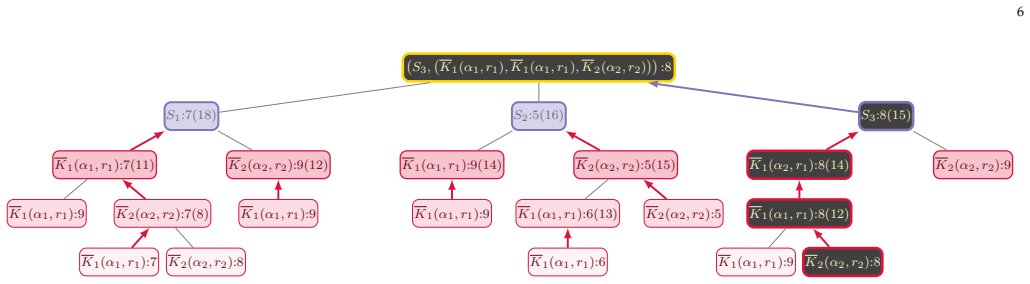
The defender chooses protections on code artifacts to maximize resistance against repeated attacks on asset confidentiality and integrity while capping overhead. The game is solved by a mini-max depth-first exploration strategy with dynamic programming. The Software Protection Index measures protection effectiveness on attack paths by merging software metrics and expert assessments.
What carries the argument
The Software Protection Index, which scores how well protections block attack paths by combining software metrics with expert assessments.
If this is right
- Protection decisions become a repeatable computation instead of repeated manual analysis.
- Applications gain measurable resistance to attacks while staying within acceptable slowdown limits.
- Risk mitigation for critical assets can be applied early in the development process without expert intervention for every case.
- The same model supports repeated re-evaluation when new attack techniques appear.
Where Pith is reading between the lines
- The approach could be embedded in compilers or build systems so protections are chosen and applied during normal compilation.
- Similar game models might help select defenses in other settings such as hardware IP protection or cloud service hardening.
- Testing whether the Software Protection Index correlates with actual attacker time-to-break on real code would strengthen the method.
Load-bearing premise
The mini-max search with dynamic programming finds near-optimal protection choices and the Software Protection Index accurately predicts real protection strength against attacks.
What would settle it
Compare attack success rates and required effort on an application before and after applying the automatically selected protections, while also measuring runtime overhead against the chosen limit.
Figures




read the original abstract
This paper introduces a novel approach for the automated selection of software protections to mitigate MATE risks against critical assets within software applications. We formalize the key elements involved in protection decision-making - including code artifacts, assets, security requirements, attacks, and software protections - and frame the protection process through a game-theoretic model. In this model, a defender strategically applies protections to various code artifacts of a target application, anticipating repeated attack attempts by adversaries against the confidentiality and integrity of the application's assets. The selection of the optimal defense maximizes resistance to attacks while ensuring the application remains usable by constraining the overhead introduced by protections. The game is solved through a heuristic based on a mini-max depth-first exploration strategy, augmented with dynamic programming optimizations for improved efficiency. Central to our formulation is the introduction of the Software Protection Index, an original contribution that extends existing notions of potency and resilience by evaluating protection effectiveness against attack paths using software metrics and expert assessments. We validate our approach through a proof-of-concept implementation and expert evaluations, demonstrating that automated software protection is a practical and effective solution for risk mitigation in software.
Editorial analysis
A structured set of objections, weighed in public.
Referee Report
Summary. The paper introduces a game-theoretic model for automated selection of software protections against MATE risks. It formalizes code artifacts, assets, security requirements, attacks, and protections. The defender applies protections to maximize resistance (measured by the Software Protection Index) while constraining overhead. The model is solved using a mini-max depth-first exploration strategy with dynamic programming optimizations. The approach is validated via a proof-of-concept implementation and expert evaluations, claiming it demonstrates automated software protection as practical and effective.
Significance. If the heuristic and SPI can be shown to be reliable, this could provide a systematic framework for protection selection in software security, reducing reliance on manual expert decisions. The formalization of the protection decision process and the composite SPI metric represent a novel extension of existing potency and resilience ideas, with potential for practical tools if supported by stronger evidence.
major comments (3)
- [Validation] Validation section: the claim that the PoC implementation and expert evaluations demonstrate practicality and effectiveness is unsupported because no quantitative results, error analysis, or details on collection/aggregation of expert assessments are provided, making it impossible to verify whether the data support the central practicality claim.
- [Algorithm] Algorithm section: the mini-max DFS+DP strategy is asserted to identify near-optimal protection selections, but no exhaustive enumeration on small instances (e.g., ≤8 artifacts) is reported to measure approximation ratio, and no ablation of the DP pruning or optimizations is included.
- [SPI] Software Protection Index definition: the SPI is presented as reliably capturing protection effectiveness against attack paths by combining software metrics with expert assessments, but no controlled experiments correlating SPI values with measured attack success rates or resistance are described.
minor comments (2)
- [SPI] Clarify the exact definition and computation of the SPI, including how expert scores are normalized and combined with metrics.
- [Related Work] Add discussion of related work on game-theoretic approaches to software protection and existing metrics for potency/resilience.
Simulated Author's Rebuttal
We thank the referee for the constructive feedback on our manuscript. We address each major comment below and describe the revisions we will make to improve clarity and support for our claims.
read point-by-point responses
-
Referee: [Validation] Validation section: the claim that the PoC implementation and expert evaluations demonstrate practicality and effectiveness is unsupported because no quantitative results, error analysis, or details on collection/aggregation of expert assessments are provided, making it impossible to verify whether the data support the central practicality claim.
Authors: We agree that the validation section requires more detail to substantiate the practicality claims. In the revised manuscript we will add quantitative results from the proof-of-concept implementation (e.g., runtime measurements and selected protection configurations on the evaluated applications). We will also describe the expert evaluation procedure, including the number of experts involved, the assessment format, and the method used to aggregate their inputs. Any available measures of variability or agreement among experts will be reported. revision: yes
-
Referee: [Algorithm] Algorithm section: the mini-max DFS+DP strategy is asserted to identify near-optimal protection selections, but no exhaustive enumeration on small instances (e.g., ≤8 artifacts) is reported to measure approximation ratio, and no ablation of the DP pruning or optimizations is included.
Authors: We acknowledge the benefit of empirical validation for the heuristic. Exhaustive enumeration remains computationally prohibitive even for modest instance sizes because of the exponential growth in protection combinations and attack paths. In the revision we will add a complexity discussion and report exhaustive results on the smallest tractable cases where feasible. We will also include an ablation study that isolates the contribution of the dynamic-programming optimizations by comparing performance with and without them. revision: partial
-
Referee: [SPI] Software Protection Index definition: the SPI is presented as reliably capturing protection effectiveness against attack paths by combining software metrics with expert assessments, but no controlled experiments correlating SPI values with measured attack success rates or resistance are described.
Authors: The SPI extends established potency and resilience concepts by integrating quantitative metrics with expert judgment along attack paths. While the current manuscript does not contain new controlled experiments that directly correlate SPI scores with observed attack success rates, we will expand the SPI section with additional justification for the chosen formulation and will outline concrete plans for future empirical studies that could establish such correlations. revision: partial
- Exhaustive enumeration on instances with up to 8 artifacts to compute approximation ratios, as this remains computationally intractable for all but the most trivial cases.
Circularity Check
No significant circularity in the game-theoretic model or SPI construction
full rationale
The paper defines the protection selection problem via an independent game-theoretic formulation in which the defender's objective (maximize resistance subject to overhead constraints) is stated directly from the problem elements (artifacts, assets, attacks, protections) without reference to the solver's outputs. The mini-max DFS+DP heuristic is introduced as an algorithmic approximation technique for solving this model, not as a redefinition or self-consistent fit of the optimum itself. The Software Protection Index is explicitly constructed by combining software metrics with external expert assessments, rather than being fitted to or derived from the optimization results or attack-path predictions within the paper. No equations or definitions reduce the claimed predictions to the inputs by construction, and no load-bearing self-citations or uniqueness theorems from prior author work are invoked to justify the central claims. Validation rests on PoC implementation and separate expert evaluations, keeping the derivation self-contained against external benchmarks.
Axiom & Free-Parameter Ledger
axioms (1)
- domain assumption Expert assessments provide reliable input for measuring protection effectiveness against attack paths
invented entities (1)
-
Software Protection Index
no independent evidence
Reference graph
Works this paper leans on
-
[1]
Guest editors’ introduction: Software protection,
P . Falcarin, C. Collberg, M. Atallah, and M. Jakubowski, “Guest editors’ introduction: Software protection,” IEEE Software, vol. 28, pp. 24–27, March 2011
work page 2011
-
[2]
C. Basile, B. De Sutter, D. Canavese, L. Regano, and B. Coppens, “Design, implementation, and automation of a risk management approach for man-at-the-end software protection,” Computers & Security, vol. 132, p. 103321, 2023
work page 2023
-
[3]
Towards understanding the skill gap in cybersecu- rity,
F. Goupil, P . Laskov, I. Pekaric, M. Felderer, A. D ¨urr, and F. Thiesse, “Towards understanding the skill gap in cybersecu- rity,” 2022
work page 2022
-
[4]
Assessment of source code obfuscation techniques,
A. Viticchi ´e, L. Regano, M. Torchiano, C. Basile, M. Ceccato, P . Tonella, and R. Tiella, “Assessment of source code obfuscation techniques,” in 2016 IEEE 16th International Working Conference on Source Code Analysis and Manipulation (SCAM) , pp. 11–20, IEEE, 2016
work page 2016
-
[5]
How professional hackers understand protected code while performing attack tasks,
M. Ceccato, P . Tonella, C. Basile, B. Coppens, B. De Sutter, P . Fal- carin, and M. Torchiano, “How professional hackers understand protected code while performing attack tasks,” in 2017 IEEE/ACM 25th International Conference on Program Comprehension (ICPC) , pp. 154–164, IEEE Computer Society, 5 2017
work page 2017
-
[6]
A. Viticchi ´e, L. Regano, C. Basile, M. Torchiano, M. Ceccato, and P . Tonella, “Empirical assessment of the effort needed to attack programs protected with client/server code splitting,” Empirical Software Engineering, vol. 25, no. 1, p. 1 – 48, 2020
work page 2020
-
[7]
A taxonomy of obfus- cating transformations,
C. Collberg, C. Thomborson, and D. Low, “A taxonomy of obfus- cating transformations,” Computer Science Technical Reports 148, Dep. of Computer Science, University of Auckland, New Zealand, 7 1997
work page 1997
-
[8]
SP 800-39. managing information security risk: Organization, mission, and information system view,
Joint Task Force Transformation Initiative, “SP 800-39. managing information security risk: Organization, mission, and information system view,” tech. rep., National Institute of Standards & Tech- nology, 2011
work page 2011
-
[9]
C. Basile et al., “ASPIRE Framework Report,” Deliverable D5.11, ASPIRE EU FP7 Project, 2016
work page 2016
-
[10]
B. Coppens et al. , “ASPIRE Open Source Manual,” Deliverable D5.13, ASPIRE EU FP7 Project, 2016
work page 2016
-
[11]
A meta-model for software protections and reverse engineering attacks,
C. Basile, D. Canavese, L. Regano, P . Falcarin, and B. De Sutter, “A meta-model for software protections and reverse engineering attacks,” Journal of Systems and Software , vol. 150, pp. 3–21, 2019
work page 2019
-
[12]
A graph-based system for network- vulnerability analysis,
C. Phillips and L. P . Swiler, “A graph-based system for network- vulnerability analysis,” in Proceedings of the 1998 Workshop on New Security Paradigms, NSPW ’98, pp. 71–79, ACM, 1998
work page 1998
-
[13]
Method to evaluate software protection based on attack modeling,
H. Wang, D. Fang, N. Wang, Z. Tang, F. Chen, and Y. Gu, “Method to evaluate software protection based on attack modeling,” in Int’l Conf. on High Performance Computing and Communications (HPCC) & Int’l Conf. on Embedded and Ubiquitous Computing (EUC), pp. 837–844, IEEE Computer Society, nov 2013
work page 2013
-
[14]
M. Ceccato, P . Tonella, C. Basile, P . Falcarin, M. Torchiano, B. Cop- pens, and B. De Sutter, “Understanding the behaviour of hackers while performing attack tasks in a professional setting and in a public challenge,” Empirical Software Engineering , vol. 24, no. 1, pp. 240–286, 2019
work page 2019
-
[15]
Automatic discovery of software attacks via backward reason- ing,
C. Basile, D. Canavese, J. d’Annoville, B. De Sutter, and F. Valenza, “Automatic discovery of software attacks via backward reason- ing,” in Proc. 1st Int’l Workshop on Software Protection , SPRO ’15, pp. 52–58, IEEE Press, 2015
work page 2015
-
[16]
Towards automatic risk analysis and mitigation of software applications,
L. Regano, D. Canavese, C. Basile, A. Viticchi ´e, and A. Lioy, “Towards automatic risk analysis and mitigation of software applications,” in Information Security Theory and Practice , pp. 120– 135, Springer International Publishing, 2016
work page 2016
-
[17]
Regano, An Expert System for Automatic Software Protection
L. Regano, An Expert System for Automatic Software Protection. PhD thesis, Politecnico di Torino, 2019
work page 2019
-
[18]
T. J. McCabe, “A complexity measure,” IEEE Transactions on software Engineering, vol. SE-2, no. 4, pp. 308–320, 1976
work page 1976
-
[19]
B. Curtis, S. Sheppard, P . Milliman, M. Borst, and T. Love, “Mea- suring the psychological complexity of software maintenance tasks with the Halstead and McCabe metrics,” IEEE Transactions on Software Engineering , vol. SE-5, no. 2, pp. 96–104, 1979
work page 1979
-
[20]
M. H. Halstead, Elements of Software Science . Elsevier, 1977
work page 1977
-
[21]
Pushing Java type obfuscation to the limit,
C. Foket, B. De Sutter, and K. De Bosschere, “Pushing Java type obfuscation to the limit,” IEEE Trans. on Dependable and Secure Computing, vol. 11, pp. 553–567, 2 2014
work page 2014
-
[22]
Obfuscation of executable code to im- prove resistance to static disassembly,
C. Linn and S. Debray, “Obfuscation of executable code to im- prove resistance to static disassembly,” in Proceedings 10th ACM conference on Computer and communications security, (New York, NY, USA), pp. 290–299, ACM, 2003
work page 2003
-
[23]
Obfuscated integration of software protections,
J. Van den Broeck, B. Coppens, and B. De Sutter, “Obfuscated integration of software protections,” Int’l Journal of Information Security, vol. 20, pp. 73–101, 2 2021
work page 2021
-
[24]
Estimating software obfuscation potency with artificial neural networks,
D. Canavese, L. Regano, C. Basile, and A. Viticchi ´e, “Estimating software obfuscation potency with artificial neural networks,” in Security and Trust Management (G. Livraga and C. Mitchell, eds.), (Cham), pp. 193–202, Springer International Publishing, 2017
work page 2017
-
[25]
Evaluation methodologies in software protection research,
B. De Sutter, S. Schrittwieser, B. Coppens, and P . Kochberger, “Evaluation methodologies in software protection research,” ACM Comput. Surv. , vol. 57, Dec. 2024
work page 2024
-
[26]
Towards opti- mally hiding protected assets in software applications,
L. Regano, D. Canavese, C. Basile, and A. Lioy, “Towards opti- mally hiding protected assets in software applications,” in Proc. Int’l Conf. on Software Quality, Reliability and Security , pp. 374–385, IEEE Computer Society, 2017
work page 2017
-
[27]
Software protection with code mobility,
A. Cabutto, P . Falcarin, B. Abrath, B. Coppens, and B. De Sutter, “Software protection with code mobility,” in Proc. of the 2nd ACM Workshop on Moving Target Defense , MTD ’15, pp. 95–103, ACM, 2015
work page 2015
-
[28]
Reactive attestation: Automatic detection and re- action to software tampering attacks,
A. Viticchi ´e, C. Basile, A. Avancini, M. Ceccato, B. Abrath, and B. Coppens, “Reactive attestation: Automatic detection and re- action to software tampering attacks,” in Proceedings of the 2016 ACM Workshop on Software PROtection , SPRO ’16, p. 73–84, ACM, 2016
work page 2016
-
[29]
Obfuscating c++ programs via control flow flattening,
T. L ´aszl´o and ´Akos Kiss, “Obfuscating c++ programs via control flow flattening,” Annales Universitatis Scientiarum Budapestinensis de Rolando E¨ otv¨ os Nominatae. Sectio Computatorica, vol. 30, 06 2007
work page 2007
-
[30]
K. Heffner and C. Collberg, “The obfuscation executive,” in Information Security (K. Zhang and Y. Zheng, eds.), (Berlin, Hei- delberg), pp. 428–440, Springer Berlin Heidelberg, 2004
work page 2004
-
[31]
Barrier slicing for remote software trusting,
M. Ceccato, M. Dalla Preda, J. Nagra, C. Collberg, and P . Tonella, “Barrier slicing for remote software trusting,” in 7th IEEE Int’l Working Conference on Source Code Analysis and Manipulation (SCAM), pp. 27–36, IEEE Computer Society, 2007. 18
work page 2007
-
[32]
Tightly-coupled self-debugging software protection,
B. Abrath, B. Coppens, S. Volckaert, J. Wijnant, and B. De Sutter, “Tightly-coupled self-debugging software protection,” in Proc. of the 6th Workshop on Software Security, Protection, and Reverse Engineering, SSPREW ’16, pp. 7:1–7:10, ACM, 2016
work page 2016
-
[33]
DIABLO: a reliable, retargetable and extensible link- time rewriting framework,
L. Van Put, D. Chanet, B. De Bus, B. De Sutter, and K. De Bosschere, “DIABLO: a reliable, retargetable and extensible link- time rewriting framework,” in Proc. Fifth IEEE Int’l Symposium on Signal Processing and Information Technology , pp. 7–12, IEEE Computer Society, 12 2005
work page 2005
-
[34]
Towards the prediction of performance degradation of obfuscated code,
S. Alberto, “Towards the prediction of performance degradation of obfuscated code,” Master’s thesis, Politecnico di Torino, 2021
work page 2021
-
[35]
La th ´eorie du jeu et les equation int ´egrales `a noyau sym´etrique gauche
E. Borel, “La th ´eorie du jeu et les equation int ´egrales `a noyau sym´etrique gauche.” comptes rendus de l’acad ´emie des sciences, 173: 1304–08. translated by lj savage in,” Econometrica, vol. 21, pp. 97–100, 1921
work page 1921
-
[36]
Programming a computer for playing chess,
S. Claude, “Programming a computer for playing chess,” Philo- sophical Magazine, Ser , vol. 7, no. 41, p. 314, 1950
work page 1950
-
[37]
Experiments with some programs that search game trees,
J. R. Slagle and J. E. Dixon, “Experiments with some programs that search game trees,” J. ACM, vol. 16, p. 189–207, apr 1969
work page 1969
-
[38]
Minimax search algo- rithms with and without aspiration windows,
H. Kaindl, R. Shams, and H. Horacek, “Minimax search algo- rithms with and without aspiration windows,” IEEE Trans. Pattern Anal. Mach. Intell. , vol. 13, p. 1225–1235, dec 1991
work page 1991
-
[39]
Information in transposition tables,
D. Breuker, J. Uiterwijk, and H. Van Den Herik, “Information in transposition tables,” Advances in Computer Chess , vol. 8, pp. 199– 211, 1997
work page 1997
-
[40]
Schaeffer, Experiments in search and knowledge
J. Schaeffer, Experiments in search and knowledge . University of Waterloo, 1986
work page 1986
-
[41]
E. A. Heinz, “Extended futility pruning,” ICGA Journal , vol. 21, no. 2, pp. 75–83, 1998
work page 1998
-
[42]
Tree-searching and tree-pruning techniques,
J. Birmingham and P . Kent, “Tree-searching and tree-pruning techniques,” in Computer chess compendium, pp. 123–128, Springer, 1988
work page 1988
-
[43]
D. E. Knuth, The Art of Computer Programming, Volume 4A: Com- binatorial Algorithms, Part 1 . Addison-Wesley, 2011
work page 2011
-
[44]
RE- Mind: a first look inside the mind of a reverse engineer,
A. Mantovani, S. Aonzo, Y. Fratantonio, and D. Balzarotti, “RE- Mind: a first look inside the mind of a reverse engineer,” in Proc. 32st Usenix Security Symposium , 2022. To appear
work page 2022
-
[45]
An observational investigation of reverse engineers’ process and mental models,
D. Votipka, S. Rabin, K. Micinski, J. S. Foster, and M. L. Mazurek, “An observational investigation of reverse engineers’ process and mental models,” in Extended Abstracts of the 2019 CHI Conference on Human Factors in Computing Systems , 2019
work page 2019
-
[46]
Design science in information systems research,
A. R. Hevner, S. T. March, J. Park, and S. Ram, “Design science in information systems research,” MIS quarterly, pp. 75–105, 2004
work page 2004
-
[47]
C. Basile, D. Canavese, and L. Regano, “ASPIRE Validation,” Deliverable D1.06, ASPIRE EU FP7 Project, 2016
work page 2016
-
[48]
ASPIRE Security Evaluation Methodology,
M. Ceccato, “ASPIRE Security Evaluation Methodology,” Deliv- erable D4.06, ASPIRE EU FP7 Project, 2016
work page 2016
-
[49]
J. Nagra and C. Collberg, Surreptitious Software: Obfuscation, Wa- termarking, and Tamperproofing for Software Protection. London, UK: Pearson Education, 2009
work page 2009
-
[50]
Risk analysis and computer security: bridging the cultural gaps,
L. J. Hoffman, “Risk analysis and computer security: bridging the cultural gaps,” in Proceedings of the 9th National Computer Security Conference , pp. 156–161, National Institute of Standards and Technology, 1986
work page 1986
-
[51]
Requirements and model for ides – a real-time intrusion-detection expert system,
D. Denning and P . G. Neumann, “Requirements and model for ides – a real-time intrusion-detection expert system,” tech. rep., SRI International, Menlo Park, CA, USA, 08 1985
work page 1985
-
[52]
O. Depren, M. Topallar, E. Anarim, and M. K. Ciliz, “An intel- ligent intrusion detection system (IDS) for anomaly and misuse detection in computer networks,” Expert Systems with Applications, vol. 29, no. 4, pp. 713–722, 2005
work page 2005
-
[53]
An integrated model of intrusion detection based on neural network and expert system,
Z. S. Pan, H. Lian, G. Y. Hu, and G. Q. Ni, “An integrated model of intrusion detection based on neural network and expert system,” in 17th Int’l Conf. on Tools with Artificial Intelligence , pp. 672–673, IEEE Computer Society, 11 2005
work page 2005
-
[54]
Artificial intelligence for cybersecurity: Literature review and future research directions,
R. Kaur, D. Gabrijel ˇciˇc, and T. Klobuˇcar, “Artificial intelligence for cybersecurity: Literature review and future research directions,” Information Fusion, vol. 97, p. 101804, 2023
work page 2023
-
[55]
Crusoe: A toolset for cyber situational awareness and decision support in incident handling,
M. Hus ´ak, L. Sadlek, S. ˇSpaˇcek, M. La ˇstoviˇcka, M. Javorn ´ık, and J. Kom ´arkov´a, “Crusoe: A toolset for cyber situational awareness and decision support in incident handling,” Computers & Security, vol. 115, p. 102609, 2022
work page 2022
-
[56]
Towards better program obfuscation: Optimization via language models,
H. Liu, “Towards better program obfuscation: Optimization via language models,” in Proc. 38th Int’l Conference on Software Engi- neering Companion , ICSE ’16, pp. 680–682, Association for Com- puting Machinery, 2016
work page 2016
-
[57]
Stochastic optimization of program obfuscation,
H. Liu, C. Sun, Z. Su, Y. Jiang, M. Gu, and J. Sun, “Stochastic optimization of program obfuscation,” in Proceedings of the 39th International Conference on Software Engineering , ICSE ’17, pp. 221– 231, IEEE Press, 2017
work page 2017
-
[58]
Feedback-driven binary code diversification,
B. Coppens, B. De Sutter, and J. Maebe, “Feedback-driven binary code diversification,” ACM Transactions on Architecture and Code Optimization (TACO), vol. 9, no. 4, pp. 1–26, 2013
work page 2013
-
[59]
Epona and the obfuscation paradox: Transparent for users and developers, a pain for reversers,
P . Brunet, B. Creusillet, A. Guinet, and J. M. Martinez, “Epona and the obfuscation paradox: Transparent for users and developers, a pain for reversers,” in Proceedings of the 3rd ACM Workshop on Soft- ware Protection, pp. 41–52, Association for Computing Machinery, 2019
work page 2019
-
[60]
Evaluating optimal phase ordering in obfuscation executives,
W. Holder, J. T. McDonald, and T. R. Andel, “Evaluating optimal phase ordering in obfuscation executives,” in Proceedings of the 7th Software Security, Protection, and Reverse Engineering / Software Security and Protection Workshop, SSPREW-7, Association for Com- puting Machinery, 2017
work page 2017
-
[61]
Obfuscator- LLVM – software protection for the masses,
P . Junod, J. Rinaldini, J. Wehrli, and J. Michielin, “Obfuscator- LLVM – software protection for the masses,” in Proceedings of the IEEE/ACM 1st International Workshop on Software Protection, SPRO’15, Firenze, Italy, May 19th, 2015 (B. Wyseur, ed.), pp. 3– 9, IEEE, 2015
work page 2015
-
[62]
Glamdring: Automatic Application Partitioning for Intel SGX,
J. Lind, C. Priebe, D. Muthukumaran, D. O’Keeffe, P . L. Aublin, F. Kelbert, T. Reiher, D. Goltzsche, D. Eyers, R. Kapitza, C. Fetzer, and P . Pietzuch, “Glamdring: Automatic Application Partitioning for Intel SGX,” in Proceedings of USENIX Annual Technical Confer- ence, pp. 285–298, USENIX Association, July 2017
work page 2017
-
[63]
Occlum: Secure and Efficient Multitasking Inside a Single Enclave of Intel SGX,
Y. Shen, H. Tian, Y. Chen, K. Chen, R. Wang, Y. Xu, Y. Xia, and S. Yan, “Occlum: Secure and Efficient Multitasking Inside a Single Enclave of Intel SGX,” in Proceedings of APLOS 2020: International Conference on Architectural Support for Programming Languages and Operating Systems, pp. 955–970, ACM, March 2020
work page 2020
discussion (0)
Sign in with ORCID, Apple, or X to comment. Anyone can read and Pith papers without signing in.