REVIEW 3 major objections 5 minor 6 cited by
OMEGA: Can LLMs Reason Outside the Box in Math? Evaluating Exploratory, Compositional, and Transformative Generalization
T0 review · 3 major / 5 minor · reviewed 2026-08-15 · deepseek-v4-flash
Pith's one-line read Current reasoning LLMs, even after RL fine-tuning, master exploratory generalization but fail at compositional and transformative math reasoning.
desk verdict OMEGA is a useful new benchmark with solid exploratory results, but its compositional and transformative claims are undercut by test items that don't force the intended skills. read the letter →
The pith
A machine-rendered reading of the paper's core claim, the machinery that carries it, and where it could break.
The reading
What carries the argument
The carrying object is OMEGA itself: a collection of 40 templated problem generators across arithmetic, algebra, combinatorics, number theory, geometry, and logic & puzzles, each with a scalar complexity measure $\delta(\theta)$ that ranks instances. Training-test pairs are constructed by fixing the template and varying the parameter region: low-complexity instances for training and higher-complexity instances for exploratory tests; two single-skill families in isolation for training and their integrated combination for compositional tests; familiar-tactic problems for training and problems whose familiar tactic is intractable for transformative tests. Solutions are generated and verified programmatically, so the benchmark can scale indefinitely. This design is what lets the authors attribute a performance drop to a specific missing reasoning skill rather than to unseen problem content.
What would settle it
Take the transformative test set (for example, the 10×10 blocked-grid path-counting problem) and solve every item using the familiar tactic from the corresponding training problems, with unlimited compute and a simulator. If many items yield to the familiar tactic, the tests do not force a paradigm shift and the near-zero accuracy cannot be attributed to missing transformative reasoning; if nearly all items resist the familiar tactic but fall to the intended alternative strategy, the paper's isolation claim is supported.
Extended reading notes
Core claim
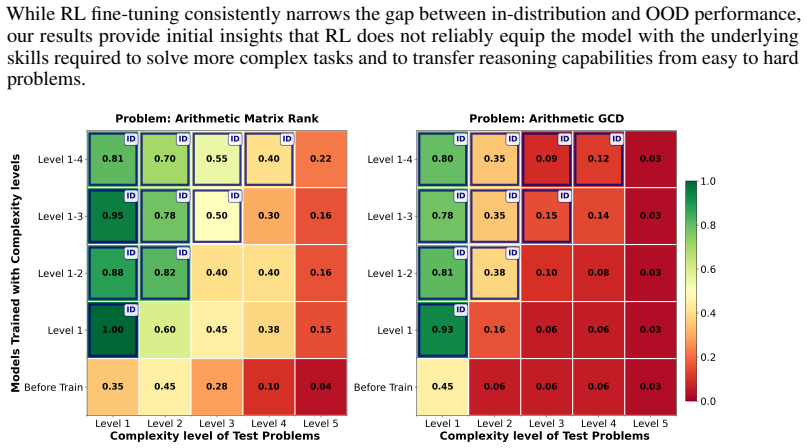
On its own terms, the paper establishes a tripartite diagnosis. First, frontier long-chain-of-thought models show near-ceiling performance at low complexity but decline to near zero as task complexity increases; trace analysis attributes this to overthinking, error spirals, and a growing preference for guesses over computation rather than arithmetic error alone. Second, RL fine-tuning on easy instances produces substantial gains on in-distribution and moderately harder exploratory tasks, but the gains plateau on high-complexity instances. Third, models trained separately on two skills fail to integrate them on compositional tests, and RL training that improves the isolated skills does not transfer to the composed task. Fourth, on transformative tests that require a different solution paradigm, RL shows negligible improvement and can even reverse prior ability. The paper concludes that current RL amplifies learned strategies but does not induce new reasoning patterns.
Load-bearing premise
The load-bearing premise is that each OMEGA problem family and complexity level isolates exactly the intended skill: that $\delta(\theta)$ measures genuine reasoning difficulty, that compositional tests cannot be solved by applying the two skills one after another, and that transformative tests cannot be solved by the familiar tactic; if any test admits an unintended shortcut, the observed failures would not measure the axis the paper claims.
Editorial extensions
If this is right
- If the OMEGA findings hold, current reasoning LLMs cannot be treated as reliable solvers on high-complexity mathematics even with long chain-of-thought and test-time search.
- RL fine-tuning is a reliable way to broaden competence within a learned strategy, but it should not be expected to produce compositional integration by itself.
- Training setups that isolate skills need to be paired with explicit composition training, because mastering the components does not yield the composite.
- Benchmarks that measure only final accuracy on static problem sets will miss the plateau: performance on exploratory generalizations can improve while transformative ability stays at zero.
- The three-axis typology provides a reusable diagnostic grid for evaluating future training methods.
Reading between the lines
- A natural extension is to use OMEGA-style train/test splits to test whether test-time search (e.g., sampling many candidates and selecting by verifier) rescues compositional tasks; the paper's Pass@k data suggest the benefit vanishes at high complexity, but the interaction with compositional and transformative tests is untested.
- The failure of RL on transformative tasks implies that reward signals based on verifiable answers may be too sparse to discover a new solution paradigm; process rewards or demonstrations of alternate strategies would be a direct training change the paper's framework could evaluate.
- If the isolation assumption holds, the same template-pair design could be moved to code generation or scientific reasoning, where "exploratory-compositional-transformative" maps onto refactoring, library composition, and novel algorithm design.
- The near-zero transformative results also suggest a testable prediction: models pretrained on diverse solution strategies across many templates should show larger transformative transfer than RL-finetuned models, since transformation requires exposure to paradigm shifts.
Signed reviews
Editorial analysis
A structured set of objections, weighed in public.
Referee Report
Summary. The paper introduces OMEGA, a programmatically generated math benchmark with matched training-test pairs along three axes of out-of-distribution generalization: exploratory, compositional, and transformative. The authors evaluate four frontier LLMs and fine-tune Qwen2.5-7B-Instruct and Qwen2.5-Math-7B with GRPO, reporting that accuracy degrades sharply with problem complexity, that RL improves explorative generalization but yields only modest compositional gains, and that transformative reasoning remains near zero. The paper additionally provides chain-of-thought error-pattern analyses, Pass@k scaling experiments, and an ablation of compositional skill pairings.
Significance. If its construct validity holds, OMEGA is a useful and unusually controlled testbed: the problems are templated with programmatic verification, the training distributions are explicit, and the RL results replicate across two Qwen variants and several domains. This makes the paper's negative result about RL and compositional/transformative generalization falsifiable and reproducible, and the release of code and dataset is a concrete asset. The main caveat is that the central claim depends on test items actually forcing the intended composition or transformation; this premise is currently asserted rather than verified, and at least two representative items admit simpler solution routes.
major comments (3)
- [§2.4–2.5, Tables 7 and 9] The load-bearing premise of the compositional and transformative experiments is that each test item can only be solved by the specified composed or reframed strategy, but the manuscript provides no independent check of this premise: the 'Decomposition' column in Table 7 and the 'Needed insight' column in Table 9 are post hoc descriptions of intended routes, not demonstrations that no simpler route exists. Two of the paper's own examples illustrate the risk. In Transformative Setting 1 (Table 9), rank(E_n) can be found by observing that the rows alternate between (1,0,1,0,...) and (0,1,0,1,...), so rank(E_n) ≤ 2 for n ≥ 2, without the named outer-product decomposition; a model failing this item may be failing symbolic-n out-of-distribution generalization rather than 'shifting to a novel paradigm.' In Compositional Setting 2 (Table 7), the number of rectangles in a regular 12-gon has the closed form C(6,2)=15 obtained by choosing two of the six diameters, and this route does not require either the trained polygon-rotation skill or the pattern-matching skill. Because the near-zero OOD accuracies in Figures 10–11 are the main evidence for the paper's central qualitative conclusions, the authors should add a validation step—for example, human or solver-generated solution protocols for every OOD item showing that the intended route is necessary, or an automated detector verifying that the trained skills are genuinely used.
- [§B.1, Figures 10–11] The headline quantitative claims rest on very small OOD test sets and single-seed RL runs. Section B.1 states that compositional and transformative OOD sets contain 20–50 samples per setting, and the GRPO runs use seed 3 only. With 20 items, the difference between 0% and 10% post-RL accuracy is within binomial sampling noise, and with no seed variance reported, the conclusion that RL yields 'little to no improvement' is not statistically supported as stated. Report per-setting test sizes, confidence intervals, or at least 3–5 seeds for the headline settings, and ideally the per-checkpoint trajectories rather than the average over the last five checkpoints.
- [§3.2.3, Figure 11] The matrix-rank result, reported as 'base model achieved decent OOD performance (70%)' with post-RL performance dropping 30 points, is an important exception to the general pattern and is currently supported by a single unseeded observation. Before drawing the conclusion that RL 'entrenches brittle heuristics,' the authors should verify that this drop is reproducible across seeds and is not an artifact of checkpoint selection or evaluation noise, and should report the per-instance trajectories that show the hypothesized entrenchment. This matters because the result is used to support the paper's characterization of how RL fails on transformative tasks.
minor comments (5)
- [Figure 7 and text] Figure 7's caption refers to 'geometry rotation problems' while the accompanying text reports Pass@k on 'letter distribution' problems; the rotation results appear in Figure 13, so the caption and cross-reference should be corrected.
- [Throughout] The paper uses 'exploratory' and 'explorative' interchangeably (e.g., Section 2.3 versus Figure 8), and similarly 'transformative' and 'transformational'; a single term per axis would improve precision.
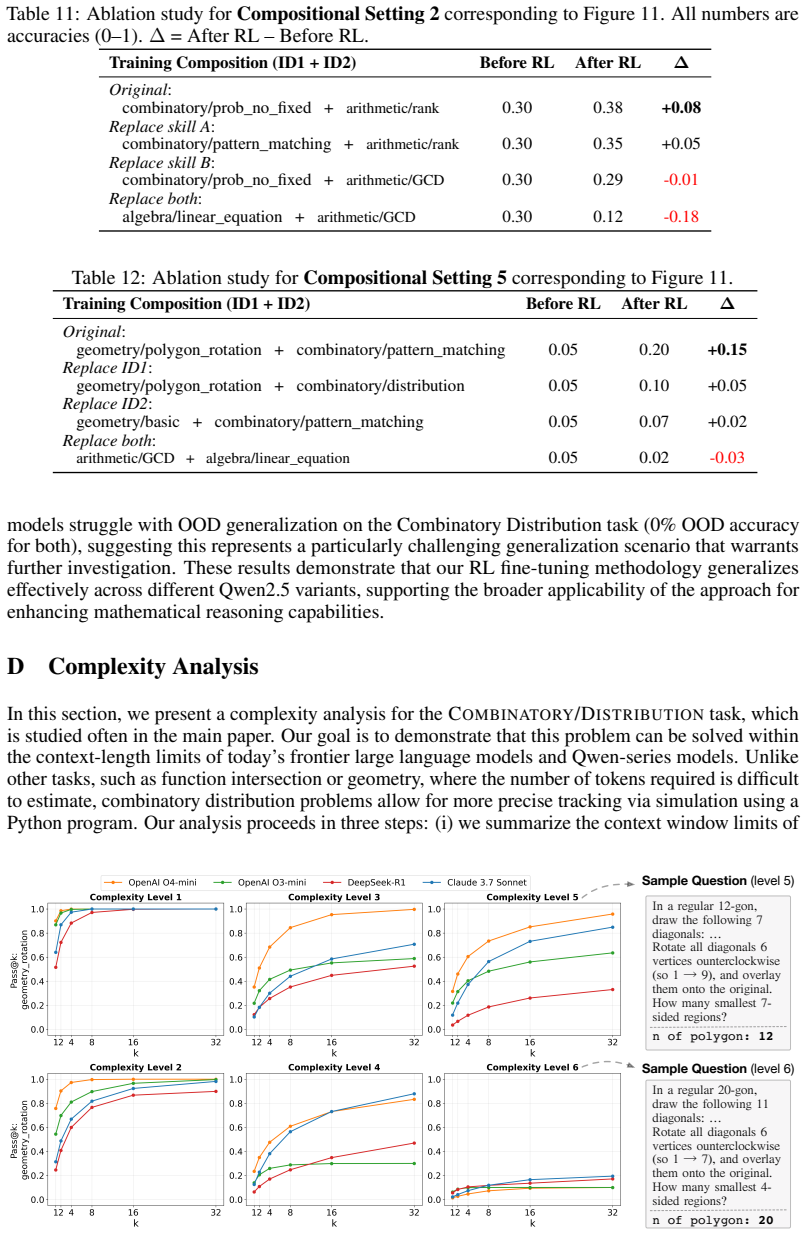
- [Tables 11–12] Tables 11 and 12 are captioned as 'corresponding to Figure 11,' but the compositional-setting ablation tracks the settings reported in Figure 10; the cross-reference appears to be mislabeled.
- [Appendix D] Appendix D's token-cost estimate assumes 'each backtrack call translates to 20 tokens' without justification; since this estimate is used to argue that context length is not the bottleneck, the constant should be justified or replaced by an upper-bound accounting based on actual rollout lengths.
- [Table 1] The entry 'OMEGA (Ours)' in Table 1 lists verification as 'N/A; Correct by Construction,' which is undercut by the appendix's use of OpenCV, grid search, and DP solvers; the verification column should match the actual pipeline.
Circularity Check
No circularity: OMEGA's claims are empirical measurements from independently generated test problems, not derivations that reduce to their inputs.
full rationale
The paper is an evaluation benchmark, not a derivation. The three generalization axes are operational definitions (Table 2, §§2.3–2.5), and the reported accuracies are measured on programmatically generated instances with independent symbolic, numerical, or graphical verification. The qualitative conclusions—that RL improves exploratory but not compositional or transformative reasoning—are empirical summaries of those measurements, not consequences of the definitions by construction. No fitted parameter is renamed as a prediction, and no uniqueness theorem or prior-work ansatz is invoked to force the central result. The only self-citations (e.g., [32] for the observation that LLMs rely on narrow strategies) support background motivation and are independently reinforced by the paper's own CoT analyses, so they are not load-bearing. The reviewer's construct-validity concern—that some transformative/compositional items (e.g., rank(E_n) via row alternation, or the 12-gon rectangle count via diameter selection) may admit familiar-tactic shortcuts—bears on whether the benchmark actually isolates the intended skills, not on whether the paper's claims reduce to its benchmark definitions by construction. A benchmark can be imperfectly valid without being circular, and no equation, fitted parameter, or self-citation chain makes the stated conclusions equivalent to the inputs.
Assumptions & free parameters
free parameters (3)
- Complexity cutoff delta_0 =
Per template, chosen so base model accuracy is below 50% on training data
- Test-set sizes =
100 per complexity level; 20-50 per compositional/transformative setting
- Token-per-backtrack multiplier =
20
assumptions (5)
- domain assumption Boden's typology of creativity (exploratory, combinatorial, transformative) is a valid decomposition of mathematical generalization.
- domain assumption Template complexity measure delta(theta) monotonically corresponds to reasoning difficulty.
- domain assumption Compositional test problems require true integration of the two trained skills and cannot be solved by applying them sequentially.
- domain assumption Transformative test problems are intractable under the familiar trained tactic.
- domain assumption Programmatically generated answers are correct.
Cite this review
Pith. "Pith review of OMEGA: Can LLMs Reason Outside the Box in Math? Evaluating Exploratory, Compositional, and Transformative Generalization." pith.science (2026). https://pith.science/paper/4F3AOGJS
@misc{pith2026250618880,
  author       = {Pith},
  title        = {Pith review of: OMEGA: Can LLMs Reason Outside the Box in Math? Evaluating Exploratory, Compositional, and Transformative Generalization},
  year         = {2026},
  howpublished = {\url{https://pith.science/paper/4F3AOGJS}},
  note         = {Machine review of arXiv:2506.18880}
}
read the original abstract
Recent large-scale language models (LLMs) with long Chain-of-Thought reasoning-such as DeepSeek-R1-have achieved impressive results on Olympiad-level mathematics benchmarks. However, they often rely on a narrow set of strategies and struggle with problems that require a novel way of thinking. To systematically investigate these limitations, we introduce OMEGA-Out-of-distribution Math Problems Evaluation with 3 Generalization Axes-a controlled yet diverse benchmark designed to evaluate three axes of out-of-distribution generalization, inspired by Boden's typology of creativity: (1) Exploratory-applying known problem solving skills to more complex instances within the same problem domain; (2) Compositional-combining distinct reasoning skills, previously learned in isolation, to solve novel problems that require integrating these skills in new and coherent ways; and (3) Transformative-adopting novel, often unconventional strategies by moving beyond familiar approaches to solve problems more effectively. OMEGA consists of programmatically generated training-test pairs derived from templated problem generators across geometry, number theory, algebra, combinatorics, logic, and puzzles, with solutions verified using symbolic, numerical, or graphical methods. We evaluate frontier (or top-tier) LLMs and observe sharp performance degradation as problem complexity increases. Moreover, we fine-tune the Qwen-series models across all generalization settings and observe notable improvements in exploratory generalization, while compositional generalization remains limited and transformative reasoning shows little to no improvement. By isolating and quantifying these fine-grained failures, OMEGA lays the groundwork for advancing LLMs toward genuine mathematical creativity beyond mechanical proficiency.
Figures


Figures from the paper (12 more)





Forward citations
Cited by 6 Pith papers
-
Ask-E: An Environment for Calibrated Question Generation
A language model trained only to write questions that split two weaker solvers improves at solving math problems, while even frontier models calibrate less than half the time.
-
The Low Frequency Trap: Video Language Models Fail at Simple Event Bookkeeping
Trace-grounded parametric profiling of three synthetic counting tasks shows current video-language models only count reliably at low event counts and low rates, and final-answer accuracy masks poor timestamp-level eve...
-
PluraMath: Extending Mathematical Reasoning Evaluation Beyond High-Resource Languages
PluraMath extends PolyMath with human-validated math problems in 18 mid-to-extreme low-resource languages and benchmarks 27 reasoning LLMs, finding a persistent high- vs low-resource performance gap.
-
RLVE: Scaling Up Reinforcement Learning for Language Models with Adaptive Verifiable Environments
Training a 1.5B language model on 400 adaptively-difficult, procedurally generated, verifiable environments improved average reasoning-benchmark performance by 3.37% absolute, compared with 0.49% from continuing origi...
-
Re:Form -- Reducing Human Annotations in Scalable Formal Software Verification with RL in LLMs: A Preliminary Study on Dafny
A minimal-prior pipeline with automated data curation and verifier-driven RL lets small LLMs generate verifiable Dafny specifications and beat larger proprietary models on a synthetic compositional benchmark.
-
Rethinking the Illusion of Thinking
Reasoning models' Towers of Hanoi failures persist under stepwise prompting, while River Crossing failures mostly vanish when tests are restricted to solvable configurations.
Reference graph
Works this paper leans on
-
[1]
Big-math: A large-scale, high-quality math dataset for reinforcement learning in language models, 2025
Alon Albalak, Duy Phung, Nathan Lile, Rafael Rafailov, Kanishk Gandhi, Louis Castricato, Anikait Singh, Chase Blagden, Violet Xiang, Dakota Mahan, and Nick Haber. Big-math: A large-scale, high-quality math dataset for reinforcement learning in language models, 2025
2025
-
[2]
The mathematics of deepmind models.The Mathematics of DeepMind Models (November 01, 2024), 2024
Noguer I Alonso et al. The mathematics of deepmind models.The Mathematics of DeepMind Models (November 01, 2024), 2024
work page 2024
-
[3]
2024 aime ii problems/problem 1, 2024
Art of Problem Solving. 2024 aime ii problems/problem 1, 2024. Accessed: 2025-03-27
work page 2024
-
[4]
Creativity and artificial intelligence.Artificial intelligence, 103(1-2):347–356, 1998
Margaret A Boden. Creativity and artificial intelligence.Artificial intelligence, 103(1-2):347–356, 1998
work page 1998
-
[5]
Compositionality and generalization in emergent languages.arXiv preprint arXiv:2004.09124, 2020
Rahma Chaabouni, Eugene Kharitonov, Diane Bouchacourt, Emmanuel Dupoux, and Marco Baroni. Compositionality and generalization in emergent languages.arXiv preprint arXiv:2004.09124, 2020
arXiv 2004
-
[6]
Training verifiers to solve math word problems.arXiv preprint arXiv:2110.14168, 2021
Karl Cobbe, Vineet Kosaraju, Mohammad Bavarian, Mark Chen, Heewoo Jun, Lukasz Kaiser, Matthias Plappert, Jerry Tworek, Jacob Hilton, Reiichiro Nakano, Christopher Hesse, and John Schulman. Training verifiers to solve math word problems.arXiv preprint arXiv:2110.14168, 2021
-
[7]
Hwang, Soumya Sanyal, Sean Welleck, Xiang Ren, Allyson Ettinger, Zaid Harchaoui, and Yejin Choi
Nouha Dziri, Ximing Lu, Melanie Sclar, Xiang Lorraine Li, Liwei Jiang, Bill Yuchen Lin, Peter West, Chandra Bhagavatula, Ronan Le Bras, Jena D. Hwang, Soumya Sanyal, Sean Welleck, Xiang Ren, Allyson Ettinger, Zaid Harchaoui, and Yejin Choi. Faith and fate: Limits of transformers on compositionality, 2023
2023
- [8]
Show all 46 references
-
[9]
Improving text-to-sql evaluation methodology.arXiv preprint arXiv:1806.09029, 2018
Catherine Finegan-Dollak, Jonathan K Kummerfeld, Li Zhang, Karthik Ramanathan, Sesh Sadasi- vam, Rui Zhang, and Dragomir Radev. Improving text-to-sql evaluation methodology.arXiv preprint arXiv:1806.09029, 2018
2018 arXiv
-
[10]
Deep learning with long short-term memory networks for financial market predictions
Thomas Fischer and Christopher Krauss. Deep learning with long short-term memory networks for financial market predictions. FAU Discussion Papers in Economics 11/2017, 2017
2017
-
[11]
Omni-math: A universal olympiad level mathematic benchmark for large language models.arXiv preprint arXiv:2410.07985, 2024
Bofei Gao, Feifan Song, Zhe Yang, Zefan Cai, Yibo Miao, Qingxiu Dong, Lei Li, Chenghao Ma, Liang Chen, Runxin Xu, et al. Omni-math: A universal olympiad level mathematic benchmark for large language models.arXiv preprint arXiv:2410.07985, 2024
-
[12]
Deepseek-r1: Incentivizing reasoning capability in llms via reinforcement learning.arXiv preprint arXiv:2501.12948, 2025
Daya Guo, Dejian Yang, Haowei Zhang, Junxiao Song, Ruoyu Zhang, Runxin Xu, Qihao Zhu, Shirong Ma, Peiyi Wang, Xiao Bi, et al. Deepseek-r1: Incentivizing reasoning capability in llms via reinforcement learning.arXiv preprint arXiv:2501.12948, 2025
2025 arXiv
-
[13]
Olympiadbench: A challenging benchmark for promoting agi with olympiad-level bilingual multimodal scientific problems, 2024
Chaoqun He, Renjie Luo, Yuzhuo Bai, Shengding Hu, Zhen Leng Thai, Junhao Shen, Jinyi Hu, Xu Han, Yujie Huang, Yuxiang Zhang, Jie Liu, Lei Qi, Zhiyuan Liu, and Maosong Sun. Olympiadbench: A challenging benchmark for promoting agi with olympiad-level bilingual multimodal scienti...
2024
-
[14]
Deepmath-103k: A large-scale, challenging, decontaminated, and verifiable mathematical dataset for advancing reasoning.arXiv preprint arXiv:2504.11456, 2025
Zhiwei He, Tian Liang, Jiahao Xu, Qiuzhi Liu, Xingyu Chen, Yue Wang, Linfeng Song, Dian Yu, Zhenwen Liang, Wenxuan Wang, et al. Deepmath-103k: A large-scale, challenging, decontaminated, and verifiable mathematical dataset for advancing reasoning.arXiv preprint arXiv:2504.11456, 2025
2025 arXiv
-
[15]
Compositionality decomposed: How do neural networks generalise?Journal of Artificial Intelligence Research, 67:757–795, 2020
Dieuwke Hupkes, Verna Dankers, Mathijs Mul, and Elia Bruni. Compositionality decomposed: How do neural networks generalise?Journal of Artificial Intelligence Research, 67:757–795, 2020. 15
2020
-
[16]
Measuring compositional generalization: A comprehensive method on realistic data.arXiv preprint arXiv:1912.09713, 2019
Daniel Keysers, Nathanael Schärli, Nathan Scales, Hylke Buisman, Daniel Furrer, Sergii Kashubin, Nikola Momchev, Danila Sinopalnikov, Lukasz Stafiniak, Tibor Tihon, et al. Measuring compositional generalization: A comprehensive method on realistic data.arXiv preprint arXiv:191...
1912 arXiv
-
[17]
Measuring compositional generalization: A comprehensive method on realistic data, 2020
Daniel Keysers, Nathanael Schärli, Nathan Scales, Hylke Buisman, Daniel Furrer, Sergii Kashubin, Nikola Momchev, Danila Sinopalnikov, Lukasz Stafiniak, Tibor Tihon, Dmitry Tsarkov, Xiao Wang, Marc van Zee, and Olivier Bousquet. Measuring compositional generalization: A compreh...
2020
-
[18]
Generalization without systematicity: On the compositional skills of sequence-to-sequence recurrent networks
Brenden Lake and Marco Baroni. Generalization without systematicity: On the compositional skills of sequence-to-sequence recurrent networks. InInternational conference on machine learning, pages 2873–2882. PMLR, 2018
2018
-
[19]
Solving quantitative reasoning problems with language models, 2022
Aitor Lewkowycz, Anders Andreassen, David Dohan, Ethan Dyer, Henryk Michalewski, Vinay Ramasesh, Ambrose Slone, Cem Anil, Imanol Schlag, Theo Gutman-Solo, Yuhuai Wu, Behnam Neyshabur, Guy Gur-Ari, and Vedant Misra. Solving quantitative reasoning problems with language models, 2022
2022
-
[20]
Numinamath
Jia Li, Edward Beeching, Lewis Tunstall, Ben Lipkin, Roman Soletskyi, Shengyi Costa Huang, Kashif Ra- sul, Longhui Yu, Albert Jiang, Ziju Shen, Zihan Qin, Bin Dong, Li Zhou, Yann Fleureau, Guillaume Lample, and Stanislas Polu. Numinamath. [https://huggingface.co/AI-MO/NuminaMa...
2024
-
[21]
Probing out-of-distribution generalization in machine learning for materials, 2024
Kangming Li, Andre Niyongabo Rubungo, Xiangyun Lei, Daniel Persaud, Kamal Choudhary, Brian DeCost, Adji Bousso Dieng, and Jason Hattrick-Simpers. Probing out-of-distribution generalization in machine learning for materials, 2024
2024
-
[22]
Gsm-plus: A comprehensive benchmark for evaluating the robustness of llms as mathematical problem solvers
Qintong Li, Leyang Cui, Xueliang Zhao, Lingpeng Kong, and Wei Bi. Gsm-plus: A comprehensive benchmark for evaluating the robustness of llms as mathematical problem solvers. InProceedings of the 62nd Annual Meeting of the Association for Computational Linguistics (Volume 1: Lon...
2024
-
[23]
Towards out-of-distribution generalization: A survey, 2023
Jiashuo Liu, Zheyan Shen, Yue He, Xingxuan Zhang, Renzhe Xu, Han Yu, and Peng Cui. Towards out-of-distribution generalization: A survey, 2023
2023
-
[24]
Prorl: Prolonged reinforcement learning expands reasoning boundaries in large language models.arXiv preprint arXiv:2505.24864, 2025
Mingjie Liu, Shizhe Diao, Ximing Lu, Jian Hu, Xin Dong, Yejin Choi, Jan Kautz, and Yi Dong. Prorl: Prolonged reinforcement learning expands reasoning boundaries in large language models.arXiv preprint arXiv:2505.24864, 2025
2025 arXiv
-
[25]
Compositional generalization by learning analytical expressions.Advances in Neural Information Processing Systems, 33:11416–11427, 2020
Qian Liu, Shengnan An, Jian-Guang Lou, Bei Chen, Zeqi Lin, Yan Gao, Bin Zhou, Nanning Zheng, and Dongmei Zhang. Compositional generalization by learning analytical expressions.Advances in Neural Information Processing Systems, 33:11416–11427, 2020
2020
-
[26]
Gsm-symbolic: Understanding the limitations of mathematical reasoning in large language models.arXiv preprint arXiv:2410.05229, 2024
Iman Mirzadeh, Keivan Alizadeh, Hooman Shahrokhi, Oncel Tuzel, Samy Bengio, and Mehrdad Farajtabar. Gsm-symbolic: Understanding the limitations of mathematical reasoning in large language models.arXiv preprint arXiv:2410.05229, 2024
-
[27]
Beyond lines and circles: Unveiling the geometric reasoning gap in large language models.arXiv preprint arXiv:2402.03877, 2024
Spyridon Mouselinos, Henryk Michalewski, and Mateusz Malinowski. Beyond lines and circles: Unveiling the geometric reasoning gap in large language models.arXiv preprint arXiv:2402.03877, 2024
2024 arXiv
-
[28]
Gsm8k, April 2022
OpenAI. Gsm8k, April 2022
2022
-
[29]
Learning to reason with llms, September 2024
OpenAI. Learning to reason with llms, September 2024
2024
-
[30]
Math 500, November 2024
OpenAI. Math 500, November 2024
2024
-
[31]
The illusion of thinking: Understanding the strengths and limitations of reasoning models via the lens of problem complexity.arXiv preprint arXiv:2506.06941, 2025
Parshin Shojaee, Iman Mirzadeh, Keivan Alizadeh, Maxwell Horton, Samy Bengio, and Mehrdad Farajtabar. The illusion of thinking: Understanding the strengths and limitations of reasoning models via the lens of problem complexity.arXiv preprint arXiv:2506.06941, 2025
2025 arXiv
-
[32]
Climbing the ladder of reasoning: What llms can-and still can’t-solve after sft?arXiv preprint arXiv:2504.11741, 2025
Yiyou Sun, Georgia Zhou, Hao Wang, Dacheng Li, Nouha Dziri, and Dawn Song. Climbing the ladder of reasoning: What llms can-and still can’t-solve after sft?arXiv preprint arXiv:2504.11741, 2025
2025
-
[33]
Mathscale: Scaling instruction tuning for mathematical reasoning, 2024
Zhengyang Tang, Xingxing Zhang, Benyou Wang, and Furu Wei. Mathscale: Scaling instruction tuning for mathematical reasoning, 2024
2024
-
[34]
The claude 3 model family: Opus, sonnet, haiku
Anthropic Team. The claude 3 model family: Opus, sonnet, haiku. 16
-
[35]
Openmathinstruct-1: A 1.8 million math instruction tuning dataset, 2024
Shubham Toshniwal, Ivan Moshkov, Sean Narenthiran, Daria Gitman, Fei Jia, and Igor Gitman. Openmathinstruct-1: A 1.8 million math instruction tuning dataset, 2024
2024
-
[36]
Grokked transformers are implicit reasoners: A mechanistic journey to the edge of generalization, 2024
Boshi Wang, Xiang Yue, Yu Su, and Huan Sun. Grokked transformers are implicit reasoners: A mechanistic journey to the edge of generalization, 2024
2024
-
[37]
Towards a theoretical framework of out-of-distribution generalization, 2021
Haotian Ye, Chuanlong Xie, Tianle Cai, Ruichen Li, Zhenguo Li, and Liwei Wang. Towards a theoretical framework of out-of-distribution generalization, 2021
2021
-
[38]
Does reinforcement learning really incentivize reasoning capacity in llms beyond the base model?arXiv preprint arXiv:2504.13837, 2025
Yang Yue, Zhiqi Chen, Rui Lu, Andrew Zhao, Zhaokai Wang, Shiji Song, and Gao Huang. Does reinforcement learning really incentivize reasoning capacity in llms beyond the base model?arXiv preprint arXiv:2504.13837, 2025
2025 arXiv
-
[39]
Scaling and beyond: Advancing spatial reasoning in mllms requires new recipes.arXiv preprint arXiv:2504.15037, 2025
Huanyu Zhang, Chengzu Li, Wenshan Wu, Shaoguang Mao, Yifan Zhang, Haochen Tian, Ivan Vuli ´c, Zhang Zhang, Liang Wang, Tieniu Tan, et al. Scaling and beyond: Advancing spatial reasoning in mllms requires new recipes.arXiv preprint arXiv:2504.15037, 2025
2025 arXiv
-
[40]
Evaluating the performance of large language models on gaokao benchmark, 2024
Xiaotian Zhang, Chunyang Li, Yi Zong, Zhengyu Ying, Liang He, and Xipeng Qiu. Evaluating the performance of large language models on gaokao benchmark, 2024
2024
-
[41]
Can models learn skill composition from examples?Advances in Neural Information Processing Systems, 37:102393–102427, 2024
Haoyu Zhao, Simran Kaur, Dingli Yu, Anirudh Goyal, and Sanjeev Arora. Can models learn skill composition from examples?Advances in Neural Information Processing Systems, 37:102393–102427, 2024
2024
-
[42]
Gsm-infinite: How do your llms behave over infinitely increasing context length and reasoning complexity?arXiv preprint arXiv:2502.05252, 2025
Yang Zhou, Hongyi Liu, Zhuoming Chen, Yuandong Tian, and Beidi Chen. Gsm-infinite: How do your llms behave over infinitely increasing context length and reasoning complexity?arXiv preprint arXiv:2502.05252, 2025. 17 A Dataset Details A.1 Details of Problem Families To provide ...
2025 arXiv
-
[43]
visualizing
+ 2 + 5is increasing. Composed function num- ber 2 3 4 5 6 algebra/func_ext_coordsAverage of allx-coordinates of local min- ima off(x) =−3(−2 sin(πx−2)+2)+2 2(−2 sin(πx−2)+2)+1. Composed function num- ber 2 3 4 5 6 algebra/func_extremaNumber of local maxima off(x) = 2 cos3π(|x...
-
[44]
conjecture
"conjecture" - The sentence makes a hypothesis or conjecture about the final answer. Typical examples include "Alternatively, maybe the matrix is singular.", "Wait, let’s check if the determinant is zero or not.", "Alternatively, maybe the problem is from a source where the an...
-
[45]
computation
"computation" - The sentence performs a mathematical computation or calculation
-
[46]
computation
"other" - The sentence is explanation, setup, conclusion, or another type of reasoning. Original math problem: {original_question} Correct answer: {correct_answer} Sentence to classify: {sentence} If you classify it as "computation", also verify if the computation is correct b...
2014
Reviewed August 15, 2026 · model on record in the stance chip above.
Discussion (0). Continue with ORCID to comment.