REVIEW 4 major objections 5 minor 37 references
Causal-Aware Intelligent QoE Optimization for VR Interaction with Adaptive Keyframe Extraction
T0 review · 4 major / 5 minor · reviewed 2026-08-06 · deepseek-v4-flash
Pith's one-line read Causal-aware exploration cuts VR resource-allocation training by 30 percent.
desk verdict Solid engineering paper whose headline causal speedup claim lacks a control for the larger action candidate set; worth reviewing but needs an ablation. read the letter →
The pith
A machine-rendered reading of the paper's core claim, the machinery that carries it, and where it could break.
The reading
What carries the argument
The causal action influence (CAI) score is the central object: a per-next-state-variable conditional mutual information $I(S'_j;A|S=s,A=a)$, computed as the KL divergence between the action-conditioned transition distribution $p(s'_j|s,a)$ and the action-marginal $p(s'_j|s)$, averaged over $|S'|$ next-state variables and approximated by a Monte-Carlo average over sampled actions. A DNN inference model, trained by negative log-likelihood under a Gaussian assumption $S'_j \sim \mathcal{N}(\mu_\theta(s,a), \sigma_\theta^2(s,a))$, supplies the distributions; the score's job is to rank candidate exploratory actions so that the agent preferentially tries actions that strongly control the next state. The second machinery piece is the partial-state division, which restricts CAI computation to genuinely action-relevant variables so the learned inference model does not waste capacity on attention data that the actions cannot influence.
What would settle it
Reproduce the training procedure on an environment with the same state-action structure but highly non-Gaussian next-state distributions (for example, multimodal or heavy-tailed latency), and check whether PS-CDDPG still reaches the target average reward in 30 percent fewer iterations than DDPG; if the gain vanishes or becomes negative, the Gaussian inference model is the load-bearing assumption.
Extended reading notes
Core claim
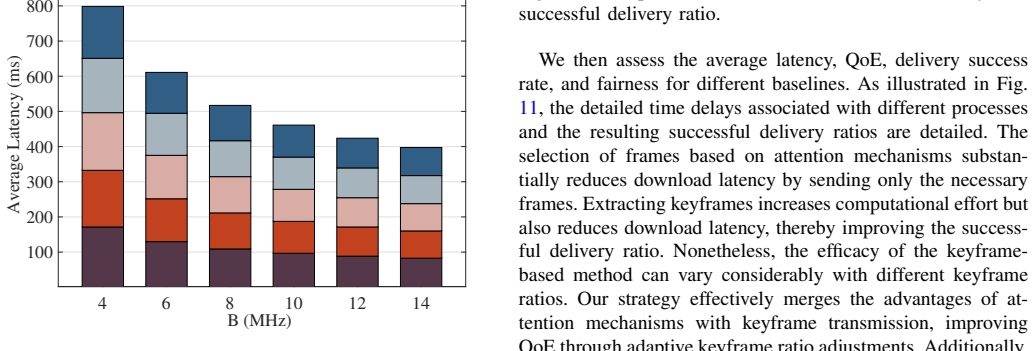
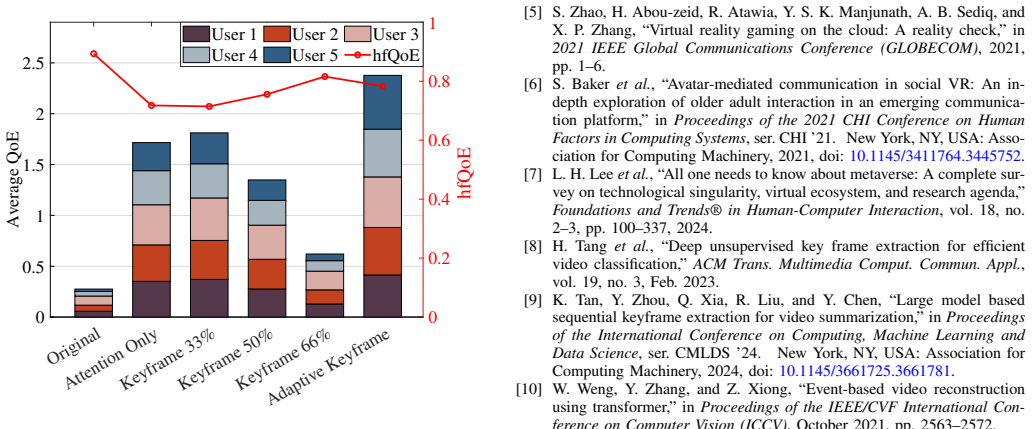
The central claim is that causal influence detection, applied only to action-relevant state variables and combined with noise-based active exploration, makes Deep Deterministic Policy Gradient training substantially more efficient for a mixed-integer QoE optimization problem in multi-user VR interaction. The paper defines a QoE function $QoE_k(t)$ based on the Weber-Fechner Law that combines latency ratio, attention-weighted character counts, and a logarithmic keyframe term, and models the joint optimization of keyframe ratio, bandwidth, and CPU frequency as a constrained MIP. To solve it, the state is split into action-relevant variables $S^{(2)}(t)$ and action-irrelevant variables $S^{(1)}(t)$ (user attention data), and a neural inference model approximates the transition distributions $p(s'_j|s,a)$ as Gaussians whose KL divergence yields the causal action influence (CAI) score. Exploration then samples a batch of noise-perturbed actions and selects among them using weight-based CAI ranking. The paper reports that the full PS-CDDPG framework reaches the desired average reward in over 30 percent fewer iterations than plain DDPG or CAI+DDPG without the state split, and that in the test environment it reduces latency, improves QoE, and maintains horizon fairness against several baselines.
Load-bearing premise
The whole training-efficiency gain rests on the assumption that the neural network's Gaussian approximation of next-state probabilities is accurate enough that the KL-divergence ranking of candidate actions reflects true causal influence; if that approximation is off, exploration is guided by noise and the reported 30 percent iteration reduction would not be explained.
Editorial extensions
If this is right
- If the reported training gain holds across environments, causal-influence-guided exploration becomes a drop-in accelerant for DDPG-style allocation policies in communication networks, since it modifies only the exploration phase.
- The attention-based keyframe model implies that transmitting fewer frames for low-attention characters and more for central vision can keep QoE high while cutting bandwidth demand; the paper shows the adaptive scheme outperforms fixed keyframe ratios, especially at limited bandwidth.
- Splitting state variables into action-relevant and action-irrelevant sets should generalize to other RL resource allocation tasks where some inputs, like user position or channel randomness, are outside the agent's control.
- The horizon-fairness constraint embedded in the reward suggests the causal-exploration approach can trade off average QoE and per-user variance without a separate fairness-training stage.
Reading between the lines
- The paper's own sensitivity analysis suggests an implicit test: the 30 percent iteration reduction should be largest when the Gaussian inference model is accurate; environments with strongly non-Gaussian transition dynamics should shrink or erase the gain, since the CAI ranking then approximates random noise.
- A neighboring application of the same machinery is multi-user cloud gaming or AR, where bandwidth, edge CPU, and frame-selection decisions share the same mixed-integer structure; the partial-state CAI scheme could be ported with the attention map replaced by gaze or saliency data.
- The weight-based selection in (22) could be made adaptive: annealing exploration noise variance $\sigma_\eta^2$ or the exploration rate $\epsilon$ according to the agreement between CAI-ranked actions and observed reward would test whether the causal signal remains informative after convergence.
- A stricter causal standard would replace the Gaussian KL proxy with a nonparametric conditional-dependence test on the same replay data; if the PS-CDDPG gain persists under that replacement, the mechanism is causal structure rather than distributional filtering.
Signed reviews
Editorial analysis
A structured set of objections, weighed in public.
Referee Report
Summary. The paper proposes a framework for QoE optimization in multi-user VR interaction with adaptive keyframe extraction. It defines a QoE metric based on the Weber-Fechner law combined with attention levels and keyframe ratios, then formulates the joint allocation of keyframe ratio, bandwidth, and CPU frequency as a mixed-integer optimization problem under fairness constraints. The proposed algorithm, PS-CDDPG, augments DDPG with causal influence detection (CAI), partial state division, and noise-based active exploration. Experiments using the CMU Motion Capture Database simulate a sub-6 GHz multi-user environment and report faster convergence, reduced latency, improved QoE, and fairness relative to several baselines.
Significance. If the central claims hold, the paper provides a useful application of causal influence detection to wireless VR resource allocation and offers a complete algorithm description with reproducible public-data simulation. Strengths include the explicit MIP formulation, the detailed PS-CDDPG pseudocode, and the sensitivity analysis of exploration hyperparameters. However, the causal mechanism is not isolated from the enlarged candidate action set, the Gaussian transition assumption for CAI is not validated, and the reported benefits lack statistical uncertainty. These gaps currently prevent the claimed causal contribution from being accepted as stated.
major comments (4)
- [Section V-B, Fig. 3, Algorithm 2] The central claim that causal influence detection yields a >30% reduction in training iterations is not isolated from the enlarged candidate set. PS-CDDPG (Algorithm 2, lines 10-18) generates N=64 noisy candidate actions and selects among them using CAI weights, whereas the DDPG baseline perturbs the actor action with a single noise vector. The convergence comparisons in Figs. 3-4 therefore vary two factors at once: candidate-set size and the selection criterion. Without an ablation that keeps the 64-candidate set but replaces CAI ranking with random, reverse, or permuted CAI scores, the reported training gain cannot be attributed to causal influence detection rather than to the benefit of evaluating multiple candidate actions. This ablation is needed to support the paper's primary contribution.
- [Section IV-B, Eqs. (15)-(18); Section VI] The CAI score assumes that each next-state variable is Gaussian given state and action, with mean and variance produced by a DNN. The authors concede in Section VI that the DNN inference model is inaccurate in complex environments, but no diagnostic is provided for the quality of the fitted transition distribution, such as calibration curves, comparison with non-parametric estimates, or checks on the KL divergence used in Eq. (17). If the Gaussian approximation is poor, CAI scores may rank actions according to approximation error rather than true causal influence, and the exploration guidance would be noise-driven rather than causal. The causal explanation of the training gain is therefore unsupported without an inference-model validation or an ablation using an alternative transition model.
- [Section V, Figs. 3-12] The evaluation reports single training curves and test averages without confidence intervals, multiple random seeds, or significance tests. The claims that the method 'significantly reduces latency', 'enhances QoE', and 'outperforms baseline approaches' require statistical support; please report means and variances over independent seeds or dataset subsamples, and where appropriate significance tests, for the main comparisons in Figs. 3, 5, 6, and 12.
- [Section III-D, Eq. (8); Section IV-A, Eq. (14)] The QoE metric in Eq. (8) is an analytical construction combining attention weights, latency, and a logarithmic keyframe term, and this same expression is used as the reward in Eq. (14). No external validation against subjective QoE scores or established QoE instruments is provided. Because the metric itself encodes a preference for attention-weighted keyframe allocation, methods that follow this preference will mechanically score higher. The paper should either validate the QoE proxy or explicitly frame the contribution as optimizing a proposed analytical metric rather than a measured user experience.
minor comments (5)
- [Section V-D, Figs. 6-12] The baseline list includes an 'Adaptive Keyframe' method, but the text and figures treat 'Adaptive Keyframe' as the proposed PS-CDDPG method. Please rename the proposed method (e.g., 'PS-CDDPG') and clarify whether the bullet-list 'Adaptive Keyframe' is a baseline or the proposed framework.
- [Section IV-C, Eqs. (21)-(22), Algorithm 2] The exploration rule is ambiguous: Eq. (21) selects the candidate with the largest CAI score, whereas Eq. (22) defines selection probabilities by rank, and Algorithm 2 only refers to 'calculate priority weights' and 'select action'. Please state explicitly whether the exploration choice is deterministic argmax or stochastic over the weights, and where Eq. (22) is applied.
- [Section V-A, Table II] The rendering CPU frequency f_r_k(t) is given as [1.5-2.5] GHz in Table II, but the optimization variables and Algorithm 2 only allocate f_e_k(t). Please clarify how f_r_k(t) is set or sampled in the simulation.
- [Section IV-C, Eq. (12), Algorithm 2] The partition of the state into S^(1)(t) and S^(2)(t) is described informally. Please provide a formal definition of these two sets and explain how S^(2)(t+1) is computed or observed in the environment step.
- [Fig. 5] Panels (c)-(f) plot multiple curves for different epsilon and sigma values without distinct markers and with unclear legend placement, making the comparisons difficult to read. Please improve the figure with explicit legends or separate subplots.
Circularity Check
No significant circularity: the claimed QoE gains are measured against an explicitly defined reward, and the causal-exploration component is an empirical training enhancement rather than a fitted prediction.
full rationale
The derivation chain is self-contained in the sense required by the circularity rubric. The QoE metric in Eq. (8) is explicitly defined by the authors, and the RL reward in Eq. (14) is defined as the sum of that QoE plus penalty terms; therefore the observation that attention-weighted keyframe allocation improves this QoE is a property of the optimization objective, not a circular derivation of an external quantity. The causal influence scores in Eqs. (15)-(18) are computed from a learned Gaussian transition model and are used only to re-rank exploratory candidate actions in Eqs. (21)-(22); the reported 30% training-iteration reduction is an empirically measured convergence result on the shared reward, not a quantity fitted into the CAI computation. The paper's one author self-citation, [3], motivates the attention-aware QoE formulation but is not load-bearing: the proposed algorithm rests on the external causal-influence method [4] and the external partial-state idea [37]. The Section VI admission that the DNN inference model limits CAI accuracy in complex environments weakens the explanatory strength of the causal mechanism but is an acknowledged approximation, not a circular step. The absence of an ablation replacing CAI ranking with random ranking is a methodological limitation, not a by-construction equivalence between input and output. No equation or fitted parameter is renamed as a prediction, and no unique solution is imported from the authors' prior work.
Assumptions & free parameters
free parameters (5)
- T_max latency threshold =
150 ms
- Attention level weights =
0, 1, 2, 3
- Minimum keyframe constant =
2 frames
- Reward penalty coefficients omega_1, omega_2 =
0.5, 0.5
- Exploration probability epsilon and noise variance sigma_eta^2 =
0.4, 0.01
assumptions (6)
- ad hoc to paper The transition distribution p(s'_j | s, a) is Gaussian with mean and variance output by a DNN.
- domain assumption The QoE function in Eq. (8), based on latency, attention level, and a logarithmic keyframe term, represents real user satisfaction.
- domain assumption Shannon capacity and the log-distance path loss model describe the sub-6 GHz link.
- domain assumption Higher keyframe ratio implies better motion reconstruction accuracy, so the log keyframe term in QoE is monotone in accuracy.
- standard math The Monte Carlo approximation with N sampled actions in Eq. (17) yields a valid CAI score.
- domain assumption DDPG with the proposed exploration converges to a good policy for the mixed-integer problem (P).
Cite this review
Pith. "Pith review of Causal-Aware Intelligent QoE Optimization for VR Interaction with Adaptive Keyframe Extraction." pith.science (2026). https://pith.science/paper/IKROHGGG
@misc{pith2026250619890,
  author       = {Pith},
  title        = {Pith review of: Causal-Aware Intelligent QoE Optimization for VR Interaction with Adaptive Keyframe Extraction},
  year         = {2026},
  howpublished = {\url{https://pith.science/paper/IKROHGGG}},
  note         = {Machine review of arXiv:2506.19890}
}
read the original abstract
The optimization of quality of experience (QoE) in multi-user virtual reality (VR) interactions demands a delicate balance between ultra-low latency, high-fidelity motion synchronization, and equitable resource allocation. While adaptive keyframe extraction mitigates transmission overhead, existing approaches often overlook the causal relationships among allocated bandwidth, CPU frequency, and user perception, limiting QoE gains. This paper proposes an intelligent framework to maximize QoE by integrating adaptive keyframe extraction with causal-aware reinforcement learning (RL). First, a novel QoE metric is formulated using the Weber-Fechner Law, combining perceptual sensitivity, attention-driven priorities, and motion reconstruction accuracy. The QoE optimization problem is then modeled as a mixed integer programming (MIP) task, jointly optimizing keyframe ratios, bandwidth, and computational resources under horizon-fairness constraints. We propose Partial State Causal Deep Deterministic Policy Gradient (PS-CDDPG), which integrates the Deep Deterministic Policy Gradient (DDPG) method with causal influence detection. By leveraging causal information regarding how QoE is influenced and determined by various actions, we explore actions guided by weights calculated from causal inference (CI), which in turn improves training efficiency. Experiments conducted with the CMU Motion Capture Database demonstrate that our framework significantly reduces interactive latency, enhances QoE, and maintains fairness, achieving superior performance compared to benchmark methods.
Figures


Figures from the paper (7 more)



Reference graph
Works this paper leans on
-
[1]
Learning-based sphere nonlinear interpolation for motion synthesis,
G. Xia, H. Sun, Q. Liu, and R. Hang, “Learning-based sphere nonlinear interpolation for motion synthesis,”IEEE Trans. Ind. Informat., vol. 15, no. 5, pp. 2927–2937, 2019
work page 2019
-
[2]
Keyframe extraction for human motion capture data based on joint kernel sparse representation,
G. Xia, H. Sun, X. Niu, G. Zhang, and L. Feng, “Keyframe extraction for human motion capture data based on joint kernel sparse representation,” IEEE Trans. Ind. Electron., vol. 64, no. 2, pp. 1589–1599, 2017
work page 2017
-
[3]
Attention-based QoE-aware digital twin empowered edge computing for immersive virtual reality,
J. Yu, A. Alhilal, T. Zhou, P. Hui, and D. H. K. Tsang, “Attention-based QoE-aware digital twin empowered edge computing for immersive virtual reality,”IEEE Trans. Wireless Commun., vol. 23, no. 9, pp. 11 276–11 290, 2024
work page 2024
-
[4]
Causal influence detection for improving efficiency in reinforcement learning,
M. Seitzer, B. Sch ¨olkopf, and G. Martius, “Causal influence detection for improving efficiency in reinforcement learning,” inAdvances in Neural Information Processing Systems, vol. 34. Curran Associates, Inc., 2021, pp. 22 905–22 918
work page 2021
-
[5]
Virtual reality gaming on the cloud: A reality check,
S. Zhao, H. Abou-zeid, R. Atawia, Y . S. K. Manjunath, A. B. Sediq, and X. P. Zhang, “Virtual reality gaming on the cloud: A reality check,” in 2021 IEEE Global Communications Conference (GLOBECOM), 2021, pp. 1–6
work page 2021
-
[6]
S. Bakeret al., “Avatar-mediated communication in social VR: An in- depth exploration of older adult interaction in an emerging communica- tion platform,” inProceedings of the 2021 CHI Conference on Human Factors in Computing Systems, ser. CHI ’21. New York, NY , USA: Asso- ciation for Computing Machinery, 2021, doi: 10.1145/3411764.3445752
arXiv 2021
-
[7]
L. H. Leeet al., “All one needs to know about metaverse: A complete sur- vey on technological singularity, virtual ecosystem, and research agenda,” Foundations and Trends® in Human-Computer Interaction, vol. 18, no. 2–3, pp. 100–337, 2024
work page 2024
-
[8]
Deep unsupervised key frame extraction for efficient video classification,
H. Tanget al., “Deep unsupervised key frame extraction for efficient video classification,”ACM Trans. Multimedia Comput. Commun. Appl., vol. 19, no. 3, Feb. 2023
work page 2023
Show all 37 references
-
[9]
Large model based sequential keyframe extraction for video summarization,
K. Tan, Y . Zhou, Q. Xia, R. Liu, and Y . Chen, “Large model based sequential keyframe extraction for video summarization,” inProceedings of the International Conference on Computing, Machine Learning and Data Science, ser. CMLDS ’24. New York, NY , USA: Association for Comput...
2024
-
[10]
Event-based video reconstruction using transformer,
W. Weng, Y . Zhang, and Z. Xiong, “Event-based video reconstruction using transformer,” inProceedings of the IEEE/CVF International Con- ference on Computer Vision (ICCV), October 2021, pp. 2563–2572
2021
-
[11]
Local self- expression subspace learning network for motion capture data,
G. Xia, P. Xue, H. Sun, Y . Sun, D. Zhang, and Q. Liu, “Local self- expression subspace learning network for motion capture data,”IEEE Transactions on Image Processing, vol. 31, pp. 4869–4883, 2022
2022
-
[12]
Keyframe extraction from motion capture sequences with graph based deep reinforcement learning,
C. Mo, K. Hu, S. Mei, Z. Chen, and Z. Wang, “Keyframe extraction from motion capture sequences with graph based deep reinforcement learning,” inACM Multimedia 2021, ser. MM ’21. New York, NY , USA: Association for Computing Machinery, 2021, p. 5194–5202
2021
-
[13]
A key-frame-based error resilient coding scheme for video transmission over differentiated services networks,
Q. Zhang and G. Liu, “A key-frame-based error resilient coding scheme for video transmission over differentiated services networks,” inPacket Video 2007, 2007, pp. 85–90
2007
-
[14]
Edge-assisted video transmission with adaptive key frame selection: A hierarchical DRL approach,
W. Zhu, R. Chen, C. Yi, and J. Cai, “Edge-assisted video transmission with adaptive key frame selection: A hierarchical DRL approach,” in2023 Biennial Symposium on Communications (BSC), 2023, pp. 89–94
2023
-
[15]
M-LVC: Multiple frames prediction for learned video compression,
J. Lin, D. Liu, H. Li, and F. Wu, “M-LVC: Multiple frames prediction for learned video compression,” inProceedings of the IEEE/CVF Conference on Computer Vision and Pattern Recognition (CVPR), June 2020
2020
-
[16]
Deep learning in latent space for video prediction and compression,
B. Liu, Y . Chen, S. Liu, and H. S. Kim, “Deep learning in latent space for video prediction and compression,” inProceedings of the IEEE/CVF Conference on Computer Vision and Pattern Recognition (CVPR), June 2021, pp. 701–710
2021
-
[17]
Resource-aware reinforcement learning-based transmission optimization for mobile augmented reality in edge computing,
S. Cheng, F. Feng, T. Bi, and T. Jiang, “Resource-aware reinforcement learning-based transmission optimization for mobile augmented reality in edge computing,”IEEE Trans. Cogn. Commun. Netw., pp. 1–1, 2024
2024
-
[18]
Attention-aware resource allocation and QoE analysis for metaverse xURLLC services,
H. Duet al., “Attention-aware resource allocation and QoE analysis for metaverse xURLLC services,”IEEE J. Sel. Areas Commun., vol. 41, no. 7, pp. 2158–2175, 2023
2023
-
[19]
A two-stage deep reinforcement learning framework for MEC-enabled adaptive 360-degree video streaming,
S. Bi, H. Chen, X. Li, S. Wang, Y . Wu, and L. Qian, “A two-stage deep reinforcement learning framework for MEC-enabled adaptive 360-degree video streaming,”IEEE Trans. Mobile Comput., pp. 1–17, 2024
2024
-
[20]
QoE-oriented mobile virtual reality game in distributed edge networks,
Y . Zhang, L. Pu, T. Lin, and J. Yan, “QoE-oriented mobile virtual reality game in distributed edge networks,”IEEE Trans. Multimed., vol. 25, pp. 9132–9146, 2023
2023
-
[21]
The logarithmic nature of QoE and the role of the Weber-Fechner law in QoE assessment,
P. Reichl, S. Egger, R. Schatz, and A. D’Alconzo, “The logarithmic nature of QoE and the role of the Weber-Fechner law in QoE assessment,” in IEEE Int. Conf. Commun. 2010, 2010, pp. 1–5
2010
-
[22]
Deep reinforcement learning with communication transformer for adaptive live streaming in wireless edge networks,
S. Wang, S. Bi, and Y . J. A. Zhang, “Deep reinforcement learning with communication transformer for adaptive live streaming in wireless edge networks,”IEEE J. Sel. Areas Commun., vol. 40, no. 1, pp. 308–322, 2022
2022
-
[23]
Adaptive digital twin-assisted 3C management for QoE-driven MSVS: A GAI-based DRL approach,
X. Huang, X. Qin, M. Li, C. Huang, and X. Shen, “Adaptive digital twin-assisted 3C management for QoE-driven MSVS: A GAI-based DRL approach,”IEEE Trans. Cogn. Commun. Netw., vol. 11, no. 2, pp. 858– 872, 2025
2025
-
[24]
A survey on causal reinforcement learning,
Y . Zeng, R. Cai, F. Sun, L. Huang, and Z. Hao, “A survey on causal reinforcement learning,”IEEE Trans. Neural Netw. Learn. Syst., vol. 36, no. 4, pp. 5942–5962, 2025
2025
-
[25]
Q-Cogni: An integrated causal reinforcement learning framework,
C. da Costa Cunha, W. Liu, T. French, and A. Mian, “Q-Cogni: An integrated causal reinforcement learning framework,”IEEE Trans. Artif. Intell., vol. 5, no. 12, pp. 6186–6195, 2024
2024
-
[26]
Interpretable reward redistribution in reinforcement learning: A causal approach,
Y . Zhanget al., “Interpretable reward redistribution in reinforcement learning: A causal approach,” inAdvances in Neural Information Pro- cessing Systems, vol. 36. Curran Associates, Inc., 2023, pp. 20 208– 20 229
2023
-
[27]
Knowledge-enhanced causal reinforcement learning model for interactive recommendation,
W. Nieet al., “Knowledge-enhanced causal reinforcement learning model for interactive recommendation,”IEEE Trans. Multimed., vol. 26, pp. 1129–1142, 2024
2024
-
[28]
Situation-dependent causal influence-based cooperative multi-agent reinforcement learning,
X. Duet al., “Situation-dependent causal influence-based cooperative multi-agent reinforcement learning,”Proceedings of the AAAI Conference on Artificial Intelligence, vol. 38, no. 16, pp. 17 362–17 370, Mar. 2024
2024
-
[29]
Synchronization medium: a consistency maintenance component for mobile multiplayer games,
A. M. Khan, S. Chabridon, and A. Beugnard, “Synchronization medium: a consistency maintenance component for mobile multiplayer games,” inProceedings of the 6th ACM SIGCOMM Workshop on Network and System Support for Games, ser. NetGames ’07. New York, NY , USA: Association for ...
2007
-
[30]
Towards decentralized task offloading and resource allocation in user-centric MEC,
L. Qin, H. Lu, Y . Chen, B. Chong, and F. Wu, “Towards decentralized task offloading and resource allocation in user-centric MEC,”IEEE Trans. Mobile Comput., pp. 1–17, 2024
2024
-
[31]
Sub-6 GHz channel modeling and evaluation in indoor industrial environments,
B. B. Cebecioglu, Y . K. Mo, S. Dinh Van, D. S. Fowler, A. Evans, A. Sivanathan, E. Kampert, B. Ahmad, and M. D. Higgins, “Sub-6 GHz channel modeling and evaluation in indoor industrial environments,”IEEE Access, vol. 10, pp. 127 742–127 753, 2022
2022
-
[32]
Enabling long-term fairness in dynamic resource allocation,
T. Si Salem, G. Iosifidis, and G. Neglia, “Enabling long-term fairness in dynamic resource allocation,”SIGMETRICS Perform. Eval. Rev., vol. 51, no. 1, p. 31–32, Jun. 2023
2023
-
[33]
Definition of QoE fairness in shared systems,
T. Hoßfeld, L. Skorin Kapov, P. E. Heegaard, and M. Varela, “Definition of QoE fairness in shared systems,”IEEE Commun. Lett., vol. 21, no. 1, pp. 184–187, 2017
2017
-
[34]
T. M. Cover,Entropy, Relative Entropy, and Mutual Information. John Wiley & Sons, Ltd, 2005, ch. 2, pp. 13–55
2005
-
[35]
Efficient Estimation of Mutual Information for Strongly Dependent Variables,
S. Gao, G. Ver Steeg, and A. Galstyan, “Efficient Estimation of Mutual Information for Strongly Dependent Variables,” inProceedings of the Eighteenth International Conference on Artificial Intelligence and Statis- tics, ser. Proceedings of Machine Learning Research, vol. 38. S...
2015
-
[36]
Nonparametric von mises estimators for entropies, divergences and mutual informations,
K. Kandasamy, A. Krishnamurthy, B. Poczos, L. Wasserman, and j. m. robins, “Nonparametric von mises estimators for entropies, divergences and mutual informations,” inAdvances in Neural Information Processing Systems, vol. 28. Curran Associates, Inc., 2015
2015
-
[37]
Causal dynamics learning for task-independent state abstraction,
Z. Wang, X. Xiao, Z. Xu, Y . Zhu, and P. Stone, “Causal dynamics learning for task-independent state abstraction,” inProceedings of the 39th International Conference on Machine Learning, ser. Proceedings of Machine Learning Research, vol. 162. PMLR, 17–23 Jul 2022, pp. 23 151–23 180
2022
Reviewed August 6, 2026 · model on record in the stance chip above.
Discussion (0). Continue with ORCID to comment.