Is Lindblad for me?
Pith reviewed 2026-05-19 07:34 UTC · model grok-4.3
The pith
The Lindblad master equation has narrower validity than common lore suggests, especially in many-body and driven systems.
A machine-rendered reading of the paper's core claim, the machinery that carries it, and where it could break.
Core claim
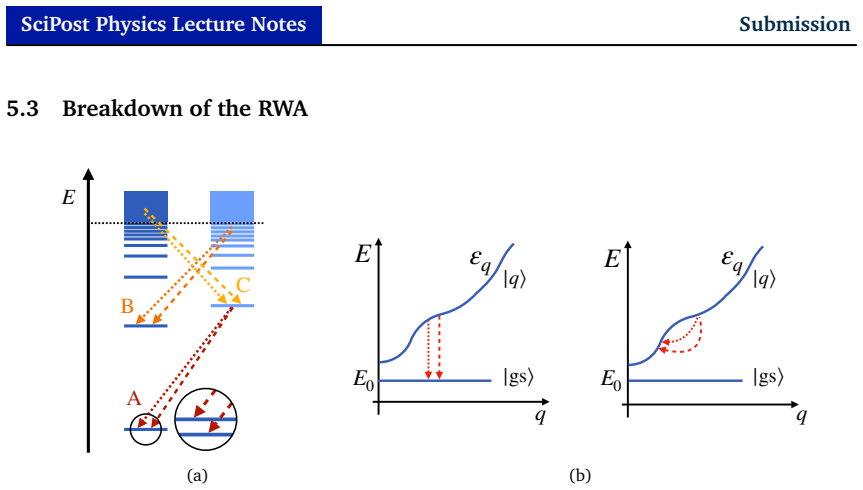
The folklore that the three standard approximations are broadly safe needs refinement; through accessible case studies the paper shows that the Markov approximation can break in strongly correlated or driven systems, the Born approximation requires sufficiently weak coupling that is often violated in many-body contexts, and the Rotating Wave Approximation can fail when driving frequencies are not well separated from system timescales, and it synthesizes these insights into a practical checklist for assessing applicability.
What carries the argument
A checklist that contrasts common lore with refined expectations about the validity of the Born, Markov, and Rotating Wave approximations in the Lindblad master equation.
If this is right
- In open quantum many-body systems the Markov approximation often fails earlier than textbooks suggest.
- Driven-open simulators provide direct tests that can expose the limits of the Rotating Wave Approximation.
- The Born approximation requires weaker system-bath coupling than is commonly assumed when interactions are strong.
- Practitioners should check all three approximations separately rather than invoking the full Lindblad framework by default.
Where Pith is reading between the lines
- Experimenters could design targeted measurements to quantify the error introduced by each approximation in a given platform.
- The checklist suggests a systematic way to decide when non-Markovian or non-perturbative master equations are required instead.
- Similar refinement exercises could be applied to other standard approximations in quantum optics and condensed-matter theory.
Load-bearing premise
The selected examples and case studies are representative enough of open quantum many-body systems and driven-open simulators to support generalized expectations about when the approximations break.
What would settle it
An experiment on a driven-open quantum simulator in which the checklist predicts the Lindblad equation should hold yet measured dynamics show clear non-Lindblad features such as non-exponential decay or unexpected correlations.
Figures




read the original abstract
The Lindblad master equation is a foundational tool for modeling the dynamics of open quantum systems. As its use has extended far beyond its original domain, the boundaries of its validity have grown opaque. In particular, the rise of new research areas including open quantum many-body systems, non-equilibrium condensed matter, and the possibility to test its limits in driven-open quantum simulators, call for a critical revision of its regimes of applicability. In this pedagogical review, we re-examine the folklore surrounding its three standard approximations (Born, Markov, and Rotating Wave Approximation), as we build our narrative by employing a series of examples and case studies accessible to any reader with a solid background on the fundamentals of quantum mechanics. As a synthesis of our work, we offer a checklist that contrasts common lore with refined expectations, offering a practical guideline for assessing the breakdown of the Lindblad framework in the problem at hand.
Editorial analysis
A structured set of objections, weighed in public.
Referee Report
Summary. The manuscript is a pedagogical review of the Lindblad master equation that re-examines the Born, Markov, and Rotating Wave Approximations through accessible examples and case studies drawn from open quantum systems. It contrasts common folklore with refined expectations and synthesizes the discussion into a practical checklist for assessing when the Lindblad framework breaks down, with emphasis on emerging areas such as open quantum many-body systems, non-equilibrium condensed matter, and driven-open quantum simulators.
Significance. If the examples are representative and the refined expectations hold, the checklist could serve as a useful practical guideline for researchers applying the Lindblad equation outside its original regime. The narrative, example-driven approach is well-suited to a review and aids accessibility for readers with standard quantum mechanics background. The work synthesizes established results rather than deriving new theorems, so its value lies in clarifying boundaries for modern applications.
major comments (1)
- [Checklist synthesis and case studies section] The central claim that the checklist provides a general guideline for open quantum many-body systems and driven-open simulators rests on the representativeness of the selected case studies. If regimes involving long-range interactions or critical slowing are omitted, the refined expectations for breakdown mechanisms (non-Markovian effects, strong coupling, many-body correlations) may not transfer reliably to the targeted new research areas.
minor comments (2)
- [Introduction] The notation distinguishing the three approximations could be introduced more explicitly in the opening sections to aid readers following the narrative.
- [Figures] A few figure captions would benefit from additional labels clarifying which approximation is being tested in each panel.
Simulated Author's Rebuttal
We thank the referee for their careful reading of the manuscript and for the constructive feedback. We address the major comment below and indicate the changes made to strengthen the discussion of the checklist's applicability.
read point-by-point responses
-
Referee: [Checklist synthesis and case studies section] The central claim that the checklist provides a general guideline for open quantum many-body systems and driven-open simulators rests on the representativeness of the selected case studies. If regimes involving long-range interactions or critical slowing are omitted, the refined expectations for breakdown mechanisms (non-Markovian effects, strong coupling, many-body correlations) may not transfer reliably to the targeted new research areas.
Authors: We agree that the representativeness of the case studies is important for supporting the checklist as a general guideline. The examples were selected for pedagogical accessibility while illustrating the core breakdown mechanisms tied to the Born, Markov, and rotating-wave approximations. Although long-range interactions and critical slowing are not treated as dedicated case studies, the checklist itself is formulated in terms of general physical criteria (timescale separation, coupling strength, and correlation structure) that remain relevant in those regimes. In the revised manuscript we have added a paragraph in the checklist synthesis section that explicitly discusses how long-range couplings can modify the Markovian assumption through altered bath correlation functions and how critical slowing can exacerbate non-Markovian effects. We also cite representative literature on open quantum many-body systems with long-range interactions to indicate where the checklist may require supplementary checks. A fully exhaustive survey of every possible regime lies outside the scope of this pedagogical review, but the added discussion clarifies the intended range of applicability. revision: partial
Circularity Check
No circularity in pedagogical review of Lindblad approximations
full rationale
This is a review paper that re-examines established approximations (Born, Markov, RWA) through examples and case studies to produce a practical checklist. No new derivations, equations, fitted parameters, or predictions are presented that could reduce to self-definitional inputs or self-citation chains. The synthesis relies on accessible narrative from fundamentals rather than any load-bearing reduction to prior author results as unverified inputs, rendering the work self-contained against external benchmarks.
Axiom & Free-Parameter Ledger
axioms (1)
- standard math Standard assumptions of quantum mechanics and the theory of open quantum systems as stated in the abstract
Forward citations
Cited by 4 Pith papers
-
Kinetically constrained superradiance
Kinetically constrained superradiance splits Dicke superradiance into selective collective decay channels that trap finite-momentum spin waves and produce dissipation-generated entanglement.
-
One knob to tune them all: Phase-controlled photon statistics and linewidth in partially pumped atomic ensembles
In partially pumped atomic ensembles, a tunable relative phase between pumped and unpumped emission contributions allows control of linewidth scaling and photon statistics from antibunched to bunched.
-
One knob to tune them all: Phase-controlled photon statistics and linewidth in partially pumped atomic ensembles
In a minimal model of partially pumped atomic ensembles, collective dissipation induces interference that allows tuning linewidth from size-independent to extensive and photon statistics from antibunched to bunched vi...
-
Quantum Dynamics: A Dilation-Based Approach
This thesis reviews and organizes dilation-based representations of quantum channel curves as an alternative to standard reduced dynamics in finite dimensions.
Reference graph
Works this paper leans on
-
[1]
C. Cohen-Tannoudji, G. Grynberg and J. Dupont-Roc, Atom-Photon Interac- tions: Basic Processes and Applications , John Wiley & Sons, Ltd, New York, doi:https://doi.org/10.1002/9783527617197 (1998)
-
[2]
M. A. Nielsen and I. L. Chuang,Quantum Computation and Quantum Information, Cam- bridge University Press, doi:https: //doi.org/10.1017/CBO9780511976667 (2000)
-
[3]
E. Joos, H. D. Zeh, C. Kiefer, D. J. Giulini, J. Kupsch and I.-O. Stamatescu, Decoherence and the appearance of a classical world in quantum theory, Springer Science & Business Media, doi:https: //doi.org/10.1007/978-3-662-05328-7 (2013)
-
[4]
Quantum Noise in Quantum Optics: the Stochastic Schr\"odinger Equation
P . Zoller and C. W . Gardiner, Quantum Noise in Quantum Optics: the Stochastic Schrödinger Equation (1997), quant-ph/9702030
work page internal anchor Pith review Pith/arXiv arXiv 1997
-
[5]
The many facets of geometry , PAGES =
H.-P . Breuer and F . Petruccione,The theory of open quantum systems, Oxford University Press, Oxford, doi:10.1093 /acprof:oso/9780199213900.001.0001 (2002)
-
[6]
M. O. Scully and M. S. Zubairy , Quantum Optics , Cambridge University Press, doi:https://doi.org/10.1017/CBO9780511813993 (1997)
-
[7]
U. Weiss, Quantum dissipative systems , World Scientific, doi:https://doi.org/10.1142/8334 (2012)
- [8]
-
[9]
H. Weimer, A. Kshetrimayum and R. Orús, Simulation methods for open quantum many-body systems , Rev. Mod. Phys. 93, 015008 (2021), doi:10.1103/RevModPhys.93.015008
-
[10]
L. M. Sieberer, M. Buchhold, J. Marino and S. Diehl,Universality in driven open quantum matter, Rev. Mod. Phys. 97, 025004 (2025), doi:10.1103 /RevModPhys.97.025004. 62 SciPost Physics Lecture Notes Submission
work page 2025
- [11]
-
[12]
M. Mitrano, S. Johnston, Y.-J. Kim and M. P . M. Dean, Exploring Quantum Ma- terials with Resonant Inelastic X-Ray Scattering , Phys. Rev. X 14, 040501 (2024), doi:10.1103/PhysRevX.14.040501
-
[13]
A. de la Torre, D. M. Kennes, M. Claassen, S. Gerber, J. W . McIver and M. A. Sentef, Colloquium: Nonthermal pathways to ultrafast control in quantum materials, Rev. Mod. Phys. 93, 041002 (2021), doi:10.1103 /RevModPhys.93.041002
work page 2021
- [14]
-
[15]
M. Aspelmeyer, T . J. Kippenberg and F . Marquardt, Cavity optomechanics, Rev. Mod. Phys. 86, 1391 (2014), doi:10.1103 /RevModPhys.86.1391
work page 2014
-
[16]
H. M. Wiseman and G. J. Milburn, Quantum Measurement and Control , Cambridge University Press, doi:https: //doi.org/10.1017/CBO9780511813948 (2010)
-
[17]
V . Gorini, A. Kossakowski and E. C. G. Sudarshan, Completely positive dynam- ical semigroups of N-level systems , Journal of Mathematical Physics 17(5), 821 (1976), doi:10.1063/1.522979, https://pubs.aip.org/aip/jmp/article-pdf/17/5/821/ 19090720/821_1_online.pdf
-
[18]
G. Lindblad, On the generators of quantum dynamical semigroups, Communications in Mathematical Physics 48(2), 119 (1976), doi:10.1007 /BF01608499
work page 1976
-
[19]
E. B. Davies, Markovian master equations, Communications in Mathematical Physics 39(2), 91 (1974), doi:https: //doi.org/10.1007/BF01608389
-
[20]
E. B. Davies,Markovian Master Equations. II., Mathematische Annalen219, 147 (1976), doi:https://doi.org/10.1007/BF01351898
-
[21]
Spohn, Kinetic equations from hamiltonian dynamics: Markovian limits , Rev
H. Spohn, Kinetic equations from hamiltonian dynamics: Markovian limits , Rev. Mod. Phys. 52, 569 (1980), doi:10.1103 /RevModPhys.52.569
work page 1980
-
[22]
R. Dümcke and H. Spohn, The proper form of the generator in the weak cou- pling limit , Zeitschrift fur Physik B Condensed Matter 34(4), 419 (1979), doi:10.1007/BF01325208
-
[23]
F . Thompson and A. Kamenev,Field theory of many-body Lindbladian dynamics, Annals of Physics 455, 169385 (2023), doi:https: //doi.org/10.1016/j.aop.2023.169385
-
[24]
R. Hartmann and W . T . Strunz, Accuracy assessment of perturbative mas- ter equations: Embracing nonpositivity , Physical Review A 101(1) (2020), doi:10.1103/physreva.101.012103
-
[25]
P . R. Eastham, P . Kirton, H. M. Cammack, B. W . Lovett and J. Keeling, Bath- induced coherence and the secular approximation , Phys. Rev. A 94, 012110 (2016), doi:10.1103/PhysRevA.94.012110
- [26]
-
[27]
F . Nathan and M. S. Rudner,Universal lindblad equation for open quantum systems, Phys. Rev. B102, 115109 (2020), doi:10.1103 /PhysRevB.102.115109
work page 2020
- [28]
-
[29]
F . Haake,On a non-markoffian master equation , Zeitschrift für Physik A Hadrons and nuclei 223, 353–363 (1969)
work page 1969
- [30]
-
[31]
J. I. Cirac, P . Zoller, H. J. Kimble and H. Mabuchi,Quantum state transfer and entangle- ment distribution among distant nodes in a quantum network , Physical Review Letters 78(16), 3221 (1997), doi:10.1103 /PhysRevLett.78.3221
work page 1997
-
[32]
C. M. Bender and S. A. Orszag, Advanced Mathematical Methods for Scientists and En- gineers I: Asymptotic Methods and Perturbation Theory , Springer, New York, NY, ISBN 978-0-387-98931-0, doi:10.1007 /978-1-4757-3069-2 (1999)
work page 1999
-
[33]
S. Milz, M. Kim, F . A. Pollock and K. Modi, Completely positive divisi- bility does not mean markovianity , Physical Review Letters 123(4) (2019), doi:10.1103/physrevlett.123.040401
-
[34]
V . Reimer, M. R. Wegewijs, K. Nestmann and M. Pletyukhov, Five ap- proaches to exact open-system dynamics: Complete positivity, divisibility, and time- dependent observables , The Journal of Chemical Physics 151(4), 044101 (2019), doi:10.1063/1.5094412, https: //pubs.aip.org/aip/jcp/article-pdf/doi/10.1063/1. 5094412/15562533/044101_1_online.pdf
-
[35]
A. Rivas, S. F . Huelga and M. B. Plenio, Quantum non-markovianity: characterization, quantification and detection , Reports on Progress in Physics 77(9), 094001 (2014), doi:10.1088/0034-4885/77/9/094001
-
[36]
B. Vacchini, A. Smirne, E.-M. Laine, J. Piilo and H.-P . Breuer, Markovianity and non- markovianity in quantum and classical systems, New Journal of Physics 13(9), 093004 (2011), doi:10.1088 /1367-2630/13/9/093004
work page 2011
-
[37]
B. Canturk and H.-P . Breuer, On positively divisible non-markovian processes (2024), 2401.12715
-
[38]
An Ontology-based Representation for Shaping Product Evolution in Regulated Industries,
R. Bhattacharya and E. Waymire, Semigroup Theory and Markov Processes, pp. 17–34, Springer International Publishing, Cham, ISBN 978-3-031-33296-8, doi:10.1007/978- 3-031-33296-8_2 (2023)
-
[39]
A. Trushechkin, Unified gorini-kossakowski-lindblad-sudarshan quantum master equation beyond the secular approximation , Phys. Rev. A 103, 062226 (2021), doi:10.1103/PhysRevA.103.062226
-
[40]
The Impressive Power of Stopwatches
R. Alicki, Invitation to quantum dynamical semigroups , vol. 597 of Lecture notes in Physics, Springer Science & Business Media, Berlin, doi:https: //doi.org/10.1007/3- 540-46122-1 (2002)
work page doi:10.1007/3- 2002
-
[41]
C. S. Tello Breuer, T . Becker and A. Eckardt, Benchmarking quantum mas- ter equations beyond ultraweak coupling , Phys. Rev. B 110, 064319 (2024), doi:10.1103/PhysRevB.110.064319. 64 SciPost Physics Lecture Notes Submission
- [42]
-
[43]
V . Gorini, A. Frigerio, M. Verri, A. Kossakowski and E. Sudarshan, Properties of quan- tum markovian master equations, Reports on Mathematical Physics 13(2), 149 (1978), doi:https://doi.org/10.1016/0034-4877(78)90050-2
-
[44]
A. Suárez, R. Silbey and I. Oppenheim,Memory effects in the relaxation of quantum open systems, The Journal of Chemical Physics 97(7), 5101 (1992), doi:10.1063/1.463831, https://pubs.aip.org/aip/jcp/article-pdf/97/7/5101/19001972/5101_1_online.pdf
-
[45]
K. Hepp and E. H. Lieb, Phase Transitions in Reservoir-Driven Open Systems with Appli- cations to Lasers and Superconductors, pp. 145–175, Springer Berlin Heidelberg, Berlin, Heidelberg, ISBN 978-3-662-06390-3, doi:10.1007 /978-3-662-06390-3_13 (1973)
work page 1973
-
[46]
P . F . Palmer,The singular coupling and weak coupling limits , Journal of Mathematical Physics 18(3), 527 (1977), doi:10.1063 /1.523296, https: //pubs.aip.org/aip/jmp/ article-pdf/18/3/527/19127035/527_1_online.pdf
work page 1977
-
[47]
Mori,Strong markov dissipation in driven-dissipative quantum systems (2024), 2404
T . Mori,Strong markov dissipation in driven-dissipative quantum systems (2024), 2404. 10195
work page 2024
- [48]
-
[49]
Barchielli, Measurement theory and stochastic differential equations in quantum me- chanics, Phys
A. Barchielli, Measurement theory and stochastic differential equations in quantum me- chanics, Phys. Rev. A 34, 1642 (1986), doi:10.1103 /PhysRevA.34.1642
work page 1986
-
[50]
A. Kiely ,Exact classical noise master equations: Applications and connections, Europhysics Letters 134(1), 10001 (2021), doi:10.1209 /0295-5075/134/10001
work page 2021
-
[51]
P . Groszkowski, A. Seif, J. Koch and A. A. Clerk, Simple master equations for describ- ing driven systems subject to classical non-Markovian noise , Quantum 7, 972 (2023), doi:10.22331/q-2023-04-06-972
-
[52]
A. Schnell, Global becomes local: Efficient many-body dynamics for global master equa- tions (2025), 2309.07105
-
[53]
C. H. Fleming and N. I. Cummings, Accuracy of perturbative master equations , Phys. Rev. E83, 031117 (2011), doi:10.1103 /PhysRevE.83.031117
work page 2011
-
[54]
L. D. Landau and E. M. Lifshitz, Statistical Physics, Butterworth-Heinemann, Oxford, third edition edn., ISBN 978-0-08-057046-4, doi:https://doi.org/10.1016/B978-0-08- 057046-4.50005-1 (1980)
-
[55]
A. Rivas and S. F . Huelga, Open quantum systems: An Introduction , vol. 10, Springer, doi:https://doi.org/10.1007/978-3-642-23354-8 (2012)
-
[56]
L. D’Alessio, Y. Kafri, A. Polkovnikov and M. Rigol,From quantum chaos and eigenstate thermalization to statistical mechanics and thermodynamics, Advances in Physics 65(3), 239 (2016), doi:10.1080 /00018732.2016.1198134
-
[57]
E. Kleinherbers, N. Szpak, J. König and R. Schützhold, Relaxation dynamics in a hub- bard dimer coupled to fermionic baths: Phenomenological description and its microscopic foundation, Phys. Rev. B 101, 125131 (2020), doi:10.1103 /PhysRevB.101.125131. 65 SciPost Physics Lecture Notes Submission
work page 2020
-
[58]
X. Li, J. Marino, D. E. Chang and B. Flebus, Solid-state platform for cooperative quantum dynamics driven by correlated emission , Phys. Rev. B 111, 064424 (2025), doi:10.1103/PhysRevB.111.064424
-
[59]
R. H. Dicke, Coherence in spontaneous radiation processes , Phys. Rev. 93, 99 (1954), doi:10.1103/PhysRev.93.99
-
[60]
M. Gross and S. Haroche, Superradiance: An essay on the theory of collective sponta- neous emission, Physics Reports93(5), 301 (1982), doi:https://doi.org/10.1016/0370- 1573(82)90102-8
- [61]
-
[62]
S. J. Masson, I. Ferrier-Barbut, L. A. Orozco, A. Browaeys and A. Asenjo-Garcia, Many- body signatures of collective decay in atomic chains, Phys. Rev. Lett.125, 263601 (2020), doi:10.1103/PhysRevLett.125.263601
-
[63]
E. Shahmoon, D. S. Wild, M. D. Lukin and S. F . Yelin, Cooperative resonances in light scattering from two-dimensional atomic arrays , Phys. Rev. Lett. 118, 113601 (2017), doi:10.1103/PhysRevLett.118.113601
-
[64]
M. Scala, B. Militello, A. Messina, J. Piilo and S. Maniscalco, Microscopic derivation of the jaynes-cummings model with cavity losses , Phys. Rev. A 75, 013811 (2007), doi:10.1103/PhysRevA.75.013811
-
[65]
F . Beaudoin, J. M. Gambetta and A. Blais,Dissipation and ultrastrong coupling in circuit qed, Phys. Rev. A 84, 043832 (2011), doi:10.1103 /PhysRevA.84.043832
work page 2011
- [66]
-
[67]
R. Betzholz, B. G. Taketani and J. M. Torres, Breakdown signatures of the phenomeno- logical lindblad master equation in the strong optomechanical coupling regime, Quantum Science and Technology 6(1), 015005 (2020), doi:10.1088 /2058-9565/abc39d
work page 2020
-
[68]
P . P . Hofer, M. Perarnau-Llobet, L. D. M. Miranda, G. Haack, R. Silva, J. B. Brask and N. Brunner, Markovian master equations for quantum thermal machines: local versus global approach, New Journal of Physics 19(12), 123037 (2017), doi:10.1088 /1367- 2630/aa964f
work page 2017
-
[69]
M. T . Mitchison and M. B. Plenio, Non-additive dissipation in open quantum networks out of equilibrium, New Journal of Physics 20(3), 033005 (2018), doi:10.1088 /1367- 2630/aa9f70
work page 2018
-
[70]
J. O. González, L. A. Correa, G. Nocerino, J. P . Palao, D. Alonso and G. Adesso, Testing the Validity of the ‘Local’ and ‘Global’ GKLS Master Equations on an Exactly Solvable Model , Open Systems & Information Dynamics 24(04), 1740010 (2017), doi:10.1142/S1230161217400108, https: //doi.org/10.1142/S1230161217400108
-
[71]
K. Shiraishi, M. Nakagawa, T . Mori and M. Ueda, Quantum master equation for many- body systems based on the Lieb-Robinson bound , Phys. Rev. B 111, 184311 (2025), doi:10.1103/PhysRevB.111.184311. 66 SciPost Physics Lecture Notes Submission
-
[72]
T . Werlang, M. A. Marchiori, M. F . Cornelio and D. Valente, Optimal recti- fication in the ultrastrong coupling regime , Phys. Rev. E 89, 062109 (2014), doi:10.1103/PhysRevE.89.062109
-
[73]
A. Levy and R. Kosloff, The local approach to quantum transport may violate the second law of thermodynamics, Europhysics Letters 107(2), 20004 (2014), doi:10.1209/0295- 5075/107/20004
-
[74]
D. Tupkary , A. Dhar, M. Kulkarni and A. Purkayastha,Fundamental limitations in lind- blad descriptions of systems weakly coupled to baths, Phys. Rev. A 105, 032208 (2022), doi:10.1103/PhysRevA.105.032208
-
[75]
E. V . Goldstein and P . Meystre,Dipole-dipole interaction in optical cavities, Phys. Rev. A 56, 5135 (1997), doi:10.1103 /PhysRevA.56.5135
work page 1997
-
[76]
A. Kamenev, Field theory of non-equilibrium systems , Cambridge University Press, doi:https://doi.org/10.1017/9781108769266 (2023)
-
[77]
D. A. Steck, Quantum and Atom Optics , Available online at http: //steck.us/teaching (revision 0.10.0,3 September 2014)
work page 2014
- [78]
-
[79]
R. E. A. C. Paley and N. Wiener, Fourier transforms in the complex domain , vol. 19, American Mathematical Society , Providence, Rhode Island, Theorem XII (1934)
work page 1934
-
[80]
L. A. Khalfin, Contribution to the decay theory of a quasi-stationary state , Sov. Phys. JETP 6 (1958)
work page 1958
discussion (0)
Sign in with ORCID, Apple, or X to comment. Anyone can read and Pith papers without signing in.