REVIEW 5 major objections 5 minor 40 references
Privacy-aware IoT Fall Detection Services For Aging in Place
T0 review · 5 major / 5 minor · reviewed 2026-08-15 · deepseek-v4-flash
Pith's one-line read This paper proposes a privacy-preserving fall detection service using UWB radar and generative augmentation, reporting 90.72% balanced accuracy and 89.33% F1-score in distinguishing falls from everyday activities.
desk verdict This is a modest empirical paper with a new UWB radar fall dataset and a TTS-GAN/InceptionTime combination, but a data-split leakage undermines the central numbers and the comparative claim. read the letter →
The pith
A machine-rendered reading of the paper's core claim, the machinery that carries it, and where it could break.
The reading
What carries the argument
The load-bearing mechanism is FD-GPT, the Fall Detection Generative Pre-trained Transformer pipeline: a TTS-GAN, a transformer-based time-series generative adversarial network, produces synthetic fall sequences to rebalance the training set, and one of four time-series classifiers (FCN, ResNet, LSTM, or InceptionTime) is trained on the augmented data. An 8-second fixed window with 1-second stride turns continuous radar streams into classification samples, and the FD-Prompt rule layer selects a model based on age, health condition, and resource availability. The UWB radar provides the non-intrusive sensor stream.
What would settle it
Collect UWB radar recordings from actual older adults falling in supervised trials and run the trained InceptionTime-plus-TTS-GAN pipeline on them; if balanced accuracy drops materially below the reported 90.72%, the actor-data assumption is the likely cause. A cheaper check is testing the pipeline on an existing public radar dataset of real falls.
Extended reading notes
Core claim
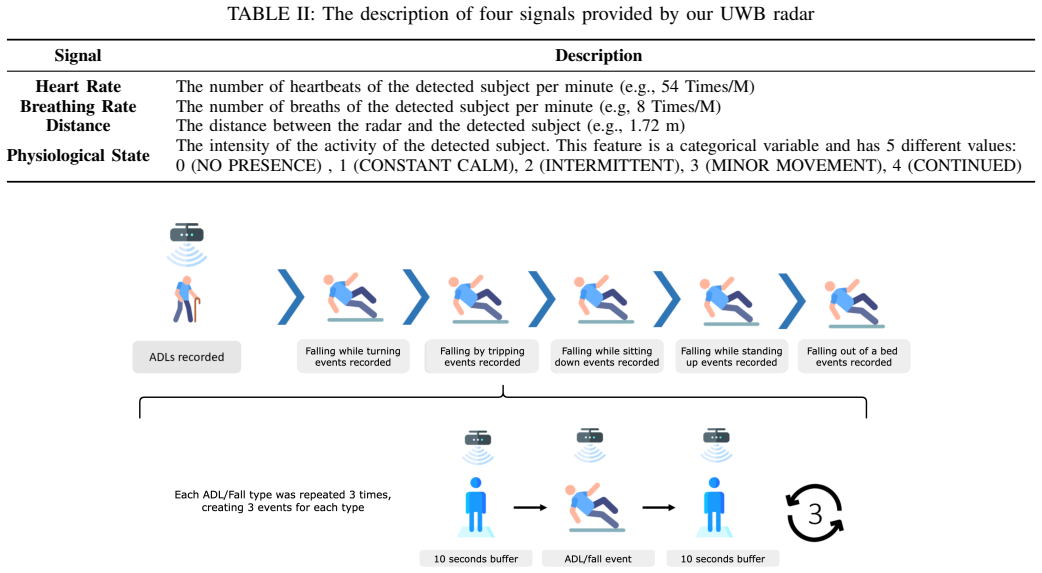
The central discovery is a working combination of sensing and learning: an off-the-shelf UWB radar supplies four privacy-preserving signals (heart rate, breathing rate, distance, and physiological state), and FD-GPT uses a TTS-GAN to synthesize fall samples that balance a heavily imbalanced dataset before training classifiers. On the collected dataset, InceptionTime trained with TTS-GAN augmented data reaches the best results, 90.72% balanced accuracy and 89.33% F1-score, outperforming no augmentation, class-weighted losses, random oversampling, and SMOTE. The paper attributes the gain to TTS-GAN approximating the true fall distribution and generating samples closer to test-set falls, and attributes InceptionTime's edge to its parallel convolutional kernels capturing different time scales. This is offered as the core of a Fall Detection-as-a-Service (FDaaS) framework that also includes a rule-based prompt layer for context-aware model selection.
Load-bearing premise
The load-bearing premise is that falls performed by ten young actors trained to mimic elderly behavior produce UWB radar signals representative of genuine elderly falls, and no validation against real elderly fall data is provided.
Editorial extensions
If this is right
- With TTS-GAN augmentation, all four classifiers improve over no augmentation and over SMOTE, indicating that generative oversampling can substitute for larger real fall datasets.
- InceptionTime is the strongest fall detector in these experiments, suggesting multi-scale convolutional time-series architectures suit radar fall signatures.
- FDaaS reframes fall detection as an IoT service with QoS attributes, enabling context-aware tradeoffs such as prioritizing latency for high-risk residents.
- UWB radar signals alone are sufficient to separate falls from daily activities, so fall alerting need not depend on cameras or wearable sensors.
Reading between the lines
- Because every fall in the dataset was acted by a young adult, real-world accuracy is likely lower; a deployment trial with actual older adults would be the decisive test.
- The 8-second window and 1-second stride are a design choice; testing window length and stride sensitivity would show whether the reported accuracy depends on this particular segmentation.
- The FD-Prompt rules are plausible but untested; comparing prompt-selected models against always-InceptionTime would quantify whether context-aware selection adds value.
- The 0.8513 average cosine similarity between real and synthetic fall samples measures distribution overlap, not detection utility; an ablation using varying amounts of real fall data would clarify how much TTS-GAN contributes.
Signed reviews
Editorial analysis
A structured set of objections, weighed in public.
Referee Report
Summary. The paper proposes FDaaS, a service-oriented fall-detection framework for smart homes that uses UWB radar sensing to preserve privacy. The framework includes FD-GPT, a data-augmentation pipeline based on TTS-GAN, and FD-Prompt, a rule-based context-aware model-selection module. The authors collect a new dataset of simulated elderly falls and ADLs from 10 younger actors, obtain 250 fall and 8880 ADL samples after preprocessing, and evaluate FCN, ResNet, LSTM, and InceptionTime classifiers under five imbalance-handling methods. The best reported result is a balanced accuracy of 90.72% and an F1 score of 89.33% for InceptionTime with TTS-GAN augmentation.
Significance. A privacy-preserving UWB-radar fall-detection service with generative augmentation is a relevant contribution to smart-aging IoT research. The paper's strengths are the explicit service abstraction, the systematic comparison of several augmentation methods, and the detailed data-collection protocol. However, the central empirical claims are currently not established because the train/test split leaks temporal context through overlapping sliding windows, the headline metrics are mislabeled in the abstract and the F1 formula is nonstandard, no uncertainty estimates are provided, and the FD-Prompt component is not implemented or validated. The dataset also comes only from younger actors, with no external validation on real elderly subjects. If the evaluation is redone with a leakage-free split and corrected metrics, the approach may still be of value, but the present evidence does not support the stated performance.
major comments (5)
- [Section IV-A.4 (Data Split)] The random 80/20 split of ADL samples is applied after sliding an 8-second window with a 1-second stride, without grouping by participant or recording session. Consequently, a test window can overlap a training window from the same continuous recording by up to 7 seconds, and the same subject appears on both sides of the split. Such near-duplicate windows make the time-series classification task nearly trivial and can inflate the reported 90.72% balanced accuracy in Table IV and the claim in Section IV-D that TTS-GAN significantly outperforms INS (88.24). The evaluation should be redone with a subject-wise or recording-session-wise split and with non-overlapping windows.
- [Section IV-C.2, Eq. (5)] The paper defines F1-score as 2*sensitivity*specificity/(sensitivity+specificity), which is not the standard F1 metric (the harmonic mean of precision and recall). On an imbalanced dataset, specificity is not a substitute for precision, so the values reported as F1 in Table V are not F1 scores. The abstract's claim of '89.33% precision' is actually this nonstandard quantity. Please correct the metric definition and report true precision and F1.
- [Section IV-D, Tables IV and V] The claim that TTS-GAN significantly improves performance is not supported by any measure of uncertainty. The tables report single runs with no standard deviations, confidence intervals, or repeated-seed experiments. For deep learning classifiers, the observed gap between TTS-GAN (90.72) and INS (88.24) could be within run-to-run variability. Please add repeated runs with different seeds and an appropriate statistical comparison.
- [Section III-C and Algorithm 1] FD-Prompt is presented as a core component of the FDaaS framework, but the manuscript states that its full rule-based optimization will be addressed in future work and that the model-selection criteria in Algorithm 1 are 'based on logical assumptions rather than expert evaluation or experimental validation.' No experiment evaluates FD-Prompt, so the paper does not validate the claim of delivering a context-aware FDaaS service; only the FD-GPT component is tested.
- [Section IV-A.1.4] The dataset is collected from 10 younger actors with a mean age of 24.1 who are trained to mimic elderly behavior, and no evaluation is performed on real elderly subjects or on the public FallAllD dataset cited as [14]. UWB radar signals of falls likely depend on body morphology and movement dynamics, so the reported detection performance may not transfer to the target population. Please add a validation experiment on real elderly data or an external benchmark, or clearly scope the claims to simulated settings.
minor comments (5)
- [Table I] The code 'RIB' is used for both 'Rising up from a bed' and 'Standing up from a bed edge', which is ambiguous and should be disambiguated.
- [Section IV-A] The subsection numbering jumps from 1.2 to 1.4; subsection 1.3 appears to be missing.
- [Title and Section III-B] The name 'Fall Detection Generative Pre-trained Transformer (FD-GPT)' is used for a pipeline built on TTS-GAN, but the paper does not describe a pre-trained transformer architecture of its own; this name may mislead readers about the novelty of the generative component.
- [Section IV-C.1 and Fig. 9] The average cosine similarity of 0.8513 is reported without explaining how many synthetic samples were generated, how the real-synthetic pairs were formed, or whether the reported value is a mean over all pairs or over per-class averages; please clarify.
- [Section IV-A.4] After data augmentation, the class counts used for training are not reported; please state the final number of fall and ADL samples after each augmentation method.
Circularity Check
No significant circularity: the central detection result is an empirical evaluation on a test split, and self-citations are background only.
full rationale
The paper's main claim is the measured fall-detection performance (Tables IV–V) after training on an 80% split and testing on the remaining 20% (Section IV-A.4: 'we randomly split the dataset into a training set (80%), and a test set (20%) while keeping the ratio of ADLs and fall samples unchanged'). The TTS-GAN augmentation is trained on the training split only, and its similarity check (average cosine similarity 0.8513, Eq. 2) is a sanity check of synthetic samples against real training data, not the reported detection accuracy. The reported accuracy/F1 numbers are therefore empirically measured on samples not used in training, not derived from the inputs by construction. The only self-citations ([2] service definitions, [34] WITSCare related work) are background or related-work context and do not carry the central claim. The FD-Prompt algorithm is admittedly not validated ('proposed based on logical assumptions rather than expert evaluation or experimental validation') and is marked as future work, so it is not a circularly justified prediction. The skeptical concern about randomly splitting overlapping sliding windows and same-subject leakage is a validity risk in the experimental protocol, not a circularity of the derivation chain; it does not make the reported accuracy equivalent to the training fit by definition. No reduction of Eq. X to Eq. Y or fitted parameter renamed as prediction was found.
Assumptions & free parameters
free parameters (13)
- beta (weighted loss) =
0.9999
- gamma (weighted loss) =
2
- TTS-GAN learning rate =
2e-4
- TTS-GAN batch size =
16
- TTS-GAN weight decay =
1e-3
- Fall detection learning rate =
1e-5
- Fall detection batch size =
64
- Fall detection weight decay =
1e-4
- Training epochs =
60 (GAN), 100 (classifiers)
- Window size =
8 seconds
- Sliding window stride =
1 second
- Epsilon for standardization =
1e-10
- Train/test split ratio =
80/20
assumptions (5)
- domain assumption Simulated falls by young actors are representative of real elderly falls for UWB radar signals.
- domain assumption UWB radar measurements (heart rate, breathing rate, distance, physiological state) contain sufficient information to distinguish falls from ADLs.
- domain assumption TTS-GAN generated fall samples approximate the true fall distribution well enough to improve classifier generalization.
- domain assumption Falls can be captured by an 8-second window centered on the event timestamp.
- domain assumption Class balancing via augmentation does not introduce harmful bias.
Cite this review
Pith. "Pith review of Privacy-aware IoT Fall Detection Services For Aging in Place." pith.science (2026). https://pith.science/paper/LF2Q23LG
@misc{pith2026250622462,
  author       = {Pith},
  title        = {Pith review of: Privacy-aware IoT Fall Detection Services For Aging in Place},
  year         = {2026},
  howpublished = {\url{https://pith.science/paper/LF2Q23LG}},
  note         = {Machine review of arXiv:2506.22462}
}
read the original abstract
Fall detection is critical to support the growing elderly population, projected to reach 2.1 billion by 2050. However, existing methods often face data scarcity challenges or compromise privacy. We propose a novel IoT-based Fall Detection as a Service (FDaaS) framework to assist the elderly in living independently and safely by accurately detecting falls. We design a service-oriented architecture that leverages Ultra-wideband (UWB) radar sensors as an IoT health-sensing service, ensuring privacy and minimal intrusion. We address the challenges of data scarcity by utilizing a Fall Detection Generative Pre-trained Transformer (FD-GPT) that uses augmentation techniques. We developed a protocol to collect a comprehensive dataset of the elderly daily activities and fall events. This resulted in a real dataset that carefully mimics the elderly's routine. We rigorously evaluate and compare various models using this dataset. Experimental results show our approach achieves 90.72% accuracy and 89.33% precision in distinguishing between fall events and regular activities of daily living.
Figures


Figures from the paper (9 more)




Reference graph
Works this paper leans on
-
[14]
M. Salehet al., “Fallalld: An open dataset of human falls and activities of daily living for classical and deep learning applications,”IEEE Sensors, vol. 21, no. 2, 2021
work page 2021
-
[1]
Internet of things: A survey on enabling tech- nologies, protocols, and applications,
A. Al-Fuqahaet al., “Internet of things: A survey on enabling tech- nologies, protocols, and applications,”IEEE comm. surveys & tutorials, vol. 17, no. 4, pp. 2347–2376, 2015
work page 2015
-
[2]
Dynamic conflict resolution of iot services in smart homes,
D. Chaki and A. Bouguettaya, “Dynamic conflict resolution of iot services in smart homes,” inICSOC. Springer, 2021, pp. 368–384
work page 2021
-
[3]
Analyzing the elderly users’ adoption of smart-home services,
D. Palet al., “Analyzing the elderly users’ adoption of smart-home services,”IEEE Access, vol. 6, pp. 51 238–51 252, 2018
work page 2018
-
[4]
Smart homes and quality of life for the elderly: a systematic review,
D. Pal, T. Triyason, and S. Funikul, “Smart homes and quality of life for the elderly: a systematic review,” in2017 IEEE international symposium on multimedia (ISM). IEEE, 2017, pp. 413–419
work page 2017
-
[5]
Emerging smart home technologies to facilitate engaging with aging,
Y . K. Choiet al., “Emerging smart home technologies to facilitate engaging with aging,”Journal of gerontological nursing, vol. 45, no. 12, pp. 41–48, 2019
work page 2019
-
[6]
w. h. organization, “Ageing and health,” Oct 2022. [On- line]. Available:https://www.who.int/news−room/f act− sheets/detail/ageing−and−health
work page 2022
-
[7]
A survey on recent advances in wearable fall detection systems,
A. Ramachandran and A. Karuppiah, “A survey on recent advances in wearable fall detection systems,”BioMed research, vol. 2020, no. 1, p. 2167160, 2020
work page 2020
Show all 40 references
-
[8]
“who wants to know all this stuff?!
S. Alkhatibet al., ““who wants to know all this stuff?!”: Understand- ing older adults’ privacy concerns in aged care monitoring devices,” Interacting with Computers, vol. 33, no. 5, p. 481–498, 11 2021
2021
-
[9]
Collaborative edge-cloud computing for personalized fall detection,
A. H. Nguet al., “Collaborative edge-cloud computing for personalized fall detection,” inAIAI. Springer, 2021, pp. 323–336
2021
-
[10]
Fall detection for elderly person care using convolutional neural networks,
X. Liet al., “Fall detection for elderly person care using convolutional neural networks,” inCISP-BMEI. IEEE, 2017, pp. 1–6
2017
-
[11]
A wearable fall detection system using deep learning,
E. Casilariet al., “A wearable fall detection system using deep learning,” inIEA/AIE. Springer, 2019, pp. 445–456
2019
-
[12]
Fall detection on a single doppler radar sensor by using convolutional neural networks,
H. Yoshinoet al., “Fall detection on a single doppler radar sensor by using convolutional neural networks,” inIEEE SMC. IEEE, 2019, pp. 2889–2892
2019
-
[13]
Transforming conversations with ai—a comprehensive study of chatgpt,
G. Bansalet al., “Transforming conversations with ai—a comprehensive study of chatgpt,”Cognitive Computation, pp. 1–24, 2024
2024
-
[15]
Adasyn: Adaptive synthetic sampling approach for imbalanced learning,
H. Heet al., “Adasyn: Adaptive synthetic sampling approach for imbalanced learning,” inIEEE CIC. Ieee, 2008, pp. 1322–1328
2008
-
[16]
Knnor: An oversampling technique for imbalanced datasets,
A. Islam, S. B. Belhaouari, A. U. Rehman, and H. Bensmail, “Knnor: An oversampling technique for imbalanced datasets,”Applied soft com- puting, vol. 115, p. 108288, 2022
2022
-
[17]
Class-balanced loss based on effective number of samples,
Y . Cuiet al., “Class-balanced loss based on effective number of samples,” inIEEE CVPR, June 2019
2019
-
[18]
Tts-gan: A transformer-based time-series generative adversarial network,
X. Liet al., “Tts-gan: A transformer-based time-series generative adversarial network,” inAIME. Springer, 2022, pp. 133–143
2022
-
[19]
Deep learning based fall detection algorithms for embedded systems, smartwatches, and iot devices using accelerometers,
D. Kraftet al., “Deep learning based fall detection algorithms for embedded systems, smartwatches, and iot devices using accelerometers,” Tech., vol. 8, no. 4, p. 72, 2020
2020
-
[20]
Fall detection with accelerometer data using residual networks adapted to multi-variate time series classi- fication,
A. Ramanathan and J. McDermott, “Fall detection with accelerometer data using residual networks adapted to multi-variate time series classi- fication,” inIJCNN, 2021, pp. 1–8
2021
-
[21]
Inceptiontime: Finding alexnet for time series classification,
H. Ismail Fawazet al., “Inceptiontime: Finding alexnet for time series classification,”Data Mining and Knowledge Discovery, vol. 34, no. 6, pp. 1936–1962, 2020
1936
-
[22]
Effect of sequence padding on the performance of deep learning models in archaeal protein functional prediction,
A. Lopez-del Rioet al., “Effect of sequence padding on the performance of deep learning models in archaeal protein functional prediction,” Scientific reports, vol. 10, no. 1, p. 14634, 2020
2020
-
[23]
Adam: A method for stochastic optimization,
D. P. Kingma and J. Ba, “Adam: A method for stochastic optimization,” arXiv preprint arXiv:1412.6980, 2014
2014 arXiv
-
[24]
An analysis on sensor locations of the human body for wearable fall detection devices: Principles and practice,
A. T. ¨Ozdemir, “An analysis on sensor locations of the human body for wearable fall detection devices: Principles and practice,”Sensors, vol. 16, no. 8, p. 1161, 2016
2016
-
[25]
Towards under- standing on the development of wearable fall detection: an experimental approach,
A. H. M. Yusoff, S. M. Salleh, and M. O. Tokhi, “Towards under- standing on the development of wearable fall detection: an experimental approach,”Health and Technology, vol. 12, no. 2, pp. 345–358, 2022
2022
-
[26]
Video-based human fall detection in smart homes using deep learning,
A. Shojaei-Hashemiet al., “Video-based human fall detection in smart homes using deep learning,” inISCAS. IEEE, 2018, pp. 1–5
2018
-
[27]
Vision-based fall detection with convolutional neural networks,
A. N ´u˜nez-Marcoset al., “Vision-based fall detection with convolutional neural networks,”Wireless communications and mobile computing, vol. 2017, 2017
2017
-
[28]
Autonomous fall detection with wearable cameras by using relative entropy distance measure,
K. a. Ozcan, “Autonomous fall detection with wearable cameras by using relative entropy distance measure,”IEEE THMS, vol. 47, no. 1, pp. 31– 39, 2016
2016
-
[29]
Range-doppler radar sensor fusion for fall detection,
B. Erol, M. G. Amin, and B. Boashash, “Range-doppler radar sensor fusion for fall detection,”IEEE Radar Conference, pp. 819–824, 2017
2017
-
[30]
Feature diversity for fall detection and human indoor activities classification using radar systems,
A. Shrestha, J. Le Kernec, F. Fioranelli, E. Cippitelli, E. Gambi, and S. Spinsante, “Feature diversity for fall detection and human indoor activities classification using radar systems,”Journal of Biomedical and Health Informatics, vol. 23, no. 6, pp. 2172–2183, 2019
2019
-
[31]
Fall detection using standoff radar-based sensing and deep convolutional neural network,
H. Sadreazami, M. Bolic, and S. Rajan, “Fall detection using standoff radar-based sensing and deep convolutional neural network,”IEEE Transactions on Circuits and Systems II: Express Briefs, vol. 67, no. 1, pp. 197–201, 2020
2020
-
[32]
Fall detection with uwb radars and cnn-lstm architec- ture,
J. Maitreet al., “Fall detection with uwb radars and cnn-lstm architec- ture,”IEEE journal of biomedical and health informatics, vol. 25, no. 4, pp. 1273–1283, 2020
2020
-
[33]
Uwb-radar-based synchronous motion recognition using time-varying range–doppler images,
Y . Wang, J. Zhou, J. Tong, and X. Wu, “Uwb-radar-based synchronous motion recognition using time-varying range–doppler images,”IET Radar, Sonar & Navigation, vol. 13, no. 12, pp. 2131–2139, 2019
2019
-
[34]
Context as a service: realizing internet of things-aware processes for the independent living of the elderly,
L. Yaoet al., “Context as a service: realizing internet of things-aware processes for the independent living of the elderly,” inInternational Conference on Service-Oriented Computing. Springer, 2016, pp. 763– 779
2016
-
[35]
Fall detection using standoff radar-based sensing and deep convolutional neural network,
H. Sadreazamiet al., “Fall detection using standoff radar-based sensing and deep convolutional neural network,”IEEE TCSII:EB, vol. 67, no. 1, pp. 197–201, 2019
2019
-
[36]
Time series classification from scratch with deep neural networks: A strong baseline,
Z. Wanget al., “Time series classification from scratch with deep neural networks: A strong baseline,” inIJCNN. IEEE, 2017, pp. 1578–1585
2017
-
[37]
In-home emergency detection using an ambient ultra-wideband radar sensor and deep learning,
M. Z. Uddinet al., “In-home emergency detection using an ambient ultra-wideband radar sensor and deep learning,” inUkrMW, 2020, pp. 1089–1093
2020
-
[38]
Near-fall detection in unexpected slips during over- ground locomotion with body-worn sensors among older adults,
S. Wanget al., “Near-fall detection in unexpected slips during over- ground locomotion with body-worn sensors among older adults,”Sen- sors, vol. 22, no. 9, p. 3334, 2022
2022
-
[39]
Data augmentation using synthetic data for time series classification with deep residual networks,
H. I. Fawaz, G. Forestier, J. Weber, L. Idoumghar, and P.-A. Muller, “Data augmentation using synthetic data for time series classification with deep residual networks,”arXiv preprint arXiv:1808.02455, 2018
2018 arXiv
-
[40]
An empirical survey of data augmentation for time series classification with neural networks,
B. K. Iwana and S. Uchida, “An empirical survey of data augmentation for time series classification with neural networks,”Plos one, vol. 16, no. 7, p. e0254841, 2021
2021
Reviewed August 15, 2026 · model on record in the stance chip above.
Discussion (0). Continue with ORCID to comment.