REVIEW 2 major objections 4 minor 54 references
A Recipe for Causal Graph Regression: Confounding Effects Revisited
T0 review · 2 major / 4 minor · reviewed 2026-08-06 · deepseek-v4-flash
Pith's one-line read Graph regression beats OOD baselines by letting confounders keep their predictive power.
desk verdict Useful empirical recipe for graph regression OOD, but the causal-intervention claim is an analogy, not a derivation. read the letter →
The pith
A machine-rendered reading of the paper's core claim, the machinery that carries it, and where it could break.
The reading
What carries the argument
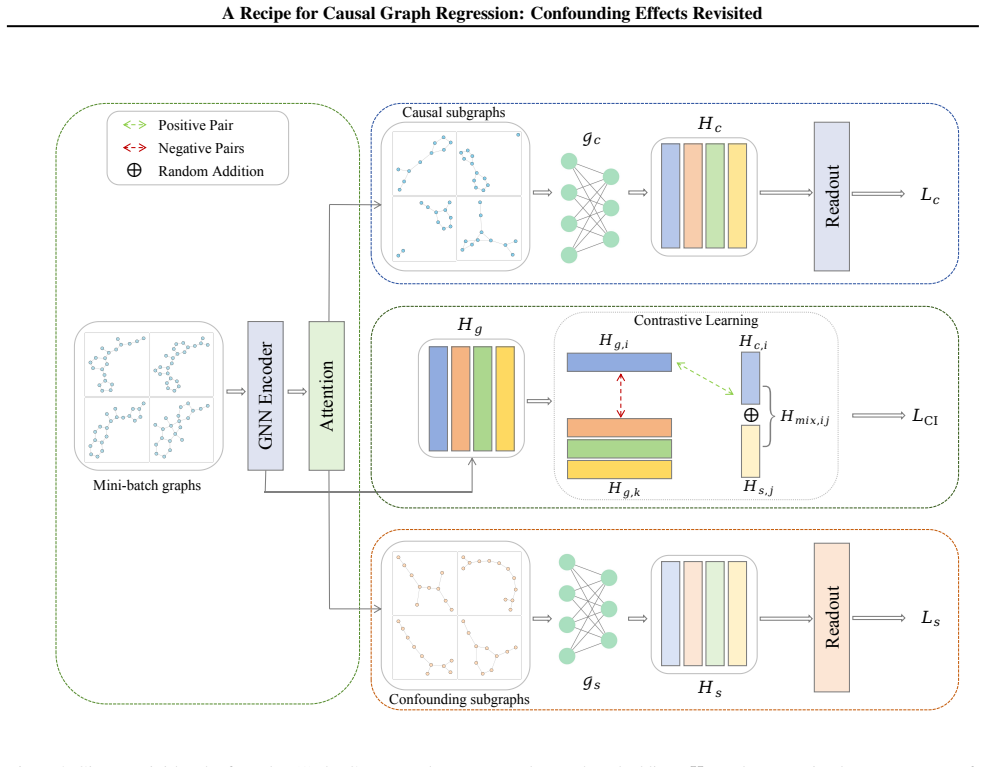
The load-bearing objects are the enhanced graph information bottleneck objective (Eq. 4), which adds a confounder-predictiveness term $-\beta I(S;Y)$ to the classical GIB loss, and the contrastive intervention loss (Eq. 17), which replaces label-conditioned counterfactual mixing with unsupervised InfoNCE alignment between $H_{g,i}$ and $H_{c,i}+H_{s,j}$. These are computed with variational Gaussian bounds, reducing the mutual-information terms to least-squares goals and an $\ell^2$ penalty on the causal embedding mean.
What would settle it
Run the method on a synthetic graph regression dataset with a known generative model where the confounder $S$ has no causal effect on $Y$ but is strongly correlated in training; if the contrastive intervention loss still improves out-of-distribution performance compared to ERM, then the improvement cannot be attributed to backdoor adjustment, or the mixed representation assumption must be violated in a way that happens to help.
Extended reading notes
Core claim
The paper claims to be the first to explicitly treat confounding features as predictive in graph regression, and to show that doing so improves generalization. Its central proposal is a two-part loss: an enhanced GIB objective $-I(C;Y)+\alpha I(C;G)-\beta I(S;Y)$ that keeps the confounder $S$ informative for the target $Y$ while still compressing the causal subgraph $C$, and a contrastive intervention loss $\mathcal{L}_{\mathrm{CI}}$ that aligns the original graph representation with randomly mixed causal-and-confounding representations. The mixed representation $H_{\mathrm{mix},ij}=H_{c,i}+H_{s,j}$ is treated as a counterfactual graph, and the InfoNCE-style alignment is presented as an implicit backdoor adjustment in representation space. The paper reports that this recipe yields state-of-the-art out-of-distribution performance on graph regression benchmarks, improving over prior causal graph learning methods that discard confounding information.
Load-bearing premise
The method treats the vector sum of a causal representation and a confounding representation as a valid counterfactual graph, and assumes that aligning with such sums implements backdoor adjustment; if that mixed representation is not a faithful stand-in for intervening on the confounder, the claimed causal invariance does not follow.
Editorial extensions
If this is right
- If the framework generalizes as reported, graph regression under distribution shift no longer needs to throw away confounders; modeling their predictive role should become a standard component of causal graph learning.
- The contrastive intervention loss provides a label-free way to implement backdoor adjustment in representation space, which could make causal intervention applicable to continuous-label tasks beyond graphs.
- The enhanced GIB objective suggests that information-theoretic disentanglement in regression should explicitly budget for confounder information rather than assuming it is noise.
- The reported benchmark results, if reproduced, would give practitioners a default causal method for graph regression rather than forcing them to adapt classification-specific tools.
Reading between the lines
- The random addition $H_{c,i}+H_{s,j}$ is a representation-space counterfactual; whether it faithfully reflects the underlying graph structure is not proven, so the method may be most reliable when causal and confounding substructures are separable in embedding space.
- The contrastive alignment could be reinterpreted as a regularizer that encourages the causal representation to be invariant to confounder changes, which suggests a direct connection to invariant risk minimization that the paper does not explore.
- A testable extension is to apply the same two-part loss to node-level or link-level regression, where the definition of a causal subgraph may need a different mask structure.
- One could probe the claim about confounder predictiveness by measuring the correlation between the learned confounder representation and the target on a held-out set where the spurious correlation is intentionally broken.
Editorial analysis
A structured set of objections, weighed in public.
Referee Report
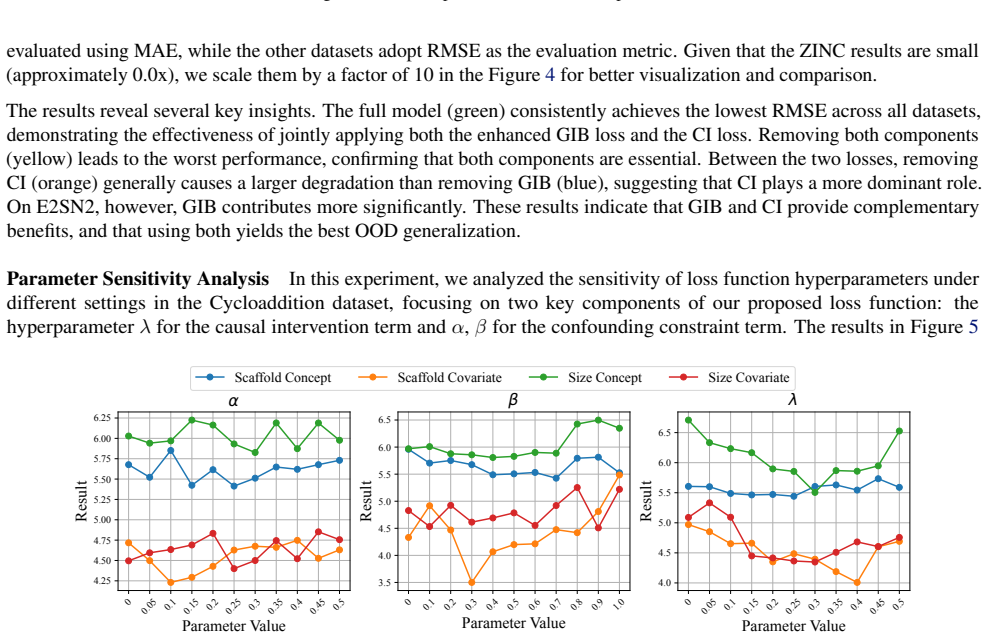
Summary. This paper studies causal graph regression (CGR), i.e., graph-level regression under out-of-distribution shifts, and proposes a framework that (i) extends the graph information bottleneck objective by explicitly modeling the predictive power of confounding subgraphs through an additive term -βI(S;Y), and (ii) introduces a contrastive intervention loss that aligns an original graph representation with a representation formed by adding the causal embedding of one graph to the confounding embedding of another graph. The authors argue that this implements an implicit form of backdoor adjustment in representation space, and they report state-of-the-art OOD performance on the GOOD-ZINC benchmark and competitive results on ReactionOOD S-OOD datasets. The paper includes ablations and a parameter sensitivity analysis, and the code is publicly released.
Significance. If the central claims hold, the paper makes a useful contribution by adapting causal graph learning ideas to regression, a setting where label-based intervention techniques do not apply. The variational bounds for I(C;G) are standard, and the reduction of the mutual information terms to MSE under a constant-variance Gaussian assumption is internally consistent (apart from a presentation issue in Eqs. (13)-(14)). The empirical results are strong: the proposed method outperforms all baselines on all eight GOOD-ZINC settings and is best or second-best in most ReactionOOD settings. The ablations (Figure 4 and Appendix A.5) show that both the enhanced GIB loss and the contrastive intervention loss contribute to the gains. The code release is a definite strength. The main weakness is that the causal intervention mechanism, which is central to the paper's framing, rests on an unvalidated assumption that embedding addition produces a valid counterfactual representation; without a derivation or direct validation, the OOD improvement could be attributed to a generic contrastive regularizer.
major comments (2)
- [Section 4.3, Eq. (16)] The counterfactual representation Hmix,ij = Hc,i + Hs,j is asserted without justification. For a GNN encoder, the embedding of a graph with subgraphs C and S is f(A⊙M, X⊙M), which is not generally equal to f(C) + f(S). The paper states that this addition 'can be understood as an implicit realization of backdoor adjustment', but no derivation or empirical validation is provided. Since the causal intervention claim is load-bearing for the paper's title and contributions, the authors should either (a) provide a theoretical condition under which GNN embeddings are additive across subgraphs, or (b) run an ablation that isolates the additive counterfactual assumption, e.g., replacing Hmix with a non-additive mixing operation (such as concatenation or a learned combination) or with Hc,i plus random noise. Without such evidence, the OOD gains can be explained by a generic contrastive regularizer that encourages invariance to confounders, and the paper's causal graph regression interpretation is not established.
- [Section 5.2, Tables 1-3] The paper claims to be the first to explicitly consider the predictive role of confounding features in graph regression, but the experiments do not include any baseline that adapts existing causal graph learning methods (e.g., CAL or DisC) to regression. The introduction states that vanilla adaptation of CGL to regression is dwarfed by ERM, yet no such adaptation appears in the comparison tables. Without this baseline, it is unclear whether the observed improvements come from the proposed enhanced GIB objective, from the contrastive intervention, or simply from the architectural choices shared with the baselines. Adding an adapted CAL-style baseline, or at least an ablation that removes only the -βI(S;Y) term while retaining the rest of the framework, would strengthen the claim that modeling confounder predictiveness is the key novelty.
minor comments (4)
- [Section 4.2, Eq. (14)] The derivation of Eq. (14) is presented in a way that confuses mutual information with conditional entropy. Eq. (13) approximates H(Y|C), not I(C;Y). Since I(C;Y) = H(Y) - H(Y|C) and H(Y) is constant, maximizing I(C;Y) is equivalent to minimizing H(Y|C), which is approximately the squared error. The text should say 'the objective for maximizing I(C;Y) reduces to minimizing the least-squares loss' rather than 'I(C;Y) reduces to the least-squares loss' and should not write LCP as a negative MSE without clarifying the target is to minimize -LCP.
- [Section 4.3, Eq. (17)] The InfoNCE formula in Eq. (17) is missing a closing parenthesis in the denominator; the intended expression is -1/B Σ_i log [ exp(sim(Hg,i, Hmix,ij)) / Σ_{k≠i} exp(sim(Hg,i, Hg,k)) ]. The notation should be fixed for clarity.
- [Section 5.1, title] The subsection title contains a typo: 'Datsets' should be 'Datasets'.
- [Section 4.2, Eq. (5)-(8)] When deriving the upper bound for I(C;G), the notation µϕ(G) is used both for the mean of the conditional distribution p(C|G) and, in Eq. (8), as the quantity whose squared norm is averaged. Since the covariance is assumed to be the identity, this is acceptable, but the text could clarify that µϕ(G) is the mean vector of the embedding distribution.
Circularity Check
No significant circularity: the enhanced GIB losses are derived from variational bounds and the OOD claims are tested on external benchmarks, not forced by the paper's own definitions.
full rationale
The paper's derivation chain is self-contained and not circular. The enhanced GIB objective in Eq. (4) is decomposed into variational approximations: I(C;G) is bounded via a Gaussian assumption leading to the L2 proxy in Eq. (8), while I(C;Y) and I(S;Y) are reduced to least-squares losses through conditional Gaussian modeling in Eqs. (13)-(15). These are standard variational reductions rather than fitted parameters being renamed as predictions. The causal intervention loss in Eq. (17) is an InfoNCE objective that aligns original graph representations with mixed representations Hc,i + Hs,j from Eq. (16); the paper explicitly phrases the backdoor-adjustment connection as 'can be understood as an implicit realization' (Section 4.3), which is an interpretive analogy rather than a derivation whose conclusion is assumed in its premise. No parameter is fitted to the reported OOD targets and then called a prediction: the hyperparameters are fixed at 0.5 (Appendix A.4), and the method's generalization claims are evaluated on external benchmarks (GOOD-ZINC and ReactionOOD). The only self-citation is to the ReactionOOD benchmark paper, which is a dataset source and is not load-bearing for the method's causal derivation. There is no imported uniqueness theorem and no ansatz smuggled in through self-citation. The conceptual concern that LCI enforces the very invariance it claims to discover is a support/correctness question about the backdoor-adjustment interpretation, not a circularity of the empirical claims, which stand or fall on the external OOD results.
Assumptions & free parameters
free parameters (3)
- alpha =
0.5
- beta =
0.5
- lambda =
0.5
assumptions (6)
- domain assumption The posterior p(C|G) is Gaussian with identity covariance (Eq. 6-7).
- domain assumption The conditional distributions p(Y|Hc) and p(Y|Hs) have constant variance sigma^2=1 (Eq. 11-14).
- domain assumption The SCM in Figure 1: G generates C and S, C affects Y, and there is a backdoor path S -> C -> Y.
- domain assumption Confounding subgraphs S have predictive power for Y in real graph regression tasks.
- ad hoc to paper The random addition Hmix = Hc + Hs yields a valid counterfactual or intervened representation.
- ad hoc to paper Optimizing the InfoNCE loss (Eq. 17) with these positive pairs enforces causal invariance.
invented entities (1)
-
Hmix,ij (mixed graph representation)
Cite this review
Pith. "Pith review of A Recipe for Causal Graph Regression: Confounding Effects Revisited." pith.science (2026). https://pith.science/paper/ZX7YSV2I
@misc{pith2026250700440,
  author       = {Pith},
  title        = {Pith review of: A Recipe for Causal Graph Regression: Confounding Effects Revisited},
  year         = {2026},
  howpublished = {\url{https://pith.science/paper/ZX7YSV2I}},
  note         = {Machine review of arXiv:2507.00440}
}
read the original abstract
Through recognizing causal subgraphs, causal graph learning (CGL) has risen to be a promising approach for improving the generalizability of graph neural networks under out-of-distribution (OOD) scenarios. However, the empirical successes of CGL techniques are mostly exemplified in classification settings, while regression tasks, a more challenging setting in graph learning, are overlooked. We thus devote this work to tackling causal graph regression (CGR); to this end we reshape the processing of confounding effects in existing CGL studies, which mainly deal with classification. Specifically, we reflect on the predictive power of confounders in graph-level regression, and generalize classification-specific causal intervention techniques to regression through a lens of contrastive learning. Extensive experiments on graph OOD benchmarks validate the efficacy of our proposals for CGR. The model implementation and the code are provided on https://github.com/causal-graph/CGR.
Figures


Figures from the paper (2 more)

Reference graph
Works this paper leans on
-
[1]
Amini, A., Schwarting, W., Soleimany, A., and Rus, D. Deep evidential regression. Advances in neural information processing systems, 33: 0 14927--14937, 2020
work page 2020
-
[2]
Arjovsky, M., Bottou, L., Gulrajani, I., and Lopez-Paz, D. Invariant risk minimization. arXiv preprint arXiv:1907.02893, 2019
arXiv 1907
-
[3]
Information bottleneck for gaussian variables
Chechik, G., Globerson, A., Tishby, N., and Weiss, Y. Information bottleneck for gaussian variables. Advances in Neural Information Processing Systems, 16, 2003
2003
-
[4]
Learning causally invariant representations for out-of-distribution generalization on graphs
Chen, Y., Zhang, Y., Bian, Y., Yang, H., Kaili, M., Xie, B., Liu, T., Han, B., and Cheng, J. Learning causally invariant representations for out-of-distribution generalization on graphs. Advances in Neural Information Processing Systems, 35: 0 22131--22148, 2022
work page 2022
-
[5]
Chen, Y., Bian, Y., Zhou, K., Xie, B., Han, B., and Cheng, J. Does invariant graph learning via environment augmentation learn invariance? Advances in Neural Information Processing Systems, 36, 2024
work page 2024
-
[6]
Debiasing graph neural networks via learning disentangled causal substructure
Fan, S., Wang, X., Mo, Y., Shi, C., and Tang, J. Debiasing graph neural networks via learning disentangled causal substructure. Advances in Neural Information Processing Systems, 35: 0 24934--24946, 2022
work page 2022
-
[7]
Generalizing graph neural networks on out-of-distribution graphs
Fan, S., Wang, X., Shi, C., Cui, P., and Wang, B. Generalizing graph neural networks on out-of-distribution graphs. IEEE Transactions on Pattern Analysis and Machine Intelligence, 2023
work page 2023
-
[8]
Domain-adversarial training of neural networks
Ganin, Y., Ustinova, E., Ajakan, H., Germain, P., Larochelle, H., Laviolette, F., March, M., and Lempitsky, V. Domain-adversarial training of neural networks. Journal of machine learning research, 17 0 (59): 0 1--35, 2016
2016
Show all 54 references
-
[9]
Robust causal graph representation learning against confounding effects
Gao, H., Li, J., Qiang, W., Si, L., Xu, B., Zheng, C., and Sun, F. Robust causal graph representation learning against confounding effects. In Proceedings of the AAAI Conference on Artificial Intelligence, volume 37, pp.\ 7624--7632, 2023
2023
-
[10]
N., Duvenaud, D., Hern \'a ndez-Lobato, J
G \'o mez-Bombarelli, R., Wei, J. N., Duvenaud, D., Hern \'a ndez-Lobato, J. M., S \'a nchez-Lengeling, B., Sheberla, D., Aguilera-Iparraguirre, J., Hirzel, T. D., Adams, R. P., and Aspuru-Guzik, A. Automatic chemical design using a data-driven continuous representation of mol...
2018
-
[11]
Good: A graph out-of-distribution benchmark
Gui, S., Li, X., Wang, L., and Ji, S. Good: A graph out-of-distribution benchmark. Advances in Neural Information Processing Systems, 35: 0 2059--2073, 2022
2022
-
[12]
R., and Liu, H
Guo, R., Cheng, L., Li, J., Hahn, P. R., and Liu, H. A survey of learning causality with data: Problems and methods. ACM Computing Surveys (CSUR), 53 0 (4): 0 1--37, 2020
2020
-
[13]
Counterfactual learning on graphs: A survey
Guo, Z., Wu, Z., Xiao, T., Aggarwal, C., Liu, H., and Wang, S. Counterfactual learning on graphs: A survey. Machine Intelligence Research, 22 0 (1): 0 17--59, 2025
2025
-
[14]
Junction tree variational autoencoder for molecular graph generation
Jin, W., Barzilay, R., and Jaakkola, T. Junction tree variational autoencoder for molecular graph generation. In International conference on machine learning, pp.\ 2323--2332. PMLR, 2018
2018
-
[15]
P., Welling, M., et al
Kingma, D. P., Welling, M., et al. Auto-encoding variational bayes, 2013
2013
-
[16]
Out-of-distribution generalization via risk extrapolation (rex)
Krueger, D., Caballero, E., Jacobsen, J.-H., Zhang, A., Binas, J., Zhang, D., Le Priol, R., and Courville, A. Out-of-distribution generalization via risk extrapolation (rex). In International conference on machine learning, pp.\ 5815--5826. PMLR, 2021
2021
-
[17]
J., Paige, B., and Hern \'a ndez-Lobato, J
Kusner, M. J., Paige, B., and Hern \'a ndez-Lobato, J. M. Grammar variational autoencoder. In International conference on machine learning, pp.\ 1945--1954. PMLR, 2017
1945
-
[18]
L., and Van Lint, H
Li, G., Knoop, V. L., and Van Lint, H. Multistep traffic forecasting by dynamic graph convolution: Interpretations of real-time spatial correlations. Transportation Research Part C: Emerging Technologies, 128: 0 103185, 2021
2021
-
[19]
Ood-gnn: Out-of-distribution generalized graph neural network
Li, H., Wang, X., Zhang, Z., and Zhu, W. Ood-gnn: Out-of-distribution generalized graph neural network. IEEE Transactions on Knowledge and Data Engineering, 35 0 (7): 0 7328--7340, 2022
2022
-
[20]
Generative causal explanations for graph neural networks
Lin, W., Lan, H., and Li, B. Generative causal explanations for graph neural networks. In International Conference on Machine Learning, pp.\ 6666--6679. PMLR, 2021
2021
-
[21]
Parameterized explainer for graph neural network
Luo, D., Cheng, W., Xu, D., Yu, W., Zong, B., Chen, H., and Zhang, X. Parameterized explainer for graph neural network. Advances in neural information processing systems, 33: 0 19620--19631, 2020
2020
-
[22]
Utilizing reinforcement learning and causal graph networks to address the intricate dynamics in financial risk prediction
Ma, F., Li, H., and Ilyas, M. Utilizing reinforcement learning and causal graph networks to address the intricate dynamics in financial risk prediction. International Journal of Information Technologies and Systems Approach (IJITSA), 17 0 (1): 0 1--19, 2024
2024
-
[23]
A survey of out-of-distribution generalization for graph machine learning from a causal view
Ma, J. A survey of out-of-distribution generalization for graph machine learning from a causal view. arXiv preprint arXiv:2409.09858, 2024
2024 arXiv
-
[24]
Interpretable and generalizable graph learning via stochastic attention mechanism
Miao, S., Liu, M., and Li, P. Interpretable and generalizable graph learning via stochastic attention mechanism. In International Conference on Machine Learning, pp.\ 15524--15543. PMLR, 2022
2022
-
[25]
Representation learning via invariant causal mechanisms
Mitrovic, J., McWilliams, B., Walker, J., Buesing, L., and Blundell, C. Representation learning via invariant causal mechanisms. arXiv preprint arXiv:2010.07922, 2020
2010 arXiv
-
[26]
and Weigend, A
Nix, D. and Weigend, A. Learning local error bars for nonlinear regression. Advances in neural information processing systems, 7, 1994
1994
-
[27]
Oord, A. v. d., Li, Y., and Vinyals, O. Representation learning with contrastive predictive coding. arXiv preprint arXiv:1807.03748, 2018
2018 arXiv
-
[28]
Interpretation and identification of causal mediation
Pearl, J. Interpretation and identification of causal mediation. Psychological methods, 19 0 (4): 0 459, 2014
2014
-
[29]
Pleiss, G., Souza, A., Kim, J., Li, B., and Weinberger, K. Q. Neural network out-of-distribution detection for regression tasks. 2019
2019
-
[30]
Causal enhanced drug--target interaction prediction based on graph generation and multi-source information fusion
Qiao, G., Wang, G., and Li, Y. Causal enhanced drug--target interaction prediction based on graph generation and multi-source information fusion. Bioinformatics, 40 0 (10): 0 btae570, 2024
2024
-
[31]
A., Cheng, A
Rollins, Z. A., Cheng, A. C., and Metwally, E. Molprop: Molecular property prediction with multimodal language and graph fusion. Journal of Cheminformatics, 16 0 (1): 0 56, 2024
2024
-
[32]
The perceptron: a probabilistic model for information storage and organization in the brain
Rosenblatt, F. The perceptron: a probabilistic model for information storage and organization in the brain. Psychological review, 65 0 (6): 0 386, 1958
1958
-
[33]
W., Hashimoto, T
Sagawa, S., Koh, P. W., Hashimoto, T. B., and Liang, P. Distributionally robust neural networks for group shifts: On the importance of regularization for worst-case generalization. arXiv preprint arXiv:1911.08731, 2019
1911 arXiv
-
[34]
Spiekermann, K., Pattanaik, L., and Green, W. H. High accuracy barrier heights, enthalpies, and rate coefficients for chemical reactions. Scientific Data, 9 0 (1): 0 417, 2022
2022
-
[35]
Stuyver, T., Jorner, K., and Coley, C. W. Reaction profiles for quantum chemistry-computed [3+ 2] cycloaddition reactions. Scientific Data, 10 0 (1): 0 66, 2023
2023
-
[36]
Causal attention for interpretable and generalizable graph classification
Sui, Y., Wang, X., Wu, J., Lin, M., He, X., and Chua, T.-S. Causal attention for interpretable and generalizable graph classification. In Proceedings of the 28th ACM SIGKDD Conference on Knowledge Discovery and Data Mining, pp.\ 1696--1705, 2022
2022
-
[37]
Enhancing out-of-distribution generalization on graphs via causal attention learning
Sui, Y., Mao, W., Wang, S., Wang, X., Wu, J., He, X., and Chua, T.-S. Enhancing out-of-distribution generalization on graphs via causal attention learning. ACM Transactions on Knowledge Discovery from Data, 18 0 (5): 0 1--24, 2024
2024
-
[38]
and Saenko, K
Sun, B. and Saenko, K. Deep coral: Correlation alignment for deep domain adaptation. In Computer Vision--ECCV 2016 Workshops: Amsterdam, The Netherlands, October 8-10 and 15-16, 2016, Proceedings, Part III 14, pp.\ 443--450. Springer, 2016
2016
-
[39]
M., and Liang, P
Tajwar, F., Kumar, A., Xie, S. M., and Liang, P. No true state-of-the-art? ood detection methods are inconsistent across datasets. arXiv preprint arXiv:2109.05554, 2021
2021 arXiv
-
[40]
and Zaslavsky, N
Tishby, N. and Zaslavsky, N. Deep learning and the information bottleneck principle. In 2015 ieee information theory workshop (itw), pp.\ 1--5. IEEE, 2015
2015
-
[41]
C., and Bialek, W
Tishby, N., Pereira, F. C., and Bialek, W. The information bottleneck method. arXiv preprint physics/0004057, 2000
2000 arXiv
-
[42]
Principles of risk minimization for learning theory
Vapnik, V. Principles of risk minimization for learning theory. Advances in neural information processing systems, 4, 1991
1991
-
[43]
F., Heinen, S
von Rudorff, G. F., Heinen, S. N., Bragato, M., and von Lilienfeld, O. A. Thousands of reactants and transition states for competing e2 and s2 reactions. Machine Learning: Science and Technology, 1 0 (4): 0 045026, 2020
2020
-
[44]
and Veitch, V
Wang, Z. and Veitch, V. A unified causal view of domain invariant representation learning. 2022
2022
-
[45]
Towards out-of-distribution generalizable predictions of chemical kinetics properties
Wang, Z., Chen, Y., Duan, Y., Li, W., Han, B., Cheng, J., and Tong, H. Towards out-of-distribution generalizable predictions of chemical kinetics properties. arXiv preprint arXiv:2310.03152, 2023
2023 arXiv
-
[46]
Handling distribution shifts on graphs: An invariance perspective
Wu, Q., Zhang, H., Yan, J., and Wipf, D. Handling distribution shifts on graphs: An invariance perspective. arXiv preprint arXiv:2202.02466, 2022 a
2022 arXiv
-
[47]
Graph information bottleneck
Wu, T., Ren, H., Li, P., and Leskovec, J. Graph information bottleneck. Advances in Neural Information Processing Systems, 33: 0 20437--20448, 2020
2020
-
[48]
Discovering invariant rationales for graph neural networks
Wu, Y.-X., Wang, X., Zhang, A., He, X., and Chua, T.-S. Discovering invariant rationales for graph neural networks. arXiv preprint arXiv:2201.12872, 2022 b
2022 arXiv
-
[49]
Deconfounding to explanation evaluation in graph neural networks
Wu, Y.-X., Wang, X., Zhang, A., Hu, X., Feng, F., He, X., and Chua, T.-S. Deconfounding to explanation evaluation in graph neural networks. arXiv preprint arXiv:2201.08802, 2022 c
2022 arXiv
-
[50]
Yu, S., Yu, X., L kse, S., Jenssen, R., and Pr \' ncipe, J. C. Cauchy-schwarz divergence information bottleneck for regression. In ICLR, 2024
2024
-
[51]
mixup: Beyond empirical risk minimization
Zhang, H. mixup: Beyond empirical risk minimization. arXiv preprint arXiv:1710.09412, 2017
2017 arXiv
-
[52]
Regexplainer: Generating explanations for graph neural networks in regression task
Zhang, J., Chen, Z., Mei, H., Luo, D., and Wei, H. Regexplainer: Generating explanations for graph neural networks in regression task. arXiv preprint arXiv:2307.07840, 2023
2023 arXiv
-
[53]
Zhao, S., Prapas, I., Karasante, I., Xiong, Z., Papoutsis, I., Camps-Valls, G., and Zhu, X. X. Causal graph neural networks for wildfire danger prediction. arXiv preprint arXiv:2403.08414, 2024
2024 arXiv
-
[54]
write newline
" write newline "" before.all 'output.state := FUNCTION n.dashify 't := "" t empty not t #1 #1 substring "-" = t #1 #2 substring "--" = not "--" * t #2 global.max substring 't := t #1 #1 substring "-" = "-" * t #2 global.max substring 't := while if t #1 #1 substring * t #2 gl...
Reviewed August 6, 2026 · model on record in the stance chip above.
Discussion (0). Sign in to comment.