REVIEW 3 major objections 4 minor 48 references
Bilayer graphene as a template for manufacturing novel 2D materials
T0 review · 3 major / 4 minor · reviewed 2026-08-06 · deepseek-v4-flash
Pith's one-line read Bilayer graphene is a uniquely versatile template for manufacturing new two-dimensional materials: it intercalates more easily than graphite, opens far wider between its sheets, and lets the encapsulated structures be imaged atom by atom.
desk verdict An honest and useful mini-review, but the load-bearing evidence that the new phases really sit between the graphene sheets is solid only for the alkali metals, not for the halides that carry the central claim. read the letter →
The pith
A machine-rendered reading of the paper's core claim, the machinery that carries it, and where it could break.
The reading
What carries the argument
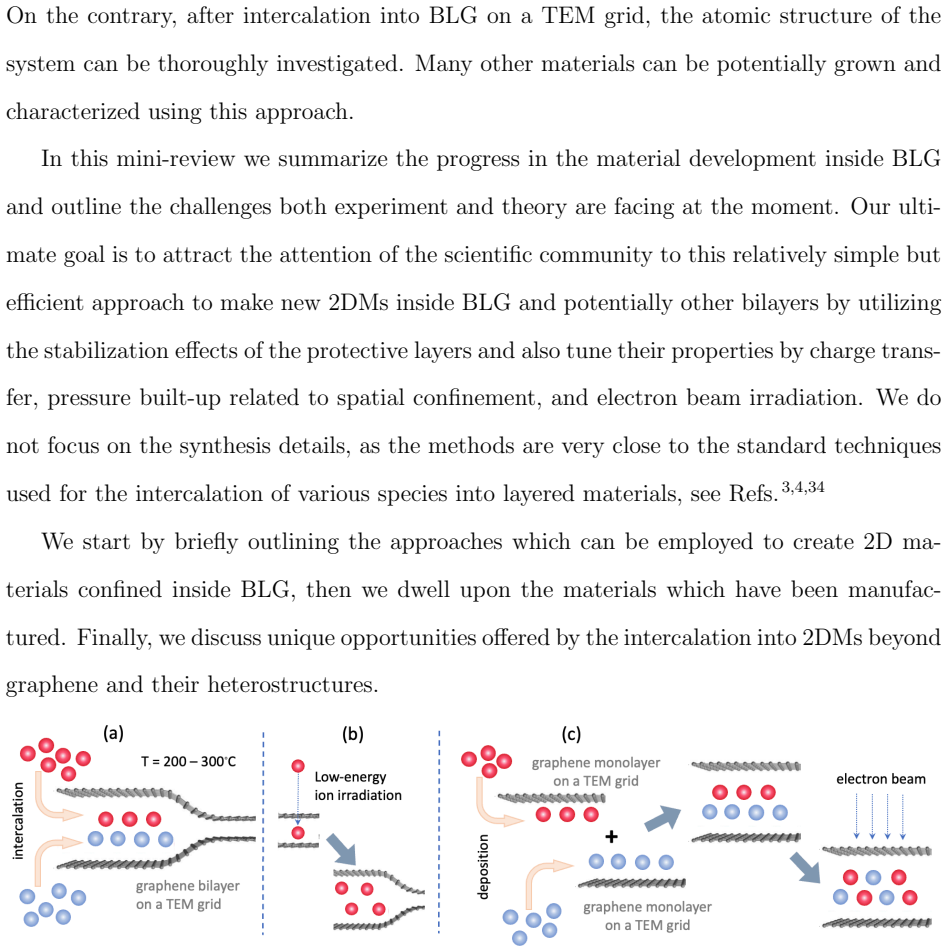
The central mechanism is encapsulation: two stacked graphene sheets act as a chemically inert, electron-transparent sandwich that confines intercalated atoms or molecules in a two-dimensional gap, protects them from the environment, and allows direct atomic-resolution imaging by TEM/STEM. Intercalation is achieved by vapour-phase transport, low-energy ion implantation, electrochemical driving, or by depositing a material on one sheet and capping it with a second ('sandwich' assembly); the confined geometry, pressure from the sheets, charge transfer with graphene, and electron-beam irradiation together stabilise phases that have no bulk layered counterpart.
What would settle it
A cross-sectional or tilt-series STEM image of a region claimed to contain an intercalated phase, such as the C6M2C6 bilayer, showing the atoms on the outer surface of the graphene stack rather than between the two sheets, would falsify the central claim.
Extended reading notes
Core claim
The central claim of the review is that bilayer graphene is a unique platform for creating novel two-dimensional materials by intercalation: compared with bulk graphite it allows easier intercalation, a much larger increase in the interlayer separation of the sheets, and direct high-resolution TEM/STEM imaging of the encapsulated material because the sheets are chemically inert and electron-transparent. The paper documents that confinement between graphene sheets not only stabilises single sheets of marginally stable layered materials but also enables synthesis of completely new 2D systems: hexagonal CuI, polymorphic metal chlorides (AlCl3, CuCl2, MoClx, FeClx/FeOCl), close-packed multi-layer Li crystals, C6M2C6 bilayers of K, Rb and Cs, self-limiting Pd, and flat few-atom Kr and Xe clusters. It also notes that the electron beam can drive phase transformations inside the sandwich, that the protective sheets exert pressure up to about one GPa while mediating charge transfer, and that the same logic should transfer to other bilayers and heterostructures.
Load-bearing premise
The central claim rests on the assumption that the structures seen in top-view electron microscopy really lie between the two graphene sheets rather than on the outer surface or as imaging and beam-damage artifacts, an ambiguity the review itself acknowledges remains a challenge.
Editorial extensions
If this is right
- The same encapsulation approach can be extended to other robust 2D hosts such as h-BN, TMDs, and their heterostructures, expanding the space of synthesizable 2D materials.
- The observation of multi-layer alkali metals and C6M2C6 bilayers overturns the assumption that alkali-metal intercalants form only single layers, reshaping predictions for ion storage and battery materials.
- Electron-beam-induced transformations inside the sandwich offer on-demand polymorph selection and the creation of in-plane heterostructures (e.g., AlCl3/CuCl2) with electronic properties ranging from insulators to semimetals.
- Because some encapsulated phases are magnetic, such as the 2D iron chlorides, the approach enables studies of two-dimensional magnetism and potential information-storage applications.
- Controlled defect creation and the use of insulating encapsulants could lead to single-photon emitters and other quantum-photonic devices.
Reading between the lines
- The ion-implantation route demonstrated for noble gases could be extended to other elements, provided graphene-network repair (for example by adding hydrocarbons) is developed; the review notes the need but does not demonstrate it.
- Twist-angle-controlled bilayer graphene may provide a tunable knob: the moiré potential could alter intercalation kinetics, layer registry, and electronic coupling to the intercalant, an avenue the review only mentions.
- Combining cross-sectional electron microscopy with in-situ electrical transport on the same device would directly attach structural assignments to functional signatures, resolving the remaining top-view ambiguity.
- A computational screen of host-bilayer and intercalant combinations (lattice constant, work function, electronegativity, size) could predict new confined phases before synthesis, using the catalogue assembled in this review as training evidence.
Editorial analysis
A structured set of objections, weighed in public.
Referee Report
Summary. This manuscript is a mini-review of experimental and theoretical work on intercalation into free-standing bilayer graphene (BLG) as a route to synthesize and stabilize two-dimensional materials (2DMs). It surveys four synthesis approaches (vapor-phase intercalation, low-energy ion implantation, graphene-sandwich assembly, and electrochemical driving), then reviews the encapsulated phases reported so far: h-CuI, AgI, NiI2, molybdenum/iron/aluminum/copper chlorides, multilayer lithium and bilayer K/Rb/Cs, self-limiting palladium, and few-atom noble-gas clusters. The authors compare these findings to DFT predictions, highlight unresolved issues including electron-beam-induced transformations and the lateral-size limit, and argue that BLG is a unique platform because intercalation is easier and the interlayer separation increases more than in graphite, while the graphene sheets remain transparent to TEM electrons.
Significance. The review is useful and timely: it collects recent results from several independent groups and makes a coherent case that BLG encapsulation can produce 2D phases with no stable layered bulk counterpart, with atomic-resolution TEM as the principal characterization tool. It is appropriately candid about open problems, explicitly flags the difficulty of distinguishing intercalated from surface phases in top-view imaging, and consistently confronts experiment with DFT. The main limitation is that the central "unique platform" claim depends on the interlayer location of the reported phases, and the evidence for that location is not equally strong across material classes; the manuscript would be strengthened by a systematic, per-material assessment of this point.
major comments (3)
- [Section '2D metals' (delithiation discussion)] The review's own statement that "unambiguous discrimination between the intercalated structures and those on the outer surface of BLG in the top view observation still remains a challenge" is made in the context of lithium, but the same ambiguity applies with equal force to h-CuI, MoClx, FeClx/FeOCl, and AlCl3/CuCl2, where the evidence is predominantly top-view TEM/STEM with EELS and DFT matching. For the alkali-metal bilayers, Ref. 29 provides a surface-removal control (e-beam shower removes surface-deposited AMs while intercalated bilayers survive), but no equivalent control or cross-sectional measurement is reported for the metal chlorides or h-CuI. The observation that no h-CuI appears on monolayer areas is suggestive but does not exclude nucleation on the outer surface of the BLG region. Please add a dedicated paragraph that, for each material class, states what evidence rules out surface adlayers or beam-induced surface artifacts, and where such evidence is lacking, explicitly identify it as an open question.
- [Table 1] Table 1 contains factual misattributions that should be corrected before publication. The MoClx row reports "Yes, formation of FeClx phases with different stoichiometries and morphologies" under electron-beam-induced transformations, but the FeClx/FeOCl phases come from FeCl3 intercalation (Ref. 25), not from MoClx (Ref. 23). The first row of the "2D material" column reads "CdI AgI NiI2", but the text and Ref. 35 describe CuI (copper iodide), not CdI. The last row lists "2D Ar clusters", while the corresponding text and Ref. 26 describe Xe and Kr clusters. These errors in a summary table undermine confidence in the review's accuracy.
- [Abstract and concluding paragraph] The claim that BLG is a "unique platform" because it allows "easier intercalation and a much larger increase in the inter-layer separation of the sheets" relative to graphite is stated without a quantitative comparison in this review. The alkali-metal studies indeed show multi-layer AM phases that are absent in graphite interior, but for the metal chlorides and h-CuI no direct graphite-control experiment is described. Please either provide comparative data or soften the language from "unique" to a more specific claim about the demonstrated advantages, so that the review's central thesis is matched by the evidence presented.
minor comments (4)
- [Introduction] In the sentence "2DMs, liquids, and and soft materials like DNA strands on graphene", "and and" should be "and".
- [2D metals] The text contains minor typographical/spacing errors, e.g., "anin-situTEM study" should be "an in-situ TEM study", and "a their high efficiency" should be "their high efficiency".
- [Figure 3 caption] In the Figure 3 caption, "preprinted with permission" should be "reprinted with permission".
- [Covalently bonded inorganic 2D materials] The paragraph on CuI states that "no h-CuI was observed in the monolayer graphene area"; this is a useful control and should be stated more prominently, as it is one of the few pieces of evidence that the phase is specific to the bilayer environment.
Circularity Check
No significant circularity: the review's claims rest on prior primary experiments with independent characterization, not on definitions or fitted predictions.
full rationale
This is a review article, not a derivation paper. It contains no equations, no fitted parameters, and no prediction that is defined in terms of its own output. The central claim that BLG enables intercalation of new 2D materials is supported by cited primary studies (e.g., Refs. 22, 23, 25, 28, 29, 35) that used multiple independent techniques: STEM/TEM imaging, EELS, Raman spectroscopy, electrical transport, electron diffraction, XAS, and DFT calculations. For the alkali-metal bilayer case, Ref. 29 includes an explicit control in which surface-deposited AMs are removed by an e-beam shower while intercalated bilayers remain, and EELS distinguishes oxidized surface species from intercalated species; this is independent evidence, not a circular appeal. The paper's own admission that 'unambiguous discrimination between the intercalated structures and those on the outer surface of BLG in the top view observation still remains a challenge' is a stated limitation of top-view imaging, not a circularity. Although many cited works include the present authors, the load-bearing evidence is external and falsifiable; self-citation alone is not circularity. No step reduces, by construction or by definition, to its own input.
Assumptions & free parameters
assumptions (3)
- domain assumption The cited experimental reports correctly assign the atomic structures of the encapsulated materials.
- domain assumption Graphene encapsulation preserves the intercalated material during electron microscopy.
- domain assumption Density functional theory calculations correctly identify metastable structures and charge transfer.
Cite this review
Pith. "Pith review of Bilayer graphene as a template for manufacturing novel 2D materials." pith.science (2026). https://pith.science/paper/N2HXWFIW
@misc{pith2026250706447,
  author       = {Pith},
  title        = {Pith review of: Bilayer graphene as a template for manufacturing novel 2D materials},
  year         = {2026},
  howpublished = {\url{https://pith.science/paper/N2HXWFIW}},
  note         = {Machine review of arXiv:2507.06447}
}
read the original abstract
Recent intensive research on two-dimensional materials (2DMs) rekindle the interest in the intercalation of various atoms and molecules into layered compounds as a tool to manufacture 2DMs and tune their optoelectronic, magnetic and catalytic properties. Intercalation into free-standing bilayer graphene (BLG) has received special attention, as graphene is stable, chemically inert and enables one to study the atomic structure of the intercalated 2DM using high-resolution transmission electron microscopy. It was also discovered that the protecting action of graphene sheets makes it possible to not only stabilize the encapsulated single sheets of marginally stable layered materials, but also synthesize completely new 2D systems inside BLG, which in comparison to the bulk graphite allows for easier intercalation and much larger increase in the inter-layer separation of the sheets. In this review, we summarize the recent progress in this area, with a special focus on new materials created inside BLG. We compare the experimental findings to the theoretical predictions, pay special attention to the discrepancies and outline the challenges in the field. Finally, we discuss unique opportunities offered by the intercalation into 2DMs beyond graphene and their heterostructures.
Figures

Reference graph
Works this paper leans on
-
[1]
Xu, J.; Dou, Y.; Wei, Z.; Ma, J.; Deng, Y.; Li, Y.; Liu, H.; Dou, S. Recent Progress in Graphite Intercalation Compounds for Rechargeable Metal (Li, Na, K, Al)-Ion Batteries. Advanced Science2017,4, 1700146
-
[2]
Zhang, J.; Lai, L.; Wang, H.; Chen, M.; Shen, Z. X. Energy storage mechanisms of anode materials for potassium ion batteries.Materials Today Energy2021, 100747
-
[3]
D.; Dai, J.; Bao, W.; Fuhrer, M
Wan, J.; Lacey, S. D.; Dai, J.; Bao, W.; Fuhrer, M. S.; Hu, L. Tuning two-dimensional nanomaterials by intercalation: Materials, properties and applications.Chemical Society Reviews2016,45, 6742–6765
-
[4]
Rajapakse, M.; Karki, B.; Abu, U. O.; Pishgar, S.; Musa, M. R. K.; Riyadh, S. M. S.; Yu, M.; Sumanasekera, G.; Jasinski, J. B. Intercalation as a versatile tool for fabri- 14 cation, property tuning, and phase transitions in 2D materials.npj 2D Materials and Applications2021,5, 30
-
[5]
Sonia, F. J.; Jangid, M. K.; Ananthoju, B.; Aslam, M.; Johari, P.; Mukhopadhyay, A. Understanding the Li-storage in few layers graphene with respect to bulk graphite: ex- perimental, analytical and computational study.Journal of Materials Chemistry A2017, 5, 8662–8679
-
[6]
Liu, C.; Bai, Y.; Zhao, Y.; Yao, H.; Pang, H. MoS2/graphene composites: Fabrication and electrochemical energy storage.Energy Storage Materials2020,33, 470–502
-
[7]
Gao, P.; Wang, L.; Zhang, Y.; Huang, Y.; Liu, K. Atomic-Scale Probing of the Dynamics of Sodium Transport and Intercalation-Induced Phase Transformations in MoS2.ACS Nano2015,9, 11296–11301
-
[8]
Eichfeld, S. M.; Hossain, L.; Lin, Y. C.; Piasecki, A. F.; Kupp, B.; Birdwell, A. G.; Burke, R. A.; Lu, N.; Peng, X.; Li, J.; Azcatl, A.; McDonnell, S.; Wallace, R. M.; Kim, M. J.; Mayer, T. S.; Redwing, J. M.; Robinson, J. A. Highly scalable, atomically thin WSe2grown via metal-organic chemical vapor deposition.ACS Nano2015,9, 2080– 2087
Show all 48 references
-
[9]
A.; Preobrajenski, A
van Efferen, C.; Hall, J.; Atodiresei, N.; Boix, V.; Safeer, A.; Wekking, T.; Vino- gradov, N. A.; Preobrajenski, A. B.; Knudsen, J.; Fischer, J.; Jolie, W.; Michely, T. 2D Vanadium Sulfides: Synthesis, Atomic Structure Engineering, and Charge Density Waves.ACS Nano2024,18, 14...
-
[10]
Y.; Kurasch, S.; Srivastava, A.; Skakalova, V.; Kotakoski, J.; Krashenin- nikov, A
Huang, P. Y.; Kurasch, S.; Srivastava, A.; Skakalova, V.; Kotakoski, J.; Krashenin- nikov, A. V.; Hovden, R.; Mao, Q.; Meyer, J. C.; Smet, J.; Muller, D. A.; Kaiser, U. Direct Imaging of a Two-Dimensional Silica Glass on Graphene.Nano Letters2012,12, 1081–1086. 15
-
[11]
C.; Porfyrakis, K.; Warner, J
Sinha, S.; Zhu, T.; France-Lanord, A.; Sheng, Y.; Grossman, J. C.; Porfyrakis, K.; Warner, J. H. Atomic structure and defect dynamics of monolayer lead iodide nanodisks with epitaxial alignment on graphene.Nature Communications2020,11, 823
-
[12]
CuAu, a hexagonal two-dimensional metal.2D Materials2020,7, 045017
Zagler, G.; Reticcioli, M.; Mangler, C.; Scheinecker, D.; Franchini, C.; Kotakoski, J. CuAu, a hexagonal two-dimensional metal.2D Materials2020,7, 045017
-
[13]
C.; Eder, F.; Kurasch, S.; Skakalova, V.; Kotakoski, J.; Park, H
Meyer, J. C.; Eder, F.; Kurasch, S.; Skakalova, V.; Kotakoski, J.; Park, H. J.; Roth, S.; Chuvilin, A.; Eyhusen, S.; Benner, G.; Krasheninnikov, A. V.; Kaiser, U. Accurate Measurement of Electron Beam Induced Displacement Cross Sections for Single-Layer Graphene.Physical Revie...
-
[14]
L.; Fernando, J
Zhang, C.; Firestein, K. L.; Fernando, J. F. S.; Siriwardena, D.; von Treifeldt, J. E.; Golberg, D. Recent Progress of In Situ Transmission Electron Microscopy for Energy Materials.Advanced Materials2020,32, 1904094
-
[15]
L.; Khestanova, E.; Rooney, a
Cao, Y.; Mishchenko, A.; Yu, G. L.; Khestanova, E.; Rooney, a. P.; Prestat, E.; Kre- tinin, a. V.; Blake, P.; Shalom, M. B.; Woods, C.; Chapman, J.; Balakrishnan, G.; Grig- orieva, I. V.; Novoselov, K. S.; Piot, B. a.; Potemski, M.; Watanabe, K.; Taniguchi, T.; Haigh, S. J.; G...
-
[16]
M.; Jalil, R.; Georgiou, T.; Bangert, U.; Novoselov, K
Zan, R.; Ramasse, Q. M.; Jalil, R.; Georgiou, T.; Bangert, U.; Novoselov, K. S. Control of radiation damage in MoS2 by graphene encapsulation.ACS Nano2013,7, 10167–10174
-
[17]
The pristine atomic structure of MoS2 monolayer protected from electron radiation damage by graphene
Algara-Siller, G.; Kurasch, S.; Sedighi, M.; Lehtinen, O.; Kaiser, U. The pristine atomic structure of MoS2 monolayer protected from electron radiation damage by graphene. Appl. Phys. Lett.2013,103, 203107
2013
-
[18]
J.; Peters, J
Nguyen, L.; Komsa, H.-P.; Khestanova, E.; Kashtiban, R. J.; Peters, J. J. P.; Lawlor, S.; Sanchez, A. M.; Sloan, J.; Gorbachev, R. V.; Grigorieva, I. V.; Krasheninnikov, A. V.; 16 Haigh, S. J. Atomic Defects and Doping of Monolayer NbSe 2.ACS Nano2017,11, 2894–2904
-
[19]
V.; Kaiser, U
Lehnert, T.; Kretschmer, S.; Br¨ auer, F.; Krasheninnikov, A. V.; Kaiser, U. Quasi-two- dimensional NaCl crystals encapsulated between graphene sheets and their decomposi- tion under an electron beam.Nanoscale2021,13, 19626–19633
-
[20]
Strategies for Preparing Graphene Liquid Cells for Transmission Electron Microscopy.Nano Letters2018,18, 3313–3321
Textor, M.; de Jonge, N. Strategies for Preparing Graphene Liquid Cells for Transmission Electron Microscopy.Nano Letters2018,18, 3313–3321
-
[21]
M.; Park, J.; Kim, K.; Ho, D.; Rasool, H
Chen, Q.; Smith, J. M.; Park, J.; Kim, K.; Ho, D.; Rasool, H. I.; Zettl, A.; Alivisatos, A. P. 3D Motion of DNA-Au Nanoconjugates in Graphene Liquid Cell Elec- tron Microscopy.Nano Letters2013,13, 4556–4561
-
[22]
V.; Ago, H.; Suenaga, K
Lin, Y.; Motoyama, A.; Kretschmer, S.; Ghaderzadeh, S.; Ghorbani-Asl, M.; Araki, Y.; Krasheninnikov, A. V.; Ago, H.; Suenaga, K. Polymorphic Phases of Metal Chlorides in the Confined 2D Space of Bilayer Graphene.Advanced Materials2021,33, 2105898
-
[23]
V.; Suenaga, K
Liu, Q.; Lin, Y.-C.; Kretschmer, S.; Ghorbani-Asl, M.; Sol ´ ıs-Fern´ andez, P.; Siao, M.- d.; Chiu, P.-w.; Ago, H.; Krasheninnikov, A. V.; Suenaga, K. Molybdenum Chloride Nanostructures with Giant Lattice Distortions Intercalated into Bilayer Graphene.ACS Nano2023,17, 23659–23670
-
[24]
K.; Krashenin- nikov, A
K¨ oster, J.; Kretschmer, S.; Storm, A.; Rasper, F.; Kinyanjui, M. K.; Krashenin- nikov, A. V.; Kaiser, U. Phase transformations in single-layer MoTe 2 stimulated by electron irradiation and annealing.Nanotechnology2024,35, 145301
-
[25]
P.; O’Hara, A.; Bao, D.-L.; Ovchinnikov, O
Bonacum, J. P.; O’Hara, A.; Bao, D.-L.; Ovchinnikov, O. S.; Zhang, Y.-F.; Gordeev, G.; Arora, S.; Reich, S.; Idrobo, J.-C.; Haglund, R. F.; Pantelides, S. T.; Bolotin, K. I. Atomic-resolution visualization and doping effects of complex structures in intercalated bilayer graphe...
-
[26]
H.; Kotakoski, J
L¨ angle, M.; Mizohata, K.; Mangler, C.; Trentino, A.; Mustonen, K.; ˚Ahlgren, E. H.; Kotakoski, J. Two-dimensional few-atom noble gas clusters in a graphene sandwich. Nature Materials2024,23, 762–767
-
[27]
S.; Prestat, E.; Abraham, J.; Dix, J.; Kashtiban, R
Vasu, K. S.; Prestat, E.; Abraham, J.; Dix, J.; Kashtiban, R. J.; Beheshtian, J.; Sloan, J.; Carbone, P.; Neek-Amal, M.; Haigh, S. J.; Geim, A. K.; Nair, R. R. Van der Waals pressure and its effect on trapped interlayer molecules.Nature Communications2016, 7, 12168
-
[28]
V.; Kaiser, U.; Smet, J
K¨ uhne, M.; B¨ orrnert, F.; Fecher, S.; Ghorbani-Asl, M.; Biskupek, J.; Samuelis, D.; Krasheninnikov, A. V.; Kaiser, U.; Smet, J. H. Reversible superdense ordering of lithium between two graphene sheets.Nature2018,564, 234–239
-
[29]
Alkali metal bilayer intercalation in graphene.Nature Communications 2024,15, 425
Lin, Y.-c.; Matsumoto, R.; Liu, Q.; Sol ´ ıs-Fern´ andez, P.; Siao, M.-d.; Chiu, P.-w.; Ago, H.; Suenaga, K. Alkali metal bilayer intercalation in graphene.Nature Communications 2024,15, 425
2024
-
[30]
T.; Lazi´ c, P.; Pletikosi´ c, I.; Pan, Z.-H.; Milun, M.; Pervan, P.; Atodiresei, N.; Brako, R.; ˇSokˇ cevi´ c, D.; Valla, T.; Michely, T.; Kralj, M
Petrovi´ c, M.;ˇSrut Raki´ c, I.; Runte, S.; Busse, C.; Sadowski, J. T.; Lazi´ c, P.; Pletikosi´ c, I.; Pan, Z.-H.; Milun, M.; Pervan, P.; Atodiresei, N.; Brako, R.; ˇSokˇ cevi´ c, D.; Valla, T.; Michely, T.; Kralj, M. The mechanism of caesium intercalation of graphene.Nature ...
-
[31]
Y.; Wang, K.; Ghosh, R
Al Balushi, Z. Y.; Wang, K.; Ghosh, R. K.; Vil´ a, R. A.; Eichfeld, S. M.; Caldwell, J. D.; Qin, X.; Lin, Y. C.; Desario, P. A.; Stone, G.; Subramanian, S.; Paul, D. F.; Wal- lace, R. M.; Datta, S.; Redwing, J. M.; Robinson, J. A. Two-dimensional gallium nitride realized via g...
-
[32]
Indium Nitride at the 2D Limit.Advanced Materials2021,33, 2006660
P´ ecz, B.; Nicotra, G.; Giannazzo, F.; Yakimova, R.; Koos, A.; Kakanakova-Georgieva, A. Indium Nitride at the 2D Limit.Advanced Materials2021,33, 2006660
-
[33]
A.; Coletti, C.; Starke, U
Forti, S.; Link, S.; St¨ ohr, A.; Niu, Y.; Zakharov, A. A.; Coletti, C.; Starke, U. Semicon- 18 ductor to metal transition in two-dimensional gold and its van der Waals heterostack with graphene.Nature Communications2020,11, 2236
-
[34]
S.; Kuntz, K
Stark, M. S.; Kuntz, K. L.; Martens, S. J.; Warren, S. C. Intercalation of Layered Materials from Bulk to 2D.Advanced Materials2019,31, 1808213
-
[35]
J.; Hricovini, K.; Richter, C.; Meyer, J
Mustonen, K.; Hofer, C.; Kotrusz, P.; Markevich, A.; Hulman, M.; Mangler, C.; Susi, T.; Pennycook, T. J.; Hricovini, K.; Richter, C.; Meyer, J. C.; Kotakoski, J.; Sk´ akalov´ a, V. Toward Exotic Layered Materials: 2D Cuprous Iodide.Advanced Materials2022,34, 2106922
-
[36]
Sodium adsorption and intercalation in bilayer graphene from density functional theory calculations.Theoretical Chemistry Accounts2016,135, 164
Yang, S.; Li, S.; Tang, S.; Dong, W.; Sun, W.; Shen, D.; Wang, M. Sodium adsorption and intercalation in bilayer graphene from density functional theory calculations.Theoretical Chemistry Accounts2016,135, 164
-
[37]
Lee, E.; Persson, K. A. Li absorption and intercalation in single layer graphene and few layer graphene by first principles.Nano Letters2012,12, 4624–4628
-
[38]
V.; Ghorbani-Asl, M.; Popov, Z
Chepkasov, I. V.; Ghorbani-Asl, M.; Popov, Z. I.; Smet, J. H.; Krasheninnikov, A. V. Al- kali metals inside bi-layer graphene and MoS2: Insights from first-principles calculations. Nano Energy2020,75, 104927
-
[39]
Lithium intercalation into bilayer graphene.Nature Communications2019,10, 275
Ji, K.; Han, J.; Hirata, A.; Fujita, T.; Shen, Y.; Ning, S.; Liu, P.; Kashani, H.; Tian, Y.; Ito, Y.; Fujita, J.-i.; Oyama, Y. Lithium intercalation into bilayer graphene.Nature Communications2019,10, 275
-
[40]
M.; Maier, J.; Smet, J
K¨ uhne, M.; Paolucci, F.; Popovic, J.; Ostrovsky, P. M.; Maier, J.; Smet, J. H. Ultrafast lithium diffusion in bilayer graphene.Nature Nanotechnology2017,12, 895–900
-
[41]
V.; Kaiser, U
Li, Y.; B¨ orrnert, F.; Ghorbani-Asl, M.; Biskupek, J.; Zhang, X.; Zhang, Y.; Bresser, D.; Krasheninnikov, A. V.; Kaiser, U. In Situ TEM Investigation of the Lithiation and 19 Delithiation Process Between Graphene Sheets in the Presence of Atomic Defects.Ad- vanced Functional ...
-
[42]
Zhang, X.; Ghorbani-Asl, M.; Zhang, Y.; Krasheninnikov, A. V. Quasi-2D FCC lithium crystals inside defective bi-layer graphene: insights from first-principles calculations. Materials Today Energy2023,34, 101293
-
[43]
Liu, M.; Kutana, A.; Liu, Y.; Yakobson, B. I. First-Principles Studies of Li Nucleation on Graphene.The Journal of Physical Chemistry Letters2014,5, 1225–1229
-
[44]
V.; Smet, J
Chepkasov, I. V.; Smet, J. H.; Krasheninnikov, A. V. Single-and Multilayers of Alkali Metal Atoms inside Graphene/MoS2 Heterostructures: A Systematic First-Principles Study.The Journal of Physical Chemistry C2022,126, 15558–15564
-
[45]
A.; Ikuhara, Y
Moriwake, H.; Kuwabara, A.; Fisher, C. A.; Ikuhara, Y. Why is sodium-intercalated graphite unstable?RSC Advances2017,7, 36550–36554
-
[46]
V.; Goddard, W
Liu, Y.; Merinov, B. V.; Goddard, W. A. Origin of low sodium capacity in graphite and generally weak substrate binding of Na and Mg among alkali and alkaline earth metals. Proceedings of the National Academy of Sciences2016,113, 3735–3739
-
[47]
K.; Neek-Amal, M.; Xiao, H.; Huang, K.; Kravets, V
Su, Y.; Prestat, E.; Hu, C.; Puthiyapura, V. K.; Neek-Amal, M.; Xiao, H.; Huang, K.; Kravets, V. G.; Haigh, S. J.; Hardacre, C.; Peeters, F. M.; Nair, R. R. Self-Limiting Growth of Two-Dimensional Palladium between Graphene Oxide Layers.Nano Letters 2019,19, 4678–4683
2019
-
[48]
C.; Motoyama, A.; Kawahara, K.; Maruyama, M.; Gao, Y.; Matsumoto, R.; Suenaga, K.; Okada, S.; Ago, H
Araki, Y.; Sol ´ ıs-Fern´ andez, P.; Lin, Y. C.; Motoyama, A.; Kawahara, K.; Maruyama, M.; Gao, Y.; Matsumoto, R.; Suenaga, K.; Okada, S.; Ago, H. Twist Angle-Dependent Molecular Intercalation and Sheet Resistance in Bilayer Graphene.ACS Nano2022,16, 14075–14085. 20
Reviewed August 6, 2026 · model on record in the stance chip above.
Discussion (0). Sign in to comment.