REVIEW 2 major objections 5 minor 6 cited by
A water-rich interior in the temperate sub-Neptune K2-18 b revealed by JWST
T0 review · 2 major / 5 minor · reviewed 2026-08-06 · deepseek-v4-flash
Pith's one-line read Repeated JWST spectra of K2-18 b show a water-rich interior, whether through a 10–25% water envelope or a thin atmosphere over a liquid ocean.
desk verdict Strong new transit data and a robust CO2 detection, but the 'conclusively water-rich' conclusion rests on a model mapping the paper's own models do not fully validate. read the letter →
The pith
A machine-rendered reading of the paper's core claim, the machinery that carries it, and where it could break.
The reading
What carries the argument
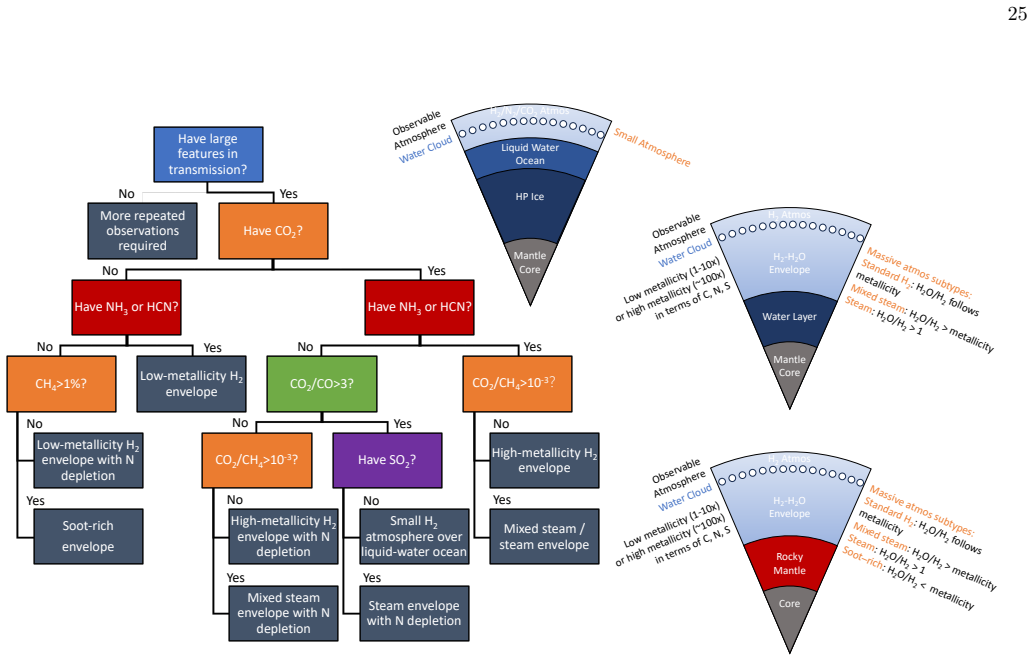
The argument turns on using the observed CO2-to-CH4 ratio as a proxy for the bulk H2O-to-H2 ratio in a massive hydrogen envelope. In water-rich envelopes, higher water content shifts carbon chemistry toward CO2 relative to CH4; the paper compares the retrieved abundance ratio to a precomputed grid of self-consistent pressure–temperature and chemistry models to read off an interior H2O fraction of 10–25% by volume. The alternative branch of the argument uses the absence of NH3 and CO together with the high CO2-to-CO ratio, as predicted for a thin H2 atmosphere resting on a liquid-water layer, to support the ocean scenario.
What would settle it
Measure the CO2-to-CO ratio with deeper NIRSpec/G395H transits: a confirmed CO2/CO below 1 would rule out the thin-atmosphere-over-ocean scenario, while CO2/CO above 3 would rule out standard massive-envelope models. Laboratory or quantum-chemical rate coefficients for the reaction CH3S + CO → CH3 + OCS would directly test the mapping used to infer the planet's water content.
Extended reading notes
Core claim
The central claim is that K2-18 b has a water-dominated interior. The evidence is the simultaneous presence of CH4 and CO2 at abundances that, according to the paper's self-consistent atmospheric models, can only be produced by either a massive H2 envelope with roughly 100 times solar metallicity and a bulk H2O content of 10–25% by volume, or a small H2 atmosphere over a liquid-water ocean. The spectrum contains no detectable H2O, NH3, or CO; the H2O absence is interpreted as a cold trap with a high Bond albedo, and the NH3 and CO nondetections favor the thin-atmosphere-over-ocean scenario, though massive-envelope alternatives with interior nitrogen sequestration are not ruled out. The paper concludes that whether or not the ocean exists, the planet's bulk volatile inventory is water-rich.
Load-bearing premise
The inference of 10–25% interior water depends on the theoretical mapping from the observed CO2-to-CH4 ratio to the H2O-to-H2 ratio in massive hydrogen envelopes; if that mapping is biased by poorly constrained sulfur chemistry such as OCS formation, a massive envelope with much less water could still reproduce the spectrum.
Editorial extensions
If this is right
- If the water-rich interior claim holds, K2-18 b joins a class of temperate sub-Neptunes whose volatile inventory is dominated by water rather than H2/He, informing formation models that accrete icy solids.
- The nondetection of water vapor implies an efficient cold trap and a Bond albedo of at least 0.3 at 2σ, with values near 0.5–0.7, close to what climate models need to avoid runaway greenhouse and sustain an ocean.
- Dimethyl sulfide and methyl mercaptan should not be treated as standalone biosignatures on massive high-metallicity sub-Neptunes, because the paper's models produce them abiotically; co-production of C2H6 or C2H2 could instead indicate biogenic surface fluxes.
- The CO2-to-CO ratio emerges as a practical diagnostic for future observations: values above roughly 3 favor a thin atmosphere over an ocean, while values below roughly 1 favor a massive H2 envelope.
Reading between the lines
- If the interior is water-rich, similar temperate sub-Neptunes such as TOI-270 d become high-priority targets for the same repeated-transit strategy, since their CO2-to-CH4 ratios could be measured the same way.
- The paper's demonstration that repeated visits weaken tentative DMS signals suggests that single-epoch biosignature claims on sub-Neptunes should be treated with caution until reproducibility is established.
- A testable corollary is that ground-based high-resolution spectroscopy targeting CO and OCS could break the degeneracy between the massive-envelope and ocean scenarios without waiting for more JWST transits.
- The cold-trap interpretation implies that transmission spectra of cool sub-Neptunes systematically under-report bulk H2O, so interior water content must be inferred from carbon chemistry—a lesson that transfers to other planets in this class.
Editorial analysis
A structured set of objections, weighed in public.
Referee Report
Summary. The paper presents four new JWST/NIRSpec transit observations (two G235H, two G395H) of the temperate sub-Neptune K2-18 b and combines them with re-reduced NIRISS/SOSS and G395H data from earlier programs. Two independent NIRSpec reductions (Eureka! and ExoTEDRF) and one NIRISS reduction (NAMELESS) are shown to agree. Three retrieval frameworks (ExoTR, AURA, SCARLET) consistently detect CH4 at log(VMR) ≈ -1.0 to -1.1 and CO2 at approximately 10^-3.5 to 10^-2.5, with 2σ upper limits on H2O, NH3, CO, and HCN. The paper then uses self-consistent EPACRIS photochemical-climate models to argue that the observed CO2-to-CH4 ratio implies a massive high-metallicity envelope with 10–25% H2O by volume, or alternatively a thin H2 atmosphere above a liquid-water ocean, and concludes that K2-18 b has a water-rich interior. It also reports marginal, sub-3σ evidence for DMS, CH3SH, and N2O, and presents abiotic photochemical pathways for DMS and CH3SH in massive high-metallicity envelopes, updating the 2021 characterization roadmap for temperate sub-Neptunes.
Significance. If the central claim is accepted, this is an important step in sub-Neptune characterization: it would be the first robust demonstration that a temperate sub-Neptune's bulk volatile inventory is water-dominated, with direct implications for interior structure and habitability. The observational core is genuinely strong: the paper ships multiple independent reduction pipelines, three independent retrieval frameworks with consistent CH4 and CO2 constraints, quantitative Bayes-factor detection tests, public data products, and transparent constrained-retrieval experiments that probe alternative compositions. The repeated-visit analysis is also a valuable methodological contribution, showing that tentative DMS/CH3SH/N2O signals weaken as more data are added. However, the headline water-rich conclusion is not a direct measurement: it depends on the Yang & Hu (2024a) model grid, whose reliability for the specific CO2/CH4 diagnostic is undercut by the same models' large overpredictions of CO, NH3, HCN, and CH3SH, and on a small-atmosphere branch that is inferred from theory rather than directly observed.
major comments (2)
- [Section 4; Sections 3.2.1 and 5.3] The central quantitative inference of a bulk H2O/H2 ratio of 10–25% by volume is obtained by comparing the retrieved CO2-to-CH4 ratio with the Yang & Hu (2024a) grid for a 100×solar C/H envelope. The same EPACRIS model family, however, overproduces CO relative to the retrieved upper limit, overproduces NH3 by at least two orders of magnitude, and produces CH3SH above the data-allowed level; Section 5.2.2 calls the CO overproduction "unexplained," and Section 5.3 states that "the interplay between sulfur and carbon chemistry in H2-dominated atmospheres remains poorly understood, with many reaction rates still unconstrained." Because the model CO2/CH4 ratio could respond to exactly these unconstrained OCS/sulfur pathways, the mapping from observed CO2/CH4 to a water-rich bulk composition is not yet robust, and a dry, high-metallicity H2-dominated envelope is not excluded. This is a load-bearing correctness risk in the central claim; the paper should either provide a quantitative propagation of the model-chemistry uncertainty into the inferred H2O/H2 range or explicitly reframe the 10–25% inference as conditional on the EPACRIS/Yang & Hu chemistry being accurate.
- [Abstract and Section 7; Sections 5.1, 5.2.1, 5.2.2] The statement that the results "conclusively demonstrate that K2-18 b has a water-rich interior" is stronger than the evidence supports. The massive-envelope branch depends on the model grid criticized above. The small-atmosphere branch assumes, rather than demonstrates, that a thin H2 atmosphere must overlie a liquid-water ocean (Section 5.2, citing Gupta et al. 2025), and the small-atmosphere model in Section 3.2.2 adopts the retrieved CH4 and CO2 abundances as lower-boundary conditions, so it is a consistency test rather than an independent prediction. In addition, the nondetections of H2O, NH3, and CO are not decisive: Sections 5.1, 5.2.1, and 5.2.2 show that constrained retrievals with elevated H2O, NH3, or CO produce visually acceptable fits with likelihood odds of only about 7:1, 3:1, and 2:1 against them, respectively. The conclusion should be softened to state that the data are consistent with a water-rich interior under the adopted photochemical/structural models, or the paper should provide a genuinely independent test of the water-rich hypothesis.
minor comments (5)
- [Section 3.1.2] The text contains the stray phrase "as shown hello thank youFigures 6 and A5," which appears to be an editing artifact and should be removed.
- [Section 3.1.2] The list of six primary molecules reads "H2O, CH4, CO2, NH3, CO2, HCN," with CO2 repeated; presumably CO was intended in one of the two positions.
- [Tables 5 and 7] The quoted 10–25% H2O range in Section 4 is based on the ExoTR abundances, but AURA returns a CO2 abundance higher by about 0.8 dex (log CO2 = -3.35^{+0.66}_{-0.80} versus -2.52^{+0.48}_{-0.57}); the text should state explicitly that the compositional range is conditional on the ExoTR retrieval and the Yang & Hu (2024a) grid, or provide a range that spans both retrieval frameworks.
- [Figure A2 caption] The caption spells "Madhusudan et al. (2023)" with a missing 'h'; the spelling should be corrected to "Madhusudhan" for consistency with the reference list.
- [Section 5.1, Eq. (3)] The skin-temperature formula is rendered ambiguously as "T skin = 1 21/4" before the bracket; please typeset the (1/2)^{1/4} factor clearly.
Circularity Check
No significant circularity: the CH4 and CO2 detections and the water-rich interpretation are model-dependent but not equivalent to their inputs by construction.
full rationale
The central observational claims (robust CH4 and CO2 detections, abundance constraints, and upper limits on H2O/NH3/CO/HCN) come from three independent retrieval frameworks (ExoTR, AURA, SCARLET) applied to the same JWST data, with cross-checks against alternative reductions are not fitted outputs of the theoretical grid that is later used for interpretation. The H2O/H2 inference in Section 4 compares the retrieved CO2/CH4 ratio to the forward grid of Yang & Hu (2024a); that grid is a parameter-free pre-existing model family whose stated assumptions do not include the target result, and it is externally falsifiable. Indeed, the paper candidly reports that the same EPACRIS models overproduce CO, NH3, HCN, and CH3SH relative to the retrievals, which is a genuine test rather than a circular confirmation. The small-atmosphere and cold-trap models do set CH4 and CO2 boundary conditions to retrieved values, but the quantities that carry the argument there (low H2O, low NH3, low CO, organosulfur yields) are computed outputs, not the assumed boundary conditions. The constrained retrievals that force high H2O, NH3, or CO explicitly demonstrate that alternative fits exist, so the paper is not merely reading its preferred scenario back out of its assumptions. The remaining concerns are about model completeness and the strength of the 'only' language, which are correctness and overclaim risks, not circular reductions.
Assumptions & free parameters
free parameters (5)
- CH4 volume mixing ratio =
log10 VMR -1.06 (+0.24/-0.37), ExoTR shifted average
- CO2 volume mixing ratio =
log10 VMR -3.35 (+0.66/-0.80) ExoTR; -2.52 (+0.48/-0.57) AURA
- Detector and instrument offsets =
Visit-dependent, ppm-level; manual -50 and +60 ppm applied to NRS2 in shifted average
- Cloud top pressure =
log P(top) > about -1.5 (2 sigma, i.e. >0.03 bar)
- Stellar heterogeneity parameters =
Fractions and temperatures with broad priors
assumptions (6)
- domain assumption Atmospheric background is 80% H2 and 20% He.
- domain assumption Isothermal pressure-temperature profile in the photosphere.
- domain assumption Molecular opacity databases (HITRAN, HITEMP, ExoMol) are accurate at the relevant temperatures, including DMS and CH3SH at 298 K.
- domain assumption The CO2-to-CH4 ratio in a massive H2 envelope maps to the bulk H2O-to-H2 ratio according to Yang & Hu (2024a).
- domain assumption A thin H2 atmosphere over a water-rich planet must be separated from the interior by a liquid layer.
- domain assumption Cold-trap relation and skin-temperature estimate for Bond albedo from the H2O upper limit.
Cite this review
Pith. "Pith review of A water-rich interior in the temperate sub-Neptune K2-18 b revealed by JWST." pith.science (2026). https://pith.science/paper/KVPS467I
@misc{pith2026250712622,
  author       = {Pith},
  title        = {Pith review of: A water-rich interior in the temperate sub-Neptune K2-18 b revealed by JWST},
  year         = {2026},
  howpublished = {\url{https://pith.science/paper/KVPS467I}},
  note         = {Machine review of arXiv:2507.12622}
}
read the original abstract
Temperate sub-Neptunes are compelling targets for detecting liquid-water oceans beyond the Solar System. If water-rich and lacking massive hydrogen-helium envelopes, these planets could sustain liquid layers beneath their atmospheres despite sizes larger than Earth. Previous observations of the temperate sub-Neptune K2-18 b revealed an H2-dominated atmosphere rich in CH4, with moderate evidence for CO2 and tentative signs of dimethyl sulfide (DMS). Here we present four new JWST/NIRSpec transit observations of K2-18 b. The resulting high-precision transmission spectrum robustly detects both CH4 and CO2, precisely measuring their abundances and firmly establishing the planet's water-rich nature: either a thick envelope with >10% H2O by volume or a thin atmosphere above a liquid-water ocean. The spectrum reveals no detectable H2O, NH3, or CO. The absence of atmospheric water vapor suggests an efficient cold trap, while the nondetections of NH3 and CO support the scenario of a small H2-rich atmosphere overlying a liquid reservoir. However, alternative models that include these gases can also reproduce the spectrum within uncertainties, highlighting the need for deeper observations. The spectrum only contains marginal signals of DMS, methyl mercaptan (CH3SH), and nitrous oxide (N2O), with none exceeding 3 sigma in model preference and all falling below ~2 sigma without imposing a strong super-Rayleigh haze. Meanwhile, our self-consistent photochemical models show that DMS and CH3SH may form abiotically in massive H2-rich atmospheres of high metallicity, making it important to consider additional indicators for their potential use as biosignatures. K2-18 b, a cool, water-rich world, stands out as one of the most promising temperate sub-Neptunes for exploring the emergence of liquid-water environments in non-Earth-like planets, motivating further characterization of its atmosphere and interior.
Figures


Figures from the paper (8 more)


Forward citations
Cited by 6 Pith papers
-
Methane on the temperate exo-Saturn TOI-199b
TOI-199 b, a 350 K exo-Saturn, shows methane in its JWST transmission spectrum—the first such detection for a temperate gas giant.
-
The SPACE Program II: No discernible spectral features in the transmission spectrum of the sub-Neptune HD 191939 b observed with HST/WFC3
The first HST/WFC3 transmission spectrum of sub-Neptune HD 191939 b shows no significant absorption features and is consistent with a flat line.
-
Phase-dependent chemistry of WASP-43 b revealed with a suite of one-, two-, and three-dimensional models
Horizontal quenching at wind speeds ≳500 m/s, plus carbon-sulfur chemistry, explains the MIRI non-detection of night-side methane on WASP-43 b without requiring high metallicity.
-
Nitrogen chemistry of hycean worlds on the example of K2-18b
Photochemical modeling of K2-18b predicts that N2-dominated nitrogen sources produce undetectable N-species, while NH3-dominated sources would make NH3, CH5N and HCN near-detectable, and that equilibrium chemistry und...
-
Hydrocarbon Hazes on Temperate sub-Neptune K2-18b supported by data from the James Webb Space Telescope
Using a new MIRI LRS reduction plus published NIRISS/NIRSpec data, the authors find that hydrocarbon haze analogues can reproduce K2-18b's 0.85-12 µm transmission spectrum without instrumental offsets, yielding an H2-...
-
Exploration of Exoplanet Atmospheres with the James Webb Space Telescope
A review of JWST's first cycles of exoplanet atmosphere observations, spanning direct imaging, transit spectroscopy, and the prospect of a ~10,000-hour population survey.
Reference graph
Works this paper leans on
-
[1]
, " * write output.state after.block = add.period write newline
ENTRY address archivePrefix author booktitle chapter doi edition editor eprint howpublished institution journal key month number organization pages publisher school series title misctitle type volume year version url label extra.label sort.label short.list INTEGERS output.state before.all mid.sentence after.sentence after.block FUNCTION init.state.consts ...
-
[2]
write newline
" write newline "" before.all 'output.state := FUNCTION format.url url empty "" new.block "" url * "" * if FUNCTION format.eprint eprint empty "" archivePrefix empty "" archivePrefix "arXiv" = new.block " " eprint * " " * new.block " " eprint * " " * if if if FUNCTION format.doi doi empty "" " " doi * " " * if FUNCTION format.pid doi empty eprint empty ""...
-
[3]
thebibliography [1] 20pt to REFERENCES 6pt =0pt 10pt plus 3pt =0pt =0pt =1pt plus 1pt =0pt =0pt -12pt =13pt plus 1pt =20pt =13pt plus 1pt \@M =10000 =-1.0em =0pt =0pt 0pt =0pt =1.0em @enumiv\@empty 10000 10000 `\.\@m \@noitemerr \@latex@warning Empty `thebibliography' environment \@ifnextchar \@reference \@latexerr Missing key on reference command Each re...
-
[4]
2025, arXiv preprint arXiv:2504.20428
Ahrer, E.-M., Radica, M., Piaulet-Ghorayeb, C., et al. 2025, arXiv preprint arXiv:2504.20428
arXiv 2025
-
[5]
2023, Publications of the Astronomical Society of the Pacific, 135, 075001
Albert, L., Lafreni \`e re, D., Doyon, R., et al. 2023, Publications of the Astronomical Society of the Pacific, 135, 075001
2023
-
[6]
Alderson , L., Wakeford , H. R., Alam , M. K., et al. 2023, , 614, 664, 10.1038/s41586-022-05591-3
-
[7]
O., Cody, G., De Gregorio, B., Nittler, L., & Stroud, R
Alexander, C. O., Cody, G., De Gregorio, B., Nittler, L., & Stroud, R. 2017, Geochemistry, 77, 227
2017
-
[8]
2023, Characterization of the visit-to-visit Stability of the GR700XD Wavelength Calibration for NIRISS/SOSS Observations , Technical Report JWST-STScI-008571, 12 pages
Baines , T., Espinoza , N., Filippazzo , J., & Volk , K. 2023, Characterization of the visit-to-visit Stability of the GR700XD Wavelength Calibration for NIRISS/SOSS Observations , Technical Report JWST-STScI-008571, 12 pages
2023
Show all 124 references
-
[9]
M., & Kockarts, G
Banks, P. M., & Kockarts, G. 2013, Aeronomy (Elsevier)
2013
-
[10]
J., Strange , J
Barber , R. J., Strange , J. K., Hill , C., et al. 2014, , 437, 1828, 10.1093/mnras/stt2011
2014 doi
-
[11]
J., Ahrer, E.-M., Brande, J., et al
Bell, T. J., Ahrer, E.-M., Brande, J., et al. 2022, Journal of Open Source Software, 7, 4503
2022
-
[12]
A., et al
Bello-Arufe , A., Damiano , M., Bennett , K. A., et al. 2025, , 980, L26, 10.3847/2041-8213/adaf22
2025 doi
- [13]
-
[14]
2012, The Astrophysical Journal, 753, 100
Benneke, B., & Seager, S. 2012, The Astrophysical Journal, 753, 100
2012
-
[15]
2013, , 778, 153, 10.1088/0004-637X/778/2/153
Benneke , B., & Seager , S. 2013, , 778, 153, 10.1088/0004-637X/778/2/153
2013 doi
-
[16]
2017, , 834, 187, 10.3847/1538-4357/834/2/187
Benneke , B., Werner , M., Petigura , E., et al. 2017, , 834, 187, 10.3847/1538-4357/834/2/187
2017 doi
-
[17]
2019 a , The Astrophysical Journal Letters, 887, L14
Benneke, B., Wong, I., Piaulet, C., et al. 2019 a , The Astrophysical Journal Letters, 887, L14
2019
-
[18]
A., Lothringer, J., et al
Benneke, B., Knutson, H. A., Lothringer, J., et al. 2019 b , Nature Astronomy, 3, 813–821, 10.1038/s41550-019-0800-5
2019 doi
-
[19]
2024, arXiv preprint arXiv:2403.03325
Benneke, B., Roy, P.-A., Coulombe, L.-P., et al. 2024, arXiv preprint arXiv:2403.03325
2024 arXiv
-
[20]
A., Kempton, E
Bergin, E. A., Kempton, E. M.-R., Hirschmann, M., et al. 2023, The Astrophysical Journal Letters, 949, L17
2023
-
[21]
B., Rajappan, M., & \"O berg, K
Bergner, J. B., Rajappan, M., & \"O berg, K. I. 2022, The Astrophysical Journal, 933, 206
2022
-
[22]
2022, Nature Astronomy, 6, 537
B \'e zard, B., Charnay, B., & Blain, D. 2022, Nature Astronomy, 6, 537
2022
-
[23]
2022, Astronomy & Astrophysics, 661, A83
Birkmann, S., Ferruit, P., Giardino, G., et al. 2022, Astronomy & Astrophysics, 661, A83
2022
-
[24]
2021, Astronomy & Astrophysics, 646, A15
Blain, D., Charnay, B., & B \'e zard, B. 2021, Astronomy & Astrophysics, 646, A15
2021
-
[25]
2014, , 564, A125, 10.1051/0004-6361/201322971
Buchner , J., Georgakakis , A., Nandra , K., et al. 2014, , 564, A125, 10.1051/0004-6361/201322971
2014 doi
-
[26]
2024, Nature Astronomy, 8, 463, 10.1038/s41550-023-02183-7
Burn , R., Mordasini , C., Mishra , L., et al. 2024, Nature Astronomy, 8, 463, 10.1038/s41550-023-02183-7
2024 doi
-
[27]
2023, JWST Calibration Pipeline , 1.9.4, Zenodo, 10.5281/zenodo.7577320
Bushouse , H., Eisenhamer , J., Dencheva , N., et al. 2023, JWST Calibration Pipeline , 1.9.4, Zenodo, 10.5281/zenodo.7577320
2023 doi
-
[28]
Chapman, S., & Cowling, T. G. 1990, The mathematical theory of non-uniform gases: an account of the kinetic theory of viscosity, thermal conduction and diffusion in gases (Cambridge university press)
1990
-
[29]
2017, , 608, A35, 10.1051/0004-6361/201731558
Cloutier , R., Astudillo-Defru , N., Doyon , R., et al. 2017, , 608, A35, 10.1051/0004-6361/201731558
2017 doi
-
[30]
2019, Astronomy & Astrophysics, 621, A49
Cloutier, R., Astudillo-Defru, N., Doyon, R., et al. 2019, Astronomy & Astrophysics, 621, A49
2019
-
[31]
A., Yurchenko , S
Coles , P. A., Yurchenko , S. N., & Tennyson , J. 2019, , 490, 4638, 10.1093/mnras/stz2778
2019 doi
-
[32]
2024, Monthly Notices of the Royal Astronomical Society, 530, 3252
Constantinou, S., & Madhusudhan, N. 2024, Monthly Notices of the Royal Astronomical Society, 530, 3252
2024
-
[33]
J., & Madhusudhan, N
Cooke, G. J., & Madhusudhan, N. 2024, arXiv preprint arXiv:2410.07313
2024 arXiv
-
[34]
2024, , 168, 227, 10.3847/1538-3881/ad7aef
Coulombe , L.-P., Roy , P.-A., & Benneke , B. 2024, , 168, 227, 10.3847/1538-3881/ad7aef
2024 doi
-
[35]
2023, , 620, 292, 10.1038/s41586-023-06230-1
Coulombe , L.-P., Benneke , B., Challener , R., et al. 2023, , 620, 292, 10.1038/s41586-023-06230-1
2023 doi
- [36]
-
[37]
2024, , 968, L22, 10.3847/2041-8213/ad5204
Damiano , M., Bello-Arufe , A., Yang , J., & Hu , R. 2024, , 968, L22, 10.3847/2041-8213/ad5204
2024 doi
-
[38]
D., Meadows, V
Domagal-Goldman, S. D., Meadows, V. S., Claire, M. W., & Kasting, J. F. 2011, Astrobiology, 11, 419
2011
-
[39]
J., Hutchings, J
Doyon, R., Willott, C. J., Hutchings, J. B., et al. 2023, Publications of the Astronomical Society of the Pacific, 135, 098001
2023
-
[40]
D., Radica, M., Welbanks, L., et al
Feinstein, A. D., Radica, M., Welbanks, L., et al. 2023, Nature, 614, 670–675, 10.1038/s41586-022-05674-1
2023 doi
-
[41]
P., & Bridges, M
Feroz, F., Hobson, M. P., & Bridges, M. 2009, Monthly Notices of the Royal Astronomical Society, 398, 1601, 10.1111/j.1365-2966.2009.14548.x
2009
-
[42]
W., Lang, D., & Goodman, J
Foreman-Mackey, D., Hogg, D. W., Lang, D., & Goodman, J. 2013, Publications of the Astronomical Society of the Pacific, 125, 306–312, 10.1086/670067
2013 doi
-
[43]
P., Youngblood, A., et al
France, K., Loyd, R. P., Youngblood, A., et al. 2016, The Astrophysical Journal, 820, 89
2016
-
[44]
2022, Earth and Planetary Science Letters, 577, 117255
Gaillard, F., Bernadou, F., Roskosz, M., et al. 2022, Earth and Planetary Science Letters, 577, 117255
2022
-
[45]
W., Allen , J
Gao , C. W., Allen , J. W., Green , W. H., & West , R. H. 2016, Comput. Phys. Commun., 203, 212, 10.1016/j.cpc.2016.02.013
2016 doi
-
[46]
Glein, C. R. 2024, The Astrophysical Journal Letters, 964, L19
2024
-
[47]
E., Rothman , L
Gordon , I. E., Rothman , L. S., Hargreaves , R. J., et al. 2022, , 277, 107949, 10.1016/j.jqsrt.2021.107949
2022
-
[48]
S., Dasgupta, R., Hough, T., & Farnell, A
Grewal, D. S., Dasgupta, R., Hough, T., & Farnell, A. 2021, Nature geoscience, 14, 369
2021
-
[49]
Gupta, A., Stixrude, L., & Schlichting, H. E. 2025, The Astrophysical Journal Letters, 982, L35
2025
-
[50]
J., Gordon , I
Hargreaves , R. J., Gordon , I. E., Rey , M., et al. 2020, , 247, 55, 10.3847/1538-4365/ab7a1a
2020 doi
-
[51]
J., Souto, D., et al
Hejazi, N., Crossfield, I. J., Souto, D., et al. 2024, The Astrophysical Journal, 973, 31
2024
-
[52]
1998, Bulletin of the American Meteorological Society, 79, 831 , 10.1175/1520-0477(1998)079<0831:OPOAAC>2.0.CO;2
Hess, M., Koepke, P., & Schult, I. 1998, Bulletin of the American Meteorological Society, 79, 831 , 10.1175/1520-0477(1998)079<0831:OPOAAC>2.0.CO;2
1998 doi
-
[53]
2023, Monthly Notices of the Royal Astronomical Society, 524, 377–402, 10.1093/mnras/stad1580
Holmberg, M., & Madhusudhan, N. 2023, Monthly Notices of the Royal Astronomical Society, 524, 377–402, 10.1093/mnras/stad1580
2023 doi
-
[54]
2019, The Astrophysical Journal, 887, 166
Hu, R. 2019, The Astrophysical Journal, 887, 166
2019
-
[55]
2021, The Astrophysical Journal, 921, 27
---. 2021, The Astrophysical Journal, 921, 27
2021
-
[56]
2021, The Astrophysical Journal Letters, 921, L8
Hu, R., Damiano, M., Scheucher, M., et al. 2021, The Astrophysical Journal Letters, 921, L8
2021
-
[57]
2024, Nature, 630, 609
Hu, R., Bello-Arufe, A., Zhang, M., et al. 2024, Nature, 630, 609
2024
-
[58]
Innes, H., Tsai, S.-M., & Pierrehumbert, R. T. 2023, The Astrophysical Journal, 953, 168
2023
-
[59]
A., et al
Jakobsen, P., Ferruit, P., de Oliveira, C. A., et al. 2022, Astronomy & Astrophysics, 661, A80
2022
-
[60]
S., Dong, X., Grinberg Dana, A., et al
Johnson, M. S., Dong, X., Grinberg Dana, A., et al. 2022, J. Chem. Inf. Model., 62, 4906, 10.1021/acs.jcim.2c00965
2022 doi
-
[61]
Jordan, S., Shorttle, O., & Quanz, S. P. 2025, arXiv preprint arXiv:2504.12030
2025 arXiv
-
[62]
Kasting, J. F. 1991, icarus, 94, 1
1991
-
[63]
Kipping , D. M. 2013, , 435, 2152, 10.1093/mnras/stt1435
2013 doi
-
[64]
D., & Cronin, T
Koll, D. D., & Cronin, T. W. 2019, The Astrophysical Journal, 881, 120
2019
- [65]
-
[66]
2024, Astronomy & Astrophysics, 686, A131
Leconte, J., Spiga, A., Cl \'e ment, N., et al. 2024, Astronomy & Astrophysics, 686, A131
2024
-
[67]
E., Rothman , L
Li , G., Gordon , I. E., Rothman , L. S., et al. 2015, , 216, 15, 10.1088/0067-0049/216/1/15
2015 doi
-
[68]
E., Bello-Arufe , A., Berta-Thompson , Z
Libby-Roberts , J. E., Bello-Arufe , A., Berta-Thompson , Z. K., et al. 2025, arXiv e-prints, arXiv:2505.21358. 2505.21358
2025 arXiv
-
[69]
S., et al
Liu, M., Grinberg Dana, A., Johnson, M. S., et al. 2021, Journal of Chemical Information and Modeling, 61, 2686
2021
-
[70]
D., & Morley, C
Loftus, K., Wordsworth, R. D., & Morley, C. V. 2019, The Astrophysical Journal, 887, 231
2019
-
[71]
2022, Science, 377, 1211
Luque, R., & Pall \'e , E. 2022, Science, 377, 1211
2022
-
[72]
2025, arXiv e-prints, arXiv:2505.13407
Luque , R., Piaulet-Ghorayeb , C., Radica , M., et al. 2025, arXiv e-prints, arXiv:2505.13407. 2505.13407
2025 arXiv
-
[73]
J., & Madhusudhan , N
MacDonald , R. J., & Madhusudhan , N. 2024, POSEIDON: Multidimensional atmospheric retrieval of exoplanet spectra , Astrophysics Source Code Library, record ascl:2412.028
2024
-
[74]
2025, , 983, L40, 10.3847/2041-8213/adc1c8
Madhusudhan , N., Constantinou , S., Holmberg , M., et al. 2025, , 983, L40, 10.3847/2041-8213/adc1c8
2025 doi
-
[75]
C., Welbanks, L., Piette, A
Madhusudhan, N., Nixon, M. C., Welbanks, L., Piette, A. A., & Booth, R. A. 2020, The Astrophysical Journal Letters, 891, L7
2020
-
[76]
A., & Constantinou, S
Madhusudhan, N., Piette, A. A., & Constantinou, S. 2021, The Astrophysical Journal, 918, 1
2021
-
[77]
2023, The Astrophysical Journal Letters, 956, L13
Madhusudhan, N., Sarkar, S., Constantinou, S., et al. 2023, The Astrophysical Journal Letters, 956, L13
2023
-
[78]
2009, , 707, 24, 10.1088/0004-637X/707/1/24
Madhusudhan , N., & Seager , S. 2009, , 707, 24, 10.1088/0004-637X/707/1/24
2009 doi
-
[79]
2012, Earth and Planetary Science Letters, 313, 56
Marty, B. 2012, Earth and Planetary Science Letters, 313, 56
2012
-
[80]
W., Chubb , K., Helling , C., & Kawashima , Y
Min , M., Ormel , C. W., Chubb , K., Helling , C., & Kawashima , Y. 2020, , 642, A28, 10.1051/0004-6361/201937377
2020 doi
-
[81]
T., Morton , T
Montet , B. T., Morton , T. D., Foreman-Mackey , D., et al. 2015, , 809, 25, 10.1088/0004-637X/809/1/25
2015 doi
-
[82]
E., Stevenson , K
Moran , S. E., Stevenson , K. B., Sing , D. K., et al. 2023, , 948, L11, 10.3847/2041-8213/accb9c
2023 doi
-
[83]
2020, The Astrophysical journal letters, 896, L22
Mousis, O., Deleuil, M., Aguichine, A., et al. 2020, The Astrophysical journal letters, 896, L22
2020
-
[84]
I., & Bergin, E
\"O berg, K. I., & Bergin, E. A. 2021, Physics Reports, 893, 1
2021
-
[85]
2020, The Astrophysical Journal Letters, 895, L47
Ohno, K., & Kawashima, Y. 2020, The Astrophysical Journal Letters, 895, L47
2020
-
[86]
A., Rogers, J
Petigura, E. A., Rogers, J. G., Isaacson, H., et al. 2022, The Astronomical Journal, 163, 179
2022
-
[87]
2024, , 974, L10, 10.3847/2041-8213/ad6f00
Piaulet-Ghorayeb , C., Benneke , B., Radica , M., et al. 2024, , 974, L10, 10.3847/2041-8213/ad6f00
2024 doi
-
[88]
J., Constantinou, S., & Binet, M
Pica-Ciamarra, L., Madhusudhan, N., Cooke, G. J., Constantinou, S., & Binet, M. 2025, arXiv preprint arXiv:2505.10539
2025 arXiv
-
[89]
2017, , 471, 4355, 10.1093/mnras/stx1849
Pinhas , A., & Madhusudhan , N. 2017, , 471, 4355, 10.1093/mnras/stx1849
2017 doi
-
[90]
2019, Monthly Notices of the Royal Astronomical Society, 482, 1485
Pinhas, A., Madhusudhan, N., Gandhi, S., & MacDonald, R. 2019, Monthly Notices of the Royal Astronomical Society, 482, 1485
2019
-
[91]
L., Kyuberis , A
Polyansky , O. L., Kyuberis , A. A., Zobov , N. F., et al. 2018, , 480, 2597, 10.1093/mnras/sty1877
2018 doi
-
[92]
M., Salyk, C., Banzatti, A., et al
Pontoppidan, K. M., Salyk, C., Banzatti, A., et al. 2019, The Astrophysical Journal, 874, 92
2019
-
[93]
2024, The Journal of Open Source Software, 9, 6898, 10.21105/joss.06898
Radica , M. 2024, The Journal of Open Source Software, 9, 6898, 10.21105/joss.06898
2024 doi
-
[94]
2023, , 524, 835, 10.1093/mnras/stad1762
Radica , M., Welbanks , L., Espinoza , N., et al. 2023, , 524, 835, 10.1093/mnras/stad1762
2023 doi
-
[95]
W., Shearer, R
Reed, N. W., Shearer, R. L., McGlynn, S. E., et al. 2024, The Astrophysical Journal Letters, 973, L38
2024
-
[96]
E., Pica-Ciamarra, L., Holmberg, M., et al
Rigby, F. E., Pica-Ciamarra, L., Holmberg, M., et al. 2024, arXiv preprint arXiv:2409.03683
2024 arXiv
-
[97]
D., & Catling, D
Robinson, T. D., & Catling, D. C. 2012, The Astrophysical Journal, 757, 104
2012
-
[98]
D., & Salvador , A
Robinson , T. D., & Salvador , A. 2023, The Planetary Science Journal, 4, 10, 10.3847/PSJ/acac9a
2023 doi
-
[99]
A., Jephcoat, A., Marty, B., & Mysen, B
Roskosz, M., Bouhifd, M. A., Jephcoat, A., Marty, B., & Mysen, B. 2013, Geochimica et Cosmochimica Acta, 121, 15
2013
-
[100]
L., et al
Scheucher, M., Wunderlich, F., Grenfell, J. L., et al. 2020, The Astrophysical Journal, 898, 44
2020
-
[101]
P., MacDonald, R
Schmidt, S. P., MacDonald, R. J., Tsai, S.-M., et al. 2025, arXiv preprint arXiv:2501.18477
2025 arXiv
-
[102]
R., & Bergin, E
Schwarz, K. R., & Bergin, E. A. 2014, The Astrophysical Journal, 797, 113
2014
-
[103]
2013, The Astrophysical Journal, 777, 95
Seager, S., Bains, W., & Hu, R. 2013, The Astrophysical Journal, 777, 95
2013
-
[104]
J., & Berger, J
Sellke, T., Bayarri, M. J., & Berger, J. O. 2001, The American Statistician, 55, 62
2001
-
[105]
Shorttle, O., Jordan, S., Nicholls, H., Lichtenberg, T., & Bower, D. J. 2024, The Astrophysical Journal Letters, 962, L8
2024
-
[106]
2004, in American Institute of Physics Conference Series, ed
Skilling , J. 2004, in American Institute of Physics Conference Series, ed. R. Fischer , R. Preuss , & U. V. Toussaint , Vol. 735, 395--405
2004
-
[107]
2008, Chemical Physics, 344, 221
Tang, Y.-Z., Pan, Y.-R., Sun, J.-Y., Sun, H., & Wang, R.-S. 2008, Chemical Physics, 344, 221
2008
-
[108]
2025, Research Notes of the AAS, 9, 118
Taylor, J. 2025, Research Notes of the AAS, 9, 118
2025
-
[109]
N., Al-Refaie , A
Tennyson , J., Yurchenko , S. N., Al-Refaie , A. F., et al. 2016, Journal of Molecular Spectroscopy, 327, 73, 10.1016/j.jms.2016.05.002
2016 doi
-
[110]
2024, The Astrophysical Journal, 963, 157
Tian, M., & Heng, K. 2024, The Astrophysical Journal, 963, 157
2024
-
[111]
2021, The Astrophysical Journal Letters, 922, L27
Tsai, S.-M., Innes, H., Lichtenberg, T., et al. 2021, The Astrophysical Journal Letters, 922, L27
2021
-
[112]
F., & Schwieterman, E
Tsai, S.-M., Innes, H., Wogan, N. F., & Schwieterman, E. W. 2024, The Astrophysical Journal Letters, 966, L24
2024
-
[113]
P., Tinetti, G., Tennyson, J., & Yurchenko, S
Tsiaras, A., Waldmann, I. P., Tinetti, G., Tennyson, J., & Yurchenko, S. N. 2019, Nature Astronomy, 3, 1086
2019
-
[114]
E., Guilera, O
Venturini, J. E., Guilera, O. M., Haldemann, J., Ronco, M. P., & Mordasini, C. 2020, Astronomy and astrophysics, 643, L1
2020
-
[115]
L., Smith , M
Villanueva , G. L., Smith , M. D., Protopapa , S., Faggi , S., & Mandell , A. M. 2018, , 217, 86, 10.1016/j.jqsrt.2018.05.023
2018 doi
-
[116]
2019, Icarus, 324, 120
Vuitton, V., Yelle, R., Klippenstein, S., H \"o rst, S., & Lavvas, P. 2019, Icarus, 324, 120
2019
-
[117]
C., McGill, P., et al
Welbanks, L., Nixon, M. C., McGill, P., et al. 2025, arXiv preprint arXiv:2504.21788
2025
-
[118]
F., Batalha, N
Wogan, N. F., Batalha, N. E., Zahnle, K. J., et al. 2024, The Astrophysical Journal Letters, 963, L7
2024
-
[119]
2024 a , The Astrophysical Journal Letters, 971, L48
Yang, J., & Hu, R. 2024 a , The Astrophysical Journal Letters, 971, L48
2024
-
[120]
2024 b , ApJ, 966, 189, 10.3847/1538-4357/ad35c8
---. 2024 b , ApJ, 966, 189, 10.3847/1538-4357/ad35c8
2024 doi
-
[121]
I., Fortney, J
Yu, X., Moses, J. I., Fortney, J. J., & Zhang, X. 2021, The Astrophysical Journal, 914, 38
2021
-
[122]
N., Mellor , T
Yurchenko , S. N., Mellor , T. M., Freedman , R. S., & Tennyson , J. 2020, , 496, 5282, 10.1093/mnras/staa1874
2020 doi
-
[123]
N., Owens , A., Kefala , K., & Tennyson , J
Yurchenko , S. N., Owens , A., Kefala , K., & Tennyson , J. 2024, , 528, 3719, 10.1093/mnras/stae148
2024 doi
-
[124]
Zhang, X., & Showman, A. P. 2018, The Astrophysical Journal, 866, 1
2018
Reviewed August 6, 2026 · model on record in the stance chip above.
Discussion (0). Continue with ORCID to comment.