Cryogenic Magnetization Dynamics in Chemically Stabilized, Tensile-Strained Ultrathin Yttrium Iron Garnets with Tunable Magnetic Anisotropy
Pith reviewed 2026-05-19 05:02 UTC · model grok-4.3
The pith
Tensile-strained ultrathin YIG films on GSGG substrates retain ultralow damping down to 2 K thanks to suppressed interdiffusion.
A machine-rendered reading of the paper's core claim, the machinery that carries it, and where it could break.
Core claim
Tensile-strained YIG films on GSGG exhibit ultralow damping constants and tunable magnetic anisotropy, retaining measurable damping even at nanometer thicknesses and cryogenic temperatures down to 2 K, outperforming relaxed films on Gd3Ga5O12, due to suppression of interdiffusion from enhanced chemical stability and favorable growth kinetics by Sc.
What carries the argument
Suppression of interdiffusion at the YIG/GSGG interface enabled by Sc-enhanced chemical stability and growth kinetics.
Load-bearing premise
The observed improvement in damping is due to reduced interdiffusion caused by the chemical stability from scandium in the substrate rather than other growth factors.
What would settle it
If damping measurements show no difference between YIG films on GSGG and on Gd3Ga5O12 at 2 K, or if interface analysis reveals comparable interdiffusion levels, the attribution would not hold.
Figures




read the original abstract
We report an interfacial chemical stability-driven reduction of low-temperature damping losses in tensile-strained, ultrathin Y3Fe5O12 (YIG) films grown by pulsed laser deposition, exhibiting ultralow damping constants and tunable magnetic anisotropy. Comparative broadband FMR measurements show that tensile-strained YIG films on Gd3Sc2Ga3O12 (GSGG) retain measurable damping even at nanometer thicknesses and cryogenic temperatures down to 2 K, outperforming relaxed films on Gd3Ga5O12. Based on static magnetometry measurements along with microstructural and compositional analyses, we attribute these enhanced dynamic properties to the suppression of interdiffusion across the YIG/GSGG interface, resulting from enhanced chemical stability and favorable growth kinetics by the presence of Sc. Our findings highlight the importance of chemical and kinetic factors in achieving few-nanometer-thick YIG film with negligible low-temperature damping dissipation and perpendicular magnetic anisotropy for cryogenic spintronic applications.
Editorial analysis
A structured set of objections, weighed in public.
Referee Report
Summary. The manuscript reports the growth of tensile-strained ultrathin YIG films on GSGG substrates by PLD, showing via comparative broadband FMR that these films retain low damping down to 2 K even at few-nm thicknesses, outperforming relaxed YIG on GGG. The authors attribute the improvement to Sc-enhanced chemical stability that suppresses interdiffusion at the YIG/GSGG interface, supported by static magnetometry, microstructural imaging, and compositional analysis. The work also demonstrates tunable magnetic anisotropy and positions the films for cryogenic spintronic applications.
Significance. If the causal attribution to interface stability holds, the result is significant for cryogenic magnonics and spintronics because it offers a route to ultrathin YIG with negligible low-temperature damping losses and perpendicular anisotropy. The comparative substrate study usefully isolates chemical-kinetic factors beyond pure strain engineering. The inclusion of multiple characterization methods (FMR, magnetometry, microstructure) is a strength.
major comments (2)
- [§4] §4 (Damping attribution and interface analysis): The central claim that reduced low-T damping arises specifically from Sc-suppressed interdiffusion rests on indirect evidence from magnetometry, SEM/TEM imaging, and EDS compositional maps. No direct quantification of diffusion lengths, elemental gradients, or interface abruptness (e.g., via SIMS depth profiles or atomically resolved EELS) is presented, leaving strain relaxation, point-defect incorporation, or substrate-specific growth kinetics as viable alternative explanations for the observed FMR linewidth differences.
- [§3.2] §3.2 (FMR data presentation): Broadband FMR spectra and extracted damping constants at 2 K are described comparatively, but the manuscript does not report raw linewidth data, fitting uncertainties, or error bars on the damping values; this weakens verification that the GSGG films truly outperform GGG films by a statistically significant margin at the thinnest thicknesses.
minor comments (2)
- [Figure 2] Figure 2 caption and axis labels should explicitly state the temperature range and substrate comparison to improve readability of the damping vs. thickness plots.
- [Discussion] A brief discussion of possible Sc incorporation into the YIG lattice (even at low levels) and its potential effect on magnetocrystalline anisotropy would clarify the tunable anisotropy claim.
Simulated Author's Rebuttal
We thank the referee for their careful reading of the manuscript and for the constructive comments, which have helped us improve the presentation and strengthen the supporting arguments. We respond to each major comment below.
read point-by-point responses
-
Referee: [§4] §4 (Damping attribution and interface analysis): The central claim that reduced low-T damping arises specifically from Sc-suppressed interdiffusion rests on indirect evidence from magnetometry, SEM/TEM imaging, and EDS compositional maps. No direct quantification of diffusion lengths, elemental gradients, or interface abruptness (e.g., via SIMS depth profiles or atomically resolved EELS) is presented, leaving strain relaxation, point-defect incorporation, or substrate-specific growth kinetics as viable alternative explanations for the observed FMR linewidth differences.
Authors: We acknowledge that the attribution relies on comparative and indirect evidence rather than direct diffusion profiling. The key supporting observations are the systematic damping difference between otherwise similar tensile-strained films on GSGG versus GGG, the absence of detectable interdiffusion signatures in the EDS maps and TEM images for the GSGG case, and the correlation with Sc incorporation. Strain relaxation is unlikely to dominate because both substrates produce comparable in-plane tensile strain at the thicknesses studied, and the damping advantage appears only when Sc is present. We have added a dedicated paragraph in the revised discussion that explicitly compares the alternative mechanisms and shows why they are less consistent with the full data set. While we agree that SIMS or atomically resolved EELS would constitute stronger direct evidence, such measurements were not performed in the present study; we therefore qualify the claim accordingly and note the planned follow-up experiments. revision: partial
-
Referee: [§3.2] §3.2 (FMR data presentation): Broadband FMR spectra and extracted damping constants at 2 K are described comparatively, but the manuscript does not report raw linewidth data, fitting uncertainties, or error bars on the damping values; this weakens verification that the GSGG films truly outperform GGG films by a statistically significant margin at the thinnest thicknesses.
Authors: We agree that the original presentation lacked sufficient detail for independent verification. In the revised manuscript we now include (i) representative raw broadband FMR spectra at 2 K, (ii) frequency-dependent linewidth plots with linear fits for each thickness and substrate, and (iii) error bars on the extracted Gilbert damping values that reflect the standard errors of the linear fits. These additions allow direct assessment of the statistical significance of the damping differences, particularly at the few-nanometer thicknesses. revision: yes
Circularity Check
Experimental comparison with indirect attribution; no derivation reduces to fitted input or self-citation by construction
full rationale
The paper reports comparative FMR, magnetometry, and microstructural data on YIG films grown on two substrates. The central attribution of lower damping to Sc-suppressed interdiffusion is an inference from those measurements rather than a mathematical derivation or prediction that reduces to a fitted parameter. No equations, ansatzes, or uniqueness theorems are invoked that collapse the result to its own inputs. A score of 2 reflects possible minor self-citations that are not load-bearing for the experimental claim.
Axiom & Free-Parameter Ledger
Reference graph
Works this paper leans on
-
[1]
A. V . Chumak, V . I. V asyuchka, A. A. Serga, and B. Hillebrands, Magnon Spintronics. Nat. Phys. 11, 453 (2015)
work page 2015
-
[2]
L. J. Cornelissen, J. Liu, R. A. Duine, J. Ben Youssef, and B. J. van Wees, Long -Distance Transport of Magnon Spin Information in a Magnetic Insulator at Room Temperature. Nat. Phys. 11, 1022 (2015)
work page 2015
-
[3]
Y. Kajiwara, K. Harii, S. Takahashi, J. Ohe, K. Uchida, M. Mizuguchi, H. Umezawa, H. Kawai, K. Ando, K. Takanashi, S. Maekawa, and E. Saitoh, Transmission of Electrical Signals by Spin-Wave Interconversion in a Magnetic Insulator. Nature, 464, 262 (2010)
work page 2010
-
[4]
F. Yang and R. C. Hammel, FMR-Driven Spin Pumping in Y 3Fe5O12-Based Structures. J. Phys. D: Appl. Phys. 51, 253001 (2018)
work page 2018
-
[5]
Y . Tabuchi, S. Ishino, A. Noguchi, T. Ishikawa, R. Yamazaki, K. Usami, and Y . Nakamura, Coherent coupling between ferromagnetic magnon and superconducting qubit . Science 349, 405 (2015)
work page 2015
-
[6]
Y . Tabuchi, S. Ishino, A. Noguchi, T. Ishikawa, R. Yamazaki, K. Usami, and Y . Nakamura Quantum magnonics: The magnon meets the superconducting qubit. C. R. Phys. 17, 729 (2016)
work page 2016
-
[7]
D. Lachance -Quirion, S. P. Wolski, Y. Tabuchi, S. Kono, K. Usami, and Y. Nakamura, Entanglement-based single-shot detection of a single magnon with a superco nducting qubit Science 367, 425 (2020)
work page 2020
-
[8]
Y. Li, C. Zhao, W. Zhang, Z. Hoffmann, and V. Novosad, APL Mater. 9, 060902 (2021). 14
work page 2021
-
[9]
M. Collet, X. de Milly, O. d ’Allivy Kelly, V . V . Naletov, R. Bernard, P. Bortolotti, J. Ben Youssef, V . E. Demidov, S. O. Demokritov, J. L. Prieto, M. Muñoz, V . Cros, A. Anane, G. de Loubens & O. Klein, Generation of coherent spin -wave modes in yttrium iron garnet microdiscs by spin–orbit torque. Nat. Commun. 7, 10377 (2016)
work page 2016
-
[10]
T. Goto, T. Y oshimoto, B. Iwam oto, K. Shimada, C. A. Ross, K. Sekiguchi, A. B. Granovsky, Y . Nakamura, H. Uchida, and M. Inoue, Three port logic gate using forward volume spin wave interference in a thin yttrium iron garnet film, Sci. Rep. 9, 16472 (2019)
work page 2019
-
[11]
Tabuchi, Y. et al. Hybridizing ferromagnetic magnons and microwave photons in the quantum limit. Phys. Rev. Lett. 113, 083603 (2014)
work page 2014
-
[12]
Zhang, X., Zou, C. -L., Jiang, L. & Tang, H. X. Strongly coupled magnons and cavity microwave photons. Phys. Rev. Lett. 113, 156401 (2014)
work page 2014
-
[13]
Barman et al., The 2021 Magnonics Roadmap, J
A. Barman et al., The 2021 Magnonics Roadmap, J. Phys.: Condens. Matter 33, 413001 (2021)
work page 2021
-
[14]
P. Görnert, R. Hergt, E. Sinn, M. Wendt, B. Keszei, and J. Vandlik, Growth kinetics and some properties of thick LPE YIG layers. J. Cryst. Growth 87, 331 (1988)
work page 1988
- [15]
-
[16]
C. L. Jermain , S. V . Aradhya, N. D. Reynolds , R. A. Buhrman, J. T. Brangham , M. R. Page, P. C. Hammel , F. Y. Yang and D. C. Ralph , Increased low -temperature damping in yttrium iron garnet thin films. Phys. Rev. B 95, 174411 (2017)
work page 2017
-
[17]
O. d’Allivy Kelly, A. Anane, R. Bernard, J. Ben Youssef, C. Hahn, A. H. Molpeceres, C. Carrétéro, E. Jacquet, C. Deranlot, P. Bortolotti, R. Lebourgeois, J.-C. Mage, G. de Loubens, O. Klein, V. Cros, and A. Fert, Inverse spin Hall effect in nanometer-thick yttrium iron garnet/Pt system. Appl. Phys. Lett. 103, 082408 (2013)
work page 2013
-
[18]
R. Arias and D. L. Mills, Extrinsic contributions to the ferromagnetic resonance response 15 of ultrathin films. Phys. Rev. B 60, 7395 (1999)
work page 1999
- [19]
-
[20]
J. F. K. Cooper, C. J. Kinane, S. Langridge,M. Ali, B. J. Hickey, T. Niizeki, K. Uchida, E. Saitoh, H. Ambaye, and A. Glavic, Unexpected structural and magnetic depth dependence of YIG thin films. Phys. Rev. B. 96, 104404 (2017)
work page 2017
-
[21]
B. Heinrich, C. Burrowes, E. Montoya, B. Kardasz, E. Girt, Y. -Y. Song, Y. Sun, and M. Wu, Spin Pumping at the Magnetic Insulator (YIG)/Normal Metal (Au) Interfaces . Phys. Rev. Lett. 107, 066604 (2011)
work page 2011
-
[22]
M. C. Onbasli , A. Kehlberger , D. H. Kim , G. Jakob , M. Kläui, A. V. Chumak , B. Hillebrands, and C. A. Ross, Pulsed laser deposition of epitaxial yttrium iron garnet films with low Gilbert damping and bulk-like magnetization. APL Mater. 2, 106102 (2014)
work page 2014
-
[23]
J. Fu, M. Hua, X. Wen, M. X ue, S. Ding, M. Wang, P. Yu, S. Liu, J. Han, C. Wang, H. Du, Y. Yang, and J. Yang, Epitaxial growth of Y3Fe5O12 thin films with perpendicular magnetic anisotropy. Appl. Phys. Lett. 110, 202403 (2017)
work page 2017
-
[24]
G. Li, H. Bai, J. Su, Z. Z. Zhu, Y. Zhang, and J. W. Cai, Tunable perpendicular magnetic anisotropy in epitaxial Y3Fe5O12 films. APL Mater. 7, 041104 (2019)
work page 2019
-
[25]
C. Y. Guo, C. H. Wan, M. K. Zhao, H. Wu, C. Fang, Z. R. Yan, J. F. Feng, H. F. Liu, and X. F. Han, Spin-orbit torque switching in perpendicular Y3Fe5O12/Pt bilayer. Appl. Phys. Lett. 114, 192409 (2019)
work page 2019
-
[26]
J. Ding, C. Liu, Y. Zhang, U. Erugu, Z. Quan, R. Yu, E. McCollum, S. Mo, S. Yang, H. Ding, X. Xu, J. Tang, X. Yang, and M. Wu, Nanometer-thick yttrium iron garnet films with perpendicular anisotropy and low damping. Phys. Rev. Appl. 14, 014017 (2020)
work page 2020
-
[27]
K.-R. Jeon, C. Ciccarelli, A. J. Ferguson, H. Kurebayashi, L. F. Cohen, X. Montiel, M. 16 Eschrig, J. W. A. Robinson, and M. G. Blamire, Enhanced Spin Pumping into Superconductors Provides Evidence for Superconducting Pure Spin Currents. Nat. Mater. 17, 499 (2018)
work page 2018
-
[28]
K.-R. Jeon, X. Montiel, S. Komori, C. Ciccarelli, J. Haigh, H. Kurebayashi, L. F. Cohen, A. K. Chan, K. D. Stenni ng, C.-M. Lee, M. Eschrig, M. G. Blamire, and J. W. A. Robinson, Tunable pure spin supercurrents and the demonstration of their ga teability in a spin -wave device. Phys. Rev. X 10, 031020 (2020)
work page 2020
-
[29]
C. Holzmann, A. Ullrich, O.-T. Ciubotariu, and M. Albrecht, Stress-Induced Magnetic Properties of Gadolinium Iron Garnet Nanoscale -Thin Films: Implications for Spintronic Devices. ACS Appl. Nano Mater. 5, 1023 (2022)
work page 2022
-
[30]
Hansen, in Physics of Magnetic Garnets, edited by A
P. Hansen, in Physics of Magnetic Garnets, edited by A. Paoletti (North -Holland, Amsterdam, 1978), Vol. 1, pp. 56–133
work page 1978
-
[31]
S. M. Zanjani and M. C. Onbaşlı, Predicting new iron garnet thin films with perpendicular magnetic anisotropy. J. Magn. Magn. Mater. 499, 166108 (2020)
work page 2020
-
[32]
W. H. Von Aulock, Handbook of Microwave Ferrite Materials (Academic, London, 1965)
work page 1965
-
[33]
R. Arakawa, S. Komori, and T. Taniyama, Strain-induced magnetic damping anomaly in La1-xSrxMnO3 (x = 0.3-0.5) thin films. arXiv:2505.19005
-
[34]
S. M.Suturin, A. M. Korovin, V. E. Bursian, L. V. Lutsev, V. Bourobina, N. L. Yakovlev, M. Montecchi, L. Pasquali, V. Ukleev, A. Vorobiev, A. Devishvili, and N. S. Sokolov, Role of gallium diffusion in the formation of a magnetically dead layer at Y₃Fe₅O₁₂/Gd₃Ga₅O₁₂ epitaxial interface. Phys. Rev. Materials 2, 104404 (2018)
work page 2018
-
[35]
D. J. Cherniak, Rare earth element and gallium diffusion in yttrium aluminum garnet. Phys Chem Minerals 26, 156 (1998)
work page 1998
-
[36]
B. Li, J. Ge, and B. Zhang, Diffusion in garnet: a review. Acta Geochimica 37, 1 (2017)
work page 2017
-
[37]
Heinrich, Ultrathin Magnetic Structures (Springer, Berlin, 2005), Vol
B. Heinrich, Ultrathin Magnetic Structures (Springer, Berlin, 2005), Vol. III
work page 2005
- [38]
- [39]
-
[40]
K.-R. Jeon, C. Ciccarelli, H. Kurebayashi, L. F. Cohen, S. Komori, J. W. A. Robinson, and M. G. Blamire, Abrikosov vortex nucleation and its detrimental effect on superconducting spin pumping in Pt/Nb/Ni80Fe20/Nb/Pt proximity structures. Phys. Rev. B 99, 144503 (2019)
work page 2019
-
[41]
Kh. Zakeri, J. Lindner, I. Barsukov, R. Meckenstock, M. Farle, U. von Hörsten, H. Wende, W. Keune, J. Rocker, S. S. Kalarickal, K. Lenz, W. Kuch, K. Baberschke, and Z. Frait, Spin dynamics in ferromagnets: Gilbert dampi ng and two -magnon scattering, Phys. Rev. B 76, 104416 (2007)
work page 2007
-
[42]
K. Lenz, H. Wende, W. Kuch, K. Baberschke, K. Nagy, and A. Jánossy, Two -magnon scattering and viscous Gilbert damping in ultrathin ferromagnets, Phys. Rev. B 73, 144424 (2006)
work page 2006
-
[43]
Sparks, Ferromagnetic-Relaxation Theory (McGraw-Hill, New York, 1964), p
M. Sparks, Ferromagnetic-Relaxation Theory (McGraw-Hill, New York, 1964), p. 226
work page 1964
-
[44]
P. C. Dorsey, S. E. Bushnell, R. G. Seed, and C. Vittoria, Structure and magnetic properties of yttrium–iron–garnet thin films prepared by laser deposition. J. Appl. Phys. 74, 1242 (1993)
work page 1993
-
[45]
S. Mankovsky, D. Kodderitzsch, G. Woltersdorf, and H. Ebert, First-principles calculation of the Gilbert damping parameter via the linear response formalism with application to magnetic transition metals and alloys. Phys. Rev. B 87, 014430 (2013)
work page 2013
-
[46]
Y. Zhao, Q. Song, S. -H. Yang, T. Su, W. Yuan, S. S. P. Parkin, J. Shi & W. Han. Experimental Investigation of Temperature -Dependent Gilbert Damping in Permalloy Thin Films. Sci. Rep. 6, 22890 (2016)
work page 2016
-
[47]
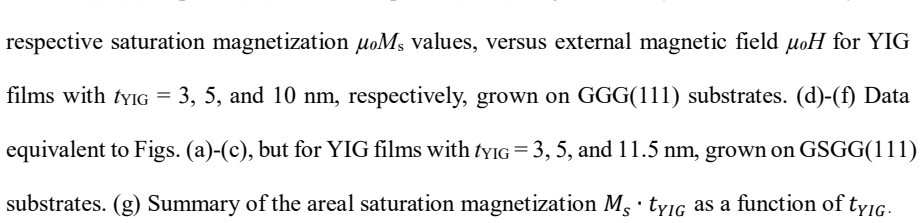
T. Yu, X.-H. Zhou, G. E. W. Bauer, and I. Bobkova, Electromagnetic Proximity Effect: Superconducting Magnonics and Beyond. arXiv:2506.18502. FIGURE CAPTIONS FIG. 1. (a) θ–2θ X-ray diffraction (XRD) scans and (b) X -ray reflectivity (XRR) profiles for 18 ultrathin YIG films with thicknesses tYIG = 3, 5, and 10 nm, grown on GGG(111) substrates. (c) and (d) ...
discussion (0)
Sign in with ORCID, Apple, or X to comment. Anyone can read and Pith papers without signing in.