REVIEW 4 major objections 4 minor 70 references
Anomalous Power Factor Enhancement and Local Structural Transition in Ni-Doped TiCoSb
T0 review · 4 major / 4 minor · reviewed 2026-08-06 · deepseek-v4-flash
Pith's one-line read The paper reports that 2 percent nickel doping raises the power factor of the half-Heusler thermoelectric TiCoSb by roughly 269 percent by making thermopower and electrical conductivity rise together at the same composition.
desk verdict Measured PF jump at x=0.02 is likely real; the disorder-to-order transition used to explain it is not established by the data. read the letter →
The pith
A machine-rendered reading of the paper's core claim, the machinery that carries it, and where it could break.
The reading
What carries the argument
The load-bearing observable is the EXAFS disorder parameter $\sigma^2$, the mean-square fluctuation of near-neighbor bond lengths around Co and Ti atoms; its value falls to a minimum at $x=0.02$ and rises on either side, and the slope change in $\sigma^2$ versus $x$ is interpreted as the disorder-to-order transition. The supporting machinery is the set of long-range structural probes that reproduce the same extremum: Williamson-Hall strain and dislocation density, Rietveld Debye-Waller factor $B_{\rm iso}$, host-phase weight fraction, and unit-cell volume. Density-functional-theory supercell densities of states carry the electronic side of the argument, converting Ni substitution into a Fermi-level shift that changes the transport from semiconducting toward metallic.
What would settle it
Measure EXAFS $\sigma^2$ on a finer series with several samples per composition and explicit uncertainties. If the minimum at $x=0.02$ and its slope discontinuity do not reproduce, or if the values at neighboring compositions overlap within error, the disorder-to-order transition is not supported. A second check is Hall-effect carrier concentration: if carrier density rises monotonically with Ni content while thermopower peaks at $x=0.02$, then the thermopower peak is not a simple carrier-concentration effect and the structural explanation has to carry the argument.
Extended reading notes
Core claim
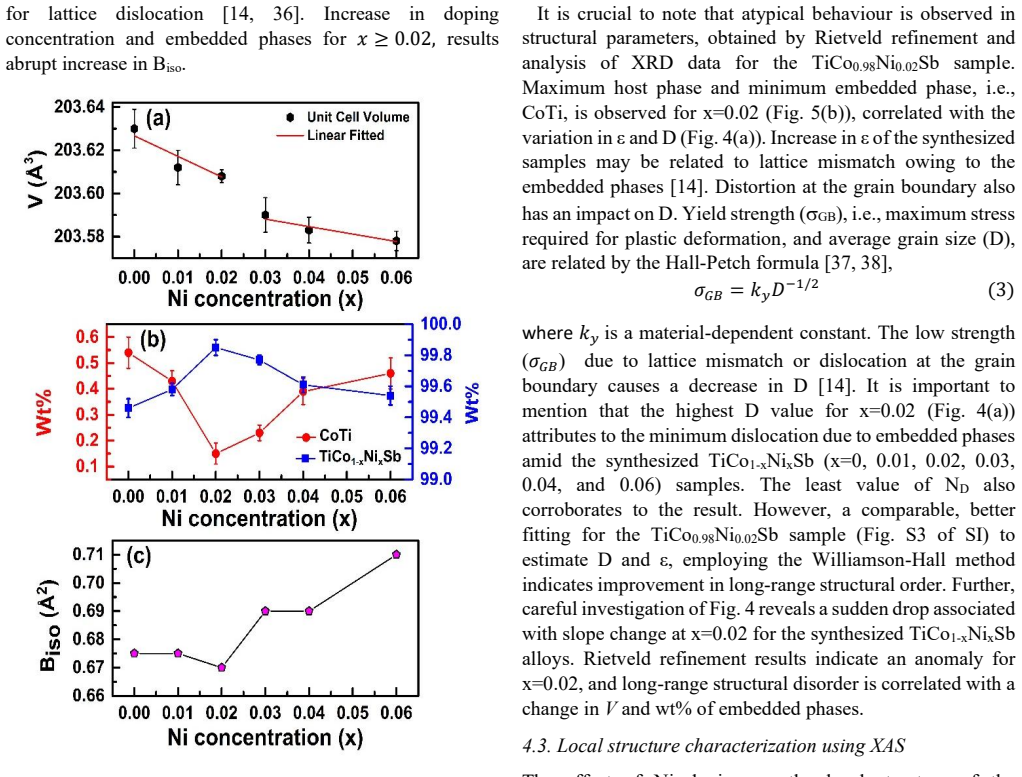
The central claim is that TiCo$_{1-x}$Ni$_x$Sb undergoes a local structural transition from a disordered to a more ordered atomic arrangement at $x=0.02$, and that this transition is what permits the thermopower and electrical conductivity to improve at the same time, producing a marked increase in power factor. The authors base the claim on four coordinated signatures at that composition: first-principles calculations that push the Fermi level toward the conduction band on Ni substitution; Rietveld refinement of X-ray diffraction showing maximum host TiCoSb phase, minimum Debye-Waller factor, and minimum strain and dislocation density; EXAFS at the Co and Ti K-edges showing a minimum in the bond-length disorder parameter $\sigma^2$ with a slope change read as the transition; and transport data in which thermopower rises up to $x=0.02$ and falls beyond, resistivity acquires a metallic low-temperature branch, and Lorentz-number and scattering analysis corroborate the electronic changes. The paper's conclusion is that the structural ordering and the transport enhancement are the same event.
Load-bearing premise
The entire interpretation rests on the dip in EXAFS $\sigma^2$ and the matching extrema in strain, Debye-Waller factor, and dislocation density at $x=0.02$ being a real disorder-to-order transition rather than scatter in a six-composition series plotted without error bars.
Editorial extensions
If this is right
- If the transition picture is correct, the $x=0.02$ composition is a genuine optimization point: the power factor reaches about 350 $\mu$W K$^{-2}$ m$^{-1}$ at 300 K, a gain of roughly 269% over the undoped sample.
- The simultaneous rise of $S$ and $\sigma$ at this composition means the usual inverse relationship between thermopower and conductivity is relaxed at the ordering point, so power factor can be improved without the standard doping trade-off.
- The structural and transport signatures line up at the same composition, which makes the disorder parameter a useful indicator for searching similar peaks in other half-Heusler alloys.
- For $x>0.02$, the thermopower falls as carrier concentration grows, so the effect is specific to the 2% composition rather than a monotonic doping trend.
- The decrease in electron-phonon and electron-electron scattering coefficients up to $x=0.02$ is consistent with a more ordered lattice conducting electrons more easily.
Reading between the lines
- A direct testable extension is a finer composition grid around $x=0.02$: the transition claim predicts that $\sigma^2$ and the Debye-Waller factor trace a sharp V-shape rather than a smooth curve.
- The paper does not measure thermal conductivity, so the impact on the figure of merit $ZT$ remains open; if the same ordering reduces phonon scattering, the lattice thermal conductivity could rise and partially offset the power-factor gain.
- The Lorentz number shows a slope change near 125 K, suggesting a temperature-driven structural event; temperature-dependent EXAFS across that range would test whether the local ordering is composition-specific or also thermally reversible.
- Because only two DFT compositions (3% and 6%) are modelled, the theoretical argument does not resolve the special status of $x=0.02$; a calculation at or near 2% would sharpen the link between the Fermi-level shift and the structural anomaly.
Editorial analysis
A structured set of objections, weighed in public.
Referee Report
Summary. The paper reports the synthesis and characterization of arc-melted TiCo_{1-x}Ni_xSb (x = 0, 0.01, 0.02, 0.03, 0.04, 0.06) half-Heusler alloys, combining DFT band-structure calculations, Rietveld refinement of powder XRD, Williamson-Hall analysis, Co and Ti K-edge XAS, and temperature-dependent resistivity and thermopower measurements. The central claim is a ~269% room-temperature power-factor enhancement at x = 0.02, attributed to a disorder-to-order local structural transition that simultaneously increases the Seebeck coefficient and electrical conductivity. The authors support this by reporting extrema at x = 0.02 in lattice strain, dislocation density, host-phase fraction, Debye-Waller factor, and EXAFS mean-square relative displacements, and they interpret the transport anomalies through the same structural picture.
Significance. If the claimed disorder-to-order transition were robustly established, the work would be of interest to the half-Heusler thermoelectric community as a rare example of simultaneous enhancement of S and σ by small doping, and it would motivate further study of local structural order as a tuning parameter for power factor. The paper deserves credit for direct transport measurements, a systematic doping series, and the use of complementary XRD and XAS probes. However, the significance is contingent on the structural anomaly at x = 0.02 being real, and that premise is not currently supported by the reported data: the fitted structural parameters have no uncertainties, the composition series has no replicates, and the EXAFS fit quality is worst exactly at the claimed transition composition.
major comments (4)
- [Section 4.3, Figs. 7(c) and 8(c), Table 2] The central structural claim rests on minima in the EXAFS disorder parameter σ² at x = 0.02, yet no uncertainties or replicate measurements are reported for any σ² value, and each composition was measured once. The 'drastic change in slope' of σ² versus x is asserted from six points without a statistical test, bootstrap, or confidence interval that would distinguish a genuine minimum from scatter. Moreover, the Ti K-edge fit at x = 0.02 has the worst R-factor (0.03933) and lowest 'happiness' (84.25) of the entire series, so the second edge invoked as confirmation is least reliable exactly at the claimed anomaly. Without error bars, the EXAFS data do not establish a local structural transition.
- [Section 4.2, Fig. 5(c), and SI Fig. S2] The Rietveld support for a long-range anomaly at x = 0.02 is internally weak. The reported Biso values are 0.675, 0.69, 0.67, 0.69, 0.69, and 0.71 Ų, a spread of ~0.04 Ų that is comparable to typical refinement precision, and the x = 0.02 pattern is not the best fit (Rwp = 22.7%, Gof = 3.62; the largest Gof in the series). The lattice parameter varies only between 5.88270 and 5.8832 Å, and the host-phase fraction changes by less than 0.4% across the series. These differences are within plausible systematic and statistical uncertainty, so the claimed minimum in Biso and the maximum host phase do not constitute demonstrated anomalies.
- [Section 4.1, Fig. 2] The DFT calculations were performed only for Ni concentrations of 0%, 3%, and 6%, so they do not sample the claimed transition composition x = 0.02. The computed Fermi-level shift is a monotonic doping trend and cannot provide evidence for an anomaly at x = 0.02; it is therefore not a valid supporting pillar for the structural-transition claim.
- [Sections 4.3 and 4.4, Eqs. (6)-(8)] There is a circularity in the argument: the 'disorder-to-order transition' is inferred from the minima in Biso, σ², and strain at x = 0.02, and the same transition is then used to explain the transport anomalies at that composition. The Lorentz number is derived from the measured thermopower using a single parabolic band model, and the resulting L(T) behavior is cited as confirming the structural transition. This does not provide independent evidence; at most it is consistent with the authors' interpretation, and it cannot validate the existence of a structural transition.
minor comments (4)
- [Section 4.2, Eq. (2)] The Williamson-Hall equation is written as βcosθ = k_B λ / D + 4ε sinθ with k_B identified as the Boltzmann constant; the standard form uses the Scherrer shape factor K, not the Boltzmann constant. This should be corrected to avoid confusion.
- [Section 4.4] There are multiple typos, including 'anazlyzed' instead of 'analyzed', 'smples' instead of 'samples' in Section 4.2, and 'XENES' instead of 'XANES' in the caption of Fig. 6. The manuscript needs careful proofreading.
- [Section 1] The Introduction states 'local structural rearrangement in TiCo_{1-x}Ni_xSb (0 < x < 0.6)' but the doping range studied is 0 < x < 0.06; the upper limit should be corrected.
- [SI, Section 1] The modified Williamson-Hall derivation contains 'Millar indices' (should be Miller) and the meaning of the 'Happiness of fit' metric used in Table 2 is not defined anywhere; it should be defined or replaced with a standard statistical measure.
Circularity Check
The Lorentz-number 'confirmation' of the disorder-to-order transition is a remapping of the measured thermopower, so one load-bearing confirmation reduces by construction to its input.
-
self definitional
[Section 4.4, Eqs. (6)-(7) and discussion of Fig. 12; echoed in Conclusion]
"temperature-dependent Lorentz number (L(T)) is estimated from the temperature dependent S(T), using the equation ... eta represents the reduced Fermi energy, which is derived from the measured S(T) using the following equation ... However, the anomalous behaviour in L(T) data for x=0.02 also confirms the structural transition [52]."
Eq. (7) gives S as a function of eta; the paper inverts this using the measured S(T) to obtain eta and then evaluates L(T) from Eq. (6). Hence L(T) is a deterministic transform of the measured S(T) for an assumed scattering parameter r, so any extremum or slope change in L(T), including the x=0.02 anomaly and the ~125 K slope change, is inherited from S(T), not an independent probe. Using that L(T) anomaly as confirmation of the structural transition, which is itself invoked to explain the S(T) enhancement, is circular: the confirming quantity carries no information beyond the input S(T).
full rationale
The paper's core PF claim is not circular: S(T) and rho(T) are measured transport data, PF = S^2*sigma is computed from them, and the x=0.02 structural anomaly (sigma^2, Biso, strain, host-phase fraction) is an independent structural input, not an output of the transport analysis. The DFT Fermi-level shift is a genuine first-principles result computed at 0, 3, and 6% Ni, though it does not sample x=0.02. The specific circular step is the Lorentz-number analysis: because L(T) is derived from the measured S(T) via Eqs. (6)-(7), citing L(T) behavior as confirmation of the disorder-to-order transition is a remapping of the same S(T) data and therefore vacuous as independent support. Other concerns, such as the lack of error bars on sigma^2 and Biso, single measurements per composition, and the worst Ti K-edge fit at x=0.02, are evidence-quality or correctness issues rather than circularity. The paper does not rely on a load-bearing self-citation chain for its central claim.
Assumptions & free parameters
free parameters (6)
- Biso (Debye-Waller factor) from Rietveld refinement =
~0.67 to 0.71 Angstrom^2 across compositions
- EXAFS mean square relative displacement (sigma^2) =
Plotted in Figs. 7(c) and 8(c); values not tabulated
- Lattice strain (epsilon) and crystallite size (D) from Williamson-Hall =
Shown in Fig. 4(a); exact values not tabulated
- Relative dislocation density (N_D/N_D|x=0) =
Fig. 4(b)
- Resistivity fit parameters (rho0^m, a, b, rho0^s, E_act) =
Shown in Figs. 9(b) and 11 and insets
- Reduced Fermi energy (eta) from single parabolic band fit to S(T) =
Not tabulated; used to compute Lorentz number
assumptions (7)
- domain assumption PBE-GGA DFT accurately describes the electronic structure of TiCoSb.
- domain assumption EXAFS theory and FEFF scattering paths are valid for these samples.
- domain assumption The single parabolic band model with a constant scattering parameter describes the thermopower.
- domain assumption Ni substitution at the Co site donates one extra electron to the system.
- domain assumption Williamson-Hall and modified Williamson-Hall methods correctly separate size and strain broadening.
- ad hoc to paper CoTi embedded phases cause the low-temperature metallic behavior in x<=0.02 samples.
- ad hoc to paper The anomalies at x=0.02 represent a real structural transition rather than noise or fitting artifacts.
Cite this review
Pith. "Pith review of Anomalous Power Factor Enhancement and Local Structural Transition in Ni-Doped TiCoSb." pith.science (2026). https://pith.science/paper/QJMY7T46
@misc{pith2026250715052,
  author       = {Pith},
  title        = {Pith review of: Anomalous Power Factor Enhancement and Local Structural Transition in Ni-Doped TiCoSb},
  year         = {2026},
  howpublished = {\url{https://pith.science/paper/QJMY7T46}},
  note         = {Machine review of arXiv:2507.15052}
}
read the original abstract
We report a significant enhancement (~269%) in the power factor (PF) and a local structural transition in Ni-doped TiCoSb samples (TiCo_{1-x}Ni_xSb, (x= 0.0, 0.01, 0.02, 0.03, 0.04, and 0.06). First-principles calculations reveal that even minute Ni doping induces a substantial shift in the Fermi level (EF) and alters the density of states (DOS). Structural analysis via Rietveld refinement of X-ray diffraction (XRD) data shows anomalous behavior at x = 0.02, supported by Williamson-Hall and modified methods. X-ray absorption spectroscopy (XAS) at the Ti and Co K-edges further confirms a pronounced local structural change at this composition. These structural transitions are consistent with temperature-dependent resistivity (\rho(T)) and thermopower (S(T)) data, which reflect changes in EF and disorder. Analysis of Lorentz number and scattering parameters reinforces the observed modifications in the electronic structure. The simultaneous enhancement of S and electrical conductivity at x = 0.02 is attributed to the disorder-to-order transition, leading to the marked rise in PF.
Figures


Reference graph
Works this paper leans on
-
[1]
T. Graf, C. Felser, S.S.P. Parkin, Simple rules for the understanding of Heusler compounds, Prog. Solid State Chem., 39 (2011) 1-50
work page 2011
-
[2]
MacDonald, Thermoelectricity: an introduction to the principles, Courier Corporation, 2006
D.K.C. MacDonald, Thermoelectricity: an introduction to the principles, Courier Corporation, 2006
work page 2006
-
[3]
R. He, D. Kraemer, J. Mao, L. Zeng, Q. Jie, Y. Lan, C. Li, J. Shuai, H.S. Kim, Y. Liu, D. Broido, C. -W. Chu, G. Chen, Z. Ren, Achieving high power factor and output power density in p-type half- Heuslers Nb 1-xTixFeSb, Proc. Natl. Acad. Sci. U.S.A., 113 (2016) 13576-13581
work page 2016
-
[4]
C. Zhou, Y. Yu, Y. -L. Lee, B. Ge, W. Lu, O. Cojocaru -Mirédin, J. Im, S. -P. Cho, M. Wuttig, Z. Shi, I. Chung, Exceptionally High Average Power Factor and Thermoelectric Figure of Merit in n-type PbSe by the Dual Incorporation of Cu and Te, J. Am. Chem. Soc., 142 (2020) 15172-15186
work page 2020
-
[5]
H. Joshi, D.P. Rai, L. Hnamte, A. Laref, R.K. Thapa, A theoretical analysis of elastic and optical properties of half Heusler MCoSb (M=Ti, Zr and Hf), Heliyon, 5 (2019) e01155
work page 2019
-
[6]
Y. Kawaharada, K. Kurosaki, H. Muta, M. Uno, S. Yamanaka, High temperature thermoelectric properties of CoTiSb half -Heusler compounds, J. Alloys Compd., 384 (2004) 308-311
work page 2004
-
[7]
M. Zhou, L. Chen, C. Feng, D. Wang, J. -F. Li, Moderate - temperature thermoelectric properties of TiCoSb-based half-Heusler compounds Ti1−xTaxCoSb, J. Appl. Phys., 101 (2007) 113714
work page 2007
-
[8]
T. Wu, W. Jiang, X. Li, Y. Zhou, L. Chen, Thermoelectric properties of p -type Fe-doped TiCoSb half -Heusler compounds, J. Appl. Phys., 102 (2007) 103705
work page 2007
Show all 70 references
-
[9]
N.V. Du, N.V. Binh, D.Q. Trung, M.T. Tran, N. Tu, P.T. Huy, J.U. Rahman, W.H. Shin, D.A. Tuan, J.Y. Cho, S. Lee, W.H. Nam, Improved thermoelectric properties of Sb-doped Ti0.5Zr0.5NiSn alloy with refined structure induced by rapid synthesis processes, J. Alloys Compd., 970 (20...
2024
-
[10]
Shutoh, S
N. Shutoh, S. Sakurada, Thermoelectric properties of the TiX(Zr0.5Hf0.5)1−XNiSn half -Heusler compounds, J. Alloys Compd., 389 (2005) 204-208
2005
-
[11]
H.B. Kang, B. Poudel, W. Li, H. Lee, U. Saparamadu, A. Nozariasbmarz, M.G. Kang, A. Gupta, J.J. Heremans, S. Priya, Decoupled phononic-electronic transport in multi-phase n-type half- Heusler nanocomposites enabling efficient high temperature power generation, Mater. Today, 36...
2020
-
[12]
L. Chen, X. Zeng, T.M. Tritt, S.J. Poon, Half-Heusler Alloys for Efficient Thermoelectric Power Conversion, J. Electron. Mater., 45 (2016) 5554-5560
2016
-
[13]
Z. Liu, S. Guo, Y. Wu, J. Mao, Q. Zhu, H. Zhu, Y. Pei, J. Sui, Y. Zhang, Z. Ren, Design of High‐Performance Disordered Half‐ Heusler Thermoelectric Materials Using 18‐Electron Rule, Adv. Funct. Mater., 29 (2019) 1905044
2019
-
[14]
Mahakal, D
S. Mahakal, D. Das, P. Singha, A. Banerjee, S.C. Das, S.K. Maiti, S. Assa Aravindh, K. Malik, Transport phenomena of TiCoSb: defect induced modification in the structure and density of states, Mater. Adv., 4 (2023) 4168-4179
2023
-
[15]
Romaka, M
L. Romaka, M. Shelyapina, Y.V. Stadnyk, D. Fruchart, E. Hlil, V. Romaka, Peculiarity of metal –insulator transition due to composition change in the semiconducting TiCo 1− x NixSb solid solution: I. Electronic structure calculations, J. Alloys Compd., 416 (2006) 46-50
2006
-
[16]
X. Yan, W. Liu, H. Wang, S. Chen, J. Shiomi, K. Esfarjani, H. Wang, D. Wang, G. Chen, Z. Ren, Stronger phonon scattering by larger differences in atomic mass and size in p -type half -Heuslers Hf1−xTixCoSb0.8Sn0.2, Energy Environ. Sci., 5 (2012) 7543-7548
2012
-
[17]
Hook, H.E
J.R. Hook, H.E. Hall, Solid state physics, John Wiley & Sons, 2013
2013
-
[18]
Cutler, J.F
M. Cutler, J.F. Leavy, R.L. Fitzpatrick, Electronic Transport in Semimetallic Cerium Sulfide, Phys. Rev., 133 (1964) A1143-A1152
1964
-
[19]
Q. Wang, X. Xie, S. Li, Z. Zhang, X. Li, H. Yao, C. Chen, F. Cao, J. Sui, X. Liu, Q. Zhang, Enhanced thermoelectric performance in Ti(Fe, Co, Ni)Sb pseudo -ternary Half -Heusler alloys, J. Materiomics, 7 (2021) 756-765
2021
-
[20]
Van Du, N.V
N. Van Du, N.V. Binh, M.T. Tran, N. Tu, P.T. Huy, J.U. Rahman, W.H. Shin, D.A. Tuan, J.Y. Cho, S. Lee, Improved thermoelectric properties of Sb -doped Ti 0.5Zr0.5NiSn alloy with refined structure induced by rapid synthesis processes, J. Alloys Compd., 970 (2024) 172528
2024
-
[21]
F. Yang, M. Li, L. Li, P. Wu, E. Pradal-Velázque, D.C. Sinclair, Optimisation of oxide -ion conductivity in acceptor -doped Na0.5Bi0.5TiO3 perovskite: approaching the limit?, J. Mater. Chem. A, 5 (2017) 21658-21662
2017
-
[22]
P. Qiu, X. Huang, X. Chen, L. Chen, Enhanced thermoelectric performance by the combination of alloying and doping in TiCoSb - based half-Heusler compounds, J. Appl. Phys., 106 (2009) 103703
2009
-
[23]
Y. Xia, V. Ponnambalam, S. Bhattacharya, A.L. Pope, S.J. Poon, T.M. Tritt, Electrical transport properties of TiCoSb half -Heusler 15 phases that exhibit high resistivity, J. Phys.: Condens. Matter, 13 (2001) 77
2001
-
[24]
R. He, H. Zhu, J. Sun, J. Mao, H. Reith, S. Chen, G. Schierning, K. Nielsch, Z. Ren, Improved thermoelectric performance of n -type half-Heusler MCo 1-xNixSb (M = Hf, Zr), Mater. Today Phys., 1 (2017) 24-30
2017
-
[25]
Rodríguez -Carvajal, Recent advances in magnetic structure determination by neutron powder diffraction, Phys
J. Rodríguez -Carvajal, Recent advances in magnetic structure determination by neutron powder diffraction, Phys. B Condens. Matter, 192 (1993) 55-69
1993
-
[26]
Runčevski, C.M
T. Runčevski, C.M. Brown, The Rietveld Refinement Method: Half of a Century Anniversary, Cryst. Growth Des., 21 (2021) 4821- 4822
2021
-
[27]
V.D. Mote, Y. Purushotham, B.N. Dole, Williamson -Hall analysis in estimation of lattice strain in nanometer -sized ZnO particles, J. Theor. Appl. Phys., 6 (2012) 6
2012
-
[28]
S. Das, P. Singha, V.A. Kulbachinskii, V.G. Kytin, G. Das, S. Janaky, A.K. Deb, S. Mukherjee, A. Maignan, S. Hebert, R. Daou, C. Narayana, S. Bandyopadhyay, A. Banerjee, Sb 2Te3/graphite nanocomposite: A comprehensive study of thermal conductivity, J. Materiomics, 7 (2021) 545-555
2021
-
[29]
Ungár, S
T. Ungár, S. Ott, P.G. Sanders, A. Borbély, J.R. Weertman, Dislocations, grain size and planar faults in nanostructured copper determined by high resolution X-ray diffraction and a new procedure of peak profile analysis, Acta Mater., 46 (1998) 3693-3699
1998
-
[30]
Mahakal, D
S. Mahakal, D. Das, A. Jana, A. Banerjee, K. Malik, Simple, Efficient and Economically Viable Techniques for temperature dependant Thermopower data acquisition of Thermoelectric materials, J. Phys.: Conf. Ser., 1579 (2020) 012020
2020
-
[31]
Kresse, J
G. Kresse, J. Hafner, Ab initio molecular dynamics for open - shell transition metals, Phys. Rev. B, 48 (1993) 13115
1993
-
[32]
Perdew, K
J.P. Perdew, K. Burke, M. Ernzerhof, Generalized gradient approximation made simple, Phys. Rev. Lett., 77 (1996) 3865
1996
-
[33]
Terada, K
M. Terada, K. Endo, Y. Fujita, R. Kimura, rsquo, iti, Magnetic Properties of Clb Compounds; CoVSb, CoTiSb and NiTiSb, J. Phys. Soc. Jpn., 32 (1972) 91-94
1972
-
[34]
Mahakal, A
S. Mahakal, A. Jana, S. Jana, P. Samal, Strain trailing band engineering and phonon transport of high ZT ZrCoBi half -Heusler alloy: a mechanistic understanding from first principles, Phys. Chem. Chem. Phys., 27 (2025) 10758-10776
2025
-
[35]
Webster, K.R.A
P.J. Webster, K.R.A. Ziebeck, Magnetic and chemical order in Heusler alloys containing cobalt and titanium, J. Phys. Chem. Solids, 34 (1973) 1647-1654
1973
-
[36]
Mahakal, D
S. Mahakal, D. Das, P. Singha, N. Rana, S. Mukherjee, K. Malik, A. Banerjee, Effects of partial substitution of Co by Ni on structural and transport properties of TiCoSb-based half-Heusler compound, J. Phys.: Conf. Ser., 2349 (2022) 012022
2022
-
[37]
Hall, The Deformation and Ageing of Mild Steel: III Discussion of Results, Proc
E.O. Hall, The Deformation and Ageing of Mild Steel: III Discussion of Results, Proc. Phys. Soc. B, 64 (1951) 747
1951
-
[38]
Petch, The Cleavage Strength of Polycrystals, J
N.J. Petch, The Cleavage Strength of Polycrystals, J. Iron Steel Inst., 174 (1953) 4
1953
-
[39]
S. Basu, C. Nayak, A. Yadav, A. Agrawal, A. Poswal, D. Bhattacharyya, S. Jha, N. Sahoo, A comprehensive facility for EXAFS measurements at the INDUS -2 synchrotron source at RRCAT, Indore, India, in: J. Phys.: Conf. Ser., IOP Publishing, 2014, pp. 012032
2014
-
[40]
Miyazaki, O.M
H. Miyazaki, O.M. Ozkendir, S. Gunaydin, K. Watanabe, K. Soda, Y. Nishino, Probing local distortion around structural defects in half -Heusler thermoelectric NiZrSn alloy, Sci. Rep., 10 (2020) 19820
2020
-
[44]
Mahakal, A
S. Mahakal, A. Jana, D. Das, N. Rana, P. Sardar, S. Hussain, S.K. Maiti, K. Malik, Drastic Modification in the Thermal Conductivity of the TiCoSb Half -Heusler Alloy: Phonon Engineering by Lattice Softening and Ionic Polarization, ACS Appl. Energy Mater., 8 (2025) 8508-8523
2025
-
[45]
Rausch, M.V
E. Rausch, M.V. Castegnaro, F. Bernardi, M.C. Martins Alves, J. Morais, B. Balke, Short and long range order of Half -Heusler phases in (Ti,Zr,Hf)CoSb thermoelectric compounds, Acta Mater., 115 (2016) 308-313
2016
-
[46]
I. -H. Hwang, Z. Jin, C. -I. Park, S. -W. Han, The influence of structural disorder and phonon on metal-to-insulator transition of VO 2, Sci. Rep., 7 (2017) 14802
2017
-
[47]
W. Xie, Q. Jin, X. Tang, The preparation and thermoelectric properties of Ti 0.5Zr0.25Hf0.25Co1−xNixSb half-Heusler compounds, J. Appl. Phys., 103 (2008) 043741
2008
-
[49]
Kramar, Y.L
O. Kramar, Y.L. Skorenkyy, Y.M. Dovhopyaty, Effective masses of carriers in the degenerate conduction band: interplay of density of electronic states peculiarities and magnetization, J. Nano Electron. Phys., 11 (2019) 05030
2019
-
[50]
Chang, Q
C. Chang, Q. Tan, Y. Pei, Y. Xiao, X. Zhang, Y. -X. Chen, L. Zheng, S. Gong, J. -F. Li, J. He, L. -D. Zhao, Raising thermoelectric performance of n -type SnSe via Br doping and Pb alloying, RSC Adv., 6 (2016) 98216-98220
2016
-
[51]
W.-S. Liu, Q. Zhang, Y. Lan, S. Chen, X. Yan, Q. Zhang, H. Wang, D. Wang, G. Chen, Z. Ren, Thermoelectric Property Studies on Cu -Doped n -Type Cu xBi2Te2.7Se0.3 Nanocomposites, Adv. Energy Mater., 1 (2011) 577-587
2011
-
[52]
Kumar, G
G. Kumar, G. Prasad, R. Pohl, Experimental determinations of the Lorenz number, J. Mater. Sci., 28 (1993) 4261-4272
1993
-
[53]
Sommerfeld, Zur elektronentheorie der metalle, Naturwissenschaften, 15 (1927) 825-832
A. Sommerfeld, Zur elektronentheorie der metalle, Naturwissenschaften, 15 (1927) 825-832
1927
-
[54]
Fenton, J
E. Fenton, J. Rogers, S. Woods, Lorenz numbers of pure aluminum, silver, and gold at low temperatures, Can. J. Phys., 41 (1963) 2026-2033
1963
-
[55]
Bodak, L
O. Bodak, L. Romaka, Y. Gorelenko, A. Tkachuk, V. Davydov, Y. Stadnyk, Crystal structure and physical properties of (Ti, Sc) NiSn and (Zr, Sc) NiSn solid solutions, J. Alloys Compd., 363 (2004) 10 - 14. S-1 Supplementary Information The influence of Ni doping on local structur...
2004
-
[56]
Modified Williamson -Hall plots and corresponding fittings for the polycrystalline TiCo1-xNixSb (x=0.0, 0.01, 0.02, 0.03, 0.04, and 0.06) half -Heusler alloys
Estimation of Dislocation density (ND), using modified Williamson-Hall plot S-3 Figure S1 . Modified Williamson -Hall plots and corresponding fittings for the polycrystalline TiCo1-xNixSb (x=0.0, 0.01, 0.02, 0.03, 0.04, and 0.06) half -Heusler alloys. Solid line represents bes...
-
[57]
Structural parameters and fitted X-ray diffraction data, obtained after Rietveld refinement S-5 Figure S2. X-ray diffraction patterns of TiCo1-xNixSb (x = 0.00, 0.01, 0.02, 0.03, 0.04, and 0.06) synthesized samples at room temperature, fitted employing Rietveld refinement usin...
-
[58]
Williamson-Hall plots of the X-ray diffraction data for synthesized TiCo1-xNixSb (x=0, 0.01, 0.02, 0.03, 0.04, and 0.06) polycrystalline half -Heusler alloys
Williamson-Hall Plots of the X-ray diffraction data S-8 Figure S3. Williamson-Hall plots of the X-ray diffraction data for synthesized TiCo1-xNixSb (x=0, 0.01, 0.02, 0.03, 0.04, and 0.06) polycrystalline half -Heusler alloys. Fitting qualities indicate a good fit for x=0.02 sa...
-
[59]
(a) Electronic configuration of (a) Co and (b) Ti in TiCoSb HH alloy
Detailed analysis of X-ray absorption spectroscopy (XAS) data for the synthesized TiCo1- xNixSb (x=0, 0.01, 0.02, 0.03, 0.04, and 0.06) samples at Ti and Co K-edge S-9 Figure S4. (a) Electronic configuration of (a) Co and (b) Ti in TiCoSb HH alloy. All possible transitions fro...
-
[60]
Temperature-dependent electrical resistivity [ρ(T)] of TiCo 1-xNixSb (x=0, 0.01, 0.02, 0.03, 0.04, and 0.06) with the fitted curve indicated by solid red and blue lines
Analysis of Non-Monotonic Temperature Dependence of Electrical Resistivity (ρ(T)) S-13 Figure S9. Temperature-dependent electrical resistivity [ρ(T)] of TiCo 1-xNixSb (x=0, 0.01, 0.02, 0.03, 0.04, and 0.06) with the fitted curve indicated by solid red and blue lines. The low-t...
-
[61]
Estimation of Dislocation density (N D), using modified Williamson-Hall plot Relative dislocation density of the TiCo 1-xNixSb (x=0.0, 0.01, 0.02, 0.03, 0.04, and 0.06) synthesized samples are estimated from the X -ray diffraction (XRD) data. The Dislocation density (ND) of th...
-
[62]
Structural parameters and fitted X -ray diffraction data, obtained after Rietveld refinement Figure S2. X-ray diffraction patterns of TiCo1-xNixSb (x = 0.00, 0.01, 0.02, 0.03, 0.04, and 0.06) synthesized samples at room temperature, fitted employing Rietveld refinement using F...
-
[63]
The Williamson–Hall equation is given by [3], 𝛽𝑐𝑜𝑠𝜃 = 𝑘𝐵𝜆 𝐷 + 4𝜀 𝑠𝑖𝑛𝜃
Williamson-Hall Plots of the X-ray diffraction data Williamson–Hall (WH) analysis was employed on X-ray diffraction (XRD) data to estimate the crystalline strain (ε) and average crystallite size (D). The Williamson–Hall equation is given by [3], 𝛽𝑐𝑜𝑠𝜃 = 𝑘𝐵𝜆 𝐷 + 4𝜀 𝑠𝑖𝑛𝜃. (S2) β...
-
[64]
The electronic configuration of Co in TiCoSb is [Ar] 3d⁹4s⁰
Detailed analysis of X-ray absorption spectroscopy (XAS) data for the synthesized TiCo1-xNixSb (x=0, 0.01, 0.02, 0.03, 0.04, and 0.06) samples at Ti and Co K-edge XAS: Co K-edge The Co K-edge absorption occurs when X-rays have enough energy to remove a 1s electron from the Co ...
-
[65]
Therefore, the 1s→4p transition is the only possible route by which the 1s electron could be excited to the higher lying levels
transition is forbidden owing to t he quantum selection rules, i.e., only Δl = ±1 transition is (a) (b) S-10 allowed. Therefore, the 1s→4p transition is the only possible route by which the 1s electron could be excited to the higher lying levels. Figure S5 . X-ray absorption f...
-
[66]
However, synthesized samples become metallic for the range 0.03 <x<0.06
Analysis of Non -Monotonic Temperature Dependence of Electrical Resistivity (ρ(T)) Temperature dependent resistivity (ρ(T)) data of TiCo₁₋ₓNiₓSb (x=0, 0.01, 0.02, 0.03, 0.04 and 0.06) synthesized samples show nonmonotonic behavior and transition from metallic to semiconducting...
-
[67]
S. Das, P. Singha, V.A. Kulbachinskii, V.G. Kytin, G. Das, S. Janaky, A.K. Deb, S. Mukherjee, A. Maignan, S. Hebert, R. Daou, C. Narayana, S. Bandyopadhyay, A. Banerjee, Sb2Te3/graphite nanocomposite: A comprehensive study of thermal conductivity, J. Materiomics, 7 (2021) 545-555
2021
-
[68]
Ungár, S
T. Ungár, S. Ott, P.G. Sanders, A. Borbély, J.R. Weertman, Dislocations, grain size and planar faults in nanostructured copper determined by high resolution X -ray diffraction and a new procedure of peak profile analysis, Acta Mater., 46 (1998) 3693-3699. S-15
1998
-
[69]
V.D. Mote, Y. Purushotham, B.N. Dole, Williamson -Hall analysis in estimation of lattice strain in nanometer-sized ZnO particles, J. Theor. Appl. Phys., 6 (2012) 6
2012
-
[70]
Konigsberger, R
D. Konigsberger, R. Prins, X -ray absorption: principles, applications, techniques of EXAFS, SEXAFS and XANES, Wiley/Interscience, New York, 159 (1988) 160
1988
-
[71]
Ravel, M
B. Ravel, M. Newville, ATHENA, ARTEMIS, HEPHAESTUS: data analysis for X -ray absorption spectroscopy using IFEFFIT, J. Synchrotron Radiat., 12 (2005) 537-541
2005
-
[72]
Parida, M
S. Parida, M. Sahoo, A. N, R.M. Tromer, D.S. Galvao, S. Dhara, Effect of Oxygen and Aluminum Incorporation on the Local Structure of GaN Nanowires: Insight from Extended X- ray Absorption Fine Structure Analysis, J. Phys. Chem. C, 125 (2021) 3225-3234
2021
-
[73]
Sahoo, A
M. Sahoo, A. Yadav, S. Jha, D. Bhattacharyya, T. Mathews, N. Sahoo, S. Dash, A. Tyagi, Nitrogen location and Ti–O bond distances in pristine and N-doped TiO2 anatase thin films by X-ray absorption studies, J. Phys. Chem. C, 119 (2015) 17640-17647
2015
-
[74]
Pavlosiuk, D
O. Pavlosiuk, D. Kaczorowski, P. Wiśniewski, Shubnikov - de Haas oscillations, weak antilocalization effect and large linear magnetoresistance in the putative topological superconductor LuPdBi, Sci. Rep., 5 (2015) 9158
2015
Reviewed August 6, 2026 · model on record in the stance chip above.
Discussion (0). Continue with ORCID to comment.