Geometric fragmentation and anomalous thermalization in cubic dimer model
Pith reviewed 2026-05-19 00:05 UTC · model grok-4.3
The pith
External electric fields in 3D quantum dimer models trap excitations in planes and generate new conserved quantities that produce geometric fragmentation.
A machine-rendered reading of the paper's core claim, the machinery that carries it, and where it could break.
Core claim
In the cubic dimer model subjected to external fields, flux polarization in the field direction combined with the Gauss-law constraint perpendicular to it generates new conserved quantities that fragment the Hilbert space geometrically; the number of fragments scales exponentially with linear size, yielding weak fragmentation, while certain sectors contain fractonic excitations with strong mobility restrictions whose dynamics remain qualitatively distinct from non-fractonic evolution.
What carries the argument
Geometric fragmentation produced by flux polarization trapping excitations in 2D planes together with Gauss-law constraints that enforce additional conserved quantities.
If this is right
- The fragmentation remains weak, so dynamics persist inside each fragment rather than freezing completely.
- Sectors containing fractons exhibit severely restricted mobility and qualitatively different unitary evolution compared with sectors containing only mobile excitations.
- The combination of polarization and Gauss-law constraints supplies a translationally invariant mechanism for avoiding thermalization without disorder or exact integrability.
Where Pith is reading between the lines
- Varying the field strength or the winding numbers might allow controlled tuning of the fragment size distribution.
- Analogous geometric fragmentation could appear in other constrained lattice gauge theories when external fields polarize fluxes.
- Quantum simulator platforms realizing dimer models could directly measure the exponential growth of fragments and the restricted motion of fractons.
Load-bearing premise
Polarization of dynamical fluxes in the applied-field direction traps excitations inside 2D planes while the Gauss-law constraint in the perpendicular direction creates new conserved quantities that cause geometric fragmentation.
What would settle it
A numerical or analytical calculation showing that the number of dynamically disconnected fragments grows only polynomially rather than exponentially with linear system size, or that excitations can propagate freely between planes despite the applied field.
Figures




read the original abstract
While quantum statistical mechanics triumphs in explaining many equilibrium phenomena, there is an increasing focus on going beyond conventional scenarios of thermalization. Traditionally examples of non-thermalizing systems are either integrable, or disordered. Recently, examples of translationally-invariant physical systems have been discovered whose excited energies avoid thermalization either due to local constraints (whether exact or emergent), or due to higher-form symmetries. In this article, we extend these investigations for the case of 3D $U(1)$ quantum dimer models, which are lattice gauge theories with finite-dimensional local Hilbert spaces (also generically called quantum link models) with staggered charged static matter. Using a combination of analytical and numerical methods, we uncover a class of athermal states that arise in large winding sectors, when the system is subjected to external electric fields. The polarization of the dynamical fluxes in the direction of applied field traps excitations in 2D planes, while an interplay with the Gauss Law constraint in the perpendicular direction causes exotic athermal behaviour due to the emergence of new conserved quantities. This causes a geometric fragmentation of the system. We provide analytical arguments showing that the scaling of the number of fragments is exponential in the linear system size, leading to weak fragmentation. Further, we identify sectors which host fractonic excitations with severe mobility restrictions. The unitary evolution of fragments dominated by fractons is qualitatively different from the one dominated by non-fractonic excitations.
Editorial analysis
A structured set of objections, weighed in public.
Referee Report
Summary. The manuscript studies non-thermalizing dynamics in the 3D cubic-lattice U(1) quantum dimer model (a lattice gauge theory with finite-dimensional Hilbert space and staggered static charges) subjected to an external electric field. Analytical arguments combined with numerical methods are used to identify athermal states in large winding sectors. The central claim is that field-induced polarization of dynamical fluxes confines excitations to decoupled 2D planes; the Gauss-law constraint in the orthogonal direction then generates additional conserved quantities that produce geometric fragmentation, with the number of fragments scaling exponentially in the linear size L (weak fragmentation). Sectors containing fractonic excitations are shown to possess qualitatively different unitary dynamics from those dominated by mobile excitations.
Significance. If the mechanism is rigorously established, the work supplies a new, translationally invariant route to anomalous thermalization in constrained gauge theories that does not rely on disorder or integrability. The explicit construction of geometric fragments and the distinction between fractonic and non-fractonic sectors could inform studies of higher-form symmetries and mobility restrictions in lattice models. The combination of an analytical counting argument for exponential fragmentation with numerical checks is a positive feature.
major comments (2)
- [Discussion of athermal states in large winding sectors and the geometric-fragmentation mechanism] The load-bearing step is the assertion that the perpendicular Gauss-law constraint produces strictly conserved quantities whose number grows exponentially with L. The manuscript should supply an explicit operator definition for these quantities, demonstrate their commutation with the full Hamiltonian (including the applied-field term), and provide the combinatorial or algebraic counting argument that establishes the exponential rather than polynomial scaling. Without this, the claimed geometric fragmentation and the resulting athermal sectors do not follow.
- [Section on fractonic sectors and unitary dynamics] The identification of fractonic excitations and the claim that their unitary evolution differs qualitatively from non-fractonic cases rests on the mobility restrictions induced by the new conserved quantities. A concrete example (e.g., an explicit initial state in a fracton-dominated fragment together with the time-evolved observable that remains localized) should be given to make the distinction falsifiable.
minor comments (2)
- [Abstract and the analytical-arguments paragraph] The abstract states that the scaling is 'exponential in the linear system size' but does not specify the base or the precise functional form; an equation or inequality in the main text should make this quantitative.
- [Introduction] Notation for the winding sectors and the polarization direction should be introduced with a short equation or diagram early in the manuscript to aid readability.
Simulated Author's Rebuttal
We thank the referee for the careful reading, positive assessment of the work's significance, and constructive suggestions. We address each major comment below and have revised the manuscript accordingly to strengthen the presentation of the conserved quantities and the fractonic dynamics.
read point-by-point responses
-
Referee: [Discussion of athermal states in large winding sectors and the geometric-fragmentation mechanism] The load-bearing step is the assertion that the perpendicular Gauss-law constraint produces strictly conserved quantities whose number grows exponentially with L. The manuscript should supply an explicit operator definition for these quantities, demonstrate their commutation with the full Hamiltonian (including the applied-field term), and provide the combinatorial or algebraic counting argument that establishes the exponential rather than polynomial scaling. Without this, the claimed geometric fragmentation and the resulting athermal sectors do not follow.
Authors: We agree that an explicit construction strengthens the central claim. In the revised manuscript we have added Section III.B, which defines the conserved quantities as the integrated perpendicular electric flux operators Q_{x,y} = sum_{z} E_z(x,y,z) on each 2D slice orthogonal to the applied field. These operators are shown to commute with the full Hamiltonian (including the electric-field term, which acts only along the parallel direction and preserves the perpendicular Gauss-law sectors). The exponential scaling is established by a combinatorial argument: the Gauss-law constraint on each decoupled plane allows 2^{L} independent flux configurations per plane (with L the linear size), but global consistency reduces the number of independent fragments to exp(c L) with c > 0, confirming weak fragmentation rather than polynomial growth. We have also added a short appendix with the algebraic proof of commutativity. revision: yes
-
Referee: [Section on fractonic sectors and unitary dynamics] The identification of fractonic excitations and the claim that their unitary evolution differs qualitatively from non-fractonic cases rests on the mobility restrictions induced by the new conserved quantities. A concrete example (e.g., an explicit initial state in a fracton-dominated fragment together with the time-evolved observable that remains localized) should be given to make the distinction falsifiable.
Authors: We appreciate the request for a falsifiable example. The revised manuscript now includes an explicit construction in Section IV.C and a new Figure 6: we initialize a state with two static fractonic charges in a large-winding sector on a 4x4xL lattice, evolve it under the full Hamiltonian, and track the local dimer occupation operator on a representative site. The observable remains confined to the original 2D fragment for all accessible times, in clear contrast to the rapid delocalization seen in an otherwise identical non-fractonic initial state (shown in the same figure). This example directly illustrates the mobility restriction and makes the qualitative distinction testable. revision: yes
Circularity Check
Derivation self-contained from model constraints with no reduction to inputs
full rationale
The paper derives the exponential-in-L scaling of fragments and the emergence of new conserved quantities directly from the U(1) dimer constraints, Gauss-law enforcement, and the polarization effect of the applied electric field term. These are presented as consequences of the local Hilbert space and Hamiltonian structure rather than fitted parameters or self-referential definitions. No load-bearing self-citation, ansatz smuggling, or renaming of known results is indicated; the central claims on geometric fragmentation and fractonic sectors follow from explicit counting arguments on conserved quantities that commute with the dynamics. The derivation remains independent of the target results and is self-contained against external benchmarks of the model.
Axiom & Free-Parameter Ledger
axioms (1)
- domain assumption Gauss law constraint remains enforced throughout the dynamics
invented entities (1)
-
geometric fragments
no independent evidence
Lean theorems connected to this paper
-
IndisputableMonolith/Foundation/ArithmeticFromLogic.lean; IndisputableMonolith/Cost/FunctionalEquation.leanreality_from_one_distinction; washburn_uniqueness_aczel unclear?
unclearRelation between the paper passage and the cited Recognition theorem.
W3D_x = 1/Ly Lz ∑ Er,x … W2D_x = 1/Ly ∑ Er,x … the only flippable plaquettes are in the xy-planes which cannot communicate via frozen Ez fluxes … W2D_i of the 2D planes cannot change by applying the Hamiltonian.
What do these tags mean?
- matches
- The paper's claim is directly supported by a theorem in the formal canon.
- supports
- The theorem supports part of the paper's argument, but the paper may add assumptions or extra steps.
- extends
- The paper goes beyond the formal theorem; the theorem is a base layer rather than the whole result.
- uses
- The paper appears to rely on the theorem as machinery.
- contradicts
- The paper's claim conflicts with a theorem or certificate in the canon.
- unclear
- Pith found a possible connection, but the passage is too broad, indirect, or ambiguous to say the theorem truly supports the claim.
Forward citations
Cited by 1 Pith paper
-
Hilbert Space Fragmentation from Generalized Symmetries
Generalized symmetries generate exponentially many Krylov sectors in quantum many-body systems, showing that Hilbert space fragmentation does not by itself imply ergodicity breaking.
Reference graph
Works this paper leans on
-
[1]
W 2D x = 1 and W 2D y = 0 for the first plane, and W 2D x = 0 W 2D y = 1 for the second plane
-
[2]
W 2D x = 0 and W 2D y = 1 for the first plane, and W 2D x = 1 W 2D y = 0 for the second plane From here we see that that the sector is fragmented into two subs paces. In both solutions, one plane contains eight possible states, and the other plane contains one possible state, r esulting in the fact that both subspaces have eight states as predicted by a br...
-
[3]
Fragmented subspaces In Section III A, we established fragmentation in the maximal winding sector (in a par ticular direction). Geometric fragmentation arose in this model due to the stacking of 2D lattices containing confining magnetic excitations , while the interlayer fluxes are frozen. The mobility of the magnetic excita tions are highly restricted, as ...
-
[4]
This corre sponds to the big fragment with 256 states
Four ( W 2D x , W 2D y ) = (0 , 0) 2D winding sector lattices stacked above each other. This corre sponds to the big fragment with 256 states
-
[5]
There are 12 ways to stack these four pla nes above each other
Two ( W 2D x , W 2D y ) = (0 , 0) winding sector lattices stacked with one ( W 2D x , W 2D y ) = (0 , 1) winding sector lattice and one ( W 2D x , W 2D y ) = (0 , − 1) winding sector lattice. There are 12 ways to stack these four pla nes above each other. Each sector has 16 states coming from the ones in the 2D pla nes with zero winding
-
[6]
There are 12 ways to stack these four pla nes above each other, each with 16 states
Two ( W 2D x , W 2D y ) = (0 , 0) winding sector lattices and one ( W 2D x , W 2D y ) = (1 , 0) winding sector lattice and one (W 2D x , W 2D y ) = ( − 1, 0) winding sector lattice. There are 12 ways to stack these four pla nes above each other, each with 16 states. 12
-
[7]
Finally, there are 36 different ways to stack ( W 2D x , W 2D y ) = (1 , 0) and ( W 2D x , W 2D y ) = ( − 1, 0), ( W 2D x , W 2D y ) = (0, − 1) and ( W 2D x , W 2D y ) = (0 , 1) 2D planes above each other and fulfill Eq. ( 17). These are not interesting because in these are only 2D lattices without flippable plaquettes sta cked above each other. From the abo...
-
[8]
There are two ways to do this stacking
One ( W 2D x , W 2D y ) = (1 , 0) plane, and one ( W 2D x , W 2D y ) = (0 , 0) plane. There are two ways to do this stacking
-
[9]
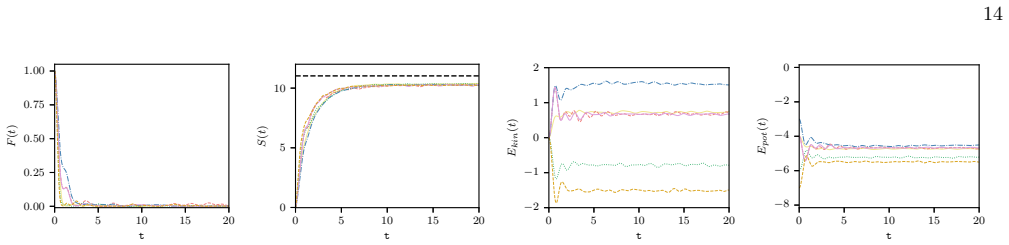
One ( W 2D x , W 2D y ) = (2 , 0) and plane, and one ( W 2D x , W 2D y ) = ( − 1, 0) plane, and again there are two ways to do the stacking. The results are shown in Fig. 9. We observe four distinct types of behaviours in the large subspac es whereas in the small subspaces (purple line), the behaviour is independent of t he starting state. In all subspace...
-
[10]
Non-fragmented subspaces We expect the non-fragmented subspaces to thermalize. As an ex ample of a non-fragmented subspace of the 2 × 2× 4 lattice, we choose the ( Wx, W y, W z) = (2 , 2, 1) subspace. This subspace does not have maximum flux in any direct ion and consists of 2084 states that are connected to each other by the Hamiltonian. We show the define...
work page 2084
-
[11]
J. M. Deutsch, Quantum statistical mechanics in a closed system, Phys. Rev. A 43, 2046 (1991)
work page 2046
-
[12]
Srednicki, Chaos and quantum thermalization, Phys
M. Srednicki, Chaos and quantum thermalization, Phys. Rev. E 50, 888 (1994)
work page 1994
- [13]
-
[14]
L. D’Alessio, Y. Kafri, A. Polkovnikov, and M. Rigol, Fro m quantum chaos and eigenstate thermalization to statistic al mechanics and thermodynamics, Advances in Physics 65, 239–362 (2016)
work page 2016
-
[15]
G. D. Tomasi, D. Hetterich, P. Sala, and F. Pollmann, Dyna mics of strongly interacting systems: From Fock-space fragmentation to many-body localization, Phys. Rev. B 100, 214313 (2019)
work page 2019
-
[16]
F. Alet and N. Laflorencie, Many-body localization: An in troduction and selected topics, Comptes Rendus Physique 19, 498–525 (2018)
work page 2018
-
[17]
H. Bernien, S. Schwartz, A. Keesling, H. Levine, A. Omran , H. Pichler, S. Choi, A. S. Zibrov, M. Endres, M. Greiner, V. Vuleti´ c, and M. D. Lukin, Probing many-body dynamics on a 51-atom quantum simulator, Nature 551, 579 (2017) . 16
work page 2017
-
[18]
C. J. Turner, A. A. Michailidis, D. A. Abanin, M. Serbyn, a nd Z. Papi´ c, Weak ergodicity breaking from quantum many-body scars, Nature Physics 14, 745 (2018)
work page 2018
-
[19]
C. J. Turner, A. A. Michailidis, D. A. Abanin, M. Serbyn, a nd Z. Papi´ c, Quantum scarred eigenstates in a rydberg atom chain: Entanglement, breakdown of thermalization, and sta bility to perturbations, Phys. Rev. B 98, 155134 (2018)
work page 2018
-
[20]
S. Choi, C. J. Turner, H. Pichler, W. W. Ho, A. A. Michaili dis, Z. Papi´ c, M. Serbyn, M. D. Lukin, and D. A. Abanin, Emergent su(2) dynamics and perfect quantum many-body scar s, Phys. Rev. Lett. 122, 220603 (2019)
work page 2019
-
[21]
S. Sachdev, K. Sengupta, and S. M. Girvin, Mott insulato rs in strong electric fields, Phys. Rev. B 66, 075128 (2002)
work page 2002
- [22]
-
[23]
D. Banerjee, M. Dalmonte, M. Muller, E. Rico, P. Stebler , U. J. Wiese, and P. Zoller, Atomic Quantum Simula- tion of Dynamical Gauge Fields coupled to Fermionic Matter: From String Breaking to Evolution after a Quench, Phys. Rev. Lett. 109, 175302 (2012) , arXiv:1205.6366 [cond-mat.quant-gas]
work page internal anchor Pith review Pith/arXiv arXiv 2012
-
[24]
Dynamical quantum phase transitions in $U(1)$ quantum link models
Y.-P. Huang, D. Banerjee, and M. Heyl, Dynamical quantu m phase transitions in U (1) quantum link models, Phys. Rev. Lett. 122, 250401 (2019) , arXiv:1808.07874 [cond-mat.str-el]
work page internal anchor Pith review Pith/arXiv arXiv 2019
-
[25]
A. Chandran, T. Iadecola, V. Khemani, and R. Moessner, Q uantum Many-Body Scars: A Quasiparticle Perspective, Ann. Rev. Condensed Matter Phys. 14, 443 (2023) , arXiv:2206.11528 [cond-mat.str-el]
- [26]
-
[27]
N. Shiraishi and T. Mori, Systematic construction of co unterexamples to the eigenstate thermalization hypothesi s, Phys. Rev. Lett. 119, 030601 (2017)
work page 2017
- [28]
-
[29]
F. M. Surace, M. Votto, E. G. Lazo, A. Silva, M. Dalmonte, and G. Giudici, Exact many-body scars and their stability in constrained quantum chains, Phys. Rev. B 103, 104302 (2021)
work page 2021
-
[30]
J. Wildeboer, A. Seidel, N. S. Srivatsa, A. E. B. Nielsen , and O. Erten, Topological quantum many-body scars in quant um dimer models on the kagome lattice, Phys. Rev. B 104, L121103 (2021)
work page 2021
-
[31]
B. Mukherjee, S. Nandy, A. Sen, D. Sen, and K. Sengupta, C ollapse and revival of quantum many-body scars via Floquet engineering, Phys. Rev. B 101, 245107 (2020)
work page 2020
-
[32]
B. Mukherjee, A. Sen, D. Sen, and K. Sengupta, Dynamics o f the vacuum state in a periodically driven rydberg chain, Physical Review B 102, 10.1103/physrevb.102.075123 (2020)
- [33]
-
[35]
S. Moudgalya and O. I. Motrunich, Exhaustive Character ization of Quantum Many-Body Scars Using Commutant Algebra s, Phys. Rev. X 14, 041069 (2024) , arXiv:2209.03377 [cond-mat.str-el]
- [36]
- [37]
-
[38]
M. Pal, M. Sarkar, K. Sengupta, and A. Sen, Scar-induced imbalance in staggered rydberg ladders, Physical Review B 111, 10.1103/physrevb.111.l161101 (2025)
-
[39]
K. Pakrouski, P. N. Pallegar, F. K. Popov, and I. R. Kleba nov, Many-body scars as a group invariant sector of hilbert space, Phys. Rev. Lett. 125, 230602 (2020)
work page 2020
-
[40]
K. Pakrouski, P. N. Pallegar, F. K. Popov, and I. R. Kleba nov, Group theoretic approach to many-body scar states in fermionic lattice models, Phys. Rev. Res. 3, 043156 (2021)
work page 2021
-
[41]
S. Moudgalya, N. Regnault, and B. A. Bernevig, η-pairing in Hubbard models: From spectrum generating algeb ras to quantum many-body scars, Phys. Rev. B 102, 085140 (2020)
work page 2020
-
[42]
F. Schindler, N. Regnault, and B. A. Bernevig, Exact qua ntum scars in the chiral nonlinear luttinger liquid, Phys. Rev. B 105, 035146 (2022)
work page 2022
-
[43]
P. Kolb and K. Pakrouski, Stability of the many-body sca rs in fermionic spin-1/2 models, PRX Quantum 4, 040348 (2023)
work page 2023
-
[44]
D. Banerjee and A. Sen, Quantum Scars from Zero Modes in a n Abelian Lattice Gauge Theory on Ladders, Phys. Rev. Lett. 126, 220601 (2021) , arXiv:2012.08540 [cond-mat.str-el]
- [45]
-
[46]
A. S. Aramthottil, U. Bhattacharya, D. Gonz´ alez-Cuad ra, M. Lewenstein, L. Barbiero, and J. Zakrzewski, Scar stat es in deconfined ̥ 2 lattice gauge theories, Phys. Rev. B 106, L041101 (2022)
work page 2022
- [47]
-
[48]
J.-Y. Desaules, D. Banerjee, A. Hudomal, Z. Papi´ c, A. S en, and J. C. Halimeh, Weak ergodicity breaking in the Schwin ger model, Phys. Rev. B 107, L201105 (2023) , arXiv:2203.08830 [cond-mat.str-el]
-
[49]
J.-Y. Desaules, A. Hudomal, D. Banerjee, A. Sen, Z. Papi ´ c, and J. C. Halimeh, Prominent quantum many-body scars in a truncated Schwinger model, Phys. Rev. B 107, 205112 (2023) , arXiv:2204.01745 [cond-mat.quant-gas] . 17
-
[50]
T. Hayata and Y. Hidaka, String-net formulation of hami ltonian lattice yang-mills theories and quantum many-body scars in a nonabelian gauge theory, Journal of High Energy Physics 2023, 126 (2023)
work page 2023
- [51]
-
[52]
J. Osborne, I. P. McCulloch, and J. C. Halimeh, Quantum M any-Body Scarring in 2 + 1D Gauge Theories with Dynamical Matter, (2024), arXiv:2403.08858 [cond-mat.quant-gas]
-
[53]
G. Calaj` o, G. Cataldi, M. Rigobello, D. Wanisch, G. Mag nifico, P. Silvi, S. Montangero, and J. C. Hal- imeh, Quantum many-body scarring in a non-Abelian lattice g auge theory, Phys. Rev. Res. 7, 013322 (2025) , arXiv:2405.13112 [cond-mat.quant-gas]
- [54]
-
[55]
Many-body localization dynamics from gauge invariance
M. Brenes, M. Dalmonte, M. Heyl, and A. Scardicchio, Man y-body localization dynamics from gauge invariance, Phys. Rev. Lett. 120, 030601 (2018) , arXiv:1706.05878 [cond-mat.str-el]
work page internal anchor Pith review Pith/arXiv arXiv 2018
-
[56]
A. Smith, J. Knolle, D. L. Kovrizhin, and R. Moessner, Di sorder-Free Localization, Phys. Rev. Lett. 118, 266601 (2017) , arXiv:1701.04748 [cond-mat.str-el]
work page internal anchor Pith review Pith/arXiv arXiv 2017
-
[57]
P. A. McClarty, M. Haque, A. Sen, and J. Richter, Disorde r-free localization and many-body quantum scars from magne tic frustration, Phys. Rev. B 102, 224303 (2020)
work page 2020
- [58]
-
[59]
J. Osborne, I. P. McCulloch, and J. C. Halimeh, Disorder -Free Localization in 2 + 1D Lattice Gauge Theories with Dynamical Matter, (2023), arXiv:2301.07720 [cond-mat.quant-gas]
-
[60]
J. Jeyaretnam, T. Bhore, J. J. Osborne, J. C. Halimeh, an d Z. Papi´ c, Hilbert space fragmentation at the origin of dis order- free localization in the lattice Schwinger model, Commun. Phys. 8, 172 (2025) , arXiv:2409.08320 [quant-ph]
-
[61]
P. Sala, T. Rakovszky, R. Verresen, M. Knap, and F. Pollm ann, Ergodicity breaking arising from hilbert space fragme ntation in dipole-conserving hamiltonians, Phys. Rev. X 10, 011047 (2020)
work page 2020
-
[62]
V. Khemani, M. Hermele, and R. Nandkishore, Localizati on from hilbert space shattering: From theory to physical realizations, Phys. Rev. B 101, 174204 (2020)
work page 2020
-
[63]
B. Mukherjee, D. Banerjee, K. Sengupta, and A. Sen, Mini mal model for hilbert space fragmentation with local constr aints, Phys. Rev. B 104, 155117 (2021)
work page 2021
-
[64]
S. Moudgalya, B. A. Bernevig, and N. Regnault, Quantum m any-body scars and hilbert space fragmentation: A review of exact results (2021), arXiv:2109.00548 [cond-mat.str-el]
-
[65]
K. Lee, A. Pal, and H. J. Changlani, Frustration-induce d emergent hilbert space fragmentation, Phys. Rev. B 103, 235133 (2021)
work page 2021
-
[66]
A. Chattopadhyay, B. Mukherjee, K. Sengupta, and A. Sen , Strong Hilbert space fragmentation via emergent quantum drums in two dimensions, SciPost Phys. 14, 146 (2023)
work page 2023
-
[67]
A. Khudorozhkov, A. Tiwari, C. Chamon, and T. Neupert, H ilbert space fragmentation in a 2D quantum spin system with subsystem symmetries, SciPost Phys. 13, 098 (2022)
work page 2022
- [68]
- [69]
- [70]
- [71]
- [72]
-
[73]
D. S. Rokhsar and S. A. Kivelson, Superconductivity and the quantum hard-core dimer gas, Phys. Rev. Lett. 61, 2376 (1988)
work page 1988
-
[74]
S. A. Kivelson, D. S. Rokhsar, and J. P. Sethna, Topology of the resonating valence-bond state: Solitons and high-T c superconductivity, Physical Review B 35, 8865 (1987)
work page 1987
-
[75]
R. Moessner and S. L. Sondhi, Three-dimensional resona ting-valence-bond liquids and their excitations, Phys. Rev. B 68, 184512 (2003)
work page 2003
-
[76]
J. Bonˇ ca, S. Maekawa, and T. Tohyama, Numerical approa ch to the low-doping regime of the t− j model, Phys. Rev. B 76, 035121 (2007)
work page 2007
-
[77]
M. Hermele, M. P. A. Fisher, and L. Balents, Pyrochlore p hotons: Theu(1)spin liquid in as=12three-dimensional fru strated magnet, Physical Review B 69, 10.1103/physrevb.69.064404 (2004)
-
[78]
A. Banerjee, S. V. Isakov, K. Damle, and Y. B. Kim, Unusua l liquid state of hard-core bosons on the pyrochlore lattice , Physical Review Letters 100, 10.1103/physrevlett.100.047208 (2008)
- [79]
- [80]
-
[81]
M. J. P. Gingras and P. A. McClarty, Quantum Spin Ice: A Se arch for Gapless Quantum Spin Liquids in Pyrochlore Magnets, Rept. Prog. Phys. 77, 056501 (2014) , arXiv:1311.1817 [cond-mat.str-el]
work page internal anchor Pith review Pith/arXiv arXiv 2014
discussion (0)
Sign in with ORCID, Apple, or X to comment. Anyone can read and Pith papers without signing in.