Analysis of Bto KM_X and Bto K^* M_X decays in scalar- and vector-mediator dark-matter scenarios
Pith reviewed 2026-05-18 21:16 UTC · model grok-4.3
The pith
The excess of missing-energy events in B+ meson decays observed by Belle-II can be explained by dark-matter fermion pair production mediated by scalar or vector bosons.
A machine-rendered reading of the paper's core claim, the machinery that carries it, and where it could break.
Core claim
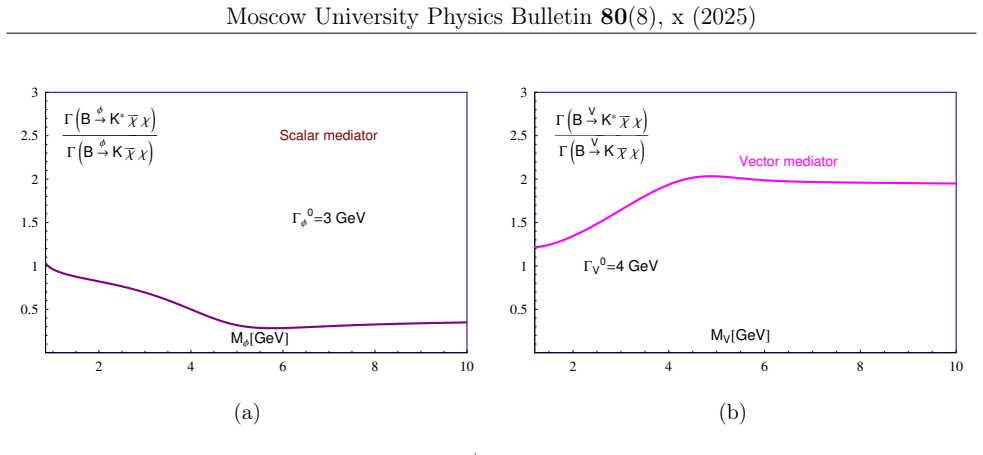
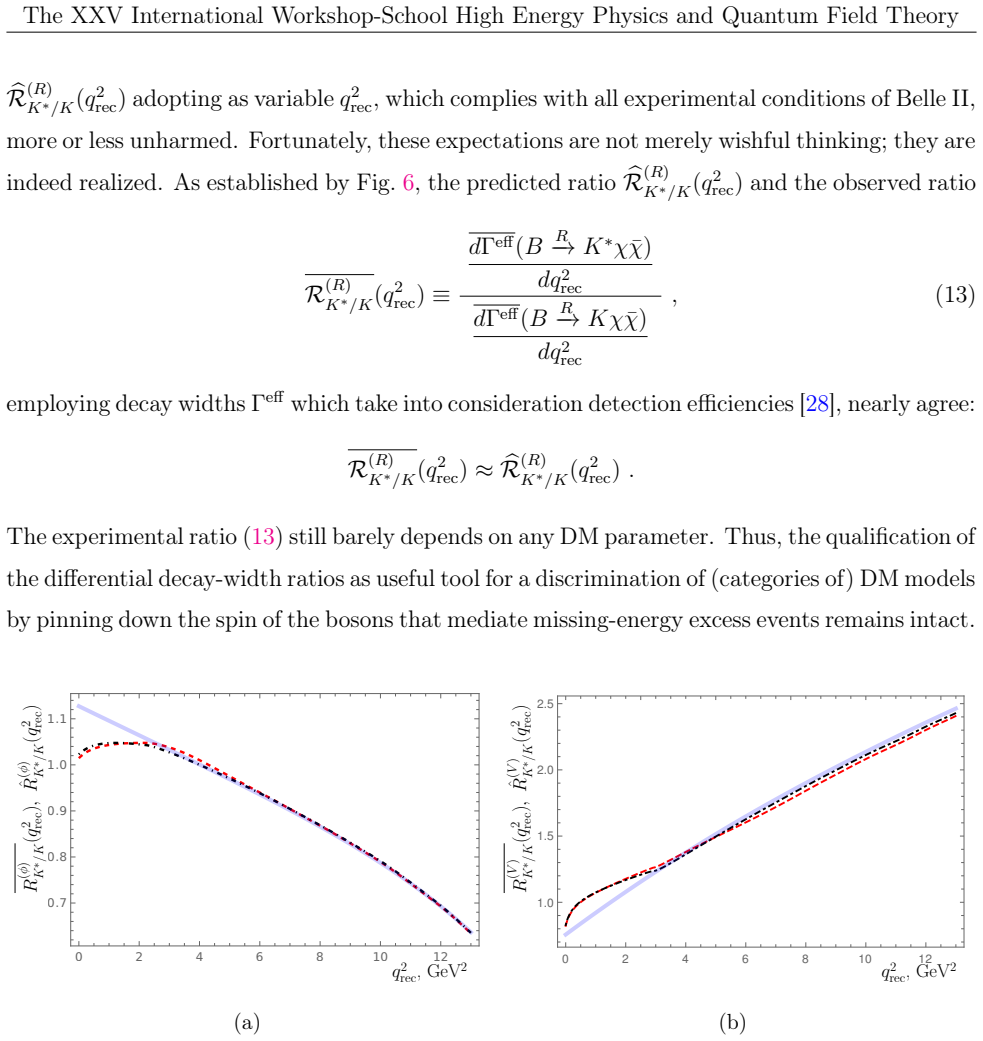
The surprising excess of missing-energy events far beyond all standard-model expectations in the weak decays of the charged ground-state B+ meson into some charged strange meson may be explained by the decay of the B meson into the strange meson and a pair of dark-matter fermion and antifermion, mediated by an (intermediate) scalar or vector boson. Thorough inspections of both the total and the differential widths of these decays provide, among others, a simple means for the (straightforward) discrimination of such mediator boson's scalar or vector nature.
What carries the argument
An intermediate scalar or vector boson mediating the decay B to strange meson plus dark-matter fermion-antifermion pair, used to compute total and differential widths for distinguishing the boson's type.
Load-bearing premise
The observed Belle-II excess is caused by new physics in the form of dark matter pair production rather than experimental systematics, background misestimation, or other standard-model effects not yet fully accounted for.
What would settle it
A detailed measurement of the differential distribution in the missing energy or the strange meson recoil mass that deviates from the predictions for both scalar and vector mediators would falsify the explanation.
Figures




read the original abstract
The surprising excess of missing-energy events far beyond all standard-model expectations in the weak decays of the charged ground-state $B^+$ meson into some charged strange meson, rather recently observed by the Belle-II experiment, may (easily) be explained by the decay of the $B$ meson into the strange meson and a pair of dark-matter fermion and antifermion, mediated by an (intermediate) scalar or vector boson. Thorough inspections of both the total and the differential widths of these decays provide, among others, a simple means for the (straightforward) discrimination of such mediator boson's scalar or vector nature.
Editorial analysis
A structured set of objections, weighed in public.
Referee Report
Summary. The manuscript claims that the Belle-II excess of missing-energy events in B+ → K+ and B+ → K* decays can be explained by B → K/K* + χχ-bar production, where χ is a dark-matter fermion, mediated by an intermediate scalar or vector boson. It computes total and differential decay widths in both scenarios to provide observables that discriminate the mediator type.
Significance. If the Belle-II excess is due to new physics, the analysis supplies a concrete EFT framework for interpreting it as dark-matter pair production and identifies differential distributions that can distinguish scalar from vector mediators. The use of standard effective-field-theory extensions with external inputs and the focus on falsifiable width predictions are strengths that could guide future Belle-II analyses.
major comments (1)
- [§3.2, Eq. (11)] §3.2, Eq. (11): the vector-mediator differential width is derived under the assumption that the mediator couples only to the dark sector; this choice is load-bearing for the claimed discrimination power, yet the text does not quantify how mixing with SM currents would alter the missing-mass spectrum.
minor comments (3)
- [§2] The notation for the missing-mass variable M_X is introduced without an explicit definition in the first paragraph of §2; a short kinematic relation to the missing energy would improve readability.
- [Figure 4] Figure 4 caption does not state the value of the mediator mass used for the plotted curves; adding this parameter value would allow direct comparison with the total-width results in Table 1.
- [§3.1] Reference [12] is cited for the B → K form factors but the numerical values adopted in the present calculation are not tabulated; a brief appendix listing the inputs would aid reproducibility.
Simulated Author's Rebuttal
We thank the referee for the positive assessment of our manuscript and for the constructive comment. We address the major comment below and will incorporate a clarifying discussion in the revised version.
read point-by-point responses
-
Referee: [§3.2, Eq. (11)] §3.2, Eq. (11): the vector-mediator differential width is derived under the assumption that the mediator couples only to the dark sector; this choice is load-bearing for the claimed discrimination power, yet the text does not quantify how mixing with SM currents would alter the missing-mass spectrum.
Authors: We appreciate this observation. The assumption that the vector mediator couples exclusively to the dark-sector fermions is a standard benchmark choice in such models, adopted to avoid strong constraints from direct-detection experiments, electroweak precision data, and other SM processes. Under this assumption, Eq. (11) yields a missing-mass spectrum whose shape differs characteristically from the scalar-mediator case, thereby enabling the discrimination we highlight. We agree that a quantitative estimate of possible mixing with SM currents would strengthen the presentation. In the revised manuscript we will add a short paragraph in §3.2 noting that any mixing angle θ would introduce interference terms suppressed by θ and by the mediator mass scale; these corrections can be bounded independently by other observables and do not erase the qualitative difference between the pure scalar and pure vector spectra in the benchmark scenarios we consider. revision: yes
Circularity Check
No significant circularity
full rationale
The paper models the Belle-II missing-energy excess in B+ → K/K* + missing energy as B → K/K* + χχ-bar mediated by a scalar or vector boson using standard effective-field-theory Lagrangians. Total and differential decay widths are derived from external inputs including meson transition form factors, CKM elements, and SM parameters drawn from independent literature. No step reduces a prediction to a parameter fitted on the same excess data, no self-citation chain carries the central claim, and the construction remains self-contained against external benchmarks without self-definitional or ansatz-smuggling reductions.
Axiom & Free-Parameter Ledger
free parameters (1)
- mediator mass and coupling strength
axioms (1)
- domain assumption The Belle-II excess is due to beyond-standard-model physics rather than unaccounted backgrounds or experimental artifacts
invented entities (1)
-
scalar or vector mediator boson
no independent evidence
Lean theorems connected to this paper
-
IndisputableMonolith/Cost/FunctionalEquation.leanwashburn_uniqueness_aczel unclear?
unclearRelation between the paper passage and the cited Recognition theorem.
interaction Lagrangians (2) and (4) for scalar/vector mediators, ratios ℛ(K*/K)(q²) and integrated widths, fits to Belle-II q²_rec data
What do these tags mean?
- matches
- The paper's claim is directly supported by a theorem in the formal canon.
- supports
- The theorem supports part of the paper's argument, but the paper may add assumptions or extra steps.
- extends
- The paper goes beyond the formal theorem; the theorem is a base layer rather than the whole result.
- uses
- The paper appears to rely on the theorem as machinery.
- contradicts
- The paper's claim conflicts with a theorem or certificate in the canon.
- unclear
- Pith found a possible connection, but the passage is too broad, indirect, or ambiguous to say the theorem truly supports the claim.
Reference graph
Works this paper leans on
-
[1]
MOTIV A TION: BELLE-II’S SURPRISING MISSING-ENERGY EXCESS FINDING Comparativelyrecently, theBelle-IIcollaborationreported[1]itsobservationofa(somewhat) astoundingexcessofdecayeventsofthecharged 𝐵+ mesonintoacharged 𝐾+ mesonandmissing energy 𝑀𝑋 (thelatteralsodenotedaneutrino-antineutrinopair ¯𝜈𝜈), 𝐵+ → 𝐾+¯𝜈𝜈. Theoutcome ofsuchmeasurementsmaybequantifiedbyc...
work page 2025
-
[2]
DARK-MA TTER SCENARIOS INVOL VING SCALAR OR VECTOR MEDIA TORS Beyond doubt, the evidently first move in any game of the kind intended should be to identify allrelevantquantitiesresidingclosetoorattheinterfaceoftheSMsectorandtheDMsectorand, subsequently, todetermineor, atleast, narrowdownthenumericalvaluesofalltheseparameters. Tothelatterquantitiesbelongal...
work page 2025
-
[3]
EXPERIMENT AL DISCRIMINA TION OF SCALAR FROM VECTOR MEDIA TOR Theactualnatureofthepossiblemediatorboson(s) 𝑅—scalarorvector(ormaybeevenboth) —isofunderstandablygreatinterest. Inthiscontext, ourthoroughanalyses[9–11]stimulatedby the 𝐵+ → 𝐾+¯𝜈𝜈 branching-ratio observations (1) of Belle II [1] underscore the importance of the simultaneous consideration of th...
-
[4]
theratioofthedifferentialdecaywidths, 𝑑Γ/𝑑𝑞2, forthetwomissing-energy 𝐵+ decays(6), ̂︀ℛ(𝑅) 𝐾*/𝐾(𝑞2) ≡ 𝑑Γ(𝐵 𝑅 − →𝐾 * ¯𝜒𝜒) 𝑑𝑞2 𝑑Γ(𝐵 𝑅 − →𝐾 ¯𝜒𝜒) 𝑑𝑞2 , 𝑅 = 𝜑, 𝑉 ; (7)
-
[5]
theratiooftherelatedintegrateddecaywidths, Γ, forthetwomissing-energy 𝐵 decays(6), ℛ(𝑅) 𝐾*/𝐾 ≡ Γ(𝐵 𝑅 − →𝐾 * ¯𝜒𝜒) Γ(𝐵 𝑅 − →𝐾 ¯𝜒𝜒) , 𝑅 = 𝜑, 𝑉 . (8) Straightforwardly, anyhadronic𝐵 𝑅 − →𝐾(*) amplitudeinvolvedinthese 𝐵-mesondecaywidths maybeexpressedintermsofacoupleof(dimensionless)formfactors[20]. Fortheseformfactors, someconvenientparametrizations[21]areava...
work page 2025
-
[6]
BELLE-II MISSING-ENERGY MYSTER Y: DARK MA TTER INTERPRET A TIONS Theultimatetaskofourstudyistodemonstratethatthe 𝑞2 distributionofthemissing-energy eventsmeasuredbyBelleII[1]canbereproducedbythetwoDMscenariosexemplifiedinSect.2. Experimentalboundaryconditions[1]necessitatetouse, insteadofthevariable 𝑞2 adoptedsofar, some“reconstruction” variable,𝑞2 rec, i...
work page 2025
- [7]
-
[8]
A. Gaz (on behalf of the Belle and Belle II Collaborations),Recent results from Belle and Belle II, Acta Phys. Polon. B Proc. Supp.17 (2024) 5-A18
work page 2024
-
[9]
Libby,Physics at Belle II, Eur
J. Libby,Physics at Belle II, Eur. Phys. J. Spec. Top.233 (2024) 241
work page 2024
-
[10]
Manoni,Status and prospects for rare𝐵 decays at Belle II, PoS (WIFAI2023) 024
E. Manoni,Status and prospects for rare𝐵 decays at Belle II, PoS (WIFAI2023) 024
-
[11]
R. Volpe (on behalf of the Belle II Collaboration), Search for 𝐵+ → 𝐾+𝜈¯𝜈 at Belle II, PoS (HQL2023) 049
-
[12]
Y. Han (on behalf of the Belle and Belle II Collaborations),Recent highlights from the Belle and Belle II experiments, Nucl. Part. Phys. Proc.347 (2024) 52
work page 2024
-
[13]
M. Liu (on behalf of the Belle and Belle II Collaborations),Measurements of electroweak penguin and lepton-flavour violating𝐵 decays to final states with missing energy at Belle and Belle II, PoS (ICHEP2024) 418
-
[14]
Search for $\boldsymbol{B\to h\nu\bar{\nu}}$ decays with semileptonic tagging at Belle
J. Grygier et al. (Belle Collaboration),Search for 𝐵 → ℎ𝜈¯𝜈 decays with semileptonic tagging at Belle, Phys. Rev. D96 (2017) 091101(R), 97 (2018) 099902 (addendum), arXiv:1702.03224 [hep -ex]
work page internal anchor Pith review Pith/arXiv arXiv 2017
-
[15]
A. Berezhnoy and D. Melikhov, 𝐵 → 𝐾*𝑀𝑋 vs. 𝐵 → 𝐾𝑀𝑋 as a probe of a scalar-mediator dark-matter scenario, EPL 145 (2024) 14001, arXiv:2309.17191 [hep-ph]
-
[16]
A. Berezhnoy, W. Lucha, and D. Melikhov, Analysis of 𝑞2 rec-distribution for 𝐵 → 𝐾𝑀𝑋 and 𝐵 → 𝐾*𝑀𝑋 decays in a scalar-mediator dark-matter scenario, Phys. Rev. D111 (2025) 075035, arXiv:2502.14313 [hep-ph]
-
[17]
Probing vector- vs scalar-mediator dark-matter scenarios in $B\to (K,K^*) M_X$ decays
A. Berezhnoy, W. Lucha, and D. Melikhov,Probing vector- vs. scalar-mediator dark-matter sce narios in 𝐵 → (𝐾, 𝐾*)𝑀𝑋 decays, arXiv:2507.10801 [hep-ph]
work page internal anchor Pith review Pith/arXiv arXiv
-
[18]
Multi-lepton Signatures of a Hidden Sector in Rare B Decays
B. Batell, M. Pospelov, and A. Ritz,Multilepton signatures of a hidden sector in rare𝐵 decays, Phys. Rev. D83 (2011) 054005, arXiv:0911.4938 [hep-ph]
work page internal anchor Pith review Pith/arXiv arXiv 2011
-
[19]
Constraints on light mediators: confronting dark matter searches with B physics
K. Schmidt-Hoberg, F. Staub, and M. W. Winkler,Constraints on light mediators: Confronting dark matter searches with𝐵 physics, Phys. Lett. B727 (2013) 506, arXiv:1310.6752 [hep-ph]. x–11 The XXV International Workshop-School High Energy Physics and Quantum Field Theory
work page internal anchor Pith review Pith/arXiv arXiv 2013
-
[20]
G.J.GounarisandJ.J.Sakurai, Finite-width corrections to the vector-meson-dominance prediction for 𝜌 → 𝑒+𝑒−, Phys. Rev. Lett.21 (1968) 244
work page 1968
-
[21]
D. Melikhov, O. Nachtmann, V. Nikonov, and T. Paulus,Masses and couplings of vector mesons from the pion electromagnetic, weak, and𝜋𝛾 transition form factors, Eur. Phys. J. C34 (2004) 345, arXiv:hep-ph/0311213
work page internal anchor Pith review Pith/arXiv arXiv 2004
-
[22]
The Physics of Heavy Z' Gauge Bosons
P. Langacker, The physics of heavy 𝑍′ gauge bosons, Rev. Mod. Phys. 81 (2009) 1199, arXiv:0801.1345 [hep-ph]
work page internal anchor Pith review Pith/arXiv arXiv 2009
-
[23]
P. Cox, A. D. Medina, T. S. Ray, and A. Spray,Novel collider and dark matter phenomenology of a top-philic 𝑍′, JHEP 06 (2016) 110, arXiv:1512.00471 [hep-ph]
work page internal anchor Pith review Pith/arXiv arXiv 2016
-
[24]
Y. Hu, Y. Liu, and Y. Liu,A study on vector mediator top-philic dark matter, Commun. Theor. Phys. 76 (2024) 085201
work page 2024
-
[25]
T. Inami and C. S. Lim,Effects of superheavy quarks and leptons in low-energy weak processes 𝐾𝐿 → 𝜇¯𝜇, 𝐾+ → 𝜋+𝜈¯𝜈 and 𝐾0 ↔ ¯𝐾0, Prog. Theor. Phys.65 (1981) 297, 65 (1981) 1772(E)
work page 1981
- [26]
-
[27]
Weak form factors for heavy meson decays: an update
D. Melikhov and B. Stech,Weak form factors for heavy meson decays: An update, Phys. Rev. D62 (2000) 014006, arXiv:hep-ph/0001113
work page internal anchor Pith review Pith/arXiv arXiv 2000
-
[28]
J. A. Baileyet al.(Fermilab Lattice and MILC Collaborations),𝐵 → 𝐾𝑙+𝑙− decay form factors from three-flavor lattice QCD, Phys. Rev. D93 (2016) 025026, arXiv:1509.06235 [hep-lat]
work page internal anchor Pith review Pith/arXiv arXiv 2016
-
[29]
$B\to V\ell^+\ell^-$ in the Standard Model from Light-Cone Sum Rules
A. Bharucha, D. M. Straub, and R. Zwicky,𝐵 → 𝑉 ℓ+ℓ− in the Standard Model from light-cone sum rules, JHEP 08 (2016) 098, arXiv:1503.05534 [hep-ph]
work page internal anchor Pith review Pith/arXiv arXiv 2016
-
[30]
Charm-loop effect in $B \to K^{(*)} \ell^{+} \ell^{-}$ and $B\to K^*\gamma$
A. Khodjamirian, Th. Mannel, A. A. Pivovarov, and Y.-M. Wang,Charm-loop effect in 𝐵 → 𝐾(*)ℓ+ℓ− and 𝐵 → 𝐾*𝛾, JHEP 09 (2010) 089, arXiv:1006.4945 [hep-ph]
work page internal anchor Pith review Pith/arXiv arXiv 2010
- [31]
-
[32]
D. Beˇ cirevi´ c, G. Piazza, and O. Sumensari,Revisiting 𝐵 → 𝐾(*)𝜈¯𝜈 decays in the Standard Model and beyond, Eur. Phys. J. C83 (2023) 252, arXiv:2301.06990 [hep-ph]
-
[33]
L. Allwicher, D. Beˇ cirevi´ c, G. Piazza, S. Rosauro-Alcaraz, and O. Sumensari,Understanding the first measurement ofℬ(𝐵 → 𝐾𝜈 ¯𝜈), Phys. Lett. B848 (2024) 138411, arXiv:2309.02246 [hep-ph]
-
[34]
K. Fridell, M. Ghosh, T. Okui, and K. Tobioka, Decoding the 𝐵 → 𝐾𝜈𝜈 excess at Belle II: Kinematics, operators, and masses, Phys. Rev. D109 (2024) 115006, arXiv:2312.12507 [hep-ph]. x–12
discussion (0)
Sign in with ORCID, Apple, or X to comment. Anyone can read and Pith papers without signing in.