REVIEW 3 major objections 4 minor 76 references
Multiband Superconductivity and High Critical Current Density in Entropy Stabilized Nb0.25Ta0.25Ti0.25Zr0.25
T0 review · 3 major / 4 minor · reviewed 2026-08-15 · deepseek-v4-flash
Pith's one-line read The paper argues that the entropy-stabilized alloy Nb0.25Ta0.25Ti0.25Zr0.25 is a bulk superconductor at 8 K with strong-coupling, likely multiband pairing, an upper critical field of about 11.94 T, and a critical current density above…
desk verdict Credible new HEA superconductor data with a record as-cast Jc, but the multiband and topological claims are overinterpreted from a single specific-heat exponent. read the letter →
The pith
A machine-rendered reading of the paper's core claim, the machinery that carries it, and where it could break.
The reading
What carries the argument
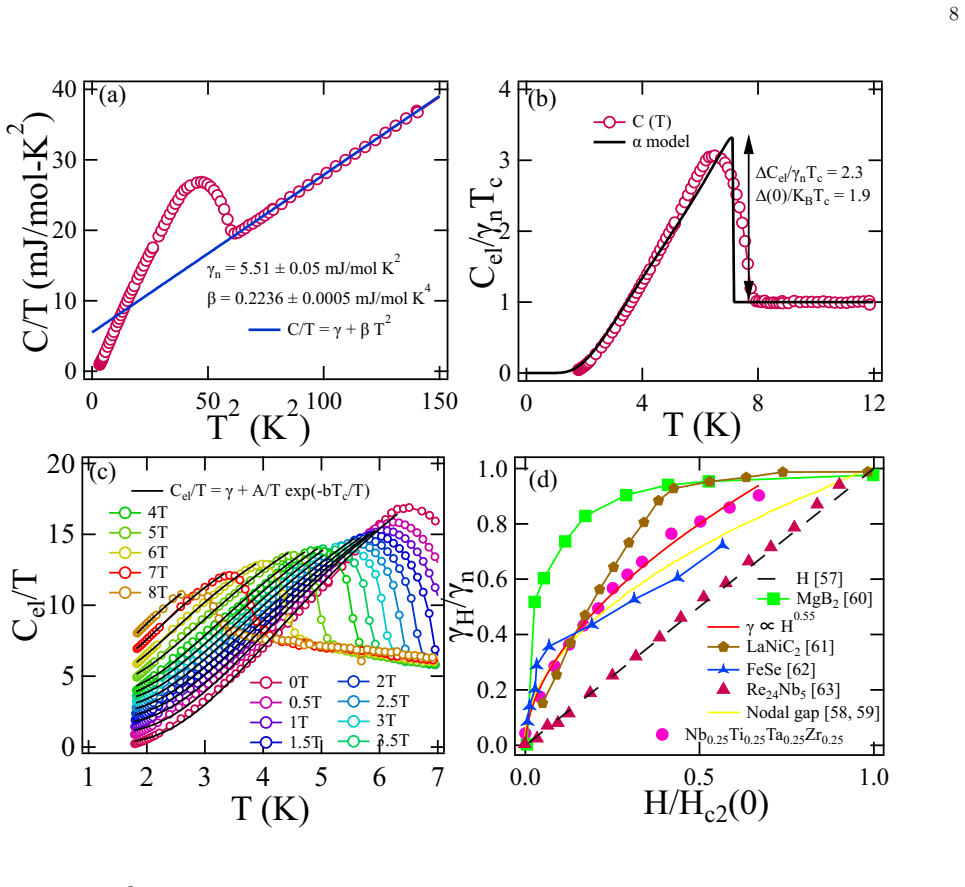
The argument is carried by three linked quantities. First, the electronic specific heat in the vortex state, reduced to the normalized Sommerfeld coefficient γ(H)/γn, gives a fitted power law $H^{0}$.55 that the paper treats as the experimental fingerprint of multiband pairing, because it lies between the linear behavior expected for single-gap vortex cores and the square-root behavior expected for nodal gaps. Second, the zero-field specific-heat jump and the electron-phonon coupling constants derived from Tc and the lattice vibrational temperature give the strong-coupling part, with ΔC/γTc ≈ 2.3 and coupling estimates in the range 0.86–1.39. Third, the DFT band structure supplies the topological suggestion: linear band crossings near the Fermi level, one surviving spin-orbit coupling, in a matrix where disorder would normally wash out such features. The pinning analysis, using a critical-state extraction of Jc and the $h^{0}$.5(1−h)^2 scaling of the pinning force, completes the practical case by attributing the high current density to grain-boundary surface pinning.
What would settle it
A gap-resolving experiment, such as point-contact Andreev reflection spectroscopy, scanning tunnelling spectroscopy, or a two-gap fit to the same specific-heat data, that finds only one superconducting gap would falsify the multiband claim; alternatively, a computed γ(H) from the band structure that reaches $H^{0}$.55 without multiple bands would show the interpretation is not unique.
Extended reading notes
Core claim
The paper claims that the equiatomic BCC medium-entropy alloy Nb0.25Ta0.25Ti0.25Zr0.25 is a bulk, strong-coupling superconductor with Tc ≈ 8 K, an upper critical field Hc2(0) ≈ 11.94 T, and a critical current density Jc ≈ 1.3–1.4 × $10^{5}$ A/cm² in the as-cast state. It interprets the specific-heat jump ΔC/γTc ≈ 2.3, above the BCS weak-coupling value of 1.43, together with the sublinear field dependence γ(H)/γn ∝ (H/Hc2(0))^0.55 as evidence for multiband strong-coupling pairing, comparing that exponent with known multiband superconductors. Density-functional calculations on a special quasirandom structure show Dirac-like band crossings near the Fermi level, and one crossing between the A and Γ points remains degenerate when spin-orbit coupling is included; the paper reads this as a symmetry-protected topological feature coexisting with disorder and superconductivity. The high critical current is attributed to surface pinning at grain boundaries, with the normalized pinning force following $h^{0}$.5(1−h)^2, a surface-pinning form.
Load-bearing premise
The multiband conclusion depends on interpreting the measured γ(H) ∝ $H^{0}$.55 as a multiband fingerprint; if a single anisotropic gap or strong-coupling anisotropy can explain that sublinear field dependence, the paper's central claim loses its experimental support.
Editorial extensions
If this is right
- A two-gap or multigap fitting procedure applied to the same specific-heat data would provide a quantitative check of the claimed multiband state.
- Systematic annealing studies that tune grain size should either confirm or weaken the surface-pinning explanation for the high Jc.
- If the 8 K transition and 11.94 T upper critical field hold in conductor form, this alloy becomes a disordered, irradiation-tolerant competitor to NbTi for high-field magnets.
- Confirmation of the SOC-protected band crossing by angle-resolved photoemission would connect entropy-stabilized alloys to the study of topological superconductivity.
Reading between the lines
- The paper leaves implicit that its γ(H) ∝ H^0.55 criterion is not unique to multiband pairing; a single anisotropic gap or strong-coupling anisotropy can also produce sublinear growth, so a two-gap fit or a phase-sensitive probe is the natural next experiment.
- I infer that the topological claim should be stress-tested against disorder: the DFT calculation used one finite supercell, and checking several random configurations or a larger supercell would show whether the surviving degeneracy is a robust property of the alloy rather than of that particular cell.
- A testable extension is thermomagnetic stability: the annealed sample shows flux jumps, so sweep-rate-dependent magnetization measurements could separate intrinsic disorder pinning from magnetothermal instabilities and guide annealing protocols toward higher Jc.
- Because the as-cast Jc already approaches the practical 10^5 A/cm² benchmark with no optimization, conductor-level processing of this alloy is a plausible next step, though the paper does not address it.
Signed reviews
Editorial analysis
A structured set of objections, weighed in public.
Referee Report
Summary. The paper reports a combined experimental and computational study of the equiatomic bcc medium-entropy alloy Nb0.25Ta0.25Ti0.25Zr0.25. The authors show bulk superconductivity with Tc ≈ 8 K, an upper critical field Hc2(0) ≈ 11.94 T from resistivity in fields up to 10 T, a lower critical field Hc1(0) ≈ 68 mT, and a critical current density exceeding 10^5 A/cm² at low fields for the as-cast sample. Specific heat measurements reveal a jump ΔC/γTc ≈ 2.3 and a field-dependent Sommerfeld coefficient that scales as γ(H) ∝ H^0.55, which the authors interpret as evidence of multiband strong-coupling superconductivity. DFT-based SQS calculations show dynamical stability, a high d-electron DOS at the Fermi level, and several Dirac-like band crossings, some of which survive spin-orbit coupling. The paper claims this is the highest Tc among medium/high-entropy alloys and highlights possible unconventional and/or topological superconductivity together with high critical current density.
Significance. If the multiband and topological interpretations were firmly established, this would be an important advance: it would identify a new entropy-stabilized superconductor with Tc ≈ 8 K, a comparatively high Hc2, and record-high critical current density among as-cast high/medium-entropy alloys, while connecting severe intrinsic disorder with unconventional pairing. The experimental dataset is broad and internally consistent for the bulk superconducting parameters: transport, magnetization, and specific heat all point to Tc ≈ 8 K and Hc2(0) ≈ 12 T, and the as-cast low-field Jc value is credible. The DFT phonon stability and electronic structure calculations add value. However, the load-bearing claim of multiband superconductivity rests almost entirely on one phenomenological scaling law, γ(H) ∝ H^0.55, which is not a diagnostic, and the strong-coupling story is weakened by an internal inconsistency in the reported electron-phonon coupling constant. The paper's central physics claim therefore needs substantially more support or a more modest framing.
major comments (3)
- [Field-dependent specific heat, Figure 5(d)] The multiband conclusion is anchored on the observation that γ(H)/γn scales as (H/Hc2)^0.55, interpreted by analogy with MgB2, LaNiC2, FeSe, and Re24Nb5. This is not a sufficient diagnostic. A sublinear γ(H) also follows from nodal or strongly anisotropic single-gap superconductors via the Volovik √H effect, and the paper itself plots the nodal-gap curve in Figure 5(d). The low-temperature fit in Eq. (16) describes a nodeless exponential gap, consistent with a single-gap BCS-like superconductor, and the α-model fit in Figure 5(b) is a single-gap fit; neither independently supports multiple bands. To justify the multiband label, the authors should provide a two-gap fit to C(T,H), a computed γ(H) from the DFT Fermi surface, or an independent probe of multiple gaps (e.g., penetration depth or muon spin rotation). As written, the headline claim of multiband superconductivity is not secured.
- [Critical current density, annealed sample] In the paragraph describing the annealed sample, the Jc values that exceed 10^5 A/cm² up to 5 T are estimated from 'the surface points of the MH loops' of loops that exhibit flux jumps. This method is not described. The Bean model, Eq. (11), normally uses the full width ΔM of a complete hysteresis loop; using selected 'surface points' without defining a selection procedure makes the annealed-sample Jc values unverifiable and potentially dependent on arbitrary choices. Please specify exactly how the surface points were chosen, how flux jumps were handled, and whether the Bean formula remains applicable to partial loops. The as-cast Jc values below 0.25 T appear credible, but the annealed high-field claim needs proper documentation before it can be used to support the benchmark-exceeding Jc claim.
- [Table II and strong-coupling analysis] There is an internal inconsistency in the electron-phonon coupling constant. Table II lists λe-ph = 0.86 ± 0.02, matching the McMillan value obtained from Eq. (15), but the text immediately after Eq. (19) states that the Allen-Dynes equation gives λe-ph = 1.39. Both values are used to support strong coupling, but they differ by more than 60%. The authors should explain which value is the final estimate, why the two formulas differ so strongly, and what λe-ph is used in subsequent statements (e.g., the density-of-states estimate in Eq. (14)). This discrepancy directly affects the strong-coupling characterization that is part of the paper's central interpretation.
minor comments (4)
- [WHH fit (Figure 3(c))] The text reports λSO = 1.63 from the WHH fit, while the caption of Figure 3(c) states λSO = 1.62; please use a consistent value.
- [α-model and Eq. (18)] Figure 5(b) gives Δ(0)/kBTc = 1.9 from the α-model fit, while Eq. (18) yields Δ(0)/kBTc ≈ 2.09; the text says these 'closely match,' but the 10% difference should at least be acknowledged or explained.
- [Eq. (5)] The Ginzburg-Landau expression for Hc2(T) in Eq. (5) is not a standard form; please justify it or reference the specific model used, since the extracted Hc2(0) depends on this choice.
- [General editing] There are several typographical issues, including 'residual residual resistivity' in the text near Eq. (1), and the repeated use of 'highlight the possibility' phrasing in the abstract and conclusions, which could be tightened.
Circularity Check
No significant circularity: the paper's headline quantities are direct measurements, and the multiband and strong-coupling interpretations are analogies and consistency checks rather than derivations that reduce to their own inputs.
full rationale
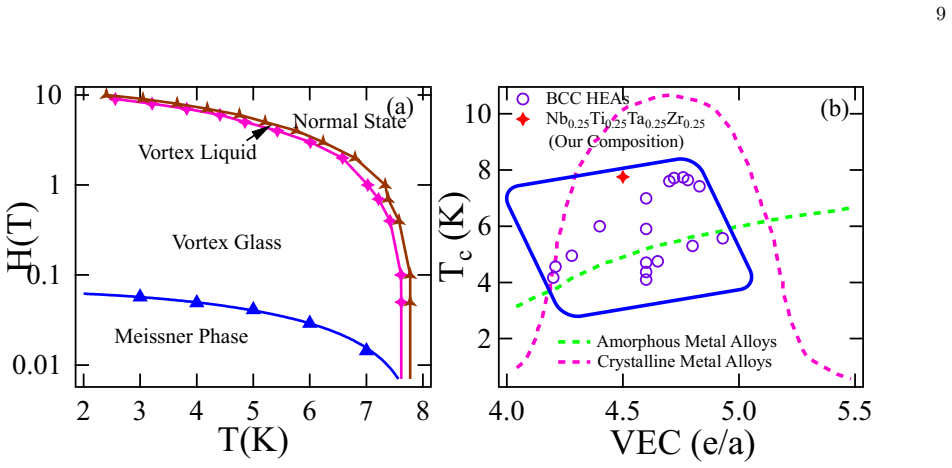
The paper's central measured quantities — Tc ≈ 8 K, Hc2(0) ≈ 11.94 T, ΔC/γTc ≈ 2.3, and Jc > 10^5 A/cm² — are direct observations, not outputs of a fitted model. The multiband claim rests on the observed sublinear field dependence γ(H) ∝ H^0.55, which is compared by analogy with known multiband superconductors; no two-gap fit or band-structure-derived γ(H) is provided, so the interpretation is under-supported but not circular. The strong-coupling parameters (ωln, 2Δ/kBTc, and λe-ph from the Allen-Dynes equation) are computed from the measured specific-heat jump using standard strong-coupling formulas (Eqs. 17–19); these are consistency checks, not independent predictions, and they do not redefine the measured jump. The DFT band-structure and phonon calculations are independent ab initio inputs. The self-citations in the VEC–Tc comparison (Fig. 6(b)) are only data compilation and are not load-bearing for the paper's claims. The internal inconsistency between λe-ph = 0.86 (Table II, McMillan formula) and λe-ph = 1.39 (Allen-Dynes estimate in the text) is a correctness concern, as is the insufficient diagnostic power of the γ(H) exponent for multiband superconductivity, but neither constitutes circularity under the required standard.
Assumptions & free parameters
free parameters (4)
- lambda_SO (spin-orbit scattering parameter) =
1.62 (also given as 1.63 in text)
- alpha_M (Maki parameter) =
1.17
- Delta(0)/k_B Tc (alpha-model gap ratio) =
1.9
- n (field-dependence exponent of gamma) =
0.55
assumptions (5)
- domain assumption Bean's critical state model applies to the bulk polycrystalline sample and the reported Jc follows from the M-H loop width.
- domain assumption The normal-state specific heat is described by a single electronic γT plus one Debye phonon βT^3 term.
- domain assumption The SQS supercell used in DFT captures the electronic structure of the infinite random solid solution.
- ad hoc to paper The sublinear field dependence gamma(H) ∝ H^0.55 is a signature of multiband superconductivity.
- ad hoc to paper For the annealed sample, Jc can be estimated from the 'surface points' of M-H loops that exhibit flux jumps.
Cite this review
Pith. "Pith review of Multiband Superconductivity and High Critical Current Density in Entropy Stabilized Nb0.25Ta0.25Ti0.25Zr0.25." pith.science (2026). https://pith.science/paper/VZ63NASY
@misc{pith2026250819584,
  author       = {Pith},
  title        = {Pith review of: Multiband Superconductivity and High Critical Current Density in Entropy Stabilized Nb0.25Ta0.25Ti0.25Zr0.25},
  year         = {2026},
  howpublished = {\url{https://pith.science/paper/VZ63NASY}},
  note         = {Machine review of arXiv:2508.19584}
}
read the original abstract
High and medium-entropy superconductors with significant intrinsic disorder are a fascinating class of superconductors. Their combination of robust structural integrity, superior mechanical properties, and exceptional irradiation tolerance makes them promising candidates for use in advanced superconducting technologies. Herein, we present a comprehensive theoretical and experimental investigation on the superconductivity of equiatomic entropy-stabilized Nb0.25Ta0.25Ti0.25Zr0.25. The material shows bulk superconductivity (transition temperature = 8K) with a high upper critical field of 11.94T. Interestingly, both the electronic band structure and specific heat data point toward unconventional multiband superconductivity. Our ab initio calculations reveal Dirac-like band crossings close to the Fermi level, with certain degeneracies persisting even in the presence of spin-orbit coupling, suggesting a possible interplay between topological electronic states and the observed unconventional superconductivity. Remarkably, the critical current density exceeds the benchmark of 10^5 A/cm2, surpassing all previously reported as-cast entropy-stabilized superconductors. This high critical current density is likely attributed to strong flux pinning at the grain boundaries, facilitated by extreme intrinsic lattice distortion. Taken together, the demonstrated dynamical stability, excellent metallicity, potential to host unconventional superconductivity, and exceptionally high critical current density highlight the potential of entropy-stabilized alloys as a platform for exploring the confluence of disorder, topology, and unconventional superconductivity.
Figures


Figures from the paper (5 more)



Reference graph
Works this paper leans on
-
[1]
T. Boutboul, S. Le Naour, D. Leroy, L. Oberli, and V. Previtali, IEEE Transactions on Applied Superconduc- tivity 16, 1184 (2006)
work page 2006
-
[2]
Banno, Superconductivity 6, 100047 (2023)
N. Banno, Superconductivity 6, 100047 (2023)
work page 2023
-
[3]
L. Zeng, J. Wang, H. Liu, L. Li, J. Qin, Y. Li, R. Chen, J. Song, Y. Hou, and H. Luo, Advanced Science , e06089 (2025)
work page 2025
-
[4]
L. Zeng, Z. Wang, J. Song, G. Lin, R. Guo, S. C. Luo, S. Guo, K. Li, P. Yu, C. Zhang, W. M. Guo, J. Ma, Y. Hou, and H. Luo, Advanced Functional Materials 33, 2301929 (2023)
work page 2023
- [5]
-
[6]
J. Guo, H. Wang, F. von Rohr, Z. Wang, S. Cai, Y. Zhou, K. Yang, A. Li, S. Jiang, Q. Wu, R. J. Cava, and L. Sun, Proceedings of the National Academy of Sciences of the United States of America 114, 13144 (2017)
work page 2017
- [7]
-
[8]
Y. F. Ye, Q. Wang, J. Lu, C. Liu, and Y. Yang, Materials Today 19, 349 (2016)
work page 2016
Show all 76 references
-
[9]
Gludovatz, A
B. Gludovatz, A. Hohenwarter, D. Catoor, E. H. Chang, E.P.George, andR.O.Ritchie, Science345, 1153(2014)
2014
-
[10]
D. H. Cook, P. Kumar, M. I. Payne, C. H. Belcher, P. Borges, W.Wang, F.Walsh, Z.Li, A.Devaraj, M.Zhang, A. Mark, A. M. Minor, E. J. Lavernia, D. Apelian, and R. O. Ritchie, Science 384, 178 (2024)
2024
-
[11]
C. P. Lee, Y. Y. Chen, C. Y. Hsu, J. W. Yeh, and H. C. Shih, Journal of The Electrochemical Society 154, C424 (2007)
2007
-
[12]
S. Jung, Y. Han, J. H. Kim, R. Hidayati, J. Rhyee, J. M. Lee, W. N. Kang, W. S. Choi, H. Jeon, J. Suk, and T. Park, Nature Communications 13, 3373 (2022)
2022
-
[13]
B. Liu, J. Wu, Y. Cui, Q. Zhu, G. Xiao, S. Wu, G. Cao, and Z. Ren, Scripta Materialia 182, 109 (2020)
2020
-
[14]
Stolze, J
K. Stolze, J. Tao, F. O. Von Rohr, T. Kong, and R. J. Cava, Chemistry of Materials 30, 906 (2018)
2018
-
[15]
A.Yamashita, T.D.Matsuda, andY.Mizuguchi, Journal of Alloys and Compounds 868, 159233 (2021)
2021
-
[16]
Hirai, N
D. Hirai, N. Uematsu, Y. Muramatsu, K. Deguchi, Y. Shimura, T. Onimaru, and K. Takenaka, Chemistry of Materials 36, 9547 (2024)
2024
-
[17]
Van De Walle, M
A. Van De Walle, M. Asta, and G. Ceder, Calphad 26, 539 (2002)
2002
-
[18]
Van De Walle, Calphad 33, 266 (2009)
A. Van De Walle, Calphad 33, 266 (2009)
2009
-
[19]
van de Walle, P
A. van de Walle, P. Tiwary, M. de Jong, D. L. Olmsted, M. Asta, A. Dick, D. Shin, Y. Wang, L. Q. Chen, and Z. K. Liu, Calphad 42, 13 (2013)
2013
-
[20]
Kresse and J
G. Kresse and J. Hafner, Physical Review B 47, 558 (1993)
1993
-
[21]
Kresse and J
G. Kresse and J. Furthmüller, Computational Materials Science 6, 15 (1996)
1996
-
[22]
Kresse and J
G. Kresse and J. Furthmüller, Physical Review B 54, 11169 (1996)
1996
-
[23]
J. P. Perdew, K. Burke, and M. Ernzerhof, Physical Re- view Letters 77, 3865 (1996)
1996
-
[24]
Senkov, J
O. Senkov, J. Scott, S. Senkova, D. Miracle, and C. Woodward, Journal of Alloys and Compounds 509, 6043 (2011)
2011
-
[25]
Supplemental Information
-
[26]
Motla, Arushi, S
K. Motla, Arushi, S. Jangid, P. K. Meena, R. K. Kush- waha, andR.P.Singh, SuperconductorScienceandTech- nology 36, 115024 (2023)
2023
-
[27]
Jangid, P
S. Jangid, P. K. Meena, R. K. Kushwaha, S. Srivastava, P. Manna, P. Mishra, S. Sharma, and R. P. Singh, Ap- plied Physics Letters 124, 192602 (2024)
2024
-
[28]
Grimvall, Physica Scripta 14, 63 (1976)
G. Grimvall, Physica Scripta 14, 63 (1976)
1976
-
[29]
N. R. Werthamer, E. Helfand, and P. C. Hohenberg, Physical Review 147, 295 (1966)
1966
-
[30]
D.Yan, D.Geng, Q.Gao, Z.Cui, C.Yi, Y.Feng, C.Song, H. Luo, M. Yang, M. Arita, S. Kumar, E. F. Schwier, K. Shimada, L. Zhao, K. Wu, H. Weng, L. Chen, X. J. Zhou, Z. Wang, Y. Shi, and B. Feng, Physical Review B 102, 205117 (2020)
2020
-
[31]
Tinkham, Introduction to Superconductivity, 2nd ed
M. Tinkham, Introduction to Superconductivity, 2nd ed. (McGraw-Hill, New York, NY, 1996)
1996
-
[32]
Klimczuk, F
T. Klimczuk, F. Ronning, V. Sidorov, R. J. Cava, and J. D. Thompson, Physical Review Letters 99, 257004 (2007)
2007
-
[33]
Maki, Physics Physique Fizika 1, 127 (1964)
K. Maki, Physics Physique Fizika 1, 127 (1964)
1964
-
[34]
Maki, Physical Review 148, 362 (1966)
K. Maki, Physical Review 148, 362 (1966)
1966
-
[35]
H. Liu, J. Yao, J. Shi, Z. Yang, D. Yan, Y. Li, D. Chen, H. L. Feng, S. Li, Z. Wang, and Y. Shi, Physical Review B 108, 104504 (2023)
2023
-
[36]
C. P. Bean, Reviews of Modern Physics 36, 31 (1964)
1964
-
[37]
Hidayati, J
R. Hidayati, J. H. Kim, S. G. Jung, K. S. Cho, J. H. Yun, and J. S. Rhyee, Acta Materialia 261, 119420 (2023). 13
2023
-
[38]
G. Kim, M. H. Lee, J. H. Yun, P. Rawat, S. G. Jung, W. Choi, T. S. You, S. J. Kim, and J. S. Rhyee, Acta Materialia 186, 250 (2020)
2020
-
[39]
B. Dam, J. Huijbregtse, F. Klaassen, R. Van Der Geest, G. Doornbos, J. Rector, A. Testa, S. Frelsem, J. Mar- tinez, B. Stauble-Pumpin, and R. Griessen, Nature 399, 439 (1999)
1999
-
[40]
Civale, B
L. Civale, B. Maiorov, A. Serquis, J. Willis, J. Coulter, H. Wang, Q. Jia, P. Arendt, J. MacManus-Driscoll, M. Maley, and S. Foltyn, Applied Physics Letters 84, 2121 (2004)
2004
-
[41]
Dew-Hughes, Philosophical Magazine 30, 293 (1974)
D. Dew-Hughes, Philosophical Magazine 30, 293 (1974)
1974
-
[42]
D. C. Larbalestier, in Superconductor Materials Science: Metallurgy, Fabrication, and Applications (Springer,
-
[43]
Meingast, P
C. Meingast, P. Lee, and D. Larbalestier, Journal of Ap- plied Physics 66, 5962 (1989)
1989
-
[44]
W. L. McMillan, Physical Review 167, 331 (1968)
1968
-
[45]
Elrod, J
S. Elrod, J. Miller, and L. Dresner, in Advances in Cryo- genic Engineering Materials (1981) pp. 601–610
1981
-
[46]
A. T. Hirshfeld, H. Leupold, and H. Boorse, Physical Review 127, 1501 (1962)
1962
-
[47]
Cucciari, D
A. Cucciari, D. Naddeo, S. Di Cataldo, and L. Boeri, Physical Review B 110, L140502 (2024)
2024
-
[48]
Kittel, Introduction to Solid State Physics, 8th ed
C. Kittel, Introduction to Solid State Physics, 8th ed. (Wiley, Hoboken, NJ, 2005)
2005
-
[49]
B. T. Matthias, Physical Review 97, 74 (1955)
1955
-
[50]
M. M. Collver and R. H. Hammond, Physical Review Letters 30, 92–95 (1973)
1973
-
[51]
Marik, K
S. Marik, K. Motla, M. Varghese, K. P. Sajilesh, D. Singh, Y. Breard, P. Boullay, and R. P. Singh, Physi- cal Review Materials 3, 060602(R) (2019)
2019
-
[52]
F. O. V. Rohr, M. J. Winiarski, J. Tao, T. Klimczuk, and R. J. Cava, Proceedings of the National Academy of Sciences of the United States of America 113, E7144 (2016)
2016
-
[53]
Sharma, N
N. Sharma, N. Sharma, T. Chakraborty, and S. Marik, Materials Today Communications 44, 111968 (2025)
2025
-
[54]
Sharma, J
N. Sharma, J. Link, K. Kargeti, N. Sharma, I. Heinmaa, S. K. Panda, R. Stern, T. Chakraborty, T. Chakrabarty, and S. Marik, Physical Review Materials 9, 064801 (2025)
2025
-
[55]
Padamsee, J
H. Padamsee, J. Neighbor, and C. Shiffman, Journal of Low Temperature Physics 12, 387 (1973)
1973
-
[56]
D. C. Johnston, Superconductor Science and Technology 26, 115011 (2013)
2013
-
[57]
C.Caroli, P.DeGennes, andJ.Matricon, PhysicsLetters 9, 307 (1964)
1964
-
[58]
Volovik, JETP Letters 58, 469 (1993)
G. Volovik, JETP Letters 58, 469 (1993)
1993
-
[59]
Volovik, JETP Letters 58, 444 (1993)
G. Volovik, JETP Letters 58, 444 (1993)
1993
-
[60]
Bouquet, R
F. Bouquet, R. Fisher, N. Phillips, D. Hinks, and J. Jor- gensen, Physical Review Letters 87, 047001 (2001)
2001
-
[61]
J. Chen, L. Jiao, J. L. Zhang, Y. Chen, L. Yang, M. Nicklas, F. Steglich, and H. Q. Yuan, New Journal of Physics 15, 053005 (2013)
2013
-
[62]
J. Chen, Y. Sun, T. Yamada, S. Pyon, and T. Tamegai, in Journal of Physics: Conference Series, Vol. 871 (IOP Publishing, 2017) p. 012016
2017
-
[63]
1 + 53 TC ωln 2 ln ωln 3TC # (17) With the obtained value ofωln = 80.7 K, the value of superconducting gap, can also be obtained through the following equation 2∆(0) kB TC = 3.53
Nodal gap [58, 59] Nb 0.25 Ti 0.25 Ta 0.25 Zr 0.25 H [57] MgB 2 [60] 20151050Cel /T 7654321 T (K) 0T 0.5T 1T 1.5T 4T 5T 6T 7T 8T C el /T = γ + A/T exp(-bT c /T) 2T 2.5T 3T 3.5T (a) (d)(c) (b) FIG. 5. (a) C/T vs T2 in zero field for Nb0.25Ta0.25Ti0.25Zr0.25, fitted using Debye ...
-
[64]
Shang, M
T. Shang, M. Smidman, S. K. Ghosh, C. Baines, L. J. Chang, D. J. Gawryluk, J. A. T. Barker, R. P. Singh, D. M. Paul, G. Balakrishnan, E. Pomjakushina, M. Shi, M. Medarde, A. D. Hillier, H. Q. Yuan, J. Quintanilla, J. Mesot, and T. Shiroka, Physical Review Letters 121, 257002 (2018)
2018
-
[65]
M. P. Fisher, Physical Review Letters 62, 1415 (1989)
1989
-
[66]
Chakrabortty and N
S. Chakrabortty and N. Mohapatra, Physical Review B 111, 094511 (2025)
2025
-
[67]
S. M. Young, S. Zaheer, J. C. Teo, C. L. Kane, E. J. Mele, and A. M. Rappe, Physical review letters 108, 140405 (2012)
2012
-
[68]
Z. Liu, B. Zhou, Y. Zhang, Z. Wang, H. Weng, D. Prab- hakaran, S. K. Mo, Z. Shen, Z. Fang, X. Dai, Z. Hussain, and Y. Chen, Science 343, 864 (2014)
2014
-
[69]
N. P. Armitage, E. J. Mele, and A. Vishwanath, Reviews of Modern Physics 90, 015001 (2018)
2018
-
[70]
Z. Wang, Y. Sun, X. Q. Chen, C. Franchini, G. Xu, H. Weng, X.Dai, andZ.Fang, PhysicalReviewB85, 195320 (2012)
2012
-
[71]
S. Y. Xu, I. Belopolski, N. Alidoust, M. Neupane, G. Bian, C. Zhang, R. Sankar, G. Chang, Z. Yuan, C. C. Lee, S. M. Huang, H. Zheng, J. Ma, D. S. Sanchez, B. Wang, A. Bansil, F. Chou, P. P. Shibayev, H. Lin, S. Jia, and M. Z. Hasan, Science 349, 613 (2015)
2015
-
[72]
B. J. Yang and N. Nagaosa, Nature communications 5, 4898 (2014)
2014
-
[73]
Bradlyn, J
B. Bradlyn, J. Cano, Z. Wang, M. Vergniory, C. Felser, R. J. Cava, and B. A. Bernevig, Science 353, aaf5037 (2016)
2016
-
[74]
F. K. Guo, C. Hanhart, U. G. Meißner, Q. Wang, Q. Zhao, and B. S. Zou, Reviews of Modern Physics 90, 015004 (2018)
2018
-
[75]
B. J. Wieder, B. Bradlyn, Z. Wang, J. Cano, Y. Kim, H. S. D. Kim, A. M. Rappe, C. Kane, and B. A. Bernevig, Science 361, 246 (2018)
2018
-
[76]
H. H. Hung, A. Barr, E. Prodan, and G. A. Fiete, Phys- ical Review B 94, 235132 (2016)
2016
Reviewed August 15, 2026 · model on record in the stance chip above.
Discussion (0). Continue with ORCID to comment.