Optimal Work Extraction from Finite-Time Closed Quantum Dynamics
Pith reviewed 2026-05-18 21:16 UTC · model grok-4.3
The pith
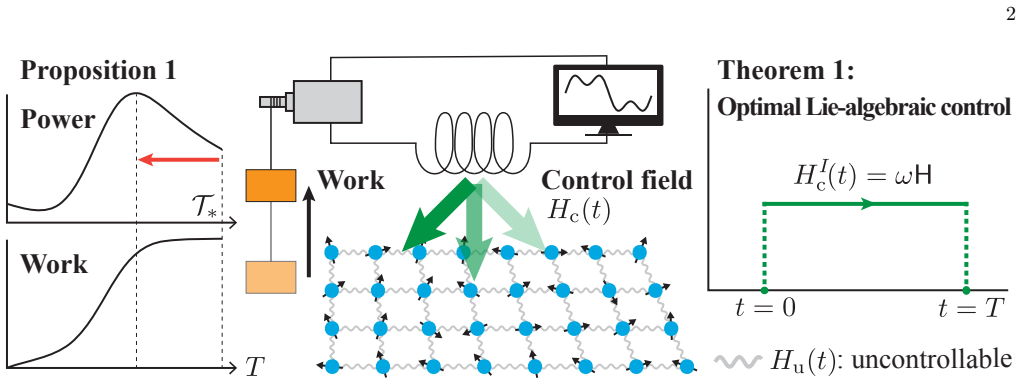
Finite-time optimal work extraction from quantum systems reduces exactly to solving one nonlinear equation under a Lie-algebra constraint.
A machine-rendered reading of the paper's core claim, the machinery that carries it, and where it could break.
Core claim
Within the class of systems where the control Hamiltonian is optimized over a Lie algebra preserved by the uncontrolled dynamics, the finite-time optimal work-extraction problem reduces exactly to a nonlinear self-consistent equation whose solution determines a time-independent control Hamiltonian in the interaction picture. This bypasses any need to optimize over full time-dependent control paths and enables efficient computation for many-body models.
What carries the argument
The nonlinear self-consistent equation derived from the Lie-algebraic closure of controllable terms, which fixes the optimal constant interaction-picture drive.
If this is right
- Power and total work cannot be maximized simultaneously in finite-time quantum work extraction.
- Optimal protocols for the Heisenberg model and SU(n)-Hubbard model are found by solving one algebraic equation rather than searching control paths.
- Maximum power is achieved only with rapid, non-quasistatic protocols.
- Many-body quantum thermodynamics problems become numerically tractable through the Lie-algebraic reduction.
Where Pith is reading between the lines
- The same reduction may apply to other finite-time quantum control tasks that preserve an algebraic structure.
- Quantum heat engines could be designed by first solving the self-consistent equation for the driving field.
- Small-system numerics could directly test whether the predicted constant protocol saturates the extracted work bound.
Load-bearing premise
The control Hamiltonian must be chosen from a Lie algebra that is preserved by the free evolution; without this closure the reduction to one equation no longer holds.
What would settle it
For a two-level system whose controls do not close under a preserved Lie algebra, a numerical search over time-dependent protocols yields strictly more work than the constant drive obtained from the self-consistent equation.
Figures


read the original abstract
Extracting useful work from quantum systems is a fundamental problem in quantum thermodynamics. In scenarios where rapid protocols are desired -- whether due to practical constraints or deliberate design choices -- a fundamental trade-off between power and efficiency is yet to be established. Here, we investigate the problem of finite-time optimal work extraction from closed quantum systems, subject to a constraint on the magnitude of the control Hamiltonian. We first reveal the trade-off relation between power and work under a general setup, showing that these fundamental performance metrics cannot be maximized simultaneously. We then identify a solvable class of finite-time optimal work-extraction problems. This class includes nontrivial many-body models such as the Heisenberg model and the SU(n)-Hubbard model. The key assumption is that the control Hamiltonian is optimized over a Lie algebra preserved by the uncontrolled dynamics. Within this class, the optimal work-extraction problem admits an exact reduction to a nonlinear self-consistent equation, circumventing extensive search over time-dependent control paths. The resulting optimal protocol turns out to be particularly simple: it suffices to use a time-independent control Hamiltonian in the interaction picture, determined by that equation. By exploiting the Lie-algebraic structure of the controllable terms, our approach is applicable to quantum many-body systems through efficient numerical computation. Our results highlight the necessity of rapid protocols to achieve the maximum power and provide an exact route to finite-time optimal work extraction in many-body quantum systems.
Editorial analysis
A structured set of objections, weighed in public.
Referee Report
Summary. The manuscript studies finite-time optimal work extraction from closed quantum systems subject to a bound on the control Hamiltonian magnitude. It establishes a general trade-off between extractable work and power, then focuses on a solvable subclass of problems (including the Heisenberg and SU(n)-Hubbard models) under the assumption that the admissible control Hamiltonians span a Lie algebra preserved by the free evolution generated by H0. Within this class the optimization is reduced exactly to a nonlinear self-consistent equation whose solution determines a time-independent control Hamiltonian in the interaction picture.
Significance. If the reduction is rigorously established, the work supplies a computationally tractable route to optimal finite-time protocols for nontrivial many-body systems without exhaustive search over time-dependent controls. The explicit identification of rapid protocols as necessary for maximum power is a useful conceptual contribution, and the Lie-algebraic framing offers a natural path to scaling.
major comments (2)
- [Abstract (key assumption paragraph)] Abstract, paragraph beginning 'The key assumption is that...': the invariance of the control Lie algebra 𝔤 under the adjoint action of the free unitary group e^{-i H0 t} is asserted for the Heisenberg model (H0 = J ∑ σi · σj) with local Pauli controls, yet no explicit verification is supplied that conjugation keeps the generators inside the original algebra rather than expanding it to the full su(2)^⊗N. This invariance is load-bearing for the claim that a constant interaction-picture control remains admissible and that the self-consistent equation parametrizes all allowed protocols.
- [Reduction to self-consistent equation] The reduction to the nonlinear self-consistent equation (described in the abstract and presumably derived in §3 or §4): the manuscript must show the explicit steps from the time-dependent control problem to the algebraic equation, including how the optimality condition is obtained from the dynamics and why the solution is guaranteed to be a global optimum rather than a stationary point. Without this derivation or a comparison against direct numerical optimization on a small instance, the exactness of the reduction remains unverified.
minor comments (2)
- [General notation] Clarify the precise definition of the control bound (e.g., whether it is an L2 or L∞ norm on the control Hamiltonian) and state it consistently in all equations.
- [Numerical validation] Add a short numerical example (e.g., two-qubit Heisenberg) that solves the self-consistent equation and compares the extracted work against a brute-force time-dependent search to illustrate the claimed efficiency.
Simulated Author's Rebuttal
We thank the referee for their detailed and constructive feedback on our manuscript. We have addressed each of the major comments below and indicate the corresponding revisions.
read point-by-point responses
-
Referee: [Abstract (key assumption paragraph)] Abstract, paragraph beginning 'The key assumption is that...': the invariance of the control Lie algebra 𝔤 under the adjoint action of the free unitary group e^{-i H0 t} is asserted for the Heisenberg model (H0 = J ∑ σi · σj) with local Pauli controls, yet no explicit verification is supplied that conjugation keeps the generators inside the original algebra rather than expanding it to the full su(2)^⊗N. This invariance is load-bearing for the claim that a constant interaction-picture control remains admissible and that the self-consistent equation parametrizes all allowed protocols.
Authors: We are grateful to the referee for identifying this important point requiring clarification. In the revised manuscript, we will add an explicit verification of the invariance for the Heisenberg model with local Pauli controls. We will include the mathematical details showing that conjugation by e^{-i H0 t} keeps the generators within the original algebra, in a new appendix or subsection. This will confirm that the time-independent control in the interaction picture remains admissible. revision: yes
-
Referee: [Reduction to self-consistent equation] The reduction to the nonlinear self-consistent equation (described in the abstract and presumably derived in §3 or §4): the manuscript must show the explicit steps from the time-dependent control problem to the algebraic equation, including how the optimality condition is obtained from the dynamics and why the solution is guaranteed to be a global optimum rather than a stationary point. Without this derivation or a comparison against direct numerical optimization on a small instance, the exactness of the reduction remains unverified.
Authors: We thank the referee for this comment. We agree that the derivation should be presented more explicitly. In the revised version, we will expand the relevant section to include the complete step-by-step derivation from the time-dependent optimal control problem to the nonlinear self-consistent equation. This will include the application of the optimality conditions derived from the dynamics under the Lie algebra constraint. Regarding global optimality, we will argue that under the assumption of the preserved Lie algebra, the problem reduces to a finite-dimensional optimization where the self-consistent equation captures the solution corresponding to the optimum. To further verify, we will add a comparison with direct numerical optimization for a small system instance, such as the two-site Heisenberg model. revision: yes
Circularity Check
No significant circularity; reduction follows from stated Lie-algebra assumption
full rationale
The paper explicitly states the key assumption that the control Lie algebra is preserved by the free evolution generated by H0, then derives that under this assumption the optimal protocol reduces to solving a nonlinear self-consistent equation for a time-independent interaction-picture control. This is a direct consequence of the invariance (allowing the interaction-picture Hamiltonian to remain in the admissible set), not a redefinition of the target quantity in terms of itself. No fitted parameters are relabeled as predictions, no self-citation chain is load-bearing for the central claim, and the derivation is presented as model-specific rather than universal. The result is therefore self-contained given the assumption; external verification of the invariance for the cited models (Heisenberg, SU(n)-Hubbard) would be a correctness issue, not a circularity issue.
Axiom & Free-Parameter Ledger
axioms (1)
- domain assumption The control Hamiltonian is optimized over a Lie algebra preserved by the uncontrolled dynamics.
Forward citations
Cited by 2 Pith papers
-
Clifford Ergotropy
Clifford ergotropy is upper-bounded by a magic measure, exhibits a control transition in two qubits, and implies a second law under Clifford operations for typical many-body states.
-
Clifford Ergotropy
Defines Clifford ergotropy with universal upper bounds that decrease with magic (via infinite-order filtered stabilizer Rényi entropy), shows results for 1-2 qubit systems including a control landscape transition, and...
Reference graph
Works this paper leans on
-
[1]
A. Lenard, Thermodynamical Proof of the Gibbs Formula for Elementary Quantum Systems, Journal of statistical physics19, 575 (1978)
work page 1978
-
[2]
W. Pusz and S. Woronowicz, Passive states and KMS states for general quantum systems, Communications in Mathematical Physics58, 273 (1978)
work page 1978
-
[3]
P. Skrzypczyk, R. Silva, and N. Brunner, Passivity, com- plete passivity, and virtual temperatures, Physical Review E91, 052133 (2022)
work page 2022
-
[4]
Y. Mitsuhashi, K. Kaneko, and T. Sagawa, Characteriz- ing Symmetry-Protected Thermal Equilibrium by Work Extraction, Physical Review X12, 021013 (2022)
work page 2022
-
[5]
A. E. Allahverdyan, R. Balian, and T. M. Nieuwenhuizen, Maximal work extraction from finite quantum systems, Europhysics Letters67, 565 (2004)
work page 2004
-
[6]
R. Alicki and M. Fannes, Entanglement boost for ex- tractable work from ensembles of quantum batteries, Phys- ical Review E87, 042123 (2025)
work page 2025
-
[7]
M. Perarnau-Llobet, K. V. Hovhannisyan, M. Huber, P. Skrzypczyk, N. Brunner, and A. Acín, Extractable Work from Correlations, Physical Review X5, 041011 (2015)
work page 2015
-
[8]
G. Francica, F. C. Binder, G. Guarnieri, M. T. Mitchi- son, J. Goold, and F. Plastina, Quantum coherence and ergotropy, Physical Review Letters125, 180603 (2020)
work page 2020
- [9]
-
[10]
A. Hokkyo and M. Ueda, Universal upper bound on er- gotropy and no-go theorem by the eigenstate thermal- ization hypothesis, Physical Review Letters134, 010406 (2025)
work page 2025
-
[11]
Paulson, H. Terletska, and H. Fotso, Work extraction from a controlled quantum emitter, JPhys photonics7, 025023 (2025)
work page 2025
-
[12]
C.-K. Hu, J. Qiu, P. J. P. Souza, J. Yuan, Y. Zhou, L. Zhang, J. Chu, X. Pan, L. Hu, J. Li, Y. Xu, Y. Zhong, S. Liu, F. Yan, D. Tan, R. Bachelard, C. J. Villas-Boas, A. C. Santos, and D. Yu, Optimal charging of a supercon- ducting quantum battery, Quantum science and technol- ogy7, 045018 (2022)
work page 2022
-
[13]
J. Q. Quach, K. E. McGhee, L. Ganzer, D. M. Rouse, B. W. Lovett, E. M. Gauger, J. Keeling, G. Cerullo, D. G. Lidzey, and T. Virgili, Superabsorption in an organic microcavity: Toward a quantum battery, Science advances 8, eabk3160 (2022)
work page 2022
-
[14]
J. Joshi and T. S. Mahesh, Experimental investigation of a quantum battery using star-topology NMR spin systems, Physical Review A106, 042601 (2022)
work page 2022
-
[15]
G. Burkard, T. D. Ladd, A. Pan, J. M. Nichol, and J. R. Petta, Semiconductor spin qubits, Reviews of modern physics95, 025003 (2023)
work page 2023
-
[16]
F. Campaioli, S. Gherardini, J. Q. Quach, M. Polini, and G. M. Andolina,Colloquium: Quantum batteries, Reviews of modern physics96, 031001 (2024)
work page 2024
-
[17]
L. P. García-Pintos, A. Hamma, and A. del Campo, Fluc- tuations in extractable work bound the charging power of quantum batteries, Physical Review Letters125, 040601 (2020)
work page 2020
-
[18]
B. Mohan and A. K. Pati, Quantum speed limits for observables, Physical Review A106, 042436 (2022). 14
work page 2022
-
[19]
D. Shrimali, B. Panda, and A. K. Pati, Stronger speed limit for observables: Tighter bound for the capacity of entanglement, the modular Hamiltonian, and the charging of a quantum battery, Physical Review A110, 022425 (2024)
work page 2024
-
[20]
Hamazaki, Speed limits to fluctuation dynamics, Com- munications physics7, 1 (2024)
R. Hamazaki, Speed limits to fluctuation dynamics, Com- munications physics7, 1 (2024)
work page 2024
-
[21]
L. Mandelstam and I. Tamm, The Uncertainty Relation Between Energy and Time in Non-relativistic Quantum Mechanics, inSelected Papers(Springer Berlin Heidelberg, Berlin, Heidelberg,1991)pp.115–123,originallypublished in J. Phys. (USSR)9, 249 (1945)
work page 1991
-
[22]
N. Margolus and L. B. Levitin, The maximum speed of dynamical evolution, Physica D. Nonlinear phenomena 120, 188 (1998)
work page 1998
-
[23]
S. Deffner and S. Campbell, Quantum speed limits: from Heisenberg’s uncertainty principle to optimal quantum control, Journal of Physics A: Mathematical and Theo- retical50, 453001 (2017)
work page 2017
-
[24]
Z. Gong and R. Hamazaki, Bounds in nonequilibrium quantum dynamics, International journal of modern physics b36, 31 (2022)
work page 2022
-
[25]
J.-Y. Gyhm, D. Rosa, and D. Šafránek, Minimal time required to charge a quantum system, Physical Review A 109, 022607 (2024)
work page 2024
-
[26]
Y. M. Bershchanskii, An iterative method for solving optimal problems with phase constraints, U.S.S.R. com- putational mathematics and mathematical physics10, 98 (2002)
work page 2002
- [27]
-
[28]
S. E. Sklarz and D. J. Tannor, Loading a Bose-Einstein condensate onto an optical lattice: An application of opti- mal control theory to the nonlinear Schrödinger equation, Physical Review A66, 053619 (2002)
work page 2002
-
[29]
S. G. Schirmer and P. d. Fouquieres, Efficient algorithms for optimal control of quantum dynamics: the Krotov method unencumbered, New journal of physics13, 073029 (2011)
work page 2011
-
[30]
O. V. Morzhin and A. N. Pechen, Krotov method for optimal control of closed quantum systems, Russian math- ematical surveys74, 851 (2019)
work page 2019
-
[31]
N. Khaneja, T. Reiss, C. Kehlet, T. Schulte-Herbrüggen, and S. J. Glaser, Optimal control of coupled spin dynam- ics: design of NMR pulse sequences by gradient ascent algorithms, Journal of magnetic resonance (San Diego, Calif.: 1997)172, 296 (2008)
work page 1997
-
[32]
J. Dominy and H. Rabitz, Exploring families of quantum controls for generating unitary transformations, Journal of physics. A, Mathematical and theoretical41, 205305 (2008)
work page 2008
- [33]
-
[34]
E. Zahedinejad, S. Schirmer, and B. C. Sanders, Evolu- tionary algorithms for hard quantum control, Physical Review A90, 032310 (2014)
work page 2014
-
[35]
S. Machnes, E. Assémat, D. Tannor, and F. K. Wilhelm, Tunable, flexible, and efficient optimization of control pulses for practical qubits, Physical Review Letters120, 150401 (2018)
work page 2018
- [36]
-
[37]
J. J. W. H. Sørensen, M. O. Aranburu, T. Heinzel, and J. F. Sherson, Quantum optimal control in a chopped ba- sis: Applications in control of Bose-Einstein condensates, Physical Review A98, 022119 (2018)
work page 2018
-
[38]
T. P. Le, J. Levinsen, K. Modi, M. M. Parish, and F. A. Pollock, Spin-chain model of a many-body quantum bat- tery, Physical Review A97, 022106 (2018)
work page 2018
-
[39]
H. Katsura and A. Tanaka, Nagaoka states in the SU(n) Hubbard model, Physical Review A87, 013617 (2013)
work page 2013
-
[40]
Deffner, Optimal control of a qubit in an optical cavity, Journal of physics
S. Deffner, Optimal control of a qubit in an optical cavity, Journal of physics. B, Atomic, molecular, and optical physics: an Institute of Physics journal47, 145502 (2014)
work page 2014
-
[41]
G. Dirr and U. Helmke, Lie theory for quantum control, GAMM-Mitteilungen31, 59 (2008)
work page 2008
-
[42]
D’Alessandro,Introduction to quantum control and dynamics(Chapman and Hall/CRC, Boca Raton, 2021)
D. D’Alessandro,Introduction to quantum control and dynamics(Chapman and Hall/CRC, Boca Raton, 2021)
work page 2021
-
[43]
N. Andrei,Modern numerical nonlinear optimization, 2022nd ed., Springer optimization and its applications (Springer International Publishing, Cham, Switzerland, 2022)
work page 2022
-
[44]
A. Carlini, A. Hosoya, T. Koike, and Y. Okudaira, Time- optimal quantum evolution, Physical Review Letters96, 060503 (2006)
work page 2006
- [45]
-
[46]
F. C. Binder, S. Vinjanampathy, K. Modi, and J. Goold, Quantacell: powerful charging of quantum batteries, New journal of physics17, 075015 (2015)
work page 2015
-
[47]
N. Shiraishi, K. Saito, and H. Tasaki, Universal trade-off relation between power and efficiency for heat engines, Physical Review Letters117, 190601 (2016)
work page 2016
-
[48]
J. M. Lee,Introduction to Riemannian manifolds, 2nd ed., Graduate texts in mathematics (Springer International Publishing, Cham, Switzerland, 2019)
work page 2019
-
[49]
J. M. Lee,Riemannian Manifolds: An Introduction to Curvature, 1997th ed., Graduate Texts in Mathematics (Springer, New York, NY, 1997)
work page 1997
-
[50]
K. W. Moore Tibbetts, C. Brif, M. D. Grace, A. Donovan, D. L. Hocker, T.-S. Ho, R.-B. Wu, and H. Rabitz, Explor- ing the tradeoff between fidelity and time optimal control of quantum unitary transformations, Physical Review A 86, 062309 (2012)
work page 2012
- [51]
-
[52]
L. T. Brady, C. L. Baldwin, A. Bapat, Y. Kharkov, and A. V. Gorshkov, Optimal protocols in quantum anneal- ing and quantum approximate optimization algorithm problems, Physical Review Letters126, 070505 (2021)
work page 2021
-
[53]
E. Dionis and D. Sugny, Time-optimal control of two-level quantum systems by piecewise constant pulses, Physical Review A107, 032613 (2023)
work page 2023
-
[54]
F. Mazzoncini, V. Cavina, G. M. Andolina, P. A. Erdman, andV.Giovannetti,Optimalcontrolmethodsforquantum batteries, Physical Review A107, 032218 (2023)
work page 2023
-
[55]
X. Li, Optimal control of quantum state preparation and entanglement creation in two-qubit quantum system with bounded amplitude, Scientific reports13, 14734 (2023)
work page 2023
-
[56]
P. Chen, D.-W. Luo, and T. Yu, Optimal entanglement generation in optomechanical systems via Krotov control 15 of covariance matrix dynamics, Physical Review Research 7, 013161 (2025)
work page 2025
-
[57]
P. Milgrom and I. Segal, Envelope theorems for arbitrary choice sets, Econometrica: journal of the Econometric Society70, 583 (2002)
work page 2002
-
[58]
S.Taie, E.Ibarra-García-Padilla, N.Nishizawa, Y.Takasu, Y. Kuno, H.-T. Wei, R. T. Scalettar, K. R. A. Hazzard, and Y. Takahashi, Observation of antiferromagnetic cor- relations in an ultracold SU(N) Hubbard model, Nature physics18, 1356 (2022)
work page 2022
-
[59]
A. W. Knapp,Lie groups beyond an introduction, Progress in Mathematics (Birkhäuser, Cambridge, MA, 1996)
work page 1996
-
[60]
M. R. Sepanski,Compact Lie Groups, 2007th ed., edited by M. R. Sepanski, Graduate Texts in Mathematics (Springer, New York, NY, 2006)
work page 2006
-
[61]
J. E. Humphreys,Introduction to Lie Algebras and Repre- sentation Theory, Graduate Texts in Mathematics, Vol. 9 (Springer New York, New York, NY, 1972)
work page 1972
-
[62]
W. Fulton and J. Harris,Representation theory: A first course, 1st ed., Graduate texts in mathematics (Springer, New York, NY, 2022)
work page 2022
-
[63]
D. Ferraro, M. Campisi, G. M. Andolina, V. Pellegrini, and M. Polini, High-power collective charging of a solid- state quantum battery, Physical Review Letters120, 117702 (2018)
work page 2018
-
[64]
R. R. Rodríguez, B. Ahmadi, G. Suárez, P. Mazurek, S. Barzanjeh, and P. Horodecki, Optimal quantum control of charging quantum batteries, New journal of physics26, 043004 (2024)
work page 2024
-
[65]
L. P. García-Pintos, S. B. Nicholson, J. R. Green, A. del Campo, and A. V. Gorshkov, Unifying quantum and classical speed limits on observables, Physical Review X 12, 011038 (2022)
work page 2022
- [66]
-
[67]
Hamazaki, Speed limits for macroscopic transitions, PRX Quantum3, 1 (2022)
R. Hamazaki, Speed limits for macroscopic transitions, PRX Quantum3, 1 (2022)
work page 2022
-
[68]
R. Hamazaki, Quantum velocity limits for multiple observ- ables: Conservation laws, correlations, and macroscopic systems, Physical Review Research6, 1 (2024)
work page 2024
-
[69]
C. Villani,Optimal Transport, Grundlehren der math- ematischen Wissenschaften (Springer, Berlin, Germany, 2015)
work page 2015
- [70]
- [71]
-
[72]
B. C. Hall,Lie groups, lie algebras, and representations, 2nd ed., Graduate texts in mathematics (Springer Inter- national Publishing, Cham, Switzerland, 2015). IX. DA T A A V AILABILITY The numerical data plotted in the figures of this Article are available from the authors upon reasonable request. 16 Appendix A: Proof of Proposition 1 We first consider ...
work page 2015
-
[73]
Optimal protocol We employ the Lagrange multiplier method with in- equality constraints [43] to maximize the extracted work underthenormconstraint. ThecorrespondingLagrangian is given by L[Hc] :=W c(Uc(T))− Z T 0 α(t) ∥Hc(t)∥2 f −ω 2 dt.(C1) Here, α(t)is a Lagrange multiplier, which is required to satisfyα(t)≥0for the maximization problem [43]. To obtain ...
-
[74]
Then, the optimal time-evolution operator satisfies [Hf,I V (T), Uc(T)ρ i V Uc(T) †] = 0from Eq. (C4). Now, the minimum time required to implementUc(T )is given by TU = ω−1∥LogU c(T)∥ f, where Log is the inverse of the exponential map X7→e X in the vicinity of the identity. Indeed, from the norm constraint and the Schrödinger equation, we obtain ωT≥ Z T 0...
-
[75]
Here, we ex- plicitly write theω-dependence of the optimal work since we here varyω with fixed T
Relation between optimal work andC For the second part [Eq.(21)], we write the optimal work as Wc(T;ω) = max X∈V,∥X∥ f ≤1 fT (X, ω),(C11) where we definefT (X, ω) := Wc(e−iωT X). Here, we ex- plicitly write theω-dependence of the optimal work since we here varyω with fixed T. LetH ω be the maximizer for the parameter ω, i.e., fT (Hω, ω) = Wc(T ; ω). Note ...
-
[76]
Proof of∥LogU c(T)∥ f =ωTwhenωT≤ℓ T given Lemma 1 Suppose by contradiction that we had ω′T := ∥LogU c(T)∥ f < ωT . Then, the same work extraction Wc(ω)could be achieved under a tighter norm constraint ∥Hc(t)∥f ≤ω ′ by the control Hamiltonian H I c (t) =ω ′ iLogU c(T) ∥LogU c(T)∥ f , t∈(0, T).(G2) That is, we would have Wc(ω′)≥ W c(ω)(G3) However, sinceω′ ...
-
[77]
Proof of Lemma 1 Unlike the other parts of the proof of Theorem 1, this part requires concepts and results from the theory of Lie algebra, such as Cartan subalgebras and roots. a. Preliminaries on Lie algebras for the proof of Lemma 1 In the following we assume that a Lie algebraV is finite-dimensional, as is the case in the main text. Definition 1(Simple...
-
[78]
Let h be a Cartan subalgebra containing bothHV and Vcρi V V † c , and letΦ := {α} be the associated root system. Then, it holds that ∀α∈Φ, α HV α Vcρi V V † c ≤0 =⇒Wc(Vc) = max V ′c ∈eiV Wc(V ′ c ).(G11) Here, the assumptionsω′′ < ω ′ ≤ω and ωT≤ℓ T im- ply that the unitary Uc(ω′′)satisfies ∥LogU c(ω′′)∥f ≤ ω′′T < ℓ T (see Eq. (C10) and the surrounding dis...
-
[79]
Proof of Lemma 2 a. Additional preliminaries on Lie algebras for the proof of Lemma 2 For the proof of Lemma 2, we employ the following additional concepts and facts about Lie algebras [59–62]. Proposition 3.Any two Cartan subalgebras h and h′ of a compact Lie algebra V are conjugate with each other, meaning that there exists V∈e iV such that h′ =VhV † [5...
discussion (0)
Sign in with ORCID, Apple, or X to comment. Anyone can read and Pith papers without signing in.