REVIEW 4 major objections 5 minor 22 cited by
Galaxea Open-World Dataset and G0 Dual-System VLA Model
T0 review · 4 major / 5 minor · reviewed 2026-08-05 · deepseek-v4-flash
Pith's one-line read Cross-embodiment pretraining can hurt a robot VLA; matching the robot's own embodiment is what wins.
desk verdict A valuable real-world dataset with an honest but partially confounded ablation; the 'cross-embodiment pre-training can degrade' claim does not survive the architecture change. read the letter →
The pith
A machine-rendered reading of the paper's core claim, the machinery that carries it, and where it could break.
The reading
What carries the argument
The load-bearing mechanism is the three-stage curriculum: Stage-1 pretrains the vision-language backbone autoregressively on roughly 1,700 hours of cross-embodiment data using discrete action tokens from a FAST-style action tokenizer; Stage-2 initializes a flow-matching action expert and trains it on the single-embodiment Galaxea Open-World Dataset with subtask-level language labels; post-training fine-tunes on at most 100 task demonstrations. The G0 dual system then couples a fine-tuned open VLM planner (System 2) with the VLA executor (System 1). The argument hinges on the distinction between the two stages: Stage-1 transfers generic visual-language priors and simple action patterns, while
What would settle it
A controlled comparison that keeps the action decoder identical across all conditions: initialize the flow-matching action expert before Stage-1, or train all variants with the same action-decoding objective, and score each condition with independent blind raters and confidence intervals. If cross-embodiment pretraining no longer lags behind single-embodiment-only pretraining under this setup, the paper's central ranking would not hold.
Extended reading notes
Core claim
The paper's central claim is that single-embodiment pretraining on the Galaxea Open-World Dataset is the critical stage of the three-stage curriculum. In the benchmark, G0 (Full), which combines cross-embodiment Stage-1 pretraining with single-embodiment Stage-2 pretraining, achieves the highest average progress score, but G0 (Stage-1) alone performs worse than all other pretrained models, and in some embodiment-specific skills, cross-embodiment pretraining underperforms even training from scratch. The authors interpret this as evidence that when the embodiment gap between the pretraining platform and the target robot is large, cross-embodiment knowledge transfer can become negative, and tha
Load-bearing premise
The central ranking rests on the hand-defined progress rubrics, averaged over ten runs per condition, being reliable and sensitive enough to separate models whose scores may differ by small amounts, while the comparisons isolate pretraining data composition rather than the change in action decoding.
Editorial extensions
If this is right
- If the central claim is correct, cross-embodiment pretraining should not be assumed beneficial; its value depends on the embodiment gap and may be negative for robots with unique kinematic structures.
- Single-embodiment data at scale provides strong few-shot adaptation: models pretrained on the target robot can be fine-tuned successfully with only 20 demonstrations per task.
- Subtask-level language annotations are a key ingredient: they enable both precise instruction following by the executor and high-accuracy planning by the VLM, with fine-tuned planning accuracy exceeding general-purpose closed models by over 50 percentage points on the reported tasks.
- The benchmark results imply that dataset curation should prioritize real-world scene and object diversity while keeping the embodiment fixed, rather than maximizing heterogeneous embodiment coverage.
- The open-sourcing of the dataset and models positions this as a reference point for future VLA training recipes and for comparing pretraining data composition choices.
Reading between the lines
- The paper leaves implicit that the comparison between Stage-1 and later stages also changes the action decoding: Stage-1 uses autoregressive discrete action tokens, while Stage-2 and post-training use a newly initialized flow-matching action expert. Part of the reported degradation could stem from this decoder mismatch rather than from the embodiment gap alone; a controlled test holding the action
- A testable extension is to run the same curriculum on embodiments that are already well represented in existing cross-embodiment datasets, such as single-arm tabletop robots; the paper's logic predicts cross-embodiment pretraining would then show a benefit, inverting the bed-making result.
- The finding suggests that a general principle for VLA scaling may be 'embodiment-aligned data first, diverse data second.' If borne out, it implies that open-world robot learning should be organized around fleets of identical robots rather than heterogeneous data pooling.
- The hand-defined progress rubrics could be expanded into continuous, independently rated success metrics; this would let the research community verify whether the reported, sometimes small, score differences persist under stricter measurement.
Signed reviews
Editorial analysis
A structured set of objections, weighed in public.
Referee Report
Summary. The paper introduces Galaxea Open-World Dataset, a 500-hour, 100K-trajectory, single-embodiment mobile-manipulation dataset collected in real-world scenes with subtask-level language annotations. It also proposes G0, a dual-system VLA architecture in which a Qwen2.5-VL-based planner (G0-VLM) issues subtask instructions to a PaLiGemma-based action model (G0-VLA). G0-VLA is trained in three stages: cross-embodiment autoregressive pre-training with FAST tokens (Stage-1), single-embodiment flow-matching pre-training on the Galaxea dataset (Stage-2), and task-specific post-training. Experiments on table bussing, microwave operation, bed making, and block stacking report progress scores, few-shot transfer, per-skill bed-making results, and G0-VLM instruction accuracy. The central claim is that single-embodiment pre-training is critical, and that cross-embodiment pre-training can even degrade performance when the embodiment gap is large.
Significance. The dataset is a potentially valuable community resource: 500 hours of consistent-embodiment, real-world, subtask-annotated demonstrations across 50 scenes and 150 tasks substantially exceed the realism and annotation granularity of many existing open datasets. The dual-system design and the systematic comparison of pre-training strategies address a question of active interest. The paper also provides useful baseline comparisons, including π0 and several closed/open VLMs, and reports 10-run averages for the physical benchmarks. If the central empirical claim were cleanly supported, the work would be an important contribution to the debate on cross-embodiment pre-training. However, as detailed below, the central ablation currently conflates pre-training data composition with action-decoding architecture, so the degradation claim is not established by the presented experiments.
major comments (4)
- [§4.2–4.3, §5.1, Figure 9] The headline claim that cross-embodiment pre-training can degrade performance is confounded. Stage-1 trains only the VLM with FAST-quantized autoregressive action tokens, while Stage-2 and post-training add a newly initialized flow-matching action expert trained with L_flow. Thus every comparison involving G0 (Stage-1) or π0 changes both the pre-training corpus and the action-decoding objective/head. The only data-only ablation with a fixed action head is G0 (Full) vs. G0 (Stage-2 400h), and Figure 9 shows G0 (Full) has the highest average progress score. That result supports the opposite conclusion: adding cross-embodiment data helps slightly. The degradation result in §5.1 and Figure 11 rests on models with a different action head, so it cannot be attributed to cross-embodiment data alone. Please either add a controlled comparison (e.g., a flow-matching head trained on cross-embodiment
- [§5, Appendix A.1] The central quantitative evidence relies on author-defined progress scores with no reported variance. The paper states that each test is run 10 times and averaged, but Figure 9 and Figure 10 do not show error bars, confidence intervals, per-run scores, or statistical tests. Given that the differences between G0 (Full) and G0 (Stage-2 400h) may be small, and that the rubric assigns discrete points per subtask (e.g., 1 point per pick/place), the ranking may not be robust. I request at least standard deviations or raw score distributions, and ideally a statement of inter-annotator reliability if the 'successful pick/place' judgments are human-assessed.
- [§5, §4.4] The benchmark tasks appear to be drawn from the same distribution as the Galaxea pre-training and fine-tuning data, but the paper never specifies the data split. If the 100 training trajectories per task and the evaluation episodes come from the same 150-task collection, then the results measure in-distribution fine-tuning rather than open-world generalization. The paper claims 'open-world generalization' in the abstract and §1. Please clarify whether the evaluation scenes, objects, and task instances are disjoint from all pre-training and fine-tuning data, and if not, temper the generalization claim accordingly.
- [§6, Table 1] The G0-VLM instruction-accuracy results are hard to interpret without knowing whether the benchmark tasks and their subtask annotations were held out from G0-VLM training. G0-VLM is fine-tuned on Dlabeled sampled from the Galaxea dataset, and the benchmark appears to use tasks from the same dataset. If the exact tasks (e.g., 'Table bussing', 'Microwave operation') appear in the training sample, the >50% margin over baselines may reflect memorization of task-specific annotation patterns. Please specify the task-level and scene-level split used for G0-VLM evaluation, and report results on held-out tasks if available.
minor comments (5)
- [§4.2] Typo: 'GalaXea' should be 'Galaxea' for consistency with the rest of the paper.
- [Appendix A.1] The progress rubric would benefit from operational definitions of 'successful pick', 'successful place', 'correct food', and 'flatten the quilt'. As written, the scoring criteria are subjective and may not be reproducible.
- [Figure 9 and Figure 10] Please add error bars or per-run score distributions. The current presentation makes it impossible to assess the reliability of the reported differences.
- [§3] The abstract and §3 give both '100K demonstration trajectories' and '500 hours'; the relationship between trajectories and hours is not stated. Please clarify the average trajectory length.
- [§4.5] The statement that image observations are not fed to DeepSeek-R1, with the argument that 'reasoning capabilities of an LLM are sufficient', is an interesting design choice but would benefit from an ablation or at least a discussion of its limitations, since the VLM planner must eventually ground instructions in visual scenes.
Circularity Check
No significant circularity; claims rest on empirical ablations, not on a derivation that reduces to its own inputs.
full rationale
I walked the claimed derivation chain. The paper's central claims are empirical: a new dataset, a three-stage training curriculum, and benchmark comparisons. No result is derived from an equation that is equivalent to its inputs by construction. The pre-training comparisons are ablation experiments, and the conclusion that single-embodiment pre-training is critical rests on measured progress scores averaged over 10 runs with rubrics defined in Appendix A.1; those rubrics are hand-defined evaluation criteria, not fitted parameters or predictions forced by the training objective. The G0-VLM instruction-accuracy numbers are supervised fine-tuning results on the same annotation schema used to construct the test options, so they reflect expected test-set resemblance rather than a circular derivation; this is a benchmark-validity concern, not a self-definitional reduction. The main methodological weakness is that G0 (Stage-1) differs from Stage-2/post-training in action decoding architecture (autoregressive FAST tokens vs. a newly initialized flow-matching action expert), so the comparison that drives the 'cross-embodiment pre-training degrades' claim is confounded. A confounded experiment is a scientific-design issue, not circularity. There are no load-bearing self-citations, no imported uniqueness theorems, no ansatz smuggled in via citation, and no renaming of known results as new organization. The paper is self-contained as an empirical study, so no circular step is identified.
Assumptions & free parameters
free parameters (2)
- progress score rubric granularity
- key-frame sampling weights in G0-VLM data construction
assumptions (5)
- standard math The flow-matching objective (Section 4.3) is a valid training target for robot action generation.
- domain assumption The isomorphic teleoperation scheme produces demonstrations that faithfully represent feasible robot motions.
- domain assumption The OXE dataset and the Galaxea robot have a 'large embodiment gap' that explains the Stage-1 degradation.
- ad hoc to paper Progress scores in Appendix A.1 are a valid measure of task success.
- domain assumption Subtask-level language annotations are consistent and accurate across the dataset.
Cite this review
Pith. "Pith review of Galaxea Open-World Dataset and G0 Dual-System VLA Model." pith.science (2026). https://pith.science/paper/DEYOWYKE
@misc{pith2026250900576,
  author       = {Pith},
  title        = {Pith review of: Galaxea Open-World Dataset and G0 Dual-System VLA Model},
  year         = {2026},
  howpublished = {\url{https://pith.science/paper/DEYOWYKE}},
  note         = {Machine review of arXiv:2509.00576}
}
read the original abstract
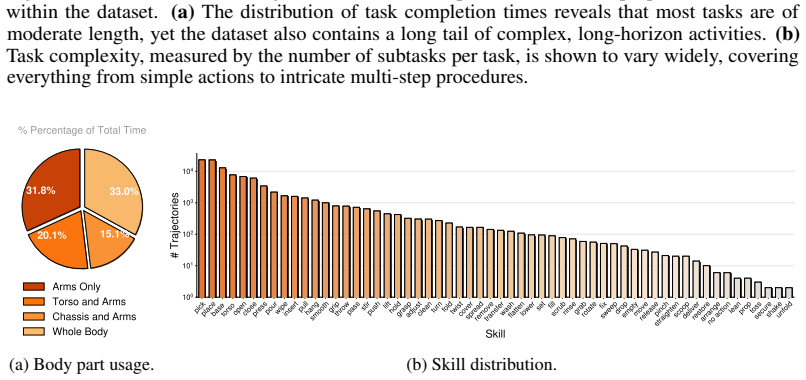
We present Galaxea Open-World Dataset, a large-scale, diverse collection of robot behaviors recorded in authentic human living and working environments. All demonstrations are gathered using a consistent robotic embodiment, paired with precise subtask-level language annotations to facilitate both training and evaluation. Building on this dataset, we introduce G0, a dual-system framework that couples a Vision-Language Model (VLM) for multimodal planning with a Vision-Language-Action (VLA) model for fine-grained execution. G0 is trained using a three-stage curriculum: cross-embodiment pre-training, single-embodiment pre-training, and task-specific post-training. A comprehensive benchmark spanning tabletop manipulation, few-shot learning, and long-horizon mobile manipulation, demonstrates the effectiveness of our approach. In particular, we find that the single-embodiment pre-training stage, together with the Galaxea Open-World Dataset, plays a critical role in achieving strong performance.
Figures


Figures from the paper (8 more)



Forward citations
Cited by 22 Pith papers
-
ACE-Data-0: Human-Centric Ambient Capture as Embodied Data Engine
ACE-Data-0 is a 150-hour home HOI dataset with millisecond-synced ego/exo video, mocap body/hands, object 6-DoF, audio, and tactile signals, plus a three-level benchmark exposing large SOTA gaps.
-
VLASH: Real-Time VLAs via Future-State-Aware Asynchronous Inference
Conditioning a VLA on a forward-rolled future robot state, trained with temporal-offset augmentation, removes the prediction-execution delay in asynchronous control.
-
XPolicyLab: A Unified Standard and Open Ecosystem for Robot Policy Evaluation and Deployment
XPolicyLab is a unified open ecosystem whose adapter contract and dependency-isolated serving reduce robot policy-environment integration from pairwise O(NM) work to O(N+M), cutting a representative integration from o...
-
Trajectory Divergence Horizon Decision for Reliable Dual-Arm Surgical Subtask Manipulation
A trajectory-divergence safety gate that truncates unstable action chunks improves VLA-based surgical manipulation success on real hardware.
-
JoyAI-RA 0.5: Scaling Robot Manipulation Learning via Dual Action Alignment
A dual action alignment framework (latent action world model plus canonical action space) converts heterogeneous human, simulated, and robot data into transferable supervision, with task scores rising monotonically as...
-
SSC: A Verifiable Structured Representation for Bimanual Manipulation Labelling
The Structured Subtask Chain (SSC) formats each manipulation subtask as a state-transition template and checks the whole chain for consistency, with vision-language models resolving ambiguous fields.
-
RynnBrain 1.1: Towards More Capable and Generalizable Embodied Foundation Model
RynnBrain 1.1 reports state-of-the-art embodied cognition and localization scores with a 122B-A10B model and improved real-robot VLA policies via joint multi-embodiment training.
-
Xiaomi-Robotics-1: Scaling Vision-Language-Action Models with over 100K Hours of Real-World Trajectories
Pre-training a VLA model on 100k hours of auto-labeled UMI trajectories, then post-training on robot data, yields SOTA simulated manipulation and data-efficient fine-tuning.
-
RxBrain: Embodied Cognition Foundation Model with Joint Language-Visual Reasoning and Imagination
A unified transformer model generates language-and-image planning sequences for embodied tasks, and shows real-robot manipulation without large-scale action pretraining.
-
Xiaomi-Robotics-U0: Unified Embodied Synthesis with World Foundation Model
A unified 38B autoregressive world model for multi-view embodied scene generation, controllable transfer, and video synthesis improves real-robot OOD robustness when used as a data engine.
-
ABot-AgentOS: A General Robotic Agent OS with Lifelong Multi-modal Memory
A robotic agent operating system with source-grounded graph memory and split-wise self-evolution improves long-horizon embodied task success and memory QA scores over baseline controllers.
-
RynnWorld-4D: 4D Embodied World Models for Robotic Manipulation
A tri-branch diffusion model co-generates RGB, depth, and optical flow from a single RGB-D image, and an inverse dynamics head on its internal latents achieves state-of-the-art bimanual manipulation success rates.
-
RoboDojo: A Unified Sim-and-Real Benchmark for Comprehensive Evaluation of Generalist Robot Manipulation Policies
RoboDojo unifies 42 capability-oriented sim tasks and 18 multi-embodiment real tasks with shared infrastructure and a 30-policy leaderboard that shows current VLAs remain far from reliable generalist manipulation.
-
GigaWorld-1: A Roadmap to Build World Models for Robot Policy Evaluation
Long-horizon action-faithful consistency, not short-term visual realism, dominates world-model reliability for robot policy evaluation; GigaWorld-1 implements that roadmap and gains 14.9% on evaluator-alignment metrics.
-
ABot-M0.5: Unified Mobility-and-Manipulation World Action Model
Aligning temporal granularity, action subspaces, and train-test conditioning yields SOTA long-horizon mobile and fine-grained manipulation success for a unified world-action model.
-
VolumeDP: Modeling Volumetric Representation for Manipulation Policy Learning
An RGB-only diffusion policy that builds an explicit volumetric representation, distills it into spatial tokens, and conditions a multi-token decoder reaches 88.8% average success on LIBERO.
-
LDA-1B: Scaling Latent Dynamics Action Model via Universal Embodied Data Ingestion
A 1B-parameter robot policy co-trained as a latent dynamics model on 30k+ hours of heterogeneous embodied data outperforms behavior-cloning baselines and uses low-quality data that hurts them.
-
RynnValue: Scaling Robotic Value Foundation Models with Temporal Distance
RynnValue shows that timestamp-derived temporal distance can replace preference labels for robotic value models, slightly beating a preference-supervised baseline on RBM-EVAL-OOD.
-
Cortex: A Bidirectionally Aligned Embodied Agent Framework for Long-horizon Manipulation
A dual-system framework with a structured subtask interface, event-balanced training, and inference harness enables VLM-guided long-horizon robotic manipulation, achieving 95.5% on LIBERO-Long and 65% on real-world ch...
-
DSWAM: A Dual-System World Action Foundation Model for Fine-Grained Robot Manipulation
A dual-system WAM with optional subtask planning outperforms matched VLA baselines on real deformable folding and broad simulated bimanual tasks.
-
From Foundation to Application: Improving VLA Models in Practice
LingBot-VLA 2.0 combines 60k hours of multi-embodiment pretraining data, an expanded whole-body action space, and dual-query distillation from depth and video teachers to improve VLA performance on GM-100 and long-hor...
-
Data Pyramid for Embodied Manipulation: A Survey
Embodied training data form a five-layer pyramid—real-robot, UMI, ego/exo, simulation, general V–L—ordered by the trade-off between scale and robot alignment, and model capabilities track how those layers are mixed.
Reference graph
Works this paper leans on
-
[1]
Open x-embodiment: Robotic learning datasets and rt-x models
Quan Vuong, Sergey Levine, Homer Rich Walke, Karl Pertsch, Anikait Singh, Ria Doshi, Charles Xu, Jianlan Luo, Liam Tan, Dhruv Shah, et al. Open x-embodiment: Robotic learning datasets and rt-x models. In Towards Generalist Robots: Learning Paradigms for Scalable Skill Acquisition@ CoRL2023, 2023
2023
-
[2]
Integrated task and motion planning
Caelan Reed Garrett, Rohan Chitnis, Rachel Holladay, Beomjoon Kim, Tom Silver, Leslie Pack Kaelbling, and Tomás Lozano-Pérez. Integrated task and motion planning. Annual review of control, robotics, and autonomous systems, 4(1):265–293, 2021
work page 2021
-
[3]
Do as i can, not as i say: Grounding language in robotic affordances
Michael Ahn, Anthony Brohan, Noah Brown, Yevgen Chebotar, Omar Cortes, Byron David, Chelsea Finn, Chuyuan Fu, Keerthana Gopalakrishnan, Karol Hausman, et al. Do as i can, not as i say: Grounding language in robotic affordances. arXiv preprint arXiv:2204.01691, 2022
arXiv 2022
-
[4]
Thinking, fast and slow
Daniel Kahneman. Thinking, fast and slow . macmillan, 2011
2011
-
[5]
Visualgpt: Data-efficient adaptation of pretrained language models for image captioning
Jun Chen, Han Guo, Kai Yi, Boyang Li, and Mohamed Elhoseiny. Visualgpt: Data-efficient adaptation of pretrained language models for image captioning. InProceedings of the IEEE/CVF conference on computer vision and pattern recognition , pages 18030–18040, 2022
work page 2022
-
[6]
Lmfusion: Adapting pretrained language models for multimodal generation
Weijia Shi, Xiaochuang Han, Chunting Zhou, Weixin Liang, Xi Victoria Lin, Luke Zettlemoyer, and Lili Yu. Lmfusion: Adapting pretrained language models for multimodal generation. arXiv preprint arXiv:2412.15188, 2024
arXiv 2024
-
[7]
Cogvlm: Visual expert for pretrained language models
Weihan Wang, Qingsong Lv, Wenmeng Yu, Wenyi Hong, Ji Qi, Yan Wang, Junhui Ji, Zhuoyi Yang, Lei Zhao, Song XiXuan, et al. Cogvlm: Visual expert for pretrained language models. Advances in Neural Information Processing Systems , 37:121475–121499, 2024
work page 2024
-
[8]
From multimodal llms to generalist embodied agents: Methods and lessons
Andrew Szot, Bogdan Mazoure, Omar Attia, Aleksei Timofeev, Harsh Agrawal, Devon Hjelm, Zhe Gan, Zsolt Kira, and Alexander Toshev. From multimodal llms to generalist embodied agents: Methods and lessons. In Proceedings of the Computer Vision and Pattern Recognition Conference, pages 10644–10655, 2025
work page 2025
Show all 30 references
-
[9]
Minivla: A better vla with a smaller footprint, 2024
Suneel Belkhale and Dorsa Sadigh. Minivla: A better vla with a smaller footprint, 2024. URL https://github.com/Stanford-ILIAD/openvla-mini
2024
-
[10]
Openvla: An open-source vision-language-action model
Moo Jin Kim, Karl Pertsch, Siddharth Karamcheti, Ted Xiao, Ashwin Balakrishna, Suraj Nair, Rafael Rafailov, Ethan Foster, Grace Lam, Pannag Sanketi, et al. Openvla: An open-source vision-language-action model. arXiv preprint arXiv:2406.09246, 2024
2024 arXiv
-
[11]
Fast: Efficient action tokenization for vision-language-action models
Karl Pertsch, Kyle Stachowicz, Brian Ichter, Danny Driess, Suraj Nair, Quan Vuong, Oier Mees, Chelsea Finn, and Sergey Levine. Fast: Efficient action tokenization for vision-language-action models. arXiv preprint arXiv:2501.09747, 2025
2025 arXiv
-
[12]
π0: A vision-language-action flow model for general robot control
Kevin Black, Noah Brown, Danny Driess, Adnan Esmail, Michael Equi, Chelsea Finn, Niccolo Fusai, Lachy Groom, Karol Hausman, Brian Ichter, et al. π0: A vision-language-action flow model for general robot control. arXiv preprint arXiv:2410.24164, 2024
2024 arXiv
-
[13]
Rdt-1b: a diffusion foundation model for bimanual manipulation
Songming Liu, Lingxuan Wu, Bangguo Li, Hengkai Tan, Huayu Chen, Zhengyi Wang, Ke Xu, Hang Su, and Jun Zhu. Rdt-1b: a diffusion foundation model for bimanual manipulation. arXiv preprint arXiv:2410.07864, 2024
2024 arXiv
-
[14]
Cogact: A foundational vision-language-action model for synergizing cognition and action in robotic manipulation
Qixiu Li, Yaobo Liang, Zeyu Wang, Lin Luo, Xi Chen, Mozheng Liao, Fangyun Wei, Yu Deng, Sicheng Xu, Yizhong Zhang, et al. Cogact: A foundational vision-language-action model for synergizing cognition and action in robotic manipulation. arXiv preprint arXiv:2411.19650, 2024
2024 arXiv
-
[15]
Tinyvla: Towards fast, data-efficient vision-language-action models for robotic manipulation
Junjie Wen, Yichen Zhu, Jinming Li, Minjie Zhu, Zhibin Tang, Kun Wu, Zhiyuan Xu, Ning Liu, Ran Cheng, Chaomin Shen, et al. Tinyvla: Towards fast, data-efficient vision-language-action models for robotic manipulation. IEEE Robotics and Automation Letters , 2025. 13
2025
-
[16]
pi0.5: a vision- language-action model with open-world generalization
Physical Intelligence, Kevin Black, Noah Brown, James Darpinian, Karan Dhabalia, Danny Driess, Adnan Esmail, Michael Equi, Chelsea Finn, Niccolo Fusai, et al. pi0.5: a vision- language-action model with open-world generalization. arXiv preprint arXiv:2504.16054 , 2025
2025 arXiv
-
[17]
Hybridvla: Collaborative diffusion and autoregression in a unified vision-language-action model
Jiaming Liu, Hao Chen, Pengju An, Zhuoyang Liu, Renrui Zhang, Chenyang Gu, Xiaoqi Li, Ziyu Guo, Sixiang Chen, Mengzhen Liu, et al. Hybridvla: Collaborative diffusion and autoregression in a unified vision-language-action model. arXiv preprint arXiv:2503.10631, 2025
2025 arXiv
-
[18]
Open- helix: A short survey, empirical analysis, and open-source dual-system vla model for robotic manipulation, 2025
Can Cui, Pengxiang Ding, Wenxuan Song, Shuanghao Bai, Xinyang Tong, Zirui Ge, Runze Suo, Wanqi Zhou, Yang Liu, Bofang Jia, Han Zhao, Siteng Huang, and Donglin Wang. Open- helix: A short survey, empirical analysis, and open-source dual-system vla model for robotic manipulation,...
2025 arXiv
-
[19]
Hi robot: Open-ended instruction following with hierarchical vision-language-action models
Lucy Xiaoyang Shi, Brian Ichter, Michael Equi, Liyiming Ke, Karl Pertsch, Quan Vuong, James Tanner, Anna Walling, Haohuan Wang, Niccolo Fusai, et al. Hi robot: Open-ended instruction following with hierarchical vision-language-action models. arXiv preprint arXiv:2502.19417, 2025
2025 arXiv
-
[20]
Vla-os: Structuring and dissecting planning repre- sentations and paradigms in vision-language-action models
Chongkai Gao, Zixuan Liu, Zhenghao Chi, Junshan Huang, Xin Fei, Yiwen Hou, Yuxuan Zhang, Yudi Lin, Zhirui Fang, Zeyu Jiang, et al. Vla-os: Structuring and dissecting planning repre- sentations and paradigms in vision-language-action models. arXiv preprint arXiv:2506.17561, 2025
2025 arXiv
-
[21]
Bridgedata v2: A dataset for robot learning at scale
Homer Rich Walke, Kevin Black, Tony Z Zhao, Quan Vuong, Chongyi Zheng, Philippe Hansen- Estruch, Andre Wang He, Vivek Myers, Moo Jin Kim, Max Du, et al. Bridgedata v2: A dataset for robot learning at scale. In Conference on Robot Learning, pages 1723–1736. PMLR, 2023
2023
-
[22]
Droid: A large-scale in-the-wild robot manipulation dataset
Alexander Khazatsky, Karl Pertsch, Suraj Nair, Ashwin Balakrishna, Sudeep Dasari, Siddharth Karamcheti, Soroush Nasiriany, Mohan Kumar Srirama, Lawrence Yunliang Chen, Kirsty Ellis, et al. Droid: A large-scale in-the-wild robot manipulation dataset. arXiv preprint arXiv:2403.1...
2024 arXiv
-
[23]
Robomind: Benchmark on multi-embodiment intelligence normative data for robot manipulation
Kun Wu, Chengkai Hou, Jiaming Liu, Zhengping Che, Xiaozhu Ju, Zhuqin Yang, Meng Li, Yinuo Zhao, Zhiyuan Xu, Guang Yang, et al. Robomind: Benchmark on multi-embodiment intelligence normative data for robot manipulation. arXiv preprint arXiv:2412.13877, 2024
2024 arXiv
-
[24]
Agibot world colosseo: A large-scale manipulation platform for scalable and intelligent embodied systems
Qingwen Bu, Jisong Cai, Li Chen, Xiuqi Cui, Yan Ding, Siyuan Feng, Shenyuan Gao, Xindong He, Xuan Hu, Xu Huang, et al. Agibot world colosseo: A large-scale manipulation platform for scalable and intelligent embodied systems. arXiv preprint arXiv:2503.06669, 2025
2025 arXiv
-
[25]
Rt-2: Vision-language-action models transfer web knowledge to robotic control
Brianna Zitkovich, Tianhe Yu, Sichun Xu, Peng Xu, Ted Xiao, Fei Xia, Jialin Wu, Paul Wohlhart, Stefan Welker, Ayzaan Wahid, et al. Rt-2: Vision-language-action models transfer web knowledge to robotic control. In Conference on Robot Learning, pages 2165–2183. PMLR, 2023
2023
-
[26]
Vlabench: A large-scale benchmark for language-conditioned robotics manipulation with long-horizon reasoning tasks
Shiduo Zhang, Zhe Xu, Peiju Liu, Xiaopeng Yu, Yuan Li, Qinghui Gao, Zhaoye Fei, Zhangyue Yin, Zuxuan Wu, Yu-Gang Jiang, et al. Vlabench: A large-scale benchmark for language-conditioned robotics manipulation with long-horizon reasoning tasks. arXiv preprint arXiv:2412.18194, 2024
2024 arXiv
-
[27]
Is diversity all you need for scalable robotic manipulation? arXiv preprint arXiv:2507.06219, 2025
Modi Shi, Li Chen, Jin Chen, Yuxiang Lu, Chiming Liu, Guanghui Ren, Ping Luo, Di Huang, Maoqing Yao, and Hongyang Li. Is diversity all you need for scalable robotic manipulation? arXiv preprint arXiv:2507.06219, 2025
2025 arXiv
-
[28]
Bridge data: Boosting generalization of robotic skills with cross-domain datasets
Frederik Ebert, Yanlai Yang, Karl Schmeckpeper, Bernadette Bucher, Georgios Georgakis, Kostas Daniilidis, Chelsea Finn, and Sergey Levine. Bridge data: Boosting generalization of robotic skills with cross-domain datasets. arXiv preprint arXiv:2109.13396, 2021
2021 arXiv
-
[29]
PaliGemma: A versatile 3B VLM for transfer
Lucas Beyer, Andreas Steiner, André Susano Pinto, Alexander Kolesnikov, Xiao Wang, Daniel Salz, Maxim Neumann, Ibrahim Alabdulmohsin, Michael Tschannen, Emanuele Bugliarello, Thomas Unterthiner, Daniel Keysers, Skanda Koppula, Fangyu Liu, Adam Grycner, Alexey 14 Gritsenko, Nei...
2024 arXiv
-
[30]
Qwen2.5-vl technical report
Shuai Bai, Keqin Chen, Xuejing Liu, Jialin Wang, Wenbin Ge, Sibo Song, Kai Dang, Peng Wang, Shijie Wang, Jun Tang, Humen Zhong, Yuanzhi Zhu, Mingkun Yang, Zhaohai Li, Jianqiang Wan, Pengfei Wang, Wei Ding, Zheren Fu, Yiheng Xu, Jiabo Ye, Xi Zhang, Tianbao Xie, Zesen Cheng, Han...
2025 arXiv
Reviewed August 5, 2026 · model on record in the stance chip above.
Discussion (0). Continue with ORCID to comment.