REVIEW 3 major objections 6 minor 54 references
Autoencoder-based non-intrusive model order reduction in continuum mechanics
T0 review · 3 major / 6 minor · reviewed 2026-08-05 · deepseek-v4-flash
Pith's one-line read The paper's core claim is that a three-stage autoencoder pipeline, trained purely on finite element snapshots, predicts accurate full-field solutions and boundary forces across nonlinear, anisotropic, and coupled thermo-mechanical problems
desk verdict Useful AE-MOR extensions, but the 'across all cases' claim overreaches; needs stronger validation. read the letter →
The pith
A machine-rendered reading of the paper's core claim, the machinery that carries it, and where it could break.
The reading
What carries the argument
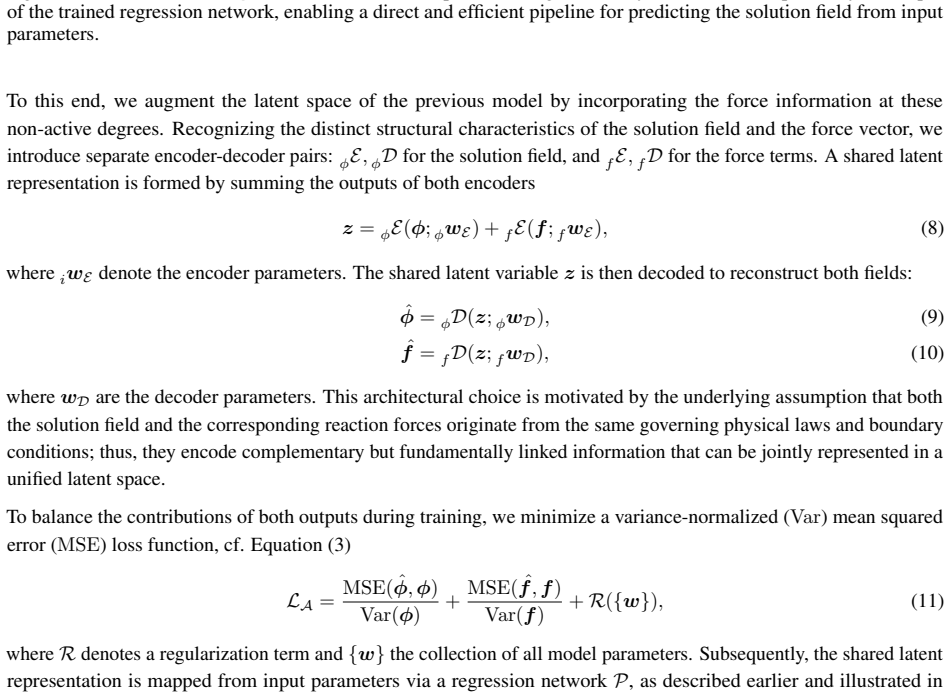
The central mechanism is the latent bottleneck: an unsupervised encoder-decoder compresses high-dimensional finite element snapshots into a few latent coordinates, then a feedforward regression network maps problem parameters to those coordinates, and the frozen decoder turns them back into full fields. Two extensions carry the paper's new claims: in the force-augmented variant the latent variable is the sum of separate displacement and force encoder outputs, forcing one shared code to serve both fields; in the multi-field variant each physical field gets its own encoder and the codes are concatenated before a shared decoder. Variance-normalized losses prevent large-magnitude fields from dom
What would settle it
Train the same multi-field architecture on the thermo-mechanical plate with no geometric imperfection, then evaluate at parameter points where the finite element reference produces two stable buckled shapes, one in the positive and one in the negative z-direction. If the surrogate frequently returns a mixed or averaged shape while the reference lands cleanly on one branch, the single-valued-manifold assumption is the cause; the paper's Figure 20 already shows qualitative deterioration, so the sharper test is to count branch-consistency across many such points.
Extended reading notes
Core claim
The central claim is that a nonlinear autoencoder can capture curved solution manifolds in continuum mechanics where a fixed linear subspace, such as POD, would struggle, and that the learned latent space can be shared or decomposed to cover additional quantities of interest. Concretely, the end-to-end surrogate is the composition of a regression network and a frozen decoder; the force-augmented variant replaces the single latent bottleneck with the sum of displacement and force encoder outputs and trains with variance-normalized losses; and the multi-field variant concatenates field-specific latent codes before a shared decoder. On the paper's benchmarks, this produces accurate reconstructi
Load-bearing premise
The surrogate treats the solution as a single-valued function of the input parameters, so when a physical system can take several valid answers for the same input (like which way a plate buckles), the training data mixes branches and the model averages them into an inaccurate prediction.
Editorial extensions
If this is right
- For a new parameter value, the surrogate answers with one decoder evaluation, replacing a full nonlinear finite element solve in the many-query setting.
- Neumann boundary reactions are available from the same end-to-end model rather than as a separate post-processing step, and including them during training also sharpens the displacement prediction.
- Multi-physics surrogates can be assembled by adding an encoder per field and concatenating latent codes, so the architecture grows with the physics instead of being rebuilt from scratch.
- The accuracy is conditional on the solution being a single-valued function of the input parameters: when multiple solution branches coexist, as in the unimperfected buckling plate, predictions degrade substantially.
Reading between the lines
- Because the pipeline treats the solver as a black box, the same latent-space recipe should transfer to non-standard outputs such as derived stress measures or localized damage fields, provided snapshot-parameter pairs can be generated; the paper does not demonstrate this.
- The force-augmented shared latent space creates a natural physical-consistency probe: reaction forces from the decoder could be checked against internal equilibrium of the predicted displacement field, and enforcing that balance during training would address the residual inconsistency the paper lists as a limitation.
- The bifurcation failure suggests a concrete preprocessing fix that the paper mentions only in passing: reflecting buckled snapshots to a common side before training would remove the mixed-branch ambiguity and might restore accuracy, which is directly testable on the same thermo-mechanical example.
Editorial analysis
A structured set of objections, weighed in public.
Referee Report
Summary. The paper proposes a three-stage, non-intrusive model order reduction framework for continuum mechanics: an unsupervised autoencoder compresses high-dimensional finite element snapshots into a low-dimensional latent space, a supervised regression network maps input parameters to latent codes, and an end-to-end surrogate reconstructs full-field solutions. Two extensions are introduced: a force-augmented variant with a shared latent space for displacements and reaction forces, and a multi-field architecture with field-specific encoders and a joint decoder. The method is validated on three benchmarks: a heterogeneous unit cell, a fiber-reinforced plate with an elliptical hole, and a transient thermo-mechanical plate. The authors claim accurate reconstructions across all cases and provide a publicly available implementation.
Significance. If the central claim were fully supported, the paper would make a useful contribution by extending non-intrusive autoencoder-based MOR to reaction-force prediction and coupled multi-field problems, areas that existing AE-based methods rarely address. The paper benefits from external high-fidelity FE references (so the benchmark is not circular), a clearly described architecture, and a public implementation. However, the validation is thin: each benchmark is assessed at a single in-domain parameter point, there are no error bars or test-set statistics, no comparison against a POD-based non-intrusive baseline, and the bifurcation failure in Section 3.3 directly contradicts the unqualified abstract claim. The significance is therefore contingent on a revision that narrows the claims and adds quantitative evidence.
major comments (3)
- [§3.3, Fig. 20; Abstract] The abstract's unqualified claim "Across all cases, it achieves accurate reconstructions of high-fidelity solutions" is contradicted by the paper's own no-imperfection thermo-mechanical experiment. Equations (5)-(6) assume a single-valued parameter-to-latent map; for the geometrically perfect plate, identical parameters produce two buckling branches (+z and -z). The MSE regression in Eq. (6) therefore fits a mean of incompatible branches. Figure 20 shows "a significant deterioration in the predictive accuracy" and a non-smooth predicted surface. The authors' remedy—introducing a 0.01 mm imperfection—changes the problem, and the training set omits (ξ,η)=(2/3,0) and (1,0) because of non-convergent FE solves. The Abstract and Section 4 should restrict the claim to problems with a unique solution or explicit symmetry breaking.
- [§3.1–§3.3 validation protocol] Each benchmark is evaluated at a single in-domain parameter point: (ξ, η) = (0.55, 0.35) for the unit cell, (0.75, 0.3) for the plate, and (ξ, η, t) = (0.5, 0.5, 0.8) for the thermo-mechanical problem. No test-set statistics, no repeated-training variability, and no error bars are reported. The introduction argues that POD's linear subspace is inadequate, but no POD-based non-intrusive baseline (e.g., POD plus regression) is quantitatively compared. The central claim of accurate reconstruction "across all cases" is not quantitatively established; a held-out parameter grid with relative L2 error statistics and one POD+regression baseline would be needed.
- [§3.1.2, Eq. (11)] The force-augmented variant's claimed benefit is supported only by qualitative force contours and a displacement-error plot (Fig. 10). No quantitative error metric for the predicted force vector f is reported, despite the variance-normalized MSE in Eq. (11) being explicitly designed to balance displacement and force losses. The superiority of summing encoder outputs into a shared latent (Eq. 8) over a simple concatenation is not tested. To support the force-prediction claim, the paper should report force errors (e.g., relative L2 error over the boundary) for both the force-augmented and force-reconstructed variants.
minor comments (6)
- [§3.2.2 caption of Fig. 15] The caption says "the displacements were then predicted by the end-to-end model of Section 3.1.2"; this appears to be a typo for Section 3.2.2.
- [Eqs. (12)–(15)] The notation for field-specific encoders and regression networks (1E, 2P) is visually awkward; superscripts or a different indexing scheme would improve readability.
- [§3.2] Typo: "hyperlelastic" should be "hyperelastic".
- [§2, End-to-End Surrogate Model] The sentence "To which is extent the prediction matches unseen states..." is ungrammatical and should be rewritten.
- [Figure 9] The labels "Prediction Force-augmentedForce-reconstructed" are run together; the figure would be clearer with separated labels.
- [§3.3] The missing training points (ξ,η)=(2/3,0) and (1,0) are mentioned only in passing; this should be noted as a data-coverage limitation in Section 4 as well.
Circularity Check
No circularity: external FE validation anchors every claim; self-citations are motivational, not load-bearing.
full rationale
The paper's central predictions (displacement, reaction forces, temperature) are evaluated against full-order finite element solutions at held-out parameter points (e.g., ξ=0.55, η=0.35 in Sec. 3.1; ξ=0.75, η=0.3 in Sec. 3.2; ξ=η=0.5, t=0.8 in Sec. 3.3), so the benchmarks are not self-referential. The force-augmented model uses force labels to define the shared latent target (Eq. 8) and trains the regression on those latent codes; this is standard supervised surrogate construction, not a fitted input renamed as a prediction. The comparison with the staggered force-reconstructed model (A.2) explicitly shows that a force decoder trained on displacement-only latent codes does not reproduce the force-augmented result, ruling out a 'prediction forced by construction' pattern. The multi-field architecture is motivated by the authors' prior intrusive MOR papers [44,45], but the present numerical validation is independent of those papers; no uniqueness theorem or ansatz is imported. The acknowledged bifurcation failure (Sec. 3.3, Fig. 20) is a correctness and scope limitation of the single-valued latent-map assumption, not a circular derivation: the paper openly reports the deterioration rather than claiming the no-imperfection case succeeds. Overall, the derivation chain is self-contained and externally benchmarked; the self-citations are motivational, not load-bearing.
Assumptions & free parameters
free parameters (7)
- Latent dimension (unit cell) =
4
- Latent dimension (mesh morphing) =
2
- Latent dimension (plate displacement) =
8
- Latent dimensions (thermo-mechanics) =
4 per field (8 concatenated)
- Learning rate =
1e-3
- Elastic net penalty factor =
1e-7 (L1 and L2)
- Encoder/decoder layer sizes =
e.g., 18580-1024-512-128-32-16-4
assumptions (5)
- domain assumption The FE solution manifold is approximately low-dimensional, so 2-8 latent neurons suffice.
- domain assumption The solution field is a single-valued function of the input parameters.
- ad hoc to paper Summing the two encoder outputs yields a unified shared latent that preserves the complementary displacement and force information (Eq. 8).
- domain assumption Elastic mesh morphing with a pseudo-isotropic material (µ=κ=1, K1=K2=0) produces valid nodal reference positions.
- standard math Neural networks with GELU/SiLU activations and MSE losses can represent the parameter-to-latent mapping accurately.
Cite this review
Pith. "Pith review of Autoencoder-based non-intrusive model order reduction in continuum mechanics." pith.science (2026). https://pith.science/paper/3BWHYYC6
@misc{pith2026250902237,
  author       = {Pith},
  title        = {Pith review of: Autoencoder-based non-intrusive model order reduction in continuum mechanics},
  year         = {2026},
  howpublished = {\url{https://pith.science/paper/3BWHYYC6}},
  note         = {Machine review of arXiv:2509.02237}
}
read the original abstract
We propose a non-intrusive, Autoencoder-based framework for reduced-order modeling in continuum mechanics. Our method integrates three stages: (i) an unsupervised Autoencoder compresses high-dimensional finite element solutions into a compact latent space, (ii) a supervised regression network maps problem parameters to latent codes, and (iii) an end-to-end surrogate reconstructs full-field solutions directly from input parameters. To overcome limitations of existing approaches, we propose two key extensions: a force-augmented variant that jointly predicts displacement fields and reaction forces at Neumann boundaries, and a multi-field architecture that enables coupled field predictions, such as in thermo-mechanical systems. The framework is validated on nonlinear benchmark problems involving heterogeneous composites, anisotropic elasticity with geometric variation, and thermo-mechanical coupling. Across all cases, it achieves accurate reconstructions of high-fidelity solutions while remaining fully non-intrusive. These results highlight the potential of combining deep learning with dimensionality reduction to build efficient and extensible surrogate models. Our publicly available implementation provides a foundation for integrating data-driven model order reduction into uncertainty quantification, optimization, and digital twin applications.
Figures


Figures from the paper (20 more)


Reference graph
Works this paper leans on
-
[1]
An introduction to the proper orthogonal decomposition
Anindya Chatterjee. An introduction to the proper orthogonal decomposition. Current Science, 78(7):808–817, 2000
work page 2000
-
[2]
Michael Hinze and Stefan V olkwein. Proper orthogonal decomposition surrogate models for nonlinear dynamical systems: Error estimates and suboptimal control. In Peter Benner, Danny C. Sorensen, and V olker Mehrmann, editors, Dimension Reduction of Large-Scale Systems, pages 261–306, Berlin, Heidelberg, 2005. Springer. 31 Autoencoder-based non-intrusive mo...
work page 2005
-
[3]
Gaetan Kerschen, Jean-claude Golinval, Alexander F. Vakakis, and Lawrence A. Bergman. The method of proper orthogonal decomposition for dynamical characterization and order reduction of mechanical systems: An overview. Nonlinear Dynamics, 41(1):147–169, 2005
work page 2005
-
[4]
Kuan Lu, Yulin Jin, Panfeng Huang, Fan Zhang, Haopeng Zhang, Chao Fu, and Yushu Chen. The applications of pod method in dual rotor-bearing systems with coupling misalignment.Mechanical Systems and Signal Processing, 150:107236, 2021
work page 2021
-
[5]
G. Berkooz, P. Holmes, and J. L. Lumley. The proper orthogonal decomposition in the analysis of turbulent flows. Annual Review of Fluid Mechanics, 25:539–575, 1993
work page 1993
-
[6]
Smith, Jeff Moehlis, and Philip Holmes
Troy R. Smith, Jeff Moehlis, and Philip Holmes. Low-dimensional modelling of turbulence using the proper orthogonal decomposition: A tutorial. Nonlinear Dynamics, 41(1):275–307, 2005
work page 2005
-
[7]
Data-driven pod-galerkin reduced order model for turbulent flows
Saddam Hijazi, Giovanni Stabile, Andrea Mola, and Gianluigi Rozza. Data-driven pod-galerkin reduced order model for turbulent flows. Journal of Computational Physics, 416:109513, 2020
work page 2020
-
[8]
Xinzhong Chen and Ahsan Kareem. Proper orthogonal decomposition-based modeling, analysis, and simulation of dynamic wind load effects on structures. Journal of Engineering Mechanics, 131(4):325–339, 2005
work page 2005
Show all 54 references
-
[9]
A comparison of projection-based model reduction concepts in the context of nonlinear biomechanics
Annika Radermacher and Stefanie Reese. A comparison of projection-based model reduction concepts in the context of nonlinear biomechanics. Archive of Applied Mechanics, 83(8):1193–1213, 2013
2013
-
[10]
An adaptive model order reduction technique for parameter-dependent modular structures
Stephan Ritzert, Domen Macek, Jaan-Willem Simon, and Stefanie Reese. An adaptive model order reduction technique for parameter-dependent modular structures. Computational Mechanics, 73(5):1147–1163, 2024
2024
-
[11]
Component-based model-order reduction with mortar tied contact for nonlinear quasi-static mechanical problems
Stephan Ritzert, Jannick Kehls, Stefanie Reese, and Tim Brepols. Component-based model-order reduction with mortar tied contact for nonlinear quasi-static mechanical problems. International Journal for Numerical Methods in Engineering, 126(8):e70041, 2025
2025
-
[12]
Ryckelynck
D. Ryckelynck. A priori hyperreduction method: an adaptive approach. Journal of Computational Physics , 202(1):346–366, 2005
2005
-
[13]
Ryckelynck
D. Ryckelynck. Hyper-reduction of mechanical models involving internal variables. International Journal for Numerical Methods in Engineering, 77(1):75–89, 2009
2009
-
[14]
Miled, D
B. Miled, D. Ryckelynck, and S. Cantournet. A priori hyper-reduction method for coupled viscoelastic–viscoplastic composites. Computers & Structures, 119:95–103, 2013
2013
-
[15]
Sorensen
Saifon Chaturantabut and Danny C. Sorensen. Nonlinear model reduction via discrete empirical interpolation. SIAM Journal on Scientific Computing, 32(5):2737–2764, 2010
2010
-
[16]
Pod-based model reduction with empirical interpolation applied to nonlinear elasticity
Annika Radermacher and Stefanie Reese. Pod-based model reduction with empirical interpolation applied to nonlinear elasticity. International Journal for Numerical Methods in Engineering, 107(6):477–495, 2016
2016
-
[17]
An, Theodore Kim, and Doug L
Steven S. An, Theodore Kim, and Doug L. James. Optimizing cubature for efficient integration of subspace deformations. ACM Transactions on Graphics, 27(5), 2008
2008
-
[18]
Dimensional reduction of nonlinear finite element dynamic models with finite rotations and energy-based mesh sampling and weighting for computational efficiency
Charbel Farhat, Philip Avery, Todd Chapman, and Julien Cortial. Dimensional reduction of nonlinear finite element dynamic models with finite rotations and energy-based mesh sampling and weighting for computational efficiency. International Journal for Numerical Methods in Engi...
2014
-
[19]
Structure-preserving, stability, and accuracy properties of the energy-conserving sampling and weighting method for the hyper reduction of nonlinear finite element dynamic models
Charbel Farhat, Todd Chapman, and Philip Avery. Structure-preserving, stability, and accuracy properties of the energy-conserving sampling and weighting method for the hyper reduction of nonlinear finite element dynamic models. International Journal for Numerical Methods in En...
2015
-
[20]
Francesco Trainotti, Jure Marinko, Johannes Maierhofer, and Daniel J. Rixen. Ecsw hyperreduction of hyper- viscoelastic components via co-simulation with abaqus. Finite Elements in Analysis and Design, 241:104222, 2024. 32 Autoencoder-based non-intrusive model order reduction ...
2024
-
[21]
J. A. Hernández, M. A. Caicedo, and A. Ferrer. Dimensional hyper-reduction of nonlinear finite element models via empirical cubature. Computer Methods in Applied Mechanics and Engineering, 313:687–722, 2017
2017
-
[22]
Bravo, S
J.R. Bravo, S. Ares de Parga, J.A. Hernández, and R. Rossi. Local-ecm: An empirical cubature hyper-reduction method adapted to local reduced order models, 2023
2023
-
[23]
Hernández, J.R
J.A. Hernández, J.R. Bravo, and S. Ares de Parga. Cecm: A continuous empirical cubature method with application to the dimensional hyperreduction of parameterized finite element models. Computer Methods in Applied Mechanics and Engineering, 418:116552, 2024
2024
-
[24]
D. Xiao, F. Fang, C. Pain, and G. Hu. Non-intrusive reduced-order modelling of the navier–stokes equations based on rbf interpolation. International Journal for Numerical Methods in Fluids, 79(11):580–595, 2015
2015
-
[25]
J. S. Hesthaven and S. Ubbiali. Non-intrusive reduced order modeling of nonlinear problems using neural networks. Journal of Computational Physics, 363:55–78, 2018
2018
-
[26]
Hesthaven, and Deep Ray
Qian Wang, Jan S. Hesthaven, and Deep Ray. Non-intrusive reduced order modeling of unsteady flows using artificial neural networks with application to a combustion problem. Journal of Computational Physics, 384:289– 307, 2019
2019
-
[27]
Projection-based model reduction: Formulations for physics-based machine learning
Renee Swischuk, Laura Mainini, Benjamin Peherstorfer, and Karen Willcox. Projection-based model reduction: Formulations for physics-based machine learning. Computers & Fluids, 179:704–717, 2019
2019
-
[28]
A nonintrusive nonlinear model reduction method for structural dynamical problems based on machine learning
Jonas Kneifl, Dennis Grunert, and Joerg Fehr. A nonintrusive nonlinear model reduction method for structural dynamical problems based on machine learning. International Journal for Numerical Methods in Engineering, 122(17):4774–4786, 2021
2021
-
[29]
Salvador, L
M. Salvador, L. Dedè, and A. Manzoni. Non intrusive reduced order modeling of parametrized PDEs by kernel POD and neural networks. Computers & Mathematics with Applications, 104:1–13, 2021
2021
-
[30]
Testing the manifold hypothesis
Charles Fefferman, Sanjoy Mitter, and Hariharan Narayanan. Testing the manifold hypothesis. Journal of the American Mathematical Society, 29(4):983–1049, 2016
2016
-
[31]
Bourlard and Y
H. Bourlard and Y . Kamp. Auto-association by multilayer perceptrons and singular value decomposition. Biological Cybernetics, 59(4):291–294, 1988
1988
-
[32]
Neural networks and principal component analysis: Learning from examples without local minima
Pierre Baldi and Kurt Hornik. Neural networks and principal component analysis: Learning from examples without local minima. Neural Networks, 2(1):53–58, 1989
1989
-
[33]
From principal subspaces to principal components with linear autoencoders, 2018
Elad Plaut. From principal subspaces to principal components with linear autoencoders, 2018
2018
-
[34]
Gonzalez and Maciej Balajewicz
Francisco J. Gonzalez and Maciej Balajewicz. Deep convolutional recurrent autoencoders for learning low- dimensional feature dynamics of fluid systems, 2018
2018
-
[35]
Deep learning of thermodynamics-aware reduced-order models from data
Quercus Hernandez, Alberto Badías, David González, Francisco Chinesta, and Elías Cueto. Deep learning of thermodynamics-aware reduced-order models from data. Computer Methods in Applied Mechanics and Engineering, 379:113763, 2021
2021
-
[36]
A comprehensive deep learning-based approach to reduced order modeling of nonlinear time-dependent parametrized PDEs
Stefania Fresca, Luca Dedè, and Andrea Manzoni. A comprehensive deep learning-based approach to reduced order modeling of nonlinear time-dependent parametrized PDEs. Journal of Scientific Computing, 87(2):61, Apr 2021
2021
-
[37]
Machine learning approach to model order reduction of nonlinear systems via autoencoder and lstm networks
Thomas Simpson, Nikolaos Dervilis, and Eleni Chatzi. Machine learning approach to model order reduction of nonlinear systems via autoencoder and lstm networks. Journal of Engineering Mechanics, 147(10):04021061, 2021
2021
-
[38]
Dimensionality reduction through convolutional autoencoders for fracture patterns prediction
Krushna Shinde, Vincent Itier, José Mennesson, Dmytro Vasiukov, and Modesar Shakoor. Dimensionality reduction through convolutional autoencoders for fracture patterns prediction. Applied Mathematical Modelling, 114:94–113, 2023. 33 Autoencoder-based non-intrusive model order r...
2023
-
[39]
Hesthaven
Federico Pichi, Beatriz Moya, and Jan S. Hesthaven. A graph convolutional autoencoder approach to model order reduction for parametrized pdes. Journal of Computational Physics, 501:112762, 2024
2024
-
[40]
Fidkowski, and Kevin J
Rakesh Halder, Krzysztof J. Fidkowski, and Kevin J. Maki. Non-intrusive reduced-order modeling using convolutional autoencoders. International Journal for Numerical Methods in Engineering, 123(21):5369–5390, 2022
2022
-
[41]
Low-dimensional data-based surrogate model of a continuum-mechanical musculoskeletal system based on non-intrusive model order reduction
Jonas Kneifl, David Rosin, Okan Avci, Oliver Röhrle, and Jörg Fehr. Low-dimensional data-based surrogate model of a continuum-mechanical musculoskeletal system based on non-intrusive model order reduction. Archive of Applied Mechanics, 93(9):3637–3663, Sep 2023
2023
-
[42]
Bordas, and Jakub Lengiewicz
Saurabh Deshpande, Hussein Rappel, Mark Hobbs, Stéphane P.A. Bordas, and Jakub Lengiewicz. Gaussian process regression + deep neural network autoencoder for probabilistic surrogate modeling in nonlinear mechanics of solids. Computer Methods in Applied Mechanics and Engineering...
2025
-
[43]
A length scale insensitive phase-field damage model for brittle fracture
Jian-Ying Wu and Vinh Phu Nguyen. A length scale insensitive phase-field damage model for brittle fracture. Journal of the Mechanics and Physics of Solids, 119:20–42, 2018
2018
-
[44]
A multi- field decomposed model order reduction approach for thermo-mechanically coupled gradient-extended damage simulations
Qinghua Zhang, Stephan Ritzert, Jian Zhang, Jannick Kehls, Stefanie Reese, and Tim Brepols. A multi- field decomposed model order reduction approach for thermo-mechanically coupled gradient-extended damage simulations. Computer Methods in Applied Mechanics and Engineering, 434...
2025
-
[45]
Multi-field decomposed hyper-reduced order modeling of damage-plasticity simulations, 2025
Jannick Kehls, Stephan Ritzert, Lars Breuer, Qinghua Zhang, Stefanie Reese, and Tim Brepols. Multi-field decomposed hyper-reduced order modeling of damage-plasticity simulations, 2025
2025
-
[46]
Polyconvexity of generalized polynomial-type hyperelastic strain energy functions for near-incompressibility
Stefan Hartmann and Patrizio Neff. Polyconvexity of generalized polynomial-type hyperelastic strain energy functions for near-incompressibility. International Journal of Solids and Structures, 40(11):2767–2791, 2003
2003
-
[47]
A. N. Gent. A new constitutive relation for rubber. Rubber Chemistry and Technology, 69(1):59–61, 03 1996
1996
-
[48]
Gaussian error linear units (gelus), 2023
Dan Hendrycks and Kevin Gimpel. Gaussian error linear units (gelus), 2023
2023
-
[49]
ParaView: An end-user tool for large data visualization
James Ahrens, Berk Geveci, and Charles Law. ParaView: An end-user tool for large data visualization. In Visualization Handbook. Elesvier, 2005. ISBN 978-0123875822
2005
-
[50]
Invariant formulation of hyperelastic transverse isotropy based on polyconvex free energy functions
Jörg Schröder and Patrizio Neff. Invariant formulation of hyperelastic transverse isotropy based on polyconvex free energy functions. International Journal of Solids and Structures, 40(2):401–445, 2003
2003
-
[51]
On the stability of POD basis interpolation on grassmann manifolds for parametric model order reduction
Orestis Friderikos, Emmanuel Baranger, Marc Olive, and David Neron. On the stability of POD basis interpolation on grassmann manifolds for parametric model order reduction. Computational Mechanics, 70(1):181–204, Jul 2022
2022
-
[52]
On finite thermal deformations
R Stojanovic, S Djuric, and L Vujosevic. On finite thermal deformations. Archiwum Mechaniki Stosowanej, 16(103-108):51, 1964
1964
-
[53]
Finite-strain thermoelasticity based on multiplicative decomposition of deformation gradient
L Vujoševi´c and V A Lubarda. Finite-strain thermoelasticity based on multiplicative decomposition of deformation gradient. Theoretical and applied mechanics, (28-29):379–399, 2002
2002
-
[54]
Felder, N
S. Felder, N. Kopic-Osmanovic, H. Holthusen, T. Brepols, and S. Reese. Thermo-mechanically coupled gradient- extended damage-plasticity modeling of metallic materials at finite strains. International Journal of Plasticity, 148:103142, 2022. 34
2022
Reviewed August 5, 2026 · model on record in the stance chip above.
Discussion (0). Continue with ORCID to comment.