Constraining axial non-standard neutrino interactions with MINOS and MINOS+
Pith reviewed 2026-05-18 19:09 UTC · model grok-4.3
The pith
MINOS and MINOS+ neutral-current data set the world's leading bounds on axial neutrino-quark non-standard interactions.
A machine-rendered reading of the paper's core claim, the machinery that carries it, and where it could break.
Core claim
The neutral current data of the MINOS and MINOS+ experiments can provide information on the axial neutral current non-standard interactions of neutrinos with the u and d quarks; i.e., on ε^{Aq}_{αβ}. Bounds are derived on the ee, eτ and ττ components of these couplings and the MINOS(+) bounds on ε^{Aq}_{eτ} and ε^{Aq}_{ττ} are currently the world leading ones. The bound on the isospin singlet case, ε^{Au}_{ττ}=ε^{Ad}_{ττ} is of particular interest because while this isospin singlet NSI is theoretically motivated, it was practically unconstrained before these results.
What carries the argument
The axial non-standard interaction couplings ε^{Aq}_{αβ} for quarks q = u or d, which alter the rate and energy spectrum of neutral-current neutrino scattering events.
If this is right
- The new bounds tighten global constraints on non-standard neutrino interactions involving tau neutrinos.
- The isospin-singlet tau-tau limit removes a previously open parameter region for theoretically motivated NSI models.
- These limits can be folded into oscillation analyses to reduce allowed parameter space for matter effects.
- Similar neutral-current samples from other long-baseline experiments can be analyzed with the same technique.
Where Pith is reading between the lines
- The same neutral-current approach could be applied to NOvA or future experiments to test consistency of the bounds.
- If the axial NSI are real, they may alter interpretations of atmospheric or solar neutrino data collected in dense matter.
- Higher-statistics runs at MINOS+ or successor detectors could convert the present upper limits into positive signals or much stronger exclusions.
Load-bearing premise
The neutral-current event sample can be cleanly attributed to axial NSI effects without dominant contamination from unmodeled systematics, flux uncertainties, or standard-model backgrounds that mimic the same spectral distortion.
What would settle it
A re-analysis of the MINOS or MINOS+ neutral-current spectrum with improved control of flux and detector systematics that shows no deviation from standard-model expectations at the level claimed by the NSI fit.
Figures


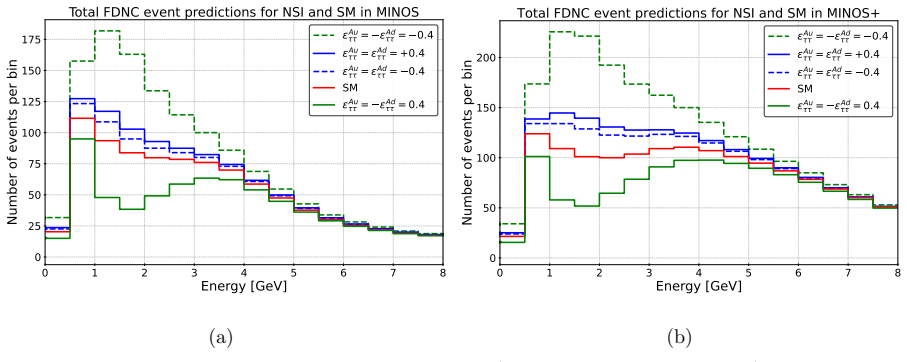


read the original abstract
We show that the neutral current data of the MINOS and MINOS+ experiments can provide information on the axial neutral current non-standard interactions of neutrinos with the $u$ and $d$ quarks; {\it i.e.,} on $\epsilon_{\alpha \beta}^{Aq}$. We derive bounds on the $ee$, $e\tau$ and $\tau \tau$ components of these couplings and show that the MINOS(+) bounds on $\epsilon^{Aq}_{e\tau}$ and $\epsilon^{Aq}_{\tau\tau}$ are currently the world leading ones. The bound on the isospin singlet case, $\epsilon^{Au}_{\tau\tau}=\epsilon^{Ad}_{\tau\tau}$ is of particular interest because while this isospin singlet NSI is theoretically motivated, it was practically unconstrained before these results.
Editorial analysis
A structured set of objections, weighed in public.
Referee Report
Summary. The manuscript uses neutral-current event samples from the MINOS and MINOS+ experiments to place constraints on axial-vector non-standard neutrino interactions (NSI) with up and down quarks, parameterized by the couplings ε^{Aq}_{αβ}. It derives limits on the ee, eτ, and ττ flavor components and asserts that the resulting bounds on ε^{Aq}_{eτ} and ε^{Aq}_{ττ} (including the isospin-singlet combination ε^{Au}_{ττ}=ε^{Ad}_{ττ}) are currently the strongest available.
Significance. If the analysis is robust, the result supplies the first practical experimental bound on a theoretically motivated isospin-singlet axial NSI operator that had previously been unconstrained. The work demonstrates an efficient reuse of existing long-baseline data for a new physics channel and could motivate similar analyses at other experiments.
major comments (2)
- [Analysis and results sections] The central claim that the MINOS(+) NC spectrum distortion is dominantly driven by axial NSI (and therefore yields world-leading bounds) rests on the assumption that unmodeled hadronic energy-scale, flux, and acceptance systematics do not produce a degenerate spectral tilt. The manuscript must demonstrate this by showing the profiled likelihood with and without the NSI parameters and by quantifying the pull on the systematic nuisance parameters when NSI are allowed to float (see the fit description and any associated figures or tables that present the best-fit values and covariance).
- [Introduction and results] The paper asserts that the isospin-singlet bound ε^{Au}_{ττ}=ε^{Ad}_{ττ} is of particular interest because it was previously unconstrained. A direct comparison table or plot against existing limits from other experiments (e.g., CHARM, NuTeV, or oscillation experiments) is required to substantiate the “world-leading” statement for both the general and singlet cases.
minor comments (2)
- [Theory section] Clarify the exact definition of the axial NSI Lagrangian term and the relation between the quark-level couplings ε^{Aq} and the effective neutrino-matter potential used in the oscillation probability.
- [Analysis section] Provide the explicit form of the likelihood function, including how the NC event rate is computed as a function of the NSI parameters and how the energy spectrum is binned.
Simulated Author's Rebuttal
We thank the referee for their careful reading and constructive comments, which help clarify the presentation of our results. We address each major point below and are prepared to revise the manuscript to incorporate the requested demonstrations and comparisons.
read point-by-point responses
-
Referee: [Analysis and results sections] The central claim that the MINOS(+) NC spectrum distortion is dominantly driven by axial NSI (and therefore yields world-leading bounds) rests on the assumption that unmodeled hadronic energy-scale, flux, and acceptance systematics do not produce a degenerate spectral tilt. The manuscript must demonstrate this by showing the profiled likelihood with and without the NSI parameters and by quantifying the pull on the systematic nuisance parameters when NSI are allowed to float (see the fit description and any associated figures or tables that present the best-fit values and covariance).
Authors: We agree that an explicit demonstration of the separation between NSI-induced distortions and systematic effects is valuable for robustness. In the revised manuscript we will add a figure showing the profiled likelihood ratio versus the NSI parameters both with and without the systematic nuisance parameters floated, together with a table (or extended discussion in the fit section) that reports the best-fit nuisance values, their pulls, and the covariance matrix elements when NSI are included. This will quantify that the spectral tilt is not absorbed by the systematics and that the NSI parameters remain well-constrained. revision: yes
-
Referee: [Introduction and results] The paper asserts that the isospin-singlet bound ε^{Au}_{ττ}=ε^{Ad}_{ττ} is of particular interest because it was previously unconstrained. A direct comparison table or plot against existing limits from other experiments (e.g., CHARM, NuTeV, or oscillation experiments) is required to substantiate the “world-leading” statement for both the general and singlet cases.
Authors: We accept that a side-by-side comparison is needed to substantiate the world-leading claim. We will insert a new table (and, if space permits, a supplementary plot) in the results section that lists the existing limits on ε^{Aq}_{eτ} and ε^{Aq}_{ττ} (including the isospin-singlet combination) from CHARM, NuTeV, and relevant oscillation analyses, placed next to the MINOS(+) bounds. This will make the improvement explicit for both the general and singlet operators. revision: yes
Circularity Check
No circularity detected in MINOS axial NSI bound derivation
full rationale
The paper constrains axial NSI parameters ε^{Aq}_{αβ} by comparing model predictions (including NSI modifications to neutrino-quark scattering) against the external neutral-current event spectra measured by MINOS and MINOS+. This is a standard data-driven fit to independent experimental observations rather than any self-referential loop. No equations redefine a fitted quantity as a prediction, no load-bearing uniqueness theorems are imported from the authors' prior work, and the central bounds rest on falsifiable comparison to real detector data rather than internal consistency alone. The approach is self-contained against external benchmarks.
Axiom & Free-Parameter Ledger
Lean theorems connected to this paper
-
IndisputableMonolith/Foundation/RealityFromDistinction.leanreality_from_one_distinction unclear?
unclearRelation between the paper passage and the cited Recognition theorem.
We derive bounds on the ee, eτ and ττ components of these couplings... using χ²_NC with covariance matrix from MINOS+ supplementary material
What do these tags mean?
- matches
- The paper's claim is directly supported by a theorem in the formal canon.
- supports
- The theorem supports part of the paper's argument, but the paper may add assumptions or extra steps.
- extends
- The paper goes beyond the formal theorem; the theorem is a base layer rather than the whole result.
- uses
- The paper appears to rely on the theorem as machinery.
- contradicts
- The paper's claim conflicts with a theorem or certificate in the canon.
- unclear
- Pith found a possible connection, but the passage is too broad, indirect, or ambiguous to say the theorem truly supports the claim.
Forward citations
Cited by 1 Pith paper
-
Complementarity Between Neutrino Neutral and Charged Current Events in the Search for New Physics
Neutral-current events supply sensitivity to isovector NSI parameters that charged-current analyses suppress, enabling the first bounded long-baseline constraints and resolution of individual quark couplings when the ...
Reference graph
Works this paper leans on
-
[1]
detector acceptance; 6) effective normalization. Most of these uncertainties ( e.g., those of 5 0 1 2 3 4 5 6 7 8 Energy [GeV] 0 20 40 60 80 100Number of events per bin FDNC Event for MINOS pre S - - - e - Beam e (a) 0 1 2 3 4 5 6 7 8 Energy [GeV] 0 20 40 60 80 100 120Number of events per bin FDNC Event for MINOS+ pre S - - - e - Beam e (b) 0 1 2 3 4 5 6 ...
-
[2]
treats all the uncertainties, including both statistical and systematic, with a covariance 6 matrix that is available in its supplementary material. Following Ref. [14], we define χ2 N C = NX i=1 NX j=1 (N obs i − N pre i (ϵ))(V −1)ij(N obs j − N pre j (ϵ)) , (3) where N is the total number of Near Detector (ND) and Far Detector (FD) bins. ( V −1)ij is th...
- [3]
-
[4]
Neutrinophilic Non-Standard Interactions
Y. Farzan and J. Heeck, Phys. Rev. D 94, 053010 (2016), arXiv:1607.07616 [hep-ph]
work page internal anchor Pith review Pith/arXiv arXiv 2016
-
[5]
Lepton Flavor Violating Non-Standard Interactions via Light Mediators
Y. Farzan and I. M. Shoemaker, JHEP 07, 033 (2016), arXiv:1512.09147 [hep-ph]
work page internal anchor Pith review Pith/arXiv arXiv 2016
-
[6]
A model for large non-standard interactions of neutrinos leading to the LMA-Dark solution
Y. Farzan, Phys. Lett. B 748, 311 (2015), arXiv:1505.06906 [hep-ph]
work page internal anchor Pith review Pith/arXiv arXiv 2015
-
[7]
Loop-induced Neutrino Non-Standard Interactions
I. Bischer, W. Rodejohann, and X.-J. Xu, JHEP 10, 096 (2018), arXiv:1807.08102 [hep-ph]
work page internal anchor Pith review Pith/arXiv arXiv 2018
-
[8]
D. V. Forero and W.-C. Huang, JHEP 03, 018 (2017), arXiv:1608.04719 [hep-ph]
work page internal anchor Pith review Pith/arXiv arXiv 2017
-
[9]
Y. Farzan, Phys. Lett. B 803, 135349 (2020), arXiv:1912.09408 [hep-ph]
-
[10]
S. Abbaslu and Y. Farzan, Nucl. Phys. B 1018, 117070 (2025), arXiv:2407.13834 [hep-ph]
-
[11]
S. Abbaslu, M. Dehpour, Y. Farzan, and S. Safari, JHEP 04, 038 (2024), arXiv:2312.12420 [hep-ph]
-
[12]
G. P. Zeller et al. (NuTeV), Phys. Rev. Lett. 88, 091802 (2002), [Erratum: Phys.Rev.Lett. 90, 239902 (2003)], arXiv:hep-ex/0110059
work page internal anchor Pith review Pith/arXiv arXiv 2002
-
[13]
S. Davidson, C. Pena-Garay, N. Rius, and A. Santamaria, JHEP 03, 011 (2003), arXiv:hep- ph/0302093
- [14]
-
[15]
S. Abbaslu, M. Dehpour, Y. Farzan, and S. Safari, JHEP 06, 041 (2025), arXiv:2412.13349 [hep-ph]
-
[16]
P. Adamson et al. (MINOS+), Phys. Rev. Lett. 122, 091803 (2019), arXiv:1710.06488 [hep-ex]
-
[17]
NuWro - Monte Carlo neutrino event generator,
NuWro official repository, “NuWro - Monte Carlo neutrino event generator,” https://github. com/NuWro/ (2025)
work page 2025
-
[18]
Simulations from a new neutrino event generator
C. Juszczak, J. A. Nowak, and J. T. Sobczyk, Nucl. Phys. B Proc. Suppl. 159, 211 (2006), arXiv:hep-ph/0512365
work page internal anchor Pith review Pith/arXiv arXiv 2006
- [19]
-
[20]
Final State Interactions Effects in Neutrino-Nucleus Interactions
T. Golan, C. Juszczak, and J. T. Sobczyk, Phys. Rev. C 86, 015505 (2012), arXiv:1202.4197 [nucl-th]. 22
work page internal anchor Pith review Pith/arXiv arXiv 2012
-
[21]
NuFit-6.0: Updated global analysis of three-flavor neutrino oscillations
I. Esteban, M. C. Gonzalez-Garcia, M. Maltoni, I. Martinez-Soler, J. P. Pinheiro, and T. Schwetz, JHEP 12, 216 (2024), arXiv:2410.05380 [hep-ph]
work page internal anchor Pith review Pith/arXiv arXiv 2024
-
[22]
Constraining new physics with Borexino Phase-II spectral data,
P. Coloma, M. C. Gonzalez-Garcia, M. Maltoni, J. P. Pinheiro, and S. Urrea, JHEP 07, 138 (2022), [Erratum: JHEP 11, 138 (2022)], arXiv:2204.03011 [hep-ph]. 23
discussion (0)
Sign in with ORCID, Apple, or X to comment. Anyone can read and Pith papers without signing in.