REVIEW 2 major objections 6 minor 2 cited by
Scale-Adaptive Generative Flows for Multiscale Scientific Data
T0 review · 2 major / 6 minor · reviewed 2026-08-05 · deepseek-v4-flash
Pith's one-line read Flow-based generative models of multiscale scientific fields require noise whose Fourier spectrum decays no faster than the target spectrum; otherwise the drift becomes unbounded near t=0, and a scale-adaptive schedule restores numerical ef
desk verdict Worth a real read: clean Gaussian analysis and a useful schedule, with the Navier-Stokes win resting on a hand-tuned parameter and a loose non-Gaussian bridge. read the letter →
The pith
A machine-rendered reading of the paper's core claim, the machinery that carries it, and where it could break.
The reading
What carries the argument
The central object is the stochastic interpolant and its conditional-expectation drift b_t(x)=E[İ_t | I_t=x], which defines a generative ODE whose law matches the data law at t=1. Gaussian analysis reduces it to the operator B(t)=(α̇α C0 + β̇β C1)(α^2 C0 + β^2 C1)^{-1}; the ratio C1 C0^{-1} controls whether the drift stays bounded near t=0, and the Cameron–Martin space of the noise plays the analogous role for general targets. The other load-bearing piece is the scalar scale-adaptive schedule (5.1), α_t = sqrt((μ*−μ*^t)/(μ*−1)), β_t = sqrt((μ*^t−1)/(μ*−1)), built from the smallest eigenvalue ratio μ* of C1 C0^{-1}; it makes the drift's Lipschitz constant 1/2 |log μ*| instead of growing polyn
What would settle it
For a Matérn target with regularity s1 and noise with lower roughness s0 < s1, Proposition 3.1 predicts ∥B(t)∥ ~ 1/t near t=0; measuring the minimum RK4 step size needed to keep the generated energy spectrum within a fixed tolerance at N=32, 64, and 128 should show a clear resolution-dependent blow-up if the claim is right. Conversely, if a Gaussian-noise generative model with s0 > s1 still produces accurate fine-scale spectra with a fixed small number of steps, the drift-blowup mechanism is not the controlling factor.
Extended reading notes
Core claim
Working in the stochastic interpolant picture, the paper establishes a roughness-matching principle: for the interpolant I_t = α_t z + β_t x_1, the drift b_t(x)=E[İ_t | I_t=x] is well posed only if the noise z is at least as rough as the target x_1. For Gaussian measures this is exact (Proposition 3.1): b_t(x)=B(t)x with B(t)=(α̇α C0 + β̇β C1)(α^2 C0 + β^2 C1)^{-1}, and an unbounded C1 C0^{-1} forces ∥B(t)∥→∞ as t→0. For general targets, compact support of the data in the noise's Cameron–Martin space gives a bounded, Lipschitz drift (Proposition 3.3). The paper then shows two regimes: matched-spectrum noise reproduces fine scales with very few steps when the target's spectrum is known, while
Load-bearing premise
The general Lipschitz-drift guarantee assumes the target distribution is compactly supported inside the noise's Cameron–Martin space; when that assumption fails, as it does for the Navier–Stokes invariant measure under matched-spectrum noise, the paper falls back on rougher noise plus a schedule whose scale parameter μ* is fitted from the observed data spectrum rather than derived.
Editorial extensions
If this is right
- White noise is too smooth for smooth data: using it as the noise in a flow model on a Matérn-like field makes the drift unbounded as t→0, so errors at fine scales cannot be controlled as resolution increases.
- When the data's fine-scale Fourier structure is known, noise with a matched spectrum reaches accurate spectra with as few as 5 RK4 steps, while white noise needs 20–80 steps and still degrades on finer grids.
- The well-posedness criterion transfers to general targets: if the data lives compactly inside the noise's Cameron–Martin space, the drift is bounded and Lipschitz on [0,1−δ].
- For rougher-than-data noise, the scale-adaptive schedule (5.1) caps the drift Lipschitz constant at 1/2 |log μ*|, turning a polynomially stiff integration problem into a logarithmically mild one.
- Using white noise plus the designed schedule with μ* read from the spectrum gives accurate Navier–Stokes enstrophy spectra at 128×128 with only 10 RK4 steps.
Reading between the lines
- The logarithmic dependence on μ* suggests the schedule's benefit should persist at higher resolution and in 3D, where the smallest resolved eigenvalue ratio shrinks only logarithmically; this is an extrapolation the paper does not run.
- The heuristic that sets μ* from the ratio of the smallest target spectral value to the noise plateau could be automated, e.g. by estimating the spectrum and choosing μ* before training, rather than fixing it by hand.
- The same Cameron–Martin reasoning may guide non-Gaussian noise families: choosing a noise whose Cameron–Martin space exactly contains the data support could combine the efficiency of spectrum-matched noise with the flexibility needed for non-Gaussian targets.
- Integrated with per-scale or hierarchical modeling, the schedule could be applied separately to different wavenumber bands rather than globally, possibly improving accuracy on intermittent fields.
Editorial analysis
A structured set of objections, weighed in public.
Referee Report
Summary. The paper studies noise distribution and interpolation schedule design within the stochastic interpolants / flow matching framework, targeting scientific data with multiscale Fourier spectra. For Gaussian targets, it shows that if the noise covariance C0 is smoother than the target covariance C1 in the sense that C1 C0^{-1} is unbounded, the drift field of the generative ODE has unbounded operator norm near t=0 (Prop. 3.1); conversely, matched-spectrum noise keeps the drift bounded and, with the proposed scalar schedule (5.1), gives a drift Jacobian bounded by (1/2)|log μ⋆| (Prop. 5.1). For general targets, a Lipschitz bound is stated under a compact-support assumption in the Cameron–Martin space of the noise (Prop. 3.3). Numerical experiments on Gaussian random fields, stochastic Allen–Cahn invariant measures, and stochastic Navier–Stokes invariant measures illustrate that spectrum-matched noise improves efficiency in the tractable cases, while for the Navier–Stokes case a scale-adaptive schedule with white noise improves the enstrophy spectrum with only 10 RK4 steps.
Significance. If the results hold, the paper makes a useful contribution by connecting noise roughness, drift regularity, and integration cost in flow-based generative models, and by giving an explicit, resolution-robust scalar schedule for Gaussian targets whose Lipschitz constant grows only logarithmically with the spectral range. The Gaussian derivations in Props. 3.1 and 5.1 are clean, and the release of code supports reproducibility. The function-space perspective and the demonstration that standard white noise can be inferior to spectrum-matched noise for smooth Gaussian/Allen–Cahn targets are valuable. However, the central practical claim for complex non-Gaussian targets such as Navier–Stokes is not backed by a quantitative theorem: Prop. 5.1 is Gaussian-only, while Prop. 3.3 only gives existence of a Lipschitz constant under assumptions that likely fail for the Navier–Stokes invariant measure. The Navier–Stokes experiment also uses a hand-fitted μ⋆ read from the data spectrum. These gaps limit the significance of the paper as a general theory, though they may be addressable by reframing and additional experiments.
major comments (2)
- [§5.2, Prop. 5.1, Prop. 3.3] The quantitative efficiency claim for the scale-adaptive schedule is proved only for Gaussian targets with C0 and C1 mutually diagonalizable (Prop. 5.1). In the Navier–Stokes experiment (Sec. 4.2.3 and 5.2), the target is non-Gaussian, the drift is a trained UNet rather than the linear Gaussian map, and μ⋆ = 10^{-5} is read off the data-to-noise enstrophy ratio at k=26. Prop. 3.3 supplies only existence of a Lipschitz constant on [0,1−δ] under compact support in the Cameron–Martin space V; it does not quantify the constant, and the compact-support assumption is not verified for the Navier–Stokes invariant measure. Indeed, the paper itself notes in Sec. 4.2.3 that the NS invariant measure is not in the Cameron–Martin space of the spectrum noise, and no analogous statement is made for white noise. Thus no stated theorem justifies applying the ½|log μ⋆| bound to the learned non-Gaussian dri
- [§5.2, Fig. 6] The parameter μ⋆ = 10^{-5} is selected directly from the data spectrum (the enstrophy ratio at the highest resolved mode). This is a fitted value, not a prediction, and Section 6 lists automated spectral estimation as future work. The observed 10-step RK4 improvement may be specific to this μ⋆, this network, and this noise normalization. To make the scale-adaptive claim credible, the paper should report sensitivity of the results to μ⋆ (e.g., varying it over several orders of magnitude) and, ideally, propose a data-driven estimator for μ⋆. Without this, the Navier–Stokes experiment is a demonstration on a hand-tuned parameter rather than a validation of a design principle.
minor comments (6)
- [§4.2.1, §4.2.2] In the experiment descriptions, the interpolant is written as It = αt z + βt z; the second factor should be βt x1 (or βt x0, depending on notation). This typo appears in both sections.
- [Appendix B, proof of Prop. 3.1] The displayed formula for Cov(˙I_t, I_t) Cov(I_t)^{-1} omits the C0 factors: it should be (˙α_t α_t C0 + ˙β_t β_t C1)(α_t^2 C0 + β_t^2 C1)^{-1}. The subsequent line is correct, but the intermediate expression is inconsistent.
- [Appendix C, Eq. (C.7)–(C.10)] The Lipschitz bound for the conditional expectation F is missing the factor β_t/α_t^2 that appears in (C.7). While this factor can be absorbed into the constant Cδ in (C.3), the displayed bound (C.10) is not correct as written and the proof should be adjusted.
- [§4.2.3] The statement that 'with more RK4 steps, the result using spectrum noise does not improve' is not supported by a figure or table. If this is an important negative result, it should be documented; otherwise it should be removed or qualified.
- [Prop. 5.1] The proposition assumes the eigenvalues of C1 C0^{-1} satisfy 1 ≥ μ1 ≥ ... ≥ μd. The paper should state what happens if the largest eigenvalue exceeds 1, since the schedule formula (5.1) and the monotonicity step in the proof rely on μ ≤ 1.
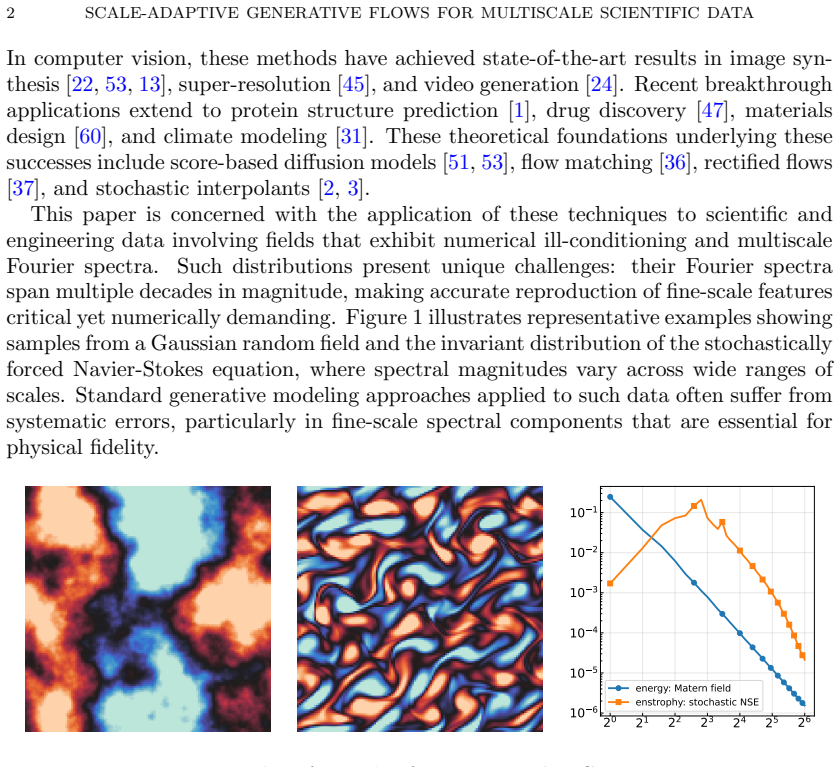
- [Figures 2–6] The energy/enstrophy spectra are averaged over ensembles, but no error bars or ensemble sizes are reported. Given that some differences between methods appear modest at low wavenumbers, error bars would strengthen the empirical claims.
Circularity Check
Core Gaussian and general-measure results are derived from first principles; only a minor, non-load-bearing self-citation and a hand-set NS schedule parameter keep this from a clean bill.
-
other
[Appendix B.2, final sentence after proof of Proposition 5.1]
"In fact, the choice (5.1) minimizes the averaged squared 2-norm of the gradient over all βt; see [10]."
This optimality claim is supported only by a self-citation to [10], a companion paper with two of the present authors (Chen, Vanden-Eijnden, Xu). However, the preceding calculation already proves the central quantitative consequence, ∥∇bt(x)∥₂ = ½|log μ⋆| for the schedule (5.1), entirely within this paper. The self-citation therefore adds an optimality gloss but is not load-bearing for the paper's main efficiency bound. It is a minor self-citation rather than a circular reduction.
full rationale
Proposition 3.1 is proven in Appendix B from Gaussian conditioning: the drift operator is computed explicitly, and the divergence lim_{t→0}‖B(t)‖=∞ follows from β_0=0 and β_t∈C¹. The Matérn example is then a direct application, not an input. Proposition 3.3 is proven in Appendix C using Cameron–Martin/Girsanov densities and a compact-support assumption; boundedness and Lipschitzness are derived, not assumed. Proposition 5.1 likewise computes the Jacobian norm of the drift for schedule (5.1) and obtains ½|log μ⋆| by direct algebra. The Navier-Stokes experiment in Sec. 5.2 sets μ⋆ = 10⁻⁵ from the data-to-noise enstrophy ratio at the finest resolved mode; this is a hand-tuned, spectrum-adaptive parameter, and Sec. 6 lists automated spectral estimation as future work. But the paper does not present μ⋆ as a predicted quantity, nor does it claim Proposition 5.1 applies verbatim to the non-Gaussian NS invariant measure; it explicitly says the schedule is “motivated by the Gaussian case.” The Gaussian and Allen-Cahn experiments use known covariances as noise, which is a demonstration rather than a circular prediction. The only noteworthy circularity-adjacent issue is the non-load-bearing self-citation to [10], yielding a score of 2.
Assumptions & free parameters
free parameters (1)
- μ⋆ (schedule parameter) =
1e-5
assumptions (5)
- standard math z ⊥ x1 (independence of noise and data)
- standard math αt, βt ∈ C^1([0,1]) with α0=β1=1, α1=β0=0, ˙βt>0, ˙αt<0
- domain assumption µ∗ is compactly supported in the Cameron-Martin space V of the noise
- domain assumption C0 and C1 are mutually diagonalizable with eigenvalues of C1C0^{-1} in [µ⋆,1]
- standard math Cameron-Martin theorem for conditional expectation formula (C.2)
Cite this review
Pith. "Pith review of Scale-Adaptive Generative Flows for Multiscale Scientific Data." pith.science (2026). https://pith.science/paper/QRSTELTZ
@misc{pith2026250902971,
  author       = {Pith},
  title        = {Pith review of: Scale-Adaptive Generative Flows for Multiscale Scientific Data},
  year         = {2026},
  howpublished = {\url{https://pith.science/paper/QRSTELTZ}},
  note         = {Machine review of arXiv:2509.02971}
}
read the original abstract
Flow-based generative models can face numerical challenges on scientific data with multiscale Fourier spectra, often producing large errors at fine scales. We approach this problem within the flow matching and stochastic interpolants framework, through the principled design of noise distributions and interpolation schedules. Working in function space ensures that the generative model remains well defined as the resolution is refined; the Lipschitz regularity of the drift is important to both this function-space well-posedness and the integration cost at fixed resolution. The central observation is that the noise should be at least as rough as the target distribution -- measured by Fourier-spectrum decay -- in order to keep the Lipschitz constant finite. For Gaussian and near-Gaussian targets whose fine-scale structure is known, matched-spectrum noise improves numerical efficiency over standard white-noise choices. For more complex non-Gaussian targets, matched-spectrum noise may not be sufficient, and we propose scale-adaptive interpolation schedules to mitigate the terminal-time stiffness that arises when the noise is rougher than the data. Numerical experiments on synthetic Gaussian random fields and on invariant measures of the stochastic Allen--Cahn and Navier--Stokes equations illustrate the approach and demonstrate its ability to generate high-fidelity samples at lower computational cost than traditional approaches.
Figures


Figures from the paper (3 more)


Forward citations
Cited by 2 Pith papers
-
Discretization and Statistical Consistency of Functional Flow Matching
Finite conditional velocity targets in functional flow matching converge in L2 to the continuum target under nonnested, strongly consistent reconstructions, with end-to-end Wasserstein control of the generated laws.
-
Telegrapher's Generative Model via Kac Flows
Kac flows, driven by the telegrapher's equation, provide a generative model with an explicit conditional velocity field and bounded velocity norm.
Reference graph
Works this paper leans on
-
[1]
Ballard, Joshua Bambrick, Sebastian W
Josh Abramson, Jonas Adler, Jack Dunger, Richard Evans, Tim Green, Alexander Pritzel, Olaf Ronneberger, Lindsay Willmore, Andrew J. Ballard, Joshua Bambrick, Sebastian W. Bodenstein, David A. Evans, Chia-Chun Hung, Michael O’Neill, David Reiman, Kathryn Tunyasuvunakool, Zachary Wu, Akvil˙ e ˇZemgulyt˙ e, Eirini Arvaniti, Charles Beattie, Ottavia Bertolli,...
work page 2024
-
[2]
Building normalizing flows with stochastic interpolants
Michael Albergo and Eric Vanden-Eijnden. Building normalizing flows with stochastic interpolants. In ICLR 2023 Conference , 2023
work page 2023
-
[3]
Stochastic interpolants: A unifying framework for flows and diffusions
Michael S Albergo, Nicholas M Boffi, and Eric Vanden-Eijnden. Stochastic interpolants: A unifying framework for flows and diffusions. arXiv preprint arXiv:2303.08797 , 2023
arXiv 2023
-
[4]
Lorenzo Baldassari, Ali Siahkoohi, Josselin Garnier, Knut Solna, and Maarten V de Hoop. Condi- tional score-based diffusion models for bayesian inference in infinite dimensions.Advances in Neural Information Processing Systems, 36, 2024
work page 2024
-
[5]
Vladimir Igorevich Bogachev. Gaussian Measures . Number 62. American Mathematical Society, 1998
work page 1998
-
[6]
$\infty$-Diff: Infinite Resolution Diffusion with Subsampled Mollified States
Sam Bond-Taylor and Chris G Willcocks. ∞-diff: Infinite resolution diffusion with subsampled mollified states. arXiv preprint arXiv:2303.18242 , 2023
work page Pith review arXiv 2023
-
[7]
Sampling is as easy as learning the score: Theory for diffusion models with minimal data assumptions
Sitan Chen, Sinho Chewi, Jerry Li, Yuanzhi Li, Adil Salim, and Anru R Zhang. Sampling is as easy as learning the score: Theory for diffusion models with minimal data assumptions. In International Conference on Learning Representations, 2023. SCALE-ADAPTIVE GENERATIVE FLOWS FOR MULTISCALE SCIENTIFIC DATA 17
work page 2023
-
[8]
New affine invariant ensemble samplers and their dimensional scaling
Yifan Chen. New affine invariant ensemble samplers and their dimensional scaling. arXiv preprint arXiv:2505.02987, 2025
arXiv 2025
Show all 60 references
-
[9]
Probabilistic forecasting with stochastic interpolants and F¨ ollmer processes
Yifan Chen, Mark Goldstein, Mengjian Hua, Michael Samuel Albergo, Nicholas Matthew Boffi, and Eric Vanden-Eijnden. Probabilistic forecasting with stochastic interpolants and F¨ ollmer processes. In International Conference on Machine Learning , pages 6728–6756. PMLR, 2024
2024
-
[10]
Lipschitz-guided design of interpolation schedules in generative models
Yifan Chen, Eric Vanden-Eijnden, and Jiawei Xu. Lipschitz-guided design of interpolation schedules in generative models. arXiv preprint arXiv:2509.01629 , 2025
2025 arXiv
-
[11]
Renormalization group flow as optimal transport
Jordan Cotler and Semon Rezchikov. Renormalization group flow as optimal transport. Physical Review D, 108(2):025003, 2023
2023
-
[12]
Renormalizing diffusion models
Jordan Cotler and Semon Rezchikov. Renormalizing diffusion models. arXiv preprint arXiv:2308.12355, 2023
2023 arXiv
-
[13]
Diffusion models beat GANs on image synthesis.Advances in Neural Information Processing Systems , 34:8780–8794, 2021
Prafulla Dhariwal and Alexander Nichol. Diffusion models beat GANs on image synthesis.Advances in Neural Information Processing Systems , 34:8780–8794, 2021
2021
-
[14]
Generative diffusion models in infinite dimensions: A survey
Giulio Franzese and Pietro Michiardi. Generative diffusion models in infinite dimensions: A survey. Philosophical Transactions A, 383(2299):20240322, 2025
2025
-
[15]
Gaussian interpolation flows
Yuan Gao, Jian Huang, and Yuling Jiao. Gaussian interpolation flows. arXiv preprint arXiv:2311.11475, 2023
2023 arXiv
-
[16]
Wavelet score-based generative modeling
Florentin Guth, Simon Coste, Valentin De Bortoli, and Stephane Mallat. Wavelet score-based generative modeling. Advances in Neural Information Processing Systems , 35:478–491, 2022
2022
-
[17]
Studies in the history of probability and statistics XLIX on the Mat´ ern correlation family.Biometrika, 93(4):989–995, 2006
Peter Guttorp and Tilmann Gneiting. Studies in the history of probability and statistics XLIX on the Mat´ ern correlation family.Biometrika, 93(4):989–995, 2006
2006
-
[18]
Mimicking the one-dimensional marginal distributions of processes having an Itˆ o differential
Istv´ an Gy¨ ongy. Mimicking the one-dimensional marginal distributions of processes having an Itˆ o differential. Probability Theory and Related Fields , 71(4):501–516, 1986
1986
-
[19]
Multilevel diffusion: Infinite dimensional score-based diffusion models for image generation
Paul Hagemann, Sophie Mildenberger, Lars Ruthotto, Gabriele Steidl, and Nicole Tianjiao Yang. Multilevel diffusion: Infinite dimensional score-based diffusion models for image generation. arXiv preprint arXiv:2303.04772, 2023
2023 arXiv
-
[20]
An introduction to stochastic PDEs
Martin Hairer. An introduction to stochastic PDEs. arXiv preprint arXiv:0907.4178 , 2009
2009 arXiv
-
[21]
Ergodicity of the 2D Navier-Stokes equations with de- generate stochastic forcing
Martin Hairer and Jonathan C Mattingly. Ergodicity of the 2D Navier-Stokes equations with de- generate stochastic forcing. Annals of Mathematics , pages 993–1032, 2006
2006
-
[22]
Denoising diffusion probabilistic models
Jonathan Ho, Ajay Jain, and Pieter Abbeel. Denoising diffusion probabilistic models. In Advances in Neural Information Processing Systems , volume 33, pages 6840–6851, 2020
2020
-
[23]
Cascaded diffusion models for high fidelity image generation
Jonathan Ho, Chitwan Saharia, William Chan, David J Fleet, Mohammad Norouzi, and Tim Sal- imans. Cascaded diffusion models for high fidelity image generation. Journal of Machine Learning Research, 23(47):1–33, 2022
2022
-
[24]
Video diffusion models
Jonathan Ho, Tim Salimans, Alexey Gritsenko, William Chan, Mohammad Norouzi, and David J Fleet. Video diffusion models. Advances in Neural Information Processing Systems , 35:8633–8646, 2022
2022
-
[25]
Blurring diffusion models
Emiel Hoogeboom and Tim Salimans. Blurring diffusion models. In The Eleventh International Conference on Learning Representations, 2023
2023
-
[26]
Subspace diffusion gener- ative models
Bowen Jing, Gabriele Corso, Renato Berlinghieri, and Tommi Jaakkola. Subspace diffusion gener- ative models. In European Conference on Computer Vision , pages 274–289. Springer, 2022
2022
-
[27]
Gotta go fast when generating data with score-based models
Alexia Jolicoeur-Martineau, Ke Li, R´ emi Pich´ e-Taillefer, Tal Kachman, and Ioannis Mitliagkas. Gotta go fast when generating data with score-based models. arXiv preprint arXiv:2105.14080 , 2021
2021 arXiv
-
[28]
Elucidating the design space of diffusion- based generative models
Tero Karras, Miika Aittala, Timo Aila, and Samuli Laine. Elucidating the design space of diffusion- based generative models. Advances in Neural Information Processing Systems , 35:26565–26577, 2022
2022
-
[29]
Diffusion generative models in infinite dimen- sions
Gavin Kerrigan, Justin Ley, and Padhraic Smyth. Diffusion generative models in infinite dimen- sions. In International Conference on Artificial Intelligence and Statistics, pages 9538–9563. PMLR, 2023
2023
-
[30]
Functional flow matching
Gavin Kerrigan, Giosue Migliorini, and Padhraic Smyth. Functional flow matching. arXiv preprint arXiv:2305.17209, 2023
2023 arXiv
-
[31]
Learning skillful medium-range global weather forecasting
Remi Lam, Alvaro Sanchez-Gonzalez, Matthew Willson, Peter Wirnsberger, Meire Fortunato, Fer- ran Alet, Suman Ravuri, Timo Ewalds, Zach Eaton-Rosen, Weihua Hu, Alexander Merose, Stephan 18 SCALE-ADAPTIVE GENERATIVE FLOWS FOR MULTISCALE SCIENTIFIC DATA Hoyer, George Holland, Ori...
2023
-
[32]
Hierarchic flows to estimate and sample high-dimensional probabilities
Etienne Lempereur and St´ ephane Mallat. Hierarchic flows to estimate and sample high-dimensional probabilities. arXiv preprint arXiv:2405.03468 , 2024
2024
-
[33]
Fourier neural operator for parametric partial differential equations
Zongyi Li, Nikola Kovachki, Kamyar Azizzadenesheli, Burigede Liu, Kaushik Bhattacharya, An- drew Stuart, and Anima Anandkumar. Fourier neural operator for parametric partial differential equations. arXiv preprint arXiv:2010.08895 , 2020
2010 arXiv
-
[34]
Score-based diffusion models in function space
Jae Hyun Lim, Nikola B Kovachki, Ricardo Baptista, Christopher Beckham, Kamyar Azizzade- nesheli, Jean Kossaifi, Vikram Voleti, Jiaming Song, Karsten Kreis, Jan Kautz, et al. Score-based diffusion models in function space. arXiv preprint arXiv:2302.07400 , 2023
2023 arXiv
-
[35]
An explicit link between Gaussian fields and Gaussian Markov random fields: The stochastic partial differential equation approach
Finn Lindgren, H ˚ avard Rue, and Johan Lindstr¨ om. An explicit link between Gaussian fields and Gaussian Markov random fields: The stochastic partial differential equation approach. Journal of the Royal Statistical Society Series B: Statistical Methodology , 73(4):423–498, 2011
2011
-
[36]
Flow match- ing for generative modeling
Yaron Lipman, Ricky TQ Chen, Heli Ben-Hamu, Maximilian Nickel, and Matthew Le. Flow match- ing for generative modeling. InThe Eleventh International Conference on Learning Representations, 2022
2022
-
[37]
Flow straight and fast: Learning to generate and transfer data with rectified flow
Xingchao Liu, Chengyue Gong, and Qiang Liu. Flow straight and fast: Learning to generate and transfer data with rectified flow. In The Eleventh International Conference on Learning Represen- tations, 2022
2022
-
[38]
Learning nonlinear operators via DeepONet based on the universal approximation theorem of operators
Lu Lu, Pengzhan Jin, Guofei Pang, Zhongqiang Zhang, and George Em Karniadakis. Learning nonlinear operators via DeepONet based on the universal approximation theorem of operators. Nature Machine Intelligence , 3(3):218–229, 2021
2021
-
[39]
Wavelet conditional renor- malization group
Tanguy Marchand, Misaki Ozawa, Giulio Biroli, and St´ ephane Mallat. Wavelet conditional renor- malization group. arXiv preprint arXiv:2207.04941 , 2022
2022 arXiv
-
[40]
Improved denoising diffusion probabilistic models
Alexander Quinn Nichol and Prafulla Dhariwal. Improved denoising diffusion probabilistic models. In International Conference on Machine Learning , pages 8162–8171. PMLR, 2021
2021
-
[41]
Spectral diffusion processes
Angus Phillips, Thomas Seror, Michael Hutchinson, Valentin De Bortoli, Arnaud Doucet, and Emile Mathieu. Spectral diffusion processes. arXiv preprint arXiv:2209.14125 , 2022
2022 arXiv
-
[42]
Wavelet diffusion models are fast and scalable image gener- ators
Hao Phung, Quan Dao, and Anh Tran. Wavelet diffusion models are fast and scalable image gener- ators. In Proceedings of the IEEE/CVF Conference on Computer Vision and Pattern Recognition , pages 10199–10208, 2023
2023
-
[43]
Infinite-dimensional diffu- sion models
Jakiw Pidstrigach, Youssef Marzouk, Sebastian Reich, and Sven Wang. Infinite-dimensional diffu- sion models. arXiv preprint arXiv:2302.10130 , 2023
2023 arXiv
-
[44]
Generative modelling with inverse heat dissi- pation
Severi Rissanen, Markus Heinonen, and Arno Solin. Generative modelling with inverse heat dissi- pation. In The Eleventh International Conference on Learning Representations , 2022
2022
-
[45]
Image super-resolution via iterative refinement
Chitwan Saharia, Jonathan Ho, William Chan, Tim Salimans, David J Fleet, and Mohammad Norouzi. Image super-resolution via iterative refinement. IEEE Transactions on Pattern Analysis and Machine Intelligence , 45(4):4713–4726, 2022
2022
-
[46]
Noise estimation for generative diffusion mod- els
Robin San-Roman, Eliya Nachmani, and Lior Wolf. Noise estimation for generative diffusion mod- els. arXiv preprint arXiv:2104.02600 , 2021
2021 arXiv
-
[47]
Blundell, Pietro Lio, Max Welling, Michael Bronstein, and Bruno Correia
Arne Schneuing, Charles Harris, Yuanqi Du, Kieran Didi, Arian Jamasb, Ilia Igashov, Weitao Du, Carla Gomes, Tom L. Blundell, Pietro Lio, Max Welling, Michael Bronstein, and Bruno Correia. Structure-based drug design with equivariant diffusion models. Nature Computational Scien...
2024
-
[48]
Bespoke solvers for generative flow models
N Shaul, J Perez, RTQ Chen, A Thabet, A Pumarola, and Y Lipman. Bespoke solvers for generative flow models. In 12th International Conference on Learning Representations , 2024
2024
-
[49]
Renormalization group flow, optimal transport and diffusion-based generative model.arXiv preprint arXiv:2402.17090, 2024
Artan Sheshmani, Yi-Zhuang You, Baturalp Buyukates, Amir Ziashahabi, and Salman Avestimehr. Renormalization group flow, optimal transport and diffusion-based generative model.arXiv preprint arXiv:2402.17090, 2024
2024 arXiv
-
[50]
Deep unsu- pervised learning using nonequilibrium thermodynamics
Jascha Sohl-Dickstein, Eric A Weiss, Niru Maheswaranathan, and Surya Ganguli. Deep unsu- pervised learning using nonequilibrium thermodynamics. In Proceedings of the 32nd International Conference on Machine Learning , pages 2256–2265, 2015. SCALE-ADAPTIVE GENERATIVE FLOWS FOR ...
2015
-
[51]
Generative modeling by estimating gradients of the data distribu- tion
Yang Song and Stefano Ermon. Generative modeling by estimating gradients of the data distribu- tion. Advances in Neural Information Processing Systems , 32, 2019
2019
-
[52]
Improved techniques for training score-based generative models
Yang Song and Stefano Ermon. Improved techniques for training score-based generative models. Advances in Neural Information Processing Systems , 33:12438–12448, 2020
2020
-
[53]
Score-based generative modeling through stochastic differential equations
Yang Song, Jascha Sohl-Dickstein, Diederik P Kingma, Abhishek Kumar, Stefano Ermon, and Ben Poole. Score-based generative modeling through stochastic differential equations. arXiv preprint arXiv:2011.13456, 2020
2011 arXiv
-
[54]
Interpolation of Spatial Data: Some Theory for Kriging
Michael L Stein. Interpolation of Spatial Data: Some Theory for Kriging . Springer Science & Business Media, 1999
1999
-
[55]
Inverse problems: A Bayesian perspective
Andrew M Stuart. Inverse problems: A Bayesian perspective. Acta Numerica, 19:451–559, 2010
2010
-
[56]
FunDiff: Diffusion models over function spaces for physics-informed generative modeling
Sifan Wang, Zehao Dou, Tong-Rui Liu, and Lu Lu. FunDiff: Diffusion models over function spaces for physics-informed generative modeling. arXiv preprint arXiv:2506.07902 , 2025
2025
-
[57]
On stationary processes in the plane
Peter Whittle. On stationary processes in the plane. Biometrika, pages 434–449, 1954
1954
-
[58]
Diffusion models: A comprehensive survey of methods and appli- cations
Ling Yang, Zhilong Zhang, Yang Song, Shenda Hong, Runsheng Xu, Yue Zhao, Wentao Zhang, Bin Cui, and Ming-Hsuan Yang. Diffusion models: A comprehensive survey of methods and appli- cations. ACM Computing Surveys , 56(4):1–39, 2023
2023
-
[59]
Wavelet flow: Fast training of high resolution normalizing flows
Jason J Yu, Konstantinos G Derpanis, and Marcus A Brubaker. Wavelet flow: Fast training of high resolution normalizing flows. Advances in Neural Information Processing Systems , 33:6184–6196, 2020
2020
-
[60]
A generative model for inorganic materials design
Claudio Zeni, Robert Pinsler, Daniel Z¨ ugner, Andrew Fowler, Matthew Horton, Xiang Fu, Zilong Wang, Aliaksandra Shysheya, Jonathan Crabb´ e, Shoko Ueda, Roberto Sordillo, Lixin Sun, Jake Smith, Bichlien Nguyen, Hannes Schulz, Sarah Lewis, Chin-Wei Huang, Ziheng Lu, Yichi Zhou...
2025
Reviewed August 5, 2026 · model on record in the stance chip above.
Discussion (0). Continue with ORCID to comment.