REVIEW 3 major objections 5 minor 2 cited by
Machine-learning consistency tests leave one strong-lensing candidate in GWTC-3: the previously known pair GW170104-GW170814.
Reviewed by Pith at T0; open to challenge. T0 means a machine referee read the full paper against a public rubric. the ladder, T0–T4 →
T0 review · deepseek-v4-flash
2026-08-04 22:51 UTC pith:UBBTOVWD
load-bearing objection Solid, well-validated methodology for scalable lensed-GW searches; the GWTC-3 conclusion that only one pair survives is plausible but the LR-based exclusion of one candidate is not robust. the 3 major comments →
Machine Learning Assisted Parameter-Space Searches for Lensed Gravitational Waves
The pith
A machine-rendered reading of the paper's core claim, the machinery that carries it, and where it could break.
Core claim
The central claim is that strong-lensing consistency between two gravitational-wave events can be tested without joint parameter estimation or large simulations of lensed and unlensed events. Instead, normalizing-flow approximations of each event's posterior are used to evaluate three non-Gaussian statistics directly: the probability that the parameter difference exceeds zero shift, a likelihood ratio comparing zero shift to the maximum-posterior shift, and the Kullback-Leibler divergence between prior and posterior as a measure of information content. Applied to GWTC-3, the method identifies GW170104-GW170814 as the only significant lensing candidate, a pair previously flagged by evidence-r
What carries the argument
The detector parameter basis: six parameters consisting of per-detector phases, inter-detector time delays, and a cycle count that replaces chirp mass. Normalizing flows, trained on each event's posterior and prior, make it computationally feasible to evaluate the KL divergence, the parameter-shift probability, and the likelihood ratio; the likelihood-ratio statistic is assigned a chi-squared distribution with the effective number of constrained parameters, extending Wilks' theorem to the maximum-posterior point.
Load-bearing premise
The calibration established on high-signal-to-noise, nearly Gaussian simulated events transfers to the real GWTC-3 events, which are lower signal-to-noise and significantly more non-Gaussian, and every normalizing flow is accurate enough that the reported significances—including rejections such as GW190828-GW200129—are not corrupted by flow error.
What would settle it
Take the GWTC-3 events that drive key conclusions, retrain their normalizing flows with independent seeds, and compare the flow-based parameter-shift probability and likelihood ratio at zero shift against direct sample-based calculations for those same pairs; if the flows fail the KS test on those events or the shift probabilities move by more than about one sigma, the reported candidate ranking is not robust.
If this is right
- Pairwise strong-lensing searches can be run at scale: a fast Gaussian preselection trims the O(n^2) pair set, and full non-Gaussian statistics are then evaluated with flow evaluations rather than joint parameter estimation.
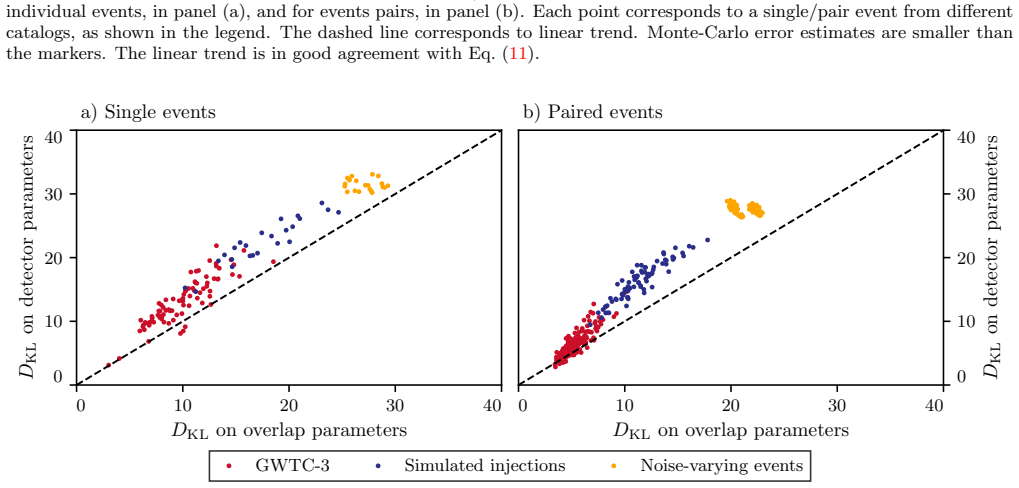
- The non-Gaussian parameter shift in the detector basis is better calibrated and more informative than the overlap basis, and it avoids false rejections caused by mass-spin degeneracy and multimodal localization.
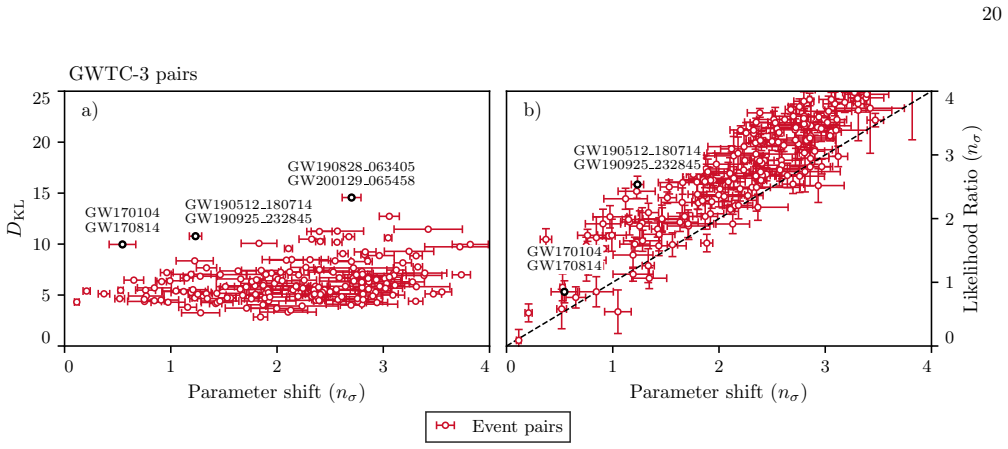
- The information-content plane (parameter-shift significance vs. KL divergence) provides a practical ranking tool for candidate selection that separates promising, ambiguous, and unlikely lensing pairs.
- The only surviving candidate in GWTC-3, GW170104-GW170814, matches a previously identified candidate, providing independent validation of the method against more costly techniques.
- The method is directly extendable to other event classes and to sub-threshold searches, with the caveat that the decision boundary in the information-content plane still needs calibration on larger simulated catalogs.
Where Pith is reading between the lines
- A natural testable extension is to calibrate the n_sigma-D_KL decision boundary on injection catalogs that reproduce GWTC-3's lower signal-to-noise ratios and strongly multimodal posteriors, since the current boundary is deduced from a small simulated sample.
- The reported significance of individual pairs, especially rejections like GW190828-GW200129, depends on the accuracy of flows for those specific events; a flow that fails the KS test could shift a pair's n_sigma by enough to change the candidate list.
- The likelihood-ratio statistic's chi-squared approximation is conservative in the sense that its true variance exceeds that of the approximating distribution, so reported rejection significances may be overestimated when parameters are only partially constrained.
- The same machinery, with the detector basis and information plane, could be applied to future catalogs with thousands of events, where the dominant bottleneck shifts from computational cost to the reliability of flow calibration across heterogeneous event morphologies.
Editorial analysis
A structured set of objections, weighed in public.
Referee Report
Summary. The paper develops a machine-learning workflow for identifying strongly lensed gravitational-wave candidates from event parameter posteriors. It extends the detector basis of Ezquiaga et al. with normalizing-flow density estimates, defines a KL-based information-content statistic, a non-Gaussian parameter-shift statistic, and a likelihood-ratio statistic whose null distribution is approximated as chi^2(Neff). Validation is carried out on two simulated catalogs: noise-varying realizations of a high-SNR event and 24 injections containing eight lensed pairs, followed by application to the 86 BBH events of GWTC-3. The central catalog claim is that only GW170104-GW170814 passes all criteria, while GW190512-GW190925 and GW190828-GW200129 are discarded mainly through the likelihood-ratio test. The normalizing-flow code is released as part of the tensiometer package.
Significance. If the calibration holds, this is a valuable methodological step: it replaces kernel-density and evidence-ratio bottlenecks with tractable flow-based statistics, demonstrates that the detector basis is more informative than the overlap basis, publicly releases the code, and independently recovers a previously discussed lensing candidate. The validation is honest about false negatives and about the limitations of the chi^2 approximation. However, the strongest catalog conclusion depends on a likelihood-ratio significance that the authors themselves show can overestimate rejection confidence, and whose null calibration is the weakest of the three estimators they consider. The manuscript is therefore a promising contribution whose headline GWTC-3 claim needs either empirical recalibration or careful softening.
major comments (3)
- [Sec. VIII and App. A.2, Eq. (19)] The rejection of GW190828-GW200129 at 4.5 sigma is load-bearing for the claim that GW170104-GW170814 is the only significant candidate. That rejection uses the likelihood-ratio statistic QL with significance assigned via the chi^2(Neff) approximation. Appendix A.2 proves that Var(QL) >= 2 Neff and states that the approximation 'can in principle overestimate the significance of rejection', being exact only when parameters are fully data- or prior-dominated. The text attributes the 4.5 sigma rejection to multimodal localization parameters, precisely the regime where the GLM assumptions underlying the approximation fail. Because the NV null calibration for QL is also the weakest of the three estimators (KS significance 5%, Fig. 5b), the 4.5 sigma number cannot be taken at face value. Please provide an empirical null calibration of QL on realistic low-SNR and multimodal pairs, or explicitly
- [Sec. VII A, Fig. 5(b)] The likelihood-ratio p-values on the noise-varying catalog have a KS significance of only 5%. This is above the 1% threshold customarily used to flag problems, but it is marginal, and the NV events are high-SNR and nearly Gaussian. The GWTC-3 pairs are lower SNR and markedly more non-Gaussian, as the paper itself documents in Appendix B. No null calibration is provided in that regime. The paper should either calibrate QL on simulated unlensed pairs with realistic non-Gaussianity or attach a systematic uncertainty to the reported n_sigma values for the likelihood-ratio test, particularly for the pairs that determine the final candidate list.
- [Sec. III and Sec. VIII] Only 90% of trained flows pass the KS test at the 5% level, compared with the 95% expected for perfect modeling; the text calls this 'very close to the ideal case'. For the specific events that drive the catalog conclusion (GW190828, GW200129, GW190512, GW190925), an inadequately trained flow could change both the parameter-shift and likelihood-ratio values. Flow variance is shown as error bars in the injection studies but is not propagated into the reported GWTC-3 significance values or the final selection decision. Please state which GWTC-3 flows, if any, fail the KS test and quantify how the final candidate list changes under flow-model uncertainty.
minor comments (5)
- [Sec. II, Eq. (1)] Typo in the text: 'the same gravitational wave eventh(t)' should read 'event h(t)'.
- [Sec. III] The architecture description '2 log2 Nparams spline flows' should define Nparams explicitly and indicate whether this is the number of parameters after pre-processing.
- [Fig. 5] The caption describes panel (a) as the parameter-shift estimator in two bases, but the figure also compares methods in panel (b). Please expand the caption so the two panels are independently described.
- [App. A.2] The sentence 'Wilks' theorem ensures that ... Delta theta_f = Delta theta_MAP' is misleading: for a fixed Delta theta_f this is an assumption about the null hypothesis, not a consequence of Wilks' theorem. Please rephrase.
- [Throughout] The detector-network name is rendered as 'L VK' with an extra space in several places; likely a typographical artifact.
Circularity Check
No significant circularity; the central claim is externally validated and not forced by fitted inputs.
full rationale
The derivation chain is self-contained. Parameter posteriors are taken from standard GW parameter estimation; normalizing flows are validated by KS tests; the KL, parameter-shift, and likelihood-ratio statistics are defined from those posteriors/priors without fitting any parameter to the lensing conclusion. The method is calibrated on two independent simulated catalogs (NV and GW injections) with known lensing status, and the GWTC-3 application uses a preselection rule fixed before application rather than tuned to recover GW170104-GW170814. The detector basis and tensiometer machinery are cited from the authors' prior work, but the paper independently demonstrates the basis' information content and the flows' accuracy; these citations are not used as unexamined constraints. The main caveats — QL's chi^2(Neff) approximation can overestimate rejection confidence (App. A2), and the LR's empirical KS significance on NV is 5% (Fig. 5b) — are calibration limitations that could weaken the rejection of pairs such as GW190828-GW200129, but they are not circular reductions: the significance is not constructed to equal the conclusion. Hence no step reduces by definition to its inputs.
Axiom & Free-Parameter Ledger
free parameters (3)
- Preselection threshold for Gaussian shift =
n_sigma <= 4
- Decision boundary in the n_sigma-D_KL plane =
Diagonal line, not quantified
- KS-test acceptance threshold for flows =
5%
axioms (5)
- domain assumption Strong lensing produces repeated chirps differing only by magnification, time delay and Morse phase (Eq. 1).
- domain assumption The waveform model and the bilby parameter estimation posteriors faithfully characterize each event.
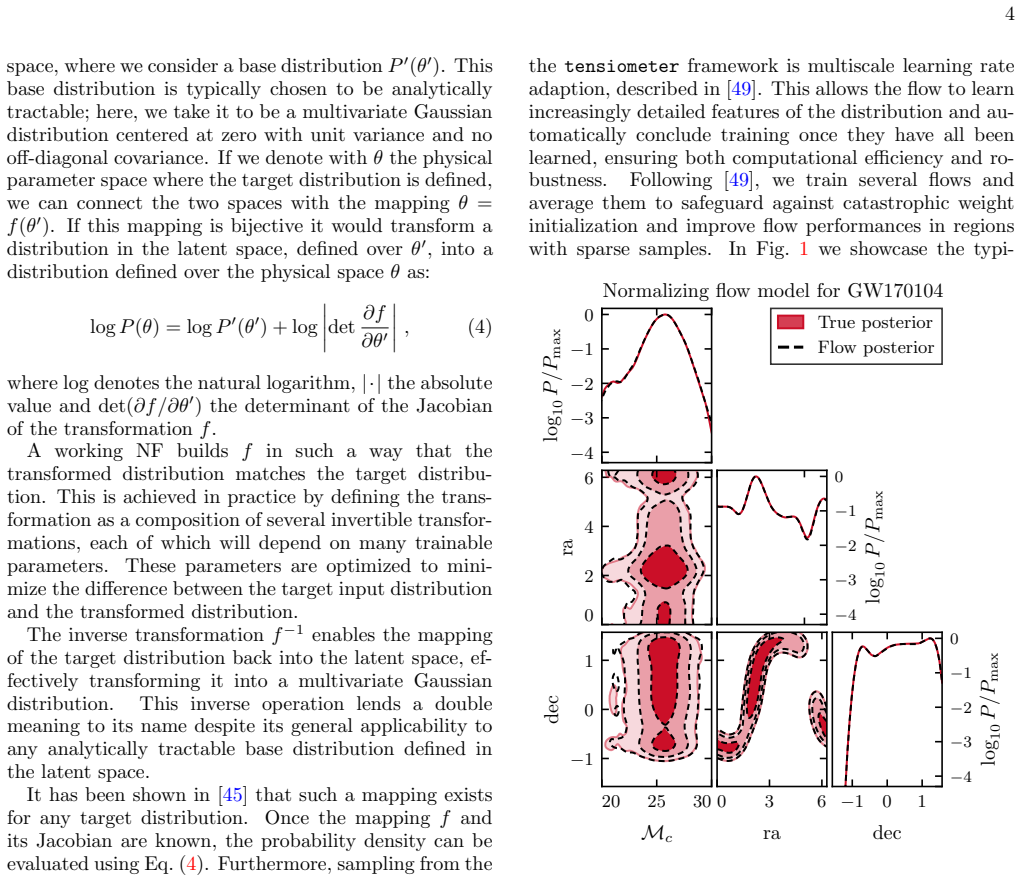
- standard math Normalizing flows can accurately represent GW posteriors, including periodic and multimodal features.
- standard math The likelihood ratio test statistic Q_L is approximately chi^2(Neff), extending Wilks' theorem to the MAP point.
- domain assumption Projecting one event's posterior into the detector basis of the other preserves the lensing consistency signal.
Cite this review
Pith. "Pith review of Machine Learning Assisted Parameter-Space Searches for Lensed Gravitational Waves." pith.science (2026). https://pith.science/paper/UBBTOVWD
@misc{pith2026250906901,
  author       = {Pith},
  title        = {Pith review of: Machine Learning Assisted Parameter-Space Searches for Lensed Gravitational Waves},
  year         = {2026},
  howpublished = {\url{https://pith.science/paper/UBBTOVWD}},
  note         = {Machine review of arXiv:2509.06901}
}
read the original abstract
When a gravitational wave encounters a massive object along the line of sight, repeated copies of the original signal may be produced due to gravitational lensing. In this paper, we develop a series of new machine-learning based statistical methods to identify promising strong lensing candidates in gravitational wave catalogs. We employ state-of-the-art normalizing flow generative models to perform statistical calculations on the posterior distributions of gravitational wave events that would otherwise be computationally unfeasible. Our lensing identification strategy, developed on two simulated gravitational wave catalogs that test noise realization and event signal variations, selects event pairs with low parameter differences in the optimal detector basis that also have a high information content and favorable likelihood for coincident parameters. We then apply our method to the GWTC-3 catalog and find a single pair still consistent with the lensing hypothesis. This pair has been previously identified through more costly evidence ratio techniques, but rejected on astrophysical grounds, which further validates our technique.
Figures








Forward citations
Cited by 2 Pith papers
-
Search for strong lensing of gravitational waves in the binary black hole events from O1-O4a
Posterior Overlap 2.0 finds no lensed BBH pairs in O1–O4a (p_L < 0.6% for all pairs) and sets a 90% upper bound of 1.4% on the strong-lensing fraction.
-
Identifying lensed gravitational waves with physics-informed posterior learning
Fusing a simulation-trained common-source mass posterior with waveform features raises lensed-event detection efficiency from 20.8% to 35.2% at 1% false-positive rate and lowers the SNR for 50% efficiency from 45.3 to 33.5.
Reference graph
Works this paper leans on
-
[1]
Lensing significance in different parameter bases We begin by comparing the significance of the parame- ter shift and likelihood ratio test statistics in the detector basis and overlap parameter bases, as shown in Fig. 7. Comparing the significance of detector basis and over- lap basis lensing results, we find that in both bases the majority of lensed pai...
-
[2]
Lensing significance with different estimators In this section, we compare different estimators within the same parameter basis. In particular, based on the conclusions drawn in the previous section, we focus on results obtained in the detector basis only, and we show these results in Fig. 11. For typical pairsn σ is highly correlated between the estimato...
work page 2020
- [3]
-
[4]
(6), and we derive the for- mula for the KL divergence averaged over data realiza- tions, Eq
Proofs of Sec IV A In the following, we demonstrate the validity of the data processing inequality (DPI) for the Kullback- Leibler (KL) divergence, Eq. (6), and we derive the for- mula for the KL divergence averaged over data realiza- tions, Eq. (11), both presented in Sec. IV A. Consider a non-invertible transformationf:θ→ θ′ =f(θ). We express the distri...
-
[5]
IV C, along with the method used to approximate its distribution
Proofs of Sec IV C In this appendix, we provide additional details con- cerning the likelihood ratio test statistic introduced in Sec. IV C, along with the method used to approximate its distribution. Consider the likelihood ratio test statistic defined in Eq. (18). In the GLM formalism it can be rewritten as: QL ≡(∆θ f −∆θ ML)T C−1(∆θf −∆θ ML) (A16) −(∆θ...
-
[6]
Schneider, J
P. Schneider, J. Ehlers, and E. E. Falco,Gravitational Lenses, Astronomy and Astrophysics Library (Springer, 1992)
1992
- [7]
-
[8]
R. Takahashi and T. Nakamura, Astrophys. J.595, 1039 (2003), arXiv:astro-ph/0305055
Pith/arXiv arXiv 2003
-
[9]
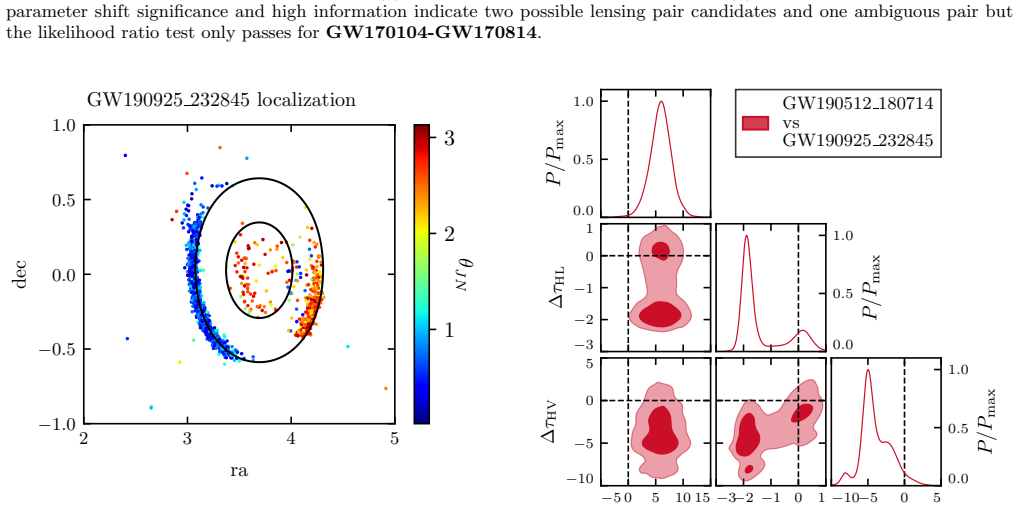
J. M. Ezquiaga, D. E. Holz, W. Hu, M. Lagos, and R. M. Wald, Phys. Rev. D103, 064047 (2021), arXiv:2008.12814 [gr-qc]. 26 0.0 0.5 1.0 P/P max 0.0 0.5 1.0 P/P max −5 0 5 10 15 log L 0.0 0.5 1.0 P/P max 0 2 4 ∆τHL −5 0 5 10 15 log L −10 0 10 ∆τHV −10 0 10 ∆τHV GW190512 180714 vs GW190925 232845 Gaussian approximation FIG. 18. Posterior distributions for par...
Pith/arXiv arXiv 2021
-
[10]
R. K. L. Lo, L. Vujeva, J. M. Ezquiaga, and J. C. L. Chan, Phys. Rev. Lett.134, 151401 (2025), arXiv:2407.17547 [gr-qc]
Pith/arXiv arXiv 2025
-
[11]
J. M. Ezquiaga, R. K. L. Lo, and L. Vujeva, (2025), arXiv:2503.22648 [gr-qc]
Pith/arXiv arXiv 2025
-
[12]
T. T. Nakamura and S. Deguchi, Prog. Theor. Phys. Suppl.133, 137 (1999)
1999
-
[13]
M. C ¸ alı¸ skan, J. M. Ezquiaga, O. A. Hannuksela, and D. E. Holz, Phys. Rev. D107, 063023 (2023), arXiv:2201.04619 [astro-ph.CO]
Pith/arXiv arXiv 2023
- [14]
-
[15]
Aasiet al.(LIGO Scientific), Class
J. Aasiet al.(LIGO Scientific), Class. Quant. Grav.32, 074001 (2015), arXiv:1411.4547 [gr-qc]
Pith/arXiv arXiv 2015
-
[16]
F. Acerneseet al.(VIRGO), Class. Quant. Grav.32, 024001 (2015), arXiv:1408.3978 [gr-qc]
Pith/arXiv arXiv 2015
-
[17]
Akutsuet al.(KAGRA), PTEP2021, 05A101 (2021), arXiv:2005.05574 [physics.ins-det]
T. Akutsuet al.(KAGRA), PTEP2021, 05A101 (2021), arXiv:2005.05574 [physics.ins-det]
arXiv 2021
-
[18]
K. K. Y. Ng, K. W. K. Wong, T. Broadhurst, and T. G. F. Li, Phys. Rev. D97, 023012 (2018), arXiv:1703.06319 [astro-ph.CO]
Pith/arXiv arXiv 2018
-
[20]
Abbottet al.(LIGO Scientific, VIRGO), Astrophys
R. Abbottet al.(LIGO Scientific, VIRGO), Astrophys. J.923, 14 (2021), arXiv:2105.06384 [gr-qc]
Pith/arXiv arXiv 2021
-
[21]
J. Janquartet al., Mon. Not. Roy. Astron. Soc.526, 3832 (2023), arXiv:2306.03827 [gr-qc]
Pith/arXiv arXiv 2023
-
[23]
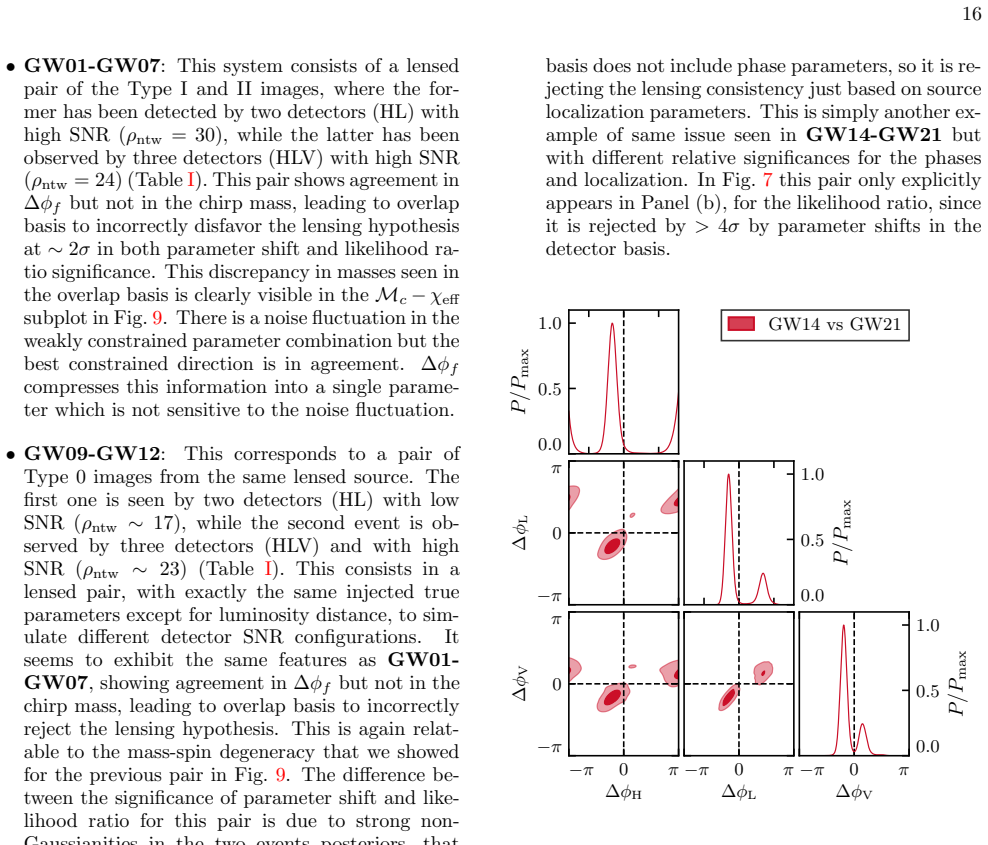
(Table I). The significance of the rejection is higher in the detector basis because the overlap basis does not include phase parameters, so it is re- jecting the lensing consistency just based on source localization parameters. This is simply another ex- ample of same issue seen inGW14-GW21but with different relative significances for the phases and loca...
-
[24]
S.-S. Li, S. Mao, Y. Zhao, and Y. Lu, Mon. Not. Roy. Astron. Soc.476, 2220 (2018), arXiv:1802.05089 [astro- ph.CO]
Pith/arXiv arXiv 2018
-
[25]
F. Xu, J. M. Ezquiaga, and D. E. Holz, Astrophys. J. 929, 9 (2022), arXiv:2105.14390 [astro-ph.CO]
Pith/arXiv arXiv 2022
-
[26]
S. Goyal, H. D., S. J. Kapadia, and P. Ajith, Phys. Rev. D104, 124057 (2021), arXiv:2106.12466 [gr-qc]
Pith/arXiv arXiv 2021
-
[27]
S. Magare, A. More, and S. Choudhary, Mon. Not. Roy. Astron. Soc.535, 990 (2024), arXiv:2403.02994 [astro- ph.HE]
Pith/arXiv arXiv 2024
-
[28]
A. Chakraborty and S. Mukherjee, Astrophys. J.984, 107 (2025), arXiv:2410.06995 [gr-qc]
Pith/arXiv arXiv 2025
-
[29]
K. Haris, A. K. Mehta, S. Kumar, T. Venumadhav, and P. Ajith, (2018), arXiv:1807.07062 [gr-qc]
Pith/arXiv arXiv 2018
-
[30]
A. Barsode, S. Goyal, and P. Ajith, Astrophys. J.980, 258 (2025), arXiv:2412.01278 [gr-qc]
Pith/arXiv arXiv 2025
-
[31]
R. K. L. Lo and I. Magana Hernandez, Phys. Rev. D 107, 123015 (2023), arXiv:2104.09339 [gr-qc]
Pith/arXiv arXiv 2023
-
[32]
J. Janquart, O. A. Hannuksela, H. K., and C. Van Den Broeck, Mon. Not. Roy. Astron. Soc.506, 5430 (2021), arXiv:2105.04536 [gr-qc]
Pith/arXiv arXiv 2021
-
[33]
A. K. Y. Li, R. K. L. Lo, S. Sachdev, J. C. L. Chan, E. T. Lin, T. G. F. Li, and A. J. Weinstein (LIGO Scientific, Virgo), Phys. Rev. D107, 123014 (2023), arXiv:1904.06020 [gr-qc]
Pith/arXiv arXiv 2023
-
[34]
A. K. Y. Li, J. C. L. Chan, H. Fong, A. H. Y. Chong, A. J. Weinstein, and J. M. Ezquiaga, (2023), arXiv:2311.06416 [gr-qc]
arXiv 2023
-
[35]
S. Goyal, S. J. Kapadia, J.-R. Cudell, A. K. Y. Li, and J. C. L. Chan, Phys. Rev. D109, 023028 (2024), arXiv:2306.04397 [gr-qc]
Pith/arXiv arXiv 2024
-
[36]
lenscat: a Public and Community-Contributed Catalog of Known Strong Gravitational Lenses
L. Vujeva, R. K. L. Lo, J. M. Ezquiaga, and J. C. L. 27 Chan, Phil. Trans. Roy. Soc. Lond. A383, 20240168 (2025), arXiv:2406.04398 [astro-ph.GA]
work page internal anchor Pith review Pith/arXiv arXiv 2025
- [37]
-
[38]
C. J. Stone, The Annals of Statistics8, 1348 (1980)
work page 1980
-
[39]
D. W. Scott and M. P. Wand, Biometrika78, 197 (1991)
work page 1991
-
[40]
M. Raveri and C. Doux, Phys. Rev. D104, 043504 (2021), arXiv:2105.03324 [astro-ph.CO]
Pith/arXiv arXiv 2021
-
[41]
J. M. Ezquiaga, W. Hu, and R. K. L. Lo, Phys. Rev. D 108, 103520 (2023), arXiv:2308.06616 [astro-ph.CO]
work page internal anchor Pith review Pith/arXiv arXiv 2023
-
[42]
N. Christensen and R. Meyer, Rev. Mod. Phys.94, 025001 (2022), arXiv:2204.04449 [gr-qc]
Pith/arXiv arXiv 2022
-
[43]
Abbottet al.(LIGO Scientific, KAGRA, VIRGO), Astrophys
R. Abbottet al.(LIGO Scientific, KAGRA, VIRGO), Astrophys. J.970, 191 (2024), arXiv:2304.08393 [gr-qc]
Pith/arXiv arXiv 2024
-
[44]
O. A. Hannuksela, K. Haris, K. K. Y. Ng, S. Kumar, A. K. Mehta, D. Keitel, T. G. F. Li, and P. Ajith, Astrophys. J. Lett.874, L2 (2019), arXiv:1901.02674 [gr- qc]
Pith/arXiv arXiv 2019
-
[45]
A. Garr´ on and D. Keitel, Class. Quant. Grav.41, 015005 (2024), arXiv:2306.12908 [gr-qc]
work page internal anchor Pith review Pith/arXiv arXiv 2024
-
[46]
G. Papamakarios and I. Murray, (2016), arXiv:1605.06376 [stat.ML]
Pith/arXiv arXiv 2016
-
[47]
D. P. Kingma, T. Salimans, R. Jozefowicz, X. Chen, I. Sutskever, and M. Welling, (2016), arXiv:1606.04934 [cs.LG]
Pith/arXiv arXiv 2016
-
[48]
D. J. Rezende and S. Mohamed, (2015), arXiv:1505.05770 [stat.ML]
Pith/arXiv arXiv 2015
-
[49]
G. Papamakarios, T. Pavlakou, and I. Murray, (2017), arXiv:1705.07057 [stat.ML]
Pith/arXiv arXiv 2017
-
[50]
S. Chen and R. Gopinath, inAdvances in Neural Infor- mation Processing Systems, Vol. 13, edited by T. Leen, T. Dietterich, and V. Tresp (MIT Press, 2000)
work page 2000
-
[51]
M. Raveri and W. Hu, Phys. Rev. D99, 043506 (2019), arXiv:1806.04649 [astro-ph.CO]
Pith/arXiv arXiv 2019
-
[52]
C. Durkan, A. Bekasov, I. Murray, and G. Papamakar- ios, arXiv e-prints (2019), 10.48550/arXiv.1906.04032, arXiv:1906.04032 [stat.ML]
-
[53]
Normalizing Flows on Tori and Spheres
D. Jimenez Rezende, G. Papamakarios, S. Racani` ere, M. S. Albergo, G. Kanwar, P. E. Shanahan, and K. Cranmer, (2020), arXiv:2002.02428 [stat.ML]
work page internal anchor Pith review Pith/arXiv arXiv 2020
-
[54]
M. Raveri, C. Doux, and S. Pandey, (2024), arXiv:2409.09101 [astro-ph.IM]
Pith/arXiv arXiv 2024
-
[55]
A. Coccaro, M. Letizia, H. Reyes-Gonzalez, and R. Torre, Symmetry16, 942 (2024), arXiv:2302.12024 [stat.ML]
Pith/arXiv arXiv 2024
-
[56]
N. J. Beaudry and R. Renner, arXiv e-prints , arXiv:1107.0740 (2011), arXiv:1107.0740 [quant-ph]
Pith/arXiv arXiv 2011
-
[57]
Albrechtet al., (2006), arXiv:astro-ph/0609591
A. Albrechtet al., (2006), arXiv:astro-ph/0609591
Pith/arXiv arXiv 2006
-
[58]
Decision-theoretic justifications for Bayesian hypothesis testing using credible sets
M. Thulin, arXiv e-prints , arXiv:1210.1066 (2012), arXiv:1210.1066 [math.ST]
work page internal anchor Pith review Pith/arXiv arXiv 2012
-
[59]
S. S. Wilks, Annals Math. Statist.9, 60 (1938)
1938
-
[60]
G. Ashtonet al., Astrophys. J. Suppl.241, 27 (2019), arXiv:1811.02042 [astro-ph.IM]
Pith/arXiv arXiv 2019
-
[61]
L. S. Collaboration, https://dcc.ligo.org/LIGO- T2000012-v1/public
-
[62]
Abbottet al.(KAGRA, VIRGO, LIGO Scientific), Phys
R. Abbottet al.(KAGRA, VIRGO, LIGO Scientific), Phys. Rev. X13, 041039 (2023), arXiv:2111.03606 [gr- qc]
Pith/arXiv arXiv 2023
-
[63]
L. Dai, B. Zackay, T. Venumadhav, J. Roulet, and M. Zaldarriaga, (2020), arXiv:2007.12709 [astro-ph.HE]
Pith/arXiv arXiv 2020
-
[64]
X. Liu, I. Magana Hernandez, and J. Creighton, Astro- phys. J.908, 97 (2021), arXiv:2009.06539 [astro-ph.HE]. [60]tensiometer, https://github.com/mraveri/tensiometer
Pith/arXiv arXiv 2021
-
[65]
G. P. Smithet al., Phil. Trans. Roy. Soc. Lond. A383, 20240134 (2025), arXiv:2503.19973 [astro-ph.HE]
Pith/arXiv arXiv 2025
-
[66]
A. M. Mathai and S. B. Provost, Statistics: A Series of Textbooks and Monographs (1992)
work page 1992
-
[67]
H. Liu, Y. Tang, and H. H. Zhang, Computational Statistics & Data Analysis54, 858 (2010)
work page 2010
-
[68]
P. B. Patnaik, Biometrika37, 78 (1950)
work page 1950
discussion (0)
Sign in with ORCID, Apple, or X to comment. Anyone can read and Pith papers without signing in.