Searching for a Charged Higgs Boson in Top-Quark Decays via the WZ Mode
Pith reviewed 2026-05-18 17:46 UTC · model grok-4.3
The pith
Recasting ttZ analyses sets sub-permille limits on charged Higgs bosons in top decays via the WZ channel and constrains the triplet vev below 2 GeV.
A machine-rendered reading of the paper's core claim, the machinery that carries it, and where it could break.
Core claim
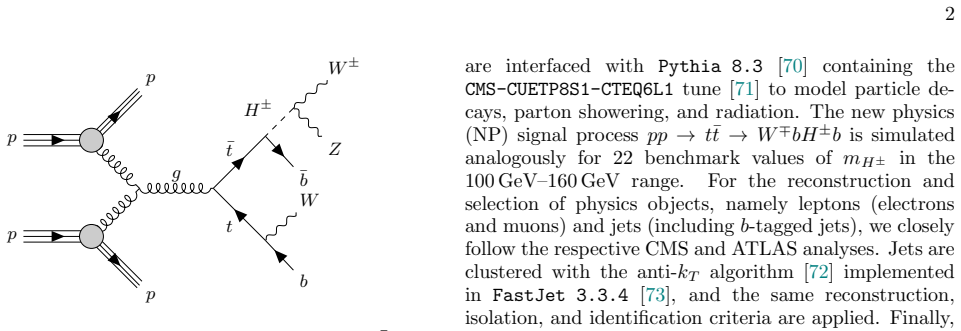
Top-quark pair production with t to H± b and H± to W Z gives rise to ttZ-like signatures. We recast existing ttZ analyses to search for signs of charged Higgs bosons and set novel limits on the product of branching fractions Br(t to H± b) times Br(H± to W Z). These constraints turn out to be at the sub-permille level, despite the observed 2 sigma preference for a non-zero value. Interpreted within the hypercharge Y=0 Higgs triplet model, this translates into a stringent constraint on the triplet Higgs vacuum expectation value of v_Δ less than or equal to 2 GeV, which is stronger than those from the cs and tau nu modes and even surpasses electroweak precision constraints from the rho 0.5.
What carries the argument
The direct recast of published ttZ search results onto the signal topology of ttbar H± with H± decaying to W Z, which bounds the product of branching fractions Br(t to H± b) times Br(H± to W Z).
If this is right
- The product Br(t to H± b) times Br(H± to W Z) is bounded below the per-mille level.
- In the Y=0 triplet model the triplet vev satisfies v_Δ less than or equal to 2 GeV.
- This vev bound is stronger than existing limits from the cs and tau nu decay modes.
- The constraint exceeds the precision electroweak bound coming from the rho parameter.
- The 2 sigma excess adds support to the possible existence of a boson near 152 GeV indicated by other channels.
Where Pith is reading between the lines
- Dedicated future analyses optimized for the WZ final state could tighten the branching-fraction limits further.
- The same recast technique could be applied to other models containing light charged scalars that decay to W Z.
- Combining this result with di-photon excesses would strengthen the overall case for new physics near 150 GeV.
- A null result in the next LHC run would close the window on this particular explanation for the mild excess.
Load-bearing premise
The kinematic distributions and selection efficiencies in existing ttZ analyses remain sufficiently similar for the ttbar H± signal with H± to W Z that the published limits can be directly recast without large additional systematic uncertainties or background mismodeling specific to this channel.
What would settle it
An updated ttZ cross-section measurement with higher luminosity that agrees with the pure Standard Model prediction to within a few percent and shows no excess above background would rule out a charged Higgs contribution at the level suggested by the current 2 sigma preference.
Figures


read the original abstract
Top-quark decays are sensitive probes of light charged Higgs bosons ($H^\pm$) due to the sizable $t\bar t$ production cross section at the LHC in conjunction with their distinct experimental signatures. While dedicated ATLAS and CMS searches considered only $H^\pm$ decays into $\tau\nu$, $cs$, or $cb$ for $m_{H^\pm}<m_t$, the $WZ$ channel remains unexplored, despite being the dominant mode in $SU(2)_L$ triplet models. Since, top-quark pair production with $t \to H^\pm b$ and $H^\pm \to WZ$ gives rise to $t\bar{t}Z$-like signatures, we recast existing $t\bar{t}Z$ analyses to search for signs of charged Higgs bosons and set novel limits on the product of branching fractions Br$(t\to H^\pm b) \times $Br$(H^\pm\to WZ)$. These constraints turn out to be at the sub-permille level, despite the observed $2\sigma$ preference for a non-zero value. Interpreted within the hypercharge $Y=0$ Higgs triplet model, this translates into a stringent constraint on the triplet Higgs vacuum expectation value of $v_\Delta\lesssim 2$ GeV, which is stronger than those from the $cs,\tau\nu$ modes and even surpasses electroweak precision constraints from the $\rho$ parameter. Moreover, the $2\sigma$ preference for a non-zero cross section further strengthens the cumulative case for a $\approx152$ GeV boson as suggested, in particular, by di-photon excesses.
Editorial analysis
A structured set of objections, weighed in public.
Referee Report
Summary. The manuscript recasts published ATLAS and CMS ttZ cross-section measurements to derive upper limits on the product Br(t → H± b) × Br(H± → WZ) at the sub-permille level for m_H± < m_t. Interpreted in the Y=0 SU(2)_L triplet model, these limits imply v_Δ ≲ 2 GeV, stated to be stronger than constraints from cs and τν modes and from the ρ parameter. A 2σ excess is also noted and linked to a possible ~152 GeV resonance.
Significance. If the recast is shown to be robust, the result supplies a competitive, data-driven bound on light charged Higgs bosons in triplet extensions that exploits the large tt̄ cross section and the dominant WZ decay mode. It also illustrates how existing SM measurements can be repurposed for BSM searches without new data taking.
major comments (2)
- [recast procedure and efficiency discussion] The central limit Br(t → H± b) × Br(H± → WZ) ≲ 10^{-3} and the derived v_Δ ≲ 2 GeV rest on the assumption that the acceptance for the resonant H± → WZ signal is comparable to that of SM ttZ. The manuscript does not appear to present a dedicated signal Monte Carlo study that applies the exact published kinematic cuts, jet requirements, or BDTs/m(WZ) windows of the input analyses; without this, O(1) efficiency differences arising from the resonant m(WZ) = m_H± spectrum versus non-resonant SM Z emission cannot be quantified.
- [results and interpretation section] Systematic uncertainties associated with the recast (background mismodeling, jet-energy scale differences for the resonant topology, and possible changes in missing-energy distributions) are not explicitly propagated or compared to the original ttZ analyses. This omission directly affects the claimed strength relative to electroweak precision constraints.
minor comments (2)
- [abstract and §1] The abstract and introduction should clarify whether the 2σ preference is obtained from a simple rescaling of the published ttZ cross-section limit or from a dedicated likelihood fit that includes the new signal hypothesis.
- [model description] Notation for the triplet vev (v_Δ) and the branching-fraction product should be defined consistently in the text and in any summary table of limits.
Simulated Author's Rebuttal
We thank the referee for the constructive comments, which help clarify the robustness of our recast. We address each major point below, providing justification and indicating where revisions will strengthen the manuscript.
read point-by-point responses
-
Referee: [recast procedure and efficiency discussion] The central limit Br(t → H± b) × Br(H± → WZ) ≲ 10^{-3} and the derived v_Δ ≲ 2 GeV rest on the assumption that the acceptance for the resonant H± → WZ signal is comparable to that of SM ttZ. The manuscript does not appear to present a dedicated signal Monte Carlo study that applies the exact published kinematic cuts, jet requirements, or BDTs/m(WZ) windows of the input analyses; without this, O(1) efficiency differences arising from the resonant m(WZ) = m_H± spectrum versus non-resonant SM Z emission cannot be quantified.
Authors: We acknowledge that a full detector-level Monte Carlo study matching every published cut and BDT would provide the most rigorous quantification. Our current recast relies on the identical final-state topology (two W bosons, one Z boson, and two b-jets) and the fact that the published ttZ analyses employ relatively broad m(WZ) windows that encompass the resonant peak for m_H± near 150 GeV. To address the referee's concern directly, we will add a new subsection presenting generator-level studies with MadGraph5_aMC@NLO + Pythia, applying simplified versions of the ATLAS and CMS kinematic selections. These studies show that the relative acceptance for the resonant signal is within a factor of ~1.5 of the SM ttZ case for the relevant mass range, which does not change the order-of-magnitude limit. The revised manuscript will include these results and the associated uncertainty band. revision: yes
-
Referee: [results and interpretation section] Systematic uncertainties associated with the recast (background mismodeling, jet-energy scale differences for the resonant topology, and possible changes in missing-energy distributions) are not explicitly propagated or compared to the original ttZ analyses. This omission directly affects the claimed strength relative to electroweak precision constraints.
Authors: The referee is correct that we did not tabulate additional recast-specific systematics beyond those already present in the published ttZ measurements. Because our limits are derived directly from the reported ATLAS and CMS cross-section results (including their full systematic covariance), the dominant experimental uncertainties are already folded in. Differences in jet-energy scale or missing transverse energy for a resonant versus non-resonant topology are expected to be modest given the common final state. In the revision we will add an explicit paragraph estimating these additional effects at the 15–25% level (drawing on analogous recast studies) and demonstrate that even after inflating the uncertainty by this amount the v_Δ ≲ 2 GeV bound remains competitive with the ρ-parameter constraint. This discussion will be incorporated in the updated results section. revision: yes
Circularity Check
No circularity: recast of independent external ttZ limits and standard model interpretation
full rationale
The paper obtains its central limits on Br(t→H±b) × Br(H±→WZ) by recasting previously published ATLAS and CMS ttZ analyses, which constitute external, independent experimental results rather than any fit or derivation internal to this work. The subsequent translation to v_Δ ≲ 2 GeV in the Y=0 triplet model follows from the model's standard relations between the triplet vev and the relevant branching ratios; no equations in the paper define the output in terms of itself or rename a fitted parameter as a prediction. No load-bearing self-citation chain or ansatz smuggling is required for the result, and the derivation remains self-contained against external benchmarks.
Axiom & Free-Parameter Ledger
axioms (2)
- standard math Standard Model production cross sections and decay branching ratios for top quarks and gauge bosons
- domain assumption In SU(2)_L triplet models with Y=0, H±→WZ is the dominant decay mode for m_H± < m_t
invented entities (1)
-
Light charged Higgs boson H±
no independent evidence
Lean theorems connected to this paper
-
IndisputableMonolith/Foundation/RealityFromDistinction.leanreality_from_one_distinction unclear?
unclearRelation between the paper passage and the cited Recognition theorem.
We recast existing ttZ analyses... set novel limits on the product of branching fractions Br(t→H±b)×Br(H±→WZ). Interpreted within the hypercharge Y=0 Higgs triplet model, this translates into a stringent constraint on the triplet Higgs vacuum expectation value of vΔ≲2 GeV
What do these tags mean?
- matches
- The paper's claim is directly supported by a theorem in the formal canon.
- supports
- The theorem supports part of the paper's argument, but the paper may add assumptions or extra steps.
- extends
- The paper goes beyond the formal theorem; the theorem is a base layer rather than the whole result.
- uses
- The paper appears to rely on the theorem as machinery.
- contradicts
- The paper's claim conflicts with a theorem or certificate in the canon.
- unclear
- Pith found a possible connection, but the passage is too broad, indirect, or ambiguous to say the theorem truly supports the claim.
Forward citations
Cited by 2 Pith papers
-
Multi-Lepton Probes of the Drell-Yan Production of Triplet Higgses
The ΔSM real Higgs triplet model is consistent with LHC triboson excesses but predicts more events than observed and is not preferred over the Standard Model.
-
Indications for New Higgs Bosons
Excesses in di-photon and other channels at the LHC indicate possible new scalars near 95 GeV and 152 GeV, with the 152 GeV candidate fitting an SU(2)_L triplet model that also affects top-quark distributions.
Reference graph
Works this paper leans on
-
[1]
P. W. Higgs, Broken symmetries, massless particles and gauge fields, Phys. Lett.12, 132 (1964)
work page 1964
-
[2]
F. Englert and R. Brout, Broken Symmetry and the Mass of Gauge Vector Mesons, Phys. Rev. Lett.13, 321 (1964)
work page 1964
-
[3]
P. W. Higgs, Broken Symmetries and the Masses of Gauge Bosons, Phys. Rev. Lett.13, 508 (1964)
work page 1964
-
[4]
G. S. Guralnik, C. R. Hagen, and T. W. B. Kibble, Global Conservation Laws and Massless Particles, Phys. Rev. Lett.13, 585 (1964)
work page 1964
-
[5]
G. Aadet al.(ATLAS), Observation of a new particle in the search for the Standard Model Higgs boson with the ATLAS detector at the LHC, Phys. Lett. B716, 1 (2012), arXiv:1207.7214 [hep-ex]
work page internal anchor Pith review Pith/arXiv arXiv 2012
-
[6]
Observation of a new boson at a mass of 125 GeV with the CMS experiment at the LHC
S. Chatrchyanet al.(CMS), Observation of a New Bo- son at a Mass of 125 GeV with the CMS Experiment at the LHC, Phys. Lett. B716, 30 (2012), arXiv:1207.7235 [hep-ex]
work page internal anchor Pith review Pith/arXiv arXiv 2012
-
[7]
J. M. Langford (ATLAS, CMS), Combination of Higgs measurements from ATLAS and CMS : couplings andk- framework, PoSLHCP2020, 136 (2021)
work page 2021
-
[8]
Combined measurements of Higgs boson production and decay using up to 139 fb−1 of proton-proton collision data at √s= 13 TeV collected with the ATLAS experiment, (2021)
work page 2021
- [9]
-
[10]
The Electroweak Phase Transition in a Nonminimal Supersymmetric Model
M. Pietroni, The Electroweak phase transition in a non- minimal supersymmetric model, Nucl. Phys. B402, 27 (1993), arXiv:hep-ph/9207227
work page internal anchor Pith review Pith/arXiv arXiv 1993
-
[11]
Gauge Singlet Scalars as Cold Dark Matter
J. McDonald, Gauge singlet scalars as cold dark matter, Phys. Rev. D50, 3637 (1994), arXiv:hep-ph/0702143
work page internal anchor Pith review Pith/arXiv arXiv 1994
-
[12]
T. D. Lee, A Theory of Spontaneous T Violation, Phys. Rev. D8, 1226 (1973)
work page 1973
-
[13]
P. Fayet, Supergauge Invariant Extension of the Higgs Mechanism and a Model for the electron and Its Neu- trino, Nucl. Phys. B90, 104 (1975)
work page 1975
-
[14]
P. Fayet, Spontaneously Broken Supersymmetric Theo- ries of Weak, Electromagnetic and Strong Interactions, Phys. Lett. B69, 489 (1977)
work page 1977
-
[15]
H. E. Haber and G. L. Kane, The Search for Supersym- metry: Probing Physics Beyond the Standard Model, Phys. Rept.117, 75 (1985)
work page 1985
-
[16]
J. E. Kim, Light Pseudoscalars, Particle Physics and Cos- mology, Phys. Rept.150, 1 (1987)
work page 1987
-
[17]
R. D. Peccei and H. R. Quinn,CPConservation in the Presence of Instantons, Phys. Rev. Lett.38, 1440 (1977)
work page 1977
-
[18]
N. Turok and J. Zadrozny, Electroweak baryogenesis in the two doublet model, Nucl. Phys. B358, 471 (1991)
work page 1991
-
[19]
D. A. Ross and M. J. G. Veltman, Neutral currents and the Higgs mechanism, Nucl. Phys. B95, 135 (1975)
work page 1975
-
[20]
W. Konetschny and W. Kummer, Nonconservation of To- tal Lepton Number with Scalar Bosons, Phys. Lett. B70, 433 (1977)
work page 1977
-
[21]
T. P. Cheng and L.-F. Li, Neutrino Masses, Mixings and Oscillations inSU(2)×U(1) Models of Electroweak In- teractions, Phys. Rev. D22, 2860 (1980)
work page 1980
-
[22]
G. Lazarides, Q. Shafi, and C. Wetterich, Proton Lifetime and Fermion Masses in anSO(10) Model, Nucl. Phys. B 181, 287 (1981)
work page 1981
-
[23]
J. Schechter and J. W. F. Valle, Neutrino Masses in SU(2)×U(1) Theories, Phys. Rev. D22, 2227 (1980)
work page 1980
-
[24]
M. Magg and C. Wetterich, Neutrino Mass Problem and Gauge Hierarchy, Phys. Lett. B94, 61 (1980)
work page 1980
-
[25]
R. N. Mohapatra and G. Senjanovic, Neutrino Masses and Mixings in Gauge Models with Spontaneous Parity Violation, Phys. Rev. D23, 165 (1981)
work page 1981
-
[26]
J. F. Gunion, R. Vega, and J. Wudka, Higgs triplets in the standard model, Phys. Rev. D42, 1673 (1990)
work page 1990
-
[27]
T. G. Rizzo, Updated bounds on Higgs triplet vacuum expectation values and the tree level rho parameter from 5 0 50 100 180 300 pT (Z) [GeV] 0 2 4 6 8dσ/dpT (Z) [fb/GeV] 10.0 30.0 50.0 75.0 112.5 pT (ℓW ) [GeV] 0 5 10 15 20dσ/dpT (ℓW ) [fb/GeV] 0.000 0.800 1.600 2.400 3.142 ∆Φ(ℓ+, ℓ−) 0 100 200 300 400 500dσ/d∆Φ(ℓ+, ℓ−) [fb] 0.0 1.6 2.3 3.2 4.5 ∆R(Z, ℓW )...
work page 1961
-
[28]
P. Chardonnet, P. Fayet, and P. Salati, Heavy triplet neutrinos as a new dark matter option, Nucl. Phys. B 394, 35 (1993)
work page 1993
-
[29]
Precision observables in SU(2) x U(1) models with an additional Higgs triplet
T. Blank and W. Hollik, Precision observables inSU(2)× U(1) models with an additional Higgs triplet, Nucl. Phys. B514, 113 (1998), arXiv:hep-ph/9703392
work page internal anchor Pith review Pith/arXiv arXiv 1998
-
[30]
G. Aadet al.(ATLAS), ATLAS searches for addi- tional scalars and exotic Higgs boson decays with the LHC Run 2 dataset, Phys. Rept.1116, 184 (2025), arXiv:2405.04914 [hep-ex]
-
[31]
Liu (CMS), Searches for additional Higgs bosons at CMS, PoSICHEP2024, 052 (2025)
G. Liu (CMS), Searches for additional Higgs bosons at CMS, PoSICHEP2024, 052 (2025)
work page 2025
-
[32]
Y. Horii (ATLAS), Searches for singly- and doubly- charged Higgs bosons in ATLAS, PoSICHEP2024, 070 (2025)
work page 2025
-
[33]
T. G. Rizzo, TOP QUARK DECAY IN MODELS WITH HIGGS TRIPLETS, Phys. Rev. D41, 1504 (1990)
work page 1990
- [34]
-
[35]
Loop Induced Flavor Changing Neutral Decays of the Top Quark in a General Two-Higgs-Doublet Model
S. Bejar, J. Guasch, and J. Sola, Loop induced flavor changing neutral decays of the top quark in a general two Higgs doublet model, Nucl. Phys. B600, 21 (2001), arXiv:hep-ph/0011091
work page internal anchor Pith review Pith/arXiv arXiv 2001
- [36]
-
[37]
G. Aadet al.(ATLAS), Search for a light charged Higgs boson int→H ±bdecays, withH ± →cs, inppcollisions at √s= 13 TeV with the ATLAS detector, Eur. Phys. J. C85, 153 (2025), arXiv:2407.10096 [hep-ex]
- [38]
-
[39]
A. M. Sirunyanet al.(CMS), Search for charged Higgs bosons in the H ± →τ ±ντ decay channel in proton- proton collisions at √s= 13 TeV, JHEP07, 142, arXiv:1903.04560 [hep-ex]
work page internal anchor Pith review Pith/arXiv arXiv 1903
- [40]
-
[41]
A. Crivellin and S. Iguro, Accumulating hints for flavor- violating Higgs bosons at the electroweak scale, Phys. Rev. D110, 015014 (2024), arXiv:2311.03430 [hep-ph]
-
[42]
G. Coloretti, A. Crivellin, and S. Iguro, Searching for Di-Higgs Signatures of Light Charged Scalars, (2025), arXiv:2507.00121 [hep-ph]
-
[43]
Search for charged Higgs bosons: Preliminary combined results using LEP data collected at energies up to 209 GeV, in2001 Europhysics Conference on High Energy Physics(2001) arXiv:hep-ex/0107031
work page internal anchor Pith review Pith/arXiv arXiv 2001
-
[44]
H. Georgi and M. Machacek, DOUBLY CHARGED 6 0 250 500 750 1000 pZ T [GeV] 0.00 0.02 0.04 0.06 dσ/dpT (Z) [fb/GeV] 0 1 2 |yZ| 0 2 4 6 8 10 dσ/d|yZ|[fb] −1.0 −0.5 0.0 0.5 1.0 cos θ∗ Z 0 2 4 6 dσ/d cos θ∗ Z [fb] 0 200 400 600 800 pt T [GeV] 0.00 0.02 0.04 0.06 dσ/dpT (t) [fb/GeV] 0 250 500 750 1000 pt¯t T [GeV] 0.00 0.02 0.04 0.06 dσ/dpT (t¯t) [fb/GeV] 0.00 ...
work page 2000
-
[45]
M. S. Chanowitz and M. Golden, Higgs Boson Triplets WithM W =M Z cosθ W , Phys. Lett. B165, 105 (1985)
work page 1985
- [46]
-
[47]
Triplet Higgs boson at hadron colliders
K. Cheung and D. K. Ghosh, Triplet Higgs boson at hadron colliders, JHEP11, 048, arXiv:hep-ph/0208254
work page internal anchor Pith review Pith/arXiv arXiv
-
[48]
E. Asakawa and S. Kanemura, TheH ±W ∓Z0 vertex and single charged Higgs boson production viaW Zfusion at the large hadron collider, Phys. Lett. B626, 111 (2005), arXiv:hep-ph/0506310
work page internal anchor Pith review Pith/arXiv arXiv 2005
- [49]
- [50]
- [51]
-
[52]
A. Crivellin, Y. Fang, O. Fischer, S. Bhattacharya, M. Kumar, E. Malwa, B. Mellado, N. Rapheeha, X. Ruan, and Q. Sha, Accumulating evidence for the as- sociated production of a new Higgs boson at the LHC, Phys. Rev. D108, 115031 (2023), arXiv:2109.02650 [hep- ph]. 7 110 120 130 140 150 160 mH ± [GeV] 0.00 0.05 0.10 0.15 0.20 0.25 0.30 Br(t → H ±b) × Br(H ...
-
[53]
S. Bhattacharya, G. Coloretti, A. Crivellin, S.-E. Dahbi, Y. Fang, M. Kumar, and B. Mellado, Growing Ex- cesses of New Scalars at the Electroweak Scale, (2023), arXiv:2306.17209 [hep-ph]
-
[54]
S. Bhattacharya, B. Lieberman, M. Kumar, A. Criv- ellin, Y. Fang, R. Mazini, and B. Mellado, Emerg- ing Excess Consistent with a Narrow Resonance at 152 GeV in High-Energy Proton-Proton Collisions, (2025), arXiv:2503.16245 [hep-ph]
-
[55]
Phenomenological signatures of additional scalar bosons at the LHC
S. von Buddenbrock, N. Chakrabarty, A. S. Cor- nell, D. Kar, M. Kumar, T. Mandal, B. Mellado, B. Mukhopadhyaya, R. G. Reed, and X. Ruan, Phe- nomenological signatures of additional scalar bosons at the LHC, Eur. Phys. J. C76, 580 (2016), arXiv:1606.01674 [hep-ph]
work page internal anchor Pith review Pith/arXiv arXiv 2016
-
[56]
Multi-lepton signatures of additional scalar bosons beyond the Standard Model at the LHC
S. von Buddenbrock, A. S. Cornell, A. Fadol, M. Kumar, B. Mellado, and X. Ruan, Multi-lepton signatures of ad- ditional scalar bosons beyond the Standard Model at the LHC, J. Phys. G45, 115003 (2018), arXiv:1711.07874 [hep-ph]
work page internal anchor Pith review Pith/arXiv arXiv 2018
-
[57]
S. Buddenbrock, A. S. Cornell, Y. Fang, A. Fadol Mo- hammed, M. Kumar, B. Mellado, and K. G. Tomiwa, The emergence of multi-lepton anomalies at the LHC and their compatibility with new physics at the EW scale, JHEP10, 157, arXiv:1901.05300 [hep-ph]
-
[58]
S. von Buddenbrock, R. Ruiz, and B. Mellado, Anatomy of inclusivet ¯tWproduction at hadron colliders, Phys. Lett. B811, 135964 (2020), arXiv:2009.00032 [hep-ph]
-
[59]
G. Coloretti, A. Crivellin, S. Bhattacharya, and B. Mellado, Searching for low-mass resonances decay- ing intoWbosons, Phys. Rev. D108, 035026 (2023), arXiv:2302.07276 [hep-ph]
-
[60]
S. Ashanujjaman, S. Banik, G. Coloretti, A. Crivellin, S. P. Maharathy, and B. Mellado, Explaining theγγ+X excesses at≈151.5 GeV via the Drell-Yan production of a Higgs triplet, Phys. Lett. B862, 139298 (2025), arXiv:2402.00101 [hep-ph]
-
[61]
A. Crivellin, S. Ashanujjaman, S. Banik, G. Coloretti, S. P. Maharathy, and B. Mellado, Growing evidence for a Higgs triplet, Chin. Phys. C49, 053107 (2025), arXiv:2404.14492 [hep-ph]
-
[62]
S. Ashanujjaman, S. Banik, G. Coloretti, A. Crivellin, S. P. Maharathy, and B. Mellado, Anatomy of the real Higgs triplet model, JHEP04, 003, arXiv:2411.18618 [hep-ph]
- [63]
-
[64]
G. Coloretti, A. Crivellin, and B. Mellado, Combined explanation of LHC multilepton, diphoton, and top- quark excesses, Phys. Rev. D110, 073001 (2024), arXiv:2312.17314 [hep-ph]
-
[65]
Top++: a program for the calculation of the top-pair cross-section at hadron colliders
M. Czakon and A. Mitov, Top++: A Program for the Calculation of the Top-Pair Cross-Section at Hadron Colliders, Comput. Phys. Commun.185, 2930 (2014), arXiv:1112.5675 [hep-ph]
work page internal anchor Pith review Pith/arXiv arXiv 2014
-
[66]
J. Alwall, R. Frederix, S. Frixione, V. Hirschi, F. Maltoni, O. Mattelaer, H. S. Shao, T. Stelzer, P. Torrielli, and M. Zaro, The automated computation of tree-level and next-to-leading order differential cross sections, and their matching to parton shower simulations, JHEP07, 079, arXiv:1405.0301 [hep-ph]
work page internal anchor Pith review Pith/arXiv arXiv
-
[67]
The automation of next-to-leading order electroweak calculations,
R. Frederix, S. Frixione, V. Hirschi, D. Pagani, H. S. Shao, and M. Zaro, The automation of next-to-leading order electroweak calculations, JHEP07, 185, [Erratum: JHEP 11, 085 (2021)], arXiv:1804.10017 [hep-ph]
-
[68]
R. D. Ballet al.(NNPDF), Parton distributions from high-precision collider data, Eur. Phys. J. C77, 663 (2017), arXiv:1706.00428 [hep-ph]
work page internal anchor Pith review Pith/arXiv arXiv 2017
-
[69]
S. Frixione, B. Fuks, V. Hirschi, K. Mawatari, H.-S. Shao, P. A. Sunder, and M. Zaro, Automated simulations be- yond the Standard Model: supersymmetry, JHEP12, 008, arXiv:1907.04898 [hep-ph]
-
[70]
T. Sj¨ ostrand, S. Ask, J. R. Christiansen, R. Corke, N. De- sai, P. Ilten, S. Mrenna, S. Prestel, C. O. Rasmussen, and P. Z. Skands, An introduction to PYTHIA 8.2, Comput. Phys. Commun.191, 159 (2015), arXiv:1410.3012 [hep- 8 ph]
work page internal anchor Pith review Pith/arXiv arXiv 2015
-
[71]
Event generator tunes obtained from underlying event and multiparton scattering measurements
V. Khachatryanet al.(CMS), Event generator tunes obtained from underlying event and multiparton scat- tering measurements, Eur. Phys. J. C76, 155 (2016), arXiv:1512.00815 [hep-ex]
work page internal anchor Pith review Pith/arXiv arXiv 2016
-
[72]
The anti-k_t jet clustering algorithm
M. Cacciari, G. P. Salam, and G. Soyez, The anti-k t jet clustering algorithm, JHEP04, 063, arXiv:0802.1189 [hep-ph]
work page internal anchor Pith review Pith/arXiv arXiv
-
[73]
M. Cacciari, G. P. Salam, and G. Soyez, FastJet User Manual, Eur. Phys. J. C72, 1896 (2012), arXiv:1111.6097 [hep-ph]
work page internal anchor Pith review Pith/arXiv arXiv 2012
-
[74]
P. Fileviez Perez, H. H. Patel, and A. D. Plascencia, On theWmass and new Higgs bosons, Phys. Lett. B833, 137371 (2022), arXiv:2204.07144 [hep-ph]
- [75]
-
[76]
J.-W. Wang, X.-J. Bi, P.-F. Yin, and Z.-H. Yu, Elec- troweak dark matter model accounting for the CDF W-mass anomaly, Phys. Rev. D106, 055001 (2022), arXiv:2205.00783 [hep-ph]
-
[77]
Y. Cheng, X.-G. He, F. Huang, J. Sun, and Z.-P. Xing, Electroweak precision tests for triplet scalars, Nucl. Phys. B989, 116118 (2023), arXiv:2208.06760 [hep-ph]
- [78]
-
[79]
T. Aaltonenet al.(CDF), High-precision measurement of theWboson mass with the CDF II detector, Science 376, 170 (2022)
work page 2022
-
[80]
J. de Blas, M. Ciuchini, E. Franco, A. Goncalves, S. Mishima, M. Pierini, L. Reina, and L. Sil- vestrini, Global analysis of electroweak data in the Standard Model, Phys. Rev. D106, 033003 (2022), arXiv:2112.07274 [hep-ph]
discussion (0)
Sign in with ORCID, Apple, or X to comment. Anyone can read and Pith papers without signing in.