REVIEW 2 major objections 5 minor 5 cited by
Quantum Monte Carlo calculation of $\delta_{\rm NS}$ in $^{10}$C using an effective field theory approach
T0 review · 2 major / 5 minor · reviewed 2026-08-04 · deepseek-v4-flash
Pith's one-line read This paper computes the nuclear-structure correction to 10C superallowed beta decay with quantum Monte Carlo wave functions and chiral EFT operators, and finds it agrees with both the traditional survey value and the recent no-core shell mo
desk verdict First QMC calculation of δ_NS in 10C, technically solid and transparent, but the 'good agreement' with prior results is carried by an arbitrary LEC band. read the letter →
The pith
A machine-rendered reading of the paper's core claim, the machinery that carries it, and where it could break.
The reading
What carries the argument
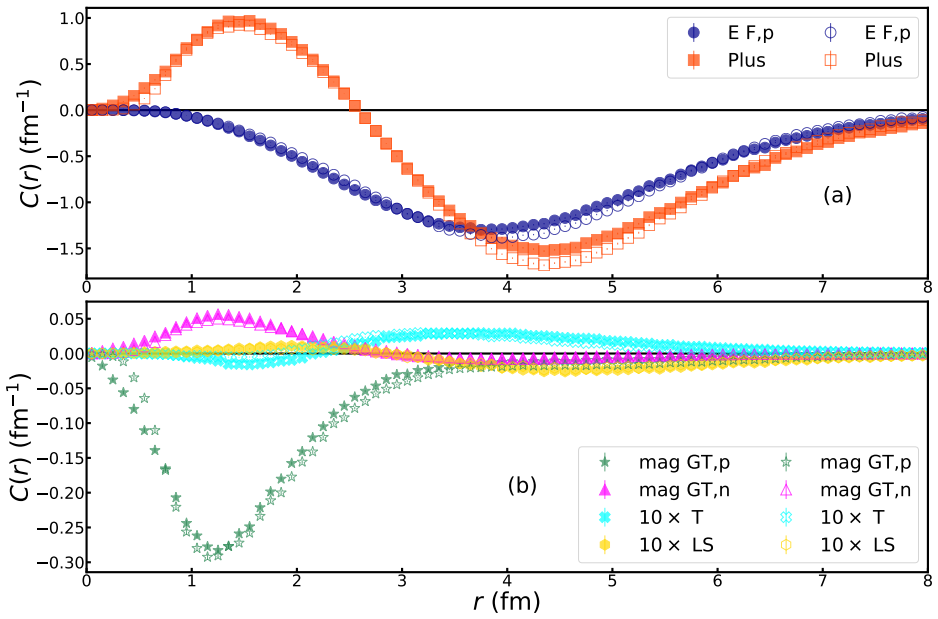
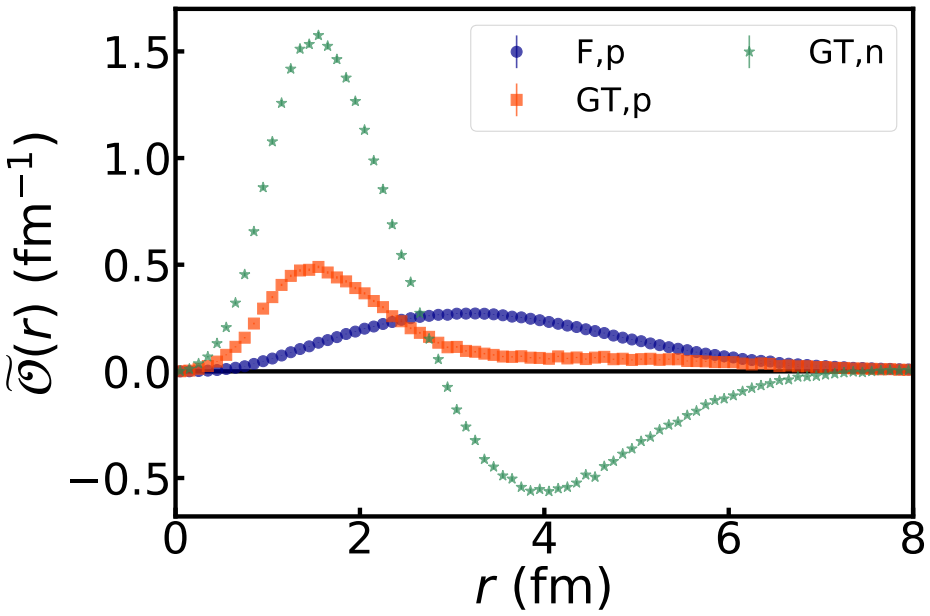
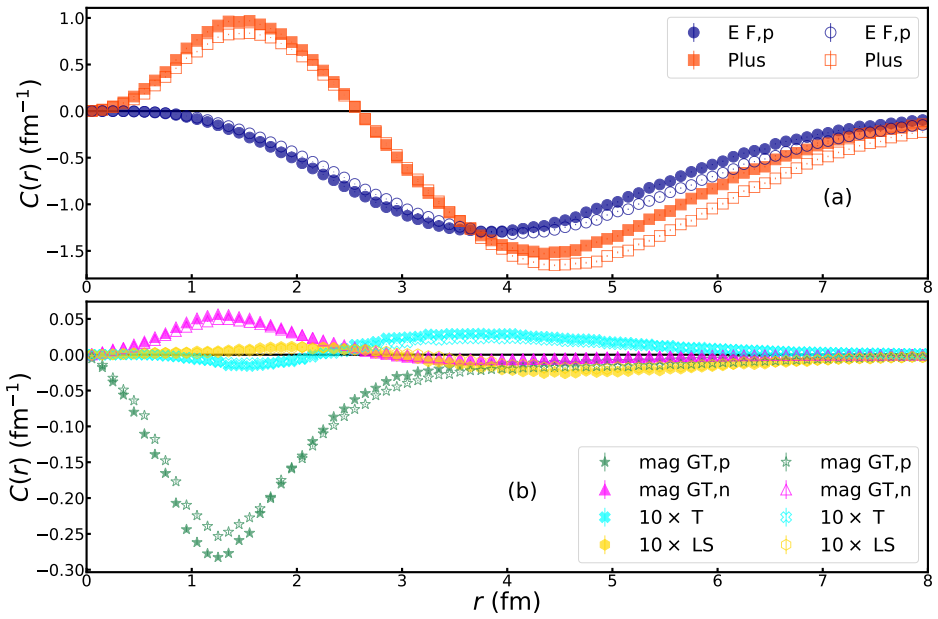
The load-bearing object is the EFT decomposition of the radiative correction into an energy-independent piece delta_NS^(0) and an energy-dependent piece delta_NS^E, with the isospin structure separated into spectator-proton and spectator-neutron contributions. Each piece is a sum over nuclear matrix elements of two-body transition operators labelled Fermi, Gamow-Teller, tensor, and spin-orbit, defined through radial functions h(r) such as the ~1/r magnetic and spin-orbit pieces, the delta-function contact terms carrying the two unknown LECs g_V1^NN and g_V2^NN, and the logarithmic O(alpha^2) Fermi term. The many-body matrix elements and their radial densities C(r) are computed with variation
What would settle it
Measure the charge radius of 10B*(0+;1) and check the paper's claimed linear correlations with M_F^E and M_F^+, and/or compute the two contact couplings g_V1^NN and g_V2^NN on the lattice: if the true LECs land outside the +/- (1/m_N)(2F_pi)^-2 band, the central values and error bars of delta_bar_NS and V_ud shift by more than the quoted ranges.
Extended reading notes
Core claim
The paper's central claim is that the nuclear-structure-dependent radiative correction delta_bar_NS for 10C -> 10B* can be evaluated using chiral EFT two-body current operators and quantum Monte Carlo (VMC and GFMC) wave functions, and that the resulting correction is consistent with the standard survey value and the more recent dispersive no-core shell model calculation. Concretely, the GFMC magnetic-plus-spin-orbit part of delta_NS^(0) sits in the range -[4.06,4.43] x 10^-3, roughly 40 percent larger in magnitude than the delta_NS,B = -3.06(35) x 10^-3 used in the traditional survey, with the difference attributed to many-body correlations in the GFMC wave functions. The energy-dependent p
Load-bearing premise
Two short-range coupling constants in the nuclear operator are not known from experiment or QCD; the paper arbitrarily sets them to plus or minus one in dimensionless form, and this choice drives the largest uncertainty in the final correction to V_ud.
Editorial extensions
If this is right
- The long-range magnetic-plus-spin-orbit part of delta_NS^(0) comes out at -[4.06,4.43] x 10^-3 in GFMC, about 40 percent larger in magnitude than the survey's delta_NS,B, so the difference is attributed to many-body correlations rather than to physics missing from the EFT.
- With the arbitrary contact-LEC range included, EFT+QMC, the traditional survey analysis, and the NCSM dispersion calculation all agree on delta_bar_NS within errors, removing a reason to suspect a large nuclear-structure error in V_ud extraction.
- The 10C-only extraction of V_ud from EFT+QMC falls between 0.97336 and 0.97355, compatible with the survey-based (0.97318) and NCSM-based (0.97317) values within the experimental error; the theory error from the unknown LECs is larger than the spread from the four Hamiltonians.
- Because the spin-independent matrix elements M_F^E and M_F^+ correlate strongly with the charge radius of 10B*, a measured radius of the 0+ daughter would directly reduce the model dependence of the energy-dependent correction.
- The corrected spin-orbit operator and the non-negligible L^CM term change the operator set of Ref. [48]; these changes matter most in systems where the LS and L^CM contributions do not cancel.
Reading between the lines
- If the two contact LECs were determined from lattice QCD or from modeled two-nucleon weak amplitudes, the dominant uncertainty in this approach would drop, likely making EFT+QMC competitive with or more precise than the dispersive NCSM evaluation.
- The strong empirical correlation between radius and the spin-independent matrix elements suggests a cheap experimental route: measuring the charge radius of the short-lived 10B* 0+ state would pin down the model dependence of the largest energy-dependent term without waiting for a full QCD calculation of the LECs.
- The sensitivity of the spin-dependent matrix elements to OPE correlations, and the nodal densities that drive GFMC changes, warn that calculations in heavier superallowed emitters need wave functions that reproduce spin-isospin correlations, not just energies and radii.
- Clarifying how pion-range contributions depend on the definition of the isospin limit, as the paper notes, is a prerequisite for consistently separating delta_C from delta_bar_NS at higher chiral orders; until that is settled, the current delta_C input is taken from the survey analysis rather than computed in the same framework.
Editorial analysis
A structured set of objections, weighed in public.
Referee Report
Summary. This paper presents the first QMC calculation of the nuclear-structure-dependent radiative correction \bar{\delta}_{NS} for the superallowed 10C→10B* decay, using the EFT formalism of Refs. [48,49]. The authors evaluate the relevant two-body operator matrix elements (magnetic, tensor, spin-orbit, contact, and O(α^2) Fermi) with VMC and GFMC wave functions generated from four Hamiltonians: AV18+UX, AV18+IL7, NV2+3-Ia, and NV2+3-Ia*. They benchmark the Fermi matrix element (M_F = 7.07), analyze the transition densities, and study the role of OPE correlations. The GFMC long-range magnetic-plus-spin-orbit contribution is -[4.06,4.43]×10^{-3} (Eq. (34)); the O(α^2) two-body contribution is -[0.21,0.40]×10^{-3} (Eq. (37)); and the energy-dependent term is +[0.97,1.17]×10^{-3} (Eq. (39)). Adding an arbitrary dimensional-analysis range for the unknown contact LECs (Eq. (A14) with \tilde{g}=±1) makes the total \bar{\delta}_{NS} compatible with the Hardy-Towner and NCSM values, and leads to the V_ud extractions in Eqs. (46)–(49).
Significance. If the underlying EFT derivation is accepted, this is a useful independent many-body evaluation of \bar{\delta}_{NS}. The paper is careful in its operator definitions, provides a transparent decomposition of uncertainties, corrects a sign in the spin-orbit operator, restores the L_CM term, and includes a simple Fermi-matrix-element sanity check. The radial-density analysis and the correlation study in Sec. V are valuable diagnostics. The main limitation is structural rather than mathematical: the two contact LECs are undetermined, and the quoted agreement with previous evaluations is obtained by adding an arbitrary LEC band to the calculated central values. The authors are transparent about this, but the abstract's "good agreement" language goes beyond what the LEC-free calculation supports. The work is nonetheless a meaningful first step in benchmarking QMC against existing shell-model and dispersive results, provided the claims are recalibrated.
major comments (2)
- [§VI, Table V, Abstract] The claim of "good agreement" is not supported by the LEC-independent part of the calculation. Summing the GFMC entries in Table V (mag+LS, O(α²), and δ_E^NS) without the contact-LEC term gives δ_NS central values of approximately −3.3 to −3.7×10^{-3} across the four interactions. These lie 0.55–0.93×10^{-3} above the NCSM value −4.22(32)×10^{-3} (Eq. (36)), i.e., about 2σ, and 0.3–0.7×10^{-3} from the Hardy–Towner value −4.0(5)×10^{-3} (Eq. (35)). The ±(0.48–0.77)×10^{-3} band from Eq. (A14) with \tilde{g}=±1 is an arbitrary dimensional-analysis prior; it only widens the error bars and does not move the central values toward the comparison targets. The abstract and the conclusion ("very good agreement" with Ref. [50]) should be revised to state that the results are compatible only after including this prior, and the LEC-free comparison should be displayed separately.
- [Appendix A, Eq. (A18)] The O(α^2) three-body transition operator is not evaluated. Because the O(α^2) two-body contribution is already −[0.21,0.40]×10^{-3} (Eq. (37)), an uncomputed three-body term of comparable size would enter at the quoted precision. The manuscript should either compute/estimate this contribution or explicitly identify it as a missing piece in the uncertainty budget. As written, "which we have not evaluated" leaves a known omission that is not reflected in the error bars.
minor comments (5)
- [Eq. (7) and Eq. (A4)] The tensor operator definition in Eq. (7) contains a typo: S^(jk)(r̂) = 3 r̂·σ^(j) r̂·σ^(k) − σ^(i)·σ^(j) should read − σ^(j)·σ^(k), as in Eq. (A4).
- [Sec. V.A] The text says the L_CM term is "actually non-negligible" in relation to Ref. [48], but later states that the LS matrix element is negligible because of a cancellation between L and L_CM. Please clarify that the individual contributions are non-negligible while their sum is small.
- [Eq. (A13)] The regulator is written as R_S = 0.8 fm^{-1}, but the Gaussian in Eq. (A13) requires R_S to have dimensions of length. This is presumably a typo for R_S = 0.8 fm; since the contact matrix elements M_CT depend on R_S, this should be corrected.
- [Eqs. (33), (46)–(49)] The error labeled σ_{g_NN_V} in Eqs. (46)–(49) is the width of an assumed LEC range, not a determined uncertainty. The manuscript should explicitly state this is a prior and that the central values would shift if the LECs were found to lie outside the assumed ±1 range.
- [Sec. VI, Eq. (44)] In the sentence following Eq. (44), "the first error" and "the second error" are clear, but the notation (56)gV(87)µ could be made more explicit by saying "the first error is from g_V and the second from the scale µ."
Circularity Check
No significant circularity: the central δ_NS calculation is not fitted to the 10C decay data; the EFT operators come from independent prior derivations, and the arbitrary LEC band is an honest uncertainty, not a self-referential fit.
full rationale
The paper's derivation chain is: (i) adopt EFT two-body operators from Refs. [48,49] (Sec. II); (ii) compute their nuclear matrix elements with VMC/GFMC for four Hamiltonians (Secs. III–V); (iii) combine them with external inputs (g_V, phase-space factors, t, δ_C) to form δ_NS and extract V_ud; (iv) compare with Hardy-Towner [45] and NCSM [50]. No step uses the 10C beta-decay data or the comparison values as an input to fix the calculation. The two LECs g_V1^NN and g_V2^NN are explicitly not fitted: Eq. (A14) sets dimensionless couplings to ±1, and Table V labels this as 'arbitrary values.' The resulting error band widens the uncertainty until overlap with Refs. [45,50] occurs, so the claimed 'good agreement' is an overlap of an a priori LEC range with external results, not a prediction forced by construction. That is an underdetermination/correctness concern, not a circular reduction. The self-citations to Refs. [48,49] (authors overlap with Gandolfi and Mereghetti) provide the operator formalism, but those are published, independent derivations already applied to 14O, and the present paper corrects a sign error in the spin-orbit operator and adds the L_CM term, demonstrating that the cited result is not being used as an unexamined black box. The V_ud comparison shares δ_C and t with Ref. [45], but the paper states this assumption explicitly and it does not feed back into the δ_NS result. No equation in the paper is equivalent to its inputs by construction, and no fitted parameter is renamed as a prediction.
Assumptions & free parameters
free parameters (3)
- g_V1^NN, g_V2^NN (contact LECs) =
Not fitted; set to +/-(1/m_N)(2F_pi)^-2, i.e., g_tilde = +/-1
- R_S (regulator for contact delta functions) =
0.8 fm^-1 (as printed; presumably fm)
- Lambda (cutoff for O(alpha^2) log operator) =
R_A^-1 = (1.2 A^1/3)^-1
assumptions (5)
- domain assumption The two-body chiral EFT operators of Refs [48,49] form the complete set of O(alpha epsilon_chi) and O(alpha Q/M_pi) contributions to delta_NS.
- domain assumption The mixed-estimate GFMC formula (Eq. 21) gives accurate off-diagonal matrix elements for operators that do not commute with the Hamiltonian.
- ad hoc to paper The three-body O(alpha^2) transition operator in Eq. (A18) is negligible.
- domain assumption The isospin-breaking correction delta_C from Ref [45] can be combined with the EFT-calculated delta_NS.
- domain assumption Setting the isospin limit with M_pi = M_pi0 in the two-body weak currents and potentials.
Cite this review
Pith. "Pith review of Quantum Monte Carlo calculation of $\delta_{\rm NS}$ in $^{10}$C using an effective field theory approach." pith.science (2026). https://pith.science/paper/ICOKVPS5
@misc{pith2026250907310,
  author       = {Pith},
  title        = {Pith review of: Quantum Monte Carlo calculation of $\delta_\rm NS$ in $^10$C using an effective field theory approach},
  year         = {2026},
  howpublished = {\url{https://pith.science/paper/ICOKVPS5}},
  note         = {Machine review of arXiv:2509.07310}
}
abstract
We compute radiative corrections to the superallowed $\beta$ decay of $^{10}{\rm C}$ in an effective field theory approach using nuclear matrix elements obtained from quantum Monte Carlo calculations. These corrections are an important ingredient in the extraction of the Cabibbo-Kobayashi-Masakawa quark mixing matrix element $V_{ud}$, and the role of this work is to illuminate the uncertainties arising from nuclear structure. Our results provide good agreement with both the traditional extraction of $V_{ud}$, as well as with a more recent evaluation performed using the no-core shell model and a dispersion formalism. The dominant uncertainty in this approach is the presence of two unknown low-energy constants that enter into the relevant nuclear matrix elements. Future determinations of these low-energy constants -- either from QCD or modeling them with two nucleon amplitudes -- would improve the precision of the extraction in this formalism.
Figures
Figures from the paper (1 more)

Forward citations
Cited by 5 Pith papers
-
Nuclear Charge Radius of $^9$Be from Muonic Atom Spectroscopy Using a Microcalorimeter
Muonic X-ray spectroscopy with a microcalorimeter yields r_c(9Be)=2.5506(51) fm, 2.4× more precise than and 2.3σ above the electron-scattering value.
-
Pion $\beta$ decay and $\tau\to\pi\pi\nu_\tau$ beyond leading logarithms
Pion β decay and τ→ππν short-distance radiative corrections are matched at NLL accuracy with evanescent-scheme dependence cancelled, giving Δ_RC^{πℓ}=0.03403(11) and a τ-HVP isospin-breaking shift of −0.07(4)×10^-10.
-
Recent Progress in Ab-Initio Nuclear Theory for Precision Physics Searches in Muonic Atoms and Superallowed $\beta$ Decays
Ab initio nuclear theory for two-photon exchange in muonic atoms and the γW box in superallowed β decays shares one hadronic tensor, with recent light-nuclei results impacting charge radii, the helium isotope shift, and Vud.
-
The Role of Ab Initio Beta-Decay Calculations in Light Nuclei for Probes of Physics Beyond the Standard Model
A status report showing ab initio beta-decay corrections now reach the 1e-4 level needed for precision Standard-Model tests, with key uncertainties from undetermined EFT low-energy constants.
-
Future directions in nuclear $\beta$ decay at FRIB and beyond
A community white paper summarizing the current state and future directions of nuclear beta-decay studies at FRIB, with no new quantitative result.
Reference graph
Works this paper leans on
-
[50]
V. Cirigliano, W. Dekens, J. de Vries, E. Mereghetti, and T. Tong, JHEP03, 033 (2024), 2311.00021
arXiv 2024
-
[1]
Operators contributing to the energy-independent correctionδ (0) NS 28
-
[2]
Operators contributing to the energy-dependent correction δE NS 29
-
[3]
inner radiative corrections
Pion-range contributions to δE NS 30 References31 I. INTRODUCTION In the Standard Model (SM) of particle physics, charged-current interactions are mediated by the Cabibbo–Kobayashi–Maskawa (CKM) quark mixing matrix [1, 2], which is predicted to be unitary. By independently measuring the individual CKM elements, the unitarity of the CKM matrix can be teste...
2020
-
[4]
Operators contributing to the energy-independent correctionδ (0) NS AtO(α), ¯δNS receives contributions from magnetic, contact and spin-orbit operators. The radial functions are hmag GT,p(r) = 4hmag T,p (r) = gA 3mN 1 +κ p r ,(A8) hmag GT,n(r) = 4hmag T,n (r) = gA 3mN κn r ,(A9) hCT GT,p(r) =− 4π 3 (gNN V1 +g NN V2 )δRS (r), hCT GT,n(r) =− 4π 3 (gNN V1 −g...
-
[5]
HereM π =M π0, andZ π is determined from the pion mass splitting M 2 π± −M 2 π0 = 2e2F 2 π Zπ,(A20) implyingZ π ∼0.8
Operators contributing to the energy-dependent correction δE NS The energy-dependent correction receives the following contributions hE F,p(r) =− r 2RA , hE F,n(r) = 0, hEπ GT,p(r) =−h Eπ GT,n(r) = g2 AZπ 3 e−Mπr 72MπRA 12 + 12Mπr−M 2 πr2 , hmeπ GT,p(r) =−h meπ GT,n(r) = g2 AZπ 3 e−Mπr 72MπRA 15−21M πr+M 2 πr2 , hEπ T,p(r) =−h Eπ T,n(r) = g2 AZπ 3 e−Mπr 7...
-
[6]
Pion-range contributions to δE NS The matrix elements of the pion-range operators that contribute toδ E NS are given in Table VI. The largest matrix element,M Eπ GT,p, entersδ E NS multiplied by the prefactor− √ 2αRAE0 ∼ 30 Model Method M Eπ GT,p M Eπ GT,n M meπ GT,p M meπ GT,n NV2+3-Ia VMC −0.048 0.014 0.013 −1.4·10 −3 GFMC −0.053 0.018 0.016 −1.5×10 −3 ...
-
[7]
Cabibbo, Phys
N. Cabibbo, Phys. Rev. Lett.10, 531 (1963)
1963
Show all 107 references
-
[8]
Kobayashi and T
M. Kobayashi and T. Maskawa, Prog. Theor. Phys.49, 652 (1973)
1973
-
[9]
Czarnecki, W
A. Czarnecki, W. J. Marciano, and A. Sirlin, Phys. Rev. D70, 093006 (2004), hep- ph/0406324
2004
-
[10]
I. S. Towner and J. C. Hardy, Rept. Prog. Phys.73, 046301 (2010)
2010
-
[11]
Navas et al
S. Navas et al. (Particle Data Group), Phys. Rev. D110, 030001 (2024)
2024
-
[12]
Hocker, H
A. Hocker, H. Lacker, S. Laplace, and F. Le Diberder, Eur. Phys. J. C21, 225 (2001), hep-ph/0104062
2001 arXiv
- [13]
-
[14]
Gorchtein and C
M. Gorchtein and C. Y. Seng, Ann. Rev. Nucl. Part. Sci.74, 23 (2024), 2311.00044
2024 arXiv
-
[15]
Cirigliano, W
V. Cirigliano, W. Dekens, E. Mereghetti, and O. Tomalak, Phys. Rev. D108, 053003 (2023), 2306.03138
2023 arXiv
-
[16]
R. W. Pattie, Jr. et al., Science360, 627 (2018), 1707.01817
2018 arXiv
-
[17]
F. M. Gonzalez et al. (UCNτ), Phys. Rev. Lett.127, 162501 (2021), 2106.10375
2021 arXiv
-
[18]
Musedinovic et al., Phys
R. Musedinovic et al., Phys. Rev. C111, 045501 (2025), 2409.05560
2025 arXiv
-
[19]
M¨ arkisch et al., Phys
B. M¨ arkisch et al., Phys. Rev. Lett.122, 242501 (2019), 1812.04666. 31
2019 arXiv
-
[20]
A. T. Yue, M. S. Dewey, D. M. Gilliam, G. L. Greene, A. B. Laptev, J. S. Nico, W. M. Snow, and F. E. Wietfeldt, Phys. Rev. Lett.111, 222501 (2013), 1309.2623
2013 arXiv
- [21]
- [22]
-
[23]
C. Y. Seng, M. Gorchtein, and M. J. Ramsey-Musolf, Phys. Rev. D100, 013001 (2019), 1812.03352
2019 arXiv
-
[24]
C.-Y. Seng, M. Gorchtein, H. H. Patel, and M. J. Ramsey-Musolf, Phys. Rev. Lett.121, 241804 (2018), 1807.10197
2018 arXiv
-
[25]
C.-Y. Seng, X. Feng, M. Gorchtein, and L.-C. Jin, Phys. Rev. D101, 111301 (2020), 2003.11264
2020 arXiv
-
[26]
Czarnecki, W
A. Czarnecki, W. J. Marciano, and A. Sirlin, Phys. Rev. D100, 073008 (2019), 1907.06737
2019 arXiv
-
[27]
Shiells, P
K. Shiells, P. G. Blunden, and W. Melnitchouk, Phys. Rev. D104, 033003 (2021), 2012.01580
2021 arXiv
- [28]
-
[29]
Carrasco, P
N. Carrasco, P. Lami, V. Lubicz, L. Riggio, S. Simula, and C. Tarantino, Phys. Rev. D93, 114512 (2016), 1602.04113
2016 arXiv
-
[30]
Bazavov et al
A. Bazavov et al. (Fermilab Lattice, MILC), Phys. Rev. D99, 114509 (2019), 1809.02827
2019 arXiv
- [31]
-
[32]
P. A. Boyle et al. (RBC/UKQCD), JHEP06, 164 (2015), 1504.01692
2015 arXiv
-
[33]
Cirigliano, A
V. Cirigliano, A. Crivellin, M. Hoferichter, and M. Moulson, Phys. Lett. B838, 137748 (2023), 2208.11707
2023 arXiv
-
[34]
Belfatto, R
B. Belfatto, R. Beradze, and Z. Berezhiani, Eur. Phys. J. C80, 149 (2020), 1906.02714
2020 arXiv
- [35]
-
[36]
Crivellin and M
A. Crivellin and M. Hoferichter, Phys. Rev. Lett.125, 111801 (2020), 2002.07184
2020 arXiv
- [37]
-
[38]
Crivellin, F
A. Crivellin, F. Kirk, C. A. Manzari, and M. Montull, JHEP12, 166 (2020), 2008.01113
2020 arXiv
-
[39]
A. K. Alok, A. Dighe, S. Gangal, and J. Kumar, Phys. Rev. D108, 113005 (2023), 2108.05614
2023 arXiv
-
[40]
Crivellin, M
A. Crivellin, M. Hoferichter, M. Kirk, C. A. Manzari, and L. Schnell, JHEP10, 221 (2021), 2107.13569
2021 arXiv
-
[41]
Crivellin, M
A. Crivellin, M. Kirk, T. Kitahara, and F. Mescia, JHEP03, 234 (2023), 2212.06862
2023 arXiv
- [42]
-
[43]
Belfatto and S
B. Belfatto and S. Trifinopoulos, Phys. Rev. D108, 035022 (2023), 2302.14097
2023 arXiv
- [44]
-
[45]
S. Q. Dinh and H. M. Tran, Nucl. Phys. B997, 116384 (2023), 2303.14913
2023 arXiv
-
[46]
G. C. Branco, J. T. Penedo, P. M. F. Pereira, M. N. Rebelo, and J. I. Silva-Marcos, JHEP 07, 099 (2021), 2103.13409
2021 arXiv
-
[47]
Crivellin, M
A. Crivellin, M. Hoferichter, and C. A. Manzari, Phys. Rev. Lett.127, 071801 (2021), 2102.02825
2021 arXiv
-
[48]
Gonz´ alez-Alonso and J
M. Gonz´ alez-Alonso and J. Martin Camalich, JHEP12, 052 (2016), 1605.07114
2016 arXiv
-
[49]
Falkowski, M
A. Falkowski, M. Gonz´ alez-Alonso, and K. Mimouni, JHEP08, 123 (2017), 1706.03783
2017 arXiv
-
[51]
J. C. Hardy and I. S. Towner, Phys. Rev. C102, 045501 (2020)
2020
- [52]
- [53]
-
[54]
Cirigliano, W
V. Cirigliano, W. Dekens, J. de Vries, S. Gandolfi, M. Hoferichter, and E. Mereghetti, Phys. Rev. C110, 055502 (2024), 2405.18464
2024 arXiv
-
[55]
Cirigliano, W
V. Cirigliano, W. Dekens, J. de Vries, S. Gandolfi, M. Hoferichter, and E. Mereghetti, Phys. Rev. Lett.133, 211801 (2024), 2405.18469
2024 arXiv
-
[56]
Gennari, M
M. Gennari, M. Drissi, M. Gorchtein, P. Navratil, and C.-Y. Seng, Phys. Rev. Lett.134, 012501 (2025), 2405.19281
2025
- [57]
-
[58]
I. S. Towner, Nucl. Phys. A540, 478 (1992)
1992
-
[59]
Carlson, S
J. Carlson, S. Gandolfi, F. Pederiva, S. C. Pieper, R. Schiavilla, K. E. Schmidt, and R. B. Wiringa, Rev. Mod. Phys.87, 1067 (2015), 1412.3081
2015 arXiv
-
[60]
Gandolfi, D
S. Gandolfi, D. Lonardoni, A. Lovato, and M. Piarulli, Front. in Phys.8, 117 (2020), 2001.01374
2020 arXiv
-
[61]
G. B. King and S. Pastore, Ann. Rev. Nucl. Part. Sci.74, 343 (2024), 2402.06602
2024 arXiv
-
[62]
B. S. Pudliner, V. R. Pandharipande, J. Carlson, S. C. Pieper, and R. B. Wiringa, Phys. Rev.C56, 1720 (1997), nucl-th/9705009
1997 arXiv
-
[63]
Pervin, S
M. Pervin, S. C. Pieper, and R. B. Wiringa, Phys. Rev. C76, 064319 (2007), 0710.1265
2007 arXiv
-
[64]
R. B. Wiringa, V. G. J. Stoks, and R. Schiavilla, Phys. Rev.C51, 38 (1995), nucl-th/9408016. 33
1995 arXiv
-
[65]
R. B. Wiringa, R. Schiavilla, S. C. Pieper, and J. Carlson, Phys. Rev. C89, 024305 (2014), URLhttps://link.aps.org/doi/10.1103/PhysRevC.89.024305
2014 doi
-
[66]
Piarulli, L
M. Piarulli, L. Girlanda, R. Schiavilla, R. Navarro P´ erez, J. E. Amaro, and E. Ruiz Arriola, Phys. Rev.C91, 024003 (2015), 1412.6446
2015 arXiv
-
[67]
Piarulli, L
M. Piarulli, L. Girlanda, R. Schiavilla, A. Kievsky, A. Lovato, L. E. Marcucci, S. C. Pieper, M. Viviani, and R. B. Wiringa, Phys. Rev.C94, 054007 (2016), 1606.06335
2016 arXiv
- [68]
- [69]
-
[70]
V. G. J. Stoks, R. A. M. Klomp, M. C. M. Rentmeester, and J. J. de Swart, Phys. Rev.C48, 792 (1993)
1993
-
[71]
H. W. Hammer, S. K¨ onig, and U. van Kolck, Rev. Mod. Phys.92, 025004 (2020), 1906.12122
2020 arXiv
-
[72]
Weinberg, Nucl
S. Weinberg, Nucl. Phys. B363, 3 (1991)
1991
-
[73]
van Kolck, Phys
U. van Kolck, Phys. Rev.C49, 2932 (1994)
1994
-
[74]
Epelbaum, A
E. Epelbaum, A. Nogga, W. Gloeckle, H. Kamada, U. G. Meissner, and H. Witala, Phys. Rev.C66, 064001 (2002), nucl-th/0208023
2002 arXiv
-
[75]
Fujita and H
J. Fujita and H. Miyazawa, Prog. Theor. Phys.17, 360 (1957)
1957
- [76]
-
[77]
Navarro P´ erez, J
R. Navarro P´ erez, J. E. Amaro, and E. Ruiz Arriola, Phys. Rev.C88, 064002 (2013), [Erra- tum: Phys. Rev.C91,no.2,029901(2015)], 1310.2536
2013 arXiv
-
[78]
Navarro P´ erez, J
R. Navarro P´ erez, J. E. Amaro, and E. Ruiz Arriola, Phys. Rev. C89, 024004 (2014), 1310.6972
2014 arXiv
-
[79]
Navarro Perez, J
R. Navarro Perez, J. E. Amaro, and E. Ruiz Arriola, Phys. Rev. C89, 064006 (2014), 1404.0314
2014 arXiv
-
[80]
J. M. Bub, M. Piarulli, R. J. Furnstahl, S. Pastore, and D. R. Phillips, Phys. Rev. C111, 034005 (2025), 2408.02480
2025 arXiv
-
[81]
Somasundaram, J
R. Somasundaram, J. E. Lynn, L. Huth, A. Schwenk, and I. Tews, Phys. Rev. C109, 034005 (2024), 2306.13579
2024 arXiv
-
[82]
O. Thim, E. May, A. Ekstr¨ om, and C. Forss´ en, Phys. Rev. C108, 054002 (2023), 2302.12624
2023 arXiv
-
[83]
Svensson, A
I. Svensson, A. Ekstr¨ om, and C. Forss´ en, Phys. Rev. C109, 064003 (2024), 2304.02004
2024 arXiv
-
[84]
K¨ onig, A
S. K¨ onig, A. Ekstr¨ om, K. Hebeler, D. Lee, and A. Schwenk, Phys. Lett. B810, 135814 (2020), 1909.08446. 34
2020 arXiv
-
[85]
Wesolowski, I
S. Wesolowski, I. Svensson, A. Ekstr¨ om, C. Forss´ en, R. J. Furnstahl, J. A. Melendez, and D. R. Phillips, Phys. Rev. C104, 064001 (2021), 2104.04441
2021 arXiv
-
[86]
Odell, P
D. Odell, P. Giuliani, K. Beyer, M. Catacora-Rios, M. Y. H. Chan, E. Bonilla, R. J. Furnstahl, K. Godbey, and F. M. Nunes, Phys. Rev. C109, 044612 (2024), 2312.12426
2024 arXiv
-
[87]
K. S. Becker, K. D. Launey, A. Ekstr¨ om, and T. Dytrych, Front. in Phys.11, 1064601 (2023), 2303.00667
2023 arXiv
-
[88]
Somasundaram, C
R. Somasundaram, C. L. Armstrong, P. Giuliani, K. Godbey, S. Gandolfi, and I. Tews, Phys. Lett. B866, 139558 (2025), 2404.11566
2025 arXiv
-
[89]
C. L. Armstrong, P. Giuliani, K. Godbey, R. Somasundaram, and I. Tews (2025), 2502.03680
2025
-
[90]
Cruz-Torres, D
R. Cruz-Torres, D. Lonardoni, R. Weiss, N. Barnea, D. W. Higinbotham, E. Piasetzky, A. Schmidt, L. B. Weinstein, R. B. Wiringa, and O. Hen, Nature Phys.17, 306 (2021), 1907.03658
2021 arXiv
-
[91]
J. L. Forest, V. R. Pandharipande, S. C. Pieper, R. B. Wiringa, R. Schiavilla, and A. Arriaga, Phys. Rev.C54, 646 (1996), nucl-th/9603035
1996 arXiv
-
[92]
Piarulli, S
M. Piarulli, S. Pastore, R. B. Wiringa, S. Brusilow, and R. Lim, Phys. Rev. C107, 014314 (2023), 2210.02421
2023 arXiv
-
[93]
Gandolfi, Private Communication
S. Gandolfi, Private Communication
-
[94]
Novario, Private Communication
S. Novario, Private Communication
- [95]
-
[96]
Cirigliano, W
V. Cirigliano, W. Dekens, J. de Vries, M. Hoferichter, and E. Mereghetti, JHEP05, 289 (2021), 2102.03371
2021 arXiv
-
[97]
D. R. Tilley, J. H. Kelley, J. L. Godwin, D. J. Millener, J. E. Purcell, C. G. Sheu, and H. R. Weller, Nucl. Phys.A745, 155 (2004)
2004
-
[98]
J. L. Friar, J. Martorell, and D. W. L. Sprung, Phys. Rev. A56, 4579 (1997), nucl- th/9707016
1997
-
[99]
G. B. King, G. Chambers-Wall, A. Gnech, S. Pastore, M. Piarulli, and R. B. Wiringa (2025), 2504.04201
2025 arXiv
- [100]
-
[101]
Angeli and K
I. Angeli and K. P. Marinova, Atom. Data Nucl. Data Tabl.99, 69 (2013)
2013
-
[102]
J. C. Hardy and I. S. Towner, Phys. Rev. C71, 055501 (2005), nucl-th/0412056
2005 arXiv
-
[103]
Chambers-Wall, A
G. Chambers-Wall, A. Gnech, G. B. King, S. Pastore, M. Piarulli, R. Schiavilla, and R. B. 35 Wiringa, Phys. Rev. C110, 054316 (2024), 2407.04744
2024 arXiv
-
[104]
Miyagi, X
T. Miyagi, X. Cao, R. Seutin, S. Bacca, R. F. Garcia Ruiz, K. Hebeler, J. D. Holt, and A. Schwenk, Phys. Rev. Lett.132, 232503 (2024), 2311.14383
2024 arXiv
-
[105]
Pastore, J
S. Pastore, J. Carlson, V. Cirigliano, W. Dekens, E. Mereghetti, and R. B. Wiringa, Phys. Rev. C97, 014606 (2018), 1710.05026
2018 arXiv
-
[106]
B. R. Barrett, P. Navratil, and J. P. Vary, Prog. Part. Nucl. Phys.69, 131 (2013)
2013
-
[107]
Cirigliano, W
V. Cirigliano, W. Dekens, J. de Vries, M. Hoferichter, and E. Mereghetti, Phys. Rev. Lett. 126, 172002 (2021), 2012.11602. 36
2021 arXiv
Reviewed August 4, 2026 · model on record in the stance chip above.
Discussion (0). Continue with ORCID to comment.