REVIEW 6 minor 188 references
Two low-energy Standard Model tests are limited by the same nuclear current correlator, so methods built for one advance the other.
Reviewed by Pith at T0; open to challenge. T0 means a machine referee read the full paper against a public rubric. the ladder, T0–T4 →
Ab initio nuclear theory for two-photon exchange in muonic atoms and the γW box in superallowed β decays shares one hadronic tensor, with recent light-nuclei results impacting charge radii, the helium isotope shift, and Vud.
T0 review reviewed 2026-07-30 challenge →
load-bearing objection Solid methods review that cleanly unifies TPE and the γW box under one hadronic tensor; no new numbers, but the synthesis and outlook are useful and the citations track the primary literature.
Recent Progress in Ab-Initio Nuclear Theory for Precision Physics Searches in Muonic Atoms and Superallowed β Decays
The pith
A machine-rendered reading of the paper's core claim, the machinery that carries it, and where it could break.
The reading
Core claim
The leading nuclear-structure corrections that limit two flagship low-energy Standard Model programs—the two-photon exchange in the muonic Lamb shift and the nuclear gamma-W box in superallowed beta decay—are two faces of the same generalized hadronic tensor, a forward electroweak current-current correlator. Methods and uncertainty tools built for one therefore transfer to the other, and recent light-nuclei ab initio results already affect charge radii, the helium isotope-shift puzzle, and the extraction of Vud.
What carries the argument
The generalized hadronic tensor: the forward current-current correlator of electroweak operators evaluated with external nuclear states. It carries all the nuclear structure in both the muonic two-photon-exchange amplitude and the gamma-W box radiative correction.
Load-bearing premise
That leftover short-distance and nuclear-shadowing pieces not fully fixed by the low-energy spectral representation can be budgeted as sub-dominant uncertainties without overturning the claimed percent-level control.
What would settle it
An ab initio gamma-W box for a heavier superallowed emitter, or a determination of the short-range EFT constants, that moves the nuclear-structure correction outside the present uncertainty band and shifts the CKM unitarity deficit by more than the claimed improvement.
If this is right
- Bayesian-quantified two-photon-exchange corrections yield precise helion and alpha-particle charge radii from muonic helium.
- Nuclear structure is exonerated as the source of the helium isotope-shift tension; the residual discrepancy is atomic.
- The first ab initio nuclear gamma-W box for 10C to 10B reduces theory uncertainty on that transition’s contribution to Vud.
- Updated nuclear polarization on charge radii used in the 26mAl analysis can cut the CKM unitarity deficit by about one standard deviation.
- The same machinery extends to gamma-Z boxes, muon capture, and neutrino-nucleus scattering.
Where Pith is reading between the lines
- If the shared-tensor claim holds, coordinated work on light muonic atoms and light superallowed emitters is the fastest route to deciding whether the Cabibbo anomaly is real.
- Bridging exact light-nuclei methods to mean-field treatments for medium-mass muonic X-ray targets is the practical bottleneck for the next round of charge-radius experiments.
- The still-unfitted short-range constants in the EFT route to the nuclear box are one multi-transition fit away from rivaling the current-algebra uncertainty.
Editorial analysis
A structured set of objections, weighed in public.
Referee Report
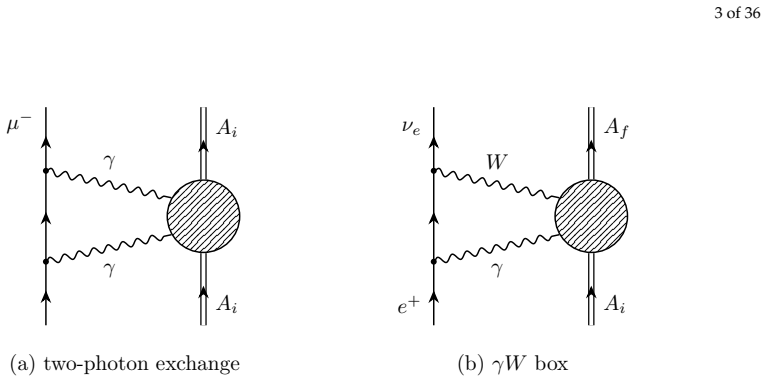
Summary. This review argues that the two-photon-exchange (TPE) correction to the Lamb shift in muonic atoms and the nuclear γW-box correction to superallowed β decays are governed by the same generalized hadronic tensor (forward electroweak current–current correlator). Consequently, χEFT Hamiltonians and currents, Lanczos-based response methods, and Bayesian truncation-error quantification developed for one problem transfer directly to the other. The authors summarize the common formalism (spectral representation and multipole decomposition), modern ab initio methods, recent N3LO Bayesian TPE results for muonic helium and their role in resolving the helium isotope-shift puzzle on the nuclear side, and the first ab initio γW-box calculation for 10C→10B with implications for Vud and top-row CKM unitarity, closing with an outlook toward heavier systems and related electroweak processes.
Significance. If the synthesis holds—and the manuscript’s Eqs. (2)–(6) and the cited primary calculations support it—the review usefully unifies two precision programs that are often treated separately, and documents concrete impact: Bayesian-quantified TPE corrections for μ3He+ and μ4He+ that helped exonerate nuclear structure in the helium isotope-shift tension, and an ab initio δNS for 10C→10B that reduces theory uncertainty relative to earlier surveys. Strengths include explicit spectral and multipole machinery, clear linkage of Lanczos response methods across both observables, and transparent discussion of residual uncertainties (nuclear shadowing, unfitted short-range EFT LECs). As a methods-and-results review rather than a new primary derivation, its value is organizational and pedagogical for the precision electroweak nuclear-physics community.
minor comments (6)
- [Section 2.1] Section 2.1, after Eq. (2): the normalization convention difference between the unit-normalized non-relativistic tensor and the relativistic β-decay Compton tensor is mentioned, but a single explicit cross-reference to the matching relation later given near Eq. (55) would help readers who enter from the muonic-atom side.
- [Section 5.4, Table 2] Table 2: the caption and surrounding text correctly note that CA δNS and EFT δ(0)_NS|mag+LS are not directly comparable; a brief footnote listing which pieces of the full δNS each column includes would reduce the chance of misquotation.
- [Section 3.3] Section 3.3: the statement that rigorous Bayesian LEC sampling has not yet been applied to polarizabilities or γW-box amplitudes is important; citing the specific emulator/EC references already in the bibliography at that sentence would tighten the outlook.
- [Figure 1] Figure 1 caption: “drawn for a β+ transition such as 10C→10B” is clear; ensuring the printed figure labels (a)/(b) match the in-text “two-photon exchange” / “γW box” wording consistently would aid skimming.
- A few typographical inconsistencies appear (e.g., “ab initionuclear”, “texorpdfstring” artifacts in the abstract source, occasional missing spaces after commas in author lists). A copy-edit pass would clean these without affecting content.
- [Section 5.1] Section 5.1 / Figure 4: the left panel is described as using PDG 2024 values; if any post-2024 updates to Vus or the unitarity plot are intended to be frozen for the review, a one-line date stamp on the figure source would help longevity.
Circularity Check
No significant circularity: review summarizes independent ab-initio results linked by standard current-algebra structure, not by construction from fitted inputs.
full rationale
This manuscript is a methods-and-results review. Its load-bearing claim is that the TPE Lamb-shift correction and the nuclear γW-box correction are both instances of the same generalized forward hadronic tensor (Eqs. 2–6), so χEFT Hamiltonians/currents, Lanczos response methods, and Bayesian truncation UQ transfer between the two programs. That kinship is standard multipole/current-algebra formalism stated explicitly in the text, not defined in terms of the numerical conclusions. Reported milestones (Bayesian N3LO TPE in muonic He; ab-initio δNS for 10C→10B) are prior primary calculations summarized against external benchmarks (CREMA Lamb shifts, electronic isotope shifts, Hardy–Towner Ft surveys, CKM unitarity). Self-citations to the authors’ own TPE and γW papers are normal review practice and do not force the structural claim by definition, fit, or uniqueness theorem. Residual pieces (Bμν/shadowing, unfitted EFT LECs) are budgeted as uncertainties in the primary works, not hidden inputs that manufacture the review’s narrative. No self-definitional loop, fitted-input-as-prediction, or ansatz-smuggling reduction is present.
Axiom & Free-Parameter Ledger
free parameters (3)
- χEFT low-energy constants (LECs) in NN/3N forces and electroweak currents
- Short-range EFT couplings gNN_V1 and gNN_V2 for nucleus-dependent radiative corrections =
unknown
- EFT breakdown scale Λb and expansion parameter Q in Bayesian truncation model
axioms (6)
- domain assumption Both TPE (muonic atoms) and the nuclear γW box are encoded in the same generalized forward hadronic tensor built from electroweak currents between nuclear states.
- domain assumption Weinberg-style χEFT provides a systematically improvable Hamiltonian and consistent electroweak currents for light nuclei at the precision needed.
- domain assumption Non-relativistic spectral sums plus multipoles plus Lanczos resolvents suffice for the leading nuclear-structure pieces after matching to relativistic normalizations.
- domain assumption Bayesian naturalness priors on EFT coefficients yield statistically meaningful truncation errors (DOB intervals).
- domain assumption Sirlin current-algebra decomposition isolates the structure-dependent γW box as the dominant nuclear uncertainty in Vud extractions.
- standard math Mathematical completeness relations, multipole orthogonality, and contour deformation of loop integrals are valid as used.
Cite this review
Pith. "Pith review of Recent Progress in Ab-Initio Nuclear Theory for Precision Physics Searches in Muonic Atoms and Superallowed $\beta$ Decays." pith.science (2026). https://pith.science/paper/ZPUVB5TD
@misc{pith2026260726781,
  author       = {Pith},
  title        = {Pith review of: Recent Progress in Ab-Initio Nuclear Theory for Precision Physics Searches in Muonic Atoms and Superallowed $\beta$ Decays},
  year         = {2026},
  howpublished = {\url{https://pith.science/paper/ZPUVB5TD}},
  note         = {Machine review of arXiv:2607.26781}
}
read the original abstract
Precision tests of the Standard Model at low energy are increasingly limited by nuclear-structure theory rather than by experiment. We review two such cases: the two-photon-exchange correction to the Lamb shift in muonic atoms, and the \texorpdfstring{$\gamma W$}{gamma-W} box radiative correction to superallowed \texorpdfstring{$\beta$}{beta} decays. Although they probe different physics, both are governed by the same generalized hadronic tensor, so that the chiral effective field theory Hamiltonians and currents, Lanczos-based response methods, and Bayesian uncertainty quantification developed for one carry over directly to the other. We summarize recent ab initio progress in light nuclei and its impact on nuclear charge radii, on the helium isotope-shift puzzle, and on the extraction of \texorpdfstring{$V_{ud}$}{Vud} for the top-row CKM unitarity test, and state a future outlook.
Figures


Reference graph
Works this paper leans on
-
[1]
Precision Beta Decay as a Probe of New Physics, 2019, [arXiv:nucl-ex/1907.02164]
Cirgiliano, V .; Garcia, A.; Gazit, D.; Naviliat-Cuncic, O.; Savard, G.; Young, A. Precision Beta Decay as a Probe of New Physics, 2019, [arXiv:nucl-ex/1907.02164]
Pith/arXiv arXiv 2019
-
[2]
Nuclearβ decay as a probe for physics beyond the Standard Model2023
Brodeur, M.; Buzinsky, N.; Caprio, M.A.; Cirigliano, V .; Clark, J.A.; Fasano, P .J.; et al. Nuclearβ decay as a probe for physics beyond the Standard Model2023. [arXiv:nucl-ex/2301.03975]
-
[3]
Search for new physics with atoms and molecules.Rev
Safronova, M.S.; Budker, D.; DeMille, D.; Kimball, D.F.J.; Derevianko, A.; Clark, C.W. Search for new physics with atoms and molecules.Rev. Mod. Phys.2018,90, 025008. https://doi.org/10.1103/RevModPhys.90.025 008
-
[4]
Hardy, J.C.; Towner, I.S. Superallowed 0+ → 0+ nuclear β decays: 2020 critical survey, with implications for Vud and CKM unitarity.Physical Review C2020,102, 045501. https://doi.org/10.1103/PhysRevC.102.045501
-
[5]
Superallowed Nuclear Beta Decays and Precision Tests of the Standard Model
Gorchtein, M.; Seng, C.Y. Superallowed Nuclear Beta Decays and Precision Tests of the Standard Model. Annual Review of Nuclear and Particle Science2024,74, 23–47. https://doi.org/https://doi.org/10.1146/ annurev-nucl-102622-020726
-
[6]
Reduced Hadronic Uncertainty in the Determi- nation ofV ud.Physical Review Letters2018,121, 241804
Seng, C.Y.; Gorchtein, M.; Patel, H.H.; Ramsey-Musolf, M.J. Reduced Hadronic Uncertainty in the Determi- nation ofV ud.Physical Review Letters2018,121, 241804. https://doi.org/10.1103/PhysRevLett.121.241804
-
[7]
Review of Particle Physics.Physical Review D2024,110, 030001
Navas, S.; et al. Review of Particle Physics.Physical Review D2024,110, 030001. https://doi.org/10.1103/ PhysRevD.110.030001
-
[8]
Glick-Magid, A.; Forssén, C.; Gazda, D.; Gazit, D.; Gysbers, P .; Navrátil, P . Nuclear ab initio calculations of 6Heβ -decay for beyond the Standard Model studies.Physics Letters B2022,832, 137259. https://doi.org/ https://doi.org/10.1016/j.physletb.2022.137259
arXiv 2022
-
[9]
Ab initio calculation of the β-decay spectrum of 6He.Phys
King, G.B.; Baroni, A.; Cirigliano, V .; Gandolfi, S.; Hayen, L.; Mereghetti, E.; Pastore, S.; Piarulli, M. Ab initio calculation of the β-decay spectrum of 6He.Phys. Rev. C2023,107, 015503. https://doi.org/10.1103/ PhysRevC.107.015503
-
[10]
Comprehensive theory of the Lamb shift in light muonic atoms.Rev
Pachucki, K.; Lensky, V .; Hagelstein, F.; Li Muli, S.S.; Bacca, S.; Pohl, R. Comprehensive theory of the Lamb shift in light muonic atoms.Rev. Mod. Phys.2024,96, 015001. https://doi.org/10.1103/RevModPhys.96.015 001
-
[11]
Muonic-Atom Spectroscopy and Impact on Nuclear Structure and Precision QED Theory2022
Antognini, A.; et al. Muonic-Atom Spectroscopy and Impact on Nuclear Structure and Precision QED Theory2022. [arXiv:nucl-th/2210.16929]
-
[12]
The size of the proton.Nature2010,466, 213–216
Pohl, R.; et al. The size of the proton.Nature2010,466, 213–216. https://doi.org/10.1038/nature09250
-
[13]
Antognini, A.; et al. Proton Structure from the Measurement of 2S-2P Transition Frequencies of Muonic Hydrogen.Science2013,339, 417–420, [https://science.sciencemag.org/content/339/6118/417.full.pdf]. https://doi.org/10.1126/science.1230016
-
[14]
CODATA recommended values of the fundamental physical constants: 2018.Rev
Tiesinga, E.; Mohr, P .J.; Newell, D.B.; Taylor, B.N. CODATA recommended values of the fundamental physical constants: 2018.Rev. Mod. Phys.2021,93, 025010. https://doi.org/10.1103/RevModPhys.93.025010
-
[15]
Measuring the α-particle charge radius with muonic helium-4 ions.Nature2021,589, 527–531
Krauth, J.; et al. Measuring the α-particle charge radius with muonic helium-4 ions.Nature2021,589, 527–531. https://doi.org/10.1038/s41586-021-03183-1
-
[16]
The helion charge radius from laser spectroscopy of muonic helium-3 ions
Schuhmann, K.; Fernandes, L.M.P .; Nez, F.; Ahmed, M.A.; Amaro, F.D.; Amaro, P .; Biraben, F.; Chen, T.L.; Covita, D.S.; Dax, A.J.; et al. The helion charge radius from laser spectroscopy of muonic helium-3 ions. Science2025,388, 854–858. https://doi.org/10.1126/science.adj2610
-
[17]
van der Werf, Y.; Steinebach, K.; Jannin, R.; Bethlem, H.L.; Eikema, K.S.E. The alpha and helion particle charge radius difference from spectroscopy of quantum-degenerate helium2023. [arXiv:physics.atom- ph/2306.02333]
-
[18]
Revisiting the Helium Isotope-Shift Puzzle with Improved Uncer- tainties from Nuclear Structure Corrections.Phys
Li Muli, S.S.; Richardson, T.R.; Bacca, S. Revisiting the Helium Isotope-Shift Puzzle with Improved Uncer- tainties from Nuclear Structure Corrections.Phys. Rev. Lett.2025,134, 032502. https://doi.org/10.1103/ PhysRevLett.134.032502
2025
-
[19]
Toward resolving the discrepancy in helium-3 and helium-4 nuclear charge radii.Phys
Qi, X.Q.; Zhang, P .P .; Yan, Z.C.; Tang, L.Y.; Chen, A.X.; Shi, T.Y.; Zhong, Z.X. Toward resolving the discrepancy in helium-3 and helium-4 nuclear charge radii.Phys. Rev. Res.2025,7, L022020. https: //doi.org/10.1103/PhysRevResearch.7.L022020
-
[20]
Second-order hyperfine correction to H, D, and3He energy levels
Pachucki, K.; Patkóš, V .c.v.; Yerokhin, V .A. Second-order hyperfine correction to H, D, and3He energy levels. Phys. Rev. A2024,110, 062806. https://doi.org/10.1103/PhysRevA.110.062806. 29 of 36
-
[21]
Rathi, S.; Jentschura, U.D.; Indelicato, P .; Ohayon, B. Binding energy of muonic beryllium: perturbative versus all-order calculations.Journal of Physics B: Atomic, Molecular and Optical Physics2026,59, 125002. https://doi.org/10.1088/1361-6455/ae7b9a
-
[22]
Ab initio calculation of nuclear-structure corrections in muonic atoms.Journal of Physics G: Nuclear and Particle Physics2018,45, 093002
Ji, C.; Bacca, S.; Barnea, N.; Hernandez, O.J.; Dinur, N.N. Ab initio calculation of nuclear-structure corrections in muonic atoms.Journal of Physics G: Nuclear and Particle Physics2018,45, 093002. https://doi.org/10.1088/ 1361-6471/aad3eb
-
[23]
Hardy, J.C.; Towner, I.S. Superallowed 0+ → 0+ nuclear β decays: 2014 critical survey, with precise results for Vud and CKM unitarity.Physical Review C2015,91, 025501. https://doi.org/10.1103/PhysRevC.91.025501
-
[24]
Gorchtein, M. γW Box Inside Out: Nuclear Polarizabilities Distort the Beta Decay Spectrum.Physical Review Letters2019,123, 042503. https://doi.org/10.1103/PhysRevLett.123.042503
-
[25]
Modern theory of nuclear forces.Rev
Epelbaum, E.; Hammer, H.W.; Meißner, U.G. Modern theory of nuclear forces.Rev. Mod. Phys.2009, 81, 1773–1825. https://doi.org/10.1103/RevModPhys.81.1773
-
[26]
Chiral effective field theory and nuclear forces.Physics Reports2011,503, 1 – 75
Machleidt, R.; Entem, D. Chiral effective field theory and nuclear forces.Physics Reports2011,503, 1 – 75. https://doi.org/https://doi.org/10.1016/j.physrep.2011.02.001
-
[27]
Nuclear effective field theory: Status and perspectives.Rev
Hammer, H.W.; König, S.; van Kolck, U. Nuclear effective field theory: Status and perspectives.Rev. Mod. Phys.2020,92, 025004. https://doi.org/10.1103/RevModPhys.92.025004
-
[28]
A Guided Tour of ab initio Nuclear Many-Body Theory.Frontiers in Physics2020,Volume 8 - 2020
Hergert, H. A Guided Tour of ab initio Nuclear Many-Body Theory.Frontiers in Physics2020,Volume 8 - 2020. https://doi.org/10.3389/fphy.2020.00379
arXiv 2020
-
[29]
Quantifying truncation errors in effective field theory
Furnstahl, R.J.; Klco, N.; Phillips, D.R.; Wesolowski, S. Quantifying truncation errors in effective field theory. Phys. Rev. C2015,92, 024005. https://doi.org/10.1103/PhysRevC.92.024005
-
[30]
Quantifying correlated truncation errors in effective field theory.Phys
Melendez, J.A.; Furnstahl, R.J.; Phillips, D.R.; Pratola, M.T.; Wesolowski, S. Quantifying correlated truncation errors in effective field theory.Phys. Rev. C2019,100, 044001. https://doi.org/10.1103/PhysRevC.100.0440 01
-
[31]
Gennari, M.; Drissi, M.; Gorchtein, M.; Navrátil, P .; Seng, C.Y. Ab Initio Strategy for Taming the Nuclear- Structure Dependence of Vud Extractions: The 10C → 10B Superallowed Transition.Physical Review Letters 2025,134, 012501. https://doi.org/10.1103/PhysRevLett.134.012501
-
[32]
Cabibbo-Kobayashi-Maskawa unitarity deficit reduction via finite nuclear size.Phys
Gorchtein, M.; Katyal, V .; Ohayon, B.; Sahoo, B.K.; Seng, C.Y. Cabibbo-Kobayashi-Maskawa unitarity deficit reduction via finite nuclear size.Phys. Rev. Res.2025,7, L042002, [arXiv:nucl-th/2502.17070]. https://doi.org/10.1103/z8g6-9j25
arXiv 2025
-
[33]
Towards Precision Muonic X-Ray Measurements of Charge Radii of Light Nuclei.Physics2024,6, 206–215
Ohayon, B.; Abeln, A.; Bara, S.; Cocolios, T.E.; Eizenberg, O.; Fleischmann, A.; Gastaldo, L.; Godinho, C.; Heines, M.; Hengstler, D.; et al. Towards Precision Muonic X-Ray Measurements of Charge Radii of Light Nuclei.Physics2024,6, 206–215. https://doi.org/10.3390/physics6010015
-
[34]
MMC Array to Study X-Ray Transitions in Muonic Atoms.J
Unger, D.; Abeln, A.; Cocolios, T.E.; Eizenberg, O.; Enss, C.; Fleischmann, A.; Gastaldo, L.; Godinho, C.; Heines, M.; Hengstler, D.; et al. MMC Array to Study X-Ray Transitions in Muonic Atoms.J. Low Temp. Phys.2024,216, 344–351. https://doi.org/10.1007/s10909-024-03141-x
-
[35]
Charge radii of Cl isotopes from x-ray spectroscopy of muonic atoms2026
Beyer, K.A.; Cocolios, T.E.; Costache, C.; Demol, P .; Deseyn, M.; Doinaki, A.; Eizenberg, O.; Gorchtein, M.; Heines, M.; Herzá ˇ n, A.; et al. Charge radii of Cl isotopes from x-ray spectroscopy of muonic atoms2026. [arXiv:nucl-ex/2605.08413]
-
[36]
Nuclear Charge Radius of9Be from Muonic Atom Spectroscopy Using a Microcalorimeter
Eizenberg, O.; et al. Nuclear Charge Radius of9Be from Muonic Atom Spectroscopy Using a Microcalorimeter
-
[37]
Higher-order proton structure corrections to the Lamb shift in muonic hydrogen.Phys
Carlson, C.E.; Vanderhaeghen, M. Higher-order proton structure corrections to the Lamb shift in muonic hydrogen.Phys. Rev. A2011,84, 020102. https://doi.org/10.1103/PhysRevA.84.020102
-
[38]
Antognini, A.; Hagelstein, F.; Pascalutsa, V . The Proton Structure in and out of Muonic Hydrogen.Annual Review of Nuclear and Particle Science2022,72, 389–418, [https://doi.org/10.1146/annurev-nucl-101920- 024709]. https://doi.org/10.1146/annurev-nucl-101920-024709
-
[39]
Nuclear currents in chiral effective field theory.Eur
Krebs, H. Nuclear currents in chiral effective field theory.Eur. Phys. J. A2020,56, 234. https://doi.org/10.1 140/epja/s10050-020-00230-9
-
[40]
Walecka, J.D.Theoretical Nuclear and Subnuclear Physics, 2nd ed.; CO-PUBLISHED WITH IMPERIAL COL- LEGE PRESS, 2004; [https://www.worldscientific.com/doi/pdf/10.1142/5500]. https://doi.org/10.1142/ 5500
-
[41]
Donnelly, T.; Haxton, W. Multipole operators in semileptonic weak and electromagnetic interactions with nuclei: Harmonic oscillator single-particle matrix elements.Atomic Data and Nuclear Data Tables1979, 23, 103–176. https://doi.org/https://doi.org/10.1016/0092-640X(79)90003-2. 30 of 36
-
[42]
SevenOperators, a Mathematica script for harmonic oscillator nuclear matrix elements arising in semileptonic electroweak interactions.Computer Physics Communications2008,179, 345–
Haxton, W.; Lunardini, C. SevenOperators, a Mathematica script for harmonic oscillator nuclear matrix elements arising in semileptonic electroweak interactions.Computer Physics Communications2008,179, 345–
-
[43]
Accurate nucleon-nucleon potential with charge-independence breaking.Phys
Wiringa, R.B.; Stoks, V .G.J.; Schiavilla, R. Accurate nucleon-nucleon potential with charge-independence breaking.Phys. Rev. C1995,51, 38–51. https://doi.org/10.1103/PhysRevC.51.38
-
[44]
High-precision, charge-dependent Bonn nucleon-nucleon potential.Phys
Machleidt, R. High-precision, charge-dependent Bonn nucleon-nucleon potential.Phys. Rev. C2001, 63, 024001. https://doi.org/10.1103/PhysRevC.63.024001
-
[45]
Quantum Monte Carlo Calculations ofA ≤ 6 Nuclei.Phys
Pudliner, B.S.; Pandharipande, V .R.; Carlson, J.; Wiringa, R.B. Quantum Monte Carlo Calculations ofA ≤ 6 Nuclei.Phys. Rev. Lett.1995,74, 4396–4399. https://doi.org/10.1103/PhysRevLett.74.4396
-
[46]
Realistic models of pion-exchange three-nucleon interactions.Phys
Pieper, S.C.; Pandharipande, V .R.; Wiringa, R.B.; Carlson, J. Realistic models of pion-exchange three-nucleon interactions.Phys. Rev. C2001,64, 014001. https://doi.org/10.1103/PhysRevC.64.014001
-
[47]
Nuclear forces from chiral Lagrangians.Phys
Weinberg, S. Nuclear forces from chiral Lagrangians.Phys. Lett. B1990,251, 288–292. https://doi.org/10.1 016/0370-2693(90)90938-3
-
[48]
Effective chiral Lagrangians for nucleon-pion interactions and nuclear forces.Nucl
Weinberg, S. Effective chiral Lagrangians for nucleon-pion interactions and nuclear forces.Nucl. Phys. B 1991,363, 3–18. https://doi.org/10.1016/0550-3213(91)90231-L
-
[49]
Three-body interactions among nucleons and pions.Phys
Weinberg, S. Three-body interactions among nucleons and pions.Phys. Lett. B1992,295, 114–121. https://doi.org/10.1016/0370-2693(92)90099-P
-
[50]
Precision Nucleon-Nucleon Potential at Fifth Order in the Chiral Expansion.Phys
Epelbaum, E.; Krebs, H.; Meißner, U.G. Precision Nucleon-Nucleon Potential at Fifth Order in the Chiral Expansion.Phys. Rev. Lett.2015,115, 122301. https://doi.org/10.1103/PhysRevLett.115.122301
-
[51]
High-Precision Nuclear Forces From Chiral EFT: State-of-the-Art, Challenges, and Outlook.Front
Epelbaum, E.; Krebs, H.; Reinert, P . High-Precision Nuclear Forces From Chiral EFT: State-of-the-Art, Challenges, and Outlook.Front. Phys.2020,8, 98. https://doi.org/10.3389/fphy.2020.00098
arXiv 2020
-
[52]
Piarulli, M.; Girlanda, L.; Schiavilla, R.; Navarro Pérez, R.; Amaro, J.E.; Ruiz Arriola, E. Minimally nonlocal nucleon-nucleon potentials with chiral two-pion exchange including ∆ resonances.Phys. Rev. C2015, 91, 024003. https://doi.org/10.1103/PhysRevC.91.024003
-
[53]
Thim, O.; Ekström, A.; Forssén, C. Perturbative calculations of light nuclei up to N3LO in chiral effective field theory.arXiv preprint arXiv:2604.149852026
-
[54]
Chiral Effective Field Theory with Partly Perturbative Pions Applied to the Few-Nucleon Sector
Thim, O. Chiral Effective Field Theory with Partly Perturbative Pions Applied to the Few-Nucleon Sector. PhD thesis, Chalmers University of Technology, Gothenburg, Sweden, 2026. https://doi.org/10.63959 /chalmers.dt/5891
2026
-
[55]
Local chiral effective field theory interactions and quantum Monte Carlo applications
Gezerlis, A.; et al. Local chiral effective field theory interactions and quantum Monte Carlo applications. Phys. Rev. C2014,90, 054323. https://doi.org/10.1103/PhysRevC.90.054323
-
[56]
Chiral Three-Nucleon Interactions in Light Nuclei, Neutron- α Scattering and Neutron Matter
Lynn, J.; et al. Chiral Three-Nucleon Interactions in Light Nuclei, Neutron- α Scattering and Neutron Matter. Phys. Rev. Lett2016,116, 062501. https://doi.org/10.1103/PhysRevLett.116.062501
-
[57]
Piarulli, M.; Tews, I. Local Nucleon-Nucleon and Three-Nucleon Interactions Within Chiral Effective Field Theory, and Neutron Matter.Front. Phys.2020,7, 245. https://doi.org/10.3389/fphy.2019.00245
arXiv 2020
-
[58]
Maximally local two-nucleon interactions at N3LO in ∆-less chiral effective field theory.Phys
Somasundaram, R.; Lynn, J.E.; Huth, L.; Schwenk, A.; Tews, I. Maximally local two-nucleon interactions at N3LO in ∆-less chiral effective field theory.Phys. Rev. C2024,109, 034005. https://doi.org/10.1103/ PhysRevC.109.034005
-
[59]
Li Muli, S.S.; Bacca, S.; Barnea, N. Implementation of Local Chiral Interactions in the Hyperspherical Harmonics Formalism.Frontiers in Physics2021,9. https://doi.org/10.3389/fphy.2021.671869
arXiv 2021
-
[60]
Quantum Monte Carlo calculations of weak transitions in A= 6–10 nuclei.Phys
Pastore, S.; Baroni, A.; Carlson, J.; Gandolfi, S.; Pieper, S.C.; Schiavilla, R.; Wiringa, R.B. Quantum Monte Carlo calculations of weak transitions in A= 6–10 nuclei.Phys. Rev. C2018,97, 022501. https://doi.org/10 .1103/PhysRevC.97.022501
-
[61]
Chiral effective field theory calculations of weak transitions in light nuclei.Phys
King, G.B.; Andreoli, L.; Pastore, S.; Piarulli, M.; Schiavilla, R.; Wiringa, R.B.; Carlson, J.; Gandolfi, S. Chiral effective field theory calculations of weak transitions in light nuclei.Phys. Rev. C2020,102, 025501. https://doi.org/10.1103/PhysRevC.102.025501
-
[62]
Role of Spin-Isospin Symmetries in Nuclear β-Decays
Li Muli, S.S.; Djärv, T.R.; Forssén, C.; Phillips, D.R. Role of Spin-Isospin Symmetries in Nuclear β-Decays. Phys. Rev. Lett.2026,136, 242501. https://doi.org/10.1103/vk51-b476
-
[63]
Quantum Monte Carlo methods for nuclear physics.Rev
Carlson, J.; Gandolfi, S.; Pederiva, F.; Pieper, S.C.; Schiavilla, R.; Schmidt, K.E.; Wiringa, R.B. Quantum Monte Carlo methods for nuclear physics.Rev. Mod. Phys.2015,87, 1067–1118. https://doi.org/10.1103/ RevModPhys.87.1067
2015
-
[64]
Lynn, J.E.; Tews, I.; Carlson, J.; Gandolfi, S.; Gezerlis, A.; Schmidt, K.E.; Schwenk, A. Quantum Monte Carlo calculations of light nuclei with local chiral two- and three-nucleon interactions.Phys. Rev. C2017, 96, 054007. https://doi.org/10.1103/PhysRevC.96.054007. 31 of 36
-
[65]
Lonardoni, D.; et al. Auxiliary field diffusion Monte Carlo calculations of light and medium-mass nuclei with local chiral interactions.Phys. Rev. C2018,97, 044318. https://doi.org/10.1103/PhysRevC.97.044318
-
[66]
Viviani, M.; Marcucci, L.E.; Rosati, S.; et al.. Variational Calculation on A = 3 and 4 Nuclei with Non-Local Potentials.Few-Body Systems2006,39, 159–176. https://doi.org/https://doi.org/10.1007/s00601-006-0158- y
-
[67]
Marcucci, L.E.; Dohet-Eraly, J.; Girlanda, L.; Gnech, A.; Kievsky, A.; Viviani, M. The hyperspherical harmonics method: a tool for testing and improving nuclear interaction models.Front. Phys.2020,8. https://doi.org/10.3389/fphy.2020.00069
arXiv 2020
-
[68]
State dependent effective interaction for the hyperspherical formalism.Phys
Barnea, N.; Leidemann, W.; Orlandini, G. State dependent effective interaction for the hyperspherical formalism.Phys. Rev. C2000,61, 054001. https://doi.org/10.1103/PhysRevC.61.054001
-
[69]
Ab initio no core shell model.Progress in Particle and Nuclear Physics2013, 69, 131–181
Barrett, B.R.; Navrátil, P .; Vary, J.P . Ab initio no core shell model.Progress in Particle and Nuclear Physics2013, 69, 131–181. https://doi.org/https://doi.org/10.1016/j.ppnp.2012.10.003
-
[70]
Coupled-cluster computations of atomic nuclei
Hagen, G.; Papenbrock, T.; Hjorth-Jensen, M.; Dean, D.J. Coupled-cluster computations of atomic nuclei. Reports on Progress in Physics2014,77, 096302. https://doi.org/10.1088/0034-4885/77/9/096302
-
[71]
Hergert, H.; Bogner, S.; Morris, T.; Schwenk, A.; Tsukiyama, K. The In-Medium Similarity Renormalization Group: A novel ab initio method for nuclei.Physics Reports2016,621, 165–222. Memorial Volume in Honor of Gerald E. Brown, https://doi.org/https://doi.org/10.1016/j.physrep.2015.12.007
-
[72]
An iteration method for the solution of the eigenvalue problem of linear differential and integral operators.Journal of Research of the National Bureau of Standards1950,45, 255–282
Lanczos, C. An iteration method for the solution of the eigenvalue problem of linear differential and integral operators.Journal of Research of the National Bureau of Standards1950,45, 255–282. https://doi.org/10.6028/ jres.045.026
-
[73]
Komzsik, L.The Lanczos method: evolution and application; SIAM, 2003
2003
-
[74]
Paige, C. Accuracy and effectiveness of the Lanczos algorithm for the symmetric eigenproblem.Linear Algebra and its Applications1980,34, 235–258. https://doi.org/https://doi.org/10.1016/0024-3795(80)90167-6
-
[75]
Do we fully understand the symmetric Lanczos algorithm yet?, 1995
Parlett, B. Do we fully understand the symmetric Lanczos algorithm yet?, 1995
1995
-
[76]
The inverse of a linear operator.Journal of Physics A: Mathematical, Nuclear and General1974, 7, 2120
Haydock, R. The inverse of a linear operator.Journal of Physics A: Mathematical, Nuclear and General1974, 7, 2120
-
[77]
The Recursive Solution of the Schrodinger Equation
Haydock, R. The Recursive Solution of the Schrodinger Equation. InSolid State Physics; Ehrenreich, H.; Seitz, F.; Turnbull, D., Eds.; Academic Press, 1980; Vol. 35,Solid State Physics, pp. 215–294. https://doi.org/https: //doi.org/10.1016/S0081-1947(08)60505-6
-
[78]
Electronic Structure from the Point of View of the Local Atomic Environment
Heine, V . Electronic Structure from the Point of View of the Local Atomic Environment. InSolid State Physics; Ehrenreich, H.; Seitz, F.; Turnbull, D., Eds.; Academic Press, 1980; Vol. 35,Solid State Physics, pp. 1–127. https://doi.org/https://doi.org/10.1016/S0081-1947(08)60503-2
-
[79]
Applications of the Recursion Method to the Electronic Structure from an Atomic Point of View
Kelly, M. Applications of the Recursion Method to the Electronic Structure from an Atomic Point of View. InSolid State Physics; Ehrenreich, H.; Seitz, F.; Turnbull, D., Eds.; Academic Press, 1980; Vol. 35,Solid State Physics, pp. 295–383. https://doi.org/https://doi.org/10.1016/S0081-1947(08)60506-8
-
[80]
Haydock, R.; Heine, V .; Kelly, M.J. Electronic structure based on the local atomic environment for tight- binding bands.Journal of Physics C: Solid State Physics1972,5, 2845. https://doi.org/10.1088/0022-3719/5/ 20/004
This paper was first reviewed by grok-4.5 on July 30, 2026.
discussion (0)
Sign in with ORCID, Apple, or X to comment. Anyone can read and Pith papers without signing in.