HARD: A Performance Portable Radiation Hydrodynamics Code based on FleCSI Framework
Pith reviewed 2026-05-21 22:38 UTC · model grok-4.3
The pith
HARD delivers a single code base for radiation hydrodynamics that runs efficiently on laptops through the largest heterogeneous supercomputers.
A machine-rendered reading of the paper's core claim, the machinery that carries it, and where it could break.
Core claim
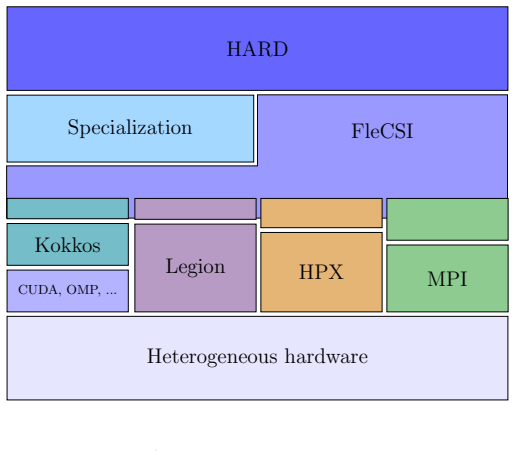
HARD expresses its computational units as tasks whose execution can be orchestrated by multiple back-end runtimes, including Legion, MPI, and HPX, while node-level parallelism is delegated to Kokkos, providing a single, portable code base that runs efficiently on laptops, small homogeneous clusters, and the largest heterogeneous supercomputers currently available.
What carries the argument
FleCSI task-based framework combined with Kokkos, which lets the same source express computations that multiple runtimes can schedule across different hardware.
Load-bearing premise
Delegating execution to multiple back-end runtimes and Kokkos will preserve numerical accuracy and performance portability without forcing platform-specific changes that would break the single-code-base claim.
What would settle it
Compile and run the unchanged HARD source on a new heterogeneous supercomputer, execute the Sedov blast-wave test, and check whether the numerical solution still matches the known analytical result while achieving competitive wall-clock time without any code edits.
Figures


read the original abstract
Hydrodynamics And Radiation Diffusion} (HARD) is an open-source application for high-performance simulations of compressible hydrodynamics with radiation-diffusion coupling. Built on the FleCSI (Flexible Computational Science Infrastructure) framework, HARD expresses its computational units as tasks whose execution can be orchestrated by multiple back-end runtimes, including Legion, MPI, and HPX. Node-level parallelism is delegated to Kokkos, providing a single, portable code base that runs efficiently on laptops, small homogeneous clusters, and the largest heterogeneous supercomputers currently available. To ensure scientific reliability, HARD includes a regression-test suite that automatically reproduces canonical verification problems such as the Sod and LeBlanc shock tubes and the Sedov blast wave, comparing numerical solutions against known analytical results. The project is distributed under an OSI-approved license, hosted on GitHub, and accompanied by reproducible build scripts and continuous integration workflows. This combination of performance portability, verification infrastructure, and community-focused development makes HARD a sustainable platform for advancing radiation hydrodynamics research across multiple domains.
Editorial analysis
A structured set of objections, weighed in public.
Referee Report
Summary. The manuscript describes HARD, an open-source code for compressible hydrodynamics with radiation-diffusion coupling, implemented on the FleCSI framework. Computational units are expressed as tasks orchestrated by multiple back-end runtimes (Legion, MPI, HPX) with node-level parallelism via Kokkos, enabling a single portable source base. Verification relies on an automated regression suite reproducing the Sod and LeBlanc shock tubes and Sedov blast wave, with direct comparisons to analytical solutions; the project includes reproducible build scripts, CI workflows, and an OSI-approved license.
Significance. If the portability claims hold, the work supplies a verified, maintainable platform for radiation-hydrodynamics simulations that can target laptops through heterogeneous supercomputers from one code base. The combination of task abstraction, Kokkos delegation, and built-in regression tests against analytical results strengthens its utility for domains such as astrophysics and high-energy-density physics, while the open distribution and CI lower barriers to adoption and extension.
major comments (1)
- [Performance and portability discussion (likely §4 or §5)] The central portability claim (single source without platform-specific tuning) rests on the assumption that FleCSI task orchestration plus Kokkos preserves both numerical fidelity and performance across Legion/MPI/HPX and heterogeneous nodes. The manuscript provides regression results for the Sod, LeBlanc, and Sedov problems but does not report quantitative performance or scaling data on heterogeneous supercomputers; this gap is load-bearing for the efficiency assertion in the abstract and introduction.
minor comments (3)
- [Abstract] Abstract contains a stray closing brace: 'Hydrodynamics And Radiation Diffusion} (HARD)'.
- [Verification / Regression tests] The verification section would benefit from explicit statement of the spatial discretization, time-stepping scheme, and radiation solver (e.g., diffusion approximation details) to allow readers to assess the numerical methods independently of the portability layer.
- [Figures] Figure captions and axis labels for any performance plots should include hardware details (node count, GPU/CPU configuration) to make scaling claims immediately interpretable.
Simulated Author's Rebuttal
We thank the referee for the positive summary, significance assessment, and recommendation of minor revision. We address the single major comment below and will incorporate changes to strengthen the manuscript.
read point-by-point responses
-
Referee: The central portability claim (single source without platform-specific tuning) rests on the assumption that FleCSI task orchestration plus Kokkos preserves both numerical fidelity and performance across Legion/MPI/HPX and heterogeneous nodes. The manuscript provides regression results for the Sod, LeBlanc, and Sedov problems but does not report quantitative performance or scaling data on heterogeneous supercomputers; this gap is load-bearing for the efficiency assertion in the abstract and introduction.
Authors: We agree that the absence of quantitative performance and scaling results on heterogeneous systems leaves the efficiency claims in the abstract and introduction less fully supported than the portability and verification aspects. The manuscript's primary emphasis is on the task-based formulation, radiation-diffusion coupling, and automated regression against analytical solutions to demonstrate correctness and reproducibility. Performance portability is inherited from the FleCSI back-ends and Kokkos delegation, which are documented elsewhere to maintain efficiency without source changes. To directly address the referee's concern, we will add a concise performance subsection (likely in §4) that reports wall-clock timings and weak-scaling behavior for the Sedov test on a heterogeneous platform using the Legion backend with Kokkos GPU execution. These data will be obtained from additional runs on an available system and will be accompanied by the corresponding input decks in the repository to maintain reproducibility. revision: yes
Circularity Check
No significant circularity
full rationale
The manuscript is a software description paper presenting the HARD radiation-hydrodynamics code, its task-based abstraction over FleCSI, and its use of Kokkos for node-level parallelism. No derivation chain, equations, fitted parameters, or predictive claims exist that could reduce to self-definitions, fitted inputs, or self-citation load-bearing steps. Verification relies on external analytical solutions for Sod, LeBlanc, and Sedov problems plus reproducible build/CI infrastructure, keeping the presentation self-contained and independent of any internal circular reduction.
Axiom & Free-Parameter Ledger
Lean theorems connected to this paper
-
IndisputableMonolith/Foundation/RealityFromDistinction.leanreality_from_one_distinction unclear?
unclearRelation between the paper passage and the cited Recognition theorem.
Built on the FleCSI framework, HARD expresses its computational units as tasks whose execution can be orchestrated by multiple back-end runtimes, including Legion, MPI, and HPX. Node-level parallelism is delegated to Kokkos, providing a single, portable code base...
-
IndisputableMonolith/Cost/FunctionalEquation.leanwashburn_uniqueness_aczel unclear?
unclearRelation between the paper passage and the cited Recognition theorem.
We adopt the co-moving (Eulerian) frame formulation of the RHD equations in the diffusion limit... with source terms involving opacity, radiation force and heating rate q-dot = c kappa rho (E - a T^4)
What do these tags mean?
- matches
- The paper's claim is directly supported by a theorem in the formal canon.
- supports
- The theorem supports part of the paper's argument, but the paper may add assumptions or extra steps.
- extends
- The paper goes beyond the formal theorem; the theorem is a base layer rather than the whole result.
- uses
- The paper appears to rely on the theorem as machinery.
- contradicts
- The paper's claim conflicts with a theorem or certificate in the canon.
- unclear
- Pith found a possible connection, but the passage is too broad, indirect, or ambiguous to say the theorem truly supports the claim.
Reference graph
Works this paper leans on
- [1]
- [2]
-
[3]
M. P. I. Forum, Mpi: A message-passing interface standard, Tech. rep., USA (1994)
work page 1994
-
[4]
H. Kaiser, P. Diehl, A. S. Lemoine, B. A. Lelbach, P. Amini, A. Berge, J. Biddiscombe, S. R. Brandt, N. Gupta, T. Heller, K. Huck, Z. Khatami, A. Kheirkhahan, A. Reverdell, S. Shirzad, M. Simberg, B. Wagle, W. Wei, T. Zhang, Hpx - the c++ standard library for paral- lelism and concurrency, Journal of Open Source Software 5 (53) (2020) 2352.doi:10.21105/jo...
-
[5]
H. C. Edwards, C. R. Trott, D. Sunderland, Kokkos: enabling manycore performance portability through polymorphic memory access patterns, Journal of Parallel and Distributed Computing 74 (12) (2014) 3202– 3216. xvi
work page 2014
-
[6]
N. J. Turner, J. M. Stone, A module for radiation hydrodynamic cal- culations with zeus-2d using flux-limited diffusion, The Astrophysical Journal Supplement Series 135 (1) (2001) 95.doi:10.1086/321779. URLhttps://dx.doi.org/10.1086/321779
-
[7]
B. van der Holst, G. Toth, I. V. Sokolov, K. G. Powell, J. P. Holloway, E. S. Myra, Q. Stout, M. L. Adams, J. E. Morel, R. P. Drake, Crash: A Block-Adaptive-Mesh Code for Radiative Shock Hydrodynamics - Implementation and Verification, Astrophys. J. Suppl. 194 (2011) 23. arXiv:1101.3758,doi:10.1088/0067-0049/194/2/23
work page internal anchor Pith review Pith/arXiv arXiv doi:10.1088/0067-0049/194/2/23 2011
-
[8]
W.Zhang, L.Howell, A.Almgren, A.Burrows, J.Bell, CASTRO:ANew Compressible Astrophysical Solver. II. Gray Radiation Hydrodynamics, Astrophys. J. Suppl. 196 (2011) 20.arXiv:1105.2466,doi:10.1088/ 0067-0049/196/2/20
work page internal anchor Pith review Pith/arXiv arXiv 2011
-
[9]
Y.-F. Jiang, Multigroup Radiation Magnetohydrodynamics Based on Discrete Ordinates including Compton Scattering, Astrophys. J. Supp. 263 (1) (2022) 4.arXiv:2209.06240,doi:10.3847/1538-4365/ ac9231
-
[10]
N. Moens, J. O. Sundqvist, I. El Mellah, L. Poniatowski, J. Teu- nissen, R. Keppens, Radiation-hydrodynamics with MPI-AMRVAC . Flux-limited diffusion,A&A657 (2022) A81.arXiv:2104.03968,doi: 10.1051/0004-6361/202141023
-
[11]
B. D. Wibking, M. R. Krumholz, QUOKKA: a code for two-moment AMR radiation hydrodynamics on GPUs,MNRAS512 (1) (2022) 1430– 1449.arXiv:2110.01792,doi:10.1093/mnras/stac439
-
[12]
Tanase, Hyesoon Kim, and Ching-Yung Lin
T. Gamblin, M. LeGendre, M. R. Collette, G. L. Lee, A. Moody, B. R. de Supinski, S. Futral, The Spack Package Manager: Bringing Order to HPC Software Chaos, Supercomputing 2015 (SC’15), Austin, Texas, USA, 2015, lLNL-CONF-669890.doi:10.1145/2807591.2807623. URLhttps://github.com/spack/spack
-
[13]
U. Ayachit, The ParaView Guide: A Parallel Visualization Application, Kitware, Inc., Clifton Park, NY, USA, 2015. URLhttps://www.paraview.org/paraview-guide/
work page 2015
-
[14]
H. Childs, E. Brugger, B. Whitlock, J. Meredith, S. Ahern, D. Pugmire, K. Biagas, M. Miller, C. Harrison, G. H. Weber, H. Krishnan, T. Fogal, A. Sanderson, C. Garth, E. W. Bethel, D. Camp, O. Rübel, M. Du- rant, J. M. Favre, P. Navrátil, VisIt: An End-User Tool For Visualizing xvii and Analyzing Very Large Data, in: High Performance Visualization– Enablin...
work page 2012
-
[15]
D. Mihalas, B. W. Mihalas, Foundations of radiation hydrodynamics, Dover Publications, INC., 1984
work page 1984
-
[16]
URLhttps://github.com/lanl/singularity-eos
singularity-eos, https://github.com/lanl/singularity-eos (aug 25 2025). URLhttps://github.com/lanl/singularity-eos
work page 2025
-
[17]
C. D. Levermore, G. C. Pomraning, A flux-limited diffusion theory, As- trophysical Journal 248 (1981) 321–334.doi:10.1086/159157
- [18]
-
[19]
A. Harten, P. D. Lax, B. v. Leer, On upstream differencing and godunov- type schemes for hyperbolic conservation laws, SIAM Review 25 (1) (1983) 35–61.doi:10.1137/1025002. URLhttps://doi.org/10.1137/1025002
-
[20]
V. Rusanov, The calculation of the interaction of non-stationary shock waves and obstacles, USSR Computational Mathematics and Mathematical Physics 1 (2) (1962) 304–320.doi:https: //doi.org/10.1016/0041-5553(62)90062-9. URLhttps://www.sciencedirect.com/science/article/pii/ 0041555362900629
-
[21]
W. L. Briggs, V. E. Henson, S. F. McCormick, A Multigrid Tutorial, Second Edition, 2nd Edition, Society for Industrial and Applied Mathe- matics, 2000.arXiv:https://epubs.siam.org/doi/pdf/10.1137/1. 9780898719505,doi:10.1137/1.9780898719505. URLhttps://epubs.siam.org/doi/abs/10.1137/1.9780898719505
work page doi:10.1137/1 2000
- [22]
-
[23]
Gist (grid impedance scan tool) [swr-22-73],
A. Reisner, C. Mauney, flecsolve (03 2025).doi:10.11578/dc. 20250418.2. URLhttps://www.osti.gov/biblio/code-154403
work page doi:10.11578/dc 2025
-
[24]
N. Roth, D. Kasen, Monte carlo radiation-hydrodynamics with implicit methods, The Astrophysical Journal Supplement Series 217 (1) (2015) 9.doi:10.1088/0067-0049/217/1/9. URLhttps://dx.doi.org/10.1088/0067-0049/217/1/9 xviii
- [25]
-
[26]
Chandrasekhar, Hydrodynamic and hydromagnetic stability, 1961
S. Chandrasekhar, Hydrodynamic and hydromagnetic stability, 1961
work page 1961
-
[27]
M. Shadmehri, Z. Enayati, M. Khajavi, Magnetized kelvin-helmholtz instability in the presence of a radiation field, Astrophysics and Space Science 341 (2) (2012) 369–374.doi:10.1007/s10509-012-1096-4. URLhttps://doi.org/10.1007/s10509-012-1096-4
-
[28]
H. Peng, F. Yu, Y. Huliuta, L. Wei, Z.-X. Wang, Y. Liu, Effect of Transverse Magnetic Field on Kelvin–Helmholtz Instability in the Pres- ence of a Radiation Field, Astrophysical Journal 970 (1) (2024) 3. doi:10.3847/1538-4357/ad5312. xix
discussion (0)
Sign in with ORCID, Apple, or X to comment. Anyone can read and Pith papers without signing in.