REVIEW 5 major objections 5 minor 35 references
MMT-FD claims 99% fault-diagnosis accuracy from only 1% labeled vibration samples by combining time-frequency self-supervised learning with meta-learning.
Reviewed by Pith at T0; open to challenge. T0 means a machine referee read the full paper against a public rubric. the ladder, T0–T4 →
T0 review · deepseek-v4-flash
2026-08-04 19:24 UTC pith:BHUKY5AG
load-bearing objection A plausible combination of known ideas, but the headline 1%-label result is not actually demonstrated by the reported experiments. the 5 major comments →
Unsupervised Multi-Attention Meta Transformer for Rotating Machinery Fault Diagnosis
The pith
A machine-rendered reading of the paper's core claim, the machinery that carries it, and where it could break.
Core claim
The central claim is that combining a time-frequency multi-attention Transformer encoder with a meta-learning loop lets a diagnosis model learn transferable fault representations from unlabeled signals. Specifically, augmented time-domain and frequency-domain views are encoded separately, the frequency encoder is trained to predict the time-domain embedding, and classification and meta-learning losses are optimized jointly. After fine-tuning with a tiny labeled subset, the model is reported to reach roughly 99% fault-diagnosis accuracy on standard bearing benchmarks and 99.49% on a rotor test bench. The authors attribute this to the meta-learned initialization and to time-frequency consisten
What carries the argument
The load-bearing mechanism is the self-supervised time-frequency alignment loss combined with a bi-level meta-learning update. The frequency encoder is trained to predict the time encoder's embedding of the same augmented sample, forcing the two views to agree and generating pseudo-labels from sample indices. Multi-head attention over time and frequency representations selects fault-relevant regions, while the MAML-style inner loop adapts to a support set and the outer loop optimizes the initialization over query sets. That initialization is what lets the model fine-tune quickly with 1% labeled data.
Load-bearing premise
The paper assumes that random within-dataset splits into 1% and 10% labeled subsets, plus separate training and testing on the same rotor platform, are enough to demonstrate generalization across equipment types; no experiment moves a trained model from one machine type to another.
What would settle it
Pretrain and fine-tune MMT-FD on data from one rotating-machine source (for example, one bearing benchmark), then test it on data from a different machine (for example, the rotor test bench or another bearing dataset) without retraining on target labels. If accuracy falls far below the claimed 99%, the generalization claim fails; a run that explicitly reports 1%-labeled and 10%-labeled accuracy separately would also settle whether the headline number depends on the larger labeled subset.
If this is right
- If the claim holds, practitioners can pretrain on unlabeled vibration histories and adapt a diagnostic model to a new machine's fault types with only tens of labeled samples.
- The time-frequency alignment objective provides an unsupervised way to learn noise-robust representations; the paper reports only about a 1% average accuracy drop when 50% of test data is corrupted with Gaussian noise.
- The ablation study attributes about 5% accuracy to the bi-level optimization and frequency-domain task, and about 2.7% to the augmentation strategy, so each component contributes to the headline result.
- The training-accuracy curves show much faster convergence than the baselines, which, if reliable, would reduce fine-tuning time in deployment.
Where Pith is reading between the lines
- A decisive test the paper does not run is true cross-machine transfer: train on one bearing dataset and test on the rotor platform or a different bearing dataset without target-labeled fine-tuning. If accuracy collapses, the 'generalization across different types of machinery' claim is unsupported.
- Because the reported 1% and 10% labeled-subset results are pooled in Table 2, a reader cannot tell whether the 99% figure reflects 1% labels or 10% labels; reporting them separately would sharpen the claim.
- The time-frequency alignment idea could plausibly transfer to other sensor modalities such as acoustic or current signals, since it only requires paired time/frequency views of the same running machine; this is a testable extension the paper leaves implicit.
Editorial analysis
A structured set of objections, weighed in public.
Referee Report
Summary. The paper proposes MMT-FD, a self-supervised meta-learning framework for few-shot rotating machinery fault diagnosis. The method combines time- and frequency-domain data augmentation, multi-head attention, a Transformer encoder, and MAML-style bi-level optimization, with a final objective comprising alignment, classification, and meta-learning losses. Experiments are reported on four bearing benchmark datasets (CWRU, PUBD, IMS, FEMTO) and on a custom rotor test bench, with an ablation study and noise-robustness test. The central claim is that MMT-FD achieves 99% fault diagnosis accuracy using only 1% labeled data and generalizes across different types of rotating machinery.
Significance. If the claimed results were reproducible, the framework would be a meaningful contribution to few-shot and unsupervised fault diagnosis: it combines standard self-supervised representation learning with meta-learning and evaluates on multiple public and custom benchmarks against 12 baselines, including recent SSL and SOTA time-series models. The paper also includes an ablation study and a hardware rotor experiment. However, the reported evidence does not currently substantiate the headline claims: the experimental protocol mixes label fractions without separating results, the rotor test uses 70% supervision and does not test cross-machine transfer, and several implementation details are internally inconsistent. The central contribution is therefore not verifiable as presented.
major comments (5)
- [Section 5.5, Table 2] The headline claim of 99% accuracy with 1% labeled data is not supported by Table 2. Section 5.5 states that the training set is divided into two equally sized subsets by randomly selecting 1% and 10% of the data, and that different fine-tuning learning rates are used for the two fractions (classifier 0.05 vs 1.0; backbone 0.0001 vs 0.01). However, Table 2 reports only 'Average' and 'Worst' accuracy per dataset, with no column identifying which label fraction produced each number. Because the 1% and 10% regimes use different learning schedules, pooling or omitting this distinction makes it impossible to attribute the reported 99.21% (CWRU) or any other result to the 1% supervised setting. The authors must report 1% and 10% results separately, with standard deviations and the exact number of labeled samples per class.
- [Section 5.8, Fig. 12] The rotor test bench experiment does not support the '1% labels' claim. Section 4 and Section 5.8 describe a 7:3 train/test split with 150 of 214 samples per state used for training, i.e., approximately 70% supervision. The 99.49% accuracy in Fig. 12 is therefore obtained in a largely supervised setting, not a few-shot one. Moreover, the rotor model is trained and tested on the same platform, so it provides no evidence for the abstract's claim of generalization across different types of rotating machinery. A genuine cross-equipment transfer experiment (e.g., pretrain on bearings, adapt with few rotor samples) is required.
- [Section 5.3 vs Section 3] The implementation description contradicts the method description. Section 5.3 states that tasks are constructed using image batches of B=16, with a random 224x224 pixel patch extracted from the original signal and SimCLR-style augmentations (horizontal flipping, cropping, adjustments), and that a C4-backbone CNN is used as the encoder. In contrast, Section 3 describes time-domain signals x(t), FFT-based frequency transforms, window warping, Gaussian noise, and Transformer encoders over H_t and H_f. The input representation, encoder architecture, and augmentation pipeline are therefore ambiguous. Additionally, Section 5.3 lists MSE and MAE as key performance indicators, while Section 5.4 and Table 2 use classification accuracy. These inconsistencies make it impossible for a reader to reproduce the experiments or verify any of the reported numbers.
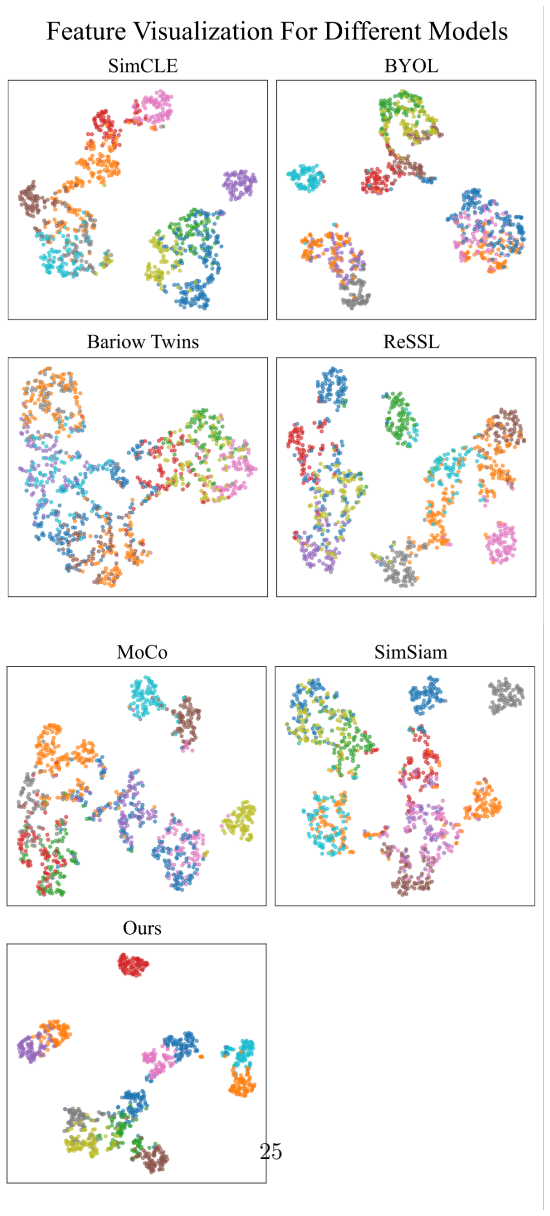
- [Section 5.7.1, Fig. 7] The signal waveform visualization experiment claims to show 'reconstructed waveforms' and states that MMT-FD exhibits higher fidelity in reconstructed signals. However, the model is not a reconstruction network: the optimization objective in Eq. (13) includes alignment, classification, and meta-learning losses, but no reconstruction loss or decoder is described anywhere. The claim of waveform reconstruction fidelity is therefore unsupported by the method and appears unrelated to the actual architecture. This section should either be removed or replaced with an evaluation of the learned representations' faithfulness to the input, or the model and loss need to be extended with a reconstruction branch.
- [Section 3.5, Eq. (13), Algorithm 1] The alignment loss L_align, which is a core component of the final objective, is never explicitly defined. The Introduction mentions a 'cross-correlation matrix loss', and Algorithm 1 refers to L_align(Z_t, Z_f), but neither the equation nor the text specifies how this loss is computed (e.g., whether it is a cross-correlation, mean-squared error between projections, or another objective). Without a precise definition of L_align, the method is not fully specified and the claimed contribution of time-frequency alignment cannot be independently implemented or tested.
minor comments (5)
- [General] The model is inconsistently named: the abstract and most of the paper use MMT-FD, but the Introduction repeatedly refers to 'MetaTrans'. The contributions list should be harmonized.
- [Section 2] 'TimeNet' appears in the description of TimesNet; this is likely a typo for 'TimesNet'. Also, some references are formatted inconsistently (e.g., [18] appears both as a reference and as a protocol source).
- [Section 5.1] The FEMTO dataset is described as containing 'inner race faults, outer race faults, and rolling element faults', but the FEMTO benchmark is commonly used for remaining useful life estimation rather than discrete fault classification. The authors should clarify how the dataset was preprocessed for classification and how many classes were used.
- [Fig. 4 and Table 2] Figure 4 is referenced as a performance comparison, but the figure is not described in detail; the caption is minimal. Please add axis labels, legend definitions, and a clear description of what the box plots or error bars represent.
- [Section 5.6, Table 4] The ablation study is reported only on the IMS dataset. If the purpose is to show that each module contributes across different machines, at least one additional dataset should be included, or the text should explicitly state that the ablation is illustrative for a single dataset.
Circularity Check
No material circularity; the reported claim is an empirical benchmark result, not a derivation that reduces to its inputs.
full rationale
The paper is an empirical machine-learning pipeline evaluated on external bearing benchmarks (CWRU, PUBD, IMS, FEMTO) and a rotor test rig. The 'predictions' are test accuracies on held-out data, not fitted parameters renamed as predictions. The objective in Eq. (13) combines a standard self-supervised alignment loss, classification losses, and a MAML-style meta-learning loss; none of these is defined in terms of the final accuracy numbers. The time-frequency alignment idea is explicitly credited to the external TFPred paper [28], and the augmentation protocol is attributed to SimCLR [29], so the framework is not a renamed version of a result imported from the authors' own prior work. The self-citations present ([15], [17], [18], [27]) are background references for meta-learning and experimental noise setups; they are not load-bearing for the central 99%-accuracy claim, and none is invoked to forbid alternatives or to justify a unique choice. The strongest weakness of the paper is evidentiary rather than circular: Section 5.5 describes a 1%/10% semi-supervised protocol, but Table 2 reports only 'Average' and 'Worst' without separating the label fractions, and the rotor experiment in Section 5.8 uses a 7:3 train/test split, so the headline '99% with 1% labels' is not cleanly demonstrated by the reported tables. That is an incomplete or ambiguous experimental validation, not a circular derivation. Accordingly, the circularity score is low.
Axiom & Free-Parameter Ledger
free parameters (6)
- loss weighting factors lambda_1, lambda_2, lambda_3 =
Not given
- number of attention heads M =
Not given
- window warping scale s =
Not given
- noise variance sigma^2 =
Not given
- frequency masking ratio =
Not given
- inner/outer loop learning rates alpha, beta =
Not given
axioms (5)
- domain assumption The frequency encoder can predict low-dimensional time-domain embeddings, and this alignment yields fault-discriminative representations (TFPred-style objective).
- domain assumption Random augmentations (window warping, flipping, noise, frequency masking) preserve fault semantics and do not change the underlying fault class.
- domain assumption MAML bi-level optimization with tasks sampled from the same benchmark datasets yields an initialization that transfers to new data with 1% labels.
- ad hoc to paper The C4-backbone encoder used for both the proposed method and baselines is an appropriate universal feature extractor for vibration signals.
- domain assumption The test accuracy reported in Table 2 is computed under the same 1%/10% semi-supervised protocol for all methods, and the 'Average' and 'Worst' columns aggregate these settings consistently.
read the original abstract
The intelligent fault diagnosis of rotating mechanical equipment usually requires a large amount of labeled sample data. However, in practical industrial applications, acquiring enough data is both challenging and expensive in terms of time and cost. Moreover, different types of rotating mechanical equipment with different unique mechanical properties, require separate training of diagnostic models for each case. To address the challenges of limited fault samples and the lack of generalizability in prediction models for practical engineering applications, we propose a Multi-Attention Meta Transformer method for few-shot unsupervised rotating machinery fault diagnosis (MMT-FD). This framework extracts potential fault representations from unlabeled data and demonstrates strong generalization capabilities, making it suitable for diagnosing faults across various types of mechanical equipment. The MMT-FD framework integrates a time-frequency domain encoder and a meta-learning generalization model. The time-frequency domain encoder predicts status representations generated through random augmentations in the time-frequency domain. These enhanced data are then fed into a meta-learning network for classification and generalization training, followed by fine-tuning using a limited amount of labeled data. The model is iteratively optimized using a small number of contrastive learning iterations, resulting in high efficiency. To validate the framework, we conducted experiments on a bearing fault dataset and rotor test bench data. The results demonstrate that the MMT-FD model achieves 99\% fault diagnosis accuracy with only 1\% of labeled sample data, exhibiting robust generalization capabilities.
Figures




Reference graph
Works this paper leans on
-
[1]
Z. Gao, C. Cecati, and S. X. Ding. A survey of fault diagnosis and fault-tolerant techniques—part i: Fault diagnosis with model-based and signal-based approaches.IEEE Transactions on Industrial Electronics, 2015
2015
-
[2]
Isermann
R. Isermann. Supervision, fault-detection and fault-diagnosis meth- ods—an introduction.Control Engineering Practice, 1997
1997
-
[3]
Jingyao Wang and Naigong Yu. Ssd-faster net: A hybrid network for industrial defect inspection.arXiv preprint arXiv:2207.00589, 2022
Pith/arXiv arXiv 2022
-
[4]
Moraru, M
A. Moraru, M. Pesko, M. Porcius, and C. Fortuna. Using machine learning on sensor data.Journal of Computing, 2010. 30
2010
-
[5]
T. Go, T. Moe, and G. Hirotsugu. Machine learning applied to sensor data analysis.Yokogawa Technical Report, 2016
2016
-
[6]
Blasch, T
E. Blasch, T. Pham, C. Y. Chong, and W. Koch. Machine learn- ing/artificial intelligence for sensor data fusion–opportunities and chal- lenges.IEEE Aerospace and Electronic Systems Magazine, 2021
2021
-
[7]
M. S. Mahdavinejad, M. Rezvan, and M. Barekatain. Machine learning for internet of things data analysis: A survey.Digital Communications and Networks, 2018
2018
-
[8]
Jingyao Wang, Luntian Mou, Changwen Zheng, and Wen Gao. Image- based freeform handwriting authentication with energy-oriented self- supervised learning.arXiv preprint arXiv:2408.09676, 2024
Pith/arXiv arXiv 2024
-
[9]
W. Zhao, A. Bhushan, A. D. Santamaria, and M. G. Simon. Machine learning: A crucial tool for sensor design.Algorithms, 2008
2008
-
[10]
Camps-Valls
G. Camps-Valls. Machine learning in remote sensing data processing. InInternational Workshop on Machine Learning for Signal Processing. IEEE, 2009
2009
-
[11]
Gupta, M
S. Gupta, M. Mittal, and A. Padha. Predictive analytics of sensor data based on supervised machine learning algorithms. In2017 Inter- national Conference on Computing, Communication, and Automation. IEEE, 2017
2017
-
[12]
Y. Lei, B. Yang, X. Jiang, F. Jia, N. Li, and A. K. Nandi. Applications of machine learning to machine fault diagnosis: A review and roadmap. Mechanical Systems and Signal Processing, 2020
2020
-
[13]
Jingyao Wang, Yiming Chen, Lingyu Si, and Changwen Zheng. Advanc- ing complex wide-area scene understanding with hierarchical coresets selection.arXiv preprint arXiv:2507.13061, 2025
arXiv 2025
-
[14]
Model-agnostic meta- learning for fast adaptation of deep networks
Chelsea Finn, Pieter Abbeel, and Sergey Levine. Model-agnostic meta- learning for fast adaptation of deep networks. InInternational confer- ence on machine learning, pages 1126–1135. PMLR, 2017
2017
-
[15]
Explicitly modeling generality into self-supervised learning.arXiv preprint arXiv:2405.01053, 2024
Wenwen Qiang, Jingyao Wang, and Changwen Zheng. Explicitly modeling generality into self-supervised learning.arXiv preprint arXiv:2405.01053, 2024. 31
Pith/arXiv arXiv 2024
-
[16]
Aniruddh Raghu, Maithra Raghu, Samy Bengio, and Oriol Vinyals. Rapid learningorfeature reuse? towards understandingtheeffectiveness of maml.arXiv preprint arXiv:1909.09157, 2019
Pith/arXiv arXiv 1909
-
[17]
Meta-auxiliarylearningformicro-expression recognition.arXiv preprint arXiv:2404.12024, 2024
Jingyao Wang, Yunhan Tian, Yuxuan Yang, Xiaoxin Chen, Changwen Zheng, andWenwenQiang. Meta-auxiliarylearningformicro-expression recognition.arXiv preprint arXiv:2404.12024, 2024
Pith/arXiv arXiv 2024
-
[18]
Towards task sampler learning for meta-learning
Jingyao Wang, Wenwen Qiang, Xingzhe Su, Changwen Zheng, Fuchun Sun, and Hui Xiong. Towards task sampler learning for meta-learning. International Journal of Computer Vision, pages 1–31, 2024
2024
-
[19]
Prototypicalnetworksfor few-shot learning.Advances in neural information processing systems, 30, 2017
JakeSnell, KevinSwersky, andRichardZemel. Prototypicalnetworksfor few-shot learning.Advances in neural information processing systems, 30, 2017
2017
-
[20]
Reptile: a scalable metalearning algo- rithm.arXiv preprint arXiv:1803.02999, 2(3):4, 2018
Alex Nichol and John Schulman. Reptile: a scalable metalearning algo- rithm.arXiv preprint arXiv:1803.02999, 2(3):4, 2018
Pith/arXiv arXiv 2018
-
[21]
Vibration-based condition monitoring: Industrial, aerospace and automotive applications
RB Randall. Vibration-based condition monitoring: Industrial, aerospace and automotive applications. 2011
2011
-
[22]
Academic press, 2009
Stephane Mallat.A Wavelet Tour of Signal Processing: The Sparse Way. Academic press, 2009
2009
-
[23]
Bearing fault diagnosis based on multi-scale cnn and lstm network.Measurement, 103:5–12, 2017
Yuanyuan Tang et al. Bearing fault diagnosis based on multi-scale cnn and lstm network.Measurement, 103:5–12, 2017
2017
-
[24]
Noise-robust fault diagnosis method for rotating machin- ery based on time–frequency analysis and convolutional neural networks
Y Jiang et al. Noise-robust fault diagnosis method for rotating machin- ery based on time–frequency analysis and convolutional neural networks. Mechanical Systems and Signal Processing, 140:106672, 2020
2020
-
[25]
Time-frequency analysis in mechanical fault diagnosis–a review with applications.Mechanical Systems and Signal Processing, 121:209–237, 2018
JL Gonzalez et al. Time-frequency analysis in mechanical fault diagnosis–a review with applications.Mechanical Systems and Signal Processing, 121:209–237, 2018
2018
-
[26]
Springer, 2006
Christopher M Bishop.Pattern Recognition and Machine Learning. Springer, 2006
2006
-
[27]
Awesome- meta+: Meta-learning research and learning platform.arXiv preprint arXiv:2304.12921, 2023
Jingyao Wang, Chuyuan Zhang, Ye Ding, and Yuxuan Yang. Awesome- meta+: Meta-learning research and learning platform.arXiv preprint arXiv:2304.12921, 2023. 32
Pith/arXiv arXiv 2023
-
[28]
Tfpred: Learning discriminative representations from unlabeled data for few-label rotating machinery fault diagnosis.Control Engineering Practice, 146:105900, 2024
Xiaohan Chen, Rui Yang, Yihao Xue, Baoye Song, and Zidong Wang. Tfpred: Learning discriminative representations from unlabeled data for few-label rotating machinery fault diagnosis.Control Engineering Practice, 146:105900, 2024
2024
-
[29]
A simple framework for contrastive learning of visual representations
TingChen, SimonKornblith, MohammadNorouzi, andGeoffreyHinton. A simple framework for contrastive learning of visual representations. In International conference on machine learning, pages 1597–1607. PMLR, 2020
2020
-
[30]
Boot- strap your own latent-a new approach to self-supervised learning.Ad- vances in neural information processing systems, 33:21271–21284, 2020
Jean-Bastien Grill, Florian Strub, Florent Altché, Corentin Tal- lec, Pierre Richemond, Elena Buchatskaya, Carl Doersch, Bernardo Avila Pires, Zhaohan Guo, Mohammad Gheshlaghi Azar, et al. Boot- strap your own latent-a new approach to self-supervised learning.Ad- vances in neural information processing systems, 33:21271–21284, 2020
2020
-
[31]
Barlow twins: Self-supervised learning via redundancy reduction
Jure Zbontar, Li Jing, Ishan Misra, Yann LeCun, and Stéphane Deny. Barlow twins: Self-supervised learning via redundancy reduction. In International Conference on Machine Learning, pages 12310–12320. PMLR, 2021
2021
-
[32]
Learning to compare: Relation network for few-shot learning
Flood Sung, Yongxin Yang, Li Zhang, Tao Xiang, Philip HS Torr, and Timothy M Hospedales. Learning to compare: Relation network for few-shot learning. InProceedings of the IEEE conference on computer vision and pattern recognition, pages 1199–1208, 2018
2018
-
[33]
FEDformer: Frequency enhanced decomposed transformer for long- term series forecasting.ICML, 2022
Tian Zhou, Ziqing Ma, Qingsong Wen, Xue Wang, Liang Sun, and Rong Jin. FEDformer: Frequency enhanced decomposed transformer for long- term series forecasting.ICML, 2022
2022
-
[34]
Timesnet: Temporal 2d-variation modeling for general time series analysis.ICLR, 2023
Haixu Wu, Tengge Hu, Yong Liu, Hang Zhou, Jianmin Wang, and Ming- sheng Long. Timesnet: Temporal 2d-variation modeling for general time series analysis.ICLR, 2023
2023
-
[35]
Bearingfaultdiagnosisbase onmulti-scalecnnandlstmmodel.Journal of Intelligent Manufacturing, 32(4):971–987, 2021
XiaohanChen, BeikeZhang, andDongGao. Bearingfaultdiagnosisbase onmulti-scalecnnandlstmmodel.Journal of Intelligent Manufacturing, 32(4):971–987, 2021. 33
2021
discussion (0)
Sign in with ORCID, Apple, or X to comment. Anyone can read and Pith papers without signing in.