REVIEW 6 minor 1 cited by
Quantum sensing in the presence of pulse errors and qubit leakage
T0 review · 0 major / 6 minor · reviewed 2026-08-04 · deepseek-v4-flash
Pith's one-line read This paper shows that a dynamical decoupling sequence's ability to preserve coherence under pulse errors does not predict its performance when actually sensing, and that leakage makes the ranking flip between protocols.
desk verdict The central claim holds up: sensing robustness and coherence-time robustness decouple, and this paper shows it with clean simulations and an experiment that actually confirms the ordering. read the letter →
The pith
A machine-rendered reading of the paper's core claim, the machinery that carries it, and where it could break.
The reading
What carries the argument
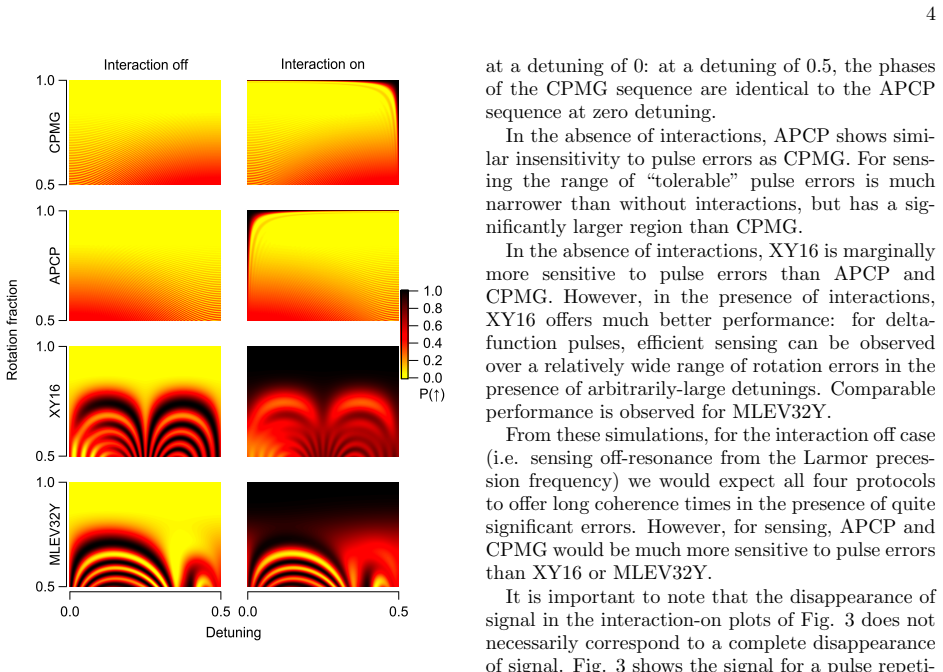
The central object is the family of Carr-Purcell-derived pulse protocols — CPMG, APCP, XY16, MLEV32Y — which differ only in the phases of their π pulses. Simulations use a single spin-1/2 sensor coupled to a spin-1/2 target, with pulse errors represented by a rotation fraction and a scaled detuning, and leakage treated as a third level coupled off-resonantly with assumed equal transition strengths. The mechanism is phase interference: CPMG/APCP keep the initial state protected from rotation errors off-resonance, but once the target interaction moves the state off the protected axis, the same errors accumulate; the phase patterns of XY16/MLEV32Y distribute the error so sensing survives, at th
What would settle it
Measure the on-resonance CPMG sensing signal while sweeping rotation fraction from 0.9 to 1.1 in a system with negligible leakage; the paper's simulation predicts the signal collapses to near zero outside a tiny window while MLEV32Y stays near full contrast. If CPMG maintains high contrast across that range, the claimed pulse-error sensitivity of CPMG sensing is falsified.
Extended reading notes
Core claim
Using simulations of a spin-1/2 sensor dipole-coupled to a target spin, plus experiments on 85Rb atoms in a neon matrix at 3 K, the paper shows that the robustness of dynamical decoupling sequences to pulse errors depends sharply on whether the sequence is preserving a protected state or evolving to sense. CPMG and APCP are nearly immune to rotation and detuning errors when the interaction is off, but on resonance their signal splits and broadens even for small rotation errors; XY16 and MLEV32Y tolerate a much wider error range while sensing. Off-resonant coupling to other Zeeman levels reverses the ranking: APCP/CPMG keep their coherence under leakage, while XY16/MLEV32Y lose an order of ma
Load-bearing premise
The leakage-simulation ordering relies on the assumption that the |1⟩↔|2⟩ and |2⟩↔|3⟩ transition strengths are exactly equal; real dipoles differ, so the predicted T2 ranking could shift.
Editorial extensions
If this is right
- Coherence-time ranking and sensing-performance ranking are nearly opposite for the four tested protocols.
- Under simultaneous pulse errors and leakage, MLEV32Y is the best available compromise among the four protocols, giving order-of-magnitude faster sensing with narrower linewidth than APCP/CPMG in the rubidium experiment.
- Shaped (tapered) pulses reduce leakage only modestly (≲50%), so choice of phase pattern matters more than pulse shaping in this system.
- For systems dominated by leakage with minimal pulse errors, APCP/CPMG should outperform XY/MLEV; for systems with small leakage and significant pulse errors, the opposite holds.
Reading between the lines
- The near-opposite ranking suggests a combined metric — e.g., error tolerance weighted by leakage resistance — could replace coherence time as a design target for sensing sequences.
- The line-splitting prediction for CPMG/APCP under rotation errors offers a clean single-spin experimental test that separates pulse-error mechanisms from environmental decoherence.
- With unequal real dipole moments, the quantitative leakage ordering likely shifts; the paper's assumption that the two transition strengths are equal is the main caveat to extrapolating the T2 ranking to other atomic species.
- Hybrid sequences that start with APCP/CPMG for coherence preservation and switch to MLEV/XY only during the sensing window might inherit benefits of both, a direction the paper does not explore.
Editorial analysis
A structured set of objections, weighed in public.
Referee Report
Summary. The manuscript investigates how pulse imperfections (rotation errors and detuning) and qubit leakage affect dynamical-decoupling sequences used for quantum sensing. Using a spin-1/2 sensor coupled to a spin-1/2 target, the authors simulate CP, CPMG, APCP, XY16, and MLEV32Y with delta-function and finite-width pulses, and experimentally compare APCP, CPMG, XY16, and MLEV32Y on 85Rb atoms in a neon matrix sensing unpolarized 21Ne nuclei. The main finding is that long coherence times off-resonance do not guarantee robust sensing on-resonance: CPMG/APCP are protected from rotation errors only when the sensor remains in a special state, while XY16/MLEV are sensing-robust but suffer from leakage to other levels. MLEV32Y offers a compromise, and experimentally enables sensing roughly an order of magnitude faster and with narrower NMR linewidth than APCP/CPMG.
Significance. The paper makes a useful and non-obvious point: a sequence's coherence time in the absence of a target is not a reliable proxy for its sensing performance under realistic pulse errors. The simulations are not fitted to the data and make falsifiable predictions (e.g., Rabi-frequency dependence of T2, rotation-error tolerance, on/off-resonance ordering) that are confirmed in Table II and Figs. 9-11. The experimental demonstration of an order-of-magnitude improvement in sensing time/linewidth with MLEV32Y is direct and relevant to the broader quantum-sensing community, e.g., NV centers and donors. The paper is clearly written and the supporting figures are informative.
minor comments (6)
- [Section IV] The three-level leakage model assumes equal |1⟩↔|2⟩ and |2⟩↔|3⟩ transition strengths. For the experimental 85Rb F=3 system the relevant leak paths have different dipole matrix elements, and the experiment actually involves two leak paths (from |m_F=-1⟩ and |m_F=0⟩). The qualitative ordering APCP/CPMG≫MLEV32Y>XY16 is, however, corroborated by the Rabi-frequency dependence in Table II. Please add a sentence justifying the simplification or a brief discussion of robustness to unequal couplings.
- [Sections III-V] The simulations are described but no code or detailed parameter set is made available. Given that the quantitative curves in Figs. 3, 5, 7, and 8 are central to the argument, please add a data/code availability statement or include the relevant parameters in the text or an appendix.
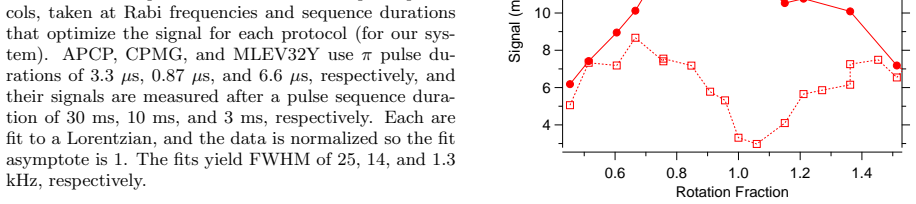
- [Section V D / Fig. 10] The NMR linewidth comparison uses different Rabi frequencies and sequence durations for each protocol (3.3/0.87/6.6 μs and 30/10/3 ms for APCP/CPMG/MLEV32Y). This is a reasonable best-performance comparison, but it should be stated more explicitly in the main text so the reader does not mistake it for a head-to-head measurement at identical settings.
- [Fig. 7 caption] The sentence "to express it in terms of the Rabi frequency used, the x-axis should be scaled by a factor of 0.5" is confusing. Please define the units of δ (e.g., δ/ω, δ/(2π/τ)) unambiguously.
- [Table II] Typo: "correponds" should be "corresponds" in the table footnote.
- [Section III vs. Section V] The simulation target is a spin-1/2 particle, while the experimental target is 21Ne with I=3/2. A one-sentence justification that the qualitative conclusions are insensitive to the target spin magnitude would help bridge the simulation and experiment.
Circularity Check
No significant circularity: the central sensing/leakage results are produced by parameter-free simulations and confirmed by independent experiment; self-citations are only apparatus context.
full rationale
The paper's derivation chain is not circular. Section III simulates the sensing sequences under rotation and detuning errors from the Schrödinger/von Neumann equation with no free parameters fitted to the target data; the predictions (e.g., CPMG/APCP are coherence-robust but sensing-fragile, XY/MLEV are sensing-robust) are concrete and falsifiable. Section IV simulates leakage in a three-level model and predicts the protocol ordering APCP/CPMG ≫ MLEV32Y > XY16 and the Rabi-frequency dependence, which is later checked against experiment in Table II and Fig. 8. The experimental T2 values are extracted from data using a fitting convention (flat distribution of decay rates, following ref. [8]), but those fits are not used as the predictions; they are measurements compared with the simulations. Self-citations (refs. [7,32,33]) describe the neon-matrix apparatus and LIF readout, which are experimental context, not proof of the central physics. No fitted parameter is renamed as a prediction, no uniqueness claim is imported, and no ansatz is smuggled in via citation. The simplified assumption of equal |1⟩↔|2⟩ and |2⟩↔|3⟩ coupling in Section IV is an idealization that could affect quantitative accuracy, but it is not a circular step: the predicted ordering is a derived consequence of the pulse-phase patterns, not an input. Overall the paper is self-contained against external benchmarks and its central claim is supported by independent simulation and experiment.
Assumptions & free parameters
free parameters (2)
- T2 decay fit maximum rate =
Varied; inferred T2 from 0.18 ms to 207 ms across conditions (Table II)
- Lorentzian fit parameters for NMR spectra =
FWHM 25, 14, 1.3 kHz for APCP, CPMG, MLEV32Y (Fig 10)
assumptions (8)
- domain assumption The dipole-dipole interaction is weak relative to the sensor-bias-field interaction and is included via first-order perturbation theory.
- domain assumption The S_zS_z and S_zS_x interaction terms are of equal magnitude.
- domain assumption The interaction strength and duration of the sequence are perfectly matched, so a target spin flips the sensor conditionally for perfect pulses.
- domain assumption The pulse repetition rate is on resonance with the Larmor precession of the target spin.
- domain assumption No decoherence in simulations.
- domain assumption The strengths of the |1>↔|2> and |2>↔|3> transitions are equal.
- domain assumption Thermal mixed state (infinite temperature) for the target spin.
- standard math Von Neumann equation and Rabi formula as the evolution rules.
Cite this review
Pith. "Pith review of Quantum sensing in the presence of pulse errors and qubit leakage." pith.science (2026). https://pith.science/paper/WDRCYU35
@misc{pith2026250909874,
  author       = {Pith},
  title        = {Pith review of: Quantum sensing in the presence of pulse errors and qubit leakage},
  year         = {2026},
  howpublished = {\url{https://pith.science/paper/WDRCYU35}},
  note         = {Machine review of arXiv:2509.09874}
}
read the original abstract
Using both simulation and experiment, we investigate the robustness of dynamical decoupling sequences to pulse errors: rotation errors and detuning errors. Whereas prior work examined the effect of errors on coherence times, here we show that quantum sensing can be affected by pulse errors in dramatically different ways than coherence times alone. We also explore the effects of qubit leakage: off-resonant coupling to other quantum levels. We find order-of-magnitude differences between commonly-used dynamical decoupling sequences in both their sensitivity to pulse errors and leakage.
Figures


Figures from the paper (7 more)


Forward citations
Cited by 1 Pith paper
-
Suppressing Detuning-Induced Bias in Ramsey Magnetometry with Composite Pulses
A three-pulse composite sequence cancels first-order detuning bias in single-qubit Ramsey magnetometry, removing the error floor that limits the single-pulse protocol.
Reference graph
Works this paper leans on
-
[1]
envelope
However, even if the probability of a leak from a single pulse is low, it may not remain low over large numbers of pulses. For a multi-pulse sequence, significant additional complexity arises due to interference between succes- sive pulses. This interference will depend sensitively on the phase evolution of the system, which is deter- mined by the detunin...
-
[2]
Using tapered pulses can reduce the power at frequencies far from the car- rier frequency, which would be expected to reduce leaks to off-resonance levels
Shaped pulses We explored the use of shaped pulses by measur- ing coherence times as a function of varying the ta- per of a Tukey window [35]. Using tapered pulses can reduce the power at frequencies far from the car- rier frequency, which would be expected to reduce leaks to off-resonance levels. Indeed, by changing from a rectangular pulse to a tapered ...
-
[3]
Ezzell, B
N. Ezzell, B. Pokharel, L. Tewala, G. Quiroz, and D. A. Lidar, Physical Review Applied20, 064027 (2023)
2023
-
[4]
C. L. Degen, F. Reinhard, and P. Cappellaro, Rev. Mod. Phys.89, 035002 (2017)
2017
-
[5]
H. Y. Carr and E. M. Purcell, Physical review94, 630 (1954)
1954
-
[6]
Kolkowitz, Q
S. Kolkowitz, Q. P. Unterreithmeier, S. D. Ben- nett, and M. D. Lukin, Physical review letters109, 137601 (2012)
2012
-
[7]
M¨ uller, X
C. M¨ uller, X. Kong, J.-M. Cai, K. Melentijevi´ c, A. Stacey, M. Markham, D. Twitchen, J. Isoya, S. Pezzagna, J. Meijer,et al., Nature communica- tions5, 4703 (2014)
2014
-
[8]
M. H. Abobeih, J. Cramer, M. A. Bakker, N. Kalb, M. Markham, D. J. Twitchen, and T. H. Taminiau, Nature communications9, 2552 (2018)
2018
Show all 37 references
-
[9]
Dargyte, D
U. Dargyte, D. M. Lancaster, and J. D. Weinstein, Phys. Rev. A104, 032611 (2021)
2021
-
[10]
Upadhyay, U
S. Upadhyay, U. Dargyte, D. Patterson, and J. D. Weinstein, Phys. Rev. Lett.125, 043601 (2020)
2020
-
[11]
Cywi´ nski, R
L. Cywi´ nski, R. M. Lutchyn, C. P. Nave, and S. D. Sarma, Physical Review B77, 174509 (2008)
2008
-
[12]
C. A. Ryan, J. S. Hodges, and D. G. Cory, Physical Review Letters105, 200402 (2010)
2010
-
[13]
Naydenov, F
B. Naydenov, F. Dolde, L. T. Hall, C. Shin, H. Fed- der, L. C. Hollenberg, F. Jelezko, and J. Wrachtrup, Physical Review B—Condensed Matter and Mate- rials Physics83, 081201 (2011)
2011
-
[14]
Hirose, C
M. Hirose, C. D. Aiello, and P. Cappellaro, Physical Review A—Atomic, Molecular, and Optical Physics 86, 062320 (2012)
2012
-
[15]
A. M. Souza, G. A. ´Alvarez, and D. Suter, Philo- sophical Transactions of the Royal Society A: Math- ematical, Physical and Engineering Sciences370, 4748 (2012)
2012
-
[16]
J. Cai, B. Naydenov, R. Pfeiffer, L. P. McGuinness, K. D. Jahnke, F. Jelezko, M. B. Plenio, and A. Ret- zker, New Journal of Physics14, 113023 (2012)
2012
-
[17]
Farfurnik, A
D. Farfurnik, A. Jarmola, L. M. Pham, Z.-H. Wang, V. V. Dobrovitski, R. L. Walsworth, D. Budker, and N. Bar-Gill, Physical Review B92, 060301 (2015)
2015
-
[18]
Farfurnik, A
D. Farfurnik, A. Jarmola, D. Budker, and N. Bar- Gill, Journal of Optics20, 024008 (2018)
2018
-
[19]
Rebentrost and F
P. Rebentrost and F. K. Wilhelm, Phys. Rev. B79, 060507 (2009)
2009
-
[20]
J. M. Gambetta, F. Motzoi, S. T. Merkel, and F. K. Wilhelm, Phys. Rev. A83, 012308 (2011)
2011
-
[21]
Z. Chen, J. Kelly, C. Quintana, R. Barends, B. Campbell, Y. Chen, B. Chiaro, A. Dunsworth, A. G. Fowler, E. Lucero, E. Jeffrey, A. Megrant, J. Mutus, M. Neeley, C. Neill, P. J. J. O’Malley, P. Roushan, D. Sank, A. Vainsencher, J. Wenner, T. C. White, A. N. Korotkov, and J. M. ...
2016
-
[22]
Hyypp¨ a, A
E. Hyypp¨ a, A. Veps¨ al¨ ainen, M. Papiˇ c, C. F. Chan, S. Inel, A. Landra, W. Liu, J. Luus, F. Marxer, C. Ockeloen-Korppi, S. Orbell, B. Tarasinski, and J. Heinsoo, PRX Quantum5, 030353 (2024)
2024
-
[23]
Meiboom and D
S. Meiboom and D. Gill, Review of scientific instru- ments29, 688 (1958)
1958
-
[24]
C. P. Slichter,Principles of magnetic resonance, Vol. 1 (Springer Science & Business Media, 2013)
2013
-
[25]
Maudsley, Journal of Magnetic Resonance (1969) 69, 488 (1986)
A. Maudsley, Journal of Magnetic Resonance (1969) 69, 488 (1986)
1969
-
[26]
Gullion, D
T. Gullion, D. B. Baker, and M. S. Conradi, Journal of Magnetic Resonance (1969)89, 479 (1990)
1969
-
[27]
M. H. Levitt and R. Freeman, Journal of Magnetic Resonance (1969)43, 502 (1981)
1969
-
[28]
M. H. Levitt, R. Freeman, and T. Frenkiel, Journal of Magnetic Resonance (1969)47, 328 (1982)
1969
-
[29]
M. H. Levitt, R. Freeman, and T. Frenkiel, Journal of Magnetic Resonance (1969)50, 157 (1982)
1969
-
[30]
Abobeih, J
M. Abobeih, J. Randall, C. Bradley, H. Bartling, M. Bakker, M. Degen, M. Markham, D. Twitchen, and T. Taminiau, Nature576, 411 (2019)
2019
-
[31]
Cohen-Tannoudji, B
C. Cohen-Tannoudji, B. Diu, and F. Laloe,Quan- tum Mechanics(John Wiley & Sons, Inc., 1977)
1977
-
[32]
C. E. Bradley, J. Randall, M. H. Abobeih, R. C. Berrevoets, M. J. Degen, M. A. Bakker, M. Markham, D. J. Twitchen, and T. H. Taminiau, Physical Review X9, 031045 (2019)
2019
-
[33]
I. I. Rabi, N. Ramsey, and J. Schwinger, Reviews of Modern Physics26, 167 (1954). 12
1954
-
[34]
D. M. Lancaster, U. Dargyte, S. Upadhyay, and J. D. Weinstein, Phys. Rev. A103, 052614 (2021)
2021
-
[35]
D. M. Lancaster, U. Dargyte, and J. D. Weinstein, Phys. Rev. Res.6, L012048 (2024)
2024
-
[36]
J. E. Sansonetti, W. C. Martin, and S. L. Young,Handbook of Basic Atomic Spectro- scopic Data (version 1.1.3)(NIST, 2013) http://physics.nist.gov/PhysRefData/Handbook/
2013
-
[37]
M. A. Bernstein, K. F. King, and X. J. Zhou,Hand- book of MRI pulse sequences(Elsevier, 2004)
2004
Reviewed August 4, 2026 · model on record in the stance chip above.
Discussion (0). Sign in to comment.