REVIEW 3 major objections 4 minor 47 references
A single end-to-end neural network can jointly learn downlink pilots, quantized feedback, movable-antenna positions, and precoding, achieving sum rates close to a perfect-CSI upper bound under limited feedback.
Reviewed by Pith at T0; open to challenge. T0 means a machine referee read the full paper against a public rubric. the ladder, T0–T4 →
An end-to-end neural network jointly designs pilots, quantized feedback, movable-antenna positions, and precoding, achieving near-perfect-CSI sum rates with limited feedback in simulated MA downlink systems.
T0 review reviewed 2026-08-05 challenge →
load-bearing objection A worthwhile end-to-end DL framework for movable-antenna systems, with a real soft spot: the λ/2 spacing constraint is only penalized, not enforced. the 3 major comments →
A Deep Learning Framework for Joint Channel Acquisition and Communication Optimization in Movable Antenna Systems
The pith
A machine-rendered reading of the paper's core claim, the machinery that carries it, and where it could break.
The reading
Core claim
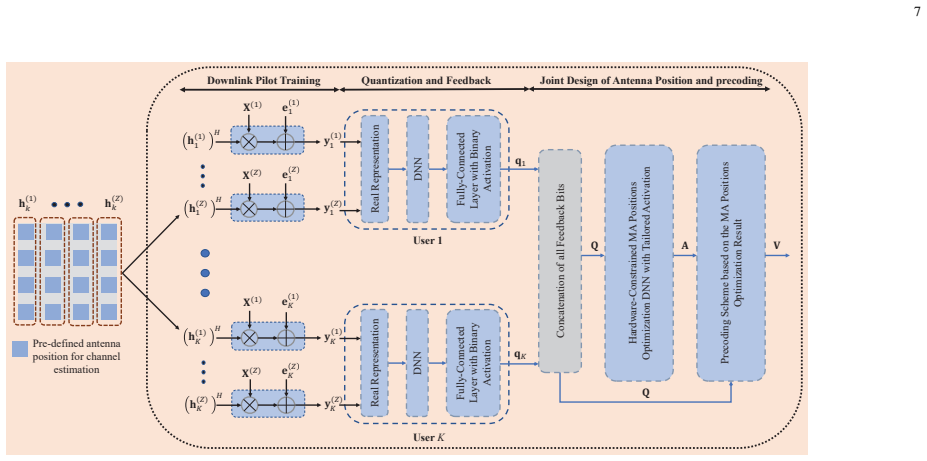
The paper's central discovery is that the two-way coupling between MA positions and channel acquisition can be exploited rather than treated as a nuisance: because the channel depends on antenna locations, the pilot signals, feedback codebook, antenna layout, and precoder should be learned as one system. The authors model the received pilot observation as a linear layer whose weight is the block-diagonal pilot matrix, each user's feedback as a DNN with a sign activation, antenna positioning as a temperature-scaled softmax followed by a top-N hard mask, and precoding as a normalized DNN; straight-through estimators let gradients pass through the nondifferentiable binary and discrete-selection
What carries the argument
The central object is a modular end-to-end neural network architecture with straight-through gradient estimation. Its components are: a learnable block-diagonal pilot matrix with per-column power normalization; per-user encoder DNNs whose final sign layer produces ±1 feedback bits; a base-station MA positioning module that maps aggregated feedback to a temperature-scaled softmax and then a top-N hard binary mask over a discretized antenna-position grid; and a precoding DNN with a power-normalizing output layer. Straight-through estimators (a sigmoid-adjust slope-annealing estimator for binary feedback and a stop-gradient trick for the hard mask) make the discrete operations trainable, while
Load-bearing premise
The λ/2 minimum antenna spacing is enforced only as a quadratic penalty in training, not as a hard constraint, so the learned antenna layouts can in principle violate the spacing rule and the reported rates may include physically infeasible positions.
What would settle it
Train the same architecture with a hard λ/2 spacing constraint, e.g., by projecting selected positions onto a feasible set or adding constrained decoding, and compare sum rates on the same channel dataset; if the hard-constrained version suffers a large throughput loss relative to the reported curves, the reported advantage depends on infeasible layouts. Alternatively, inspect the trained selection masks directly: if a substantial fraction of final test-time layouts contains pairs closer than λ/2, the physical feasibility premise is violated.
If this is right
- Jointly optimized pilots and feedback allow reliable operation with far fewer feedback bits than hand-crafted quantization, with near-saturation performance in the low-bit regime.
- The statistical-CSI variant makes antenna layouts quasi-static, reducing movement overhead while keeping sum rate close to the instantaneous-CSI design.
- The learned system maintains its advantage as the number of users grows, where estimation-error accumulation degrades conventional baselines.
- Performance tracks the perfect-CSI upper bound across varying path richness without retraining for each specific channel sparsity level.
Where Pith is reading between the lines
- Beyond the paper, the end-to-end design principle likely extends to multi-cell and integrated-sensing-and-communication settings, where pilot contamination and sensing objectives create similar cross-module couplings that separate optimization ignores.
- A natural testable extension is to replace the discretized grid selection with continuous position outputs, e.g., direct regression or local refinement around the selected grid points, to see whether performance improves beyond the λ/4 grid resolution used in training.
- Because training uses synthetic geometric Rician channels, deployment on measured channels may require fine-tuning; robustness to distribution shift is untested and would be a sensible validation step.
- If the minimum-spacing penalty is not strong enough, the reported rates may rely on antenna layouts that violate the λ/2 coupling constraint; enforcing the constraint as a hard projection would test whether the advantage survives physically feasible layouts.
Editorial analysis
A structured set of objections, weighed in public.
Referee Report
Summary. The paper proposes an end-to-end deep learning framework for an MA-aided multiuser downlink system. The BS jointly learns (i) downlink pilot matrices, (ii) per-user quantized feedback of received pilots, (iii) MA position selection on a discretized movable region, and (iv) multiuser precoding, with a loss equal to negative average sum rate. A second variant uses a Transformer over Tδ feedback slots to determine MA positions from statistical CSI while precoding adapts instantaneously. Simulation results compare the proposed scheme with DL, gradient-based, antenna-selection, and fixed-position baselines under perfect/estimated CSI and report higher sum rates, close to perfect-CSI upper bounds, especially under limited feedback and sparse channels.
Significance. If the reported gains are reproducible, the paper makes a useful contribution: it is one of the first attempts to jointly learn pilot design, feedback quantization, MA-position selection, and precoding in MA systems, and the two-timescale statistical extension addresses a practical movement-overhead concern. The work is clearly relevant to the journal's readership. Strengths include a non-trivial end-to-end formulation, explicit treatment of the binary feedback bottleneck via a straight-through estimator, and a wide set of comparative simulations. The main limitation is that the central performance claims are simulation-only and currently rest on a soft penalty for a hard physical constraint; the statistical-CSI training procedure is also underspecified.
major comments (3)
- [§III-A3, §III-B, §V] The minimum-spacing constraint (12f)/(32f) is not actually enforced. The selection grid is λ/4-spaced (last paragraph of §V), and the top-N selection in Eq. (18)–(19) can return two grid points that are only λ/4 apart. The only mechanism discouraging this is the quadratic penalty Ldist in Eq. (26) with an unspecified weight β, and in inference the hard top-N mask bypasses the soft probabilities used during training, so no feasibility certificate exists. Since the field-response model (4) contains no mutual-coupling term, sub-λ/2 layouts are scored as valid, whereas the AS-ZF and Fixed-ZF baselines are restricted to feasible λ/2-spaced layouts. To support the headline gain, the authors should either impose (12f) as a hard constraint / projection or report the fraction of selected layouts that violate it, and show that the gap to baselines persists on feasible layouts.
- [§IV-C and Algorithm 1] The statistical-CSI training pipeline is underspecified. Problem (P2) requires collecting Qall over Tδ time slots and optimizing A = f_S_AP(Qall), but Algorithm 1 trains on per-sample H(b) with the instantaneous loss (25); it does not show how the Tδ-slot aggregation is formed, what the corresponding loss is, or how the long-term position is held fixed while per-slot precoding is updated. Without this information the statistical-CSI results in Figs. 5–9 are not reproducible, and it is unclear whether the reported statistical-CSI gains come from the proposed mechanism or from an implicit training/evaluation protocol.
- [§VI, Figs. 5–9] All simulation figures show single curves without error bars, confidence intervals, or number of random trials. Claims such as “consistently outperforms” and the quantitative comparisons in Fig. 7 (95.86% and 96.80% of the upper bound) are therefore not supported with statistical significance. Please report mean ± standard deviation over at least three independent training runs/random seeds, or otherwise quantify the variability of the reported rates.
minor comments (4)
- [Throughout] Typos and grammar: “repsectively,” “Euclidation,” “throughout” (for throughput), “comsumption,” “Beside.” In §II-C, the text says “instantaneous x- and z-coordinates” while the model uses (x,y); Eq. (12f) also writes (xi,zi) inconsistently with an=[xn,yn].
- [Algorithm 1] The pseudocode uses “GreedySelect(p_G, N)” where the text defines a top-N operator; please unify the notation. Also, the annealing factor schedule is defined but the exact value of β in Eq. (27) and the temperature τ used in the reported experiments are not stated.
- [References [40], [41]] The straight-through estimator is attributed to [40] and [41], but those references do not appear to be the standard STE sources (e.g., Bengio et al., “Estimating or propagating gradients through stochastic neurons”). Please replace with the appropriate citations.
- [Eq. (14) and Eq. (7)] The symbol yk is used both for the complex received pilot vector and for its real-valued concatenated representation; please distinguish these (e.g., y_k and Žy_k) to avoid confusion.
Circularity Check
No significant circularity: the end-to-end learning pipeline is trained and evaluated on held-out channel samples; self-citations are background models, not used to force the central claim.
full rationale
The paper's claimed contribution is an end-to-end trainable DNN for pilots, feedback, MA placement, and precoding. The training objective (24)-(27) is the negative sum rate computed from true channel realizations, and the same objective is evaluated on held-out samples from the same channel distribution. There is no fitted constant or target value that is later renamed as a prediction: the learned mappings X, F_k, f_AP, f_BF are all optimized against the same performance metric they are evaluated on, which is standard learning rather than a circular derivation. Self-citations appear at Eq. (4) (field-response model, citing [12],[17],[23]) and Eq. (30) (statistical channel model, citing [23]); these are model assumptions imported from prior work by the same group, but they do not contain or presuppose the paper's central result (that joint DL training outperforms the benchmarks), and they are not used as uniqueness or optimality arguments. The 'perfect-CSI upper bound' is a self-implemented DL benchmark, not an external theorem, so reporting 95-97% of it is empirical comparison, not a derivation that reduces to inputs. The lambda/2 spacing constraint is only a soft penalty (Eq. (26)), which is a feasibility/correctness risk rather than a circular step. Also, the ST-estimator citations [40],[41] appear unrelated to the cited technique, an integrity concern outside circularity. No step in the derivation chain is equivalent to its inputs by construction.
Axiom & Free-Parameter Ledger
free parameters (3)
- Softmax temperature τ
- Spacing penalty weight β
- STE annealing factor schedule =
ω(0)=1, multiplied by 1.01 per epoch up to 10
axioms (4)
- domain assumption Field-response channel model with a finite number of paths: h_k = Q_k^H Σ_k f_k(u_k) (Section II-B)
- domain assumption Statistical channel model: AoDs and PRM constant over time, receive phases i.i.d. uniform, ψ_k ~ CN(0, Diag(b_k)) (Section IV-A)
- domain assumption Error-free uplink feedback link (Section III-A-3)
- domain assumption The discrete grid approximation of the continuous moving region (Section III-A-3, eq. 15)
Cite this review
Pith. "Pith review of A Deep Learning Framework for Joint Channel Acquisition and Communication Optimization in Movable Antenna Systems." pith.science (2026). https://pith.science/paper/ZJ3DJOL2
@misc{pith2026250910487,
  author       = {Pith},
  title        = {Pith review of: A Deep Learning Framework for Joint Channel Acquisition and Communication Optimization in Movable Antenna Systems},
  year         = {2026},
  howpublished = {\url{https://pith.science/paper/ZJ3DJOL2}},
  note         = {Machine review of arXiv:2509.10487}
}
read the original abstract
This paper presents an end-to-end deep learning framework in a movable antenna (MA)-enabled multiuser communication system. In contrast to the conventional works assuming perfect channel state information (CSI), we address the practical CSI acquisition issue through the design of pilot signals and quantized CSI feedback, and further incorporate the joint optimization of channel estimation, MA placement, and precoding design. The proposed mechanism enables the system to learn an optimized transmission strategy from imperfect channel data, overcoming the limitations of conventional methods that conduct channel estimation and antenna position optimization separately. To balance the performance and overhead, we further extend the proposed framework to optimize the antenna placement based on the statistical CSI. Simulation results demonstrate that the proposed approach consistently outperforms traditional benchmarks in terms of achievable sum-rate of users, especially under limited feedback and sparse channel environments. Notably, it achieves a performance comparable to the widely-adopted gradient-based methods with perfect CSI, while maintaining significantly lower CSI feedback overhead. These results highlight the effectiveness and adaptability of learning-based MA system design for future wireless systems.
Figures



Reference graph
Works this paper leans on
-
[1]
Capacity of multi-antenna Gaussian channels,
E. Telatar, “Capacity of multi-antenna Gaussian channels,” Eur . Trans. Telecommun., vol. 10, no. 6, pp. 585–595, Nov. 1999
work page 1999
-
[2]
An overview of MIMO communications—a key to gigabit wireless,
A. Paulraj, D. Gore, R. Nabar, and H. Bölcskei, “An overview of MIMO communications—a key to gigabit wireless,” Proc. IEEE, vol. 92, no. 2, pp. 198–218, Feb. 2004
work page 2004
-
[3]
Broadband MIMO-OFDM wireless communications,
G. L. Stüber, J. R. Barry, S. W. McLaughlin, Y . Li, M. A. Ingram, and T. G. Pratt, “Broadband MIMO-OFDM wireless communications,” Proc. IEEE, vol. 92, no. 2, pp. 271–294, Feb. 2004
work page 2004
-
[4]
An overview of massive MIMO: Benefits and challenges,
L. Lu, G. Y . Li, A. L. Swindlehurst, A. Ashikhmin, and R. Zhang, “An overview of massive MIMO: Benefits and challenges,”IEEE J. Sel. Topics Signal Process., vol. 8, no. 5, pp. 742–758, Oct. 2014
work page 2014
-
[5]
Millimeter- wave NOMA with user grouping, power allocation and hybrid beamform- ing,
L. Zhu, J. Zhang, Z. Xiao, X. Cao, D. O. Wu, and X. Xia, “Millimeter- wave NOMA with user grouping, power allocation and hybrid beamform- ing,” IEEE Trans. Wireless Commun. , vol. 18, no. 11, pp. 5065–5079, Nov. 2019
work page 2019
-
[6]
Multi-user MIMO using ZF-based multi- plexing coordinated with user-wise spatial diversity,
F. Adachi and R. Takahashi, “Multi-user MIMO using ZF-based multi- plexing coordinated with user-wise spatial diversity,” in Proc. IEEE 92nd V eh. Technol. Conf. (VTC-Fall), Oct. 2020, pp. 1–5
work page 2020
-
[7]
Massive MIMO detec- tion techniques: A survey,
M. A. Albreem, M. Juntti, and S. Shahabuddin, “Massive MIMO detec- tion techniques: A survey,” IEEE Commun. Surveys Tuts. , vol. 21, no. 4, pp. 3109–3132, 4th Quart. 2019
work page 2019
-
[8]
Variable-phase-shift-based RF-baseband codesign for MIMO antenna selection,
X. Zhang, A. F. Molisch, and S.-Y . Kung, “Variable-phase-shift-based RF-baseband codesign for MIMO antenna selection,” IEEE Trans. Signal Process., vol. 53, no. 11, pp. 4091–4103, Nov. 2005
work page 2005
-
[9]
A Tutorial on Movable Antennas for Wireless Networks
L. Zhu, et al. “A tutorial on movable antennas for wireless networks,” IEEE Communications Surveys & Tutorials. , Feb. 2025. [Online]. Avail- able: https://arxiv.org/abs/2502.17905
work page internal anchor Pith review Pith/arXiv arXiv 2025
-
[10]
Capacity maximization for FAS- assisted multiple access channels,
H. Xu, K.-K. Wong, W. K. New, F. R. Ghadi, G. Zhou, R. Murch, C.-B. Chae, Y . Zhu, and S. Jin, “Capacity maximization for FAS- assisted multiple access channels,” IEEE Trans. Commun. , vol. 73, no. 7, pp. 4713–4731, Jul. 2025
work page 2025
-
[11]
Movable antennas for wireless commu- nication: Opportunities and challenges,
L. Zhu, W. Ma, and R. Zhang, “Movable antennas for wireless commu- nication: Opportunities and challenges,” IEEE Commun. Mag. , vol. 62, no. 6, pp. 114–120, Jun. 2024
2024
-
[12]
Modeling and performance analysis for movable-antenna enabled wireless communications,
L. Zhu et al., “Modeling and performance analysis for movable-antenna enabled wireless communications,” IEEE Trans. Wireless Commun. , vol. 23, no. 6, pp. 6234–6250, Jun. 2024
work page 2024
-
[13]
Performance analysis and optimization for movable antenna aided wideband communications,
L. Zhu, W. Ma, Z. Xiao, and R. Zhang, “Performance analysis and optimization for movable antenna aided wideband communications,” IEEE Trans. Wireless Commun. , vol. 23, no. 12, pp. 18653–18668, Dec. 2024
work page 2024
-
[14]
Movable-antenna array enhanced beam- forming: Achieving full array gain with null steering,
L. Zhu, W. Ma, and R. Zhang, “Movable-antenna array enhanced beam- forming: Achieving full array gain with null steering,” IEEE Commun. Lett., vol. 27, no. 12, pp. 3340–3344, Dec. 2023
2023
-
[15]
Multi-beamforming with movable-antenna array,
W. Ma et al. , “Multi-beamforming with movable-antenna array,” IEEE Commun. Lett. , vol. 28, no. 3, pp. 697–701, Mar. 2024
work page 2024
-
[16]
Dynamic beam coverage for satellite communications aided by movable-antenna array,
L. Zhu et al. , “Dynamic beam coverage for satellite communications aided by movable-antenna array,” IEEE Trans. Wireless Commun. , Early Access, Dec. 2024, doi:10.1109/TWC.2024.3514353
- [17]
-
[18]
W. Ma, L. Zhu and R. Zhang, ”Movable Antenna Enhanced Wireless Sensing via Antenna Position Optimization,” IEEE Transactions on Wireless Communications., vol. 23, no. 11, pp. 16575-16589, Nov. 2024
work page 2024
-
[19]
Joint antenna position optimization and beamforming for movable antenna arrays,
Z. Wang, Y . Zeng, and R. Zhang, “Joint antenna position optimization and beamforming for movable antenna arrays,” IEEE Trans. Wireless Commun., vol. 21, no. 5, pp. 3248–3262, May 2022
work page 2022
-
[20]
A. Khalili and R. Schober, “Movable antenna enabled ISAC: Tackling slow antenna movement, dynamic RCS, and imperfect CSI via two- timescale optimization,” arXiv preprint arXiv:2503.18547, Mar. 2025. [Online]. Available: https://arxiv.org/abs/2503.18547
work page internal anchor Pith review Pith/arXiv arXiv 2025
-
[22]
Movable antenna-aided secure full-duplex multi-user communications,
J. Ding, Z. Zhou, and B. Jiao, “Movable antenna-aided secure full-duplex multi-user communications,” IEEE Trans. Wireless Commun. , vol. 24, no. 3, pp. 2389–2403, Mar. 2025
work page 2025
-
[23]
G. Yan, L. Zhu, and R. Zhang, “Movable antenna aided multiuser communications: Antenna position optimization based on statistical chan- nel information,” arXiv preprint arXiv:2502.20856, Feb. 2025. [Online]. Available: https://arxiv.org/abs/2502.20856
Pith/arXiv arXiv 2025
-
[24]
J. Lee, G.-T. Gil, and Y . H. Lee, “Channel estimation via orthogonal matching pursuit for hybrid MIMO systems in millimeter wave communi- cations,” IEEE Trans. Commun., vol. 64, no. 6, pp. 2370–2386, Jun. 2016
work page 2016
-
[25]
Millimeter wave channel estimation via exploiting joint sparse and low-rank structures,
X. Li, J. Fang, H. Li, and P. Wang, “Millimeter wave channel estimation via exploiting joint sparse and low-rank structures,” IEEE Trans. Wireless Commun., vol. 17, no. 2, pp. 1123–1133, Feb. 2018
work page 2018
-
[26]
Spatially common sparsity based adaptive channel estimation and feedback for FDD massive MIMO,
Z. Gao, L. Dai, Z. Wang, and S. Chen, “Spatially common sparsity based adaptive channel estimation and feedback for FDD massive MIMO,” IEEE Trans. Signal Process. , vol. 63, no. 23, pp. 6169–6183, Dec. 2015
work page 2015
-
[27]
Compressed sensing based channel estimation for movable antenna communications,
W. Ma, L. Zhu, and R. Zhang, “Compressed sensing based channel estimation for movable antenna communications,” IEEE Commun. Lett. , vol. 27, no. 10, pp. 2747–2751, Oct. 2023
work page 2023
-
[28]
Z. Xiao et al., “Channel estimation for movable antenna communication systems: A framework based on compressed sensing,” IEEE Trans. Wireless Commun., vol. 23, no. 9, pp. 11814–11830, Sept. 2024
work page 2024
-
[29]
Wireless networks design in the era of deep learning: model-based, AI-based, or both?
A. Zappone, M. Di Renzo, and M. Debbah, “Wireless networks design in the era of deep learning: model-based, AI-based, or both?” IEEE Trans. Commun., vol. 67, no. 10, pp. 7331–7376, Oct. 2019
work page 2019
-
[30]
Deep learning for joint source- channel coding of text,
N. Farsad, M. Rao, and A. Goldsmith, “Deep learning for joint source- channel coding of text,” in Proc. IEEE Int. Conf. Acoust., Speech Signal Process. (ICASSP), Calgary, AB, Canada, Apr. 2018, pp. 2326–2330
work page 2018
-
[31]
Deep learning-based channel estimation,
M. Soltani, V . Pourahmadi, A. Mirzaei, and H. Sheikhzadeh, “Deep learning-based channel estimation,” IEEE Commun. Lett. , vol. 23, no. 4, pp. 652–655, Apr. 2019
work page 2019
-
[32]
Deep-learning- based millimeter-wave massive MIMO for hybrid precoding,
H. Huang, Y . Song, J. Yang, G. Gui, and F. Adachi, “Deep-learning- based millimeter-wave massive MIMO for hybrid precoding,” IEEE Trans. V eh. Technol., vol. 68, no. 3, pp. 3027–3032, Mar. 2019
work page 2019
-
[33]
CNN-Based Channel Map Estimation for Movable Antenna Systems
Y . Huang, W. Mei, X. Wei, Z. Chen, and B. Ning, “CNN-based channel map estimation for movable antenna systems,” arXiv preprint arXiv:2505.21001, May 2025. [Online]. Available: https://arxiv.org/abs/ 2505.21001
work page internal anchor Pith review Pith/arXiv arXiv 2025
-
[34]
Correlation-based machine learning techniques for channel estimation with fluid antennas,
S. Ji, C. Psomas, and J. Thompson, “Correlation-based machine learning techniques for channel estimation with fluid antennas,” in Proc. IEEE Int. Conf. Acoust., Speech Signal Process. (ICASSP), Seoul, Korea, May 2024, pp. 8891–8895
work page 2024
-
[35]
Deep learning enabled multicast beamforming with mov- able antenna array,
J.-M. Kang, “Deep learning enabled multicast beamforming with mov- able antenna array,” IEEE Wireless Commun. Lett. , vol. 13, no. 7, pp 1848–1852, Jul. 2024
work page 2024
-
[36]
Learning-based joint beam- forming and antenna movement design for movable antenna systems,
C. Weng, Y . Chen, L. Zhu, and Y . Wang, “Learning-based joint beam- forming and antenna movement design for movable antenna systems,” IEEE Wireless Commun. Lett. , vol. 13, no. 8, pp. 2120–2124, Aug. 2024
work page 2024
-
[37]
Fluid antenna system liberating multiuser MIMO for ISAC via deep reinforcement learning,
C. Wang et al. , “Fluid antenna system liberating multiuser MIMO for ISAC via deep reinforcement learning,” IEEE Trans. Wireless Commun. , vol. 23, no. 9, pp. 10879–10894, Sept. 2024
work page 2024
-
[38]
Deep learning for distributed channel feedback and multiuser precoding in FDD massive MIMO,
F. Sohrabi, K. M. Attiah, and W. Yu, “Deep learning for distributed channel feedback and multiuser precoding in FDD massive MIMO,”IEEE Trans. Wireless Commun. , vol. 20, no. 7, pp. 4044–4057, Jul. 2021
work page 2021
-
[39]
Exploring the Impact of Temperature Scaling in Softmax for Classification and Adversarial Robustness
H. Xuan, B. Yang, and X. Li, “Exploring the impact of temperature scaling in softmax for classification and adversarial robustness,” arXiv preprint arXiv:2502.20604, 2025
work page internal anchor Pith review Pith/arXiv arXiv 2025
-
[40]
Neural networks and machine learning,
A. Sayal et al. , “Neural networks and machine learning,” in Proc. 2023 IEEE 5th Int. Conf. Cybernetics, Cognition Machine Learn. Appl. (ICCCMLA), Hamburg, Germany, 2023
work page 2023
-
[41]
Hierarchical multiscale recurrent neural networks for detecting suicide notes,
A. M. Schoene, A. P. Turner, G. De Mel, and N. Dethlefs, “Hierarchical multiscale recurrent neural networks for detecting suicide notes,” IEEE Trans. Affective Comput. , vol. 14, no. 1, pp. 153–164, Jan.–Mar. 2023
work page 2023
-
[42]
PyTorch: An Imperative Style, High-Performance Deep Learning Library,
A. Paszke et al. , “PyTorch: An Imperative Style, High-Performance Deep Learning Library,” arXiv preprint arXiv:1912.01703, Dec. 2019
Pith/arXiv arXiv 1912
-
[43]
Adam: A method for stochastic optimization,
D. P. Kingma and J. Ba, “Adam: A method for stochastic optimization,” in Proc. Int. Conf. Learn. Represent. (ICLR) , San Diego, CA, USA, 2015
work page 2015
-
[44]
A. Vaswani et al. , “Attention is all you need,” in Advances in Neural Information Processing Systems (NeurIPS), Long Beach, CA, USA, 2017, pp. 5998–6008
work page 2017
-
[45]
BERT: Pre-training of deep bidirectional transformers for language understanding,
J. Devlin, M.-W. Chang, K. Lee, and K. Toutanova, “BERT: Pre-training of deep bidirectional transformers for language understanding,” in Proc. North American Chapter of the Association for Computational Linguistics (NAACL), Minneapolis, MN, USA, 2019, pp. 4171–4186
work page 2019
- [46]
-
[47]
Pilot contamination and precoding in multi-cell TDD systems,
J. Jose, A. Ashikhmin, T. L. Marzetta, and S. Vishwanath, “Pilot contamination and precoding in multi-cell TDD systems,” IEEE Trans. Wireless Commun., vol. 10, no. 8, pp. 2640–2651, Aug. 2011
work page 2011
-
[48]
Fast antenna subset selection in MIMO systems,
M. Gharavi-Alkhansari and A. Gershman, “Fast antenna subset selection in MIMO systems,” IEEE Trans. Signal Process. , vol. 52, no. 2, pp. 339– 347, Feb. 2004
work page 2004
This paper was first reviewed by deepseek-v4-flash on August 5, 2026.
discussion (0)
Sign in with ORCID, Apple, or X to comment. Anyone can read and Pith papers without signing in.