Multi-block exceptional points in open quantum systems
Pith reviewed 2026-05-18 17:03 UTC · model grok-4.3
The pith
Exceptional points from non-Hermitian Hamiltonians correspond to multi-block exceptional points in the no-jump Liouvillian of open quantum systems.
A machine-rendered reading of the paper's core claim, the machinery that carries it, and where it could break.
Core claim
Exceptional points in non-Hermitian Hamiltonians map onto a novel multi-block structure of exceptional points in the no-jump Liouvillian; quantum jump terms modify this block structure. In qubit and qutrit systems coupled to additional ground-state sinks, variation of physical parameters navigates the block structure, changes the order of the exceptional points, and alters the population dynamics of the states; the quantum geometric tensor detects the points of both kinds.
What carries the argument
The multi-block exceptional points of the no-jump Liouvillian superoperator, which inherit their degeneracy pattern from the exceptional points of the corresponding non-Hermitian Hamiltonian.
If this is right
- Tuning system parameters moves the open-system dynamics through different orders of multi-block exceptional points.
- Population decay rates and steady-state distributions change according to the order of the multi-block points.
- The quantum geometric tensor registers both non-Hermitian exceptional points and the associated multi-block points in the Liouvillian.
- Including quantum jump terms lifts or splits the block degeneracies that exist in the no-jump limit.
Where Pith is reading between the lines
- The block structure may provide a route to engineer controlled degeneracies in open-system spectra without requiring exact PT symmetry.
- In regimes where the Markovian separation weakens, the multi-block signature should disappear, offering a diagnostic for non-Markovian effects.
- Similar block patterns could appear in other superoperator descriptions that omit dissipative channels, such as in cascaded quantum systems.
Load-bearing premise
The standard Markovian approximation must hold so that coherent evolution remains separable from the quantum jump terms.
What would settle it
Compute or measure the eigenvalues and eigenvectors of the no-jump Liouvillian for a driven qubit coupled to a sink and check whether the predicted block degeneracies appear exactly where the non-Hermitian Hamiltonian shows exceptional points.
Figures




read the original abstract
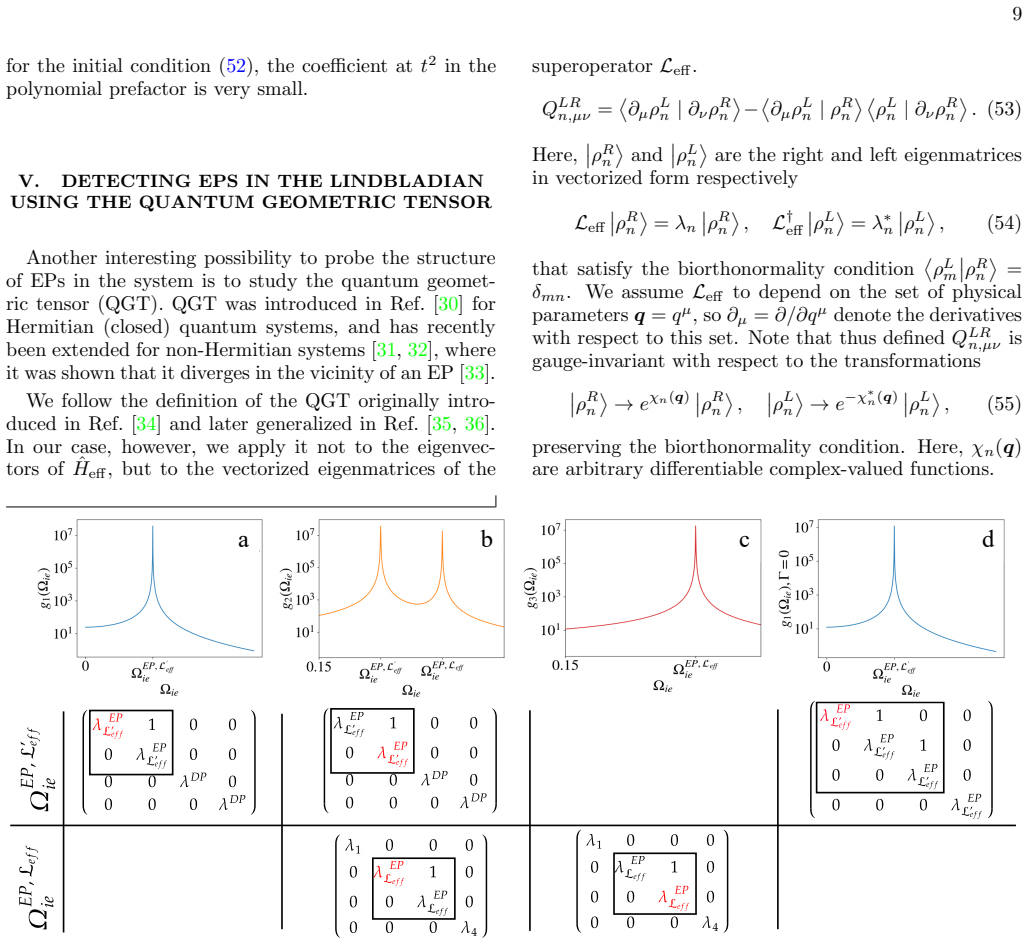
Open quantum systems can be approximately described by non-Hermitian Hamiltonians (NHHs) and Liouvillian superoperators. The two approaches differ by quantum jump terms corresponding to a measurement of the system by its environment. We analyze the emergence of exceptional points (EPs) in NHHs and Liouvillian superoperators. In particular, we show how EPs in NHHs relate to a novel type of EPs -- multi-block EPs -- in the no-jump Liouvillian, i.e. the Liouvillian superoperator in absence of quantum jump terms. We further analyze how quantum jump terms modify the multi-block structure. To illustrate our general findings, we present two prime examples: qubits and qutrits coupled to additional ground state levels that serve as sinks of the population. In those examples, we can navigate through the EP block structure by a variation of physical parameters. We analyze how the dynamics of the population of the states is affected by the order of the EPs. Additionally, we demonstrate that the quantum geometric tensor serves as a sensitive indicator of EPs of different kinds.
Editorial analysis
A structured set of objections, weighed in public.
Referee Report
Summary. The manuscript claims that exceptional points (EPs) of non-Hermitian Hamiltonians (NHHs) map onto a novel multi-block EP structure in the no-jump Liouvillian (the Liouvillian superoperator with quantum jump terms removed). It derives how the addition of jump terms modifies this block structure, illustrates the construction with explicit qubit and qutrit models coupled to sink levels, shows that physical parameters can be tuned to traverse the EP blocks, examines the resulting population dynamics as a function of EP order, and demonstrates that the quantum geometric tensor detects EPs of different kinds.
Significance. If the central mapping holds under the stated approximations, the work supplies a concrete bridge between the NHH and full-Lindblad descriptions of open systems and introduces a new organizing principle (multi-block coalescence) for EPs in dissipative generators. The low-dimensional sink models are analytically tractable and allow explicit navigation of the EP structure; the use of the quantum geometric tensor as a diagnostic adds a geometric observable that may be measurable. These elements together provide a useful framework for analyzing and potentially controlling exceptional-point physics in Markovian open quantum systems.
major comments (2)
- [§3] §3, Eq. (8)–(10): the derivation of the multi-block Jordan structure in the no-jump Liouvillian follows directly from excising the jump dissipators, but the manuscript must explicitly verify that the block-diagonal form and eigenvalue coalescence survive the re-introduction of the jump terms for the parameter values used in the qubit and qutrit examples; otherwise the claimed modification of the multi-block EP by jumps rests on an untested perturbation assumption.
- [§4.2] §4.2, Fig. 3 and surrounding text: the navigation of the EP block structure by varying the sink coupling strength is presented for the qutrit model, yet no quantitative check is given that the Born-Markov or weak-coupling conditions remain satisfied across the plotted parameter range; if those conditions are violated, the separation into no-jump and jump parts (and therefore the multi-block EP itself) may not be valid.
minor comments (3)
- The notation for the no-jump Liouvillian superoperator is introduced without a compact symbol; a single symbol (e.g., L_0) would improve readability when comparing spectra in §3 and §4.
- Figure 2 caption should state the precise values of all fixed parameters (not only the varied one) so that the plotted trajectories can be reproduced without consulting the main text.
- A brief remark on the relation of the multi-block EPs to previously studied Liouvillian exceptional points (e.g., those arising from full Lindblad generators) would help situate the novelty claim.
Simulated Author's Rebuttal
We thank the referee for their careful reading of the manuscript and for the constructive comments. We are pleased that the referee finds the work to provide a useful framework for analyzing exceptional-point physics in open quantum systems. Below we address each major comment in detail.
read point-by-point responses
-
Referee: [§3] §3, Eq. (8)–(10): the derivation of the multi-block Jordan structure in the no-jump Liouvillian follows directly from excising the jump dissipators, but the manuscript must explicitly verify that the block-diagonal form and eigenvalue coalescence survive the re-introduction of the jump terms for the parameter values used in the qubit and qutrit examples; otherwise the claimed modification of the multi-block EP by jumps rests on an untested perturbation assumption.
Authors: We agree with the referee that an explicit verification for the specific examples would strengthen the presentation. Although the general analysis of how jump terms modify the structure is provided, we have now added numerical evidence in the revised manuscript. Specifically, we include a new figure or table in an appendix showing the eigenvalues of both the no-jump and full Liouvillians for the qubit and qutrit parameters used in the main text. This confirms that the block-diagonal form and the coalescence of eigenvalues within blocks are preserved under the re-introduction of the jump terms, with only minor shifts consistent with perturbative effects. revision: yes
-
Referee: [§4.2] §4.2, Fig. 3 and surrounding text: the navigation of the EP block structure by varying the sink coupling strength is presented for the qutrit model, yet no quantitative check is given that the Born-Markov or weak-coupling conditions remain satisfied across the plotted parameter range; if those conditions are violated, the separation into no-jump and jump parts (and therefore the multi-block EP itself) may not be valid.
Authors: We thank the referee for highlighting the importance of confirming the validity of the underlying approximations. In the revised manuscript, we have added a quantitative discussion in section 4.2. We derive the conditions for the Born-Markov and weak-coupling approximations in terms of the system parameters and explicitly check that the range of sink coupling strengths used in Fig. 3 satisfies these conditions for the chosen decay rates and energy splittings. We also indicate the valid parameter regime on the figure to guide the reader. revision: yes
Circularity Check
No significant circularity; central mapping follows from explicit operator definitions under standard Markovian approximation
full rationale
The paper's core result establishes a correspondence between exceptional points of non-Hermitian Hamiltonians and multi-block exceptional points in the no-jump Liouvillian by direct construction: the no-jump Liouvillian is defined as the full Liouvillian with quantum jump dissipators removed, so its spectrum and Jordan-block structure are inherited from the effective non-Hermitian generator by the standard separation of coherent and dissipative terms in the Lindblad equation. This is a definitional relation rather than a derived prediction or self-referential loop. No fitted parameters are invoked, no self-citations serve as load-bearing uniqueness theorems, and the qubit/qutrit examples simply illustrate navigation of the resulting block structure via physical parameters. The additional analysis of population dynamics and the quantum geometric tensor supplies independent observable content. The derivation remains self-contained against the external benchmark of the Markovian master equation.
Axiom & Free-Parameter Ledger
axioms (1)
- domain assumption Open quantum systems can be approximately described by non-Hermitian Hamiltonians and Liouvillian superoperators differing by quantum jump terms.
Lean theorems connected to this paper
-
IndisputableMonolith/Foundation/AlexanderDuality.leanalexander_duality_circle_linking unclear?
unclearRelation between the paper passage and the cited Recognition theorem.
If the effective Hamiltonian is tuned to an EP, the corresponding effective Liouvillian naturally exhibits a novel type of EP characterized by multiple Jordan blocks at the same eigenvalue… block sizes (2n−1),(2n−3),…,1
-
IndisputableMonolith/Cost/FunctionalEquation.leanwashburn_uniqueness_aczel unclear?
unclearRelation between the paper passage and the cited Recognition theorem.
L′eff ∼ J2N−1(λ) ⊕ J2N−3(λ) ⊕ … ⊕ J1(λ)
What do these tags mean?
- matches
- The paper's claim is directly supported by a theorem in the formal canon.
- supports
- The theorem supports part of the paper's argument, but the paper may add assumptions or extra steps.
- extends
- The paper goes beyond the formal theorem; the theorem is a base layer rather than the whole result.
- uses
- The paper appears to rely on the theorem as machinery.
- contradicts
- The paper's claim conflicts with a theorem or certificate in the canon.
- unclear
- Pith found a possible connection, but the passage is too broad, indirect, or ambiguous to say the theorem truly supports the claim.
Forward citations
Cited by 2 Pith papers
-
Converting non-Hermitian degeneracies of any order: Hierarchies of exceptional points and degeneracy manifolds
Derogatory exceptional points in non-Hermitian systems can be converted to non-derogatory exceptional points of the same order by infinitesimal perturbations, forming hierarchies of degeneracy structures both with and...
-
Characterizing all non-Hermitian degeneracies using algebraic approaches: Defectiveness and asymptotic behavior
An algebraic framework systematically characterizes the asymptotic dispersion of all multi-block non-Hermitian degeneracies, including n-bolical points and exceptional points of various orders.
Reference graph
Works this paper leans on
-
[1]
Effective Liouvillian EPs in non-Hermitian qubits FIG. 2: Realization of a non-Hermitian qubit formed by the two upper excited states in a dissipative three-level system. We first consider the case of the effective non- Hermitian qubit reailized by the two excited states of the three-level system. We denote the three levels as|g⟩, |e⟩and|i⟩, where|g⟩stand...
-
[2]
Quantum jumps as perturbations of the system To study the effect of the quantum jump terms on the multiblock EP (26) of the effective Liouvillian, we add a dissipative term connecting the levels|i⟩and|e⟩: Leff =L ′ eff + Γ " ˆL⊗ ˆL∗ − ˆL† ˆL⊗1+1⊗ ˆLT ˆL∗ 2 # (27) We consider two variants of the intra-qubit dissipation: (i) ˆL=|e⟩⟨i|, describing the decay ...
-
[3]
Effective Liouvillian EPs in a non-Hermitian qutrit In case of an effective non-Hermitian qutrit, the situ- tation becomes richer albeit more complicated. Tuning 6 FIG. 3: Formation of a non-Hermitian qutrit via a dissipative four-level system. For the excited states|h⟩, |i⟩, and|e⟩— ordered from highest to lowest energy—we make the simplifying assumption...
-
[4]
Quantum jumps as perturbations of the system To study the effect of the quantum jumps, we include the dissipation within the effective non-Hermitian qutrit. Similar to the case of the qubit, we consider two different examples of the dissipation: (i) dissipation from level|h⟩into the levels|i⟩,|e⟩and from level|i⟩into the level|e⟩with the same rate Γ L(i) ...
- [5]
- [6]
-
[7]
Wiersig, Review of exceptional point-based sensors, Photon
J. Wiersig, Review of exceptional point-based sensors, Photon. Res.8, 1457 (2020)
work page 2020
-
[8]
J. Feilhauer, A. Schumer, J. Doppler, A. A. Mailybaev, J. B¨ ohm, U. Kuhl, N. Moiseyev, and S. Rotter, Encircling exceptional points as a non-Hermitian extension of rapid adiabatic passage, Phys. Rev. A102, 040201 (2020)
work page 2020
-
[9]
Z. Gong, Y. Ashida, K. Kawabata, K. Takasan, S. Hi- gashikawa, and M. Ueda, Topological phases of non- Hermitian systems, Phys. Rev. X8, 031079 (2018)
work page 2018
-
[10]
E. J. Bergholtz, J. C. Budich, and F. K. Kunst, Ex- ceptional topology of non-Hermitian systems, Rev. Mod. Phys.93, 015005 (2021)
work page 2021
-
[11]
N. Okuma and M. Sato, Non-Hermitian topological phe- nomena: A review, Annual Review of Condensed Matter Physics14, 83 (2023)
work page 2023
-
[12]
C. Poli, M. Bellec, U. Kuhl, F. Mortessagne, and H. Schomerus, Selective enhancement of topologically in- duced interface states in a dielectric resonator chain, Na- ture Comm.6, 6710 (2015)
work page 2015
-
[13]
J. M. Zeuner, M. C. Rechtsman, Y. Plotnik, Y. Lumer, S. Nolte, M. S. Rudner, M. Segev, and A. Szameit, Ob- servation of a topological transition in the bulk of a non- Hermitian system, Phys. Rev. Lett.115, 040402 (2015)
work page 2015
-
[14]
S. Weimann, M. Kremer, Y. Plotnik, Y. Lumer, S. Nolte, K. G. Makris, M. Segev, M. C. Rechtsman, and A. Sza- meit, Topologically protected bound states in photonic parity–time-symmetric crystals, Nature Mat.16, 433 (2017)
work page 2017
- [15]
-
[16]
W. Chen, c. Kaya ¨Ozdemir, G. Zhao, J. Wiersig, and L. Yang, Exceptional points enhance sensing in an optical microcavity, Nature548, 192 (2017)
work page 2017
-
[17]
M. A. Bandres, S. Wittek, G. Harari, M. Parto, J. Ren, M. Segev, D. N. Christodoulides, and M. Khajavikhan, Topological insulator laser: Experiments, Science359, eaar4005 (2018)
work page 2018
-
[18]
A. Dikopoltsev, T. H. Harder, E. Lustig, O. A. Egorov, J. Beierlein, A. Wolf, Y. Lumer, M. Emmerling, C. Schneider, S. H¨ ofling, M. Segev, and S. Klembt, Topo- logical insulator vertical-cavity laser array, Science373, 1514 (2021)
work page 2021
-
[19]
H. Zhou, C. Peng, Y. Yoon, C. W. Hsu, K. A. Nelson, L. Fu, J. D. Joannopoulos, M. Soljaˇ ci´ c, and B. Zhen, Ob- servation of bulk Fermi arc and polarization half charge from paired exceptional points, Science359, 1009 (2018)
work page 2018
- [20]
-
[21]
A. Kodigala, T. Lepetit, and B. Kant´ e, Exceptional points in three-dimensional plasmonic nanostructures, Phys. Rev. B94, 201103 (2016)
work page 2016
-
[22]
C. Wang, Z. Fu, W. Mao, J. Qie, A. D. Stone, and L. Yang, Non-Hermitian optics and photonics: from clas- sical to quantum, Adv. Opt. Photon.15, 442 (2023)
work page 2023
-
[23]
F. Minganti, A. Miranowicz, R. W. Chhajlany, and F. Nori, Quantum exceptional points of non-Hermitian Hamiltonians and Liouvillians: The effects of quantum jumps, Phys. Rev. A100, 062131 (2019)
work page 2019
-
[24]
J. Wiersig, Robustness of exceptional-point-based sen- sors against parametric noise: The role of Hamiltonian and Liouvillian degeneracies, Phys. Rev. A101, 053846 (2020)
work page 2020
- [25]
- [26]
-
[27]
F. Minganti, A. Miranowicz, R. W. Chhajlany, I. I. Arkhipov, and F. Nori, Hybrid-Liouvillian formalism connecting exceptional points of non-Hermitian Hamilto- nians and Liouvillians via postselection of quantum tra- jectories, Phys. Rev. A101, 062112 (2020)
work page 2020
-
[28]
L. S´ a, P. Ribeiro, and T. Prosen, Symmetry classification 15 of many-body Lindbladians: Tenfold way and beyond, Phys. Rev. X13, 031019 (2023)
work page 2023
-
[29]
M. Naghiloo, Y. N. Joglekar, and K. W. Murch, Quantum state tomography across the exceptional point in a single dissipative qubit, Nat. Phys.15, 1232 (2019)
work page 2019
-
[30]
W. Chen, M. Abbasi1, Y. N. Joglekar, and K. W. Murch, Quantum jumps in the non-Hermitian dynamics of a superconducting qubit, Phys. Rev. Lett.127, 140504 (2021)
work page 2021
-
[31]
V. Lidskii, Perturbation theory of non-conjugate oper- ators, Computational Mathematics and Mathematical Physics6, 73 (1966)
work page 1966
-
[32]
J. Moro, J. V. Burke, and M. L. Overton, On the Lidskii– Vishik–Lyusternik perturbation theory for eigenvalues of matrices with arbitrary Jordan structure, Journal on Ma- trix Analysis and Applications18, 793 (1997)
work page 1997
-
[33]
J. Moro and F. M. Dopico, First order eigenvalue pertur- bation theory and the Newton diagram, inApplied Math- ematics and Scientific Computing, edited by Z. Drmaˇ c, V. Hari, L. Sopta, Z. Tutek, and K. Veseli´ c (Springer US, Boston, MA, 2003) pp. 143–175
work page 2003
-
[34]
J. P. Provost and G. Vallee, Riemannian structure on manifolds of quantum states, Communications in Math- ematical Physics76, 289 (1980)
work page 1980
-
[35]
D. D. Solnyshkov, C. Leblanc, L. Bessonart, A. Nalitov, J. Ren, Q. Liao, F. Li, and G. Malpuech, Quantum metric and wave packets at exceptional points in non-Hermitian systems, Phys. Rev. B103, 125302 (2021)
work page 2021
-
[37]
Q. Liao, C. Leblanc, J. Ren, F. Li, Y. Li, D. Solnyshkov, G. Malpuech, J. Yao, and H. Fu, Experimental measure- ment of the divergent quantum metric of an exceptional point, Phys. Rev. Lett.127, 107402 (2021)
work page 2021
-
[38]
D. Brody and E.-M. Graefe, Information Geometry of Complex Hamiltonians and Exceptional Points, Entropy 15, 3361 (2013)
work page 2013
-
[39]
Y.-M. R. Hu, E. A. Ostrovskaya, and E. Estrecho, Gen- eralized quantum geometric tensor in a non-Hermitian exciton-polariton system, Optical Materials Express14, 664 (2024)
work page 2024
- [40]
-
[41]
G. A. Starkov, M. V. Fistul, and I. M. Eremin, Formation of exceptional points in pseudo-hermitian systems, Phys. Rev. A108, 022206 (2023)
work page 2023
-
[42]
A. Trampus, A canonical basis for the matrix transfor- mation x→ax + xb, Journal of Mathematical Analysis and Applications14, 242 (1966)
work page 1966
discussion (0)
Sign in with ORCID, Apple, or X to comment. Anyone can read and Pith papers without signing in.